
Table 1
Ostrom’s Design Principles for self-governance of common pool resources (adapted from Ostrom 1990).
| Design Principle 1 | Clearly defined boundaries The boundaries of the resource and individuals with rights to use the resource are clearly defined. |
| Design Principle 2 | Proportional equivalence between benefits and costs Those who use the largest proportion of a resource are required to pay the highest proportion of the costs (monetary or otherwise) and that rules address local conditions. |
| Design Principle 3 | Collective-choice arrangements Individuals who are impacted by rules relating to the resource are included in the group that can modify these rules |
| Design Principle 4 | Mutual Monitoring The resource and resource users can be jointly monitored to ensure the accountability of resource users to agreed-upon rules or norms |
| Design Principle 5 | Graduated sanctions Sanctions (typically applied by other resource users) will apply to resource users who violate operational rules, with these sanctions increasing for repeat or more severe offences |
| Design Principle 6 | Resolution mechanisms Low-cost, local arenas to resolve conflicts among users (or between users and officials) are available |
| Design Principle 7 | Minimal recognition of rights to organize The rights of users to design their own institutions and rules to manage resource use are not disputed by officials |
| Design Principle 8 | Nested enterprises The aforementioned design principles are organized across multiple organizational layers appropriate to the scale of the resource system, whereby lower-level units are nested inside of higher-level units of governance. |
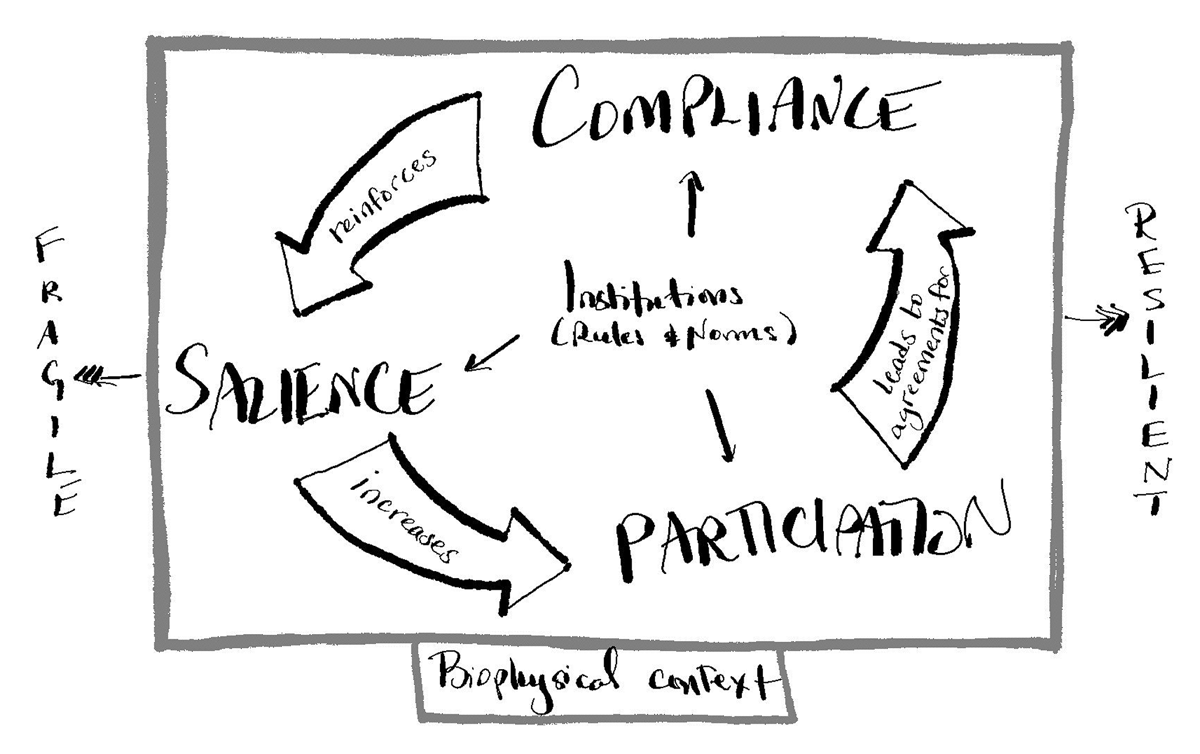
Figure 1
The diagram of salience, participation, and compliance represents interconnected action situations that are present across many types of environmental challenges where collective action can contribute to problem solving.
Table 2
Definitions of Key Concepts for Collective Action in Large-Scale Commons Dilemmas.
| CONCEPT | DEFINITION | THEORETICAL EXPECTATION |
|---|---|---|
| Salience | Belief in the need for action in response to a perceived problem or proposed solution. | Higher salience leads to knowledge exchanges and greater agreement on perceived problems to foster participation and/or legitimize government actions |
| Participation | Engaging with new rule or social norm formation to provide assurances and commitments that behavior changes will be undertaken and lead to desired outcomes. | Participation matters by generating new patterns of behavior that directly benefit the environment or indirectly influence other people’s behavior through examples or new norms. |
| Compliance | Act of engaging in or legitimizing enduring, long-term pro-environmental behavior and upholding this behavior in others. | Compliance costs are influenced by the level of individual self-compliance and perceived legitimacy in the government’s role to constrain behavior. |