
Table 1
Summary of the drivers of institutional change present across all case study villages.
| Internal/external categories of drivers for change | Drivers | Effects |
|---|---|---|
| Internal factors to the CAF: Poor design and ineffective forest management institutions | Unclear forestland boundaries | At the creation of the CAF, the project’s failure to recognize customary territory limits led to land conflicts among the villages. The CAF managers’ inability to solve those disputes generated frustrations and led villagers to question the effectiveness of the CAF’s institutions; hence, they took action to bring about change. |
| Weak management & enforcement | The ineffective surveillance of the forest, communication with the people and enforcement of the CAF rules and regulations (punishing offenses) has led to mistrust between forest managers and the people and eventually people’ discouragement and disengagement. | |
| Unattractive fuelwood market | The irregular silvicultural activities contributed to the decline of fuelwood stock inside the forest (the main financial source for the CAF) and the low wood price decreased local incomes and incentives and the overall attractiveness of the CAF. | |
| Unfair benefit sharing | The exclusion from the forest management and benefit sharing schemes of actors such as the customary chiefs (custodians of the forestland) and the mayor nurtured revolts against the current system. Forest managers were perceived as the main beneficiaries of the CAF at the expense of the people. | |
| Contested accountability | The CAF managers’ reluctance to be accountable to local leaders for the forest management created mistrust and led the people to question their authority and their ability to represent the collective interests. | |
| External factors to the CAF: Land pressure | Commodification of land | People’s frustrations and disappointments with the CAF motivated them to seek alternative usages of the forestland. The increase in land sales although culturally forbidden was perceived as a more attractive option for them. |
| Population growth | Population growth in addition to internal and external migration increased the need for more farmland; hence, pressure on the forest was intensified. |
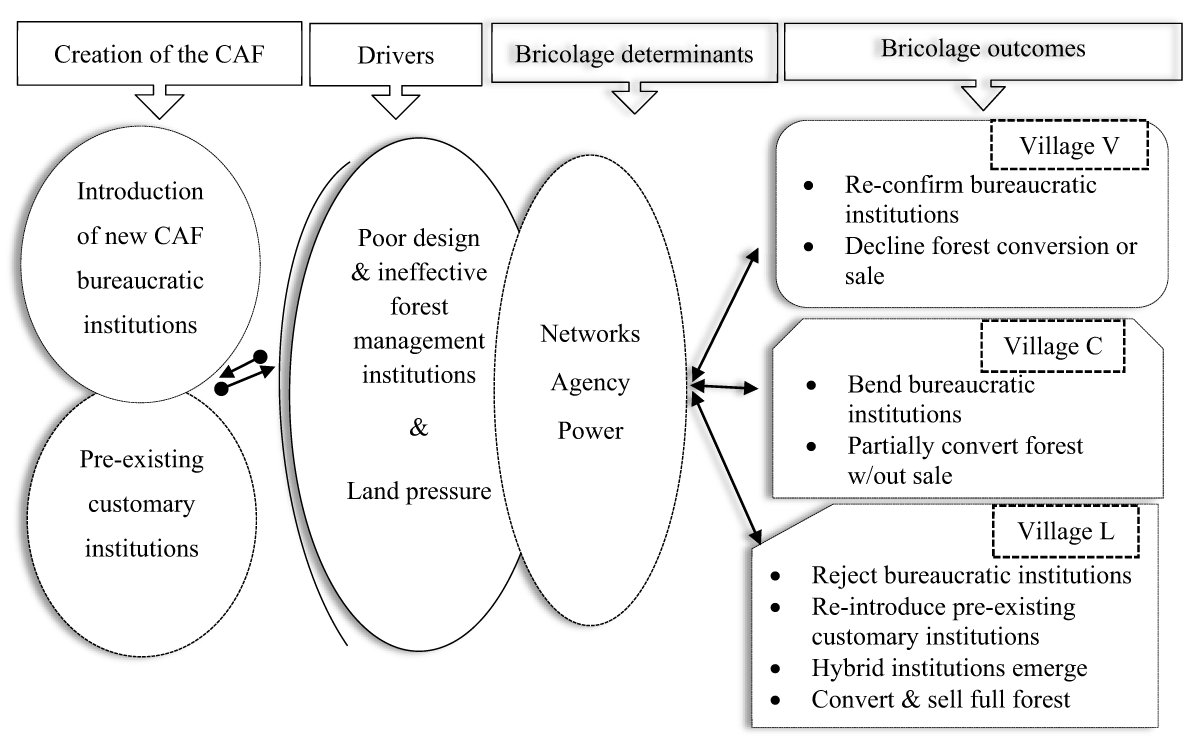
Figure 1
The CAF’s institutional arrangements and bricolage outcomes.