
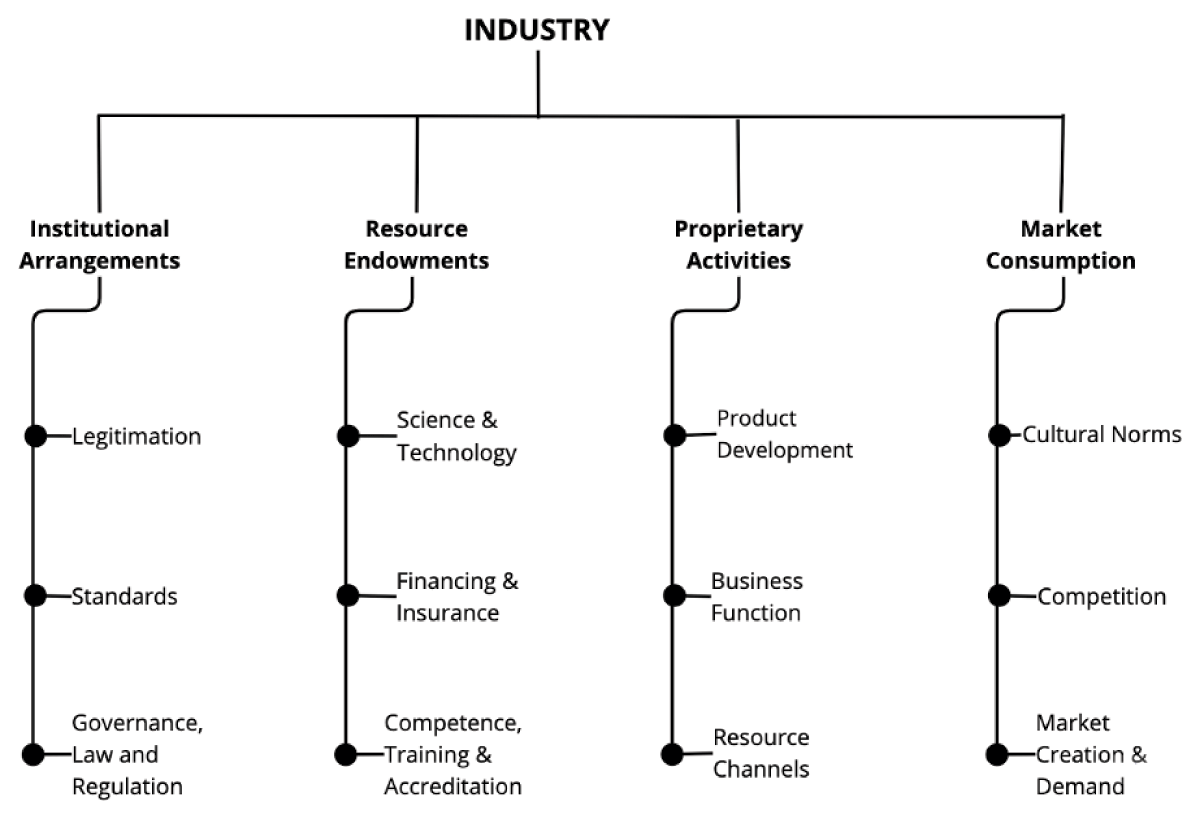
Figure 1
An industrial infrastructure for technological innovation (adapted from Van de Ven, A. H. (2005) ‘Running in Packs to Develop Knowledge-Intensive Technologies’, MIS Quarterly. Minneapolis: University of Minnesota, MIS Research Center, 29(2), pp. 365–378).
Table 1
Social System Framework components within the context of emergent and mature systems.
| VAN DE VEN COMPONENT | CONTEXT WITHIN EMERGENT TECHNOLOGY | APPLICATION/ADAPTATION TO MATURE TECHNOLOGY (PIDS) | EXAMPLES |
|---|---|---|---|
| Institutional Arrangement | Governance, standards, and regulation legitimise emergent technology and systems | Governance and standards must be adhered to and continuously maintained (to preserve trust and maintain continued operation). This confers a degree of legitimacy on the PID system as expectations are predictable and can be co-ordinated. | DOIs which are used by Crossref and DataCite are based on the DOI ISO10 standard,11 allow for stakeholders to use it in various systems as the expectations are predictable. |
| Resource Endowments | Resources like knowledge, money, and human capital must be mobilised/obtained to support creation of innovation and technology | Resources must be acquired or marshalled to ensure financial viability and that knowledge development is an ongoing process. | ORCID and DataCite make use of their consortia and consortia leads to help mobilise local knowledge and expertise (ORCID Inc, 2020; DataCite, 2024). |
| Proprietary Activities | Within emergent systems, proprietary activities help with development of innovation and early diffusion of technology within user base and stakeholders | Within mature systems, proprietary activities ensure there is continuous development in the evolution of technology and product, to maintain the rate of adoption and usage within stakeholders. | With ORCID, the community & engagement team collect feedback from stakeholders, which is provided to the product team that then prioritise it to ensure that ORCID continues to evolve according to user requirements (Dineen, Demain and Demeranville, 2020). |
| Market Creation/Demand | Actively understand stakeholder interpretation of emergent technology to create market to engage users and ensure demand is satisfied | Within mature systems, user engagement is a continuous process done through stakeholder relationships. Market creation and demand are constantly reinforced through value delivery. | ORCID has committed to creating value by committing to listen to its stakeholders (Shillum, 2021) |