Introduction
Persistent identifiers (PIDs) for scholarly work have been around in one form or another for more than 20 years (Klump and Huber, 2017a). A PID is a unique and enduring reference used to clearly identify scholarly entities such as researchers, journal articles, datasets, and organisations. PIDs enable the unambiguous identification and tracking of these entities over time and across different platforms (McMurry et al., 2017). In addition, they are connected to registries of information about those entities, known as metadata. By providing resilient references to entities, they play a crucial role in research infrastructure by enabling unique identification over time, which helps make research and scholarly outputs more findable, accessible, interoperable, and reusable (FAIR)1 (Wilkinson, 2016). PIDs are essential to modern research and open science as they are tools that can guarantee provenance, discoverability, and traceability of scientific results (McMurry et al., 2017). PID organisations like ORCID, Crossref, etc., act as stewards of PID technologies like ORCID IDs, DOIs, respectively, which are widely used in the research ecosystem. These organisations also maintain sustainable operational models and attribute their ongoing success to active community participation and vested interest of stakeholders in these technologies (ORCID, 2025; Korzec et al., 2025). Viewed holistically, the preceding observations suggest that organisations that successfully sustain widely used PIDs do so through a combination of resilient technology, adaptable and robust organisational capacities to manage the technology, and ongoing collaboration with its stakeholders.
We talk of persistence for identifiers of research entities; however, persistence is a feature of organisations and not of technology (Kunze, 2001). It is not an inherent quality of a research entity, nor is it bestowed upon by a specific naming convention; rather, it is attained through a service provider’s successful stewardship of research entities and their identifiers (Kunze, 2001). At the very least, it implies that the service provider has committed to provide specific long-term access to the entity, which would then be subject to their policies (Kunze et al., 2017), i.e., some entities would be strictly unchanging, some subject to correction (as in minor updates) due to revision, while other entities might require major updates that result in significant change or release.2 If it is indeed the service provider that generates the long-term functionality of persistence to identifiers for research entities, it is worth asking if persistence is a function of the organisation, then what sort of organisational mechanisms need to be in place for the successful and continued operation of these service providers or PID stewards, to meet their responsibilities of guaranteeing persistence? One approach to answering this question is to take an enhanced perspective of the industry/sector in which PIDs operate. There are standards currently available, like the principles of Open Archival Information System (OAIS) (OCLC and Lavoie, 2014) and Core Trustworthy Data Repository Requirements offered by CoreTrustSeal3 which could apply to PIDs; however, OAIS is an ISO standard that provides a conceptual framework designed to guide long-term preservation and management of digital information; it is not an infrastructure or platform that provides engagement between various stakeholders. CoreTrustSeal, on the other hand, is a certification that is important to acknowledge repositories that hold data for long term preservation. However, PIDs are not just repositories that contain information; they also function as a platform with multiple stakeholders that interact not just with the data in the platform, but also with each other. While these principles can and should be applied to PIDs, they do not adequately look at PIDs from a holistic perspective but rather through a particular lens.
Taken together, the preceding section supports the assertion that persistence in PIDs depends on the interplay of reliable and scalable technology, robust technical infrastructure, community engagement, financial resources, and effective governance. Synthesising these insights suggests that these mechanisms do not operate in isolation; rather, their interrelationships shape the role that organisations play in sustaining persistence in PID technologies. This is a conceptual paper that explores PIDs within the context of persistence and what constitutes persistence? Can persistence be explained by technology alone, or only governance, or only stakeholders, or is it the interaction of all of them? This paper defines persistence as the organisation’s capacity to keep identifiers governed, trusted, maintained, and usable over time despite changes in technology, policy, funding, or stakeholder behaviour. The organisation is the PID steward or co-ordinating body that assumes long-term responsibility for sustaining a PID system. We build a case to explore the underlying organisational mechanisms that underpin persistence in PIDs. To identify the various organisational mechanisms underpinning PID providers, this paper adapts the social system framework (Van de Ven, 2005) to understand how the different mechanisms interact independently and with each other. The paper concludes by presenting the outcomes of adapting the social system framework to PIDs and establishes a foundation for future research in this area.
Background
PIDs
PIDs are long-lasting, managed, and registered unique digital references (often in the form of a URL) to an entity that can be represented or described online, as defined by the United States Department of Energy’s Office of Science and Technology Information (ORFG PID Strategy Working Group, 2024). This means that to be considered a ‘persistent identifier’ or a ‘PID’, an identifier and its underlying infrastructure must capture, at the very least, minimal metadata required for operational needs and be made available in consistent and reliable ways. It also must exhibit persistence over time, which can be facilitated and perhaps best achieved when there is community ownership and public governance to ensure sustainable infrastructure support and widespread adoption. When working correctly, PIDs interoperate and reference each other within research discovery and management systems, linking descriptive information to other entities, without restrictions (Van De Sompel et al., 2014). McMurry et al. (2017) talk about characteristics of PIDs which are rooted in principles of openness, transparency, and community involvement.
PIDs play a crucial role in research infrastructure by providing resilient references to entities, thereby enabling unique identification over time, which helps make research and scholarly outputs more FAIR4 (Wilkinson, 2016). Another advantage that PIDs provide to the research community is that, without accessing the research entity itself, PIDs can identify the entity and/or retrieve a description of the entity (Ananthakrishnan et al., 2020). Thus, irrespective of where the research entity is located on the World Wide Web, PIDs allow for unambiguous identification of these research entities. This is especially useful in instances where provenance of research needs to be ascertained, and the research needs to be verified. PIDs, when implemented well, allow for better management and stewardship of research entities for the benefit of the entire research community. This could be considered a pre-condition to support knowledge discovery and research innovation.
PIDs are not just a technical construct but a community effort that is collaborative in nature. Beyond simply identifying and linking key stakeholders that include publishers, funders, and researchers, PIDs also facilitate interactions among these stakeholders (Mejias, 2020), thereby enhancing the integration and interoperability of research processes. For PIDs to continue to remain persistent or persevere despite change for a certain period, they require organisations that are supported by the community and have research infrastructure that is open to everyone, with no barriers to access. For example: providing open data, software, openly available documentation, open-source code, tools that are free, etc. Organisations with open research infrastructures that are considered to be resilient possess the following attributes: equitable, provide value, trustworthy, interoperable, sustainable, community-driven, and governed (Cousijn, Hendricks and Meadows, 2021). In 2015, a set of guidelines were developed to help scholarly organisations with open research infrastructures to run and sustain themselves (Bilder, Lin and Neylon, 2020). The guidelines are called ‘Principles of Open Scholarly Infrastructure’ (POSI). Organisations or communities that have assumed stewardship of PIDs can adopt POSI principles, which may help them in addressing some of the key challenges facing PIDs.
PIDs and persistence
In this section, we seek to understand some of the challenges associated with PIDs, especially around persistence, as articulated by Car, Golodoniuc and Klump (2017). These challenges could be categorised into the following: issues that look at ensuring the persistence of the PID system itself, issues related to ensuring persistence of infrastructure that is required for continued operation of PIDs, and obstacles around adoption and diffusion of PIDs by various stakeholders. PIDs, as research infrastructure systems, operate as complex adaptive systems that require continual adaptation of governance, technology, and community practices in response to shifting environmental contexts and stakeholder expectations (Holland, 1992; Sarta, Durand and Vergne, 2021). Thus, a fundamental attribute of PIDs revolves around the dynamic relationship between the technology, its users, and its stakeholders, which gives rise to its inherent socio-technical characteristics.
The key notion behind utilising PIDs for research/scholarly entities is that PIDs maintain a degree of resilience or resistance to change. This resilience is crucial as several factors could threaten this persistence; for example, the PID steward/vendor providing the PID changes its policies, or, the organisation is no longer sustainable, or there is insufficient usage or adoption from the community to allow for the organisation to continue the support and maintenance of the PID (Car, Golodoniuc and Klump, 2017; Wilkinson, 2016). A question often discussed within the PID community relates to the duration of resistance to change – is it perpetual, or does it depend on the policies and guarantees provided by the PID steward, or even the continual ongoing operation of the PID steward itself. While PIDs are supposed to be persistent and resist change for a certain period, they are not immune to change. If PIDs are going to undergo change, then it ought to be managed and communicated to stakeholders. Several principles have been frequently articulated to ensure effective management and communication of change, such as:
substituting persistent, location-independent identifiers for URLs (Lawrence et al., 2001);
separating the identity of an entity from its location on the internet (Klump and Huber, 2017b; Lawrence et al., 2001);
not reassigning or deleting identifiers, rather deprecating them if no longer required (Kunze et al., 2017; McMurry et al., 2017);
ensuring that the identifier does not describe the research entity; rather, the metadata that describes the research entity links the description to the identifier5 (McMurry et al., 2017).
A question frequently asked by the research community with regards to PIDs is who looks after (or provides) PIDs, maintains the infrastructure required, and establishes the processes and standards required for the continued operation of PIDs. Is there an expectation that PIDs ought to be maintained by an individual, a group of individuals, small organisations, or big multinational companies? Then there is the question of how PIDs are funded, who funds them, whether the funds are going to be one-off or ongoing, and whether there is a sustainable model for the business. As well, who decides which technology ought to be used and the policies around it, or is the persistence of PIDs a combination of both technology and policy working hand-in-hand? Klump and Huber (2016) discuss how poor PID system policies and management can result in zombie PIDs6 or orphaned PIDs.7 They raise questions about the fate of PIDs that are no longer needed or lose community support. What happens to PIDs if they are no longer required, if the community loses interest, or if they have fulfilled their purpose? The governance principles within POSI (Bilder, Lin and Neylon, 2020) talk of ‘living will’, which provides guidance on how some of the issues can be addressed.
A further consideration concerns the reliability and trustworthiness of PIDs. How trustworthy are they and is trust associated with the PID itself or the entity that operates the PID? Bütikofer (2009) outlines an organisational framework for the management of identifiers as well as infrastructure and security in the context of long-term preservation of information, as some key criteria required to establish trust in a PID system. However, if the entity that operates the PID is not trusted by the users of the PID or even the community, then will that affect the trustworthiness of the PID in question? Is it possible for the user community to ensure the effectiveness and persistence of the identifiers, or is participation also required by research organisations, publishers, funders, or maybe an intervention in terms of governmental policy?
PIDs as a socio-technical system
By their very nature, PIDs are a system that is utilised by multiple stakeholders and rely on robust community support, clearly defined processes and trustworthy infrastructure. Drawing on Tilson et al. (2010) conceptualisation of digital infrastructures, a comparable argument can be extended to PIDs, in that they are shaped by their users while also shaping how those users interact with PIDs. We can think of it as a paradox of duality, where the PID system is influenced by its users and needs them to ensure continued adoption and usage in order to sustain operations; however, at the same time, it continues to influence the way users use it to innovate and evolve and meet the needs of the community (Tilson, Lyytinen and Sørensen, 2010). PIDs are used not just to identify and link various scholarly entities (e.g., publishers, funders, researchers, etc.) but also to facilitate interaction between them (Mejias, 2020). As such, PIDs exhibit some properties inherent to technological systems while also demonstrating the social nature of the technology, i.e., they incorporate technical elements (such as software and hardware) alongside associated organisational structure, user base (stakeholders) and standards. Thus, PIDs can also be identified as a socio-technical construct rather than just a technology.
By identifying and examining the organisational mechanisms that underpin PID providers and their operations, there exists a possibility to understand how organisational persistence can be fostered within the boundaries of governance and policy. Bilder, Lin and Neylon (2020) have outlined principles around ‘governance’ and ‘sustainability’, which assist in addressing some of the challenges raised above with regard to questions of funding and governance. Nevertheless, addressing the challenges of ownership, finance, technology, policy, and credibility posed by PID platforms requires a comprehensive approach that includes not only the technological aspects but also an understanding of the social aspects involving stakeholders, users, and governance of the PID technology. Adoption and usage are intrinsically linked; adoption creates a potential for continued use, which further reinforces the value of the adopted item and thereby encourages further adoption (Katz and Shapiro, 1985). If this feedback loop between adoption and usage is positive (i.e., as the adoption of the PID increases, it is used more, which drives further adoption, which in turn drives the usage), there is an incentive for the PID organisation to ensure the persistence of their PID. By identifying the diverse artefacts and components that make up the PID system, it is possible to clarify how these elements facilitate and provide value to users of PID systems, which would incentivise PID organisations to sustain the PID.
To examine the organisational mechanisms that underpin PID organisations and to understand the complex relationships between stakeholders, the PID organisation, and the technology itself necessitates looking at a framework that adopts an expanded perspective of the technology ecosystem, encompassing a wide range of components that are necessary to drive adoption and usage by creating value. The Agile Manifesto (Beck et al., 2001) with its focus on individuals and interactions, working software, customer collaboration, and responding to change was considered; however, there is a lack of sufficient guidance in terms of a framework to address organisational functions around trust, governance, culture, and market creation, which did not render it suitable for the purpose of this paper. Standards like the principles of OAIS (OCLC and Lavoie, 2014) and the Core Trustworthy Data Repository Requirements offered by CoreTrustSeal (CoreTrustSeal Standards and Certification Board, 2025) were also considered, and while the frameworks8 provide valuable mechanisms for assessing repository-level processes, controls and organisational capabilities; however, due to their predominantly compliance-oriented focus, they would be limited in their capacity to explain holistically the dynamic and distributed conditions through which trust, and sustainability outcomes emerge across broader socio-technical ecosystems. On the other hand, the social system framework introduced by Van De Ven, (1993), focusses broadly around the ecosystem of the industry which is being investigated and articulates the components that need to be present to develop a successful and sustainable knowledge-intensive technology. Van De Ven’s, (1993) ‘Social System Framework’ was developed to study the emergence of new innovative technology and what is required to sustain it, by outlining how the diverse elements (governance, technology, stakeholders) can work together. Since the framework looks at technology systems holistically from a socio-technical point of view, there is scope to adapt and use the Social System Framework (Van De Ven, 1993), to a socio-technical system like PIDs. Since persistence is the phenomenon being considered, adapting the social system framework by Van De Ven, (1993) will aid us in understanding how the interplay between the various diverse socio-technical elements like technology, governance, stakeholders, etc., within the system, functions, and contribute towards persistence. The social system framework is more useful as it brings together governance, resources, organisational activity and ongoing demand together in one framework. While the Social System Framework was originally used to understand how technology emergence can be sustained, in this paper we adapt the framework to understand how to sustain persistence in mature PID infrastructure.
Social system framework
The social system framework, as illustrated by Van de Ven (2005) and shown in Figure 1, was first introduced by Garud and Van de Ven (1987) and proposed by Van De Ven (1993) in which the authors adopt a detailed perspective of industry that encompasses various components of infrastructure for technology innovation, such as institutional arrangements, resource endowments, proprietary activities, and market consumption. It outlines the possibility of building a successful and sustainable knowledge-intensive technology when there are partnerships and collaborations between various stakeholders in the public and private sectors.
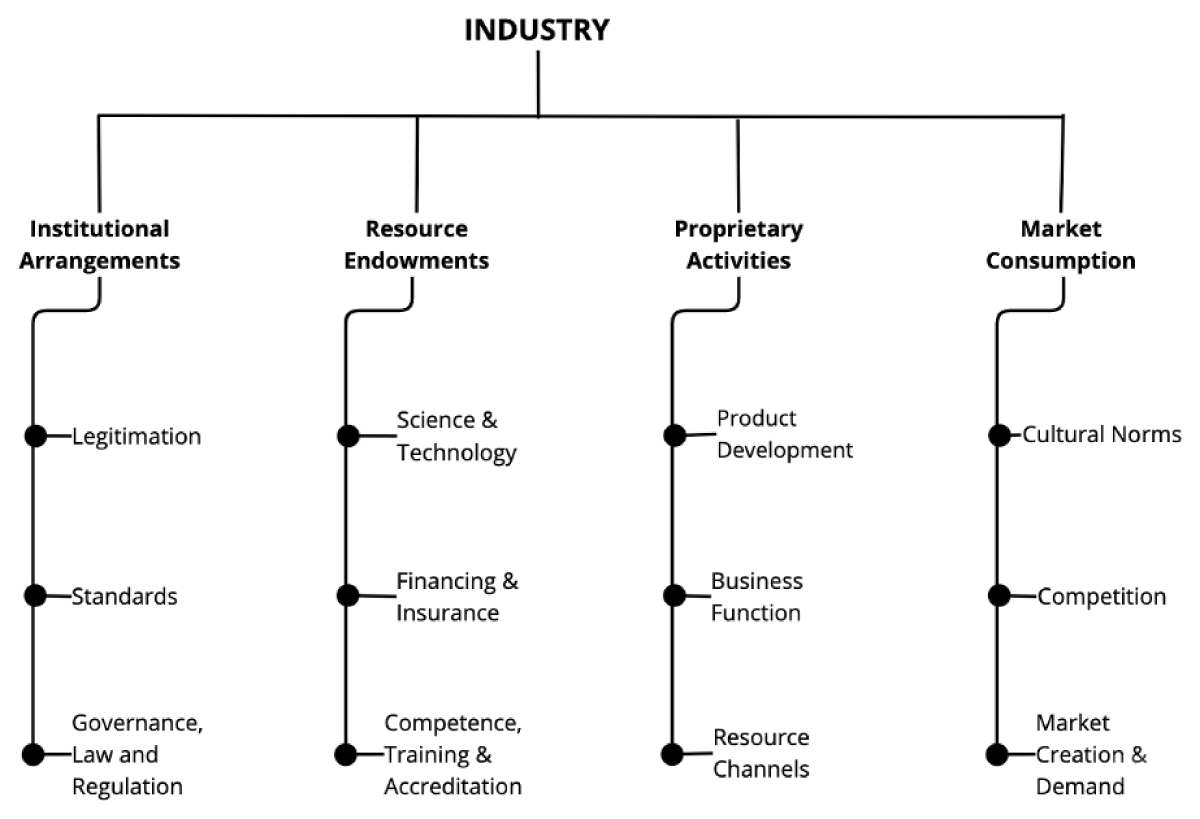
Figure 1
An industrial infrastructure for technological innovation (adapted from Van de Ven, A. H. (2005) ‘Running in Packs to Develop Knowledge-Intensive Technologies’, MIS Quarterly. Minneapolis: University of Minnesota, MIS Research Center, 29(2), pp. 365–378).
As a multidimensional approach, the social system framework (Van De Ven, 1993) provides a broad overview of knowledge-intensive industries, and focusses on how emergent technology can be sustained through adoption and usage. On the other hand, PID systems like ORCID IDs, DOIs, etc., are quite mature in terms of emergence as well as their current rates of adoption (Korzec et al., 2025; ORCID, 2025). To ensure persistence of PIDs, it is necessary that adoption and usage rates continue to be sustained over time. Adapting the social system framework (Van De Ven, 1993) to mature PID systems allows us to explore the intersectionality between governance, stakeholders, and technology and look at how value can be derived from the PID systems to drive adoption and usage. The development and utilisation of PIDs is a collaborative enterprise involving diverse stakeholders. PID systems are not just a system only dependent on technology but also on their stakeholders for continued support to maintain persistence. Stakeholders can provide this support if they have sufficient incentives to ensure effective participation (Van De Ven, 1993), and thus sustain PIDs. To understand how the various stakeholders of PID systems derive value from PIDs, it is essential to identify the organisational mechanisms that underpin PID organisations and to examine the complex relationships between these mechanisms and the organisations themselves.
The social system framework (Van De Ven, 1993) was developed to identify the diverse elements (governance, technology, stakeholders) of an emerging technology and how these elements ought to work independently and with each other to sustain the technology. In the case of PIDs, although the technology has moved beyond the emergent phase, sustaining persistence requires a comprehensive approach that first identifies the relevant socio-technical elements and then examines how these elements function independently and in relation to each other.
The contribution of this paper to the literature lies in adapting the social system framework structure (Van De Ven, 1993) to analyse PIDs holistically, by identifying the relevant socio-technical elements and analysing how their interplay contributes towards sustaining PID persistence.
Adapted social system framework for PIDs
In the social system framework expressed by Garud and Van de Ven (1987) and introduced by Van De Ven (1993), Figure 1 illustrates the components required for an industry to be successful. The framework is used to understand and outline what infrastructure is required to develop and sustain emergent innovative technology. Kunze (2001) talks of persistence more as a function of organisation than of technology; however, in our paper, while technology is a core component of PIDs, it is not a distinct or a standalone feature, but we consider it to be a part of a socio-technical system where the technology is interdependent on the social, economic, and institutional elements and vice versa. From this perspective, persistence then becomes a dynamic function or outcome of this relationship between the technology and socio-economic aspects. Based on our conceptual understanding, in a mature PID infrastructure, we hypothesise that legitimacy has to be sustained, resources continually replenished, products and services continually adapted, and demand continually reinforced. This ongoing coordination and continual sustaining of activities is the key difference between an emergent technology and mature PID infrastructure.
To adapt the social system framework (Van De Ven, 1993) to PIDs, the PID ecosystem is treated as a socio-technical system rather than a traditional industry. In this adapted view, the framework is focussed on the author’s concept of a PID steward (the organisation that issues and maintains the identifier and its registry services) operating within a wider community of stakeholders. Persistence is therefore explored as an organisational outcome: the ability of the PID steward to maintain persistence of the identifier over time by sustaining adoption and ongoing usage. Below, the social system framework is adapted to PIDs by mapping the original four components to PID-specific mechanisms, allowing us to conceptually understand how organisational capability and commitment to managing stakeholder relationships reinforce the feedback loop between adoption, usage, value, and persistence.
Institutional arrangements: Within the social system framework (Van De Ven, 1993), it refers to the rules, norms, and legitimacy mechanisms that coordinate stakeholder expectations. In the context of PIDS, it includes governance models (e.g., board and membership structures), transparency, policy commitments about persistence, accountability, and shared standards and principles (e.g., interoperability standards, POSI-aligned practices). Institutional arrangements are central to conferring legitimacy and trust to the PID steward, as a lack of trust will reduce adoption and weaken usage.
Resource endowments: Van De Ven (1993) talks about resource endowments as the financial, human, and knowledge resources required for an innovative technology. Extrapolating this to a PID steward would include sustainable revenue for ongoing operations, skilled labour, and knowledge and training resources that can build stakeholder capability (technical documentation, support documentation). Resource endowments enable the organisation to maintain service continuity and respond to evolving stakeholder needs.
Proprietary activities: According to Van De Ven (1993), these are organisational activities that transform knowledge and resources into services that can be used by stakeholders. For PIDs, this would include product development (e.g., workflows, APIs, metadata schemas), operational reliability, scalability, support, and continuous improvement informed by stakeholder feedback. Proprietary activities are necessary in building, maintaining, and evolving the product that can be adopted by stakeholders.
Market consumption: Van De Ven (1993) talks of creation and strengthening of demand for services through adoption and ongoing usage across the various stakeholder groups (researchers, institutions, funders, publishers, repositories, vendors, and governments). Within the context of PIDs, ‘market’ is shaped through cultural norms (i.e., user expectations, community practices), stakeholder-specific value propositions, and network effects (value increases as more entities are identified and linked). Because PIDs are an infrastructure that connects research entities and makes those connections reusable and dependable over time, sustained usage of PIDs depends heavily on the PID steward’s ability to create and maintain shared incentives for continued use.
In this paper, this adaptation of the social system framework to PIDs is proposed as a way to analyse persistence as an organisational outcome. In the sections that follow, we look at exploring how organisational structures, resource commitments, service-development activities, and market building practices interact to sustain adoption and usage of PIDs over time.
Conceptual Analysis
In this section, we build on the social system framework presented in Figure 1 and move from the original theoretical formulation to a PID-specific conceptual extrapolation. In doing so, we examine how the framework’s constituent components may need to be reinterpreted and adapted to reflect the characteristics of a mature socio-technical system such as PIDs. We then explore the conceptual implications arising from this adaptation and discuss the consequences of extending the framework to the PID context.
Components of the social system framework
Institutional arrangements
Garud and Van de Ven (1987) define institutional arrangements as administrative rules, norms, laws, and conventions that are used by society to legitimise, regulate, and coordinate the actions and expectations of individuals that make them predictable. Institutional arrangements include regulatory instruments, such as governance, legitimacy (Aldrich and Fiol, 1994; Meyer and Rowan, 1977), and standards (Van de Ven, 2005; Van de Ven et al., 2008). For any emerging innovative technology industry, it is necessary for the technology to gain legitimacy and trust from the community in which it operates, to enhance its survival prospects and gain resources. Having institutional arrangements like governance and standards in place confers on the technology a degree of trust and legitimacy, as expectations are now predictable and can be coordinated and regulated.
Within the context of PIDs, governance is important in helping the PID gain legitimacy, resources, and stability while enhancing their survival prospects (Meyer and Rowan, 1977). Governance and standards create and develop legitimacy, which in turn fosters and supports trust (Van De Ven, 1993). Extrapolating Van De Ven (1993) explanation of governance and the trust it bestows to an organisation, the authors perceive that trust in an organisation (PID steward), and its technology is fundamental to its efficient and continued operation, as it encourages both adoption and ongoing use. This increased usage enhances perceived value, which in turn stimulates further demand and reinforces continued adoption. This process contributes to organisational and financial sustainability, which in turn enables persistence. The governance principles within POSI9 (Bilder, Lin and Neylon, 2020) and the FAIR data principles (FORCE11, 2016; Wilkinson, 2016) are examples of some practices recognised by stakeholders as offering assurance for PID systems, thereby providing legitimacy to the PID steward. From the perspective of PIDs as a system, standards are essential as they will permit stakeholders to adapt the technology to their needs, while ensuring compatibility and interoperability across different advancements. For example: – DOI as a PID provides a lot of value with validated processes, infrastructure, common standards, and associated metadata (Paskin, 2011). However, it is the agreed standards of governance, scope, policy, and technology that are set by the International DOI Foundation (IDF) (International DOI Foundation, 2017), that allows for DOI to deliver benefits to its stakeholders. As long as there are standards around the technology, which allow it to be interoperable and reusable (Philipson, 2018), PID providers may opt to use different methods of implementing the technology, depending on the needs of their stakeholders.
Resource endowments
There are certain basic resources that are critical to the emergence and success of any technology/industry. Garud and Van de Ven (1987) allude to three different kinds of resources that are critical to developing most technological innovations:
Science and technology: To engage or foster innovative technology, basic knowledge must first be produced and then appropriated (Garud and Van de Ven, 1987). In the context of this paper, it is assumed that basic knowledge has been produced and developed by the PID organisation. However, knowledge needs to be provided to stakeholders for them to learn, use, and engage with the technology so that feedback can be provided to develop technology that meets stakeholder requirements.
Financing and insurance: Financial systems have a significant role within organisations as they are connected to how these organisations adapt and respond to changes in their environment. When organisations lack financial resources, they are unlikely to develop and diffuse their innovations (Van de Ven et al., 2008). For PIDs to be successfully implemented and diffused among stakeholders, financial resources need to be available (Korzec et al., 2025; ORCID, 2025). There is a need for organisations that assume stewardship of PIDs to have financial reserves beyond operating and ongoing costs. For identifiers to be persistent, one of the things necessary is that the organisation that has the stewardship for PIDs is to be able to adapt to change. The goal is to ensure that beyond operating costs, there are reserves to withstand economic, social and technological unpredictability (Bilder, Lin and Neylon, 2020).
Competence and training: For a new technology to emerge, it is necessary to have a competent labour pool that can perform essential tasks, further development, and problem solving (Van De Ven, 1993). In the context of PIDs, ensuring the adoption and diffusion of PID technology among stakeholders necessitates that organisations assuming stewardship of PIDs develop and enhance human resources within their stakeholder groups, equipping them with the necessary skills to utilise the technology effectively. For example, ORCID staff have developed documentation to educate and assist the community in using the API to read/write from the ORCID registry (Lehmann-Haupt, 2022). There is also a programme that works with system vendors to help them tailor their systems to interact with the ORCID registry so that their users benefit. These actions serve to further diffuse ORCID ID within the community (Lehmann-Haupt, 2022).
Proprietary activities
Proprietary activities are those pursuits that are involved in transforming basic knowledge into proprietary actions related to infrastructure like the development of technology, research and development, manufacturing, marketing, distribution, etc. (Garud and Van de Ven, 1987; Van De Ven, 1993; Van de Ven, 2005; Van de Ven et al., 2008). Proprietary activities, as discussed by Van De Ven, (1993), are:
Product development: Within the context of this paper, the product is considered a tangible or intangible item or service that could be created, developed, or offered by an organisation to fulfil specific purposes or satisfy the demands of the market. The product development for the technology in question (PIDs) needs to be fit for purpose if it is to be used by its target market. A closer inspection of the products developed by PID organisations that are widely used within the research ecosystem, e.g., ORCID IDs, Crossref DOIs, DataCite DOIs, etc., allows us to infer that success for these organisations is a result of the participation and the vested interest of its stakeholders in these products.
Business function: Van de Ven (2005) argues that an organisation’s proprietary function is linked to the innovation of its product and its subsequent commercialisation to the wider community. In this paper, we look at organisations that assume stewardship of PIDs (e.g., DataCite, Crossref, etc.) and are focused on providing goods and services based on the sustainability principles outlined within POSI principles (Bilder, Lin and Neylon, 2020). These organisations generally tend to collaborate with each other rather than compete in order to improve and innovate their services (Cousijn et al., 2021).
Market consumption
For any new innovation, there does not necessarily need to be a market; it is not something that spontaneously materialises; rather, it requires deliberate development (Van de Ven et al., 2008). Market demands arise from consumers who are aware and have been educated with regard to the new innovation, however, Van de Ven, (2005) maintains that informed, educated and well-aware customers do not necessarily pre-exist but that they should be created. With regards to PID technologies and products derived from PID technologies, even if there is a stakeholder group already present that wants the product, it needs to be further developed and extended to include other potential members within the community to ensure that the technology (or product derived from the technology) is able to diffuse itself within the community continuously. The three activities that are critical to market consumption, as discussed by Van De Ven, (1993) are:
Cultural norms: Van de Ven et al. (2008) reason that ‘there may be multiple possible interpretations or uses for products that may be different from those originally intended’. This interpretive flexibility of the product could be caused due to various cultural norms within a wider stakeholder community. Similarly, in the context of PIDs, how they are used depends on how the stakeholders want to use them. For example, ORCID IDs, which are PIDs for researchers and contributors, provide researchers with a registry that connects them with the various research outputs they have produced or contributed to. However, funding organisations (like the Australian Research Council (ARC), within the Australian context) use ORCID IDs to populate researchers’ grant applications where possible (Haak, 2020). Thus, the same product (ORCID IDs) is used differently by two stakeholder groups.
Market creation and demand: Van de Ven et al. (2008) assert that the market for commercialising innovations should be actively established and that customers should be informed and educated about new innovative products. In this paper, the focus is on the PID steward at the centre of the social system framework. It is vital for the PID steward to identify how their stakeholders use their technology while needing to improve stakeholder skills in understanding and using their technology. The ability of the stakeholders to engage with said technology over a period of time may become a key success factor in the adoption and usage of the technology (Fichman, 1992; Garud and Van de Ven, 1987). The ability of the PID stewards to engage with their stakeholder community to understand product usage and innovate to meet stakeholder requirements will be a key success factor in the adoption and usage of PIDs.
Competition: Van de Ven et al. (2008) reason that firms engaged in emerging innovation are the paradox of cooperation and competition in that, while each firm competes to establish a distinctive position, at the same time, they must also cooperate with each other to establish innovation infrastructures. However, in this paper the focus is on PID organisations, e.g., ORCID, DataCite, Crossref etc., who have similar stakeholders (e.g., vendors, publishers, etc.), who may compete with each other, i.e., different vendors/publishers may compete among themselves for market share, however, for the PID organisations themselves, since the value is not just in the identifiers themselves, but in their attributed relationships with other PIDs, ongoing coordination and collaboration is necessary to sustain themselves (Cousijn et al., 2021).
Discussion
In Van de Ven (2005) the systemic consequences of adapting the social system framework model to industry is the development of innovative emergent technology systems and how a continuous rate of adoption and usage can be sustained to develop the industry for that system. Conceptually, adapting the social system framework to a mature system like PIDs, allows us to identify the organisational mechanisms that underpin and support the development of PIDs as a socio-technical system. Table 1 translates Van de Ven’s social system framework from emergent technology contexts to mature PID infrastructure.
Table 1
Social System Framework components within the context of emergent and mature systems.
| VAN DE VEN COMPONENT | CONTEXT WITHIN EMERGENT TECHNOLOGY | APPLICATION/ADAPTATION TO MATURE TECHNOLOGY (PIDS) | EXAMPLES |
|---|---|---|---|
| Institutional Arrangement | Governance, standards, and regulation legitimise emergent technology and systems | Governance and standards must be adhered to and continuously maintained (to preserve trust and maintain continued operation). This confers a degree of legitimacy on the PID system as expectations are predictable and can be co-ordinated. | DOIs which are used by Crossref and DataCite are based on the DOI ISO10 standard,11 allow for stakeholders to use it in various systems as the expectations are predictable. |
| Resource Endowments | Resources like knowledge, money, and human capital must be mobilised/obtained to support creation of innovation and technology | Resources must be acquired or marshalled to ensure financial viability and that knowledge development is an ongoing process. | ORCID and DataCite make use of their consortia and consortia leads to help mobilise local knowledge and expertise (ORCID Inc, 2020; DataCite, 2024). |
| Proprietary Activities | Within emergent systems, proprietary activities help with development of innovation and early diffusion of technology within user base and stakeholders | Within mature systems, proprietary activities ensure there is continuous development in the evolution of technology and product, to maintain the rate of adoption and usage within stakeholders. | With ORCID, the community & engagement team collect feedback from stakeholders, which is provided to the product team that then prioritise it to ensure that ORCID continues to evolve according to user requirements (Dineen, Demain and Demeranville, 2020). |
| Market Creation/Demand | Actively understand stakeholder interpretation of emergent technology to create market to engage users and ensure demand is satisfied | Within mature systems, user engagement is a continuous process done through stakeholder relationships. Market creation and demand are constantly reinforced through value delivery. | ORCID has committed to creating value by committing to listen to its stakeholders (Shillum, 2021) |
Adapting the social system framework to PIDs allows us to identify and explore the following mechanisms:
Trust and legitimacy: Institutional Arrangements provide structure around regulatory instruments like governance, legislation, and standards that allow for organisations to gain legitimacy and trust. By adapting institutional arrangements to PIDs and viewing through the lens of an organisational structure, we can examine aspects of governance and standards and how it preserves trust and confers a degree of legitimacy on the technology as expectations become predictable and can be coordinated. Governance is crucial for PIDs as it provides them with a mechanism to gain legitimacy, acquire resources, and achieve stability, thereby enhancing their prospects for survival. For PIDs, standards are just as fundamental, since they enable stakeholders to tailor the technology to their needs while ensuring compatibility and interoperability across various advancements. Together, governance and standards help to establish legitimacy in the PID system, which helps to cultivate stakeholder trust. This trust is essential as it makes stakeholders more willing to adopt the system and continue using it over time. This ongoing usage is essential for PIDs to function effectively, remain relevant, and sustain operations. It is therefore essential to maintain trust and legitimacy over time to support the long-term viability of PID systems.
Knowledge development: Proprietary activities when adapted to PIDs is better understood when viewed through the lens of knowledge development. With the social system framework, as the technology is emerging, work is required to transform basic knowledge into proprietary actions like product development, research & development, marketing, etc. (Van De Ven, 1993; Van de Ven, 2005) so that it is diffused within the community. In this paper, we have identified PIDs as being around for more than 20 years and when we adapt proprietary activities to PIDs, it acknowledges that there is a need for PID stewards/providers to continuously develop the technology and product to maintain the rate of adoption and usage. Different stakeholders will engage with and use the system differently, which implies that the knowledge developed will differ for different stakeholders. By continuing to develop knowledge in response to stakeholder feedback, it creates demand, which reinforces an increase in usage and adoption and further diffuses the PID system within the community. For example: ORCID have developed user guides and tutorials to help its members use the ORCID API, along with separate documentation for system vendors (ORCID, 2020, 2026). Providing knowledge to stakeholders on multiple ways of engaging with the system, ORCID enables continued use and value creation, which drives further adoption. This increased adoption supports the long-term viability of the organisation and, in turn, contributes to persistence.
Finance: Financial resources play a significant role within organisations as it is connected to how organisations adapt and respond to changes in their environment. Lack of financial resources means that organisations are unlikely to develop and diffuse technology (Van de Ven et al., 2008). For PIDs to be successfully implemented and diffused there needs to be availability of financial resources (Van De Ven, 1993), as well as financial reserves beyond operating and ongoing costs to enable PID organisations to withstand economic, social and technological unpredictability (Bilder, Lin and Neylon, 2020).
Product development: With product development, it is essential to understand how users/stakeholders utilise the product. In the case of PIDs, if it is to be used by the stakeholders, it must be purpose-built for them with input from them. Understanding how stakeholders use their products will allow PID stewards to innovate to meet stakeholder requirements. Ensuring that there is continuous development in the evolution of product based on user feedback will help maintain the rate of adoption and usage by stakeholders.
Market creation and demand: It is not enough for the PID steward to ascertain how stakeholders utilise their technology; effort needs to be applied to enhance stakeholder skills in understanding and employing PID systems effectively, as persistence depends not only on initial adoption, but on continued and repeated usage, which reinforces the value of the systems. Developing the ability of stakeholders to engage with the PID system continuously over a period of time may become a key success factor in the adoption and usage of PIDs. Ensuring that stakeholders understand the value of a PID system allows for creation of new markets and reinforces demand.
Collaboration: Within the research ecosystem, PID stewards are organisations that incorporate the cumulative knowledge contributed by the community across various domains, including research, education, commerce, and government. These organisations tend to collaborate and cooperate with each other in order to develop and access resources and create market demand, thereby contributing to the increase in the adoption and usage of PIDs (Fenner, 2015).
The mechanisms identified above allow us to comprehend how the different stakeholders interact with the technology and each other while letting us discern how the value proposition for the PID system as a collective (i.e., technology and stakeholders) continues to evolve. Taken together, the adapted social system framework highlights that persistence in PIDs is produced by the interaction of institutional arrangements, resource endowments, proprietary activities, and market consumption rather than just the technology. It describes a cumulative socio-technical feedback process that links stakeholder acceptance to long-term persistence. Within the PID ecosystem, governance and trust establish legitimacy and predictable expectations; financial and human resources provide the capacity to operate reliably; and the development of products and services that can be adopted and used by stakeholders. These organisational capabilities then shape market consumption by enabling stakeholders to perceive ongoing value, which leads to increased usage. Continuously evolving the value-proposition of PIDs by making it appealing for the stakeholders (Klump and Huber, 2017b), ensures that PID organisations can continue to drive usage of PIDs which will lead to further adoption, which in turn leads to increased usage, creating a steady, continuous level of demand. Demand subsequently encourages continued investment, resource allocation, and governance support, thereby reinforcing the viability of the PID system. This allows us to theorise that persistence emerges not as a static outcome but as the cumulative result of a self-reinforcing pathway where legitimacy is converted into engagement, engagement into adoption, and adoption into sustained usage, which leads into network effects, which in turn leads to demand that supports persistence. We understand that much of the value of PIDs is derived from the relationships (between research entities, communities, and systems), and the capability and commitment of the PID steward to manage stakeholder relationships. If there is constant demand for PIDs, there is a reason for PIDs to remain resilient and persistent as long as the needs of the stakeholders (community) are met.
Conclusion
This is a conceptual paper that explores PIDs through an organisational lens to comprehend the various mechanisms that underpin the persistence of PIDs. It explores how Van de Ven’s social system framework (2005) can be adapted to understand the various mechanisms that form a part of the PID system and how their interactions with each other affect the adoption and usage of the system. Initial understanding gained by adapting the social system framework to PID systems has discerned that from an organisational perspective, capability and commitment in managing relationships could influence the adoption and usage of PIDs within the research sector. When viewed from an organisational perspective, it seems that the more competent a PID steward is in managing relationships between the different stakeholders, the greater is the perceived value of the PID system, which could result in increased usage and adoption, which in turn would enable persistence. It elucidates how engagement with stakeholders to realise the perceived value of PIDs leads to increased demand, which drives adoption and usage, thereby ensuring that the PIDs remain resilient and persistent. The PID steward’s proficiency in articulating a distinct value proposition for each stakeholder group could also be crucial to maintaining consistent demand for PIDs.
Further research is required to advance the adaptationof the framework as a valuable approach to understand how organisational mechanisms that underpin persistence in PIDs can be used to align incentives along with stakeholder value propositions to sustain adoption and long-term stewardship, thereby propagating a network effect that will ensure resilience and persistence of PIDs.
Notes
[1] FAIR – Findable, Accessible, Interoperable, Reusable https://www.go-fair.org/fair-principles/.
[2] A dataset revision identifies a change to the bitstream, while a release is an editorial process designating a revision for publication (Klump et al., 2021).
[4] FAIR – Findable, Accessible, Interoperable, Reusable https://www.go-fair.org/fair-principles/.
[5] The identifier is just a label, in that it does not describe the research entity (e.g., researchers, dataset, manuscripts etc.). The actual descriptive details are provided by the metadata, which is connected to the identifier (McMurry et al., 2017).
[6] Zombie PIDs are PIDs where the identifier exists, but one or more underlying services that provide it with the functionality of being persistent is lost (Klump and Huber, 2016).
[7] Orphaned PIDs are PIDs where the organisation that provides the PIDs or the infrastructure for the PID no longer exists (Klump and Huber, 2016).
[8] Frameworks considered here are the Agile framework, the principles of OAIS, and the CoreTrustSeal certification.
[10] ISO – International Standards Organisation, an independent, non-governmental international organization. https://www.iso.org/home.html.
[11] ISO 26324:2025 Information and documentation — Digital object identifier system https://www.iso.org/standard/88862.html.