
Introduction
Access to accurate, relevant, and timely data is essential for Aboriginal and Torres Strait Islander Peoples to exercise self-determination and inform policy, planning and decision-making (Walter, Kukutai et al., 2021). Equally critical are mechanisms that enable Indigenous Peoples to protect and control data and/or information about themselves, their people, culture, and Nations (Carroll et al., 2020; Lovett et al., 2019). These needs can be met through enacting Indigenous Data Sovereignty (IDSov), which places Indigenous Peoples at the core of decision-making over their data. To strengthen and rebuild Indigenous decision-making, Aboriginal and Torres Strait Islander Peoples need their inherent rights to control their own data to be actioned, which in turn will facilitate stronger evidence-based decision-making within their communities (Carroll et al., 2020).
Throughout history, data1 and its lifecycles (e.g., creation, collection, use, storage, and sharing) have been a fundamental part of Indigenous culture (Lovett et al., 2019). Indigenous Peoples have been data experts since time immemorial, using a variety of physical, oral, and more recently digital mechanisms to record and transmit information about their knowledge systems and lifeways, and doing so in ways that align with cultural values and protocols. However, in the CANZUS2 countries and with the spread of settler-colonisation, much of the gathering of information about Indigenous Peoples has been by non-Indigenous entities, such as governments (Walter, 2016), teaching, learning, and research institutions like universities (Marley, 2020), and other organisations (Jelfs, 2016), with no or limited consultation with Indigenous Peoples. Too often the data agendas have colonial dynamics inbuilt, and do not reflect the heterogeneity of Indigenous Peoples and their diverse priorities, values, and cultures. In Australia, this has resulted in data being collected about Aboriginal and Torres Strait Islander Peoples that do not meet the aspirations or priorities of Aboriginal and Torres Strait Islander Peoples (both community and individual) (Schnarch, 2004). Moreover, restrictive legislation and institutional policies have further denied Aboriginal and Torres Strait Islander Peoples access and (re)use of data derived from their communities and have limited mechanisms or structures for use or reuse by Aboriginal and Torres Strait Islander groups from where the data originate. This data imbalance undermines Aboriginal and Torres Strait Islander Peoples’ self-determination (Davis, Kukutai and Taylor, 2016; Kukutai and Taylor, 2016; Walter, Lovett, et al., 2021), as it limits Aboriginal and Torres Strait Islander decision-making processes while also restricting Indigenous self-governance (Rainie et al., 2019). In doing so, Aboriginal and Torres Strait Islander Peoples’ data simply preserve the colonial privileges of non-Indigenous data-users and policy makers, leading to what Māori scholar Tahu Kukutai identified as the ongoing and ineffective practices of data-colonialism (Kukutai and Cormack, 2020).
Indigenous Data Sovereignty
Globally, Indigenous responses to these challenges have converged into the IDSov global movement, which affirms the right of Indigenous Peoples to govern the ownership, collection, and application of data about their Indigenous communities, peoples, lands, and resources (Kukutai and Taylor, 2016; Snipp, 2016). Early IDSov leadership in Canada originated from the development of the OCAP® (Ownership, Control, Access, Possession) principles by the First Nations Information Governance Centre (FNIGC) (FNIGC, 2018). The CARE Principles for Indigenous data governance (Collective Benefit, Authority to Control, Responsibility, Ethics) were developed in 2018 and have also been widely adopted internationally (Carroll et al., 2020; Carroll et al., 2021). However, they were not intended to replace Indigenous Peoples’ domestic IDSov Principles. Rather, the CARE Principles are designed to direct institutions and data actors towards their own local, regional, and nationally based principles (Taitingfong et al., 2024). At the core of IDSov is Indigenous leadership and decision-making across the entire lifecycle of data and within the broader data ecosystems (Smith, 2016; Walter and Carroll, 2021).
While the term data has various definitions that have evolved over time (from the early 1600’s), for the purposes of this paper we adopt one of the earliest recorded meanings in that data/datum (from Latin) refers to things/something given, offered or granted (Smith and Hall, 1871; Rosenberg, 2013). Indigenous data is therefore data, information, or knowledge in any format that impacts Indigenous Peoples, nations, and communities at the collective and individual levels (Figure 1) (Rainie et al., 2019). While this definition does not specify the form of data (digital, analogue, etc.), in relation to IDSov, this is deliberate to ensure the wide variety of Indigenous data is covered by the IDSov concept. Additionally, IDSov refers to both individual and collective (or Nation) data rights. For example, individuals have rights over their personal data; and at the collective (or Nation) level, Indigenous Peoples have the right to govern data related to their communities, including cultural knowledges, lands and resources.
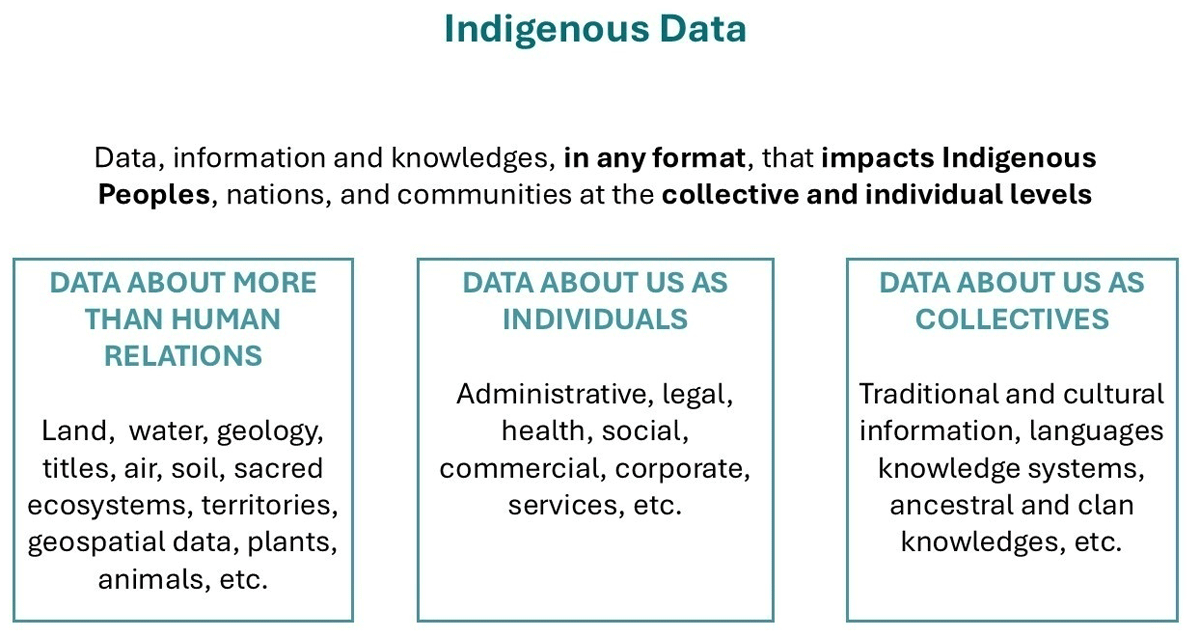
Figure 1
Indigenous Data interconnected domains, encompassing people, Country, language, culture, and resources. Adapted from Jennings et al. (2025), British Columbia First Nations’ Data Governance Initiative (2018), and Maiam nayri Wingara (2018).
IDSov is supported by Indigenous Peoples’ inherent rights of self-determination and governance over their peoples (including communities), country and resources as described in the United Nations Declaration on the Rights of Indigenous Peoples (UNDRIP) (Davis, Kukutai and Taylor, 2016; Kukutai and Taylor, 2016; United Nations, 2007). Article 18 and Article 31 of UNDRIP address Indigenous Peoples’ rights to have control and decision-making capabilities over Indigenous data, and that data are to be used in ways to support Indigenous Peoples. For example, Article 18 states Indigenous Peoples have the right to participate in decision-making matters which affect their rights, in accordance with their own procedures and maintain and develop their own Indigenous decision-making institutions (Rainie et al., 2019; United Nations, 2007). This includes the right of Indigenous Peoples to self-determine all aspects of the Indigenous data lifecycle, including conceptualisation, collection, access, analysis, interpretation, management, dissemination, and reuse (Kukutai and Taylor, 2016; Snipp, 2016). Moreover, Article 31 refers to the right of Indigenous Peoples to maintain, control, protect and develop their cultural heritage, traditional knowledge and traditional cultural expressions (United Nations, 2007). This includes Indigenous Peoples’ right to control and protect their Indigenous Cultural and Intellectual Property (ICIP).3
Indigenous Data Sovereignty (IDSov) is enacted through Indigenous Data Governance (IDGov), which has two key components; Indigenous Governance of Data (IGD) and Indigenous Data for Governance (IDG). Indigenous Governance of Data focuses on embedding Indigenous mechanisms and processes for Indigenous data wherever it resides, and in whatever form it takes. Currently, much of the IDG work is focused on data holdings that sit outside the control of Indigenous Peoples (FNIGC, n.d.; Hudson et al., 2023; Lovett et al., 2019; Smith, 2016). Indigenous Data for Governance emphasises that Indigenous Peoples need access to accurate and timely data about their communities and resources to strengthen their nation-building projects. Indigenous Data for Governance realises Indigenous community aspirations (Hudson et al., 2023; Lovett et al., 2019; Smith, 2016), supports Indigenous Nation (re)building, and acknowledges the impact of colonisation on Indigenous Governance (including Indigenous Lore and Cultural Authority).
Indigenous Data Sovereignty origins and history
Following the groundbreaking work led by First Nations people of Canada (FNIGC, 2018), there has been increasing development of IDSov networks within other CANZUS countries. For example, Te Mana Raraunga – Māori Data Sovereignty Network, Aotearoa (New Zealand) (Te Mana Raraunga, n.d.), the United States Indigenous Data Sovereignty Network (USIDSN) (U.S. Indigenous Data Sovereignty Network, n.d.) and Maiam nayri Wingara Indigenous Data Sovereignty Collective (MnW IDSov Collective) in Australia (MnW IDSov Collective, 2018). These networks come together to form the Global Indigenous Data Alliance (GIDA) (GIDA, 2023). There are also nascent IDSov networks outside the CANZUS countries such as Sweden, Norway, and Finland (Axelsson and Mienna, 2021), Basque Country in Spain (Bengoetxea, 2021), and Mexico (Rodríguez, 2021), all actively advocating for Indigenous data rights and changes for Indigenous data practice.
Australian Indigenous Data Sovereignty Principles – Maiam nayri Wingara
In 2018, Maiam nayri Wingara and the Australian Indigenous Governance Institute (AIGI) convened the National Indigenous Data Sovereignty Summit (the Summit) in Australia. Over 40 Aboriginal and Torres Strait Islander delegates and leaders from peak bodies, the public service, the tertiary education sector, and various Indigenous communities attended (MnW InDSov Collective and AIGI, 2018). The summit aimed to advance IDSov and IDGov through the development of Australian IDSov principles.
At the Summit, five principles for IDSov in Australia were developed by delegates and leaders now referred to as ‘The Maiam nayri Wingara Indigenous Data Sovereignty Principles’ (herein MnW Principles) (MnW IDSov Collective and AIGI, 2018). The MnW Principles are the overarching IDSov principles for Australia. At the conclusion of the Summit, it was agreed by delegates that Aboriginal and Torres Strait Islander peoples had the right to:
Exercise control of the data ecosystem4 including creation, development, stewardship, analysis, dissemination, and infrastructure;
Data that are contextual and disaggregated (available and accessible at individual, community, and First Nations levels);
Data that are relevant and empowers sustainable self-determination and effective self-governance;
Data structures that are accountable to Indigenous Peoples and First Nations; and
Data that are protective and respects our individual and collective interests.
Operationalising Australian IDSov principles through implementing IDGov
Operationalising the MnW IDSov Principles is required as the necessary next step for Aboriginal and Torres Strait Islander Peoples to enact their data rights (Carroll et al., 2020; Lovett et al., 2019; Maiam nayri Wingara Indigenous Data Sovereignty Collective and Australian Indigenous Governance Institute, 2018; Rainie et al., 2019). While operationalisation of IDSov principles has been successfully led by Indigenous Peoples (Jones et al., 2018; Yoorrook Justice Commission, 2022), within non-Indigenous organisations operationalising the principles has been minimal or tokenistic (Bishop, 2016; Jelfs, 2016), particularly those organisations working with Indigenous administrative data (Walter and Carroll, 2021). This lack of progress may reflect a number of factors, including a poor conceptual understanding of IDSov, the inability to move from abstract concepts (principles) to tangible action, a lack of respect for the Indigenous rights agenda, and an inability/want to redress inequitable power relations despite CANZUS countries having endorsed UNDRIP. The inability of policy agencies to adapt means nation states retain the status quo of maintaining exclusion of Indigenous peoples from data ecosystems. Indigenous Data Governance requires enabling mechanisms and supporting structures (e.g., policies and procedures) embedded with Indigenous values and worldviews which enact IDSov and Indigenous rights to implement Indigenous control over the data and the data lifecycle (see Figure 2). This transforms data systems to address historical and systemic barriers that Indigenous people have faced and continue to face since colonisation (Carroll et al., 2020; Lovett et al., 2019). The data lifecycle, in this context, refers to the Indigenous data lifecycle: the set of stages through which data move, including conceptualisation, collection, storage, analysis, dissemination, and reuse from an Indigenous perspective (see Figure 2). Effective IDGov ensures Aboriginal and Torres Strait Islander Peoples and their organisations and institutions can access and use data to make the decisions that support their communities and people in ways that meet their developmental needs and aspirations. Where non-Indigenous entities, such as governments, hold Indigenous data, IDGov ensures Aboriginal and Torres Strait Islander Peoples have oversight over data holdings and institutional processes.
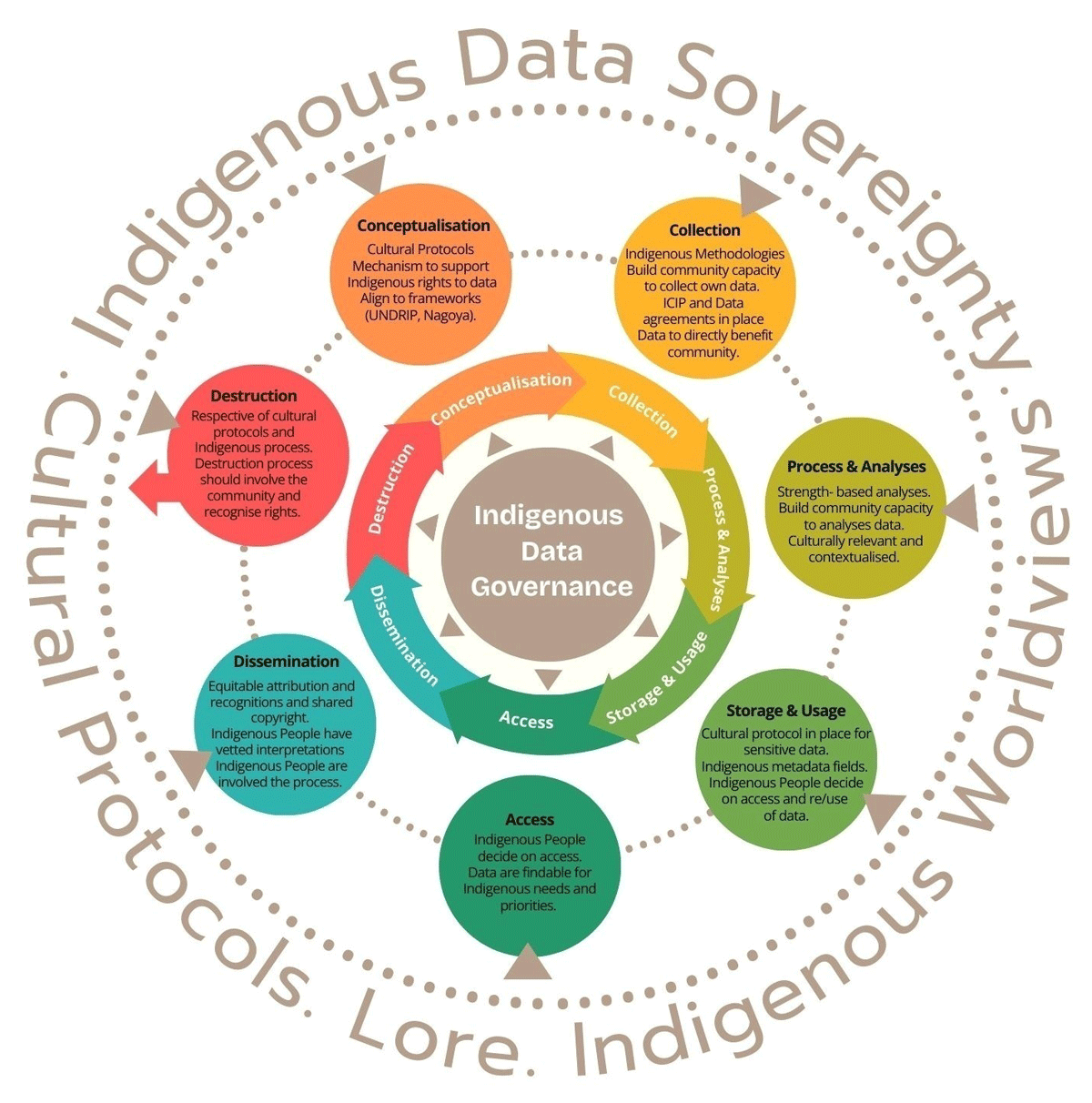
Figure 2
The Indigenous Data Lifecycle.
A simplified data lifecycle from an Indigenous viewpoint, showing the broad stages through which data move and the points at which Indigenous rights, interests, and decision-making apply.
This paper provides an operational framework for implementing IDGov in accordance with MnW IDSov principles. Specifically, it focuses on the application of the MnW IDSov principles within the Australian context and recognises that IDSov work in other jurisdictions continues to influence and support the Australian IDSov work. We focus on institutions and data actors that hold or generate Indigenous data that sit outside the control of Aboriginal and Torres Strait Islander communities. For each principle, we identify its purpose, outline mechanisms to enact each principle, suggest practical actions to implement each mechanism, and provide relevant case studies. These mechanisms are not exhaustive, nor are they required in every application of IDSov; rather, Aboriginal and Torres Strait Islander communities may choose to adopt some or all of them, or develop their own based on their priorities and needs.
Methods
This paper draws on the synthesis of the existing scholarship, policy documents, and lived and professional experience of authors in IDSov and IDGov. The framework was further informed by key lessons from the Māori data governance model (Kukutai et al. 2023) and the development of the CARE Data Maturity Model (Collaboratory for IDGov, n.d.). These sources were used to refine the language of the framework and to identify case studies that illustrate IDGov practices that demonstrate feasibility and benefit of each mechanism presented.
Further, the development of the operational framework presented in this paper is grounded in the MnW IDSov Principles, which were produced in a nationally convened, community-driven deliberative process in 2018 (MnW IDSov Collective and AIGI, 2018b). A second national gathering was held in 2023 using a community-driven process, to further consider what IDSov and IDGov mean in practice for Aboriginal and Torres Strait Islander Peoples (MnW, AIGI and Lowitja Institute, 2023). The discussions and priorities emerging from the gathering partly informed the development of the framework.
Across the authorship team – all IDSov and IDGov experts C.S.P., R.B., R.T. and R.L. were involved in sessions that first discussed each principle and what application of that principle could mean in practice. A series of sessions were held to refine the purpose, which explains why the principle matters; and the mechanisms, which outline the practical actions, policies, and processes required for each MnW principle using a Delphi process to gain consensus amongst the expert group to lessen uncertainty about how to enact each principle in practice (Hasson et al. 2000). They are not intended to be exhaustive, rather, they provide minimum practical guidance and markers of progress that can support organisations to strengthen IDSov and IDGov over time. Not all mechanisms or indicators are required in every situation or context. The MnW principles mechanisms can be adapted to the specific circumstances in which they are being applied, including the priorities, governance structures, and data needs of the Indigenous communities involved.
The Supplementary Table 1 was developed as a companion resource, for those wanting more details than provided in this paper due to length constraints. It provides more detailed implementation guidance than could be included in the main text. It links each MnW Principle and stage of the data lifecycle to the relevant mechanism, practical actions and indicators of implementation.
Mechanisms and case studies for implementing MnW IDSov principles
Principle: Exercise control of the data ecosystem including creation, development, stewardship, analysis, dissemination and infrastructure.
Purpose of principle
Indigenous Data Sovereignty requires that Aboriginal and Torres Strait Islander Peoples exercise authority over the data ecosystem. The data ecosystem refers to the broader social, institutional, technical, and policy environment within which data are created, managed, and used including the people, institutions, infrastructures, policies, technologies, and governance arrangements that shape data practices. This Principle asserts control, and decision-making power must rest with Indigenous Peoples across all stages of the data lifecycle, from conceptualisation of data (including indicator and measure development) through to analysis, dissemination and reporting (see Figure 2). This principle emphasises the need to shift data power dynamics to Aboriginal and Torres Strait Islander Peoples, supported by mechanisms that implement and sustain this change (Carroll et al., 2020).
Some government organisations engage Aboriginal and Torres Strait Islander Peoples in advisory capacities across aspects of the data lifecycle. However, these roles typically lack decision-making authority, limiting meaningful opportunities to challenge settler-colonial data practices and resulting in data collection that advances colonial agendas while offering little relevance to Indigenous priorities (Lovett, Prehn et al., 2020). A paradigm shift is therefore needed to ensure Aboriginal and Torres Strait Islander Peoples hold genuine decision-making power across the data lifecycle, moving beyond consultation to embed Indigenous authority in governance.
Mechanism – Indigenous Data Governance through stewardship
A key mechanism to enact this principle is the establishment of an Indigenous Data Governance Committee (IDGC) with delegated data custodian and stewardship roles (for specific action and indicators for establishing an IDGC, see Supplementary Table 1). Unlike advisory structures that lack decision-making power, IDGCs act as stewards of data on behalf of the Indigenous communities they represent. Due to the heterogeneous nature of Aboriginal and Torres Strait Islander communities, this is not a one-size-fits-all approach. The IDGC will need to have representation, appropriate to the data source in question or being developed. Depending on the agency and data holdings this may require local, regional, or national level representation and should involve Aboriginal and Torres Strait Islander Peoples who have the closest relationship to the conceptual knowledge represented in the data (Barrowcliffe et al., 2025).
The responsibilities of IDGCs include:
identifying the need for Indigenous data
leading the conceptual development of new Indigenous data
developing Indigenous data use protocols and agreements for use of data
reviewing data management plans to ensure they encapsulate an Indigenous worldview (Andersen and Walter, 2013)
determining conditions for access, restricted use, or future repurposing of sensitive data (including cultural)
shaping organisational policies to embed Indigenous authority throughout the data ecosystem
A practical example of this principle is The Mayi Kuwayu: The National Study of Aboriginal and Torres Strait Islander Wellbeing (herein referred to as the MK Study), a national study of Aboriginal and Torres Strait Islander culture, health, and wellbeing developed by Aboriginal and Torres Strait Islander Peoples (MK Study, 2022). This study is governed by an IDGC – the Mayi Kuwayu Data Governance Committee (MKDGC), a 12-member all Indigenous committee that reviews and provides assessment of applications for the use of MK data according to the MnW IDSov principles (Jones et al., 2018; Lovett, Brinckley, et al., 2020). The MKDGC has the authority to impose conditions and restrictions on the use of data to ensure research is conducted ethically and provides accountability to Aboriginal and Torres Strait Islander Peoples. The final data analysis and associated research outputs (research papers) are vetted by the MKDGC to ensure adherence to the pre-specified data analysis plan approved by the committee. This model demonstrates how delegated Indigenous stewardship strengthens and protects Indigenous rights to Indigenous data.
Mechanism – Indigenous data audit and review
A second mechanism to enable this Principle is the systematic audit and review of all Indigenous data and associated governance processes (for specific actions and indicators for conducting a data audit and review, see Supplementary Table 1). This begins with a comprehensive audit of all Indigenous data or data assets currently collected, stored, or used by the organisation. Second, it requires a review of the organisation’s policies, procedures, and protocols to ensure they enable and uphold Indigenous control across the data ecosystem. In addition, organisations must engage in the continuous identification of Indigenous data holdings and integrate tools that support the disclosure, recognition, and appropriate use of Indigenous data across the lifecycle.
As part of an existing project, an Indigenous data audit was conducted (see Table 1) to create an Indigenous data asset register. The Indigenous data asset register records the information that should be captured during an Indigenous data audit: the nature of each asset, its source, data quality, known issues, storage locations, custodian of the data, and reporting arrangements. Creating an Indigenous data asset register in this way is a practical starting point for the audit and review. It makes visible the full scope of an organisation’s Indigenous data holdings, surfaces gaps in identification, access and governance, and creates a foundation from which IDGov and Indigenous stewardship arrangements can be initiated. In a world of ‘big data’ and ‘open data’, the majority of Indigenous data are held by organisations or institutions outside the current control of Aboriginal and Torres Strait Islander Peoples. Establishing Indigenous stewardship and custodianship is central to supporting the management and oversight of the data within an organisation. This responsibility may include how data will be coded, stored, governed, moved (in and out of an organisation) and cared for across the entire data life cycle. While these processes may resemble conventional Western data management systems, the difference is that the decision-making responsibility lies with Aboriginal and Torres Strait Islander Peoples. Indigenous Data Sovereignty can only be exercised and led by Indigenous Peoples as the right holders of Indigenous data. Therefore, Aboriginal and Torres Strait Islander Peoples must determine what data are collected, why they are collected, and how and by whom data are data used, in alignment with cultural protocols and ethics (e.g., AIATSIS, 2020).
Table 1
Indigenous data register example from an Indigenous data audit, 2024.
| NAME OF INDIGENOUS DATA ASSET | ABOUT | SOURCE | DATA QUALITY ASSESSMENT | ISSUES IDENTIFIED | STORAGE LOCATION | CUSTODIAN | WHAT IS CURRENTLY REPORTED FROM THE ASSET INTERNALLY | WHAT IS CURRENTLY REPORTED FROM THE ASSET EXTERNALLY (PUBLICLY) | ACCESS/USE POLICIES FOR COMMUNITY | CURRENTLY SHARED WITH? |
|---|---|---|---|---|---|---|---|---|---|---|
| Admitted Patient Collection | This asset contains person level inpatient data for public and private hospitals. | Public and private hospitals | Ongoing. Data is cleaned and checked for consistency as it is processed. Data is cleaned and checked for consistency as it is processed. | Inconsistent provision of private hospital data. Missing Indigenous identification on a small number of records each year. | Health data warehouse | Chief Health Data Officer | Significant internal reporting, including activity, safety and quality, costs, planning & population health. | Significant national and jurisdictional reporting, including activity, safety and quality, costs, planning & population health. | Data Access Policy Link Requests for aggregate data analysis and unit record data are made directly via a customer portal | Australian Institute of Health and Welfare The National Health Funding Body Independent Health and Aged Care Pricing Authority. |
This mechanism may also include repatriation of Indigenous data, as Aboriginal and Torres Strait Islander Peoples have the right to recover and/or repossess known and unknown Indigenous data (Hudson et al., 2023). Indigenous data repatriation has been the topic of ongoing discussions within specific fields for a long time and the growing body of scholarship (for example, see Carroll et al., 2023; Gardiner et al., 2011; Thorpe, Faulkhead and Booker, 2020) on this topic is worthy of its own paper. Discussing the nuances of Indigenous data repatriation is beyond the scope of this paper.
Principle: Data that are contextual and disaggregated (available and accessible at individual, community and First Nations levels)
Purpose of principle
This principle aims to address BADDR (Blaming, Aggregate, Decontextualised, Deficit, and Restricted) data (Walter, 2018) and seeks to redress systemic negative stereotypes that have long shaped representations of Indigenous people in data. Stereotyping in data occurs when aggregated or decontextualised data are interpreted without reference to the historical, political, and structural conditions that produce them, presenting the outcomes of colonisation as an inherent characteristic of Indigenous Peoples rather than as a consequence of policy and dispossession (Walter, 2018).
The contextualisation of Indigenous data by non-Indigenous data actors often applies Western norms without accounting for the heterogeneous nature of Aboriginal and Torres Strait Islander Peoples or the broader socio-political structures shaping their lives (Bodkin-Andrews et al., 2024; Walter, 2018). These practices perpetuate ongoing systemic racism and inequities and obscure the real story behind the data (Bodkin-Andrews et al., 2024). This principle directly counteracts stereotyping by requiring that data be disaggregated to reflect Indigenous diversity rather than a single homogenised category and that contextual statements accompany the data addresses the structural conditions of the data.
This principle creates processes to ensure Indigenous data are available at the level required to make informed decisions (e.g., for policies and programs) while remaining accessible to Aboriginal and Torres Strait Islander Peoples to address their own priority needs and aspirations. Indigenous authority must guide decisions about how the data are contextualised, disaggregated, made available, and accessed.
Mechanism – Indigenous data contextual statements
Indigenous data contextual statements are explanatory statements, that sit alongside Indigenous data or outputs from analysis of Indigenous data to explain social, cultural, historical, and political conditions that shape trends and patterns in the data. A contextual statement should be developed by or with Aboriginal and Torres Strait Islander Peoples who hold authority in relation to the data in question. These statements are powerful tools to provide the realities and to make visible the social and political milieu in which the phenomena being investigated take place (Walter, 2018) (for specific actions and indicators for developing contextual statements, see Supplementary Table 1). These contextual statements help prevent data being read in isolation or through a deficit-based lens by contextualising the systematic polices and events that have contributed to the results presented. Such statements also reveal historical biases and inaccuracies embedded in data. Therefore, contextual statements support more accurate and respectful interpretation of Indigenous data.
For example, a contextual statement about the national partnership agreement on Closing the Gap5 for Indigenous employment could read as follows:
A priority of the national agreement is employment of Aboriginal and Torres Strait Islander peoples. This priority is required due to their historical exclusion from the economy. During the ‘protection era’ from 1883–1967 the lives of Aboriginal people in New South Wales (NSW) were in the hands of the NSW Aborigines Protection/Welfare Board. The impact of the Board’s systematic control over Aboriginal communities through policies of segregation, assimilation, child removal and wage withholding would endure for decades, and the negative results of those government directives are still being seen today.
Mechanism – Culturally informed disaggregation methods
Methods for disaggregation must reflect the diversity of Aboriginal and Torres Strait Islander communities. Place-based approaches can generate data collection that are more reflective of the community diversity and support evidence-based decision-making at local and regional levels (for specific actions and indicators for culturally informed disaggregation methods, see Supplementary Table 1). For example, Yarrabah Counts, where the community recognised that Yarrabah is a resettlement community and therefore sought to understand the variety of tribal groups represented. This ensured that data collection and interpretation could cater to differing cultural needs and priorities. Such approaches generate data that are more beneficial, meaningful, and relevant for communities (Lovett et al., 2024; Wright et al., 2022; Yu, 2011).
Mechanism – Available and Accessible data
Building on the identification of Indigenous data assets, mechanisms are required to enable access and use of data across the data lifecycle (e.g., data application and conditions for access and use) (for specific actions and indicators for enabling data access, see Supplementary Table 1). These mechanisms may include Data Governance Agreements and Standard Operating Procedures (SOPs), with specific clauses addressing IDSov and ICIP. Where privacy laws restrict direct access (i.e., health data – anonymity) alternative communication tools, such as reports or factsheets, should be developed to ensure Aboriginal and Torres Strait Islander Peoples can access and benefit from the data.
Additional processes are also needed to support Indigenous data repatriation for communities. Within the Galleries, Libraries, Archives and Museums (GLAM) sector many Aboriginal and Torres Strait Islander Peoples are excluded from the management of collections that hold their own cultural heritage or Indigenous data relevant to them, due to settler-colonial legal systems and institutional frameworks for management. Digital repatriations offer a pathway to address this exclusion. For example, the Passamaquoddy Tribe of Maine in the northeastern United States has worked with the Library of Congress to digitally repatriate audio recordings from historic wax cylinders featuring Passamaquoddy songs, stories, and speech documented in 1890 (Long Now, 2019). The project focused on digitising and restoring the audio for use by Passamaquoddy communities and establishing the tribe as the primary curatorial authority over public availability and usage of the recordings (Library of Congress, n.d.). The Passamaquoddy use a community content management system known as Mukurtu (Mukurtu, n.d.) to host the recordings and has applied Local Contexts’ Traditional Knowledge (TK) labels to denote culturally sensitive materials and communicate restrictions around commercial usage (Passamaquoddy People, n.d.).
Principle: Data that are relevant and empower sustainable self-determination and effective self-governance.
Purpose of principle
The aim of this Principle is to ensure that Aboriginal and Torres Strait Islander Peoples have the authority to define what data are relevant and meaningful for their own priorities. It positions data as a resource for self-determination and governance enabling Aboriginal and Torres Strait Islander Peoples to set their own data agendas, determine what constitutes ‘good’ data, and builds the capacity and capability to collect and govern these data within communities.
Mechanism – Participatory engagement and data needs assessment
To enact this Principle, Indigenous-led governance structures must be established to ensure Aboriginal and Torres Strait Islander Peoples hold decision-making authority across the data lifecycle (for specific actions and indicators for participatory engagement and data needs assessment, see Supplementary Table 1). These mechanisms position data as a resource for nation-building and governance building the foundations and actions to support self-determination. This includes ensuring that the data produced are relevant and empowering. To do this, the focus must shift from a consultation process to a relationship where Indigenous Peoples make decisions about what data are collected and used (Anderson et al., 2024; Castellano, 2004).
Participatory engagement is a key mechanism to ensuring Aboriginal and Torres Strait Islander Peoples have meaningful leadership within – and authority over – a given data ecosystem. This should be grounded in deep relationship-building over time and involve the conduct of a ‘data needs’ assessment, early in a project or partnership. The purpose of the data needs assessment is for communities to identify specific kinds of data they already have, as well as data they still need, to practise empowered self-governance. Non-Indigenous organisations have a responsibility to ensure that data are ‘fit for purpose’; meaning data that are provided in the right form, culturally appropriate in content and use, accessible, and relevant to the specific decisions, priorities, and benefits of the communities. This responsibility extends across the data lifecycle and requires data practices to advance Indigenous Peoples’ rights and support their well-being (Carroll et al., 2020, 2021).
For example, the Yarrabah Counts project, a community-led data initiative in Far North Queensland was led by the Yarrabah community and supported by researchers to strengthen their governance capability and ensure that the data collected was relevant to local priorities and empowering for decision-making (Lovett et al., 2024). The first step involved a community governance group, the Yarrabah Leaders Forum, overseeing and authorising all aspects of the project, ensuring decisions about data rested with Yarrabah people themselves (Lovett et al., 2024). Through facilitated workshops, Elders and the community identified their community priorities and then those priorities were mapped to data items and measures from surveys to create the local data collection tool – Yarrabah Counts (a community embedded survey) and included priorities across areas including health, education, housing, and ensuring cultural continuity through diverse community needs. Rather than relying on externally imposed indicators, the process embedded Indigenous authority in defining, collecting, and using the data (Lovett et al., 2024). Internationally, the Akwesasne pollution project on Mohawk tribal lands in the colonial nation-states of Canada and the United States demonstrates how participatory engagement enabled the community to identify critical data gaps, reclaim control over environmental monitoring, and generate data directly aligned with their governance and health priorities (Johnson-Zafiris, 2024).
Mechanism – Rights-based protocols and policies for self-governance
Another mechanism to enact this principle is the development and implementation of governance protocols and policies that uphold Aboriginal and Torres Strait Islander Peoples’ rights to determine the collection, access, analysis, interpretation, management, dissemination, reuse, and repatriation of their data (Hudson et al., 2023) (for specific actions and indicators for developing these protocols, see Supplementary Table 1). Self-governance is the objective that this mechanism supports; the protocols and policies are the instruments to achieve it. This also includes the right to recover, repatriate, reclaim known and unknown data about their ancestors, clans, nations, communities, and non-human relations – see Figure 1, Indigenous data (Hudson et al., 2023).
Despite the current dearth of legal frameworks within Australia to uphold Aboriginal and Torres Strait Islander Peoples’ data rights, as an endorser of UNDRIP it has affirmed these rights. Accordingly, any organisation working with, collecting, or holding Indigenous data carries a responsibility to provide meaningful opportunities for Aboriginal and Torres Strait Islander communities to exercise and enact those rights. Organisations can develop their own internal policies alongside Aboriginal and Torres Strait Islander Peoples to uphold their data rights. Some sectors have established particular protocols for upholding Indigenous data rights. For example, in Australia the national and state libraries dealing with Indigenous materials are to operate within the Aboriginal Torres Strait Islander Library Information and Resource Network (ATSILIRN) protocols (ATSILIRN, 2012), and in the United States, Protocols for Native American Archival Materials (PNAAM) (FAC, 2007) are in effect. These protocols embed IDGov in day-to-day practice and distribute responsibility for IDGov across the organisation, rather than placing the labour entirely on the shoulders of Indigenous staff and communities. Other sectors need to develop their own protocols to uphold IDSov and implement IDGov into business as usual.
Principle: Data structures that are accountable to Indigenous Peoples and First Nations
Purpose of principle
This principle aims to overcome current barriers to IDGov by embedding accountability within data structures. Data structures are a way to organise, store and manage so they can be accessed, retrieved and processed efficiently (IBM, 2024). Embedding Indigenous authority within data structures also requires that physical and digital infrastructures are accountable to Indigenous rights and enable Indigenous governance over data. Embedding Indigenous authority in data structures ensures that infrastructures are developed and used in ways that uphold Aboriginal and Torres Strait Islander Peoples’ data rights and enable collective benefit.
Mechanism – Indigenous data standards and Metadata
One mechanism to support this principle is the development and adoption of Indigenous data standards, including provenance, protocol, and permission-based metadata (for specific actions and indicators for data standards and metadata, see Supplementary Table 1). Standards provide guidance that allows for consistency across data ecosystems. Metadata are commonly understood as “data about data” including information about dataset origin, author, provenance, context, structure, and conditions of use (Badman and Kosinski, 2025). In an Indigenous data context, metadata can also act as a governance mechanism by recording Indigenous Peoples’ relationship and links to data, as well as protocols, permissions, access conditions and identifying who the Indigenous authority is for the data (IEEE, 2025).
Standards-setting bodies play an important role in articulating recommended practices surrounding Indigenous data. For example, the Institute of Electrical and Electronics Engineers (IEEE) is a global standards-setting body for engineering, computing, and technology information (https://standards.ieee.org/ieee/2890/10318/) that released the Recommended Practice for Provenance of Indigenous Peoples’ Data. Developed through collaboration between Indigenous and allied scholars, this Recommended Practice is intended to facilitate the interoperability of provenance fields among different information platforms and databases and to support the disclosure and use of Indigenous Peoples’ data. Its development involved more than 5 years of deliberation, discussion, and consultation with Indigenous Peoples. The IEEE Recommended Practice serves as the first example of a standard for Indigenous Peoples’ data. Other standard-setting bodies and professional organisations can develop standards to guide data actors interacting with Indigenous data.
Data should be stored with appropriate metadata to support access and governance by Indigenous communities (Golan et al., 2022). Metadata should include appropriate attribution to the Indigenous knowledge holders, protocols for use throughout the entire data lifecycle including secondary use and publication. Indigenous and allied scholars have been developing standards and recommendations pertaining to metadata for Indigenous Peoples’ data. The Indigenous Metadata Bundle provides recommendations for initial categories to support the recognition and inclusion of Indigenous Peoples’ data (see, https://indigenousdatalab.org/3006-2/). These categories include governance, protocols, provenance, lands and waters, and the implementation of Local Contexts, Notices and Labels.
The Local Contexts hub was established in 2019 to provide Indigenous communities tools to reassert cultural authority over Indigenous data (Local Contexts, n.d.). These tools include digital tags known as Institutional Notices (hereafter ‘Notices’) and Traditional Knowledge (TK) or Biocultural (BC) Labels (hereafter ‘Labels’). Notices are tools designed for institutions and researchers to support ethical use and reinforce relationships with Indigenous communities. They also work to educate the public about Indigenous rights and interests in historical and future collections. Labels can be customised by the Community and establish Indigenous cultural authority and governance over Indigenous data and collections by adding provenance information and contextual metadata and data (see Local Contexts https://localcontexts.org/). An example of successful development and use of the labels can be seen in the Passamaquoddy community’s (North America) customization of labels for wax cylinder recordings of cultural song held by the Library of Congress (https://localcontexts.org/tk-label-in-use-passamaquoddy/).
Mechanism – Indigenous Data Management Plan (IDMPs)
A second mechanism is the development of IDMPs, guided and approved by IDGCs. A Data Management Plan (DMP) is a widely used tool for documenting how data will be managed across its lifecycle. An IDMP adapts this established practice to embed Indigenous Authority, rights, responsibilities and governance into data management practice. An IDMP clearly outlines the purpose (or rationale) of the data, defines how data will be managed throughout the lifecycle and specifies access conditions, restrictions and obligations (including access and use) (Hudson-Vitale and Moulaison-Sandy, 2019) (for specific actions and indicators for developing an IDMP, see Supplementary Table 1). These plans should reference the Data Agreement and/or Licensing Agreements that define ownership, repatriation of the Indigenous data and/or the data asset, ICIP and Intellectual Property (IP).6 They should also embed safeguards for consent and data sharing (i.e., accessible, restrictions, permissions use and future use of data), Aboriginal and Torres Strait Islander rights (including Right of Reply7), and dispute resolution and process for breaches (Hudson-Vitale and Moulaison-Sandy, 2019; Walter, Kukutai, et al., 2021). For example, an IDMP may specify that consultation and approval is sought from individuals or Community before data is (re)used or disseminated.
Mechanism – Indigenous owned data infrastructures
Indigenous Data Sovereignty movements support broader transformative aims of developing Indigenous-owned and controlled data infrastructures. At present, Aboriginal and Torres Strait Islander-owned data infrastructures are lacking, with the majority of Aboriginal and Torres Strait Islander data being collected and held by Government institutes (e.g., Health: Australian Institute for Health and Welfare, Census: Australian Bureau of Statistics, Environmental: Bureau of Meteorology and GeoSciences Australia), hence the need for Indigenous custodianship and/or stewardship mechanisms. This imbalance highlights the urgent need for custodian and data stewardship mechanisms that can establish genuine Indigenous governance, accountability and long-term sustainability of data infrastructure. An example is Te Pā Tūwatawata, a decentralised data storage network designed, developed, and owned by Māori. In the United States, the Native BioData Consortium (NBDC) is a leading example of a sovereign data infrastructure, as the first Indigenous-led genomics nonprofit physically located within Tribal jurisdiction (NBDC, n.d.).
Principle: Data that are protective and respects our individual and collective interests
Purpose
The purpose of the principle is to ensure that data are ethical, representative of the interests and needs of Aboriginal and Torres Strait Islander Peoples, and do not cause harm to individuals and/or communities. It also requires that organisations (or individuals) that hold and are custodians for Indigenous data uphold the cultural integrity and dignity of Aboriginal and Torres Strait Islander Peoples and communities across the life cycle of the data.
Mechanism – Ethical processes and practices to minimise harm
The central mechanism for enacting this Principle is the development of procedures that support Indigenous Peoples’ rights to govern Indigenous data (for specific actions and indicators for these procedures, see Supplementary Table 1). The procedures must be embedded with Indigenous data protocols to reflect ethical conduct, moral rights, cultural safety, and relational accountability. They should strengthen Indigenous data rights to data and knowledge and provide recognition and attribution of Aboriginal and Torres Strait Islander Peoples. Protection of Indigenous Cultural and Intellectual Property (ICIP) should also be a core function.
The procedures must have a protective and benefit-driven purpose: to prevent the perpetuation of racism, extractive research, misuse, and misinterpretation of data, while ensuring that Indigenous data are used to generate benefit, visibility, and positive outcomes. Organisational responsibility must be clearly articulated, ensuring that the burden of ethical practice and supporting Indigenous rights to their data does not fall disproportionately on Aboriginal and Torres Strait Islander employees. The procedures should be treated as a living document, regularly reviewed and updated through the IDGC and/or with relevant Indigenous communities.
As a minimum, procedures for Indigenous data should address the following areas: i) Free, prior informed consent (FPIC); ii) Standards of behaviour; iii) Authorship, attribution, and acknowledgement; and iv) Ethical harm minimisation and power redress.
i) Free, prior and informed consent (FPIC)
Free, Prior and Informed Consent is an ethical standard and a fundamental aspect of Indigenous Peoples rights to self-determination protected by international human rights standards, which recognise the rights to self-determination. It is supported by international frameworks including United Nations Declaration on the Rights of Indigenous Peoples (UNDRIP) (United Nations, 2007), the Convention on Biological Diversity, and International Labour Organization Convention 169 (FAO, 2016).
Therefore, consent processes must be transparent, culturally appropriate, and grounded in Indigenous authority, ensuring individuals and communities retain control over how data relating to them are collected, used, stored, shared, and reused. In practice this means consent must be sought before the data collections begins or any plan or action takes place (prior); that it be independently decided and given voluntarily without coercion or pressure (free); and that communities and individuals are given complete and comprehensible information about how their data will be used, stored, and shared (informed). Consent can also be reviewed, renewed, renewed, or withdrawn as circumstances change (FAO, 2016).
ii) Standards of behaviour
Standards of behaviour are necessary to guide organisations working with Aboriginal and Torres Strait Islander Peoples and communities to uphold and strengthen cultural protocols. These standards are designed to establish respectful ways of engaging with Aboriginal and Torres Strait Islander Peoples and communities and their data. They must take into account the unique challenges to Aboriginal and Torres Strait Islander People’s social, emotional, and cultural wellbeing (Thorpe, 2024) that arise in spaces where Indigenous data are held.
This includes ensuring staff demonstrate high levels of cultural integrity, supported by ongoing training, and understand Indigenous methods that can be applied across the data lifecycle. Staff should also maintain awareness of Aboriginal and Torres Strait Islander culture and community dynamics, to guide how data are collected, accessed, stored and used in ways that respect cultural lore and practice (e.g., men’s and women’s business, sacred sites, and cultural species). Finally, standards of behaviour must extend to requiring protections for Aboriginal and Torres Strait Islander Peoples in digital and public spaces. This may include processes to monitor online platforms for trolling, and to respond to racism, discrimination, and hate speech on social networking sites.
iii) Authorship, attribution, and acknowledgement
Ensuring that staff operate to ethical standards requires a written agreement that clearly details the legal and moral rights relating to any knowledge shared by Aboriginal and Torres Strait Islander People and/or communities. The agreement should stipulate appropriate forms of recognition and attribution for the contributions of Indigenous owners of the knowledge. Attribution refers to practices that support Indigenous acknowledgment and authorship, and address the rights of associated knowledge-holders (Carroll et al., 2022; Golan et al., 2022). Indigenous rights to knowledge should be recognised in intellectual property processes, including copyright, co-authorship, and co-ownership, trademarks and patents (Wilson and Barrowcliffe, 2022). Agreements between Aboriginal and Torres Strait Islander communities and researchers or organisations can fill the gaps left by the lack of legislation for ICIP and IDSov. Licensing agreements can further define ownership, rights, interests, obligations, and restrictions relating to ICIP. IP, and copyright which must be negotiated prior to entering any agreement. Where Australian legislation is lacking, sector-specific protocols can be used as triggers for responsibilities and as guides for best practice. Care should also be taken to ensure that any written agreement (and application thereof) is also of an iterative or flexible enough nature (AIATSIS, 2020) to ensure that emerging (potentially unexpected) Indigenous Knowledges and associated rights may also be protected.
iv) Ethical harm minimisation and power redress
Ethical practice requires more than minimising harm, it must actively promote strengths, resilience, and self-determination across the data lifecycle (see Figure 2). Analysis and reporting should reject deficit discourses, instead centring Indigenous capabilities, strengths, resilience, and knowledge of individuals (Fogarty et al., 2018; Hammond and Zimmerman, 2012). As per the contextual and disaggregated principle: contextual statements must accompany Indigenous data to ensure accuracy, respect, and cultural grounding.
Power redress requires addressing the structural inequities that shape data practices. This involves recognising the historical legacies of colonial data extraction and embedding mechanisms that shift authority back to Aboriginal and Torres Strait Islander Peoples. Practical strategies include Indigenous-led structures such as Indigenous Data Governance Committees mandated co-authorship and attribution agreements; and benefit-sharing arrangements that ensure communities are not only consulted but hold decision-making power throughout the data lifecycle.
Ethical practice must also demand transparency and accountability from institutions. Organisations should be required to report back to communities on how data are used, what outcomes are generated, and what benefits flow. This shifts responsibility from individuals to systems, ensuring that data processes reinforce collective rights rather than institutional convenience. These practices contribute to an ethical environment where data protect and empower Aboriginal and Torres Strait Islander Peoples.
Applying and prioritising the mechanisms in practice
The MnW Principles and the associated mechanisms to enact the principles are interconnected and should not be applied in isolation. Their relevance and application must be determined by Aboriginal and Torres Strait Islander Peoples who hold authority in relation to the data and adapted to the scale and purpose and context of each organisation. Indigenous governance structures, in particular IDGCs, are foundational to this process. IDGCs establish the Indigenous decision-making authority required to guide the selection and application of relevant mechanisms, including data audit, the development of IDMPs, research agreements, and the process for consent and conditions of (re)use. Where Indigenous decision-making authority is absent, what follows is not IDGov and cannot support IDSov. Indigenous Peoples alone hold the right to enact governance over their data; without this authority embedded in practice, implementation will further perpetuate the extractive data practices of colonisation.
Implementation should be understood as ongoing organisational responsibility that will require additional resourcing as embedding IDGov in data systems will inevitably introduce new approaches that will require work to implement what may be complex systems change. Indigenous Data Governance is not a one-off activity or a tick box exercise. Organisations must commit adequate time, funding, staff and technical support to sustain Indigenous decision-making across the data lifecycle – an example of the resource implications is introducing an Indigenous Data Governance mechanism as has been done in the Mayi Kuwayu Study (Lovett et al., 2020). Critically, the responsibility to reform organisational systems should not fall primarily to Indigenous employees. The mechanisms outlined in this framework provides practical entry points for this work.
Conclusion
Implementing IDGov within existing data ecosystems is essential to support IDSov. The MnW principles can be operationalised through the implementation of the outlined mechanisms to transform current data systems. All data actors and institutions holding Aboriginal and Torres Strait Islander data carry responsibilities for IDSov, which necessitates the adoption of IDGov mechanisms that recognise and uphold Indigenous Peoples’ rights and authority over data. Realising this paradigm shift will require coordinated action across sectors and sustained institutional commitment and investment. Embedding Indigenous Governance will maximise the value of data to advance equity, address priorities and needs of Indigenous people and support community wellbeing. It also contributes to nation (re)building and strengthening the integrity of Australia’s data systems more broadly.
Looking forward, the rapid emergence of new data systems and technology including Artificial Intelligence (AI), Big Data and linked data highlights further significant ethical and professional practice considerations. These technologies often draw upon data that are influenced by long-standing colonial biases, amplifying risks of misappropriation and harm (Walter, Lovett et al., 2021). To safeguard against this, protocols and processes need to be developed to uphold IDSov in the design and application of these technologies. Integrating ICIP rights with Indigenous data rights is critical to prevent exploitation and ensure that digital innovation reduces, rather than reinforces, existing information inequalities. By embedding Indigenous Data Governance in both current and emerging data ecosystems, this can advance Indigenous rights and protect Indigenous knowledge systems. In turn, this will create data infrastructure that supports the needs, aspirations and authority of Aboriginal and Torres Strait Islander Peoples.
Additional File
The additional file for this article can be found as follows:
Supplementary Table 1
Mechanisms and Indicators to Operationalise the Maiam nayri Wingara Principles (MnW). DOI: https://doi.org/10.5334/dsj-2026-032.s1
Notes
[1] For the purposes of this paper, we align with the Maiam nayri Wingara operationalisation of ‘Indigenous Data’ as ‘information or knowledge, in any format or medium, which is about and may affect Indigenous peoples both collectively and individually. This not only includes data about us as Indigenous peoples (e.g., census data) and our resources (e.g., environmental data), but includes data from us (e.g., Traditional Knowledges and Oral Histories) (Maiam nayri Wingara 2018).
[2] CANZUS is an acronym for Canada, Australia, Aotearoa (New Zealand), and the United States, a collective of Anglo-colonised states.
[3] ICIP are the tangible and intangible intellectual property which is held by individuals, families, kinships, and community as a whole (Janke, 2019). Expressions of ICIP rights include both traditional and contemporary Indigenous Knowledge; cultural expressions such as songs, ceremonies, art, design, expertise and technical knowledge; and cultural heritage.
[4] The data ecosystem refers to the full network of actors who generate, collect, process, disseminate, analyse, or use data and associated services, together with the legal, policy, administrative and technological infrastructure that enables interaction and shape how data are accessed, used and valued. Definition adapted from United Nations Statistics Division, 2025.
[5] Closing the Gap (2020) refers to Australia’s National policy for improving outcomes for for Aboriginal and Torres Strait Islander Peoples. See: Closing the Gap, National Agreement on Closing the Gap (available at: https://www.closingthegap.gov.au).
[6] When referring to Intellectual Property (IP) in this paper we are specifically referring to the legal understanding of Intellectual Property including copyright, patents, and trademarks.
[7] For more information about Right of Reply see the Indigenous Archives Collectives Position Statement on the Right of Reply (https://indigenousarchives.net/indigenous-archives-collective-position-statement-on-the-right-of-reply-to-indigenous-knowledges-and-information-held-in-archives/).
Acknowledgements
We acknowledge the Traditional Owners of the lands on which this work was conducted. Sovereignty was never ceded. We pay our respects to Elders past and present. We also acknowledge the ongoing impacts of colonisation, whose legacies continue to shape data practices, governance systems, and the lived experiences of Indigenous communities today. We further recognise the many Aboriginal and Torres Strait Islander and First Nation leaders, scholars, communities, and organisations whose ongoing contributions have shaped and strengthened the Maiam nayri Wingara (MnW) Indigenous Data Sovereignty Principles in Australia.
Author contributions
C.S.-P. led the conceptualisation of the paper, developed the operational framework, and undertook all primary drafting, synthesis, and revision. R.T. and R.B. contributed to the refinement and articulation of the mechanisms, supported manuscript development, and assisted in aligning the framework with Indigenous Data Governance practice. J.P. provided editorial input and contributions to manuscript drafting. M.W. and G.B.-A. provided critical scholarly review and foundational expertise as originators of the Maiam nayri Wingara Principles. R.L. provided high-level advice and oversight and contributed foundational expertise as an originator of the Maiam nayri Wingara Principles.
Author Informations
C.S.-P. is a Muruwari/Gangugari woman, living on unceded Turrbal, Jagera, and Yugara Country, with a background in Marine Science; her current research focuses on Indigenous Data Sovereignty and Indigenous Data Governance.
R.T. is a Chamoru postdoctoral researcher at the Udall Center for Studies in Public Policy and the Native Nations Institute at the University of Arizona. Her research focuses on environmental justice, Indigenous self-determination, emerging technologies, and Indigenous Data Sovereignty.
R.B. is a Butchulla-Wonamutta postdoctoral research fellow at Macquarie University who researches Indigenous rights and representation in the knowledge continuum.
J.P. is Worimi and an Adjunct Associate Professor of Sociology and Social Work at the University of Tasmania.
M.W. is a Palawa scholar from Lutruwita/Tasmania and a Distinguished Professor Emerita in Sociology at the University of Tasmania.
G.B.-A. is an inland D’harawal scholar with ancestral connections to the Bidigal (Bitter-water) and Nattaimattagal (Sweet-water) clans located around what is now labelled south-west Sydney and the southern highlands (lower-case intended).
R.L. is a Ngiyampaa/Wongaibon social epidemiologist with a focus on settler-colonial studies and Indigenous cultural determinants of wellbeing, data sciences.