
Introduction
Carlinville, Illinois, a small town in the Midwestern United States, is surprisingly significant, ecologically speaking. In 1884, Carlinville resident and biology professor Charles Robertson (1858–1935) began an ambitious study of local plants and insects. Unlike collectors seeking rare specimens, or specialists focused on a particular branch of the evolutionary tree, Robertson set out to investigate the insect visitors of all flower species within a 10-mile radius of his home. He cataloged insect specimens from 1884 through 1918, published a long series of articles, and compiled his Carlinville pollination network data in his 1928 monograph Flowers and Insects: Lists of Visitors of Four Hundred and Fifty-three Flowers (Parks, 1936; Robertson, 1884 and 1928a). Overall, his investigation culminated in more than 100 scientific publications, over 30,000 insect specimens, and species descriptions for several plants and hundreds of insects (Parks, 1936; Marlin and LaBerge, 2001). At the time of his death, his biographer called his published works ‘the basis for all floral ecological work in North America’ (Parks, 1936, p. 90), and his findings have enduring scientific value as key baseline data in subsequent pollination studies (Burkle, Marlin and Knight, 2013; Marlin and LaBerge, 2001; Memmott and Waser, 2002; Memmott et al., 2007).
Robertson’s records provide invaluable insights into an ecosystem that can never be observed firsthand again. By all accounts he was a meticulous researcher for his time, but expectations for scientific records have changed considerably since his day. Thanks to Robertson’s ‘exhaustive, detailed collections’ (Marlin and LaBerge, 2001), Carlinville is ‘one of the most carefully collected localities in the world’ (Michener, 2007, p. 103). The network he observed is ‘an order of magnitude larger than any other available pollination network’ (Memmott et al., 2007, p. 711). However, due to differences in scientific practices then and now, Robertson’s publications do not contain all of the information expected by present-day researchers. Scientists reusing his findings lament the lack of quantitative data and methodological detail that would allow them to understand his processes, calculate visitation rates, and make statistical comparisons (Burkle, Marlin and Knight, 2013; Lutz 2013; Marlin and LaBerge, 2001, Tooker, Hauser and Hanks, 2006). One researcher compared investigating his methods to ‘solving a mystery’ with only his publications and specimen logs as clues (Lutz, 2013). Challenges like these are not unique to Robertson. In fact, they are so common that they have galvanized a movement. Researchers across the life sciences are working to make legacy findings more trustworthy and reusable by linking them to key context like related publications, records, and provenance information (Fawcett et al., 2022; Grieb et al., 2025; Wittner et al., 2023).
One key source of context for Robertson’s published findings is his archival materials. The Charles Robertson Papers at the University of Illinois Archives includes his insect specimen collection logs, his recordbook of plant-insect network data, a selection of his scientific correspondence, and bound copies of his published papers (University of Illinois Archives, n.d.). The specimen collection logs were digitized and made available online in 2018. The recordbook of network data is unfortunately too large to digitize on most scanners, and is lacking the information necessary to reliably translate Robertson’s shorthand into machine-readable data. Robertson’s correspondence, however, contains heretofore unpublished insights about his process and collaborators. To provide context for and enhance the reusability of Robertson’s findings, we digitized this correspondence and his annotated copies of his published papers, some of which were not openly accessible or were difficult to find online.
This paper presents the results of a quantitative analysis of data extracted from Robertson’s correspondence, which provides some of the contextual and methodological information missing from his published work. This analysis demonstrates the collaborative nature of his work, the contributions of his collaborators, the challenges of species determination, and the value of considering specimen exchange in analyses of scientific correspondence. His correspondence reveals that he developed professional relationships with a wide range of entomologists; he frequently consulted with multiple experts on a single specimen; and his work to identify his specimens continued long after he completed his specimen collection logs in 1918. These insights enhance the public record of Robertson and his processes. Furthermore, the dataset helps make the archival materials more accessible to scientists. The tabular data summarizes the materials in a familiar format, as opposed to an archival finding aid, and serves as a detailed index to the digitized correspondence, facilitating access to the original text. Taken together, the results of this analysis and the improved access to Robertson’s correspondence significantly enhance the information available for assessing the validity and reusability of his findings.
Background
Robertson was a lifelong resident of Carlinville, Illinois, a farming and coal-mining town of about 1,000 residents when he was born in 1858 (Emery, 2026). More than 200 miles from Chicago and 50 miles from St. Louis, this rural location limited Robertson’s access to the educational resources and scientific institutions only available in major cities. Fortunately, Blackburn University (now Blackburn College) opened in Carlinville in 1859 (Illinois Historical Records Survey, 1937). Robertson studied there before also taking courses in botany at Harvard University and entomology at the University of Illinois (Walker, 1911). He never completed his college degree, but Blackburn awarded him an honorary M.S. in 1886 and an honorary Ph.D. in 1901 (Blackburn University, 1902). He was a member of the Blackburn faculty from 1880 to 1886 and taught classes in Botany and Greek, and returned as chair of Biology in 1898, a position he held for 12 years (Walker, 1911). Throughout his tenure as a faculty member, Robertson continued his field research, although he published more intensively when he was not teaching.
Robertson’s publications provide a wealth of qualitative information about the flowers and insects he observed. By today’s standards, however, specific information about his methods is scant and scattered. However, Parks’ (1936) biography provides some general insights. Before embarking on his study, Robertson purchased all of the supplies necessary for what he expected to be at least a 25-year endeavor, ensuring consistency of materials over the long term. He worked throughout the blooming season from early spring through late fall, and typically spent at least three days per week in the field, even while teaching. He began his research by locating and identifying all flowering species of plants within a 10-mile radius of his home before moving on to observing and identifying insects. With a one-horse buggy as his only mode of transport, it was impossible to observe all flowering plants in situ, especially since many only bloomed for short periods of time. He therefore moved local plants to his own property a year before he planned to study their insect visitors, but he worried about how this transplantation impacted plant-insect interactions. According to Parks, Robertson wrote a paper about his process for moving plants but never published it, and to the best of our knowledge no copy has survived. His published papers and monograph contain few details about how he conducted his research, which is typical of scientific works at the time. Parks, however, paints a picture of a methodical and forward-thinking naturalist who conducted as thorough an investigation as possible within the practical constraints of life at the turn of the twentieth century.
Early in his research, Robertson ran up against a major constraint that would plague him for years. Many of the insects he observed had yet to be described in the taxonomic literature (Robertson, 1928a). To address these gaps, he turned to correspondence with fellow scientists. In the late 1800s when Robertson started his investigation, scientific specializations and institutions had begun to emerge, and inquiries could be directed to professional scientists who spent much of their time answering correspondence (Vandome, 2016). Entomology was a relatively new field at the time, and researchers like Robertson who were struggling to identify insects often sent difficult specimens to professionals who could compare them to the large reference collections at their institutions (Coleman, 2021; Furniss, 2003; White and O’Brien, 2017).
Some of this correspondence with professional entomologists may have been based on personal relationships, but at that time professional scientists and amateur enthusiasts also made new connections by listing their contact information in public directories (Goldstein, 1994). Robertson was an active member of at least two such directories. He appears in most of the available editions of the Naturalists’ Directory between 1880 and 1925, and in the Entomologists’ Directory in 1900, which is the only edition we were able to identify (Cassino, 1877; Skinner, 1900). Individuals listed in the Naturalists’ Directory had to confirm their information regularly, which indicates that Robertson actively sought out scientific correspondence, even with strangers, despite Parks’ (1936) claim that he was ‘a man of few contacts with contemporary scientists’ (p. 85). Perhaps Parks was referring to in-person connections, but since Robertson studied a wide range of insect species and did not have ready access to reference collections, scientific correspondence must have been essential to his investigation and can therefore provide important context for understanding his work.
Methods
Research workflow was organized around two main goals: analyzing extracted data from the correspondence, and maximizing public access to not just the data but also to the rich detail in the original materials. Starting from the paper records, we digitized the correspondence and immediately made it openly accessible in the University of Illinois Archives’ digital collections. The physical correspondence records are separated into folders labeled with the name of the primary—but not only—correspondent. This structure is maintained in the digital collection for continuity. We also digitized and published two bound volumes containing most of Robertson’s published papers. Both volumes contain annotations, apparently by Robertson, making them a unique resource for understanding his research as an iterative process.
After completing the digitization, we manually extracted data from the correspondence while maintaining links to the original materials. We worked from the scanned copies to avoid damaging the paper records or disturbing their original order. Although we experimented with optical character recognition (OCR), the correspondence was too varied and layered for accurate text extraction with automated methods. Instead, we manually transcribed key features into a tabular dataset, verifying and refining the transcriptions over multiple iterations. This iterative process built familiarity with each correspondents’ handwriting and with the content, allowing us to identify connections between items. We identified entomologists mentioned by name in the records, but intentionally decided not to transcribe species names. Significant challenges with interpreting handwriting and verifying the spelling of outdated taxonomies put such transcription outside the scope of this project.
Even for those elements we did transcribe, extracting data necessarily involves some simplification and loss of detail. To mitigate this, we structured the correspondence data to serve as an index allowing users to easily locate each item of correspondence in the digital collection. We also created additional indexes by correspondent name and specimen number to maximize the usability of the original materials.
We then cleaned, analyzed, visualized, and published the data. We used OpenRefine to clean and normalize names and key terms before analyzing the data in RStudio with the tidyverse, ggplot2, treemap, networkD3, and htmlwidgets packages. The correspondence data is supplemented by the indexes described above and three smaller datasets: basic biographical data about Robertson’s correspondents sourced from Bionomia and Wikidata (Shorthouse, 2020; Wikidata, 2023), a comprehensive bibliography of his published works with links to open-access copies, and a list of 15 insect specimens in the correspondence that were associated with more than one taxonomic order.
Reproducibility
Final versions of the data, indexes, documentation, code, and code outputs are freely available in the Illinois Data Bank repository in widely accessible, non-proprietary file formats (Caldrone, Lees and Anderson, 2026). The Illinois Data Bank is CoreTrustSeal certified and meets commonly agreed upon standards for preservation and access. The data will remain freely available for the foreseeable future and will be reviewed by preservationists at least once every five years. For transparency and reproducibility, all tools used for cleaning and analysis are open source and the code includes detailed comments.
Dataset Usage Notes
The correspondence data is organized by the folders used in the physical and digitized collections, which are named for the primary correspondent represented therein (e.g., W. H. Ashmead Correspondence). Each row in the correspondence data file represents one item of correspondence, with 201 items in total. Most of the items are lists of specimens sent or letters received in return. Many of the specimen lists were sent, annotated, returned, and annotated again. We therefore chose not to follow the to/from structure typically used for correspondence data. The materials also include scraps of paper, partial documents, and pages torn from notebooks. For records with ambiguous start and end points, such as pages torn from notebooks, we prioritized usability, breaking potentially related pages into separate items when each page contained large amounts of data. Since the amount of information per item varies greatly, item count is not a meaningful measure for quantitative analysis. Page count is more meaningful, but page size varies as well. Item and page numbers are primarily useful for locating records in the digitized collection, especially when used in tandem with the indexes.
Each row of the correspondence data file contains item data, correspondence data, and specimen data. Item data includes item number, folder name, PDF page range, and record type. Related items are noted if known. Correspondence data for each item includes sent date, correspondent name, other entomologists mentioned, a list of symbols present in annotations (e.g., checkmarks), and a summary description of the content including correspondent location if known. Most dates were transcribed directly from the record, although some were inferred based on a clear connection to other items. Specimen data for each item includes insect order, specimen numbers, and True/False fields indicating whether the item contains specimen numbers, species identifications, sex, collection date, collection location, and indications that the correspondent retained Robertson’s specimens.
Correspondence Analysis
The Charles Robertson Papers at the University of Illinois Archives includes a selection of his scientific correspondence that documents when, where, how, and with whom he exchanged thousands of insect specimens. The collection includes lists of specimens Robertson sent out, mostly but not always for determination, as well as the letters and postcards he received in return, and a few publications by others. The correspondence ranges from 1887 to 1928, although the timespan may be longer as many specimen lists and a small number of letters are undated. Many items have multiple annotations in different handwriting, providing rich and layered evidence of Robertson’s collaborative process for species determination (Figure 1).
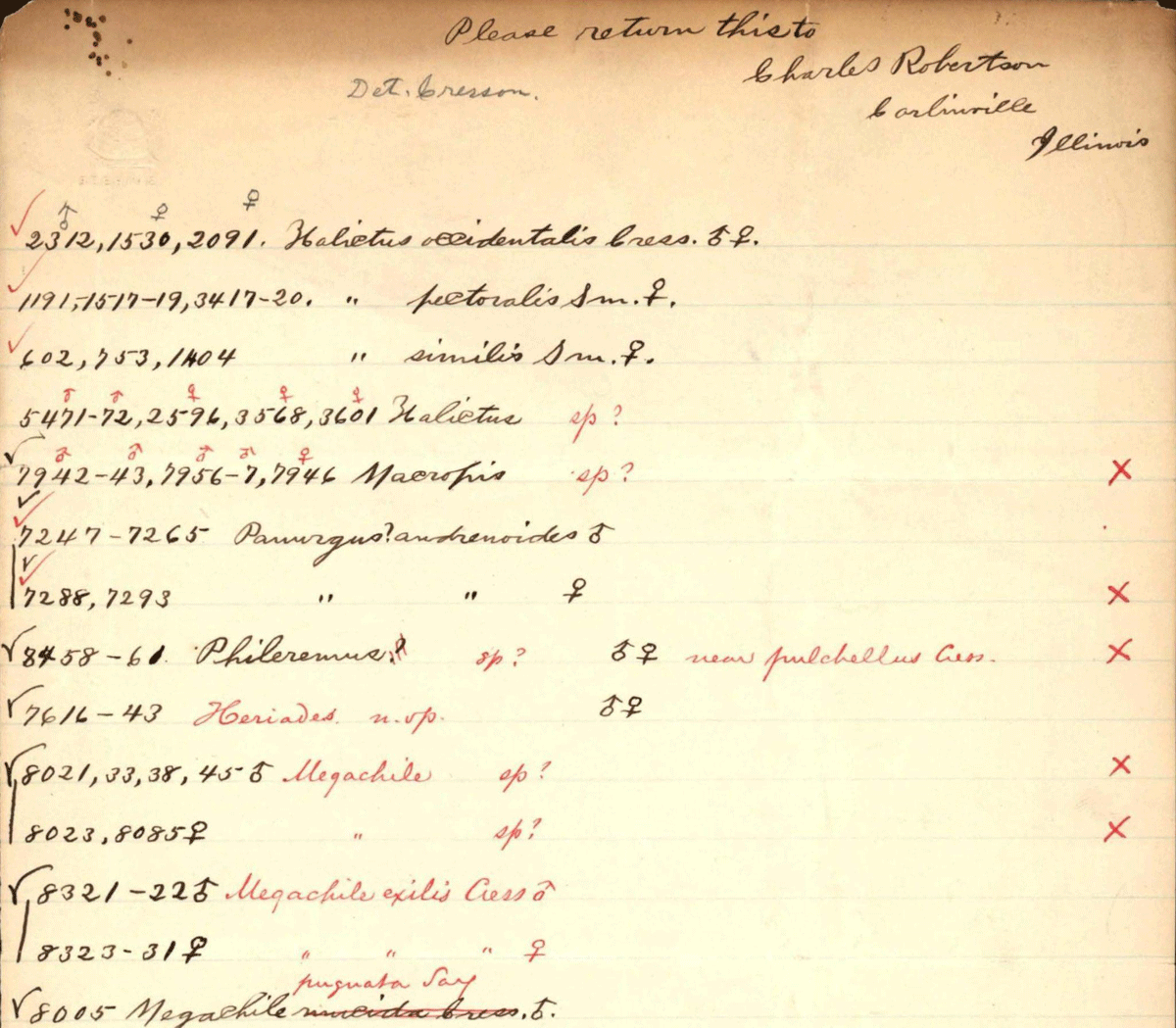
Figure 1
Partial view of a list of specimens with handwriting by Robertson (black ink and pencil) and E. T. Cresson (red ink). Charles Robertson Papers, Box 1, Folder: General Correspondence, Record series 43/5/21, University of Illinois Archives.
The collection is limited to the topic of insect specimens and primarily contains the correspondence Robertson received. He apparently retained very few copies or drafts of the letters he sent (Items 603 and 604 provide the only two examples in this collection). More of his letters may be preserved in the archived papers of his correspondents, but at the time of this writing no digital copies were findable and accessible online. An example of Robertson’s letter writing is available in the papers of botanist George Golding Kennedy (Robertson, 1892). Kennedy wrote to Robertson to inquire about his series of articles on ‘Flowers and Insects’. Robertson’s reply is brief but cordial and includes an offer to send Kennedy a bound copy of his ‘Biological Papers’ for $1.00 once he returned from Florida, where he often visited and worked. Robertson’s focus on his work is in keeping with the correspondence in the University of Illinois Archives, which contains very few allusions to his personal life. It appears that Robertson separated his personal and professional contacts, although it is possible other letters containing personal information were removed before the correspondence was archived.
The Archives acquired Charles Robertson’s papers from the Illinois Natural History Survey (INHS) in 2019, but provenance before then is not fully documented. The INHS likely acquired the materials when they purchased Robertson’s specimen collection from his family in 1940 (Daily Illini, 1940). The correspondence is roughly organized by taxonomic order, but dates and correspondents are jumbled. This disorder is a testament to its utility. The correspondence was not just retained but reused, remixed, and reshuffled as it was mined for details about his specimens. Despite the disorder, the correspondence includes several duplicates and small scraps of paper that could have been easily lost or discarded, suggesting the collection was carefully stewarded by Robertson, his family, and the INHS before it was deposited with the Archives.
Robertson’s process for specimen exchange
The surviving correspondence helps fill some gaps in the record about Robertson’s process for species determination. After assigning specimen identification numbers in his collection log, he typically grouped specimens by order and created lists of those he sent out for determination. Most lists contain specimens from a single order with a taxonomic label at the top, often accompanied by recipient name and date sent. On some lists, Robertson (1928b) dispensed with specimen identification numbers in favor of sequential numbers, a practice he confirmed but did not explain in a brief description of his labeling methods. Robertson sent these lists and specimens to his correspondents, often retaining copies of the lists for himself, as indicated by the presence of annotated and unannotated copies of the same list. His correspondents wrote their determinations on the lists or in letters, and often noted that they retained some of the specimens Robertson had sent.
Although the correspondence does not contain notes on how Robertson packaged his specimens before sending them, an early letter provides some clues. In 1887, E. T. Cresson wrote with determinations for those bee specimens that ‘escaped the wreck’ of the package Robertson sent, noting that the surviving specimens were in good condition due to Robertson’s careful collecting methods and blaming the mail service for the damage (Item 806). For future exchanges, Cresson advised:
‘See that the pins are well secured in the cork, then tie all the boxes together (if more than one) and put them in a larger box with plenty of wool, cotton or soft elastic packing put in, not too tightly, the space between the inner boxes and outer box,’ and send them by Express ‘as mail is too risky’ (Item 806).
Since Cresson was a founding member of The American Entomological Society and was at that time the editor of their Transactions, Robertson likely took his advice to heart (Entomological News, 1926). At any rate, Robertson’s later shipments seem to have been more successful. Subsequent letters do not mention such damage, and in 1919, J. M. Aldrich at the Smithsonian Institution states that Robertson’s specimens arrived in perfect condition (Item 836). Cresson’s letter provides not just practical advice, but some articulation of the methodological detail that was usually not reported in publications at the time because it was either considered to be common knowledge or unimportant.
A series of professional conversations
The archived correspondence represents a series of mostly brief and highly professional exchanges with a wide range of entomological experts over 42 years. The collection includes letters or postcards from 23 correspondents, and five other individuals are represented only by lists of the specimens Robertson sent to them (Table 1). Of the 28 total correspondents, only six corresponded with Robertson for 5 years or more, but even those exchanges contain almost no hint of a personal relationship. Robertson and J. R. Malloch corresponded over a period of 12 years and their most intimate exchange is a 1928 postcard that Malloch closes with, ‘Best wishes to self and Mrs. R.’ (Item 827). The most substantial evidence of a personal relationship comes from S. A. Rohwer who ends a 1918 letter with, ‘I wish to thank you and Mrs. Robertson for your kind hospitality, and wish to assure you that the day I spent in Carlinville will always be a bright spot in my memory’ (Item 514). These two brief statements stand out as rare allusions to Robertson’s personal life in correspondence that is otherwise entirely focused on insects.
Table 1
Robertson’s correspondents. *Acknowledged in Flowers and Insects (Robertson, 1928a).
| CORRESPONDENT NAME | ITEM TYPES | DATE RANGE | DURATION (YEARS) |
|---|---|---|---|
| Aldrich, John Merton (1866–1934)* | letter, list | 1919 | 1 |
| Ashmead, William Harris (1855–1908)* | letter, list | 1892–1901 | 10 |
| Banks, Nathan (1868–1953)* | letter, list | 1919 | 1 |
| Beamer, Raymond Hill (1889–1957) | letter, list | 1927 | 1 |
| Coquillett, Daniel William (1856–1911)* | letter, list | 1891–1901 | 11 |
| Crawford, James Chamberlain (1880–1950)* | letter, list | 1927–1928 | 2 |
| Cresson, Ezra Townsend (1838–1926)* | letter, list | 1887–1888 | 2 |
| Curran, Charles Howard (1894–1972) | letter, list | 1923 | 1 |
| Cushman, Robert Asa (1880–1957)* | letter, list, publication | 1920 | 1 |
| Fox, William Joseph (1872–1947)* | letter, list | 1892–1896 | 5 |
| French, George Hazen (1841–1935)* | list | 1892 | 1 |
| Frost, Charles Albert (1872–1962)* | letter, list | 1919–1921 | 3 |
| Henshaw, Samuel (1852–1941)* | list, postcard | 1888 | 1 |
| Howard, Leland Ossian (1857–1950)* | letter | 1893 | 1 |
| Hungerford, Herbert Barker (1885–1963) | letter | 1927 | 1 |
| Johnson, Charles Willison (1863–1932)* | list | 1895 | 1 |
| Liebeck, Charles K. (1863–1947)* | list | 1896 | 1 |
| Malloch, John Russell (1875–1963)* | letter, postcard | 1917–1928 | 12 |
| McAtee, Waldo Lee (1883–1962) | letter, publication | 1916–1920 | 5 |
| Osborn, Herbert (1856–1954) | list | 1890 | 1 |
| Parker, Ralph R. (1888–1949)* | letter, list | 1919 | 1 |
| Parshley, Howard Madison (1884–1953)* | letter, list | 1919 | 1 |
| Rohwer, Sievert Allen (1887–1951)* | letter, list, publication | 1918–1920 | 3 |
| Sandhouse, Grace Adelbert (1896–1940) | letter | 1925 | 1 |
| Skinner, Henry (1861–1926) | list | 1896 | 1 |
| Townsend, Charles Henry Tyler (1863–1944)* | letter, list, postcard | 1891–1907 | 17 |
| Viereck, Henry Lorenz (1881–1931) | letter | 1905 | 1 |
| Williston, Samuel Wendell (1851–1918)* | letter, list | 1887–1889 | 3 |
Robertson was widely connected within the burgeoning profession of North American entomology, and correspondence with these professionals substantially contributed to his work. All correspondents represented here had a claim to expertise through publications and/or positions with museums, universities, or research institutions. The majority of correspondents (20 of 28) are also acknowledged in the preface of his Flowers and Insects monograph for their assistance with species determination (Robertson 1928a). Of the 24 experts Robertson (1928a) acknowledged in Flowers and Insects, four names do not appear as correspondents in this collection: Arthur Burton Gahan, Theodore Pergande, Charles Arthur Hart, and Phillip Reese Uhler. However, they may have been recipients of any of the several specimen lists lacking a name. Of the eight correspondents Robertson did not acknowledge (Beamer, Curran, Hungerford, McAtee, Osborn, Sandhouse, Skinner, and Viereck), only Curran and Viereck appear to have provided species determinations. The others corresponded with Robertson about the exchange of insects and reference materials, but with no evidence that they identified specimens for him. It is possible that Robertson made a mistake in omitting Curran and Viereck from his acknowledgements, but it is more likely that their determinations were contradicted by another correspondent, a pattern discussed more fully in the next section.
Robertson’s communications with these 28 experts were not only focused on insects but were also apparently brief. Records for most of Robertson’s correspondents are contained to a single year, and many include only one exchange of specimens. He corresponded for at least 10 years with Coquillett, Townsend, Ashmead, and Malloch (Figure 2), but even these communications contain long gaps. His correspondence with Townsend was the longest at 17 years, but with a 13-year gap from 1894 to 1907. This gap was not just an accident of which records survived. Townsend had recently returned to the U.S. from the Philippines and remarked on how surprised Robertson must be to hear from him after so many years (Item 622). Townsend was also Robertson’s most frequent correspondent with 13 letters and postcards, most of which were sent within an 18-month period between 1891 and 1892. However, the frequency of Townsend’s correspondence is less indicative of friendly intimacy and more related to the difficulties of species determination, a challenge that proliferates across the entire collection.
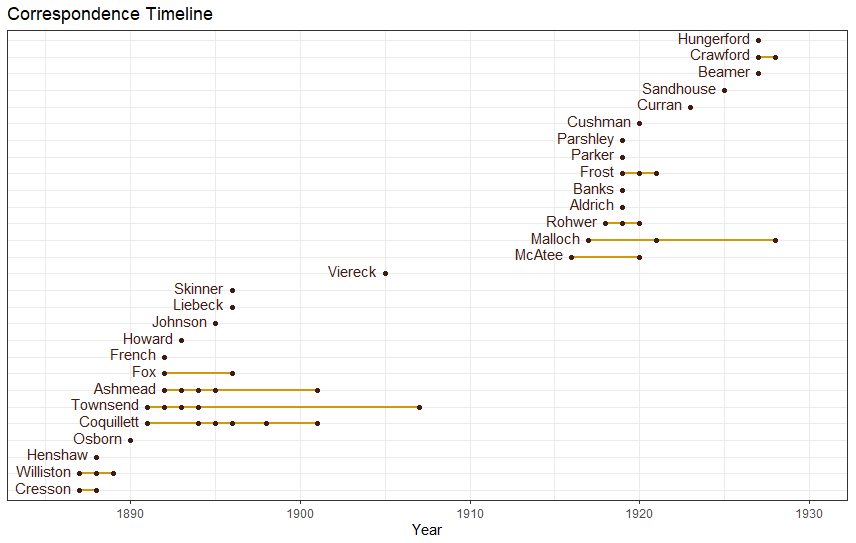
Figure 2
Correspondence timeline. Dots represent years for which there are named and dated correspondence and/or lists of specimens sent. There is a relative lack of records dated between 1901 and 1916. Little is known of Robertson’s life at this time except that he was chair of biology at Blackburn from 1898 through 1909 (Walker, 1911).
The challenges of species determination
The selection of Robertson’s scientific correspondence preserved in the Archives was motivated by the difficulties of matching his specimens with their species. The records reference 3,205 unique specimen numbers, representing approximately 10% of the collection he amassed over his lifetime. These specimens belong to five taxonomic orders, according to Robertson’s labels: Diptera (1712 specimens, 53%), Hymenoptera (1383, 43%), Coleoptera (103, 3%), Hemiptera (12, 0.4%), and Lepidoptera (10, 0.3%) (Figure 3). Robertson reached out for assistance because he could not possibly identify such a wide range of specimens on his own, given an incomplete taxonomic record and without access to an extensive reference collection. Determination must have been a struggle for the experts he consulted as well because many of his specimens were examined by more than one correspondent. Most specimens (75%) were sent to a single correspondent, but 25% were sent to multiple correspondents with some reaching up to five individuals (Figure 4 and Table 2). In some cases, sharing was initiated by the correspondent, particularly in institutional settings with multiple experts working together. In other cases, Robertson deliberately sent out the same specimen multiple times.
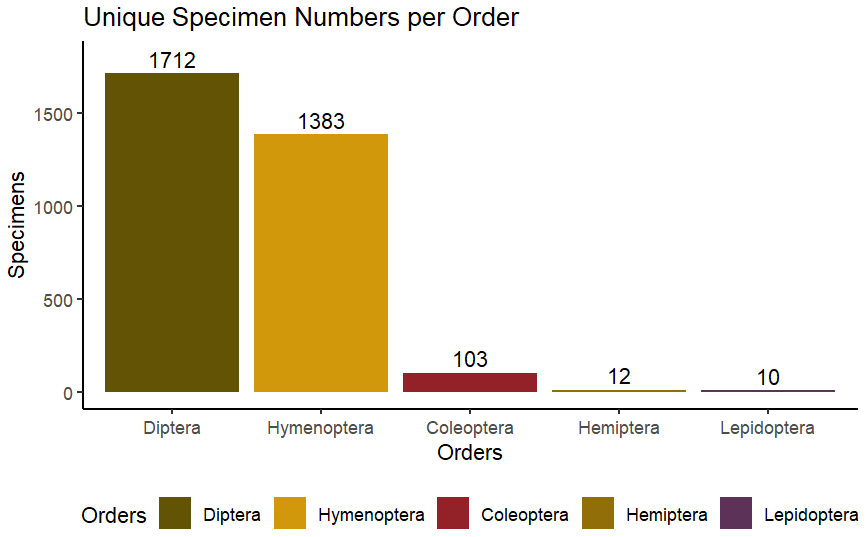
Figure 3
Unique specimen numbers per order.
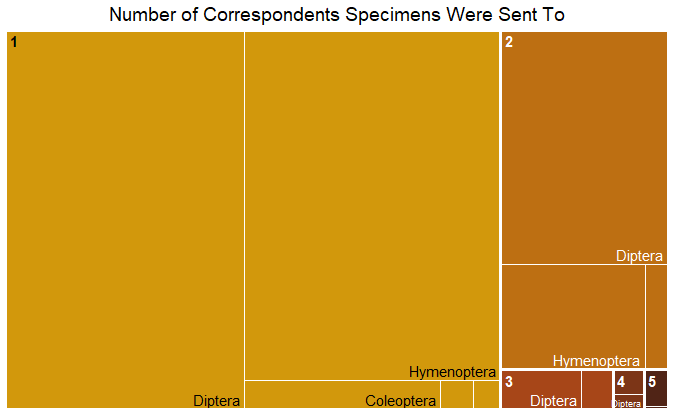
Figure 4
Number of correspondents specimens were sent to. Most specimens (75%) were sent to a single correspondent (square 1), but 25% were sent to two or more correspondents (squares 2–5). Specimens counted by specimen identification number. Specific counts and percentages provided in Table 2.
Table 2
Specimens sent per order. Although the correspondence references 3,205 specimen numbers, 15 of those were assigned to two different orders, bringing the total by order to 3,220. A table of those 15 is provided in the published dataset.
| ORDERS | SENT TO 1 | SENT TO 2 | SENT TO 3 | SENT TO 4 | SENT TO 5 | DISTINCT SPECIMENS | TOTAL SENT |
|---|---|---|---|---|---|---|---|
| Diptera | 1,161 | 503 | 41 | 6 | 1 | 1,712 | 2,319 |
| Hymenoptera | 1,152 | 194 | 16 | 10 | 11 | 1,383 | 1,683 |
| Coleoptera | 72 | 31 | – | – | – | 103 | 134 |
| Hemiptera | 12 | – | – | – | – | 12 | 12 |
| Lepidoptera | 10 | – | – | – | – | 10 | 10 |
| Total | 2,407 | 728 | 57 | 16 | 12 | 3,220 | 4,158 |
| Percentage | 74.75% | 22.61% | 1.77% | 0.50% | 0.37% |
Seeking multiple opinions on the same specimen implies that species determination was challenging, but Robertson and his correspondents also commented on the difficulty directly. Ashmead, Banks, Cresson, Curran, Fox, Frost, Rohwer, and Townsend all provided corrections to or expressed uncertainties about determinations they made for Robertson. Frost called such changes ‘rather vexatious’ (Item 303), and it seems Robertson agreed in principle since he published the fact that he received conflicting determinations for 32 insects (Robertson, 1928a). His private remarks were more pointed. One specimen list, which lacks a correspondent name, contains an annotation from Robertson that reads ‘Erroneous determinations are worse than worthless. All records based on them are false’ (Item 308). His frustration is understandable since correcting erroneous determinations across multiple paper records—logbooks, specimen labels, interaction data, and publication drafts—would have been an administrative burden that detracted from other work.
The difficulty of the enterprise as a whole is underscored by the fact that it took a network of expertise to identify Robertson’s extensive and varied specimen collection. In the entire correspondence collection, there is no evidence that any of Robertson’s 28 correspondents identified insects from multiple orders (Figure 5). Even those correspondents who examined several hundred specimens only focused on a single order. Robertson’s top correspondents, by a wide margin in terms of specimen numbers, were S. W. Williston (890 specimens) and E. T. Cresson (850 specimens), leading experts in Diptera and Hymenoptera respectively. Although he never held a professional position in entomology, Williston was considered a ‘pioneer in dipterology’ and published extensively on the topic (Aldrich, 1918, p. 323). Most of the Diptera Williston identified for Robertson are referenced in typed lists that provide few details about his process. Only one letter from Williston survives, and there likely were not others since he was remembered as a ‘notably poor correspondent’ (Aldrich, 1918, p. 327). Cresson, who for decades held leadership positions in The American Entomological Society and in disciplinary journals, identified a few dozen specimens for Robertson in 1887 and then initiated a larger exchange. After receiving this initial shipment of carefully collected specimens, Cresson asked Robertson to ‘send me all of your bees (except Andrena and Halitcus) and I will go over them, and name such as I can’ (Item 806). Interestingly, both Williston and Cresson worked on large batches of specimens represented by extensive lists but only a few letters.
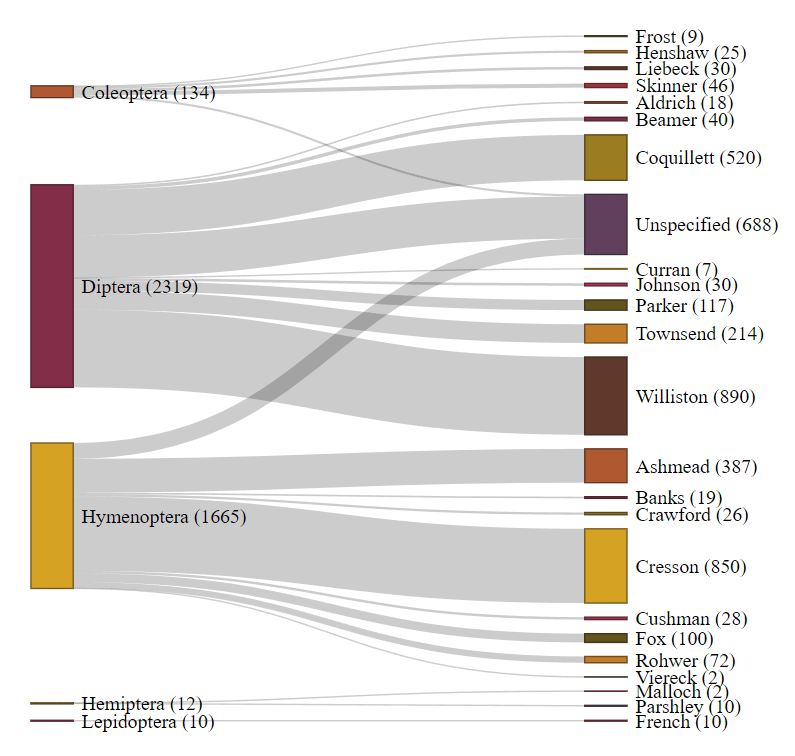
Figure 5
Specimens to correspondents sankey diagram. Totals represent count of specimen numbers. Specimen numbers are counted once per correspondent. Specimens are counted more than once per order if they were sent to multiple correspondents.
These substantial collaborations with Williston and Cresson occurred early in Robertson’s career, as did those with his other major contributors in terms of specimen count. Coquillett (520 specimens), Ashmead (387 specimens), and Townsend (214 specimens) all examined insects for Robertson in the late 1800s. All three were highlighted in the preface to Flowers and Insects for their particularly helpful expertise, but the challenges of species determination continued long into Robertson’s career (Robertson, 1928a). Robertson (1928a) singled out Parker for his work correcting mistaken Sarcophagidae determinations as late as 1920. He also sent out specimens for determination at least as late as 1923 (Items 830 and 831), a full five years after 1918, the latest collection date entered in his specimen logs. After 1923, his correspondence references specimen exchanges, but without determinations. It appears that most of the determination work was completed in the earlier years of his career, with the exception of some particularly challenging specimens that received conflicting determinations.
Discussion
Correspondence was integral to Robertson’s decades-long study of plant–insect interactions. His goal of cataloging interactions between species of insects and flowering plants within a 10-mile radius of his home was too ambitious for one person to complete using only the taxonomic literature, especially since many of the insect species he collected had not yet been described. His rural location also limited his access to the other main reference resource available at that time, the large specimen collections housed at scientific institutions. Naturally, he sought assistance from entomological experts through correspondence. Although he had a reputation for being relatively withdrawn from scientific society, he sought out new correspondents over the course of his career by enlisting in directories for naturalists and entomologists, and he made connections with many leading entomologists of his time. These connections made his landmark study possible by pooling expertise that was distributed across four decades and throughout the U.S. and Canada.
Robertson’s correspondents included a wide variety of experts at universities, museums, and scientific institutions, and he sent these contacts more than 3,000 insect specimens. His archived correspondence is largely impersonal and focuses on species determinations, a collaborative process primarily recorded in the extensive specimen lists his correspondents annotated and returned. With so many insect species not yet described in the literature, this process was often fraught. Many of his correspondents expressed uncertainties about or provided corrections to their own work. Analysis of the collection as a whole reveals that a quarter of the specimens Robertson sent out needed to be examined by multiple experts, many of whom provided conflicting determinations. Though complex and often vexatious, this collaborative effort substantially contributed to Flowers and Insects, the culmination of Robertson’s pollinator network study, which has enduring scientific value.
Although the correspondence stretches across 42 years from 1887 to 1928, it appears that the bulk of the determinations were completed before 1900 by Williston, Cresson, Coquillett, Ashmead, and Townsend. The vast majority of the specimens sent out for determination belonged to the Diptera or Hymenoptera orders, and specialization by order was the rule. Robertson made a practice of limiting shipments to a single order, and all of his correspondents worked with only one order, even those entomologists who received several hundred specimens. This siloing of expertise helps explain why Robertson’s work required such a prolonged series of brief, professional exchanges. His specimen collection was too diverse for any one person, or even a small group, to analyze.
While the correspondence reveals patterns in how this specimen determination work was conducted, the collection has inherent limitations. Without clear provenance records, the completeness of the materials is uncertain, and several of Robertson’s specimen lists lack a date and/or correspondent name. Patterns emerged, but the unnamed, undated specimen lists could change the timeline or the relative contributions of his collaborators. Fortunately, the specimen identification numbers Robertson used are overwhelmingly clear and consistent, even when the handwriting is otherwise difficult to interpret. It is therefore possible to track individual specimens across the collection, even in records where dates, places, or names are muddled. By linking specimen numbers to names, dates, and items, the dataset also reveals provenance information for thousands of Robertson’s specimens and, in many cases, makes it possible to identify the scientists who provided determinations for them. Specimen analysis illuminated the labors of Robertson’s correspondents much more definitively than the number, length, or text of their communications. This suggests that, for scientific correspondence about specimen exchange, specimens should be considered alongside the length and frequency of communications when measuring the strength of connections. Indeed, in Robertson’s surviving correspondence, the specimens are truly the stars of the show. The records reveal rare glimpses of the corresponding entomologists who were almost entirely focused on the insects they studied.
In the future, we intend to delve deeper into the entomologists behind the insects to further illuminate Robertson’s network of collaborators. We plan to conduct a network analysis to explore connections within the group represented in this correspondence. Since the archival records reveal few details about the correspondents themselves, further historical research will be required to give context and meaning to these connections.
Conclusion
Charles Robertson’s archived correspondence records his quest for information not available in the literature. Filling in those gaps was deeply challenging. It not only motivated this collected correspondence, it also helped define Robertson’s scientific legacy. Over the course of his career, he described hundreds of bee species, an endeavor driven entirely by information deficiencies and not by personal interest, as he explains in Flowers and Insects:
‘On account of the impossibility of getting all of the bees identified it was necessary to describe the new species and match the sexes, thus making a digression which interrupted the study and involved an intrusion into a field which there was no inclination to cultivate’ (Robertson, 1928a, p. 4).
Robertson’s information challenges stemmed from the fact that entomology was a young field with much yet to be recorded. Scientists reusing his work today contend with a different kind of information challenge, one stemming from differences in scientific practices then and now. Robertson focused on the flowers and insects in his field of study and published very little about how he conducted his investigations. Without a coherent record of his process, scientists are forced to stitch together scattered pieces of information to understand and build upon his work. Robertson’s archived correspondence fills in some of the gaps. His surviving letters and specimen lists clarify the contributions of his many collaborators and provide insights into the timing and difficulties of his species determination work.
Contending with information gaps takes valuable time and resources, and as reuse of Robertson’s work shows, it may be impossible to anticipate which details will be required for future research. To reduce the risk of creating new gaps and to keep our findings connected to their original context, we created detailed indexes linking items, correspondents, and specimens in our dataset to specific pages in the digitized correspondence. These links make the full correspondence records more accessible and navigable, inviting others to make further discoveries about Robertson, his collaborators, and the insects they studied.
Acknowledgements
We would like to thank John Marlin for stewarding these materials at the INHS and providing context about Robertson’s work, Jeremy McAninch of Blackburn College for his assistance in locating additional Robertson materials held by the Blackburn College archives, Tommy McElrath for his guidance on historic entomological taxonomies, and Heidi Imker for her insightful comments on an early draft of the manuscript.
Author Contributions
All authors conceptualized the project, collected the data, and reviewed and approved the final manuscript. Sandi Caldrone led the writing process, and cleaned, curated, analyzed, and visualized the data. Marcella Lees did initial data collection and assisted with the writing process. Bethany Anderson took the lead in writing the grant proposal to secure funding for this project, organized team research meetings, and researched and wrote portions of the paper.
Author Information
Sandi Caldrone is the Research Data Librarian and Assistant Professor in the University Library at the University of Illinois Urbana-Champaign. She holds a bachelor and master of arts in anthropology from Northern Illinois University and a master of science in library and information science from the University of Illinois Urbana-Champaign. Her research focuses on the curation and rehabilitation of historical data for practical reuse.
Marcella Lees is the Digital Archivist at the Art Institute of Chicago Archives. She holds a master of science in library and information science from the University of Illinois Urbana-Champaign and a bachelor of arts in history from Carleton College. Her research focuses on digital archives, digital preservation, and archives accessibility.
Bethany G. Anderson is the Natural and Applied Sciences Archivist and Associate Professor in the University Archives at the University of Illinois Urbana-Champaign. Her research focuses on the history of anthropology, cybernetics, scientific archives, and women and gender in science. She holds a bachelor of arts in anthropology from the University of Michigan, a master of arts in Near Eastern art and archaeology from the University of Chicago, and a master of science in information studies from the University of Texas at Austin.