
1. Introduction
Since their inception, the FAIR (findable, accessible, interoperable, reusable) principles have gained substantial traction across data repositories (Wilkinson et al., 2016; Digital Science et al., 2026). However, interpretations as to how the principles should be implemented for individual repositories vary (Wittenburg, 2018; Jacobsen et al., 2020). Since 2018, GO FAIR US has sought to streamline the assessment of repositories’ ‘FAIRness’, i.e., the degree to which they adhere to the FAIR principles. In this paper, we introduce the ‘Work Plan’, a resource for documenting tailored strategies to improve repositories’ FAIRness. Work Plans align with GO FAIR US’s ‘data landscaping’ work—efforts supporting FAIR data ecosystems at the National Institute of Allergy and Infectious Diseases (NIAID, 2024).
Work Plans are key deliverables of tailored FAIRness assessments. They capture (i) the FAIR assessment team’s understanding of a repository’s approach to FAIR implementation, based on evidence gathered during the assessment process, and (ii) a set of prioritized strategies for improving the repository’s FAIRness for itself and for the data ecosystem in which it is situated, thereby improving the impact of scientific data.
This paper focuses on the assessment of unique repositories, or ‘target repositories’, with some discussion of their role within broader ‘data ecosystems’. The assessment process is delivered by a ‘FAIR assessment team’ made up of (i) independent experts from GO FAIR US and (ii) a range of stakeholders of the target repository representing four personas: program officers or managers, staff with technical or service responsibilities, users contributing data, and users downloading data (Hoebelheinrich et al., 2025). This diversity of input ensures a keen understanding of how the target repository operates, elucidating gaps between stated goals and practices, and their actual services, tools, and infrastructure. The result of this gap analysis is an actionable Work Plan.
Work Plans prompt and frame discussions with a repository’s stakeholders to achieve the following:
Identify opportunities to enhance FAIRness given the repository’s own goals;
Explain the relationships between the repository’s architectural and implementation choices, its FAIRness, and the experiences of its users;
Improve users’ ability to produce impactful science; and
Enable a more interoperable and impactful data ecosystem to which the repository contributes.
This paper is structured as follows. Section 2 describes the motivations for and process of co-creating a Work Plan with stakeholders of the target repository, including key findings from previous implementations, and theoretical foundations. Section 3 presents the entire Work Plan, for which a template is provided (Appendix II). Section 4 discusses GO FAIR US’s approach to development and communication tactics that can be used to present an implementable Work Plan in real-world settings.
2. Work Plan Methodology
2.1. Background work
Work Plans represent the culmination of a FAIR assessment following the persona-specific methodology of Hoebelheinrich et al. (2025). The assessment process, depicted in Figure 1, is initiated upon the request of the target repository or its funders, and begins with the development of the target repository’s ‘profile’, which contains basic summary information (e.g., repository name, organizational context, and scientific domain), and detailed FAIR-related information (e.g., metadata standards, ontologies, and curation services). Profile information is gathered from publicly available sources, including repository websites and relevant literature that describes a specific repository’s mission, infrastructure, and services.
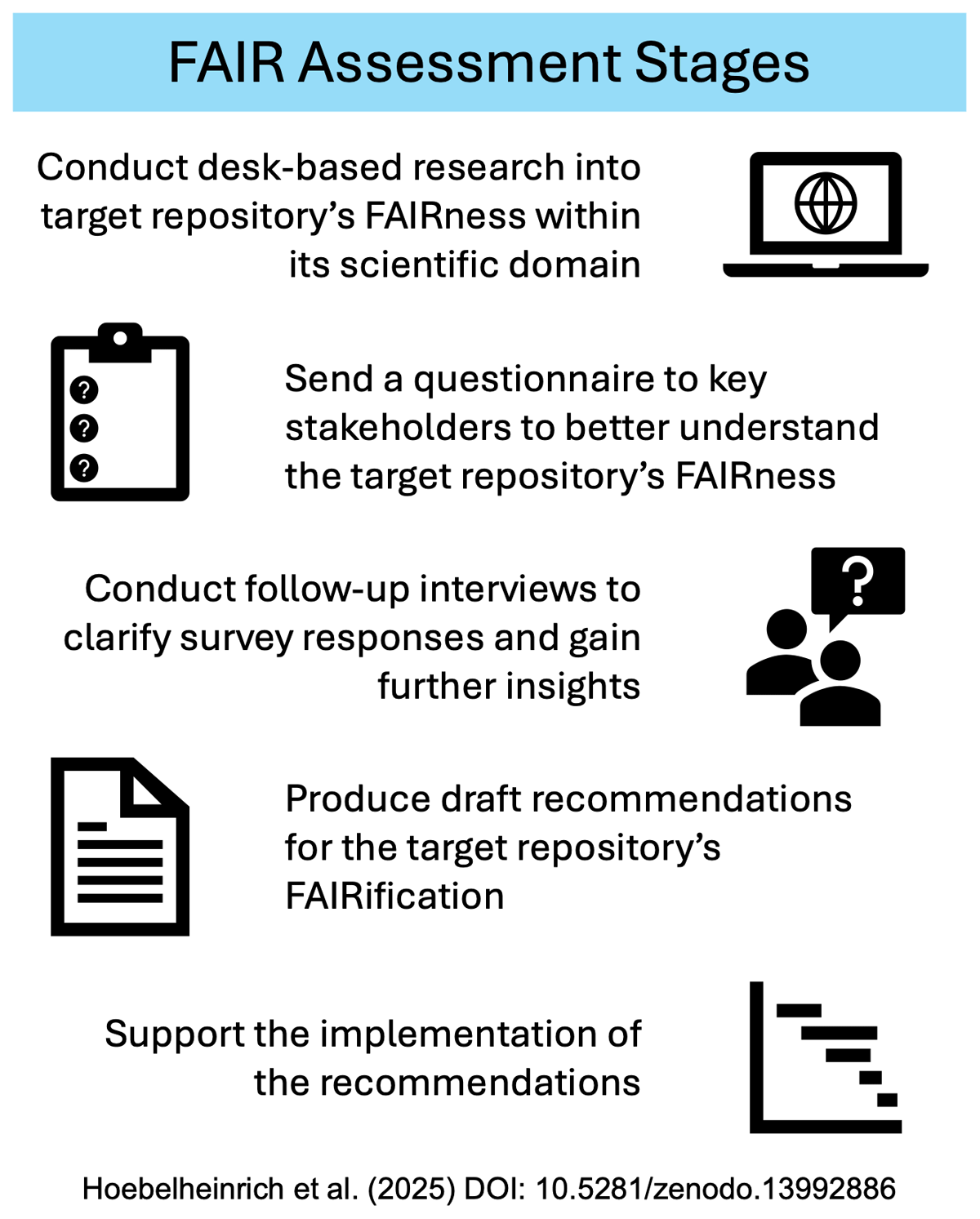
Figure 1
The five stages of the persona-specific methodology for FAIR assessments.
The FAIR assessment team then gathers data through a questionnaire (see Appendix I) to obtain a comprehensive overview of a repository’s practices and stakeholders’ roles. Follow-up interviews with repository stakeholders are arranged to reach a deeper understanding of key technical aspects of practice and implementation approaches related to each of the FAIR principles, and to identify and discuss repository goals and needs.
With this, the FAIR assessment team develops a detailed understanding of the target repository’s system, data architecture, operational processes, and subsequently its FAIR maturity level (Bahim et al., 2020) as an organization within a broader data ecosystem.
2.2. Iteration and validation
The effectiveness of a Work Plan depends on its ability to accurately reflect repository-specific characteristics and incorporate the perspectives of the stakeholders who will ultimately implement the recommendations. This is achieved by iterative communication between the FAIR assessment and repository teams, thus allowing a Work Plan to evolve through two discernible stages: a Preliminary Work Plan, and a Final Work Plan (Appendix II contains a template).
A Preliminary Work Plan contains potential strategies and tasks with dependencies when applicable. Although it incorporates goals gleaned through profile and stakeholder engagement exercises, the FAIR assessment team does not presume to know which strategies and tasks are best for the repository. Rather, the FAIR-enhancing tasks are presented as menu items from which the repository can select its favored work. The FAIR assessment team then seeks feedback from repository stakeholders who know the repository’s focus, mission, and goals. Feedback may be on the relevance, accuracy, and completeness of content; on prioritization of recommendations; and on clarity of communication.
After input is received, subsequent discussions with relevant repository and data ecosystem leadership clarify and refine the recommendations within the Preliminary Work Plan. These discussions ultimately evaluate and validate a given Work Plan. The process results in a Final Work Plan, which the repository can use to guide practicable implementation strategies and funding requests. Final Work Plans also establish specific support options that the FAIR assessment team may provide, with a focus on relevant use cases, and technological solutions. The Final Work Plan is agreed upon by the FAIR assessment team and the repository’s leadership.
2.3. Theoretical foundations
It is important to acknowledge the great variety of assessment models and metrics for measuring FAIRness, including automated solutions. This variety is tackled by Hoebelheinrich et al. (2025) when setting out GO FAIR US’s persona-specific methodology for FAIR assessments. It is worth mentioning Peng et al.’s (2024) meta-analysis of FAIR assessment methodologies, which led to their proposal of the FAIRness quality maturity matrix (FAIR-QMM), as illustrated in Figure 2.
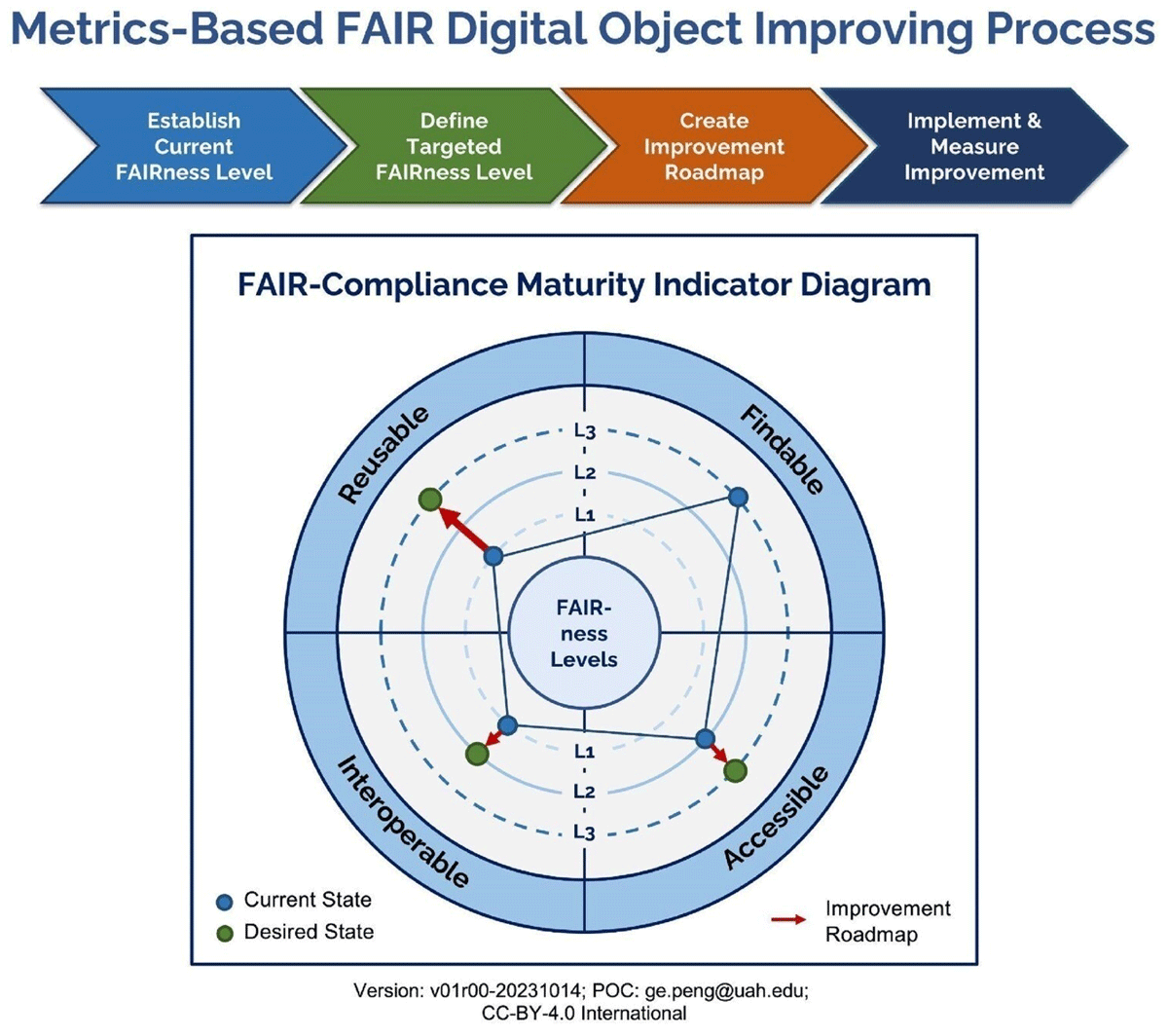
Figure 2
FAIR-compliance maturity indicator diagram.
While the FAIR-QMM focuses on FAIRness at the digital object level, we have extrapolated it to the repository level, which also helps assess repositories within distributed data ecosystems. Further discussion about the value of framing FAIRness as a question of maturity is provided in Section 4.1. Table 1 shows how GO FAIR US’s approach extends the FAIR-QMM.
Table 1
How GO FAIR US’s Assessment Methodology mirrors the FAIR-QMM.
| METRICS-BASED FAIR DIGITAL OBJECT IMPROVEMENT PROCESS | GO FAIR US ASSESSMENT METHODOLOGY |
|---|---|
| Establish current FAIRness level | Using the persona-based methodology, describe and document what a target repository is doing to implement the FAIR principles |
| Define targeted FAIRness level | Based on the findings from the persona-based methodology, develop a Preliminary Work Plan |
| Create improvement roadmap | Seed the Preliminary Work Plan with tasks associated with one or more of the five Work Plan strategic areas; work with the target repository and its stakeholders to choose, prioritize, and plan to implement the strategic choices |
| Implement and measure improvement | Complete the assessment process by finalizing the target repository’s Work Plan and identify the vision for and measurement of successful achievement of the target repository’s goals |
3. Work Plan Components
This section introduces the Generic Work Plan template’s sections and work categories.
3.1. Document Status and Work Plan Summary
The first two subsections of the Work Plan provide information about the Work Plan: Document Status and Work Plan Summary. The former provides version control, and the latter contains contact details for both the FAIR assessment team and the target repository.
3.2. Work Categories
The ‘Work Categories’ section introduces the five strategic areas used to organize the subsequent ‘Detailed Strategies’ section. The Work Categories are listed in Figure 3 and detailed below.
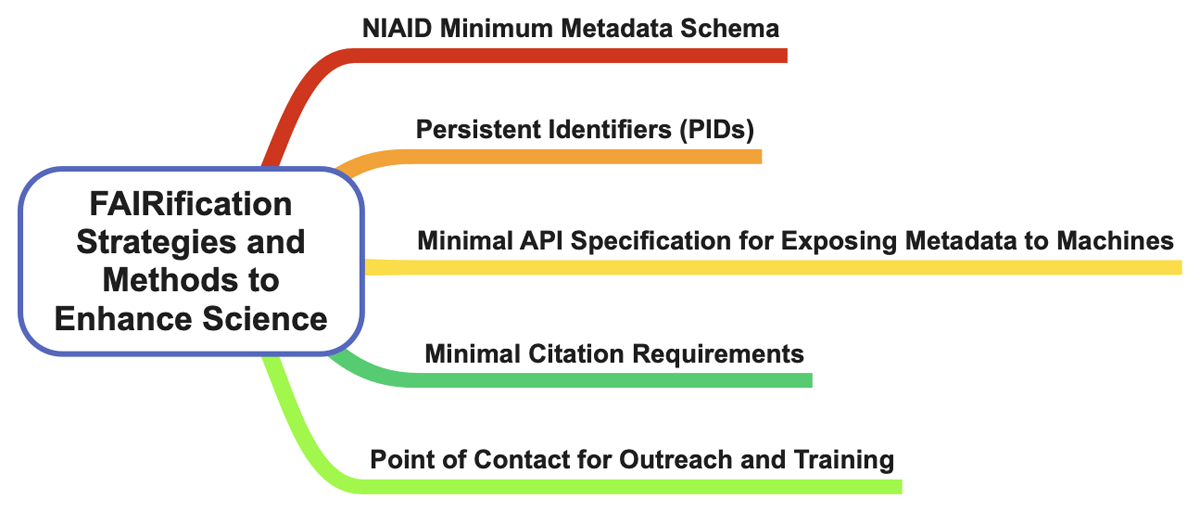
Figure 3
FAIRification strategies and methods to enhance science.
Persistent Identifier (PID) Strategies promote the use of globally unique, persistent, and resolvable identifiers (GUPRIs) (Juty et al., 2020). ‘Globally unique’ means the identifier is a specific name for the artefact at hand. ‘Persistent’ indicates that the identifier need not change due to updated infrastructures or dependencies. ‘Resolvable’ indicates that the identifier can be accessed via standard web protocols. Together, these features increase the long-term value of the identified data and metadata to scientific researchers. An example PID Strategy is: ‘Implement PIDs for people, organizations, and controlled vocabulary terms that can be used for attribution or other authoritative information.’
Metadata Strategies promote the use of structured, standardized descriptions of digital research artefacts. Well-designed metadata enables data discovery, understanding of the context in which data is being used or generated, and data reuse for validation and new scientific discoveries (Data Science Dispatch, 2025). An example Metadata Strategy is: ‘Share domain-centric approaches used that other domain repositories or data contributors can support or adopt, e.g., by identifying specific metadata schemes, controlled vocabularies, and data formats.’
Community Development Strategies address how research communities work together, understand and define disciplinary and transdisciplinary needs, and ensure their objectives are well met. Indeed, community-driven approaches can play a significant role in promoting open science and improving data science practices (Armeni et al., 2021). These strategies enhance scientific cooperation within and across communities and domains. An example Community Development Strategy is: ‘Modify existing data sharing and data use agreements, or citation guidelines to add recommendations that will facilitate the creation of citations for key entities such as datasets or studies.’
Architectural Strategies provide technical structures that support functions related to data and metadata, such as their storage, discovery, retrieval, aggregation, and interoperability with both internal and external systems. Ideally, architectures enable FAIRification workflows associated with such functions, and allow various views of the data and the transfer of data from original sources to re-users. An example Architectural Strategy is: ‘Transform metadata into interoperable formats that can be harvested by other repositories or services (e.g., JSON-LD), and expose it through an OpenAPI-compatible application program interface.’ For discussion of a workflow for health data that includes an example architectural strategy, see Sinaci et al. (2020).
‘Carpe Diem’ Strategies emphasize additional context-specific actions undertaken when opportunities arise due to grant funding, staff availability, or the redevelopment of tools and services. ‘Carpe Diem’ Strategies can simplify the implementation of effective data services and streamline tools for users. ‘Carpe Diem’ Strategies are tailored to a repository’s circumstances but can also identify opportunities to work with other repositories within a given data ecosystem. An example ‘Carpe Diem’ Strategy is ensuring users’ knowledge of the persistence strategy of the target repository by means of a preservation statement available on the repository’s website, or by gaining CoreTrustSeal (n.d.) certification.
3.3. Detailed strategies
This section captures the strategies co-developed by the FAIR assessment team and the target repository’s stakeholders. It builds on preceding sections and provides specific recommendations that can be included in a Work Plan. Not all Work Plan strategies, categories, or tasks are expected to be included in every Work Plan; rather, selections are made based on relevance to the target repository’s context and priorities. Acceptance of the priority level assigned to each recommendation depends upon several factors, including the target repository’s capabilities for implementing each suggested change, and the value for repository users.
The excerpt from the Work Plan template in Table 2 illustrates how the FAIR assessment team could evaluate the implementation of a PID Strategy, noting that some improvements could be made in the target repository’s approach to presenting citation preferences for their datasets. In the example, the team ascertains that only Tasks C, D, and E are relevant for improving the target repository because Tasks A and B are already accomplished, but those tasks could be completed to better achieve FAIR principles F1, F2, and F4. Thus, the indications of effort for Tasks C, D, and E are higher and larger in scope, but the benefits would presumably be greater as well.
Table 2
Sample PID Strategy sections from the Generic Work Plan template.
| ITEM # | PRIORITY | FAIRIFICATION TASK DESCRIPTION | EXPECTED OUTCOME | FAIR PRINCIPLE | METRICS | DEPENDENCIES, RESOURCES REQUIRED, AND NOTES |
|---|---|---|---|---|---|---|
| 1 | PID Implementation Strategies These strategies focus on identifying the data and metadata artifacts, and their component entities, using identifiers that are globally unique, persistent, resolvable in a browser for humans or computers, and citable in documentation and publications. All of these features increase the value of the underlying data and metadata to scientific researchers, and to anyone else who wants to explore or work with the resulting resources. | |||||
| […] | ||||||
| 1.4 | High: A, B Medium: C, D, E | PID Strategy: Dataset Citation (A) Present to submitters the format and use of citation strings for datasets and data files (using corresponding identifiers) in addition to publications. (B) Publish the citation strings on the site for each dataset. (C) Identify datasets in the best way possible, and report results to data providers and repository managers (D) Add citation information to presented information in the repository. (E) Evaluate the prospects of adding dataset identifier/citation fields to relevant data portals and clinicaltrials.gov. | Increased familiarity with, adoption of, and respect for data citations; increased visibility of dataset reuse. | F1, F2, F4 | 1) Number of citations of repository’s citation identifiers 2) Number of other references to repository’s dataset citations 3) Altmetrics value for repository’s datasets | Effort:  Dependencies: - Notes: - Data citation and identification strategies can work hand-in-hand. - GO FAIR US can suggest best options for citation strings for the repository. - GO FAIR US could offer tracking strategies to detect dataset citations of all of the repository’s datasets. This is a large-scope item but would have benefits across many repositories. |
One lower-effort example is the Community Development Strategy: ‘Assess Strategies for Expanding Domain Researcher Data Sharing and Reuse’ (Table 3, item 3.1). This example shows that the first three tasks associated with this strategy have higher priority than the last two, but all of them together would take minimal effort to address FAIR principles F4 and I1.
Table 3
Sample Community Assessment Strategies section from the Generic Work Plan template.
| ITEM # | PRIORITY | FAIRIFICATION TASK DESCRIPTION | EXPECTED OUTCOME | FAIR PRINCIPLE | METRICS | DEPENDENCIES, RESOURCES REQUIRED, AND NOTES |
|---|---|---|---|---|---|---|
| Community and Assessment Strategies These strategies explicitly address the ability of research communities to work together, to understand and define their own discipline’s needs and any transdisciplinary needs, and to ensure their community’s objectives are well met. When these strategies are implemented, scientific cooperation within specific communities or domains and across domains can be enhanced while making the sharing process more efficient and effective. | ||||||
| 3.1 | High: A, B, C Medium: D, E | Assess Strategies for Expanding Domain Researcher Data Sharing and Reuse (A) Assess existing data sharing and data use agreements to determine whether recommendations can be included that will allow the creation of citations for datasets. (B) Solicit feedback from research data submitters or re-users on their experiences with the repository for purposes of assessing and improving submission and download workflows. (C) Assess whether there are other places on the repository’s public web pages where examples of recommended formats for citing published outputs from use and reuse of the datasets can be displayed prominently. (D) Consider adding information about the repository to repository registries such as fairsharing and SciCrunch to expand awareness of the repository and its data. (E) Assess whether more data usage metrics can be added to the download functions or to associated search methods. | Increased awareness of the repository’s existence, with improvement in both dataset downloads and uploads (sharing). | F4, I1 | Measure impacts on data usage statistics of expanded sharing of information about the data collections within the repository (e.g., increased number of citations, altmetrics) For a given modification or set of modifications: 1) Percentage change in citations 2) Percentage change in altmetrics 3) Percentage change in visits to relevant page type 4) Percentage change in user access requests | Effort:  Dependencies: - GO FAIR US staff time Notes: - These strategies more broadly evaluate project-specific opportunities for improving data sharing and reuse, with GO FAIR US team members providing significant analytical support. - Each strategy pursues targeted improvements, at relatively low cost. |
4. Discussion
This section introduces reflections on the development and communication tactics used to further the FAIRification of a distributed data ecosystem.
4.1. From FAIRness assessment to FAIR maturity
When implementing the FAIR principles, choices made by a single repository often affect other repositories in its data ecosystem. Recognition of this reality sometimes results in repositories making choices from a spirit of comparison, and even competition, especially when funding is needed for changes to a repository’s strategies for improved FAIRness. What we and project funders found most productive was the assessment of repositories’ FAIR maturity within ecosystems.
The concept of FAIR maturity was introduced and described in the seminal work of the Research Data Alliance (RDA) FAIR Data Maturity Model Working Group (Bahim et al., 2020). The RDA Working Group defined data maturity indicators that were applied to data and metadata, and assigned three levels of priority: essential, important, and useful. While the concept has only recently been applied to organizational self-assessment, e.g., as a FAIR Maturity Matrix for the life sciences (Pistoia Alliance, 2025), FAIR maturity for organizations within data ecosystems offers language that downplays competitive approaches and injects the idea of collaborative change that can impact not only a single repository but the broader data ecosystem. The collaborative spirit of the FAIR maturity approach is similar to that of GO FAIR US, where improving FAIRness involves greater findability and reuse of the data managed and offered by a combination of repositories, services, and tools within a data ecosystem.
GO FAIR US has also developed the FAIR Implementation Profile (FIP) to make a target repository’s FAIR maturity more measurable (GO FAIR, n.d.). A FIP is a machine-actionable profile that describes the implementation choices made by the target repository. Said implementation choices may be further described by being registered as FAIR Enabling Resources (FAIR Connect, n.d.).
4.2. Tailoring communications
In the process of gathering information from target repositories and turning that information into Preliminary and Final Work Plans, we have found it useful to tailor communications to each repository.
4.2.1 Understanding approaches to digital objects
While developing customized Work Plans for target repositories, GO FAIR US has had to take into account how repositories delineate the digital objects they collect differently, and the impact of this on FAIR implementation choices. For example, when looking at biomedical life science data repositories, we found a different understanding of fundamental concepts related to data versus metadata for digital objects. The variety of different digital object types—often composed of digital entities that may themselves benefit from descriptive metadata for purposes of citation, provenance, or reuse—may not lend itself easily to the typical FAIR-related considerations. Questions that arose included the following: what are the digital entities that should have metadata within an aggregation of clinical data which forms the base data of the output from an analytical tool? (See Graybeal et al., 2025.) What metadata is needed to find and reuse that aggregation in the target repository? What metadata is needed to compare aggregations that could either affirm or extend study results? The answers to these questions depend on what target repository data generators and re-users need to do their research and are reflected in the choices made for the infrastructure and services of the target repository. When conducting assessments, we found it important to weigh these differences and choices carefully, helping to produce more tailored recommendations.
4.2.2 Opportunity or compliance?
While most repositories have some notion of what the FAIR principles are, their implementation choices may have different motivations. On the one hand, FAIRification efforts may be deemed an issue of compliance with requirements set by repository funders and leadership. On the other hand, FAIRification strategies may be deemed an opportunity to extend the infrastructure and services provided to data users. Each perspective is legitimate, but a target repository’s motivations have implications for how FAIRification efforts are communicated. Without careful communication, it is more difficult to tailor recommendations with buy-in from data ecosystem leadership.
Refraining from being rigid FAIR ‘evangelists’ promotes more productive collaboration. We needed to continually remind ourselves that there are many ways to strive for adherence to the FAIR principles. We also needed to remember that each of the target repositories was passionate about the generation and sharing of impactful science in their domain. This was reflected in their relationship with the FAIR principles and Work Plans, i.e., FAIRification tasks that aligned closely with their scientific priorities were more interesting than pursuing FAIRness per se.
Recognizing the differences in notions of FAIR compliance versus FAIR opportunity has proven to be pivotal in moving FAIR implementation forward for the broader data ecosystem that we analyzed. The differences in approach reflect those who expect their leadership to make strong recommendations for repositories to achieve compliance with the FAIR principles, versus those who prefer the provision of opportunities to achieve a higher level of FAIR maturity within or across repositories’ infrastructures and services.
Partway through the analysis phase of the landscaping project, the funding organization made a decision to take what GO FAIR US had presented from a representative sample of target repositories within the data ecosystem, and create a list of recommendations (Mayer et al., 2025). The recommendations were organized into five areas designed to facilitate better discovery, sharing, and reuse of the data within the ecosystem’s purview. Although the recommendations are easily aligned with the FAIR principles, their focus and stated impetus directly address the broader goal of increasing the impact of scientific products generated, curated, and managed by the ecosystem’s users and staff. This nuanced approach balances both the compliance and opportunities perspectives, offering a means to adjust scoping for the repositories’ different kinds of funding opportunity. More in-depth information about the specific context and content of the recommendations is out of scope for this paper. Additional papers may be forthcoming as the project continues.
5. Conclusion
We have introduced the Work Plan, a practical method for comprehensively documenting repositories’ FAIRification strategies. The strategies address five areas: PIDs, metadata, community development, architecture, and opportunity considerations. The Work Plan is the culmination of the initial phase of a ‘persona-based’ framework for assessing the FAIRness of repositories. The persona-based framework helps tailor Work Plans which account for the real-world limitations faced by repository funders, managers, and developers.
The Work Plan is a powerful decision-making and prioritization tool. While the task of increasing any repository’s FAIRness is always limited by resource constraints, the Work Plan helps catalog and weigh different options.
We have also introduced lessons from deploying Work Plans, including their value in eliciting thoughtful reflections from evaluated repositories, prompting further collaboration, and improving cohesion between FAIR assessment teams, repositories, and their data ecosystems. In the context of such ecosystems, Work Plans provided the structural basis to build a broad set of recommendations that could be released as community guidance.
Additional File
The additional file for this article can be found as follows:
Appendices
FAIRification and data landscape pre-interview questionnaires, and Generic Work Plan Template. DOI: https://doi.org/10.5334/dsj-2026-025.s1
Acknowledgements
We are grateful to the wider GO FAIR US team who are contributing to this project: John Graybeal, Alyssa Arce, Kevin Coakley, Doug Fils, Keith Maull, Matt Mayernik, Bert Meerman, and Barend Mons.
We acknowledge the strategic guidance and feedback provided by Reed S. Shabman and Wilbert Van Panhuis in the Office of Data Science and Emerging Technologies (ODSET) at the National Institute of Allergy and Infectious Diseases (NIAID). This material is based upon work supported by the Frederick National Laboratory for Cancer Research operated by Leidos Biomedical Research, Inc. under contract number 75N91020F00022. Any opinions, findings, and conclusions or recommendations expressed in this material are those of the author(s) and do not necessarily reflect the views of the Frederick National Laboratory for Cancer Research, Leidos Biomedical Research, Inc., or NIAID.
Additionally, development of the Work Plan concept relied on work with NIAID repositories. We are grateful to all of the repository staff, primary investigators, and NIAID staff supporting these repositories whose participation in interviews and work plan reviews allowed us to fine-tune these methods. This includes repository staff from Access Clinical Data@ NIAID, TB Portals, Immune Epitope Database and Analysis Resource, ImmuneSpace, ImmPort, and ITN Trialshare.
Repository participation in this project has no impact on current or future funding from NIAID or NIH. Further, no material in this publication represents funding requirements for NIH/NIAID-funded repositories or future funding applications.
Author Contributions
Nancy J. Hoebelheinrich: conceptualization, writing—original draft, writing—review & editing; Ismael Kherroubi Garcia: writing—original draft, writing—review & editing; Christopher Erdmann: writing—review & editing; Julianne Christopher: conceptualization, project administration, writing—review & editing; Lisa M. Mayer: writing—review & editing; Darya Pokutnaya: writing—review & editing; Christine Kirkpatrick: conceptualization, project administration, writing—review & editing.