
Table 1
The PRIMAD model for reproducibility in a computational experiment; each reproducibility label is associated with its gain and the way of achieving it. What dimensions will change are represented by the dark-coloured cells, what could possibly change are represented by the light-coloured ones, and what will not change are the non-coloured cells (adapted and extended from Freire, Fuhr and Rauber (2016)). The original table has been updated with new gains and labels, which are highlighted in underlined text to clearly distinguish the additions.
| Label: Repeat | ||||||
| Platform | Research Objective | Implementation | Method | Actor | Data (Raw) | Data (Parameter) |
| Gain: Consistency across Trials, Determinism | ||||||
| Label: Port, Relocate | ||||||
| Platform | Research Objective | Implementation | Method | Actor | Data (Raw) | Data (Parameter) |
| Gain: Cross-Platform Compatibility (Portability), Minimal Dependency (Flexibility) | ||||||
| Label: Reuse/Repurpose | ||||||
| Platform | Research Objective | Implementation | Method | Actor | Data (Raw) | Data (Parameter) |
| Gain: Cross-Disciplinary Application (Apply Code in Different Settings), Resource Efficiency | ||||||
| Label: Re-code, Reinterpret | ||||||
| Platform | Research Objective | Implementation | Method | Actor | Data (Raw) | Data (Parameter) |
| Gain: Improved Code Quality, Correctness of Implementation, Expand Adoption, Enhanced Efficiency, Flexibility | ||||||
| Label: Ratify, Validate | ||||||
| Platform | Research Objective | Implementation | Method | Actor | Data (Raw) | Data (Parameter) |
| Gain: Hypothesis Correctness, Validation via a Different Approach, Findings Robustness | ||||||
| Label: Review, Independent Verify | ||||||
| Platform | Research Objective | Implementation | Method | Actor | Data (Raw) | Data (Parameter) |
| Gain: Enhanced Transparency (Sufficiency Information), Independent Verification | ||||||
| Label: Resample, Generalise | ||||||
| Platform | Research Objective | Implementation | Method | Actor | Data (Raw) | Data (Parameter) |
| Gain: Applicability across Different Settings | ||||||
| Label: Reparameterisation, Recalibration, Parameter Sweep, | ||||||
| Platform | Research Objective | Implementation | Method | Actor | Data (Raw) | Data (Parameter) |
| Gain: Robustness, Adaptation to Other Conditions (Sensitivity), Parameters Optimisation | ||||||
Table 2
Overview of the BCO framework, highlighting the three top-level fields and its eight domains. Domains marked with an asterisk (*)—Error Domain, Parametric Domain, and Extension Domain—are optional and may be included as needed.
| BCO TOP-LEVEL FIELDS | |
|---|---|
| Unique Identifier, Schema Version’s Reference and Lightweight Cryptographic Hash Value | |
| BCO DOMAINS | |
| Usability Domain: An array of free text values that should align with the terminology used in the BCO name, keywords, and external references (xref) sections. It is intended to describe the computational workflow in the following sections: the need, method, results, and how the results can be used or interpreted for the scientific use case. | Provenance Domain: History, version, contributors and review status of the BCO. |
| Input/output Domain: input and output files used by the computational workflow for execution. | |
| Description Domain: Pipeline steps, input and output file relations, and external references for review. | Execution Domain: Execution of a BCO in terms of scripts and the information required to run a pipeline. |
| * Error Domain: Specifies the accepted error range in an empirical and algorithmic manner. | * Parametric Domain: A set of parameters used to customise the pipeline |
| * Extension Domain: The part of the workflow used to encompass additional structures outside the BCO schema. | |
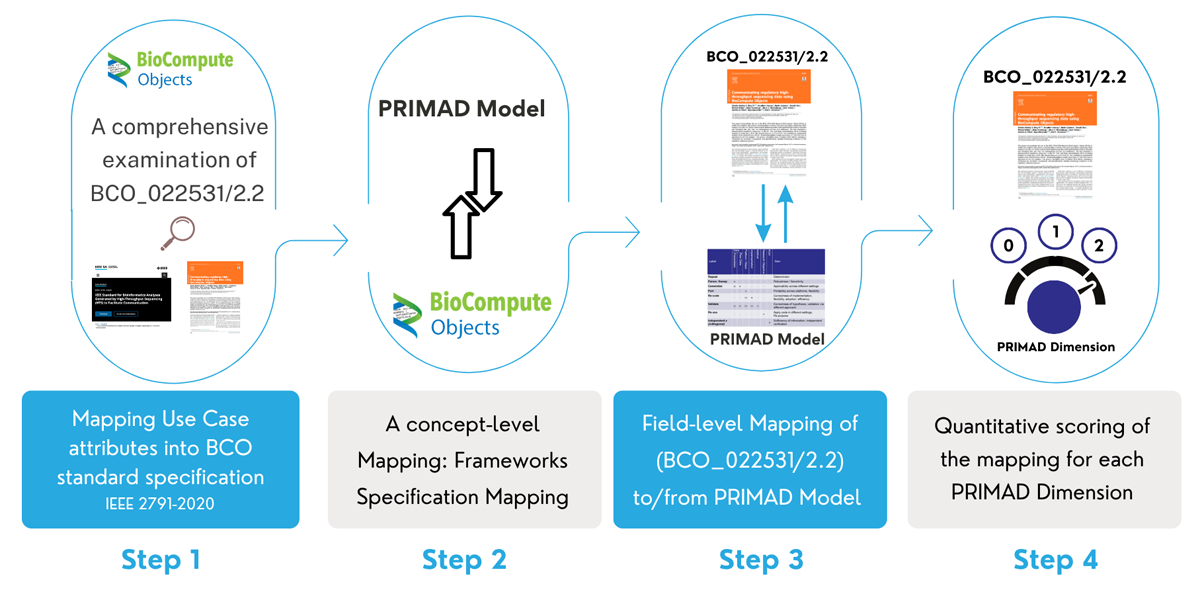
Figure 1
Method steps for the systematic examination between the BCO and PRIMAD frameworks, including four steps (use case examination, concept-level/general mapping, field-level mapping, and quantitative scoring) applied to the BCO_022531/2.2 use case.
Table 3
A Mapping summary between the PRIMAD model dimensions and BCO domains and fields. For clarity, some subfields have been excluded. An asterisk (*) indicates optional domains and fields.
| BIOCOMPUTE OBJECT | PRIMAD MODEL | ||||
|---|---|---|---|---|---|
| DOMAIN | FIELDS | SUB FIELDS | DIMENSION | ||
| Usability | Free Text | Research Objective | Consistency | Transparency | |
| Method | |||||
| Provenance | Name | ||||
| Version | |||||
| Review* | status | ||||
| reviewer comment | |||||
| date | |||||
| reviewer | |||||
| reviewer details | |||||
| Derived From* | |||||
| Obsolescence Time* | |||||
| Embargo Period* | |||||
| Created Time | |||||
| Modification Time | |||||
| Contributors | Name | Actor | |||
| Contribution | |||||
| other details | |||||
| Licence | |||||
| Description | Keywords | ||||
| External References | Namespace, Name, IDs, Access Time | Platform | |||
| Platform/Environment | |||||
| Pipeline Steps | Step Number | Implementation | |||
| Name | |||||
| Description | |||||
| Version* | |||||
| Prerequisites* | Platform | ||||
| Input List | Data (Input Data) | ||||
| Output List | Consistency | ||||
| Script | Implementation | ||||
| Execution | Script driver | Platform | |||
| Algorithmic tools and Software Prerequisites | Name | ||||
| Version | |||||
| URI | Platform | ||||
| Access Time | |||||
| SHA1 Checksum | |||||
| External Data Endpoints | Name | Platform | |||
| URI | |||||
| Environment Variables | |||||
| IO | Input Subdomain | Filename* | Data (Input Data) | ||
| URI | |||||
| Access Time* | |||||
| SHA1 Checksum* | |||||
| Output Subdomain | Filename* | Consistency | |||
| Media Type | |||||
| URI | |||||
| Access Time* | |||||
| SHA1 Checksum* | |||||
| Parametric* | Parameter | Data (Parameter) | |||
| Value | |||||
| Step | |||||
| Error* | Algorithmic Subdomain | Inclusion Rule | Consistency | ||
| Reference | |||||
| Empirical Error | Inclusion Rule | ||||
| Reference | |||||
| Definitions | |||||
| Extension* | Free Text | ||||
Table 4
Summary of mapped fields and quantitative scores for PRIMAD dimensions in the BCO use case (BCO_022531/2.2), where field scores (Si) were assigned as 0 = missing/empty, 1 = present but insufficiently detailed or inaccessible, and 2 = present and verifiable.
| PRIMAD DIMENSION | NO. OF MAPPED FIELDS IN THE DIMENSION (nd) | SUM OF SCORES OF THE MAPPED FIELDS | ||
|---|---|---|---|---|
| Platform | 7 | 10 | 71 | |
| Research Objective | 1 | 2 | 100 | |
| Implementation | 5 | 9 | 90 | |
| Method | 1 | 2 | 100 | |
| Actor | 3 | 6 | 100 | |
| Data | Data Parameter | 3 | 6 | 100 |
| Data Input | 3 | 5 | 83 | |
| Consistency | 10 | 17 | 85 | |
| Transparency | 58 | 78 | 67 | |
Table 5
Proposed aspects for the PRIMAD model and their documentation through the BCO domains’ fields.
| TIME | ADDITIONAL RESOURCES | ||
|---|---|---|---|
| BCO Fields | Domains | BCO Fields | Domains |
| Obsolescence Time | Provenance | External References | Description |
| EMBARGO PERIOD | FAULT TOLERANCE | ||
| Created Time | BCO Fields | Domains | |
| Modification Time | Empirical Error Values | Error | |
| Review Date | Algorithm Error Values | Error | |
| Input/output Subdomain Access Time | I/O | METADATA SCHEMAS | |
| Input/output List Access Time | Description | BCO Fields | Domains |
| External Reference Access Time | BCO Schema version | Top-Level Fields | |
| DATA CATEGORISATIONS | Additional Schema | Extension | |
| BCO Fields | Domains | VERSION | |
| Input/output Subdomains | I/O | BCO Fields | Domains |
| Input/output Lists | Description | BCO Version | Provenance |
| Parameters | Parametric | Software Prerequisites Version | Execution |
| HUMAN ROLES | Pipeline Step Version | Description | |
| BCO Fields | Domains | LICENCE | |
| Contributor | Provenance | BCO fields | Domains |
| Reviewer | BCO licence | Provenance | |
| REVIEW | |||
| BCO Fields | Domains | BCO fields | Domains |
| Review Status | Provenance | Review Date | Provenance |
| Reviewer Comment | Reviewer | ||
| FUNCTIONALITY | |||
| BCO Fields | Domains | BCO Fields | Domains |
| Platform/Environment | Description | Modification Time | Provenance |
| Pipeline Step’s Prerequisite | BCO Version | ||
| SHA Checksum | Execution | Obsolescence Time | |
| Environment Variable | Embargo Period | ||
| External Data Endpoints | BCO licence | ||
| Software Prerequisites | SHA Checksum | I/O | |
| ETag | Top-Level Fields | ||
Table 6
The proposed depth is in the form of aspects for each PRIMAD model’s dimension.
| PRIMAD DIMENSIONS | RESEARCH OBJECTIVE | METHOD | PLATFORM | IMPLEMENTATION | ACTOR | DATA |
|---|---|---|---|---|---|---|
| PROPOSED ASPECTS | ||||||
| Data Categorisations | ✓ | |||||
| Versions | ✓ | ✓ | ✓ | ✓ | ||
| Time | ✓ | ✓ | ✓ | |||
| Additional Resources | ✓ | ✓ | ✓ | |||
| Fault Tolerance | ✓ | ✓ | ✓ | |||
| Licence | ✓ | ✓ | ||||
| Functionality | ✓ | ✓ | ✓ | |||
| Human Roles | ✓ | |||||
| Review | ✓ | |||||
| Metadata Schemas | ✓ | ✓ | ✓ | ✓ | ✓ |