
1. Introduction
Reproducibility is fundamental in science as a means of validating and strengthening studies, giving researchers confidence in their results and enabling them to build on these findings (House of Commons Science, Innovation and Technology Committee, 2023). This principle has received increased attention in the scientific field in recent decades (Ioannidis, 2005; Donoho et al., 2009; Pashler and Harris, 2012), including concerns voiced as a ‘reproducibility crisis’ (Baker, 2016). Numerous initiatives launched in scholarly communities across different domains have sought to highlight the state of the art and best practices in various fields, including psychology (Open Science Collaboration, 2015), biology (Errington et al., 2021), computer science (Collberg and Proebsting, 2016), social science (Hardwicke et al., 2020) and artificial intelligence (AI) (Hutson, 2018; Gundersen and Kjensmo, 2018). As computational methods have become more prevalent in research (Freire, Bonnet and Shasha, 2012), the reproducibility of analysis workflows, simulations, digital twins, and AI predictions has come to the foreground. Although reproducibility is thought to be facilitated by computational approaches, challenges arise even when automation covers all or most of the steps in research experiments (Crook, Davison and Plesser, 2013). For example, a recent effort to reproduce crash-free executions across 101 scientific workflows achieved only a 28% success rate (Grayson et al., 2023). This is despite the development of many approaches for enhancing computational reproducibility, such as research outputs repository platforms (e.g., Zenodo, Figshare), research packaging approaches (e.g., Whole Tale, RO-Crate), workflow management systems (e.g., Snakemake, Nextflow), containers (e.g., Docker, Singularity), computational notebooks (e.g., Jupyter) and version control systems (e.g., Git, GitHub).
Efforts have been made to define reproducibility and compare it with the concepts of replicability, robustness, generalisability, reusability, and the overarching issue of transparency (Claerbout and Karrenbach, 1992; Stodden, 2014; Goodman, Fanelli and Ioannidis, 2016; NASEM, 2019; TTW Community et al., 2019; ACM, 2020; Gundersen, 2021). Initiatives to incentivise adherence include measures such as the reproducibility badging practices of research publishers (ACM, IEEE, Elsevier, and Springer Nature) (NISO, 2021). The tendency towards ‘R’ wordplay (reproducible, repeatable, reusable, retrievable, reprocessable, repurposable, reliable, recoverable, etc.) can become overwhelming (De Roure, 2014). Unfortunately, the terminology of reproducibility and replicability is not consistent across disciplines (Plesser, 2017); here, we use the definitions of the National Academies of Sciences, Engineering, and Medicine (NASEM) with respect to computation (NASEM, 2019):
Reproducibility: ‘obtain consistent computational results using the same input data, computational steps, methods, code, and conditions of analysis’
Replicability: ‘obtain consistent results across studies aimed at answering the same scientific question, each of which has obtained its own data’
Generalisability: ‘the extent that results of a study apply in other contexts or populations that differ from the original one’
1.1. Unpacking reproducibility: The PRIMAD framework
The NASEM definitions hint at fixity—that is, there are properties of a digital file or object that remain fixed or unchanged (Kim et al., 2020), while others may be altered when comparing results. This concept of fixity is explicitly addressed in the PRIMAD framework (Freire, Fuhr and Rauber, 2016) through systematic descriptions of computational experiments. The acronym ‘PRIMAD’ (Table 1) stands for the key variables that can either change or stay fixed during the reproduction of a computational study (Freire, Fuhr and Rauber, 2016):
P – Platform: The execution environment and computational context. This dimension represents the different specifications of the execution environment in the study. It includes hardware, software, compilers, storage and/or different-purpose platforms (such as management and dissemination).
R – Research Objective or goals of the study.
I – Implementation: The computational code or source code.
M – Methods: The algorithm, pseudocode and/or the methodology that fulfils the study goals.
A – Actor: The people who contribute to the study.
D – Data: Input data and data parameter values of the source code.
Table 1
The PRIMAD model for reproducibility in a computational experiment; each reproducibility label is associated with its gain and the way of achieving it. What dimensions will change are represented by the dark-coloured cells, what could possibly change are represented by the light-coloured ones, and what will not change are the non-coloured cells (adapted and extended from Freire, Fuhr and Rauber (2016)). The original table has been updated with new gains and labels, which are highlighted in underlined text to clearly distinguish the additions.
| Label: Repeat | ||||||
| Platform | Research Objective | Implementation | Method | Actor | Data (Raw) | Data (Parameter) |
| Gain: Consistency across Trials, Determinism | ||||||
| Label: Port, Relocate | ||||||
| Platform | Research Objective | Implementation | Method | Actor | Data (Raw) | Data (Parameter) |
| Gain: Cross-Platform Compatibility (Portability), Minimal Dependency (Flexibility) | ||||||
| Label: Reuse/Repurpose | ||||||
| Platform | Research Objective | Implementation | Method | Actor | Data (Raw) | Data (Parameter) |
| Gain: Cross-Disciplinary Application (Apply Code in Different Settings), Resource Efficiency | ||||||
| Label: Re-code, Reinterpret | ||||||
| Platform | Research Objective | Implementation | Method | Actor | Data (Raw) | Data (Parameter) |
| Gain: Improved Code Quality, Correctness of Implementation, Expand Adoption, Enhanced Efficiency, Flexibility | ||||||
| Label: Ratify, Validate | ||||||
| Platform | Research Objective | Implementation | Method | Actor | Data (Raw) | Data (Parameter) |
| Gain: Hypothesis Correctness, Validation via a Different Approach, Findings Robustness | ||||||
| Label: Review, Independent Verify | ||||||
| Platform | Research Objective | Implementation | Method | Actor | Data (Raw) | Data (Parameter) |
| Gain: Enhanced Transparency (Sufficiency Information), Independent Verification | ||||||
| Label: Resample, Generalise | ||||||
| Platform | Research Objective | Implementation | Method | Actor | Data (Raw) | Data (Parameter) |
| Gain: Applicability across Different Settings | ||||||
| Label: Reparameterisation, Recalibration, Parameter Sweep, | ||||||
| Platform | Research Objective | Implementation | Method | Actor | Data (Raw) | Data (Parameter) |
| Gain: Robustness, Adaptation to Other Conditions (Sensitivity), Parameters Optimisation | ||||||
Computational reproducibility studies are labelled differently in the PRIMAD framework. In Table 1, computational reproducibility labels are explicitly associated with their intended gains and the dimensions’ conditions required to achieve them. The presented dimensions clarify which elements will change, could possibly change, or remain unchanged. This updated labelling is adapted from the original PRIMAD table (Freire, Fuhr and Rauber, 2016) and extended to provide more explicit guidance on reproducibility practices, their purposes, and outcomes:
Repeat: Nothing is changed.
Relocate/Port: The software platform changes, but the encoding of the algorithm itself remains the same.
Reuse/Repurpose: The experimental set-up is reused or repurposed for a different question, assuming it to be trustworthy.
Re-code/Reinterpret: The algorithm/pseudocode remains the same but is re-implemented. The software platform may change.
Ratify/Validate: Changing the method allows for the validation of a hypothesis’s correctness using a different methodological approach. This change will result in alterations to the parameters, implementation, and possibly the execution environment (platform). Additionally, a change in data may occur because the new methodology could require a different type of dataset.
Review/Independent Verify: The actor is different to the instigator for independent verification.
Resample/Generalise: The computational aspects remain the same, but they are applied to different data, which could imply changes in parameters too.
Reparameterisation/Recalibration: A specialisation of generalisation (a specialisation of robustness), where the parameters are systematically altered (a ‘sweep’ across the parameters) for code reruns over the same data; or an algorithm optimisation in which the parameter is adjusted to enhance the algorithm’s performance.
In Table 1, the labels ‘Reuse/Repurpose’ and ‘Review/Independent Verify’ focus on changing the Research Objective and Actor dimensions consecutively without changing the core structure and setting of the experiment, which includes Method, Implementation, and Data (Row and Parameter) dimensions. As a result, these labels are orthogonal to the remaining labels.
The NASEM (2019) specifications for reproducibility, replicability and generalisability could be mapped to the computational reproducibility labels of PRIMAD with harmonious gains as follows:
Reproducibility (NASEM): Repeat (PRIMAD): Nothing Changes: Result Consistency
Replicability (NASEM): Validate (PRIMAD): The main change in Method, in addition to consequent changes in other dimensions: Findings Robustness.
Generalisability (NASEM): Reuse (PRIMAD): Change in Objective/Purpose: Cross-Disciplinary Application.
PRIMAD (Freire, Fuhr and Rauber, 2016) also introduces two further dimensions:
Consistency: The success or failure of a reproducibility study evaluated with respect to whether the results are consistent with the previous ones rather than identical.
Transparency: The ability to look into all necessary components to be able to understand the path from the hypothesis to the results. The degree of transparency should be used as a measure of the degree of inspection possible on codes and the availability of data.
Consistency and Transparency represent the non-direct dimensions of the PRIMAD model, as they are not explicitly mentioned in the model acronym, unlike the direct dimensions P: Platform, R: Research Object, I: Implementation, M: Method, A: Actor, and D: Data.
1.2. Metadata Research Object for reproducibility reporting
Computational pipelines have increasingly been adopted in biomedical science, including critical domains such as human health. Next-generation sequencing (NGS) analysis methods used in precision medicine (Alterovitz et al., 2018) have spurred the development of the IEEE 2791-20201 standard for Bioinformatics Analyses Generated by High-Throughput Sequencing (HTS) (Alterovitz et al., 2018; Simonyan, Goecks and Mazumder, 2017). Known as the BioCompute Object (BCO), this framework is specifically tailored to meet the demands of reproducibility in regulatory settings, notably in the evaluation, validation and verification of bioinformatics pipelines for the FDA (King et al., 2022), by standardising the reporting of genomic data information for exchange between stakeholders (Alterovitz et al., 2018; Simonyan, Goecks and Mazumder, 2017). The framework recommends and combines multiple standards for comprehensive documentation of NGS data and analyses (Alterovitz et al., 2018). These standards include Fast Healthcare Interoperability Resources, the Global Alliance for Genomics and Health, Common Workflow Language (King et al., 2022), FAIR data principles (Findability, Accessibility, Interoperability, and Reusability) (Wilkinson et al., 2016), and Research Objects (Bechhofer et al., 2013).
Research Objects represent semantic encapsulation mechanisms for the research products used and produced during the research life cycle. The data, software, computational and manual processes, and documentation necessary for exchange, reuse and reproducibility are encapsulated, described and interlinked using metadata. The BCO packages data and metadata tailored to the generation, computation, and sharing of genomic pipelines. Other examples of research object frameworks include the FAIR Digital Object (De Smedt, Koureas and Wittenburg, 2020) and the RO-Crate (Soiland-Reyes et al., 2022), which has also developed profiles for the provenance of workflow execution pipelines (Leo et al., 2024).
The BCO is a pragmatic framework developed by the life science community. It is a structured, human- and machine-readable JSON metadata file that captures the provenance, execution details, inputs and outputs, and intended use of a bioinformatics workflow. The BCO framework has three top-level fields and eight domains, as shown in Table 2. The three fields—a unique identifier, a reference to its schema version, and a lightweight cryptographic hash value—are required attributes meant to aid the detection of unintended BCO alterations. The required domains are Usability, Provenance, Execution, Description, and Input/Output (IO), while Parametric, Extension, and Error are optional (Table 2). The Usability domain is free text, whereas the others consist of a set of structured fields. However, some fields in the compulsory domains are optional.
Table 2
Overview of the BCO framework, highlighting the three top-level fields and its eight domains. Domains marked with an asterisk (*)—Error Domain, Parametric Domain, and Extension Domain—are optional and may be included as needed.
| BCO TOP-LEVEL FIELDS | |
|---|---|
| Unique Identifier, Schema Version’s Reference and Lightweight Cryptographic Hash Value | |
| BCO DOMAINS | |
| Usability Domain: An array of free text values that should align with the terminology used in the BCO name, keywords, and external references (xref) sections. It is intended to describe the computational workflow in the following sections: the need, method, results, and how the results can be used or interpreted for the scientific use case. | Provenance Domain: History, version, contributors and review status of the BCO. |
| Input/output Domain: input and output files used by the computational workflow for execution. | |
| Description Domain: Pipeline steps, input and output file relations, and external references for review. | Execution Domain: Execution of a BCO in terms of scripts and the information required to run a pipeline. |
| * Error Domain: Specifies the accepted error range in an empirical and algorithmic manner. | * Parametric Domain: A set of parameters used to customise the pipeline |
| * Extension Domain: The part of the workflow used to encompass additional structures outside the BCO schema. | |
Bioinformatics platforms, such as Seven Bridges, DNAnexus, Galaxy, the High-Performance Integrated Virtual Environment (HIVE), and the Cancer Genomics Cloud (CGC), have developed support for BCOs. A suite of tools (Xiao et al., 2020; Patel et al., 2021), including a BCO portal and editor,2 has been built around the standard.
1.3. Examining the reproducibility of BioCompute Objects
Despite the promotion of BCOs as a reproducibility standard for regulatory analysis, claims regarding the suitability of the BCO framework for reproducibility reporting have yet to be systematically examined. The BCO can be considered an implementation and interpretation of the reproducibility approach promoted by the PRIMAD model, which serves as a roadmap for the reproducibility of computational experiments. By cross-mapping the PRIMAD and BCO frameworks, we can systematically test the BCO’s claims for reproducibility reporting and PRIMAD’s robustness as a useful mechanism for understanding reproducibility.
2. Methods
To initiate the systematic examination between the BCO and PRIMAD frameworks, we used a published BCO ‘Regulatory BioCompute Object for Hepatitis C Virus Resistance Analysis’ (BCO_022531/2.2) (King et al., 2022) as a use case. This use case represents the workflow underlying the analysis of resistance to 3D treatment for hepatitis C genotype 1 and illustrates the failure of a treatment combination for the disease. The treatment combines ‘a protease inhibitor (paritaprevir), an NS5 A inhibitor (ombitasvir), and a polymerase inhibitor (dasabuvir)’. Treatment failed in 18 out of a sample of 100 patients in a simulated clinical trial for resistance against 3D treatment. The regulatory BCO (BCO_022531/2.2) represents an NGS pipeline on the HIVE analysis platform fields (Simonyan et al., 2016) designed specifically for the genomics and bioinformatics. The use case pipeline involves two primary steps (‘HIVE-Hexagon’ and ‘Sequence Profiling Engine’), each reported through specific BCO domains, particularly within the Description, Execution, Parametric, and Error domains.
The systematic examination between BCO and PRIMAD analyses involved an initial examination (Step 1) phase followed by mapping (Steps 2 and 3) and quantitative scoring (Step 4) phases, as outlined in the following steps, see Figure 1:
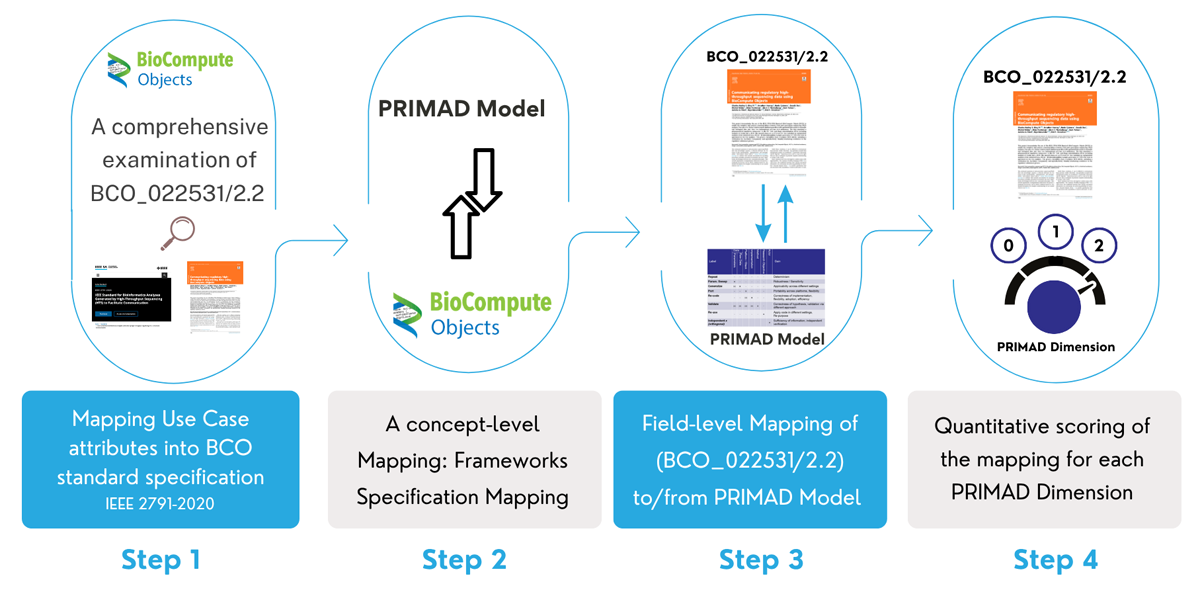
Figure 1
Method steps for the systematic examination between the BCO and PRIMAD frameworks, including four steps (use case examination, concept-level/general mapping, field-level mapping, and quantitative scoring) applied to the BCO_022531/2.2 use case.
Step 1: Comprehensive examination (BCO_022531/2.2 and BCO standard specification).
An examination of the BCO use case (BCO_022531/2.2) explored its content and the corresponding BCO specification (IEEE 2791-2020) to identify domains, fields and their usage. See Supplementary Data 1.
Step 2: Concept-level/general mapping (framework-to-framework).
A general mapping of the PRIMAD model to the BCO framework was conducted at the conceptual level using the definitions and specifications of both frameworks. See Supplementary Data 2.
Step 3: Field-level mapping (BCO_022531/2.2 to/from PRIMAD).
A mapping of the BCO use case (BCO_022531/2.2) fields to/from the PRIMAD model dimensions was performed, producing a structured crosswalk that links each PRIMAD dimension to/from the relevant BCO fields available in the use case. See Supplementary Data 3 and 4.
Step 4: Quantitative scoring of the mapping for each PRIMAD dimension.
The field-level mapping output was operationalised into a scoring rubric applied to BCO_022531/2.2; see Supplementary Data 5. Each mapped BCO field (required and optional) was assigned a score based on its availability and verifiability in the use case:
0 = empty (not provided)
1 = present but insufficient for reuse
2 = present and sufficient for reuse
Scores were documented in a scoring table that includes the observed use-case value and a brief rule-based justification. For each PRIMAD dimension, a normalised completeness score was computed as:
si ∈ {0,1,2} is the score for each mapped BCO field in the PRIMAD dimension d
nd is the number of mapped fields in that dimension
d ∈ {Platform,Research Objective,Implementation,Method,Actor,Data} is the PRIMAD dimension.
For the purpose of this paper, the notation PRIMAD.Dimension refers to the specific dimension of the PRIMAD model, either the direct dimensions (Platform, Research Objective, Implementation, Method, Actor, and Data) or the non-direct dimensions (Transparency and Consistency). PRIMAD.Dimension (sub) refers to a sub-dimension, while BCO.Domain indicates the specific domain of the BCO, with fields or subfields of the BCO domains denoted in italic text. For consistency with the tables, we will use an English short form of the BCO domains, while the fields correspond to the JSON keys.
3. Results
The results of the systematic examination steps are presented in the Supportive Information section. In the following sections, we will review the results of the comprehensive examination of use case BCO_022531/2.2 (Step 1). Then, we will discuss the results of the concept-level/general mapping and field-level mapping using the use case (Steps 2 and 3). Finally, we will showcase the results of the quantitative scoring of use case mapping (Step 4).
3.1. Comprehensive examination of BCO_022531/2.2
The examination is presented in a tabular format of BCO_022531/2.2, which includes domains and their attributes and can be viewed from the BCO Portal.3 Our analysis is based on the BCO specification version 22.01,4 released on February 9, 2022, encompassing the BCO user guide5 and the IEEE 2791-20206 schemas. Information on domains was extracted from the BCO’s JSON. BCO_022531/2.2 generally adheres to the requirements of the BCO specification; however, in practice, we uncovered several issues:
Insufficient licence. The compulsory field license is filled in with the URL https://opensource.org/licenses/MIT, but the link directs one to a license template. Information on the year and the copyright holder is not explicitly stated in this BCO.
Missing or obfuscated field values. Files lack descriptive names that reflect their primary functionality (e.g., P0641M00002_S2_L001_R2_001 and P0641M00002_S2_L001_R1_001). Such file naming conventions are common in laboratory or instrument outputs, but their meanings are challenging to interpret outside of a specific context.
Access to platforms. Accessing the use case workflow platform (HIVE) required time and consent from the authors to activate the account and open the referenced files. Therefore, we noticed that the files and script links had empty pages, leading us to inquire whether access to these domains requires authorisation; it was confirmed that authorisation is required, and it was provided to us. File retrieval or re-computation based on the BCO cannot be carried out independently of its platform of origin.
3.2. Mapping the PRIMAD dimensions and BCO domains
Table 3 summarises the mapping between PRIMAD dimensions and BCO domains (Steps 2 and 3). The general mapping (Step 2) and the field-level mapping within the BCO use case (BCO_022531/2.2) (Step 3) are, as expected, not a one-to-one correspondence. We apply BCO_022531/2.2 to highlight the objectives of certain BCO fields concerning the PRIMAD dimensions.
Table 3
A Mapping summary between the PRIMAD model dimensions and BCO domains and fields. For clarity, some subfields have been excluded. An asterisk (*) indicates optional domains and fields.
| BIOCOMPUTE OBJECT | PRIMAD MODEL | ||||
|---|---|---|---|---|---|
| DOMAIN | FIELDS | SUB FIELDS | DIMENSION | ||
| Usability | Free Text | Research Objective | Consistency | Transparency | |
| Method | |||||
| Provenance | Name | ||||
| Version | |||||
| Review* | status | ||||
| reviewer comment | |||||
| date | |||||
| reviewer | |||||
| reviewer details | |||||
| Derived From* | |||||
| Obsolescence Time* | |||||
| Embargo Period* | |||||
| Created Time | |||||
| Modification Time | |||||
| Contributors | Name | Actor | |||
| Contribution | |||||
| other details | |||||
| Licence | |||||
| Description | Keywords | ||||
| External References | Namespace, Name, IDs, Access Time | Platform | |||
| Platform/Environment | |||||
| Pipeline Steps | Step Number | Implementation | |||
| Name | |||||
| Description | |||||
| Version* | |||||
| Prerequisites* | Platform | ||||
| Input List | Data (Input Data) | ||||
| Output List | Consistency | ||||
| Script | Implementation | ||||
| Execution | Script driver | Platform | |||
| Algorithmic tools and Software Prerequisites | Name | ||||
| Version | |||||
| URI | Platform | ||||
| Access Time | |||||
| SHA1 Checksum | |||||
| External Data Endpoints | Name | Platform | |||
| URI | |||||
| Environment Variables | |||||
| IO | Input Subdomain | Filename* | Data (Input Data) | ||
| URI | |||||
| Access Time* | |||||
| SHA1 Checksum* | |||||
| Output Subdomain | Filename* | Consistency | |||
| Media Type | |||||
| URI | |||||
| Access Time* | |||||
| SHA1 Checksum* | |||||
| Parametric* | Parameter | Data (Parameter) | |||
| Value | |||||
| Step | |||||
| Error* | Algorithmic Subdomain | Inclusion Rule | Consistency | ||
| Reference | |||||
| Empirical Error | Inclusion Rule | ||||
| Reference | |||||
| Definitions | |||||
| Extension* | Free Text | ||||
The mapping result is presented with respect to the PRIMAD model dimensions as follows:
PRIMAD. Platform: HIVE is the leading platform in BCO.Description that holds the BCO files and serves as the platform for running the script under BCO.Execution.
PRIMAD. Research Objective maps only to the name field in BCO.Provenance.
PRIMAD. Implementation maps to multiple fields in BCO.Description and BCO.Execution.
PRIMAD. Method maps to BCO.Usability but not BCO.Description because the pipeline steps are platform-dependent (HIVE).
PRIMAD. Actor maps to BCO.Provenance’s contributor field and its subfields: {name, contribution, affiliation, email and ORCID}.
PRIMAD. Data (Raw) includes data input (raw only) and maps to both BCO.IO and the input list fields in BCO.Description. There are three input files in the input subdomain of BCO.IO and four in the input list of BCO.Description (one for Step 1 and three for Step 2 of the pipeline).
PRIMAD. Data (Parameter) represents parameters that are used to measure an algorithm’s robustness and sensitivity as the initial parameters for an experiment. In BCO.Parametric, a parameter list is used to customise a pipeline to affect results, recognising that humans ‘tweak’ the pipeline. In the use case pipeline, there are 24 parameters for Step 1 and 32 parameters for Step 2.
PRIMAD. Consistency: The output subdomain of BCO.IO and the output list of BCO.Description are compulsory. Although BCO.Error is optional, it is used to define the tolerance range for input to ensure that its result is accepted. Neither has clear and direct corresponding dimensions in the PRIMAD model. We mapped the output subdomain of BCO.IO and the output list of BCO.Description and BCO.Error onto PRIMAD.Consistency. In the use case, nine values of the error range with their subfields’ descriptions appear in BCO.Error. There are four output files in BCO.IO on the HIVE platform and 16 files for the pipeline in BCO.Description (12 files for Step 1 and four files for Step 2).
PRIMAD. Transparency: We did not distinguish between the recommended and compulsory attributes for reproducibility. The PRIMAD model was extended to cover the Transparency dimension to include all the required elements of the experiment’s life cycle and guarantee reproducibility. For PRIMAD.Transparency, in the general mapping, we include all BCO compulsory fields within compulsory domains. Moreover, some compulsory fields within these domains could not be directly mapped to a specific dimension. As a result, they are assigned to PRIMAD. Transparency. With the field-level mapping, we added BCO.Error and BCO.Parametric. BCO.Extension was not mapped because it was empty for this use case. It is optional and contains extra information that follows an additional pipeline schema in addition to the main BCO schema (IEEE 2791-2020). This information can be related to any part of a workflow. Correspondingly, this domain can be mapped onto all PRIMAD dimensions except for the Research Objective.
3.3. Quantitative scoring of the BCO_022531/2.2 mapping
To complement the conceptual and field-level mappings, the mapped fields of BCO_022531/2.2 were quantitatively scored using the rubric described in Step 4; see Table 4.
Table 4
Summary of mapped fields and quantitative scores for PRIMAD dimensions in the BCO use case (BCO_022531/2.2), where field scores (Si) were assigned as 0 = missing/empty, 1 = present but insufficiently detailed or inaccessible, and 2 = present and verifiable.
| PRIMAD DIMENSION | NO. OF MAPPED FIELDS IN THE DIMENSION (nd) | SUM OF SCORES OF THE MAPPED FIELDS | ||
|---|---|---|---|---|
| Platform | 7 | 10 | 71 | |
| Research Objective | 1 | 2 | 100 | |
| Implementation | 5 | 9 | 90 | |
| Method | 1 | 2 | 100 | |
| Actor | 3 | 6 | 100 | |
| Data | Data Parameter | 3 | 6 | 100 |
| Data Input | 3 | 5 | 83 | |
| Consistency | 10 | 17 | 85 | |
| Transparency | 58 | 78 | 67 | |
The scoring results showed generally high coverage across most operationalised PRIMAD dimensions. PRIMAD.Research Objective, PRIMAD.Method, PRIMAD.Actor, and PRIMAD.Data (Parameter) each achieved 100%, indicating that all mapped fields for these dimensions were present and sufficient for use in the examined use case. PRIMAD.Implementation achieved 90%, PRIMAD.Consistency achieved 85%, PRIMAD.Data (Input) achieved 83%, while PRIMAD.Platform achieved 71%, indicating that these dimensions were largely covered but included some fields that were either null (such as the file name for the input data file and the SHA-1 Checksum value for both input and output data files in BCO.IO), insufficiently detailed (such as license), or inaccessible (input, output, and script data files).
PRIMAD.Transparency, assessed across all BCO standard fields, scored 67%, the lowest among all assessed dimensions. This indicates that, although much of the use case metadata was available, the Transparency dimension was reduced by a noticeable number of missing values for optional fields, inaccessible fields, or insufficiently detailed fields distributed across the BCO domains; see Supplementary Data 5.
These quantitative results refine the qualitative mapping by showing that the BCO_022531/2.2 use case strongly supports several reproducibility-relevant dimensions, but not uniformly. In particular, the results highlight stronger coverage of the study objective, method, actors, and parameter reporting, compared with weaker coverage of platform reporting, data input reporting, and consistency (output results) due to accessibility issues with data files and the platform. Therefore, the scoring provides an objective summary of where the use case supports reproducibility well and where additional reporting detail would be required to strengthen independent verification and reuse.
4. Discussion
The mapping between the PRIMAD dimensions and the BCO domains demonstrated that the reproducibility perspective underlying one framework could be integrated into the other and also identified the enhancements to each framework to better ensure reproducibility. The outcomes of this study are twofold:
The importance of applying conceptual frameworks in practice, as we identify strengths and weaknesses in the PRIMAD model
A demonstration of the utility of a systematic examination of standards and models that are intended to advance adequate reproducibility reporting, with recommendations formulated for improving the BCO standard
In the following sections, we will discuss key observations regarding reproducibility in both frameworks and present our recommendations to address their gaps.
4.1. Entanglements and redundancies in both frameworks
A prominent observation was the presence of ‘entanglements’ and redundancies in reporting across the dimensions/domains of both frameworks. The PRIMAD Platform, Method, and Implementation dimensions are entangled with each other (Chapp et al., 2019). Entanglement refers to the interdependent relations among some dimensions, where modifications or changes in one dimension can significantly affect others. While separating different properties helps support comprehensive workflow reporting (Goble et al., 2019), in practice, the boundaries are often blurred, especially in the experiments of a given workflow type (Haendel et al., 2016). As a result, updating a script in PRIMAD.Implementation may impact PRIMAD.Method and PRIMAD.Platform. In BCO_022531/2.2, employing HIVE as an execution platform requires adjustments to the BCO’s study methods. PRIMAD.Method, in principle, maps to BCO.Usability—a free text field describing the BCO as a whole—and BCO.Description, a structured description not intended for computation. However, in this use case, PRIMAD.Method maps solely to BCO.Usability. BCO.Description is tailored for HIVE, as the pipeline consists of two steps: ‘HIVE-Hexagon’ and ‘Sequence Profiling Engine’, where ‘HIVE’ refers to the workflow’s platform and contains input and output data files. BCO.Execution, as expected, is platform-dependent, since it is mapped to the PRIMAD.Implementation.
Similarly, there are apparent redundancies across some BCO fields, such as input and output files appearing in both BCO.Description and BCO.IO. However, this distinction is necessary to identify files used at the execution level, including intermediates across steps (BCO.Description), versus the subset of ‘main’ files identified as significant for the entire computational workflow at a study level (BCO.IO).
4.2. PRIMAD abstraction versus BCO specifics
The PRIMAD model is proposed as a conceptual approach to framing reproducibility in scientific computational experiments. The BCO standard is considered an implemented approach that is more detailed and tailored for NGS pipelines, which represents a step toward guaranteeing the reproducibility of these pipelines. The mapping between the PRIMAD model and the BCO framework reflects the demand for each to consider the other’s perspective on reproducibility. The dimensions of the PRIMAD model are conceptual; each dimension has a name and a definition, but there is no checklist for each dimension. In contrast, each domain in the BCO framework includes a group of defined fields. In practice, the abstractions in the PRIMAD model require depth and detail tailored to the needs of each scientific discipline.
Conversely, the specifications in the BCO framework would benefit from an additional level of abstraction. Reporting an experiment conceptually eases portability, reimplementation and long-term reproducibility. Experimental software is subject to transformation as time progresses (Freire and Chirigati, 2018). The BCO offers a certain level of abstraction when detailing the pipeline within BCO.Usability and BCO.Description. In BCO.Usability, researchers are advised to include free text to report the need, method, results, and how the results can be used or interpreted. BCO.Description has structured fields to capture information in a standardised format for FDA submission. It includes aspects of pipeline steps (step_number, name, description, version, prerequisite, input_list, output_list), external references (xref), compatible platforms (platform) and keywords.
In practice, when we consider the use case (BCO_022531/2.2), BCO.Usability reports a method outline, while BCO.Description reports pipeline steps that are platform-dependent, with pipeline_steps.name: ‘HIVE-Hexagon’. Despite this, there is no mapping between the method outlines (BCO.Usability) and pipeline steps (BCO.Description) to facilitate porting the experiment to another platform. A comprehensive and systematic separation of platform implementation from pipeline abstraction supports pipeline reproducibility across different platforms (experiment portability) or different implementations (method reinterpretation).
4.3. Extending the PRIMAD model for reproducible pipelines in practice
In addition to Transparency and Consistency as non-direct dimensions for PRIMAD, Freire, Fuhr and Rauber (2016) and Freire and Chirigati (2018) suggested two additional non-direct dimensions for the PRIMAD model: Coverage and Longevity. Coverage means the portion of experiments that can be reproduced (Freire, Bonnet and Shasha, 2012). However, full reporting does not always guarantee reproducibility due to various issues. These issues may relate to costs, complicated or customised preparations of data or software, data sensitivity, and copyright or licensing challenges. Longevity refers to the ability to reproduce experiments long after their creation. This dimension’s importance is attributed to the nature of software, which may evolve over time or become obsolete. As we will discuss next, capturing the times at which a software is created, updated, and accessed highlights longevity (Grayson et al., 2023).
The power of the PRIMAD model lies in the fact that it serves as a reproducibility framework for computational experiments across all scientific disciplines. It has been adopted in studies to clarify specific aspects of reproducibility, including information retrieval (IR) experiments (Breuer, 2020; Breuer, Keller and Schaer, 2022), neural information retrieval (Ferro et al., 2016), music information retrieval (MIR) (Knees et al., 2022), high-performance computing (HPC) (Chapp, Stodden and Taufer, 2020), natural sciences (Gryk and Ludäscher, 2017), scientific experiments’ provenance (Samuel and König-Ries, 2022) and astronomy (Chapp et al., 2019). Nevertheless, using the model with its general perspective and dimensions presents challenges for researchers in accurately reporting experiment details.
Ensuring reproducibility requires avoiding a one-size-fits-all approach (Stewart et al., 2021). The PRIMAD model’s abstraction makes it applicable to a wide range of computational experiments, but it is expected to be extended and customised to provide tailored checklists in practice for each scientific discipline (Chapp et al., 2019; Freire, Fuhr and Rauber, 2016). The systematic capture of provenance (Freire and Chirigati, 2018) for each dimension facilitates reproducibility, which, in turn, satisfies the requirements for depth in each dimension, as identified in this investigation.
A scientific workflow is a crucial component of computational science. It refers to a series of tasks, processes, or steps directed towards achieving a computational goal or result. Providing a FAIR framework for developing a computational workflow is anticipated to improve the reproducibility and transparency of the workflow life cycle (Goble et al., 2019). Our detailed examination of a genomic data workflow analysis using the BCO framework highlighted the necessity for expanded depth and detail in each dimension of the PRIMAD model to reproduce these computational pipelines. Inspired by the BCO framework, we propose 10 cross-cutting aspects for the PRIMAD dimensions: time, additional resources, data categorisations, functionality, versions, human roles, licences, fault tolerance, reviews, and metadata schemas. Table 5 identifies related BCO subfields as examples of each aspect.
Table 5
Proposed aspects for the PRIMAD model and their documentation through the BCO domains’ fields.
| TIME | ADDITIONAL RESOURCES | ||
|---|---|---|---|
| BCO Fields | Domains | BCO Fields | Domains |
| Obsolescence Time | Provenance | External References | Description |
| EMBARGO PERIOD | FAULT TOLERANCE | ||
| Created Time | BCO Fields | Domains | |
| Modification Time | Empirical Error Values | Error | |
| Review Date | Algorithm Error Values | Error | |
| Input/output Subdomain Access Time | I/O | METADATA SCHEMAS | |
| Input/output List Access Time | Description | BCO Fields | Domains |
| External Reference Access Time | BCO Schema version | Top-Level Fields | |
| DATA CATEGORISATIONS | Additional Schema | Extension | |
| BCO Fields | Domains | VERSION | |
| Input/output Subdomains | I/O | BCO Fields | Domains |
| Input/output Lists | Description | BCO Version | Provenance |
| Parameters | Parametric | Software Prerequisites Version | Execution |
| HUMAN ROLES | Pipeline Step Version | Description | |
| BCO Fields | Domains | LICENCE | |
| Contributor | Provenance | BCO fields | Domains |
| Reviewer | BCO licence | Provenance | |
| REVIEW | |||
| BCO Fields | Domains | BCO fields | Domains |
| Review Status | Provenance | Review Date | Provenance |
| Reviewer Comment | Reviewer | ||
| FUNCTIONALITY | |||
| BCO Fields | Domains | BCO Fields | Domains |
| Platform/Environment | Description | Modification Time | Provenance |
| Pipeline Step’s Prerequisite | BCO Version | ||
| SHA Checksum | Execution | Obsolescence Time | |
| Environment Variable | Embargo Period | ||
| External Data Endpoints | BCO licence | ||
| Software Prerequisites | SHA Checksum | I/O | |
| ETag | Top-Level Fields | ||
In addition to the current exploration, Willis (2020) attempted to present a list of elements required for reproducible computational research artefacts. This list can serve as a checklist for preparing computational experiments for reproducibility. We recommend incorporating our proposed aspects into various dimensions, as detailed in Table 6. In the following discussion, each aspect and its corresponding PRIMAD dimensions are examined in detail, including how the aspect contributes to ensuring reproducibility, the involved PRIMAD dimensions, and the related BCO fields.
Table 6
The proposed depth is in the form of aspects for each PRIMAD model’s dimension.
| PRIMAD DIMENSIONS | RESEARCH OBJECTIVE | METHOD | PLATFORM | IMPLEMENTATION | ACTOR | DATA |
|---|---|---|---|---|---|---|
| PROPOSED ASPECTS | ||||||
| Data Categorisations | ✓ | |||||
| Versions | ✓ | ✓ | ✓ | ✓ | ||
| Time | ✓ | ✓ | ✓ | |||
| Additional Resources | ✓ | ✓ | ✓ | |||
| Fault Tolerance | ✓ | ✓ | ✓ | |||
| Licence | ✓ | ✓ | ||||
| Functionality | ✓ | ✓ | ✓ | |||
| Human Roles | ✓ | |||||
| Review | ✓ | |||||
| Metadata Schemas | ✓ | ✓ | ✓ | ✓ | ✓ |
Data Categorisation: Originally, in the PRIMAD model, the Data dimension encompassed input data, including both raw data and parameters. Indeed, the Data dimension explicitly requires comprehensive reporting of all data utilised or generated during a study. Simultaneously, data should be classified into input, intermediate, and output, each with its own rules for treatment in an experiment (Chapp et al., 2019). Data in the BCO are categorised into input, output, and parameter; see Table 5.
Version: Awareness of the versions of the data repository or library, script driver, and software tools that represent the resources of a computational experiment is a significant issue, as are the versions of data and script files. Additionally, it is important to maintain awareness of the versions for metadata schemas or any standards utilised throughout the computational study. A lack of such awareness can impede the reproduction of a study. Accordingly, versioning should be treated hierarchically, such that changes to higher-level components of the study, such as the research method, propagate to dependent components, including implementation and datasets, while preserving explicit provenance and inheritance relationships among versions. Furthermore, as shown in Table 6, we propose a version aspect for the Research Objective dimension that reflects the study/experiment version. The versions of a study itself, if it has more than one, should maintain provenance and inheritance, as version in BCO.Provenance; see Table 5.
Time: The time aspect adds timestamps for various events in the lifecycle. Access to resources is limited in time, so researchers should consider running studies for a suitable period to enable them to use all facilities while they are available (forbidden as embargo in BCO.Provenance), operational and active (not shut down or expired as obsolete_after in BCO.Provenance); see Table 5. Tracking time after a study is completed is equally important, and tracking time after modification creates a new version. Additionally, tracking access time can identify the activities and conditions related to research resources.
Additional Resources: While a computational experiment is rerun, different resources are accessed and used. These resources can take the form of a platform, database, repository, schema, ontology, and script library, as referenced using xref in BCO.Description (External References); see Table 5. Identifying the resource type, its associated experiment elements with their identifiers or citations (data, script, actor, etc.), its requirements for environment configuration, and its prerequisites for access and use should be clearly indicated in experiment reporting.
Fault Tolerance: To reproduce a study, variations in input and intermediate data may be permitted and are crucial for demonstrating accepted tolerance levels. This approach also aligns with permissible variations for environmental variables. The level of output variations should be reported to determine the success of reproducibility. These variations serve to declare wriggle room that moderates fixity. Additionally, this variation can be utilised to optimise the algorithm within empirical_error and algorithmic_error in BCO.Error; see Table 5. PRIMAD.Consistency, as an additional dimension in the model, represents fault tolerance for the result in a non-directional manner.
Licences: Reporting a licence for reusing code or scripts in computational experiments is recommended (Willis, 2020). Understanding the copyright status of the study and its data is also necessary before pursuing reproducibility. In Table 5, the license in BCO.Provenance provides a license for the BCO as a whole Research Object, rather than for individual data files and scripts.
Functionality: Ensuring that data files and scripts or codes are functional before reproducing an experiment is essential. The execution resources and infrastructure, such as servers, platforms, libraries, repositories, and software tools, should also be functional, as discussed in the ‘additional resources’ aspect. Before utilising a file, data, or script, one should verify its validity, confirm that it is properly updated, and ensure compatibility with the execution environment prerequisites. Moreover, assessing its accessibility and confirming that all necessary permissions are provided is necessary.
The BCO adopts the functionality aspect through many fields, as shown in Table 5. For validity, the etag includes a string generated by a Secure Hash Algorithm, a SHA-256 hash function, to protect the object from alterations without proper validation. Additionally, this algorithm is optional when applied to input and output files. Besides this algorithm, including the BCO expiration date (obsolete_after) reflects the study’s intended validity period. The BCO provides many fields that ensure the requirements of the execution environment, such as the prerequisites of the pipeline step, xrf (external references), environment_variables, software_prerequisites, and external_data_points (network requirements). Recording the modification dates of study data, along with their versions and details of changes, enhances the study’s maintainability. In addition, the platform field presents the alternative’s compatible platforms. Usage permission is employed in the embargo and licence fields.
For the computational experiment, the constraints that could affect the file and resource functionalities differ across disciplines. These constraints may relate to the passage of time (e.g., platforms, software, or file formats that are no longer in use), specific authority (files being sensitive or confidential), property rights (property software or platforms), complex configurations, and so on. Consequently, some fields addressing the proposed aspect of ‘functionality’ also encompass additional aspects, such as time, version, licensing, and other resources. This explains why some BCO fields are duplicated for functionality in Table 5. We recommend reporting the functionalities of the files and various resources concerning the nature of the scientific discipline. This can be achieved through continuous testing (Hettne et al., 2012) that monitors validity, maintainability, accessibility and usage permissions.
Human Roles: In computational experiments, even with the automation of most or all experimental steps, humans can play vital roles in executing certain procedures. They create, observe, make decisions, review, examine and reason, among other activities. However, such roles are often under-reported or difficult to document in current reporting conventions. Accordingly, for the PRIMAD model, additional attributes are needed to document the duties that humans assume in an experiment (Chapp et al., 2019). These roles can be described using the Contributor Roles Taxonomy (CRediT), which identifies 14 roles for research contributors (Brand et al., 2015), and several more detailed taxonomies have been proposed for research outputs and software contributions (Peroni and Shotton, 2018; Alliez et al., 2020). The BCO standard provides a list of contribution roles based on the PAV ontology (Ciccarese et al., 2013): {authoredBy, contributedBy, createdAt, createdBy, createdWith, curatedBy, derivedFrom, importedBy, importedFrom, providedBy, retrievedBy, retrievedFrom, sourceAccessedBy}. At the same time, including the research contact details could mitigate any inquiries about reproducing the study.
Reviews: Acquiring knowledge of the review outcomes before reproducing a specific study may enhance its reproducibility (Willis, 2020). This can help identify obstacles in the review process and factors that may complicate reproducibility. The review process is reported in BCO.Provenance including: {status, reviewer_comment, date, reviewer}. For the PRIMAD model, we recommend making the reporting of review details optional because the model can evaluate the study itself.
Metadata Schemas: Metadata facilitates experimental reporting. Leipzig et al. (2021) argue that metadata for a computational experiment can turn the reproducibility crisis into an opportunity. The BCO framework features a compulsory main field for the schema that describes a given version of this BCO specification.7 Naturally, a change to the metadata schema itself can cause semantic or syntactic differences across the other fields; therefore, the schema version should be explicit, as shown by the BCO. Additionally, the BCO framework can link another schema in BCO.Extension for additional structured information, such as FHIR (Fast Healthcare Interoperability Resources) extensions for embedding metadata following the FHIR standard (Ayaz et al., 2021). Standard metadata types include descriptive, administrative, structured metadata and markup languages (Samuel and König-Ries, 2022). Metadata can be domain-specific or consist of cross-domain elements. They can be human-readable, machine-readable, or both. A BCO specification is structured human- and machine-readable metadata, while CRediT is descriptive human-readable metadata. Schema.org is a notable metadata format used to engage semantics in web pages. CWL (Common Workflow Language) is a workflow and tool metadata for sharing across different pipeline platforms (Crusoe et al., 2022). The PRIMAD model dimensions serve as metadata that describe the key components of the computational experiments. The depth of each dimension can be further detailed using our proposed aspects or alongside a domain-specific metadata standard tailored to the discipline’s requirements.
4.4. BCO reconfiguration
The investigation through the PRIMAD model and BCO standard motivated the idea of reconfiguring some BCO fields to emphasise reproducibility. This reconfiguration enables clearer and more abstract viewing of workflow details by researchers outside the NGS discipline while maintaining detailed experiment reporting for long-term reproducibility by discipline experts. Refer back to Table 2, which outlines the main BCO domains and their primary functionalities. In the following discussion, we offer recommendations for some specific BCO domains.
4.4.1. Data and method consistency across domains
For the computational experiment, the method and data description should be consistent with the implementation, facilitating the experiment’s portability (port) and reinterpretation (re-code); see Table 1. Consistency in the data description is achieved by declaring the input, output, and intermediate files and their relation to the method and implementation. Additionally, the methodology consistency ensures that the method and associated data can be directly mapped to the corresponding implementation. This can be observed in BCO.Usability and BCO.Description through the BCO schema specification. However, as discussed in section 4.2, the use case (BCO_022531/2.2) did not adopt the methodology consistency between BCO.Usability and BCO.Description.
In the BCO, data are mentioned in the BCO.IO, BCO.Description and BCO.Parametric domains, which include data files and parameters that have been used or obtained as results, while methods are noted in BCO.Usability and BCO.Description domains. To ensure consistency in the description of data and methods across BCO domains, we recommend the following steps:
Merge BCO.Usability and BCO.Description into one domain that describes the workflow independently from the platform. The merged domain will include BCO.Usability text that describes the objectives, method outlines, results, and result interpretation structurally in the form of definite fields, and input_list, output_list, platform (compatible platforms/execution environments within BCO), keywords, and xrf (external references) fields from BCO.Description. The proposed merged domain will represent a conceptual view of the workflow in a systematic manner (definite fields). We could suggest naming it the Conceptual Domain.
Expand BCO.Execution to include the pipeline_steps fields that previously existed in BCO.Description and are associated with step script, excluding input/output list and platform/environment fields.
Retain BCO.IO and BCO.Parametric as domains for the input, output and parameter, as they are platform-dependent.
In the Conceptual domain, the proposed domain, we suggest structuring its fields as follows:
Method: The experiment methodology should be platform-independent and include sufficient information to apply it to a different platform (port) or implementation (re-code). This can be accomplished by linking the method outlines to the pipeline steps and the input/output data files, which remain platform-independent.
External Reference: In addition to its list of databases and/or ontology IDs that are cross-referenced in the BCO, it could include the names of scientific theoretical methods used in the workflow associated with their published references. Listing each reference will help clarify their role in the BCO.
Keywords: Provide the Keyword field with a list that accurately reflects the core content of the experiment. The field may include terms related to aspects such as objectives, methods, platform names, database and ontology names, contributors’ names, and their affiliations.
Meaningful Names for Files: Emphasise assigning meaningful names to input and output files in order to be understandable for the external researcher (Trisovic et al., 2022).
SHA-1 Checksums Field: Make these fields mandatory for both input and output files, as they provide a direct mechanism for verifying file identity and assessing reproducibility.
4.4.2. Enhance the provenance domain with reproduction studies and publications
Documenting previous reproducibility studies and their outcomes is crucial, as it sustains time and effort for future reproducibility initiatives or reviews. It also highlights necessary modifications to the experiments and ensures proper documentation of scientific efforts for researchers. Additionally, including the resulting scientific publications or any type of experiment dissemination will connect the experiment to its associated scientific merit. Therefore, we suggest extensions to the BCO.Provenance as follows:
BCO Reproduction Provenance: We recommend documenting the provenance of previous reproducibility processes performed in a study. This can be achieved by adding fields to capture the details of the reproducibility processes conducted within the BCO framework, including the date, result, obstacles, coverage (Freire, Bonnet and Shasha, 2012), and a new BCO’s reference if it exists.
BCO-Related Disseminations: We suggest including any related scientific publication identifiers, such as digital object identifiers (DOIs), to enable new studies to reference how the works are documented in these publications in addition to the BCOs themselves. In addition to the publications, it could include any other types of study activities, such as talks, presentations, or posters, in the form of DOIs in any medium or platform through which this experiment has been published or shared.
4.4.3. Permission for resource usage across domains
To enhance the functionality of the various resources used in the experiment, we recommend including a field for each referenced BCO resource (such as data, scripts, libraries, and platforms), indicating whether it is open access, requires authorisation, or is not authorised. Justifications should be provided, such as the presence of sensitive data or proprietary software, along with details on how to obtain authorisation if possible.
5. Conclusion
This study pursues two primary objectives: to assess the reproducibility of using the BCO as a framework for reporting the NGS pipeline and to evaluate the suitability of the PRIMAD model as a reproducibility framework for computational workflows, specifically in genomic data. These objectives are achieved by examining both frameworks in a published BCO use case (BCO_022531/2.2) (King et al., 2022).
The result confirms the applicability of the PRIMAD model to computational experiments, as it provides broad guidelines for the approaches used across different disciplines. Additionally, our examination of the model proposed extensions to support the reproduction of the computational workflow (pipeline). The extensions identified 10 aspects to expand the model dimensions. These aspects are inspired by the BCO framework, which includes time, additional resources, data categorisations (Chapp et al., 2019), functionality, versions, human roles (Chapp et al., 2019), licences, fault tolerance, reviews, and metadata schemas.
Unequivocally, our findings support the BCO framework’s promotion of reproducibility. The BCO demonstrated its strength with a tailored reproducibility framework for the NGS pipeline reporting. However, the examination methodology—including concept- and field-level mapping in addition to the quantitative scoring—of both frameworks onto a published BCO use case (BCO_022531/2.2) revealed some omissions regarding BCO reproducibility.
Therefore, we recommend including a systematic conceptual reporting of the computational workflow in the form of definite fields in the BCO schema. This reporting should be platform-independent and aligned with the workflow’s data and implementation. It will support Longevity (Freire and Chirigati, 2018) and aid its portability to another execution environment if the experiment software/platform is no longer usable or accessible. In addition, we propose some recommendations to the BCO.Provenance domain for reporting reproduction trials and related publications.
This study identifies key attributes for achieving reproducibility in computational workflows in bioinformatics, such as checklists and replication kits. Our findings underscore the importance of implementing tools specifically designed to assist researchers in their reporting tasks. Moreover, we advocate for further investigation into applying the PRIMAD model in relation to aspects of reproducibility across different scientific disciplines. An approach based on this common conceptual model will enhance the reproducibility of computational science.
Supporting Information
The supplementary data for this paper are available on Zenodo (DOI: 10.5281/zenodo.18905822) as an RO-Crate, providing a structured reporting approach for the study and its associated assets. The RO-Crate contains:
ro-crate-metadata.json: RO-Crate metadata in JSON format.
ro-crate-preview.html: Human-readable RO-Crate metadata (HTML preview).
Methodology Flow Diagram.png: Diagram illustrating the study methodology.
Data_File_V2.ods: Open data spreadsheets containing the study data, organised into the following sheets:
Supplementary Data 1: Comprehensive examination of the BCO_022531/2.2 use case with respect to the BCO specification.
Supplementary Data 2: Concept-level/general mapping of the PRIMAD model to the BCO framework (specifications).
Supplementary Data 3: Field-level mapping of BCO_022531/2.2 attributes to PRIMAD model dimensions.
Supplementary Data 4: Field-level mapping of PRIMAD dimensions to BCO_022531/2.2 domains and fields.
Supplementary Data 5: Quantitative scoring of PRIMAD dimensions for the BCO_022531/2.2 use case.
Tables 1–6: Six spreadsheets containing the source data for all tables reported in this manuscript.
Data_File_V2.pdf: PDF rendering of Supplementary Data 1–5 and Manuscript Tables (1–6) for improved visual readability.
Notes
Acknowledgements
Many thanks to Charles Hadley King (ORCID: 0000-0003-1409-4549), Jonathan Keeney (ORCID:0000-0002-7665-6204) and Raja Mazumder (ORCID: 0000-0001-8823-9945) for providing authorisation to access the use case files (BCO_022531/2.2) on the HIVE platform. Thanks also to Eli Chadwick (ORCID: 0000-0002-0035-6475) for reviewing the manuscript and providing valuable feedback.
Author Contributions
Conceptualisation: Meznah Aloqalaa (MA), Stian Soiland-Reyes (SSR) and Carole Goble (CG)
Methodology: MA, SSR and CG
Investigation: MA
Writing – original draft: MA
Writing – review and editing: MA, SSR and CG
Supervision: SSR and CG