
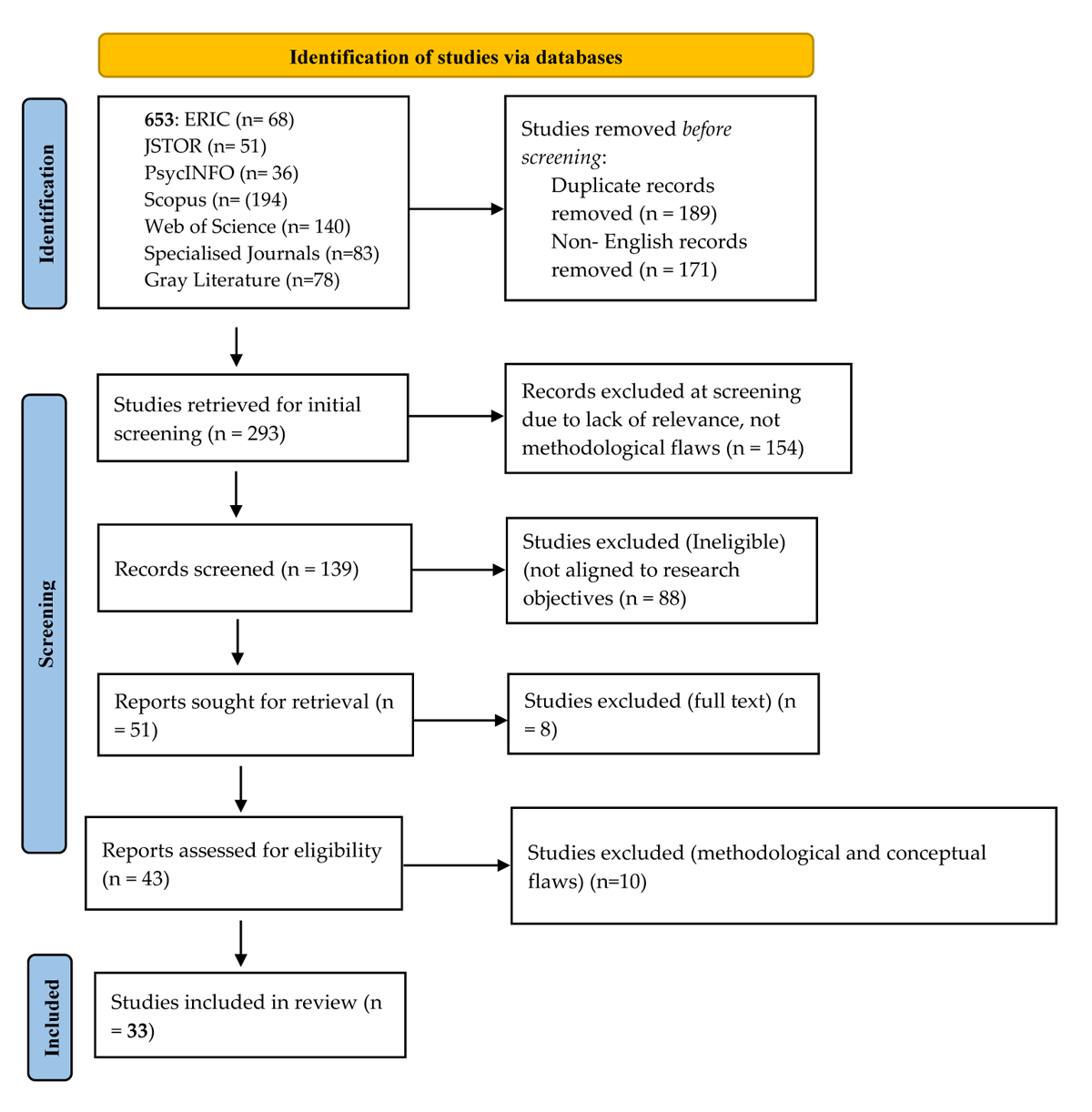
Figure 1
Flowchart of study selection process.
Table 1
Application of CASP domains in the study selection process.
| CASP DOMAIN | ASSESSMENT CRITERIA | GUIDING QUESTIONS | PRIMARY EXCLUSION GROUNDS | STUDIES EXCLUDED (n) |
|---|---|---|---|---|
| Validity (Internal Rigour) | Clarity of study aims; appropriateness of design; adequacy of sampling; transparency of data collection | Was the research aim clearly defined? Was the design methodologically appropriate? | Unclear aims, inappropriate study design, or insufficient methodological detail | 4 |
| Results (Reliability of Findings) | Analytical rigour; coherence and credibility of findings; acknowledgement of bias and limitations | Were findings clearly reported and analytically sound? | Inconsistent findings, weak analysis, or unaddressed bias | 3 |
| Applicability (Relevance and Contribution) | Alignment with review objectives; transferability of findings; practical or policy relevance | Do findings meaningfully address the review objectives and inform practice or policy? | Limited relevance, poor transferability, or unsupported conclusions | 3 |
Table 2
Systemic ethical tensions in the implementation of open science (ETI dimension).
| ETHICAL TENSION | DESCRIPTION | KEY EVIDENCE (STUDIES) | INSTITUTIONAL/GEOGRAPHIC CONTEXT |
|---|---|---|---|
| Universal openness vs contextual justice | Uniform OA policies ignore unequal capacities and epistemologies, reproducing inequity | Leonelli (2022); Raju et al. (2023); Bailey (2025) | Global South vs Global North; postcolonial research environments |
| Access vs ability to contribute | Scholars can read OA but cannot afford APCs to publish | Hadad and Aharony (2024); Heaton et al. (2019); Kankam et al. (2024) | Israel; Ghana; developing countries |
| Transparency vs privacy and dignity | Open data mandates conflict with participant privacy and cultural values | Avuglah et al. (2020); Kvale et al. (2023); Dube (2025) | Ghana; qualitative research contexts |
| Openness vs quality and integrity | Predatory journals exploit OA rhetoric, undermining scholarly trust | Manca et al. (2017); Shen and Björk (2015); Cohen et al. (2019) | India, Nigeria, biomedical sciences |
| Democratisation vs commodification | Commercial platforms (CRIS, mega-agreements) transform openness into market control | DeSanto (2023); Schöpfel et al. (2022) | UK universities; European research infrastructures |
| Inclusion vs epistemic dominance | Northern languages, journals, and standards define legitimate knowledge | Panda and Hasan (2023); Raju and Badrudeen (2022) | Sweden, US vs Africa |
Table 3
Power asymmetries in open science implementation (ETI dimension).
| POWER ASYMMETRY TYPE | MANIFESTATION | IMPACT ON OPEN SCIENCE | EVIDENCE | ETI RATING |
|---|---|---|---|---|
| Financial Resource Disparity | APCs require a month’s salary in Ghana; mega-deals consume entire library budgets | Unfunded researchers excluded from gold OA; two-tier publishing system | Kankam et al. (2024); Hadad and Aharony (2024) | High |
| Epistemic/Geographic Dominance | Sweden/US account for about 70%+ Library Science ETDs; Africa contributes about 4.14% | Global South scholarship marginalised; Northern peer review bias | Panda and Hasan (2023); Resnik and Elmore (2016) | High |
| Infrastructural Capacity Gap | Inadequate ICT facilities, internet connectivity, and IT staff in the Global South | Repository adoption failures; reliance on mediated deposits | Mbughuni et al. (2024); Kodua-Ntim (2024) | High |
| Commercial Platform Control | 10 of 12 UK institutions use commercial CRIS (Elsevier PURE, Symplectic) | Commodification of research; vendor lock-in; surveillance potential | DeSanto (2023); Schöpfel et al. (2022) | Medium |
| Peer Review Bias | Inter-rater reliability ~chance; gender, institutional prestige, geographic bias | Systematic exclusion of the Global South; less prestigious institutions are disadvantaged | Resnik and Elmore (2016); Strinzel et al. (2019) | High |
| Data Bias and AI Fairness | 47% of medical datasets contain gender bias, disproportionately affecting females | Open datasets perpetuate discrimination; 42% more fairness issues with biased data | Uddin et al. (2026) | Medium |
Table 4
Governance maturity assessment of open science initiatives (GML dimension).
| CONTEXT/INITIATIVE | GML STAGE | GOVERNANCE CHARACTERISTICS | EVIDENCE (STUDIES) |
|---|---|---|---|
| Diamond OA Platforms (UCT, continental) | Stage 4–5: Advanced/Optimised | Community governance; multilingual support; social justice framework; stakeholder co-design | Raju et al. (2023); Raju and Badrudeen (2022); Bailey (2025) |
| UK REF 2021 OA Policy | Stage 3: Developing | Structured compliance mandates; punitive enforcement; limited ethical oversight; creates a two-tier system | DeSanto (2023) |
| GISAID Data Platform | Stage 4: Advanced | User agreements protecting attribution; mediated access; addresses postcolonial power asymmetries | Leonelli (2022) |
| Tanzanian Institutional Repositories | Stage 2: Initial | Policies exist but are not implemented; low awareness; inadequate ICT infrastructure; no incentives | Mbughuni et al. (2024) |
| Ghanaian University Repositories | Stage 2: Initial | Mediated deposits undermine agency; academics are unaware that work was deposited; overburdened IT | Kodua-Ntim (2024) |
| Indian OA Mandates | Stage 2–3: Initial/Developing | Policies mandating OA deposit but no APC funding; only 16.7% define embargo periods | Nazim et al. (2023) |
| Commercial CRIS (PURE, Symplectic) | Stage 2: Initial | Ethics committees are rarely involved (20% response rate); surveillance concerns; no privacy-by-design | Schöpfel et al. (2022) |
| Predatory Journal Blacklists | Stage 1–2: Awareness/Initial | Ad hoc classification; 72 journals on both blacklists and whitelists; insufficient peer review focus | Strinzel et al. (2019) |
Table 5
Stakeholder communities and core conflicts with universal openness mandates.
| STAKEHOLDER COMMUNITY | UNIVERSAL OPENNESS EXPECTATION | EXPERIENCED CONFLICT | KEY EVIDENCE (STUDIES) |
|---|---|---|---|
| Indigenous and local knowledge communities | Data sharing and unrestricted reuse | Conflicts with epistemological traditions, communal ownership, and cultural protection | Leonelli (2022); Raju et al. (2023); Bailey (2025) |
| Global South researchers | Publish in gold OA journals; deposit in repositories | APCs require a month’s salary; no institutional funding; perceived as a ‘second-class’ green OA alternative | Kankam et al. (2024); Heaton et al. (2019); DeSanto (2023) |
| Qualitative researchers with human subjects | FAIR data principles; open data mandates | Privacy protection vs transparency; participant dignity vs reuse; ‘as open as possible, as closed as necessary’ tension | Kvale et al. (2023); Avuglah et al. (2020); Dube (2025) |
| Academic librarians | Promote OA; manage repositories; provide scholarly communication support | Insufficient budget for APCs; lack of institutional support; ‘tilting at windmills’ without national policies | Hadad and Aharony (2024); Kingsley et al. (2022) |
| Unfunded researchers and early-career scholars | Publish in high-impact OA journals for career advancement | Cannot afford APCs; vulnerable to predatory journals; APC waivers require proving disadvantage | Heaton et al. (2019); Keeler et al. (2024); Harrington and Scott (2023) |
| African scholars and institutions | Self-archive in institutional repositories; participate in global OA | Inadequate ICT infrastructure; mediated deposits undermine agency; work ‘buried, never seeing daylight’ | Mbughuni et al. (2024); Kodua-Ntim (2024); Raju et al. (2023) |
| Ethics committees | Oversight of research integrity and CRIS implementation | Rarely involved in CRIS development (20% response rate); ethics expertise excluded from open science infrastructure | Schöpfel et al. (2022) |
| Students and faculty (film studies example) | Legal access to required course materials | Copyright law prevents access; 42% download illegally; forced choice between academic success and legal compliance | Rodgers (2018) |
Table 6
Implementation equity scores for open science approaches (IES dimension).
| IMPLEMENTATION APPROACH | IES SCORE | EQUITY STRENGTHS | EQUITY LIMITATIONS |
|---|---|---|---|
| Diamond OA (no author/reader fees) | 8–10 (High) | Removes financial barriers for both sides; enables Global South participation; community governance | Limited infrastructure funding; sustainability challenges; volunteer labour dependence |
| APC-Based Gold OA | 2–3 (Low) | Immediate open access to readers | Month’s salary for a single article; unfunded researchers excluded; creates two-tier system |
| Green OA with Institutional Repositories | 4–6 (Medium) | Free for authors; preserves institutional scholarship | Perceived as ‘second class’; embargo periods; low adoption; mediated deposits undermine agency |
| Multi-tenant Shared Infrastructure | 7–9 (High) | Cost reduction; enables under-resourced institutions; regional cooperation; institutional autonomy | Requires coordination; sustainability depends on collective commitment |
| Compliance Mandates (REF 2021 model) | 3–5 (Low-Medium) | High participation rates; enforced standards | Punitive approach; funded/unfunded divide; ‘teaching to the test’; surveillance concerns |
| Mediated Access Platforms (GISAID) | 6–8 (Medium-High) | Protects against exploitation; addresses postcolonial asymmetries; builds trust | Criticised as not ‘sufficiently open’; requires user agreements |
| Commercial CRIS Platforms | 2–4 (Low) | Professional support; integration capabilities | Commodifies research; vendor lock-in; expensive; excludes less-resourced institutions; privacy concerns |
| Bias-Audited Open Datasets | 7–9 (High) | 42% fewer fairness issues; protects marginalised groups; addresses algorithmic discrimination | Limited adoption; no standardised audit requirements; resource-intensive validation |
Table 7
Emerging frameworks and governance models for responsible open science.
| FRAMEWORK/MODEL | KEY FEATURES | ADDRESSED STRUCTURAL FAILURES | EVIDENCE (STUDIES) | STAKEHOLDER FOCUS |
|---|---|---|---|---|
| Diamond Open Access Platforms | No APCs, multilingual support, community-led governance | Mitigates Global South exclusion; reduces ‘Northernisation’ of OA; supports equity and inclusion | Bailey (2025); Raju and Badrudeen (2022) | Global South researchers, unfunded scholars |
| Multi-tenant Continental Infrastructure | Shared technical platform; institutional branding; cost pooling; DSpace open-source | Addresses capacity and infrastructure gaps; enables regional cooperation; avoids vendor lock-in | Raju et al. (2023) | Under-resourced institutions |
| Mediated Access Data Governance (GISAID model) | User agreements; attribution requirements; controlled linkage; trust-building | Prevents exploitation; addresses postcolonial power asymmetries; expands participation | Leonelli (2022) | Low-resourced environments |
| Privacy-by-Design Repository Systems | Tiered access; participant dialogue; shared stewardship; GDPR compliance | Balances transparency with protection; respects participant self-image and dignity | Kvale et al. (2023); Dube (2025) | Qualitative researchers |
| Bias-Audited Dataset Curation | Gender/demographic analysis; fairness testing; bias-free certification | Prevents algorithmic discrimination; 42% fewer fairness issues with bias-free data | Uddin et al. (2026) | AI/ML researchers; marginalised groups |
| Author Rights Retention Advocacy | CC licensing; clear non-exclusive agreements; copyright education | Addresses copyright confusion; empowers authors; prevents rights exploitation | Cantrell and Wipperman (2023); Laakso and Polonioli (2018) | All researchers |
| Proactive APC Waiver Systems | Automatic application based on affiliation; removes the burden of proving disadvantage | Eliminates ‘prove you’re poor’ requirement; reduces bureaucratic barriers | Harrington and Scott (2023) | Unfunded researchers |
| Ethics-Integrated CRIS Design | Privacy-by-default; ethics committee involvement; researcher agency preservation | Addresses surveillance concerns; integrates ethical oversight from inception | Schöpfel et al. (2022) | All researchers |
Table 8
Comparative analysis: Dominant vs. equity-oriented governance models.
| GOVERNANCE DIMENSION | DOMINANT/COMMERCIAL MODELS | EQUITY-ORIENTED/COMMUNITY MODELS |
|---|---|---|
| Funding Mechanism | Article Processing Charges (APCs); subscription fees; mega-deals consuming library budgets; month’s salary for single article | Diamond OA (no author/reader fees); institutional consortia; public funding; proactive waivers |
| Publisher Ownership | Commercial corporations (Elsevier, Springer); profit-driven; shareholder accountability; commodification of research | Community-governed; university/library-led; non-profit foundations; scholar ownership; public good orientation |
| Editorial Control | Brand-based gatekeeping; Global North editorial boards; prestige hierarchies; inter-rater reliability ~chance | Distributed governance; regional representation; context-sensitive review; bias-aware processes |
| Access to Publishing | Ability-to-pay determines participation; unfunded researchers excluded; two-tier funded/unfunded system | Universal access regardless of resources; automatic waivers; no-fee models enabling Global South participation |
| Infrastructure | Commercial CRIS (PURE, Symplectic); platform lock-in; vendor dependency; expensive; excludes less-resourced institutions | Open-source software (DSpace); multi-tenant shared platforms; community support; regional cooperation |
| Language/Geographic Inclusion | English dominance; Swedish 38% of LIS ETDs; Africa 4%; Northern scholarship privileged; non-Western research seen as ‘weeds’ | Multilingual support; translation resources; validation of non-Western scholarship; decolonised content |
| Rights Retention | 43% require copyright transfer; 11% contradictory terms; authors lose control; exploitation of publicly-funded research | Author copyright retention; CC licensing; clear non-exclusive agreements; researcher empowerment |
| Ethical Oversight | Ethics committees are rarely involved (20% response); post-hoc compliance; surveillance potential; no privacy-by-design | Ethics-integrated design; privacy-by-default; stakeholder co-governance; participant dialogue |
| Quality Assurance | Traditional peer review with documented biases (gender, geographic, institutional); predatory journals exploit gaps | Bias-aware review; open review options; community evaluation; dataset fairness audits; rigorous standards |
Table 9
Mapping structural failures to mitigating approaches.
| STRUCTURAL FAILURE IN CURRENT OA | ROOT CAUSES IDENTIFIED | MITIGATING APPROACHES FROM STUDIES |
|---|---|---|
| Financial exclusion of unfunded researchers | APC funding model; mega-deals consuming budgets; no-fee journals underfunded; month’s salary per article | Diamond OA platforms (Raju et al., 2023); proactive APC waivers (Harrington and Scott, 2023); multi-tenant infrastructure |
| Predatory publishing is contaminating the scholarly record | Profit-driven exploitation; publish-or-perish pressures; 14.9–24.7% indexed in PubMed; predatory neurology journals (101) outnumber legitimate (73) | Researcher education programs; rigorous database curation with DOAJ standards; bias-aware peer review (Strinzel et al., 2019) |
| Geographic concentration (Sweden/US 70%+ ETDs; Africa 4%) | Infrastructural disparities; funding inequities; doctoral program capacity gaps; English dominance; Northern editorial bias | Regional capacity building; multilingual platforms; diamond OA removing barriers; continental shared infrastructure (Raju et al., 2023) |
| Peer review bias (gender, geographic, institutional) | Global North editorial gatekeeping; confirmatory bias; prestige hierarchies; brand-based selection; inter-rater reliability ~chance | Double-blind review; distributed editorial boards; context-sensitive criteria; community governance (Resnik and Elmore, 2016) |
| Copyright confusion and rights exploitation | Complex publisher agreements; 43% require transfer; 11% contradictory terms; researchers lack legal literacy | Author rights retention advocacy; CC licensing standardisation; institutional legal support (Cantrell and Wipperman, 2023) |
| Privacy violations in data sharing | Transparency mandates override protection; 97% privacy concerns but 50% lack adequate protections; rigid FAIR principles | Privacy-by-design systems; tiered access; participant dialogue; shared stewardship (Kvale et al., 2023; Dube, 2025) |
| Repository adoption failures and mediated deposits | Undermines agency; awareness gaps; overburdened IT; academics unaware of work deposited; no career incentives | Author self-archiving with training; policy alignment with incentives; dedicated staffing (Kodua-Ntim, 2024; Mbughuni et al., 2024) |
| Dataset bias perpetuates discrimination | 47% medical datasets gender-biased; historical exclusion reproduced; no fairness requirements; 42% more fairness issues with biased data | Mandatory bias audits; demographic representation standards; fairness certification; bias-free datasets (Uddin et al., 2026) |
| Epistemic marginalisation of Global South scholarship | English dominance; Northern editorial control; African research seen as ‘weeds’; work ‘buried, never seeing daylight’; citation hierarchies | Continental platforms validating local knowledge; decolonized content; multilingual infrastructure (Raju and Badrudeen, 2022) |
| Ethics expertise excluded from infrastructure design | Technical implementation divorced from oversight; 20% ethics committee response; CRIS developed without ethics input | Ethics-integrated design; privacy-by-default architecture; stakeholder co-governance (Schöpfel et al., 2022) |