
Introduction
The global movement toward open science has become a defining paradigm in contemporary research policy and practice. Promoted for its potential to enhance transparency, collaboration, accountability, and reproducibility, open science encompasses a suite of practices, including open access publishing, open data sharing, open methodologies, and open peer review (Leonelli, 2022; Lindemann and Häberlein, 2023). Funding agencies, academic institutions, and researchers are increasingly adopting these practices, positioning openness as a catalyst for democratising knowledge production and accelerating scientific progress (Düwell, 2019; Hosseini et al., 2022). The adoption of UNESCO’s 2021 Recommendation on Open Science by all 193 member states further solidifies openness as a normative framework in global research governance (Shaw et al., 2022; UNESCO, 2021).
However, despite significant momentum, concerns persist regarding the uneven implementation and ethical implications of open science. A 2021 report by the Research-on-Research Institute evaluated the effectiveness of coordinated open science initiatives, concluding that while there were notable increases in open access and preprint dissemination, progress in data sharing and preprint peer review remained limited. These findings underscore persistent systemic gaps in collaborative responsibility and ethical oversight (Shaw et al., 2022; Waltman et al., 2021). At the heart of these challenges lies a prevailing assumption: that the ethical underpinnings of open science are universally valid, value-neutral, and applicable across all research contexts (Fecher and Friesike, 2014; Giannelos et al., 2022; Haven et al., 2022). However, in practice, this assumption often obscures complex ethical tensions that surface when openness is enacted in varied cultural settings (Fox et al., 2021). As a result, open science implementation may perpetuate epistemic inequities and systematic exclusions in knowledge production and validation, especially in research involving Indigenous communities or other historically marginalised groups.
While advocates frequently portray open science as ethically progressive, its operationalisation can conflict with the values, norms, and epistemologies of communities situated outside dominant Western paradigms (Simm and Eigi-Watkin, 2024; Walter et al., 2021). Specifically, ethical dilemmas arise in contexts involving Indigenous knowledge systems, traditional ecological knowledge, sacred data, or identity-bound narratives. Research examining these tensions highlights three primary areas of concern: recognition of sacred knowledge (Cocq, 2023), collective ownership norms (Ewuoso et al., 2023; Khalil et al., 2022), and traditional governance systems (Williams and Hardison, 2013). These tensions are particularly pronounced in research conducted with vulnerable or marginalised populations, where the open sharing of information may breach community trust, undermine data sovereignty, or facilitate the exploitation of culturally sensitive knowledge (Resnik, 2023; Hofmann, 2022).
The uncontextualised dissemination of Indigenous health data or cultural knowledge can lead to misrepresentation and appropriation (Carroll et al., 2021; Walter et al., 2021), erosion of community trust (Dutta et al., 2021), or direct harm to knowledge holders (Kraft and Mittendorf, 2024). These risks intensify when meaningful engagement and culturally appropriate governance mechanisms are absent. Such scenarios expose the disconnect between the aspirational goals of open science and the realities of ethical research in pluralistic societies.
Exacerbating this gap is the often top-down, prescriptive enforcement of open science policies. Research funders and institutions increasingly mandate compliance with open data and access protocols but frequently do so without equipping researchers with the tools or ethical frameworks necessary for culturally sensitive decision-making (Leonelli, 2022; Lindemann and Häberlein, 2023). This ‘one-size-fits-all’ approach risks marginalising local knowledge protocols and eroding community-defined research ethics (Kraft and Mittendorf, 2024; Walter et al., 2021). Although the Centre for Open Science (COS) proposes a five-level model to foster transparency, reproducibility, and openness, its focus on behavioural change, institutional incentives, and policy alignment remains insufficient for grappling with the ethical complexities of diverse research environments (Shaw et al., 2022). The model does not adequately address the intersection of openness with epistemic justice, the fair treatment of individuals and communities as knowers, cultural diversity, or ethical pluralism, which are critical dimensions for responsible global research. Achieving meaningful openness in decentralised, culturally heterogeneous research contexts requires both structural alignment and ethical reflexivity (Shaw et al., 2022). Without inclusive frameworks, researchers face precarious dilemmas when institutional mandates conflict with principles of reciprocity, relational accountability, and cultural respect (Lilja, 2025).
Despite expanding literature on the ethics of open science, much of the discourse remains generalist or technocratic, privileging abstract principles such as transparency or limited concerns like anonymity, privacy, and individual informed consent (Cavalli, 2025; Düwell, 2019; Shaw et al., 2022). Studies rarely interrogate how cultural norms, collective ownership, or sacred knowledge systems challenge the assumptions underpinning mainstream open science frameworks (Albuquerque et al., 2025; Cavalli, 2025). Consequently, researchers lack adequate models or practical guidance for ethically navigating cross-cultural or Indigenous research contexts (Albuquerque et al., 2025; Ewuoso et al., 2023; Lilja, 2025).
This scoping review addresses this critical gap by systematically mapping the intersection between open science ethics and cultural diversity. Rather than presuming openness as a universal good, the review interrogates its ethical contingencies and limitations across varied settings. The aim is to reorient the discourse from high-level critique to actionable insights for fostering responsible, context-sensitive research. Specifically, the review aims to do the following:
Identify and map systemic ethical tensions and power asymmetries arising from the implementation of open science across diverse institutional, geographic, and socio-economic contexts.
Analyse stakeholder experiences of conflict between universal openness mandates and context-specific epistemological, resource, and ethical considerations.
Examine emerging governance and infrastructural frameworks that enable equitable, context-sensitive, and ethically responsible open science.
Materials and Methods
To ensure integrity, methodological soundness, and accountability, this scoping review was conducted in accordance with the Preferred Reporting Items for Systematic Reviews and Meta-Analyses Extension for Scoping Reviews (PRISMA-ScR) guidelines (Tricco et al., 2018). The guidelines facilitated a systematic and standardised approach to this review, encompassing all essential stages described in this section. To further enhance the robustness and credibility of the process, the study protocol was preregistered on the Open Science Framework (OSF).
Analytical framework development
To systematically examine the ethical tensions at the intersection of open science and cultural diversity, this review employed a three-dimensional analytical framework. The framework comprises the Ethical Tension Index (ETI), Governance Maturity Level (GML), and Implementation Equity Score (IES), three interdependent dimensions where ETI assesses conflict intensity (what ethical dilemmas exist), GML assesses governance capability (gaps in policy and oversight), and IES assesses fairness (how equitably openness is implemented across contexts).
These three dimensions were developed by the authors as an integrative analytical tool specifically designed for this review, drawing on established conceptual frameworks in research ethics and science governance. The ETI builds on ethical conflict typologies in cross-cultural research ethics literature (Ewuoso et al., 2023; Resnik, 2023). The GML adapts capability maturity modelling principles, notably those of the Capability Maturity Model Integration (Giannelos et al., 2022) to the domain of open science governance, applying its five-stage progression (from ad hoc awareness to optimised practice) to assess the functional sophistication of ethical oversight in open science initiatives. The IES operationalises equity assessment by aggregating documented barriers and enablers drawn from the implementation equity literature (Khalil et al., 2022; Walter et al., 2021). Each dimension was operationalised using explicit indicator sets and coding criteria, as described in detail in the subsections below.
Ethical Tension Index (ETI)
This dimension evaluated the intensity and nature of ethical conflicts through three components:
Value Conflicts: Tensions between universal openness principles and culturally specific norms, sacred knowledge systems, or collective ownership traditions. Indicators include documented incompatibility between open data mandates and community consent protocols, conflicts between transparency requirements and sacred knowledge protection, or tensions between individual attribution and collective authorship norms.
Power Asymmetries: Disparities in capacity, resources, and representation between Global North and Global South institutions, or between Indigenous and non-Indigenous researchers. Indicators include unequal access to publication infrastructure, exclusion from editorial boards or governance structures, language barriers, or capacity gaps in open science implementation.
Harm Potential: Risk of cultural appropriation, erosion of data sovereignty, breach of community trust, or misrepresentation of knowledge systems. Indicators include documented cases of knowledge exploitation, erosion of community control over data, or violations of Indigenous data sovereignty principles.
Studies were assessed for the presence or absence of these indicators across all three components. Contexts were categorised as low tension (0–3 indicators: minimal conflict, compatible values, adequate safeguards), moderate tension (4–6 indicators: emerging conflicts, partial alignment, some protective mechanisms), or high tension (7–9 indicators: severe conflicts, incompatible frameworks, inadequate protections). The threshold values were determined through pilot testing to ensure meaningful differentiation between categories whilst maintaining code reliability.
Governance Maturity Level (GML)
This dimension captured the functional sophistication of ethical governance across five stages:
Stage 1 – Awareness: Recognition of ethical issues without formal policies; ad hoc responses to conflicts; reliance on individual researcher judgement.
Stage 2 – Initial: Basic guidelines emerging; limited cultural sensitivity; minimal stakeholder engagement; policies developed without community input.
Stage 3 – Developing: Structured policies developed; community consultation protocols established; emerging Indigenous data sovereignty awareness; some enforcement mechanisms.
Stage 4 – Managed: Integrated ethical frameworks; meaningful co-governance models; culturally responsive oversight mechanisms; consistent enforcement capabilities; regular evaluation and adaptation.
Stage 5 – Optimised: Exemplary practices; community-led governance; full epistemic justice integration; demonstrated positive impact across diverse contexts; continuous innovation and improvement.
Two independent reviewers coded each study using a decision matrix outlining characteristic features of each stage. Discrepancies were resolved through consensus discussion, with a third reviewer consulted when agreement could not be reached. Inter-rater agreement for GML coding achieved Cohen’s κ = 0.79, indicating substantial agreement (McHugh, 2012).
Implementation Equity Score (IES)
This dimension assessed how equitably open science principles are implemented across diverse contexts. Reported barriers were categorised as:
Resource Disparities: Inadequate funding, infrastructure deficits, capacity gaps in marginalised institutions, or unaffordable article processing charges.
Recognition Gaps: Exclusion of non-Western epistemologies, devaluation of Indigenous knowledge, lack of culturally diverse authorship, or absence of non-English language support.
Participation Barriers: Language barriers, inaccessible platforms, limited representation in governance structures, or exclusion from editorial decision-making.
Benefit Distribution: Unequal access to the advantages of openness, appropriation risks, asymmetric knowledge flows, or exploitation of marginalised communities’ data.
Contexts were classified as high equity (0–1 barriers: equitable implementation with minimal systemic obstacles), moderate equity (2–3 barriers: some equity concerns requiring attention), or low equity (4+ systematic barriers: severe inequities requiring fundamental restructuring). For quantitative comparison, IES scores ranging from 1–10 were assigned through aggregation of barrier indicators, with higher scores indicating greater equity. These scores were calculated by assigning points for the absence of barriers and the presence of equity-enhancing features such as fee waivers, multilingual support, community governance, and equitable benefit-sharing mechanisms. Inter-rater reliability for IES coding achieved Cohen’s κ = 0.81, indicating strong agreement.
Methods for identifying and filtering sources
A comprehensive search strategy was employed to capture relevant academic and grey literature. Electronic databases included ERIC, JSTOR, PsycINFO, Web of Science, and Scopus, while key journals such as Philosophy Documentation Centre, Journal of Responsible Innovation, Science and Engineering Ethics, Ethics and Information Technology, and Science and Public Policy were reviewed. Grey literature sources included OpenGrey, ProQuest Dissertations, Theses Global, EThOS, Google Scholar, UNESCO publications, and institutional repositories. This approach ensured a broad spectrum of insights on open science ethics, cultural diversity, and responsible research practices. The search strategy was structured using the PCC (Population, Concept, Context) framework:
Population: Researchers, research institutions, Indigenous communities, marginalised populations.
Concept: Open science ethics, cultural diversity, data sovereignty, epistemic justice.
Context: Cross-cultural research, Indigenous research, Global South contexts, vulnerable populations.
Building on the PCC framework, the search protocol employed four keyword categories combined using Boolean operators. The first category, ‘Open Science Practices’, used (‘open science’ OR ‘open data’ OR ‘open access’ OR ‘open research’ OR ‘research transparency’). The second category, ‘Ethics and Values’, used (‘research ethics’ OR ‘ethical tensions’ OR ‘epistemic justice’ OR ‘ethical frameworks’ OR ‘responsible research’). The third category, ‘Cultural Diversity’, used (‘cultural diversity’ OR ‘Indigenous knowledge’ OR ‘data sovereignty’ OR ‘traditional knowledge’ OR ‘cross-cultural research’). The fourth category, ‘Governance and Implementation’, used (‘governance frameworks’ OR ‘policy implementation’ OR ‘research governance’ OR ‘ethical oversight’). These categories were combined to refine results and exclude literature reviews, systematic reviews, and meta-analyses using NOT (‘literature review’ OR ‘systematic review’ OR ‘meta-analysis’). This structured keyword strategy ensured a comprehensive and focused capture of literature, encompassing the multifaceted nature of open science ethics in diverse cultural contexts and providing a robust foundation for the scoping review.
In addition to the fundamental PCC framework, the following eligibility criteria were established to refine the literature search for this study:
Language: English only. This limitation is acknowledged as potentially reinforcing Global North perspectives and is discussed as a methodological constraint.
Publication period: January 2015 to January 2026.
Methodological and conceptual relevance: Studies with clear ethical concepts, rigorous methodologies, and findings that inform responsible open research practices across diverse cultural contexts.
The PRISMA-ScR flow diagram (Figure 1) presents the systematic processes of literature identification, screening, and study selection applied in this scoping review, in accordance with Tricco et al. (2018).
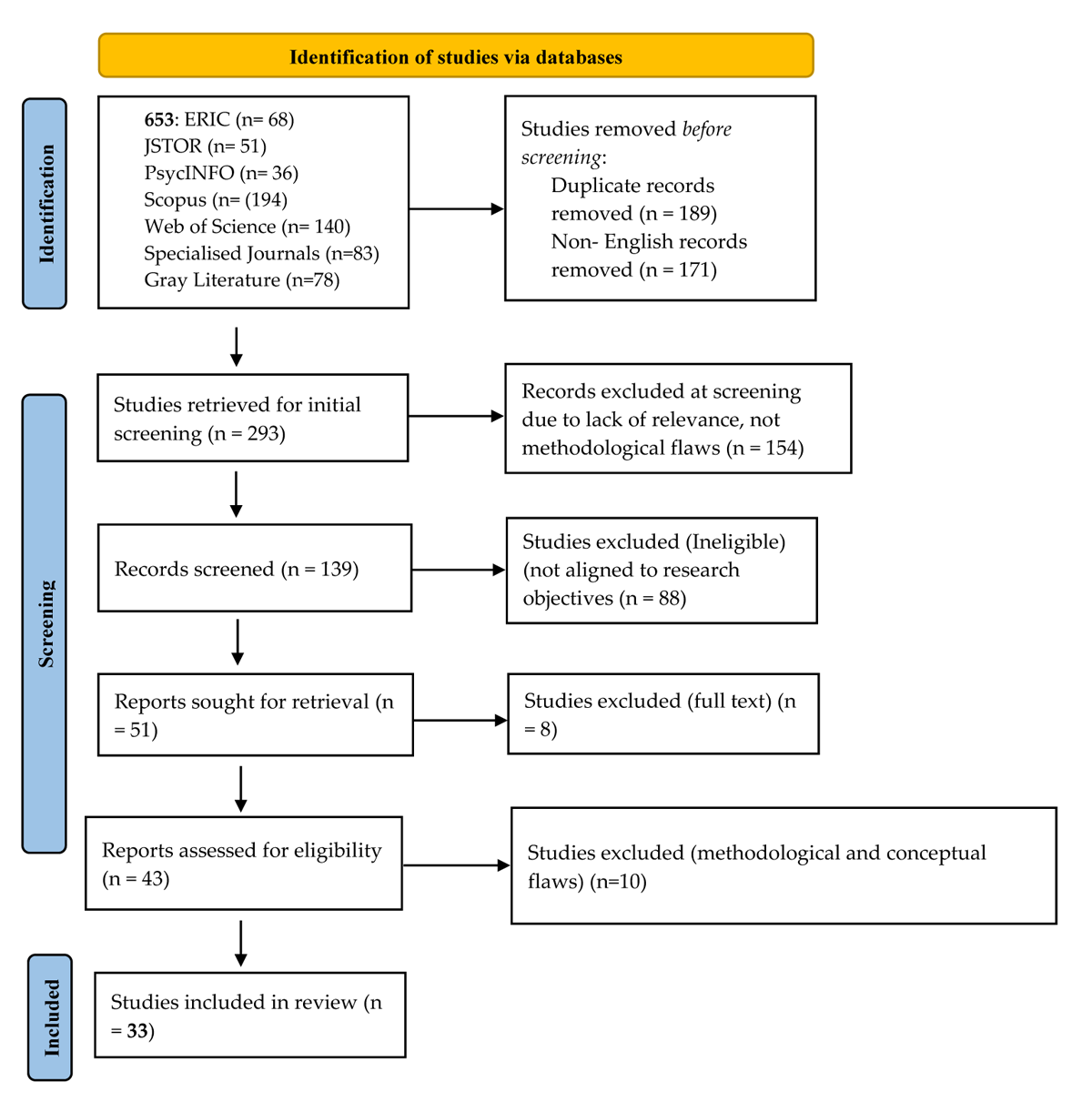
Figure 1
Flowchart of study selection process.
Study selection process
The process of study selection adhered to the PRISMA-ScR framework, ensuring methodological rigour and transparency throughout. Initial comprehensive searches across multiple databases and supplementary sources identified a total of 653 records, which were subsequently imported into Rayyan software (version 1.5.0) for deduplication (Rayyan, 2025). Through this process, 189 duplicate entries were removed, and 171 non-English records were excluded in accordance with predefined language criteria, resulting in 293 unique records eligible for subsequent screening.
Screening was performed using ASReview software (version 2.0), an open-source, machine learning-assisted platform that leverages active learning algorithms to prioritise studies according to predicted relevance (ASReview, 2025). All records flagged as potentially relevant by the algorithm were manually reviewed by two independent screeners to ensure no eligible studies were missed. During this stage, 154 studies not subjected to peer review were excluded, leaving 139 records for title and abstract assessment. A further 88 records were eliminated due to misalignment with the study’s objectives, yielding 51 studies for in-depth quality appraisal.
Quality evaluation employed the Critical Appraisal Skills Programme (CASP) checklists, which provide structured, design-specific instruments for assessing the validity, reliability, and applicability of research (CASP, 2025). Specific checklists were applied according to study design: the Qualitative Studies Checklist for ethnographic and interview studies, the Systematic Review Checklist for evidence syntheses, the Cohort Study Checklist for longitudinal analyses, and the Case Control Study Checklist for comparative investigations. During this appraisal, eight studies were excluded because full texts were inaccessible or incomplete, whilst ten additional studies were removed due to methodological or conceptual limitations, including a suboptimal study design, insufficient evidence, or a lack of theoretical coherence. CASP appraisal was conducted across three domains: validity, results, and applicability, each addressing essential aspects of methodological integrity and practical significance (CASP, 2025).Table 1 presents the operationalisation of these domains, the guiding questions applied, and the studies excluded at each stage.
Table 1
Application of CASP domains in the study selection process.
| CASP DOMAIN | ASSESSMENT CRITERIA | GUIDING QUESTIONS | PRIMARY EXCLUSION GROUNDS | STUDIES EXCLUDED (n) |
|---|---|---|---|---|
| Validity (Internal Rigour) | Clarity of study aims; appropriateness of design; adequacy of sampling; transparency of data collection | Was the research aim clearly defined? Was the design methodologically appropriate? | Unclear aims, inappropriate study design, or insufficient methodological detail | 4 |
| Results (Reliability of Findings) | Analytical rigour; coherence and credibility of findings; acknowledgement of bias and limitations | Were findings clearly reported and analytically sound? | Inconsistent findings, weak analysis, or unaddressed bias | 3 |
| Applicability (Relevance and Contribution) | Alignment with review objectives; transferability of findings; practical or policy relevance | Do findings meaningfully address the review objectives and inform practice or policy? | Limited relevance, poor transferability, or unsupported conclusions | 3 |
The review included 33 studies that satisfied methodological rigour and conceptual relevance, forming the foundation of the final evidence base.
Inter-rater reliability and consistency
To ensure methodological rigour and minimise subjective bias, inter-rater reliability was maintained throughout study selection and appraisal. Two independent reviewers screened titles, abstracts, and full texts against predefined inclusion and exclusion criteria. Cohen’s Kappa (κ = 0.84), calculated from independent screening of all records, indicated strong agreement (Li et al., 2023). Discrepancies were resolved through discussion, with a third reviewer consulted when consensus could not be reached (Tricco et al., 2018). Consistency was further reinforced during the application of CASP appraisal checklists and analytical framework coding, with both reviewers independently evaluating all dimensions (ETI: κ = 0.81; GML: κ = 0.79; IES: κ = 0.81). Patterns in disagreements were documented, revealing that most discrepancies arose in borderline cases where studies exhibited characteristics of multiple categories. These cases were resolved through reference to the framework development criteria and expert consultation. This iterative process of independent review, cross-checking, and consensus ensured that study selection and coding were systematic, transparent, and reproducible, enhancing the trustworthiness of the evidence base.
Data extraction and charting
A structured data extraction framework guided by the analytical dimensions was used. Key extracted information included the following:
Bibliographic details: Author, year, journal/source, country, institutional affiliation.
Study context: Research type, disciplinary focus, cultural setting, participant demographics.
Ethical dimensions: Types of tensions, value conflicts, power dynamics, harm potential.
Governance characteristics: Policy frameworks, oversight mechanisms, stakeholder engagement models, and community consent processes.
Implementation equity: Resource distribution, recognition patterns, participation barriers, benefit flows.
Standards alignment: Findable, Accessible, Interoperable, and Reusable (FAIR) principles adaptation, Collective Benefit, Authority to Control, Responsibility, and Ethics Principles (CARE) principles compliance, UNESCO recommendations, Indigenous data sovereignty protocols.
Analytical framework indicators: ETI, GML, IES scores and categorisations.
Key findings: Emergent tensions, governance innovations, equity gaps, promising practices.
The extraction framework was pilot-tested with five studies and refined for clarity and feasibility, ensuring clear distinctions between reported versus measured ethical tensions and between aspirational policies and actual practices. Data were charted in both tabular and narrative formats to highlight patterns across study contexts, cultural settings, and governance approaches. The complete data extraction template is provided in the Supplementary Materials.
Data synthesis and analysis
Data were synthesised using descriptive and thematic approaches consistent with scoping review methodology:
Descriptive analysis: Summarised publication year, geographic distribution, institutional types, research domains, and cultural contexts.
Thematic analysis: Identified recurring ethical tensions, value conflicts, governance challenges, and equity patterns through iterative coding.
Framework coding: Positioned studies along ETI, GML, and IES dimensions to enable systematic comparison.
Triangulating quantitative and qualitative findings revealed consistencies, discrepancies, and gaps, with emphasis on geographic and cultural patterns. Critical analysis assessed whether reported tensions reflected genuine ethical conflicts or implementation shortcomings and whether governance innovations yielded measurable improvements in equity and cultural responsiveness. Analysis also examined relationships among the three framework dimensions, investigating whether high ETI contexts systematically exhibited low GML or IES scores, and whether certain governance approaches proved more effective in specific contexts. All procedures were systematically documented to ensure transparency, reproducibility, and adherence to PRISMA-ScR guidelines.
Triangulation across the three dimensions proceeded as follows: each included study was first coded independently against all three dimensions (ETI, GML, and IES). Studies yielding qualitative evidence (e.g., ethnographic accounts, interview findings, policy analyses) were assessed for the presence of ETI indicators and GML stage characteristics through thematic analysis. Studies yielding quantitative evidence (e.g., survey data, bibliometric counts, inter-rater reliability statistics) were used to assign IES scores and to validate ETI and GML categorisations. Convergence was assessed by examining whether qualitative and quantitative evidence from the same study pointed toward the same dimensional classifications; divergences were documented and discussed. Cross-dimensional synthesis then examined whether studies with high ETI ratings also exhibited low GML and IES scores and whether governance models rated at higher GML stages corresponded to improved IES outcomes. This multi-dimensional approach enabled systematic comparison across the thematically distinct result tables (Tables 2, 3, 4, 5, 6, 7, 8, 9), linking each table’s focus, ethical tensions, power asymmetries, governance maturity, stakeholder experiences, equity scores, and emerging frameworks into a coherent evidence base.
Results
The results are organised to address each research objective systematically using the analytical framework dimensions: Ethical Tension Index (ETI), Governance Maturity Level (GML), and Implementation Equity Score (IES). Tables 1, 2, 3 present findings related to systemic ethical tensions and power asymmetries (Objective 1), Tables 4, 5 examine stakeholder experiences and conflicts (Objective 2), and Tables 6, 7, 8 synthesise emerging frameworks and governance models (Objective 3).
Systemic ethical tensions and power asymmetries in the implementation of open science
This subsection presents findings related to Research Objective 1 by mapping the systemic ethical tensions and power asymmetries that emerge from the implementation of open science across diverse institutional, geographic, and socio-economic contexts, as identified through the scoping review. The findings are organised according to the ETI and GML dimensions of the analytical framework.
Table 2 summarises the principal systemic ethical tensions identified in the review, illustrating how universal open science policies intersect with contextual realities to produce inequities, ethical conflicts, and uneven research participation across regions and institutions. These tensions reflect the ETI dimension of the analytical framework, demonstrating that conflicts arise not from openness as an abstract ideal, but from specific economic, epistemic, and governance arrangements that structure its implementation.
Table 2
Systemic ethical tensions in the implementation of open science (ETI dimension).
| ETHICAL TENSION | DESCRIPTION | KEY EVIDENCE (STUDIES) | INSTITUTIONAL/GEOGRAPHIC CONTEXT |
|---|---|---|---|
| Universal openness vs contextual justice | Uniform OA policies ignore unequal capacities and epistemologies, reproducing inequity | Leonelli (2022); Raju et al. (2023); Bailey (2025) | Global South vs Global North; postcolonial research environments |
| Access vs ability to contribute | Scholars can read OA but cannot afford APCs to publish | Hadad and Aharony (2024); Heaton et al. (2019); Kankam et al. (2024) | Israel; Ghana; developing countries |
| Transparency vs privacy and dignity | Open data mandates conflict with participant privacy and cultural values | Avuglah et al. (2020); Kvale et al. (2023); Dube (2025) | Ghana; qualitative research contexts |
| Openness vs quality and integrity | Predatory journals exploit OA rhetoric, undermining scholarly trust | Manca et al. (2017); Shen and Björk (2015); Cohen et al. (2019) | India, Nigeria, biomedical sciences |
| Democratisation vs commodification | Commercial platforms (CRIS, mega-agreements) transform openness into market control | DeSanto (2023); Schöpfel et al. (2022) | UK universities; European research infrastructures |
| Inclusion vs epistemic dominance | Northern languages, journals, and standards define legitimate knowledge | Panda and Hasan (2023); Raju and Badrudeen (2022) | Sweden, US vs Africa |
Table 3 details the specific power asymmetries that underpin the ethical tensions identified in Table 2, demonstrating how resource disparities, geographic dominance, infrastructural gaps, and systemic biases create uneven participation in open science. The ETI ratings indicate the severity of ethical conflict associated with each asymmetry, with ‘High’ ratings reflecting severe conflicts, incompatible frameworks, and inadequate protections.
Table 3
Power asymmetries in open science implementation (ETI dimension).
| POWER ASYMMETRY TYPE | MANIFESTATION | IMPACT ON OPEN SCIENCE | EVIDENCE | ETI RATING |
|---|---|---|---|---|
| Financial Resource Disparity | APCs require a month’s salary in Ghana; mega-deals consume entire library budgets | Unfunded researchers excluded from gold OA; two-tier publishing system | Kankam et al. (2024); Hadad and Aharony (2024) | High |
| Epistemic/Geographic Dominance | Sweden/US account for about 70%+ Library Science ETDs; Africa contributes about 4.14% | Global South scholarship marginalised; Northern peer review bias | Panda and Hasan (2023); Resnik and Elmore (2016) | High |
| Infrastructural Capacity Gap | Inadequate ICT facilities, internet connectivity, and IT staff in the Global South | Repository adoption failures; reliance on mediated deposits | Mbughuni et al. (2024); Kodua-Ntim (2024) | High |
| Commercial Platform Control | 10 of 12 UK institutions use commercial CRIS (Elsevier PURE, Symplectic) | Commodification of research; vendor lock-in; surveillance potential | DeSanto (2023); Schöpfel et al. (2022) | Medium |
| Peer Review Bias | Inter-rater reliability ~chance; gender, institutional prestige, geographic bias | Systematic exclusion of the Global South; less prestigious institutions are disadvantaged | Resnik and Elmore (2016); Strinzel et al. (2019) | High |
| Data Bias and AI Fairness | 47% of medical datasets contain gender bias, disproportionately affecting females | Open datasets perpetuate discrimination; 42% more fairness issues with biased data | Uddin et al. (2026) | Medium |
Table 4 applies the GML dimension of the analytical framework to assess the functional sophistication of ethical governance across different open science contexts and initiatives. The GML stages range from Stage 1 (Awareness) through Stage 5 (Optimised), with the higher stages indicating more developed governance structures, stakeholder engagement, and ethical oversight. The findings reveal significant variation in governance maturity, with diamond OA platforms and mediated access systems demonstrating advanced governance, while commercial CRIS and predatory journal responses remain at early stages.
Table 4
Governance maturity assessment of open science initiatives (GML dimension).
| CONTEXT/INITIATIVE | GML STAGE | GOVERNANCE CHARACTERISTICS | EVIDENCE (STUDIES) |
|---|---|---|---|
| Diamond OA Platforms (UCT, continental) | Stage 4–5: Advanced/Optimised | Community governance; multilingual support; social justice framework; stakeholder co-design | Raju et al. (2023); Raju and Badrudeen (2022); Bailey (2025) |
| UK REF 2021 OA Policy | Stage 3: Developing | Structured compliance mandates; punitive enforcement; limited ethical oversight; creates a two-tier system | DeSanto (2023) |
| GISAID Data Platform | Stage 4: Advanced | User agreements protecting attribution; mediated access; addresses postcolonial power asymmetries | Leonelli (2022) |
| Tanzanian Institutional Repositories | Stage 2: Initial | Policies exist but are not implemented; low awareness; inadequate ICT infrastructure; no incentives | Mbughuni et al. (2024) |
| Ghanaian University Repositories | Stage 2: Initial | Mediated deposits undermine agency; academics are unaware that work was deposited; overburdened IT | Kodua-Ntim (2024) |
| Indian OA Mandates | Stage 2–3: Initial/Developing | Policies mandating OA deposit but no APC funding; only 16.7% define embargo periods | Nazim et al. (2023) |
| Commercial CRIS (PURE, Symplectic) | Stage 2: Initial | Ethics committees are rarely involved (20% response rate); surveillance concerns; no privacy-by-design | Schöpfel et al. (2022) |
| Predatory Journal Blacklists | Stage 1–2: Awareness/Initial | Ad hoc classification; 72 journals on both blacklists and whitelists; insufficient peer review focus | Strinzel et al. (2019) |
Stakeholder experiences of conflict between universal openness mandates and contextual realities
This subsection reports findings related to Research Objective 2 by examining how different stakeholder communities experience and negotiate conflicts between universal open science mandates and their specific epistemological frameworks, resource constraints, and ethical priorities. The findings are organised according to the IES dimension of the analytical framework.
Table 5 presents an overview of key stakeholder communities identified in the literature and summarises the core conflicts they experience when universal openness expectations intersect with local knowledge systems, material conditions, and ethical obligations. The findings reveal that conflicts are not isolated to specific groups but represent systemic tensions affecting diverse stakeholders across geographic, disciplinary, and institutional contexts.
Table 5
Stakeholder communities and core conflicts with universal openness mandates.
| STAKEHOLDER COMMUNITY | UNIVERSAL OPENNESS EXPECTATION | EXPERIENCED CONFLICT | KEY EVIDENCE (STUDIES) |
|---|---|---|---|
| Indigenous and local knowledge communities | Data sharing and unrestricted reuse | Conflicts with epistemological traditions, communal ownership, and cultural protection | Leonelli (2022); Raju et al. (2023); Bailey (2025) |
| Global South researchers | Publish in gold OA journals; deposit in repositories | APCs require a month’s salary; no institutional funding; perceived as a ‘second-class’ green OA alternative | Kankam et al. (2024); Heaton et al. (2019); DeSanto (2023) |
| Qualitative researchers with human subjects | FAIR data principles; open data mandates | Privacy protection vs transparency; participant dignity vs reuse; ‘as open as possible, as closed as necessary’ tension | Kvale et al. (2023); Avuglah et al. (2020); Dube (2025) |
| Academic librarians | Promote OA; manage repositories; provide scholarly communication support | Insufficient budget for APCs; lack of institutional support; ‘tilting at windmills’ without national policies | Hadad and Aharony (2024); Kingsley et al. (2022) |
| Unfunded researchers and early-career scholars | Publish in high-impact OA journals for career advancement | Cannot afford APCs; vulnerable to predatory journals; APC waivers require proving disadvantage | Heaton et al. (2019); Keeler et al. (2024); Harrington and Scott (2023) |
| African scholars and institutions | Self-archive in institutional repositories; participate in global OA | Inadequate ICT infrastructure; mediated deposits undermine agency; work ‘buried, never seeing daylight’ | Mbughuni et al. (2024); Kodua-Ntim (2024); Raju et al. (2023) |
| Ethics committees | Oversight of research integrity and CRIS implementation | Rarely involved in CRIS development (20% response rate); ethics expertise excluded from open science infrastructure | Schöpfel et al. (2022) |
| Students and faculty (film studies example) | Legal access to required course materials | Copyright law prevents access; 42% download illegally; forced choice between academic success and legal compliance | Rodgers (2018) |
Table 6 applies the IES dimension of the analytical framework to assess how equitably different open science approaches distribute benefits, burdens, and opportunities across diverse stakeholder communities. IES scores range from 1-10, with higher scores indicating greater equity in implementation. The findings reveal that approaches grounded in community governance and non-commercial logics (diamond OA, multi-tenant infrastructure, bias-audited datasets) achieve substantially higher equity scores than market-driven or compliance-focused models.
Table 6
Implementation equity scores for open science approaches (IES dimension).
| IMPLEMENTATION APPROACH | IES SCORE | EQUITY STRENGTHS | EQUITY LIMITATIONS |
|---|---|---|---|
| Diamond OA (no author/reader fees) | 8–10 (High) | Removes financial barriers for both sides; enables Global South participation; community governance | Limited infrastructure funding; sustainability challenges; volunteer labour dependence |
| APC-Based Gold OA | 2–3 (Low) | Immediate open access to readers | Month’s salary for a single article; unfunded researchers excluded; creates two-tier system |
| Green OA with Institutional Repositories | 4–6 (Medium) | Free for authors; preserves institutional scholarship | Perceived as ‘second class’; embargo periods; low adoption; mediated deposits undermine agency |
| Multi-tenant Shared Infrastructure | 7–9 (High) | Cost reduction; enables under-resourced institutions; regional cooperation; institutional autonomy | Requires coordination; sustainability depends on collective commitment |
| Compliance Mandates (REF 2021 model) | 3–5 (Low-Medium) | High participation rates; enforced standards | Punitive approach; funded/unfunded divide; ‘teaching to the test’; surveillance concerns |
| Mediated Access Platforms (GISAID) | 6–8 (Medium-High) | Protects against exploitation; addresses postcolonial asymmetries; builds trust | Criticised as not ‘sufficiently open’; requires user agreements |
| Commercial CRIS Platforms | 2–4 (Low) | Professional support; integration capabilities | Commodifies research; vendor lock-in; expensive; excludes less-resourced institutions; privacy concerns |
| Bias-Audited Open Datasets | 7–9 (High) | 42% fewer fairness issues; protects marginalised groups; addresses algorithmic discrimination | Limited adoption; no standardised audit requirements; resource-intensive validation |
Reconfiguring open science: Emerging frameworks and governance models for ethical and equitable openness
This section addresses Research Objective 3 by examining how emerging frameworks, governance models, and infrastructural approaches respond to the ethical tensions and structural failures identified in prevailing open science implementations. The findings integrate all three analytical framework dimensions (ETI, GML, IES) to assess how proposed solutions address both the intensity of ethical conflicts and the equity of implementation outcomes.
Table 7 summarises emerging frameworks and governance models designed to address structural inequities and ethical shortcomings in current open science practices. These approaches demonstrate higher GML stages (3–5) and improved IES scores (6–10) compared to dominant commercial models, indicating more mature governance and more equitable implementation. The frameworks prioritise community governance, non-commercial logics, and context-sensitive design that directly addresses the power asymmetries and ethical tensions documented in Tables 2, 3.
Table 7
Emerging frameworks and governance models for responsible open science.
| FRAMEWORK/MODEL | KEY FEATURES | ADDRESSED STRUCTURAL FAILURES | EVIDENCE (STUDIES) | STAKEHOLDER FOCUS |
|---|---|---|---|---|
| Diamond Open Access Platforms | No APCs, multilingual support, community-led governance | Mitigates Global South exclusion; reduces ‘Northernisation’ of OA; supports equity and inclusion | Bailey (2025); Raju and Badrudeen (2022) | Global South researchers, unfunded scholars |
| Multi-tenant Continental Infrastructure | Shared technical platform; institutional branding; cost pooling; DSpace open-source | Addresses capacity and infrastructure gaps; enables regional cooperation; avoids vendor lock-in | Raju et al. (2023) | Under-resourced institutions |
| Mediated Access Data Governance (GISAID model) | User agreements; attribution requirements; controlled linkage; trust-building | Prevents exploitation; addresses postcolonial power asymmetries; expands participation | Leonelli (2022) | Low-resourced environments |
| Privacy-by-Design Repository Systems | Tiered access; participant dialogue; shared stewardship; GDPR compliance | Balances transparency with protection; respects participant self-image and dignity | Kvale et al. (2023); Dube (2025) | Qualitative researchers |
| Bias-Audited Dataset Curation | Gender/demographic analysis; fairness testing; bias-free certification | Prevents algorithmic discrimination; 42% fewer fairness issues with bias-free data | Uddin et al. (2026) | AI/ML researchers; marginalised groups |
| Author Rights Retention Advocacy | CC licensing; clear non-exclusive agreements; copyright education | Addresses copyright confusion; empowers authors; prevents rights exploitation | Cantrell and Wipperman (2023); Laakso and Polonioli (2018) | All researchers |
| Proactive APC Waiver Systems | Automatic application based on affiliation; removes the burden of proving disadvantage | Eliminates ‘prove you’re poor’ requirement; reduces bureaucratic barriers | Harrington and Scott (2023) | Unfunded researchers |
| Ethics-Integrated CRIS Design | Privacy-by-default; ethics committee involvement; researcher agency preservation | Addresses surveillance concerns; integrates ethical oversight from inception | Schöpfel et al. (2022) | All researchers |
Table 8 provides a detailed comparative analysis across key governance dimensions, demonstrating fundamental differences between market-driven and equity-oriented approaches to open science. The comparison reveals that equity-oriented models systematically address the ETI conflicts identified in Table 2 by shifting away from commercial control toward community governance, from ability-to-pay barriers toward universal access, and from Northern dominance toward multilingual, regionally inclusive infrastructure. These structural differences correspond to the GML advancement from Stages 1–3 (dominant models) to Stages 4–5 (equity-oriented models) and explain the IES score differences observed in Table 6.
Table 8
Comparative analysis: Dominant vs. equity-oriented governance models.
| GOVERNANCE DIMENSION | DOMINANT/COMMERCIAL MODELS | EQUITY-ORIENTED/COMMUNITY MODELS |
|---|---|---|
| Funding Mechanism | Article Processing Charges (APCs); subscription fees; mega-deals consuming library budgets; month’s salary for single article | Diamond OA (no author/reader fees); institutional consortia; public funding; proactive waivers |
| Publisher Ownership | Commercial corporations (Elsevier, Springer); profit-driven; shareholder accountability; commodification of research | Community-governed; university/library-led; non-profit foundations; scholar ownership; public good orientation |
| Editorial Control | Brand-based gatekeeping; Global North editorial boards; prestige hierarchies; inter-rater reliability ~chance | Distributed governance; regional representation; context-sensitive review; bias-aware processes |
| Access to Publishing | Ability-to-pay determines participation; unfunded researchers excluded; two-tier funded/unfunded system | Universal access regardless of resources; automatic waivers; no-fee models enabling Global South participation |
| Infrastructure | Commercial CRIS (PURE, Symplectic); platform lock-in; vendor dependency; expensive; excludes less-resourced institutions | Open-source software (DSpace); multi-tenant shared platforms; community support; regional cooperation |
| Language/Geographic Inclusion | English dominance; Swedish 38% of LIS ETDs; Africa 4%; Northern scholarship privileged; non-Western research seen as ‘weeds’ | Multilingual support; translation resources; validation of non-Western scholarship; decolonised content |
| Rights Retention | 43% require copyright transfer; 11% contradictory terms; authors lose control; exploitation of publicly-funded research | Author copyright retention; CC licensing; clear non-exclusive agreements; researcher empowerment |
| Ethical Oversight | Ethics committees are rarely involved (20% response); post-hoc compliance; surveillance potential; no privacy-by-design | Ethics-integrated design; privacy-by-default; stakeholder co-governance; participant dialogue |
| Quality Assurance | Traditional peer review with documented biases (gender, geographic, institutional); predatory journals exploit gaps | Bias-aware review; open review options; community evaluation; dataset fairness audits; rigorous standards |
Table 9 consolidates findings across all three research objectives by mapping the structural failures identified through the ETI and stakeholder conflict analysis (Objectives 1–2) to the specific mitigating approaches documented in the literature (Objective 3). This synthesis demonstrates that structural failures in open science are not inherent to openness itself but arise from specific economic arrangements (APC models), epistemic hierarchies (Northern editorial control), governance deficits (ethics committee exclusion), and infrastructural inequities (mediated deposits, ICT gaps). The table shows that targeted, context-sensitive interventions aligned with equity-oriented governance can meaningfully mitigate these failures when implemented at appropriate GML stages with attention to IES outcomes. The evidence base indicates that approaches scoring highest on IES (diamond OA, multi-tenant infrastructure, bias-audited datasets, privacy-by-design systems) also demonstrate the most advanced GML characteristics and most effectively address the high-ETI conflicts documented in the stakeholder experiences.
Table 9
Mapping structural failures to mitigating approaches.
| STRUCTURAL FAILURE IN CURRENT OA | ROOT CAUSES IDENTIFIED | MITIGATING APPROACHES FROM STUDIES |
|---|---|---|
| Financial exclusion of unfunded researchers | APC funding model; mega-deals consuming budgets; no-fee journals underfunded; month’s salary per article | Diamond OA platforms (Raju et al., 2023); proactive APC waivers (Harrington and Scott, 2023); multi-tenant infrastructure |
| Predatory publishing is contaminating the scholarly record | Profit-driven exploitation; publish-or-perish pressures; 14.9–24.7% indexed in PubMed; predatory neurology journals (101) outnumber legitimate (73) | Researcher education programs; rigorous database curation with DOAJ standards; bias-aware peer review (Strinzel et al., 2019) |
| Geographic concentration (Sweden/US 70%+ ETDs; Africa 4%) | Infrastructural disparities; funding inequities; doctoral program capacity gaps; English dominance; Northern editorial bias | Regional capacity building; multilingual platforms; diamond OA removing barriers; continental shared infrastructure (Raju et al., 2023) |
| Peer review bias (gender, geographic, institutional) | Global North editorial gatekeeping; confirmatory bias; prestige hierarchies; brand-based selection; inter-rater reliability ~chance | Double-blind review; distributed editorial boards; context-sensitive criteria; community governance (Resnik and Elmore, 2016) |
| Copyright confusion and rights exploitation | Complex publisher agreements; 43% require transfer; 11% contradictory terms; researchers lack legal literacy | Author rights retention advocacy; CC licensing standardisation; institutional legal support (Cantrell and Wipperman, 2023) |
| Privacy violations in data sharing | Transparency mandates override protection; 97% privacy concerns but 50% lack adequate protections; rigid FAIR principles | Privacy-by-design systems; tiered access; participant dialogue; shared stewardship (Kvale et al., 2023; Dube, 2025) |
| Repository adoption failures and mediated deposits | Undermines agency; awareness gaps; overburdened IT; academics unaware of work deposited; no career incentives | Author self-archiving with training; policy alignment with incentives; dedicated staffing (Kodua-Ntim, 2024; Mbughuni et al., 2024) |
| Dataset bias perpetuates discrimination | 47% medical datasets gender-biased; historical exclusion reproduced; no fairness requirements; 42% more fairness issues with biased data | Mandatory bias audits; demographic representation standards; fairness certification; bias-free datasets (Uddin et al., 2026) |
| Epistemic marginalisation of Global South scholarship | English dominance; Northern editorial control; African research seen as ‘weeds’; work ‘buried, never seeing daylight’; citation hierarchies | Continental platforms validating local knowledge; decolonized content; multilingual infrastructure (Raju and Badrudeen, 2022) |
| Ethics expertise excluded from infrastructure design | Technical implementation divorced from oversight; 20% ethics committee response; CRIS developed without ethics input | Ethics-integrated design; privacy-by-default architecture; stakeholder co-governance (Schöpfel et al., 2022) |
Discussion
The findings of this scoping review reveal profound tensions between the universal aspirations of open science and the contextual realities of diverse research environments. While proponents position open science as a normatively neutral framework that democratises knowledge production (UNESCO, 2021), the evidence demonstrates that its operationalisation systematically privileges Western epistemologies, well-resourced institutions, and commercial publishing infrastructures (Shaw et al., 2022). The persistent gap between policy rhetoric and implementation outcomes suggests that openness, as currently configured, functions less as a universal good than as a culturally specific arrangement that reproduces existing epistemic hierarchies (Walter et al., 2021). This pattern is particularly evident in contexts involving Indigenous knowledge systems, where mandated data sharing conflicts fundamentally with collective ownership norms, sacred knowledge protocols, and traditional governance structures (Ewuoso et al., 2023; Williams and Hardison, 2013). It is important to note that these two observations are compatible rather than contradictory. Table 9 demonstrates that structural failures are not inherent to the ideal of openness itself (Giannelos et al., 2022; Hosseini et al., 2022); the principle that knowledge should be accessible and shared is not the source of harm. What produces harm is the specific economic, epistemic, and governance architecture through which openness is currently operationalised, one that encodes culturally particular assumptions as universal requirements (Leonelli, 2022; Walter et al., 2021; Simm and Eigi-Watkin, 2024). The claim that openness is a “culturally specific arrangement” is, therefore, a diagnosis of its present configuration, not a rejection of its aspirational potential (Fecher and Friesike, 2014; Düwell, 2019). Openness remains a worthwhile ideal; the challenge is to reconstitute it through pluralistic, community-governed frameworks that do not presuppose a single epistemological tradition as the default (Ewuoso et al., 2023; Raju et al., 2023; Khalil et al., 2022; UNESCO, 2021).
The systematic analysis of power asymmetries exposes how resource disparities translate into epistemic exclusions. Article processing charges, infrastructural deficits, and language barriers do not merely constrain participation; they determine whose knowledge enters the scholarly record and whose remains marginalised (Lindemann and Häberlein, 2023). The dominance of Global North institutions in editorial control, peer review networks, and policy development perpetuates a unidirectional knowledge flow that extracts intellectual labour and data from Global South whilst concentrating recognition and citation advantages in well-resourced centres (Leonelli, 2022). This asymmetry challenges the foundational claim that open science enhances equity, suggesting instead that without structural intervention, openness may amplify existing inequalities rather than ameliorate them (Düwell, 2019).
The governance maturity assessment reveals that most open science initiatives remain in early stages of ethical development, characterised by awareness of tensions but no functional mechanisms to address them (Shaw et al., 2022). Institutional policies frequently mandate compliance with transparency protocols but provide neither the resources nor the ethical frameworks necessary for culturally sensitive implementation (Kraft and Mittendorf, 2024). This governance deficit is particularly consequential in research involving vulnerable populations, where the absence of meaningful community engagement, co-governance structures, and culturally responsive oversight leaves researchers navigating complex ethical terrain without adequate guidance (Lilja, 2025). The tension between institutional mandates and relational accountability obligations places individual researchers in precarious positions, forced to choose between compliance and ethical responsibility (Fox et al., 2021).
The stakeholder conflict analysis demonstrates that these tensions are not isolated incidents but systematic manifestations of a fundamental mismatch between open science’s universalist assumptions and the epistemological pluralism of global research communities (Simm and Eigi-Watkin, 2024). Indigenous researchers consistently report conflicts between open data mandates and community sovereignty, between transparency requirements and sacred knowledge protection, and between individual attribution norms and collective authorship traditions (Carroll et al., 2021). These conflicts intensify when research involves traditional ecological knowledge, health data, or cultural narratives, where uncontextualised dissemination risks appropriation, misrepresentation, and direct harm to knowledge holders (Cocq, 2023; Resnik, 2023). The persistence of these tensions across diverse geographic and disciplinary contexts suggests that current open science frameworks lack the conceptual architecture necessary to accommodate non-Western ways of knowing (Albuquerque et al., 2025; Cavalli, 2025).
The emergence of equity-oriented governance models offers a counterpoint to dominant commercial approaches. Diamond open access platforms, multi-tenant infrastructure initiatives, and community-controlled data repositories demonstrate that alternative configurations are both feasible and functional (Hosseini et al., 2022). These models systematically address the structural failures identified in the analysis by shifting from ability-to-pay barriers to universal access, from Northern editorial control to regionally inclusive governance, and from individual consent frameworks to collective data sovereignty protocols (Khalil et al., 2022). The higher implementation equity scores and advanced governance maturity levels achieved by these alternatives indicate that the tensions documented in this review are not inherent to openness itself but arise from specific economic arrangements, epistemic hierarchies, and governance deficits that can be reconfigured (Giannelos et al., 2022).
Yet the persistence of market-driven models despite available alternatives raises critical questions about the political economy of scholarly communication and the vested interests that sustain inequitable arrangements (Fecher and Friesike, 2014). The findings suggest that achieving equitable open science requires not merely technical adjustments or policy refinements but fundamental restructuring of the institutional, economic, and epistemic architectures that govern knowledge production (Leonelli, 2022). Without such transformation, open science risks becoming another mechanism through which dominant paradigms secure their legitimacy whilst marginalising alternative knowledge systems (Dutta et al., 2021).
Conclusions and Recommendations
This scoping review establishes that the implementation of open science across diverse contexts generates systematic ethical tensions that cannot be resolved through technical standardisation or policy harmonisation alone. The evidence demonstrates that openness, as currently configured, embeds culturally specific assumptions about knowledge ownership, epistemic authority, and research ethics that conflict fundamentally with Indigenous knowledge systems, collective governance traditions, and non-Western epistemologies. These conflicts are not incidental implementation challenges but structural features of open science frameworks that privilege individual attribution, transparent dissemination, and Western notions of public knowledge over alternative models of collective stewardship, sacred confidentiality, and community-controlled access.
The power asymmetries documented in the analysis reveal that resource disparities, infrastructural deficits, and governance exclusions systematically marginalise Global South institutions and Indigenous communities from meaningful participation in open science. The persistence of commercial models despite available non-profit alternatives indicates that technical feasibility is insufficient to drive systemic change; transformation requires deliberate intervention to dismantle the economic and epistemic structures that perpetuate inequity. The emergence of community-controlled platforms, culturally responsive governance frameworks, and equity-oriented infrastructure demonstrates that alternative configurations can achieve both openness and justice when designed with attention to power, context, and difference. Achieving responsible open science, therefore, demands not universal mandates but pluralistic frameworks that accommodate diverse knowledge systems, respect community sovereignty, and distribute both benefits and governance authority equitably.
The study underscores that research institutions and funding agencies should move beyond compliance-focused open science mandates to develop context-sensitive frameworks that recognise epistemic pluralism and accommodate diverse knowledge governance systems. This requires establishing co-governance structures that include Indigenous communities, Global South institutions, and marginalised populations in policy development; providing resources for culturally responsive implementation rather than merely mandating openness; and creating legitimate pathways for selective confidentiality, mediated access, and community-controlled dissemination when full transparency conflicts with ethical obligations. Institutions should prioritise investment in non-commercial infrastructure such as diamond open access platforms, multi-tenant repositories, and community-controlled data systems that eliminate financial barriers whilst maintaining high scholarly standards. Policy frameworks must explicitly address power asymmetries by redistributing editorial authority, supporting multilingual scholarship, and ensuring that the benefits of openness flow equitably to knowledge producers in all contexts rather than concentrating in well-resourced centres.
Organisations and funders should replace or complement article processing charge mandates with direct investment in diamond open access platforms and shared repository infrastructure, supported by automatic affiliation-based waiver systems. Policy development and review should adopt co-governance models that position Indigenous communities and Global South institutions as equal partners, reinforced through targeted investment in infrastructure, multilingual support, and training. Publicly funded open datasets should undergo mandatory bias audits, with fairness certification required for publication. Ethics oversight should be embedded in the design and procurement of open science infrastructure from inception rather than applied retrospectively.
Research teams working with Indigenous or marginalised communities should apply the CARE principles alongside the FAIR principles from project inception, supported by community data agreements defining access conditions, attribution norms, and rights to restrict or withdraw data. Qualitative datasets should adopt privacy-by-design approaches, including tiered access and dialogue-based consent rather than unrestricted sharing. Where funding for article processing charges unavailable, green open access self-archiving should serve as the default dissemination strategy, supported by training in rights retention and Creative Commons licensing. Authorship and editorial networks should also be diversified to strengthen geographic and disciplinary representation.
Individual researchers should retain copyright through author addenda or non-exclusive licensing agreements and verify journal legitimacy through the Directory of Open Access Journals (DOAJ) and Committee on Publication Ethics (COPE) prior to submission. Self-archiving preprints and accepted manuscripts in institutional or disciplinary repositories improves accessibility without incurring article processing charges. Researchers operating across cultural contexts should consult community representatives on data governance expectations before developing open data protocols and advocate for ethics-integrated open science policies that support equitable funding and recognition of non-English and non-Western scholarship.
Limitations Areas for Further Research
This review is constrained by several methodological limitations that warrant acknowledgement. The restriction to English-language publications likely reinforces Global North perspectives and may exclude significant scholarship published in other languages, particularly work by Global South scholars addressing open science in their own contexts. The analytical framework, whilst systematically applied, necessarily involves interpretive judgements in categorising ethical tensions, governance maturity, and implementation equity; different reviewers might code borderline cases differently despite strong inter-rater reliability measures. The scoping review methodology prioritises breadth over depth, mapping the landscape of tensions without the detailed examination that a systematic review or meta-analysis would provide. The reliance on published literature may under-represent the experiences of researchers and communities who face the most severe barriers to scholarly publication, potentially creating selection bias toward more resourced contexts. Finally, the rapidly evolving nature of open science policy and practice means that governance models and infrastructural approaches identified as emerging may have matured or changed substantially between the literature search and publication.
Future research should address several critical gaps identified in this review. Empirical studies examining the long-term outcomes of equity-oriented governance models are needed to assess whether diamond open access platforms, community-controlled repositories, and co-governance frameworks deliver sustained improvements in participation, recognition, and benefit distribution for marginalised communities. Comparative analysis across disciplines, particularly in fields with strong Indigenous knowledge components such as ecology, anthropology, and public health, would illuminate how contextual factors shape ethical tensions and governance responses. Research examining the political economy of scholarly communication infrastructure could reveal why market-based models persist despite demonstrated inequities and what structural interventions might accelerate the transition to non-commercial alternatives. Studies engaging directly with Indigenous communities, Global South institutions, and vulnerable populations through participatory methodologies would centre the perspectives of those most affected by current open science arrangements. Finally, longitudinal research tracking policy evolution, institutional practice change, and researcher behaviour over time would clarify whether current governance innovations represent meaningful transformations or temporary accommodations within fundamentally unchanged systems.
Supplementary Materials
Additional documentation include Supplementary File: Complete data extraction template with framework coding guidelines and a list of included studies in the review. DOI: https://doi.org/10.5334/dsj-2026-021.s1
Abbreviations
The following abbreviations are used in this manuscript:
CASP – Critical Appraisal Skills Programme
CARE – Collective Benefit, Authority to Control, Responsibility, Ethics
ETI – Ethical Tension Index
FAIR – Findable, Accessible, Interoperable, Reusable
GML – Governance Maturity Level
IES – Implementation Equity Score
OSF – Open Science Framework
PRISMA-ScR – Preferred Reporting Items for Systematic Reviews and Meta-Analyses Extension for Scoping Reviews
UNESCO – United Nations Educational, Scientific and Cultural Organisation
Ethics and Consent
Ethical review was not required as this scoping review analysed publicly available published literature without primary data collection involving human participants.
Acknowledgements
The authors acknowledge the College of Graduate Studies, University of South Africa, for facilitating the writing retreat (20–24 October 2025) that supported manuscript development. Gratitude is extended to two postdoctoral research fellows at the University of South Africa for independent verification of framework coding and inter-rater reliability assessment.
Data Accessibility Statement
This scoping review synthesises existing published literature. No original datasets were generated. All included studies are comprehensively cited in the reference list. The study protocol was preregistered on the Open Science Framework.
Author Contributions
Conceptualisation and analytical framework development, J.C., M.M.N., and P.N.; methodology and protocol design, J.C., M.M.N., and P.N.; systematic literature search and screening, J.C. and M.M.N.; quality appraisal and framework coding, J.C. and M.M.N.; data synthesis and thematic analysis, J.C.; original draft preparation, M.M.N.; critical revision and intellectual enhancement, M.M.N. and P.N.; supervision and strategic oversight, P.N.; funding acquisition, P.N. All authors contributed to manuscript refinement and approved the final version.