
Introduction
In modern science, large data generation has outpaced our ability to manage data effectively, making systematic data stewardship and data management essential. Reliable, well-documented data prevents redundant work, simplifies collaboration, and enables long-term accessibility (Erdmann et al., 2019). The FAIR (Findable, Accessible, Interoperable, Reusable) principles for data (Wilkinson et al., 2016) provide a framework to ensure scientific data remains useful for future research. Consequently, many funding agencies now demand researchers to publish their data in recognized repositories in a FAIR-compliant manner. In materials science, where experiments are often complex and multidisciplinary, rigorous documentation and seamless access to information are particularly critical. Yet while FAIR principles provide the vision, the practical implementation in daily lab routines remains a challenge.
A FAIR-compliant electronic lab notebook (ELN) captures experimental details digitally from the start, experiment by experiment, reducing errors and saving time. Beyond local benefits, medium to large volumes with FAIR data unlock data-driven discovery and AI-powered analysis (Scheffler et al., 2022)—the ‘fourth paradigm’ of science (Hey, Tansley and Tolle, 2009; Himanen et al., 2019)—allowing both insights to be derived from existing data and enabling large-scale collaboration.
ELNs have become popular since the early 2000s (Rubacha, Rattan and Hosselet, 2011), with an increasing number of domain-specific solutions (Kanza et al., 2017) addressing persistence and consistency requirements (Oleksik, Milic-Frayling and Jones, 2014). Systems such as Kadi4Mat (Brandt et al., 2021), Chemotion (Tremouilhac et al., 2017), eLabFTW (CARPi, Minges and Piel, 2017), and Herbie (Hereon, 2023) illustrate this development. Kadi4Mat is tailored toward materials science and supports the use of internationalized resource identifiers (IRIs), for example, via the TIB Terminology Service (n.d.), to reference external vocabularies and ontologies. Chemotion, by contrast, provides a FAIR-compliant repository but focuses on the highly standardized domain of chemical reactions. Herbie appears to be the first ELN to actively integrate ontologies (Kirchner et al., 2025).
While many modern ELNs now support FAIR principles and basic workflow modeling, dedicated systems such as KadiStudio (Griem et al., 2022) demonstrate a more comprehensive shift toward fully structured, reproducible digital research environments. Nonetheless, laboratories still face a trade-off between flexibility and ease of use, resulting in inconsistent data and slow adoption by users. Building templates that accelerate the recording process is typically not straightforward, especially without controlled vocabularies at hand. Those templates, however, do not dynamically help the user correctly link, permit, add tags, and assign meaningful identifiers. In the ELN Kadi4Mat, the record interface becomes very hard to overlook for long metadata entries. The user interface seems to be made for record creation, but lacks overview and easy navigation when huge amounts of record links and files need to be viewed.
For experimental groups without dedicated digitalization staff, FAIR implementation in ELNs can be challenging. High flexibility in experimental documentation shifts the responsibility for modeling complex digital processes to the user, complicating standardization. Workflows might not be easily transferable between groups, and onboarding students or short-term staff is time-consuming. Users need to see a personal benefit, an advantage for their experimental work, within a short time span. Thus, fast and widely spread adoption requires intuitive interfaces, guided templates, and the ability to supplement formal metadata with spontaneous observations and annotations (Higgins, Nogiwa-Valdez and Stevens, 2022).
To bridge these gaps, we developed the FAIR-Save (FS) software suite designed to make FAIR adoption intuitive and robust. Controlled vocabularies are simpler to implement than ontologies (Saeedizade and Blomqvist, 2024; Tudorache, 2020), which are not a FAIR requirement. Therefore, building on previous initiatives (Garabedian et al., 2022), we derived controlled vocabulary from our ontology and used it for collaborative metadata creation within diverse teams, supported by the VocPopuli tool (Bagov, Greiner and Garabedian, 2022; Garabedian et al., 2023). The development of our own ontology was motivated by the fact that a single field-related ontology is often not sufficient to describe the diverse processes, materials, instruments, and analytical methods in an experimental research group. Consequently, similar to approaches by other groups (Eisenbart et al., 2025), we constructed our own ontology tailored to our research workflow while reusing concepts from existing ontologies wherever possible. From this ontology, the controlled vocabulary used in VocPopuli was subsequently derived and continues to be extended iteratively according to the same principle whenever new experimental requirements arise. The core application, FS-DigitalBook, together with specialized apps, enables reliable metadata collection, enforces group conventions, and ensures data quality. Unlike paper notebooks that still dominate, our solution provides structure and quality, lowering the barrier to FAIR practices and supporting both human and AI-driven discovery. Our end-to-end solution for digital lab management is seeing increasing adoption, with increasing numbers of recorded lab processes per year from around 50 to over 2,000 in the Greiner Research Group. This is due to the continuous implementation of essential features and interface improvements to make the usage more intuitive and efficient.
System Architecture and Components
For easy documentation during manual lab operations, FAIR-Save implements a full end-to-end workflow, from creating controlled vocabularies, over data input in the ELN, analysis, data and metadata overview, to verified FAIR data publication (Figure 1). The use of individual capabilities and the immediate benefits for the user are listed in Table 1. All applications are Python-based and communicate with the Kadi4Mat-managed data repository via the Kadi4Mat application programming interface (API).
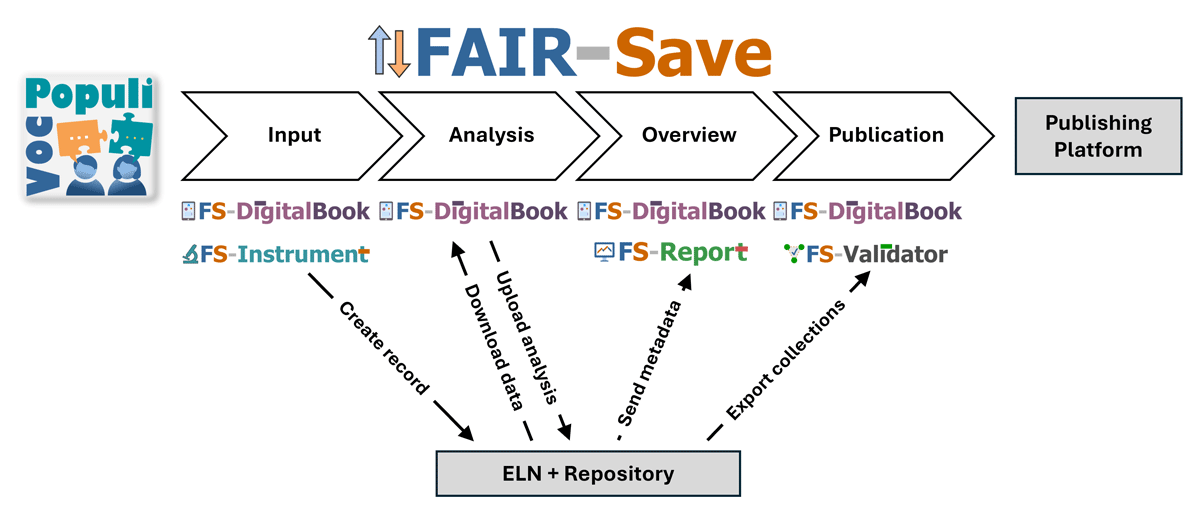
Figure 1
Scheme of the FAIR-Save framework linking controlled vocabularies, structured ELN documentation, metadata analysis, validation, and FAIR data publication.
Table 1
FAIR-Save components and apps, their functions, and their benefits for the user.
| APP | HOW DOES A USER USE IT? | WHAT IS THE USER’S BENEFIT? |
|---|---|---|
| VocPopuli [21] | Manage controlled vocabularies | Ensures standardized, reusable, and shareable metadata published in Flachmann et al.’s (2025c) work |
| Provide metadata schema | Exports vocabulary in a usable format for all subsequent apps | |
| FS-DigitalBook | Create forms | Drag-and-drop form creation with all approved fields. Possibility to enter notes and hints, prefill fields and requirements (Further explanation in Supplemental Information A1) |
| Create records | Timestamped comments, QR code scanning, process photos, standardized inputs with explanations, metadata mapping Automatic enforcement of group conventions, for example, permissions and tags (further explanation in Supplemental Information A2 and A3) | |
| Create labels | Prepares labels with QR codes, titles, and IDs understandable for humans and computers | |
| Create collections | Creates collections applying our rules | |
| View record files and links | Optimized graphical user interface, structural overview of collections and record, data navigation | |
| Analyze record data | Linked raw data and software for processing and visualization with GitLab/GitHub integration | |
| Publish collections | Exports anonymized FAIR-compliant data ready to publish (An example for published collections from the FAIR-Save can be found on Zenodo (Flachmann et al., 2023)) | |
| Offline mode on tablets | Works without internet and synchronize later | |
| FS-Instrument | Run in the background of LabVIEW program | Automatically creates records and uploads experimental data |
| FS-Report | Visualize metadata | Understands experiment context and compares results, comprehends metadata of all records |
| FS-Validator | Check metadata for correctness | Automated coherence check against the latest published version of our controlled vocabulary (Flachmann et al., 2025c), uncovers inconsistencies and helps correct mistakes |
In Kadi4Mat (Brandt et al., 2021), data is organized in records, which serve as the basic entries for metadata. Data files can be attached, other records can be linked with a link name and direction, and they can be organized in one or multiple collections acting as folders. To reflect our research workflow, we modeled our data as objects, processes, and software, allowing experiments, samples, and computational steps to be captured in a structured and FAIR-compliant manner.
VocPopuli allows modeling of our research workflow by developing a controlled vocabulary consistent with the FAIR principles (Garabedian et al., 2023). VocPopuli is an editor for the vocabulary knowledge graph that enables users to define terms as well as the semantic relationships between them. Through these relationships, terms are organized in a hierarchical structure and can be linked to existing terminologies where suitable concepts are available. Thus, this software represents our first step toward structured documentation of our research in a FAIR fashion. It needs to describe the experiments before starting, listing the processes, equipment used, and data connected to those steps.
At the core of the FAIR-Save suite is FS-DigitalBook, the daily-use app for documenting experiments, samples, and processes. Using the collaboratively managed vocabulary from VocPopuli, it enables structured form creation with hints, constraints, requirements, and prefilled fields. It guides users intuitively through data entry while supporting correct data capture by showing only logically valid options based on the defined concepts and relations. This guidance strongly improves usability compared to conventional ELNs by automatically enforcing group conventions, adding links to associated records and collections, and preparing FAIR data publication.
These complementary applications extend functionality: i) FS-Instrument integrates experimental machines and uploads data directly from LabVIEW setups. ii) FS-Report extracts and compares metadata across projects for quick insight. iii) FS-Validator checks metadata coherence against the controlled vocabulary, ensuring consistency prior to publication.
Usage and Impact of ELNs and FAIR Data
A user-centric perspective highlights that the value of FAIR data in ELNs goes far beyond meeting institutional and funding requirements. These tools directly shape how researchers work on a daily basis: recording and retrieving data, collaborating with colleagues, and managing experiments. This perspective allows us to understand how different user groups interact with the software, what functions they rely on, and how this end-to-end solution supports their specific roles within the research process.
Benefits for researchers
For researchers—from student assistants, bachelor’s, master’s, PhD, or postdoctoral researchers to professionals and principal investigators (PI)—the primary advantage of ELNs and FAIR data is experienced in the streamlined capture and retrieval of information. Recording data digitally from the beginning avoids later transcription steps, reduces errors, and keeps experimental documentation in one place. In addition, it is often forgotten and overlooked in academic research institutions that data are connected to one person, as an individual researcher documents only in his or her repository, in his or her lab language, in his or her mother tongue. If this originator leaves, data and results might become unavailable and/or useless. Using ELNs, personal knowledge can be transformed into collective knowledge.
FAIR-Save simplifies data collection and inspection for scientists via:
FS-Instrument: Users can focus on the experiment while documentation is generated automatically from the configured settings.
Integrated record creation (Figure 2): Forms mirror experimental instructions and present fields in logical order, ensuring that no parameters are overlooked. In those guided workflows, users can capture images, attach files, and add timestamped comments directly to their record. QR code label scanning ensures valid links to the data structure. The optimized user interface with clear, tab-based record viewer replaces endless lists and allows faster navigation and better focus on relevant data.
Offline mode: Experiments can be conducted offline; data synchronizes once a connection becomes available.
Data processing: Users can select a record to analyze with a chosen processing tool, which is automatically downloaded from Kadi4Mat or linked platforms such as GitLab.
Collection and label creation: All essential tasks for daily lab work, creating collections, managing collections, and linking data, can be performed within a single app.
Record viewer: Data can be monitored, copied directly to presentations, and explored through a structured view of collections and links (Figure 3). Unlike the standard Kadi4Mat interface (Supplemental Information Figure A1), the record viewer loads the complete collection tree together with all associated records, enabling faster navigation through complex data structures. Files of selected records are displayed directly, and context actions such as right-click access provide immediate links back to the ELN.
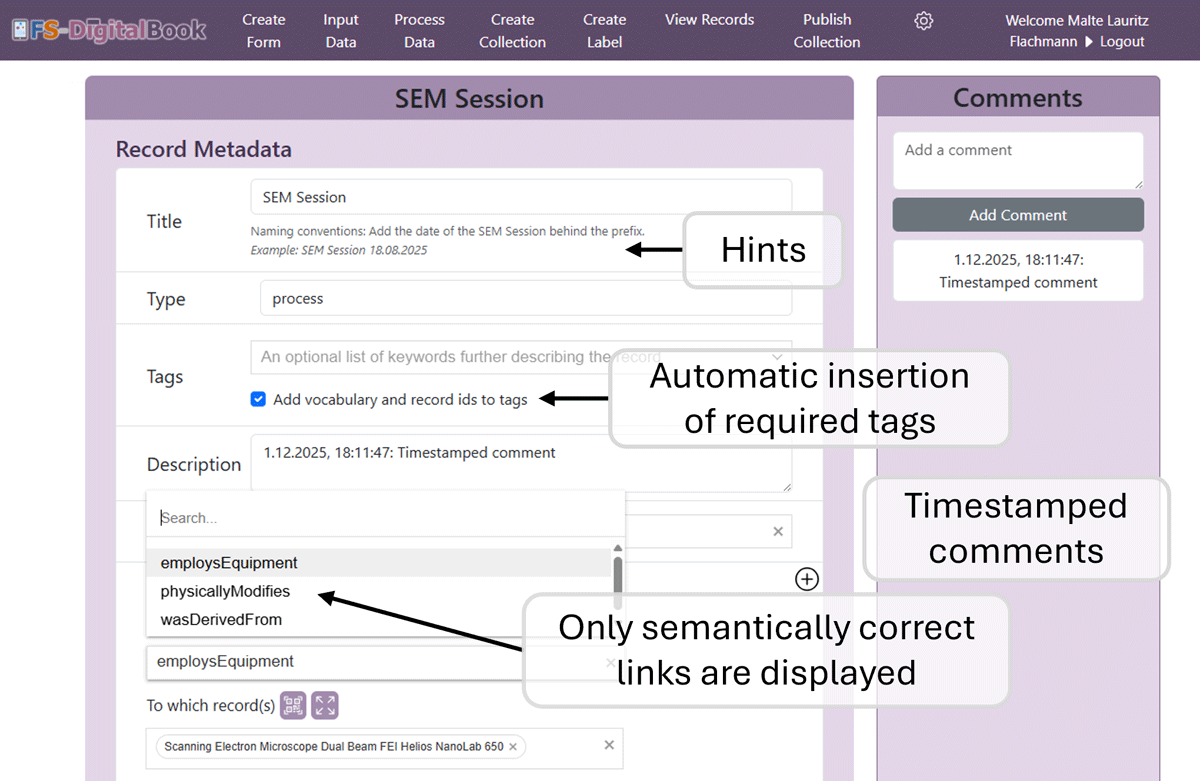
Figure 2
Screenshot of a landing page in FS-DigitalBook. The opened form displays hints for the user, timestamped comments, and automated suggestions.
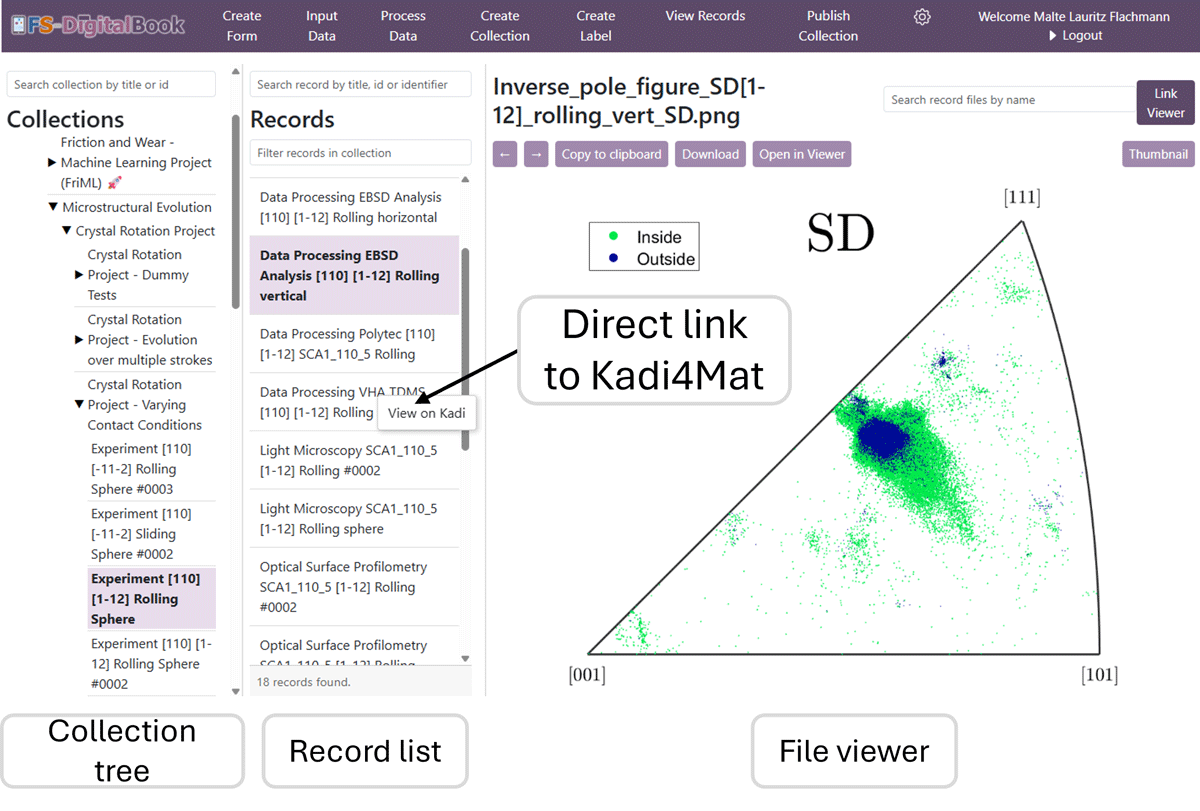
Figure 3
Screenshot of the ‘record viewer page’ displaying the ‘file viewer interface’ with focus on the file content showing navigation, record selection, and direct file preview.
The combination of these features addresses several well-known challenges that often hinder reproducibility and data reusability, such as missing metadata, inconsistent documentation, or difficult-to-access information. By structuring the capture of all relevant data and metadata, the system makes it easier for researchers, both within and outside each principal investigator’s lab, to understand experimental parameters, follow previous work, and build on existing results. This strengthens compliance with the FAIR principles, improving user satisfaction, adoption, and efficiency.
Benefits for data stewards
Data stewards face a fundamental challenge: ensuring FAIR compliance and data quality while supporting researchers who prioritize experimental work over documentation. We designed our FAIR-Save suite to offer a lab data management platform that supports every aspect of the research data lifecycle and helps data stewards in proactive infrastructure management.
FAIR-Save integrates all critical functions for laboratory management into one software suite:
VocPopuli: Enables to collaboratively develop controlled vocabularies, with standardized terminology ensuring consistent metadata across all lab activities.
Form creation: Provides explanations and instructional notes for each metadata term. Supports users with curated vocabulary options that make incorrect entries unlikely. Simplifies form creation and accelerates onboarding.
Structured link visualization: A tree-like view of the collection structure and linked records helps users to understand relationships between datasets and maintain an overview of laboratory activities (Figure 4). Relevant record information, such as descriptions, operators, and process timestamps, is displayed directly, allowing fast comparison between related records. Users can filter and customize the visualization based on the controlled vocabulary, navigate directly to linked records through the link table, and access similar records through the collection tree and record list. Switching layouts enables a seamless transition between link-focused inspection and file-focused viewing. For comparison, the standard Kadi4Mat layout is shown in Supplemental Information Figure A2.
Publishing of data: Automated publishing of data ensures privacy while streamlining the creation of FAIR open data.
FS-Validator: Provides automated quality checks for every dataset, reducing the need for manual review.
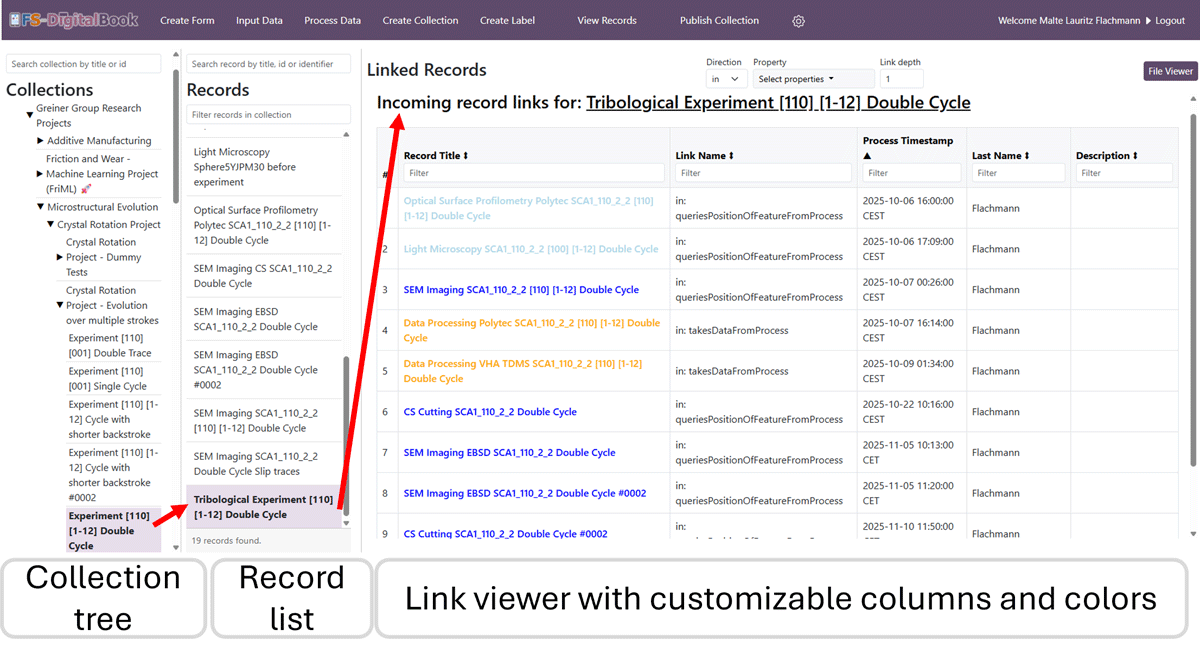
Figure 4
Screenshot of the ‘record viewer page’ showing the ‘link viewer’ with focus on the fast overview of key metadata for structured navigation and record comparison.
FAIR-Save embeds internal standards directly into laboratory workflows by design, allowing data stewards to focus on strategic tasks, such as developing vocabularies aligned with community standards, designing forms for new experimental methods, and coordinating data publication strategies.
Benefits for group leaders and principal investigators
Group leaders and PIs need quick insights into project progress, data completeness, and research outcomes to steer and guide current and future research. FAIR-Save supports them with two features:
Interactive overview: Allows users to explore records and links across projects, samples, and results, supporting progress monitoring and research planning.
FS-Report: Summarizes metadata to help identify trends, investigate influencing factors in experiments, and enable statistical analysis (example in Figure 5). By aggregating metadata across records, it enables longitudinal analysis of routinely documented parameters that would otherwise remain difficult to interpret. For example, consistently logged instrument parameters such as scanning electron microscope pressure before venting can reveal trends indicating vacuum pump or sensor health, supporting preventive maintenance and improving long-term laboratory reliability.
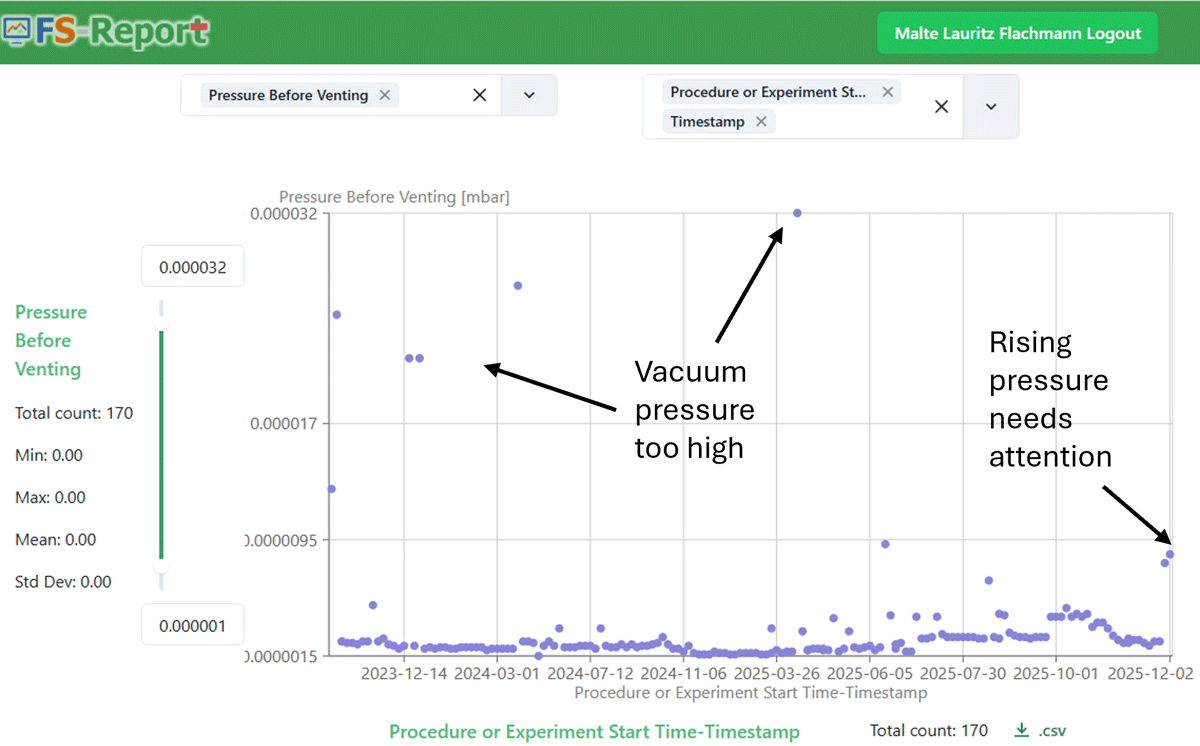
Figure 5
Screenshot of FS-Report displaying a time-series analysis of metadata across laboratory activities.
By centralizing information and linking data, FAIR-Save ensures that research output is organized, ready for publication, and reusable for future projects.
Value and benefits
Having outlined the core functionalities of the FAIR-Save suite and the ways in which individual users benefit from them, the following section presents quantitative evidence of its adoption and impact within the Greiner Research Group at the Karlsruhe Institute of Technology.
User adoption has grown over the past years, starting with only one person focusing on setting up the system in 2021. Figure 6 shows the beginning of ELN use with 45 records in 2021 and four times as many (162) in 2022. The significant rise in activity in 2023 (almost eight-fold increase to 1,250 records) is the result of the introduction of the FS-DigitalBook. The second sharp increase in 2025 correlates with the implementation of several key features, most notably the automation of data processing and the record viewer, which greatly simplifies navigation through the current dataset (4,857 records; 9,752 links; and 27,996 files across 274 collections). In 2025, FAIR-Save is used by all 14 active lab members, and 65% of them are routine users. The combination of facilitating features plays a key role in user satisfaction and adoption, which, in return, only then raises the full digital potential on all levels: users’ experience improves usability, efficiency, and confidence; data stewards maintain quality and FAIR compliance; PIs achieve oversight and reproducibility. This dual focus on operational adoption and structural data management results in a system that is not only technically effective but also widely embraced by all lab members.
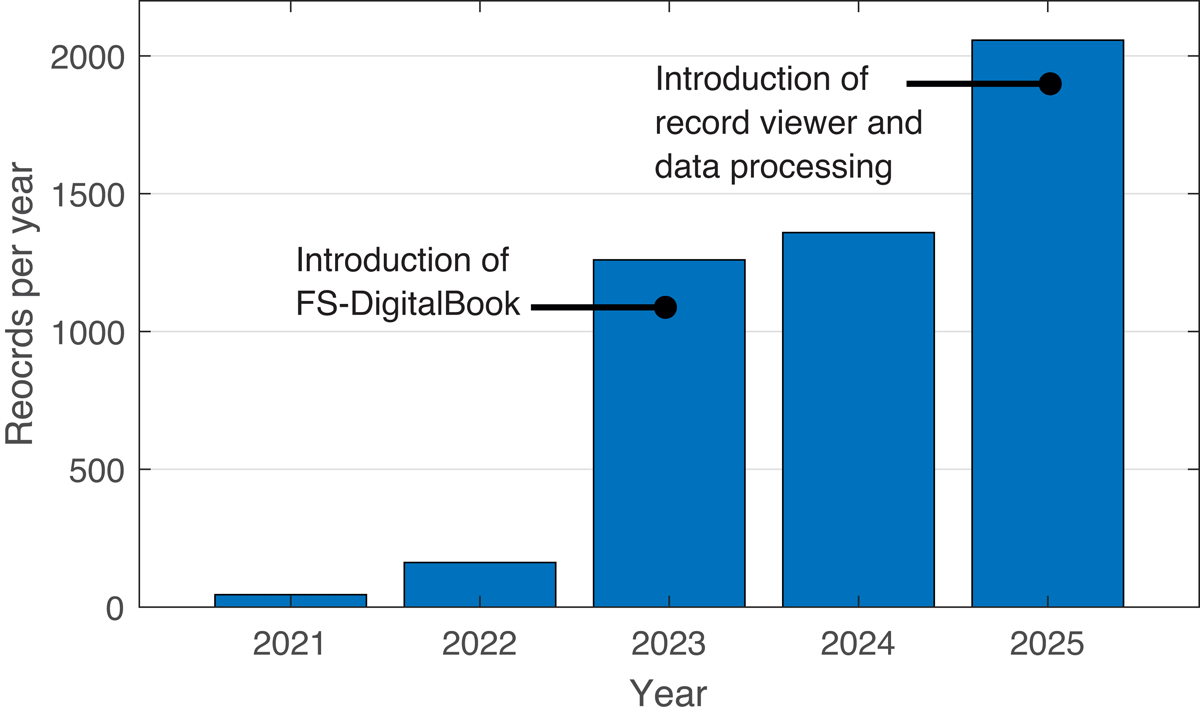
Figure 6
Total number of records per year created by the Greiner Research Group.
Discussion
FAIR principles are becoming more and more widely used. This adoption is, on one hand, due to the digitalization in research in general and its increasing speed in sharing and publishing data. Metadata makes results understandable and improves reproducibility. FAIR principles could be considered the base to connect everything. On the other hand, research institutions, funding agencies, and publishers demand FAIR data. The EU’s research policy states open science as a central pillar of Horizon Europe, which mandates research data management in compliance with the FAIR principles. The publication of research data that complies with the FAIR principles is the default (‘as open as possible, as closed as necessary’).
While the adoption of ELNs has increased dramatically, and initiatives such as MaterialsCommons4EU and all its associated national initiatives reflect the growing emphasis on FAIR data in materials science, one critical aspect has often remained underappreciated: the facilitation of high-quality digital documentation directly at the laboratory bench. Our software suite addresses this challenge by combining usability and rigor in a single system. The application design centers on a single principle: make data entry as easy as possible where data originate. This required three key decisions.
First, we adopted a vocabulary derived from our initial ontology rather than demanding users to work directly with a full ontology. Developing and maintaining ontologies requires significant expertise and time (Saeedizade and Blomqvist, 2024), resources that typical lab users will and cannot dedicate when a paper notebook offers a faster alternative. By providing a hierarchical structure of well-defined terms, we lower the barrier to digital documentation and enable users to adopt structured metadata without the overhead of ontology engineering.
Second, we streamlined the user interface and data entry workflow, with particular emphasis on repetitive laboratory processes. When parameters rarely change, users are understandably reluctant to re-enter them each time. By prefilling stable parameters and prompting edits only when necessary, we reduce cognitive load and help ensure that all relevant details are consistently captured.
Third, we implemented an end-to-end workflow within a single software environment. Users should not need multiple tools for daily documentation tasks. Automated data transfer from instruments, combined with metadata mapping that populates input fields automatically, minimizes manual transcription, reduces errors, and supports seamless integration into existing lab routines.
The impact of FAIR-Save lies in its ability to transform both the structural and operational dimensions of laboratory work. On the structural level, FAIR-Save ensures that i) metadata are complete, ii) consistently structured, and iii) interlinked, breaking down data silos and enabling long-term reuse and interoperability. In doing so, the suite not only streamlines laboratory operations but also enhances the overall quality, accessibility, and impact of the resulting data. On the operational level, FAIR-Save has proven to i) lower the mental barriers of users for adoption, ii) support clear roles and responsibilities, and iii) simplify the integration of FAIR practices into everyday research routines. At present, no formal satisfaction metrics are available, and user feedback outside our own laboratory has not yet been systematically evaluated. Broader usability assessment across additional laboratory environments remains a goal for future work.
Although the current software is tightly integrated with a single lab notebook, Kadi4Mat, the underlying design intentionally separates domain logic from the ELN-specific interface layer. This allows readers to adopt and integrate the software into their own laboratory infrastructure by replacing the Kadi4Mat-specific API calls with those of an ELN of their choice. As with ELN data migration (Starman et al., 2025), metadata must be reconfigured for different ELNs. However, the core functions implemented in FAIR-Save, such as record creation, metadata assignment, file upload, link management, data processing, and publication preparation, are standard across most ELNs and therefore require only limited adaptation effort. Integration into another ELN primarily requires a programmable API that creates and updates records, organizes entries in collections or comparable structures, and maintains stable record identifiers with configurable metadata fields, so that FAIR-Save modules for form generation, validation, reporting, and publication preparation can interact reliably with the target system.
The built-in conventions reflect the practices and research workflows of our research group. Laboratories following different process models may need to adjust these conventions accordingly. Furthermore, the software includes submodules for direct metadata mapping from instrument files. These mappings are used to extract specific experimental parameters from measurement files and automatically assign them to the corresponding metadata fields in the associated records. These mappings are instrument-specific and cannot be published because they rely on proprietary file formats and manufacturer-dependent file structures.
Future work will focus on evaluating FAIR-Save in a broader range of laboratory environments. Interest in the software has already emerged from several groups across different areas of materials science, including both research laboratories and service-oriented facilities. Feedback from these collaborations will help assess FAIR-Save’s applicability across diverse workflows and guide its further development into a more flexible framework for FAIR laboratory data management.
Conclusions
ELNs are experiencing rapid adoption across research institutions, yet a critical gap remains in providing end-to-end workflows from the laboratory bench to publication. This software suite addresses this challenge by offering an intuitive interface for recording metadata in a structured, FAIR-compliant manner. By simplifying workflows, automating routine tasks, and reducing the burden on researchers, the system significantly enhances user adoption. The usage statistics presented demonstrate substantial uptake, confirming that streamlined, user-centered design is key to the successful implementation of research data management infrastructure. The result is a tablet-based software suite that embeds FAIR principles directly into laboratory workflows, addressing a critical gap in the digitalization of scientific research. In addition, it enables researchers to record experimental processes in real time, while specialized apps extend functionality across the research workflow, ensuring that both researchers and data stewards can contribute effectively.
Data Accessibility Statement
All source code is openly accessible and released under the Apache 2.0 license in the following repositories:
VocPopuli: https://gitlab.com/metacook/vocpopuli and Zenodo (Bagov et al., n.d.).
FAIR-Save project: https://gitlab.kit.edu/kit/iam-zm/materials-tribology-group/fair-save and Zenodo (Flachmann et al., 2025a, 2025b, 2025d, 2025e).
Additional File
The additional file for this article can be found as follows:
Supplemental Information
Supplemental Information A1 to A4. DOI: https://doi.org/10.5334/dsj-2026-020.s1
Acknowledgements
The authors thank Floriane Bresser (VocPopuli and FS-Validator), Sophia Markus (FS-DigitalBook), Miłosz Meller (VocPopuli), Florence Sarmah (FS-DigitalBook), Berke Senturk (VocPopuli and FS-Report), and Nuoyao Ye (FS-DigitalBook and VocPopuli) for their programming contributions to this project.
Author Contributions
Conceptualization: N.T.G, M.L.F.
Software: M.L.F., I.B.
Writing—original draft preparation: M.L.F.
Writing—review and editing: M.L.F., N.T.G., C.G.
Resources: C.G.