
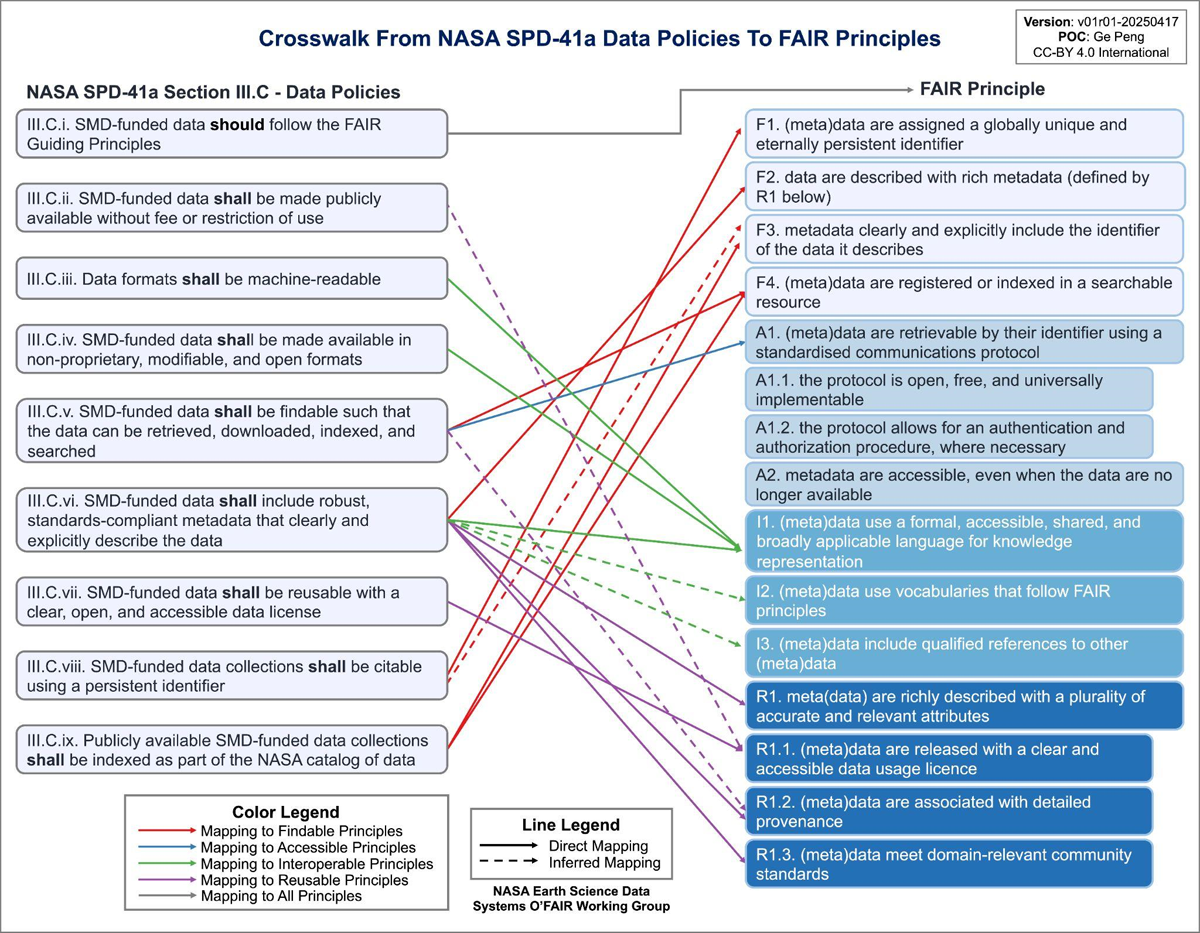
Figure 1
Crosswalk from the data requirements that are defined in the SPD-41a (NASA SMD, 2022) to the FAIR principles that are defined in Wilkinson et al. (2016). Direct mappings from SPD-41a to FAIR are denoted by solid lines, while the dashed lines indicate that the mappings may be inferred or may not always hold. Mappings to Findable/Accessible/Interoperable/Reusable principles are denoted by red/blue/green/purple lines, respectively. Source: Peng et al. (2024a).
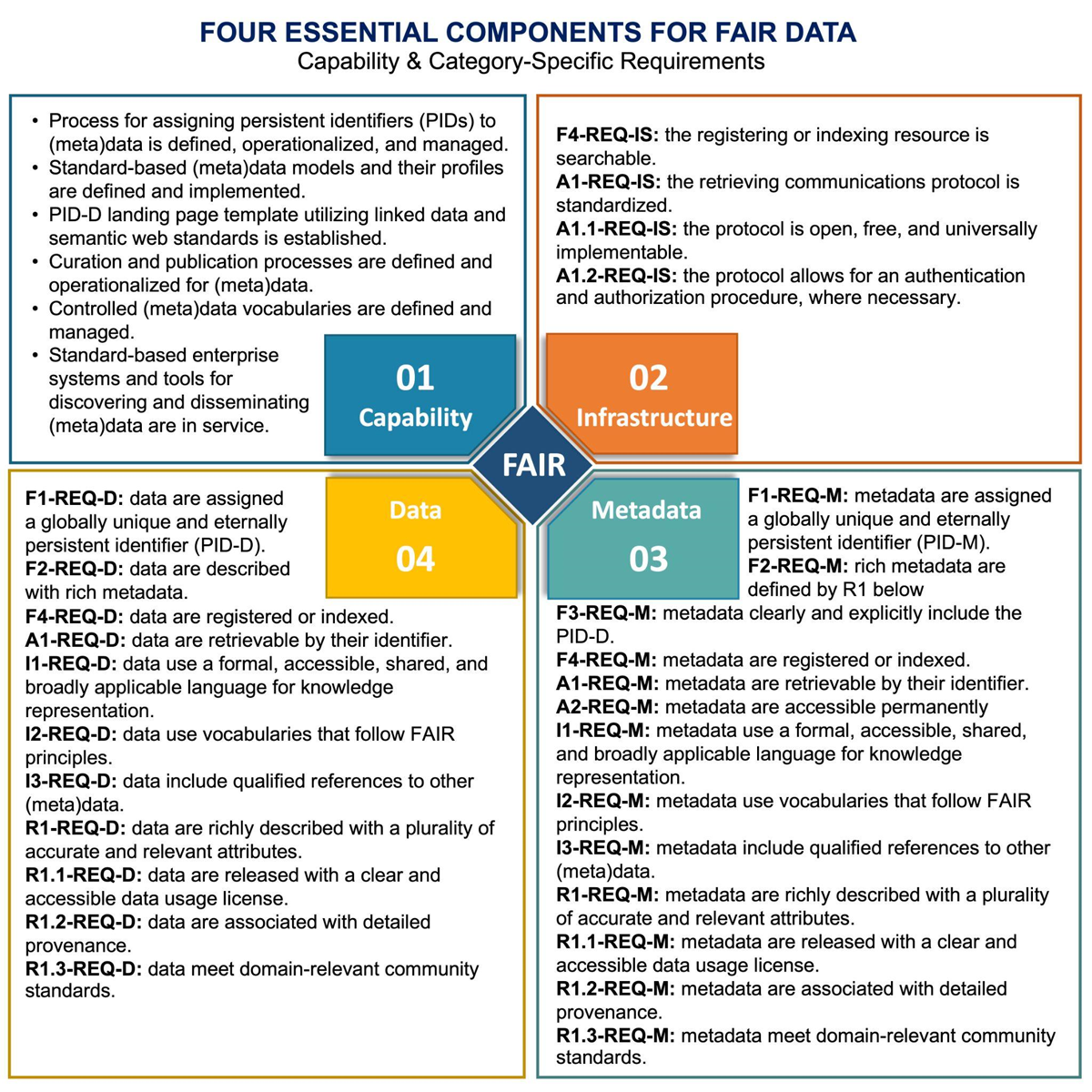
Figure 2
Diagram depicting the four essential components for FAIR data: Capability, Infrastructure, Metadata, and Data. The text boxes provide examples of capabilities and list category-specific FAIR requirements. The naming convention for the requirement identifier is: {FAIR ID}-REQ-{Category ID}, where, {FAIR ID} = [F1, F2, F3, F4; A1, A1.2, A1.2, A2; I1, I2, I3; R1, R1.1, R1.2, R1.3], denoting individual FAIR sub-principles; {Category ID} = [D; M; IS], denoting the Data, Metadata, and Infrastructure category, respectively. Based on Peng (2024).
Table 1
A list of NASA Earth science enterprise capabilities.
| NASA ENTERPRISE CAPABILITY | DESCRIPTION |
|---|---|
| Common Metadata Repository (CMR) | CMR is a system that catalogs and manages metadata, and provides search functionality. It is a centralized backend system supporting data and product discovery through NASA’s Earthdata Search portal. The CMR uses an extensible Unified Metadata Model (UMM) which crosswalks to various metadata standards such as ISO 19115-2 and DIF-10, ensuring metadata quality, consistency, and comprehensiveness (NASA ESDIS CMO, 2023). CMR provides an open-source API. |
| Earthdata Login | Earthdata Login is a single-sign-on system that manages Earth data user registration and profile. |
| Earthdata Search (EDS) | EDS is a map web-based tool and an advanced platform that facilitates data search and discovery, visualization, and access. EDS also provides an open-source API. |
| Global Change Master Directory (GCMD) | GCMD is a system that manages and provides access to controlled vocabulary of keywords. GCMD keywords are a set of controlled Earth science vocabularies maintained in the Keyword Management System (KMS), output in RDF, JSON, and XML (NASA ESDIS, 2016). They include various categories such as science keywords, platforms, instruments, data centers, locations, projects, providers, services, and more, each assigned with a unique UUID. |
| Distributed Active Archive Centers (DAACs) | DAACs are primarily discipline-focused repositories that are responsible for acquiring, curating, archiving, managing, distributing, and supporting the use of hosted NASA’s Earth science data. An exception is the ASF DAAC, which is sensor-specific and focused solely on synthetic aperture radar data. DAACs provide data management best practices, vocabularies, tools, and services to support data access and utilization, pertaining to their disciplines and complementary to EDS. They also offer user support and training for data use, tailored to the uniqueness of their data products. |
[i] Acronyms are captured in Appendix A.
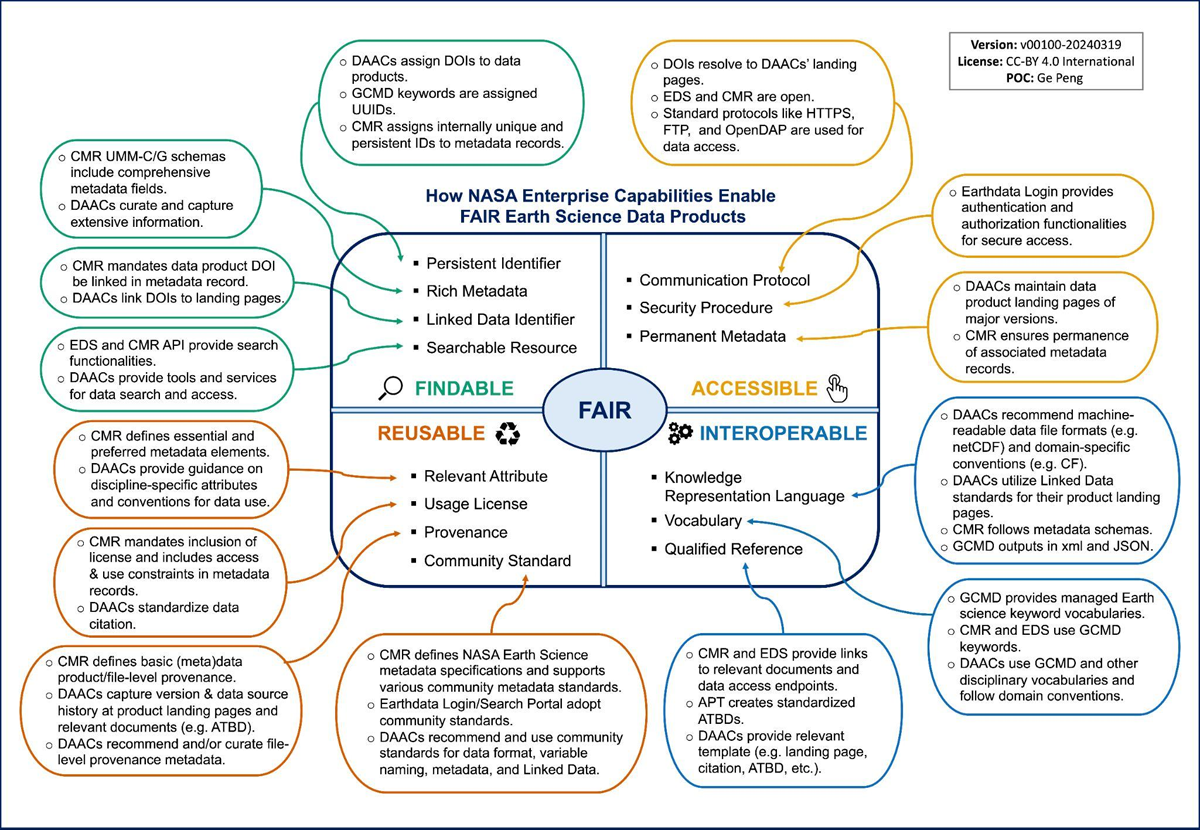
Figure 3
A schematic diagram summarizes how NASA enterprise capabilities enable FAIR earth science data products. The center of the diagram contains four sections, representing the four dimensions of the FAIR Principles. The core concepts of the FAIR sub-principles within each dimension, as defined in Peng et al. (2024b), are listed in each quadrant. Acronyms are captured in Appendix A.
Table 2
Characteristics of a Digital Object Identifier (DOI), Universally Unique Identifier (UUID), and local identifier (ID), as well as their compliance level to the F1 principle, that is, (meta)data are assigned a globally unique and eternally persistent identifier.
| IDENTIFIER TYPE | DOI | UUID | LOCAL ID |
|---|---|---|---|
| What it is | A globally unique, persistent identifier used to cite and access digital resources (e.g., datasets, publications) | A 128-bit number used to uniquely identify information in distributed systems | A unique identifier used within a specific organization, repository, or system |
| Example | 10.5067/GHGMR-4FJ04 | 8012fda7-3ea4-4ef2-bb4e-0f66d4d9e850 | C1996881146 |
| Globally Unique | Yes | Yes | No |
| Eternally Persistent | Yes | No | No |
| F1 Compliance Level | Satisfying | Meeting | Supporting |
Table 3
A list of category-specific requirement IDs associated with the Findability principles (described in Figure 2), NASA enabling resources and their compliance level, and O’FAIR working group (WG) recommendation identifiers (IDs) along with their level of priority and effort required to implement. Acronyms are captured in Appendix A.
| FAIR-F REQ ID | NASA ENABLING RESOURCES | COMPLIANCE LEVEL (SATISFYING/MEETING/SUPPORTING) | O’FAIR WG RECOMMENDATION ID (PRIORITY/EFFORT) |
|---|---|---|---|
| F1-REQ-D | Data Product DOI; NASA DOI Process | Satisfying | |
| F1-REQ-M | CMR UMM-C ConceptID | Supporting | F-1 (Low/Easy); F-2 (Medium/Moderate) |
| F2-REQ-D | CMR UMM-C Required metadata elements | Meeting | R-2 (Medium/Moderate) |
| F2-REQ-M | CMR UMM-C fields | Supporting | F-3 (Low/Moderate); A-2 (Medium/Easy); R-4 (High/Easy) |
| F3-REQ-M | CMR UMM-C required DOI element; Linked DOI (landing page website; data files) | Satisfying; Compliance level varies by DAACs | I-2 (Medium/Moderate); R-5 (High/Easy) |
| F4-REQ-D | CMR; Earthdata Search | Satisfying | |
| F4-REQ-M | CMR; Earthdata Search | Satisfying | |
| F4-REQ-IS | CMR API; Earthdata Search Portal | Satisfying |
Table 4
Same as Table 3 except for Accessibility.
| FAIR-A REQ ID | NASA ENABLING RESOURCES | COMPLIANCE LEVEL (SATISFYING/MEETING/SUPPORTING) | O’FAIR WG RECOMMENDATION ID (PRIORITY/EFFORT) |
|---|---|---|---|
| A1-REQ-D | Data product DOI landing page; Worldview; Harmony | Satisfying | |
| A1-REQ-M | CMR/Earthdata Search | Satisfying | |
| A1-REQ-IS | HTTPS; OPeNDAP; CMR API/Earthdata Search Portal; Worldview; Harmony; | Satisfying | |
| A1.1-REQ-IS | HTTPS; OPeNDAP; CMR/Earthdata Search; Harmony; | Satisfying | |
| A1.2-REQ-IS | Earthdata Login System | Satisfying | |
| A2-REQ-M | Version management—Vary by DAACs | Meeting | A-1 (Low/Moderate); A-2 (Medium/Easy) |
Table 5
Same as Table 3 except for Interoperability.
| FAIR-I REQ ID | NASA ENABLING RESOURCES | COMPLIANCE LEVEL (SATISFYING/MEETING/SUPPORTING) | O’FAIR WG RECOMMENDATIONS ID (PRIORITY/EFFORT) |
|---|---|---|---|
| I1-REQ-D | netCDF; HDF; CF; ACDD; RDF; JSON-LD | Meeting; Supporting | I-1 (High/Moderate) |
| I1-REQ-M | CMR UMM-C; GCMD | Meeting | I-4 (High/Easy) |
| I2-REQ-D | CF Standard Names; ACVSNC | Meeting; Supporting | I-1 (High/Moderate) |
| I2-REQ-M | GCMD; CF; ACDD | Supporting | I-3 (Low/Easy); I-5 (High/Moderate) |
| I3-REQ-D | Linked data | Supporting | I-1 (High/Moderate); I-2 (Medium/Moderate); I-6 (High/Moderate) |
| I3-REQ-M | UMM-C elements (AssociatedDOIs and AssociatedURLs) | Supporting | I-6 (High/Moderate); A-2 (Medium/Easy) |
Table 6
Same as Table 3 except for Reusability.
| FAIR-R REQ ID | NASA ENABLING RESOURCES | COMPLIANCE LEVEL (SATISFYING/MEETING/SUPPORTING) | O’FAIR WG RECOMMENDATION ID (PRIORITY/EFFORT) |
|---|---|---|---|
| R1-REQ-D | CMR UMM-C elements; GCMD keywords; netCDF global attributes | Supporting | R-1 (High/Moderate); R-3 (High/Easy) |
| R1-REQ-M | CMR UMM-C required elements; GCMD keywords | Meeting | R-2 (Medium/Moderate); I-3 (Low/Easy); R-4 (High/Easy) |
| R1.1-REQ-D | NASA Data Policy | Supporting | R-3 (High/Easy) |
| R1.1-REQ-M | Publication process of CMR UMM records; GCMD; | Supporting | I-3 (Low/Easy) |
| R1.2-REQ-D | Some of the UMM-C elements; netCDF global attributes | Supporting | R-5 (Medium/Challenging) |
| R1.2-REQ-M | A few of the UMM-C elements | Supporting | R-5 (Medium/Challenging); A-1 (Low/Moderate); A-2 (Medium/Easy) |
| R1.3-REQ-D | netCDF; HDF; GeoTIFF; DPDG; | Meeting | R-1 (High/Moderate) |
| R1.3-REQ-M | UMM (DIF 10; ECHO 10; ISO 19115); CF; ACDD; JSON-LD | Varying: Mostly Meeting; ISO 19,115 & JSON-LD—Satisfying) |
Table 7
A list of Recommendation ID (ID), description, the level of criticality in facilitating FAIR compliance and the level of effort or resource needed for implementation for Findability and Accessibility. From Peng et al. (2024a). The naming convention for ID: {FAIR Dimension}-n, where {FAIR Dimension} = [F; A; I; R], respectively, and n is numerical value, running from 1 to 3 for F, 2 for A, 6 for I, and 5 for R, respectively. The level of criticality is classified as low, medium, and high for NASA based on their criticality in facilitating FAIR compliance. The estimated level of effort and resource requirement for implementing a recommendation is categorized as Easy, Moderate, Challenging, or Resource Intensive.
| ID | DESCRIPTION | CRITICALITY/IMPLEMENTATION EFFORT |
|---|---|---|
| F-1 | Assign globally unique identifiers, such as Universally Unique Identifiers (UUIDs) or Archival Resource Keys (ARKs), to each of the CMR ConceptIDs, at least for all the collection ConceptIDs. These identifiers should be managed for their uniqueness and persistence within CMR. | Low/Easy |
| F-2 | Assign and maintain a globally unique and persistent identifier (PID) to the satellite mission or field campaign and ensure that the PID is resolved to a permanent mission/campaign landing page and explicitly embedded as structured, machine-actionable metadata, utilizing standards for linked data on the web. | Medium/Moderate |
| F-3 | Register with appropriate unique and persistent identifier (PID) systems (e.g., data producers/curators with ORCID.org and organizations with ROR.org or re3data.org). Those PIDs should be used and included in relevant metadata and documents to denote uniquely the individual data producers and organizations. | Low/Moderate |
| A-1 | Leverage the DataCite metadata schema to establish a common approach to associate DOIs of different versions of a data product and extend the Unified Metadata Model (UMM) to establish associations among data product metadata records. | Low/Moderate |
| A-2 | The ESDIS CMR team and the DAACs work together to develop a common approach to cross-reference different versions of a data product and provide versioning information on data product landing pages. | Medium/Easy |
Table 8
Same as Table 7 except for Interoperability.
| ID | DESCRIPTION | CRITICALITY/IMPLEMENTATION EFFORT |
|---|---|---|
| I-1 | Develop actionable strategies and guidelines to enable or enhance machine-actionability, utilizing community Linked Data standards and the semantic representation of NASA Earth science digital data and other associated digital resources. | High/Challenge |
| I-2 | Data product DOI (collection) should be included in individual data files (granules) in a machine-actionable fashion, if appropriate. | Medium/Moderate |
| I-3 | Release the GCMD keywords collection, and release the collection as it changes, with a formal CC0+Attribution Request usage license and link it to the GCMD landing page with the recommended citation. The recommended citation should include the license in a machine-actionable fashion. | Low/Easy |
| I-4 | Utilize GCMD Science Keywords (including their URIs) in metadata to describe their data products, when it is appropriate to do so. | High/Easy |
| I-5 | Explore community standards, develop actionable strategies to improve the semantic representation of NASA vocabularies, and support their implementation for GCMD science keywords, utilizing relevant ontologies like those in SWEET. | High/Moderate |
| I-6 | Develop an ESDIS-wide template for defining a set of core fields as qualified references and provide best practices of embedding them in data product landing pages as linked data and that of including them in CMR data product level metadata records. | High/Moderate |
Table 9
Same as Table 7 except for Reusability.
| ID | DESCRIPTION | CRITICALITY/IMPLEMENTATION EFFORT |
|---|---|---|
| R-1 | Data producers should follow the recommendations provided in the Data Product Development Guide (DPDG) document. Data producers should also raise questions and provide feedback when issues are encountered in application of the DPDG. | High/Moderate |
| R-2 | Data producers and DAACs should utilize the pyQuARC API to evaluate the consistency, completeness and robustness of their data product-level metadata records and should seek solutions to the shortcomings identified during the process. | Medium/Moderate |
| R-3 | A machine-readable Creative Commons data usage license such as that from the Software Package Data Exchange (SPDX) Specification (https://spdx.org/licenses/) should be explicitly included in a mandatory CMR UMM-C element. | High/Easy |
| R-4 | The data product DOI should be a mandatory, machine-readable, and linked-data element on its landing page. | High/Easy |
| R-5 | Establish an ESDIS procedure/task force to develop technical and practical specifications for capturing a more robust provenance of NASA Earth science data products in CMR UMM-C and/or UMM-G. | Medium/Challenging |