
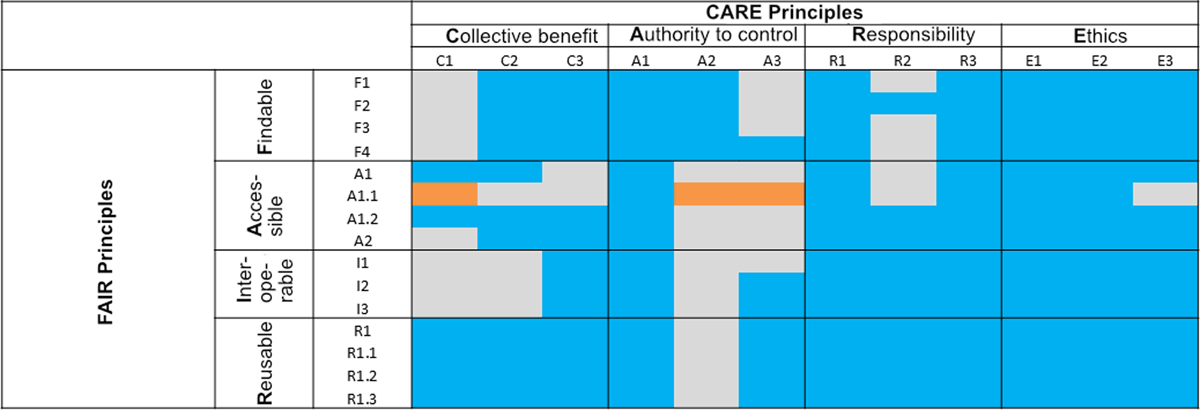
Figure 1
Consolidated results for our evaluation matrix, combinations of FAIR and CARE sub-principles are shown as 1) aligned in blue (78%), 2) independent in grey (21%), and 3) contradictory in orange (2%).
Table SM.1
The FAIR Guiding principles and sub-principles, their official definitions and the (summarised) definitions used for the evaluation of the joint implementations.
| PRINCIPLES | SUB-PRINCIPLES | OFFICIAL DEFINITION | DEFINITION USED IN MATRIX |
|---|---|---|---|
| Findable | F1 | (Meta)data are assigned a globally unique and persistent identifier | Unique and persistent identifier |
| F2 | Data are described with rich metadata (defined by R1 below) | Rich metadata | |
| F3 | Metadata clearly and explicitly include the identifier of the data it describes | Metadata include identifier of data | |
| F4 | (Meta)data are registered or indexed in a searchable resource | Searchable resource | |
| Accessible | A1 | (Meta)data are retrievable by their identifier using a standardised communications protocol | Retrievable by identifier |
| A1.1 | The protocol is open, free, and universally implementable | Open, free, universally implementable | |
| A1.2 | The protocol allows for an authentication and authorization procedure, where necessary | Authentication and authorisation procedure | |
| A2 | Metadata are accessible, even when the data are no longer available | Metadata remain accessible | |
| Interoperable | I1 | (Meta)data use a formal, accessible, shared, and broadly applicable language for knowledge representation. | Formal, accessible, shared language |
| I2 | (Meta)data use vocabularies that follow FAIR principles | Vocabularies that follow FAIR | |
| I3 | (Meta)data include qualified references to other (meta)data | References to other (meta)data | |
| Reusable | R1 | (Meta)data are richly described with a plurality of accurate and relevant attributes | Rich description of (meta)data |
| R1.1 | (Meta)data are released with a clear and accessible data usage licence | Clear and accessible data usage licence | |
| R1.2 | (Meta)data are associated with detailed provenance | Detailed provenance | |
| R1.3 | (Meta)data meet domain-relevant community standards | Domain-relevant community standards |
Table SM.2
The CARE principles for Indigenous Data Governance and sub-principles, their official definitions and the (summarised) definitions used for the evaluation of the joint implementations.
| PRINCIPLES | SUB-PRINCIPLES | OFFICIAL DEFINITION | DEFINITION USED IN MATRIX |
|---|---|---|---|
| Collective benefit | C1 | For inclusive development and innovation | Active support of use and reuse of data |
| C2 | For improved governance and citizen engagement | Ethical use of open data | |
| C3 | For equitable outcomes | Any value created should benefit Indigenous communities | |
| Authority to control | A1 | Recognising rights and interests | Recognises rights and interests and free, prior and informed consent |
| A2 | Data for governance | Data for governance: right to relevant data | |
| A3 | Governance of data | Governance of data: develop protocols | |
| Responsibility | R1 | For positive relationships | Respectful and dignified |
| R2 | For expanding capability and capacity | Expand capability and capacity of Indigenous Peoples | |
| R3 | For Indigenous languages and worldviews | Respect for languages and worldviews | |
| Ethics | E1 | For minimising harm and maximising benefit | Minimising harm and maximising benefit, no stigmatising |
| E2 | For justice | Justice: address imbalances in power and resources and human rights | |
| E3 | For future use | Future use |
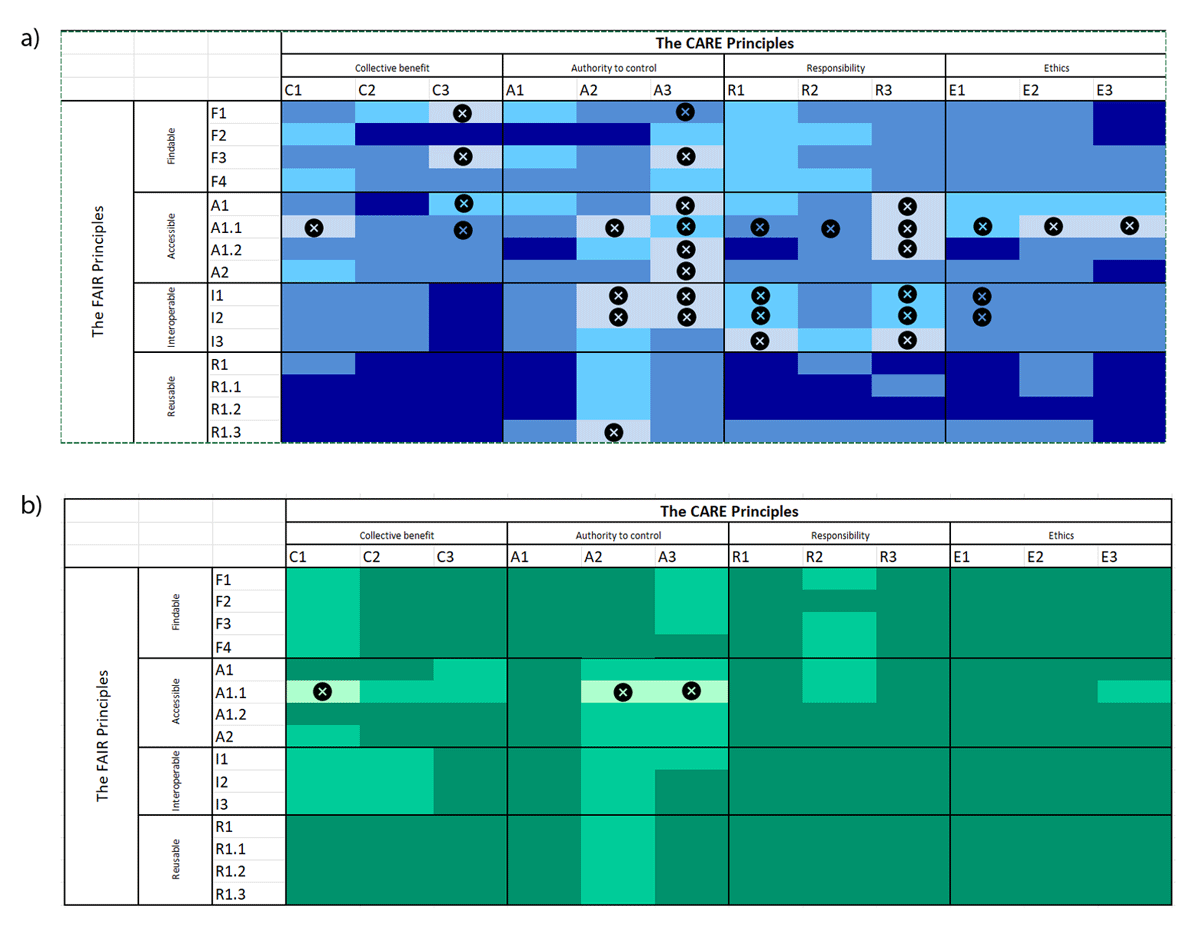
Figure SM.1
Top (1a): Scoring results shown with a colour gradient. Darkest blue indicates unanimous agreement, followed by majority agreement (3 of 4 evaluators), 50–50 choices, and lightest blue where all three options were chosen. Principles and sub-principles are defined in Tables SM.1–SM.2. Circles with crosses mark sub-principle pairs where one or two evaluators judged a contradiction; none had more than two. Bottom (1b): Consensus matrix (step 3). Circles with crosses indicate contradictions at the data level. Darkest cells (sea green) represent alignments, while lighter cells (jade) without crosses represent sub-principle pairs that can be implemented independently.