
Introduction
Indigenous and Local Knowledge (ILK) plays an important role in biodiversity research (Kadykalo, Cooke and Young, 2021; Root-Bernstein et al., 2023; Usher, 2000). In addition, ILK also plays an integral part in the Science-Policy interface, as can be seen, for example, in the role it plays in intergovernmental platforms (Díaz et al., 2015; Ford et al., 2016; Huambachano, Nemogá Soto and Mwampamba, 2025; IUCN, 2022; McElwee et al., 2020; Wiegleb and Bruns, 2025) as well as in Multilateral Environmental Agreements, such as the Kunming-Montreal Global Biodiversity Framework of the Convention on Biological Diversity (CBD, 2022).
For the effective implementation of these agreements and global intergovernmental initiatives, it is essential to adopt a whole-of-society approach that ensures inclusivity. It needs to integrate diverse knowledge systems, that is, structured ways to generate, validate and share knowledge. Open, transparent and (re)usable processes, part of the FAIR (Findability, Accessibility, Interoperability and Reusability) principles for scientific data management and stewardship (Wilkinson et al., 2016, see also Table SM.1), are a framework for handling and delivering scientific views. They seek to build trust through transparency, prevent misunderstandings between parties (Vohland et al., 2011) and increase the likelihood of uptake of the knowledge collected in scientific publications in future research and policies. At the same time, ILK’s grounding in traditional information on biodiversity and ecosystems provides diversity of sustainable practices, enriches concepts of nature and broadens our understanding of nature’s contributions to people (McElwee et al., 2020). Adopting the CARE (Collective benefit, Authority to control, Responsibility and Ethics) principles for Indigenous Data Governance ensures ethical and inclusive data management (The Global Indigenous Data Alliance, 2019; see also Table SM.2), and thus increases the benefits that Indigenous Peoples and local communities (IPLCs) gain from sharing their knowledge (Carroll et al., 2020; The Global Indigenous Data Alliance, 2019). Although the need for and importance of implementing both FAIR and CARE simultaneously is clear, this scarcely is done. Nevertheless, it is suggested that the combined implementation of the FAIR and CARE principles offers an opportunity to cross-fertilise each other through actions and responsibilities across the data lifecycle and ecosystem (Carroll et al., 2021).
Here, we evaluated the alignments, independencies, or contradictions in the operationalisation of FAIR and CARE based on our activities for the completed assessment reports of the Intergovernmental Science-Policy Platform on Biodiversity and Ecosystem Services (IPBES) (IPBES, 2019, 2022b, 2022c, 2023). Since its founding in 2012, IPBES has acknowledged the value of using multiple knowledge systems, bringing scientific knowledge and ILK together, and has consequently incorporated aspects of ILK as well as the interests of IPLCs in its data and knowledge management policy (IPBES, 2013, IPBES, 2022a; Thaman et al., 2013). Within the IPBES platform, experts use available data and knowledge, but do not conduct experiments or fieldwork. Instead, data sets are collated and analysed, requiring meticulous metadata development and management. Specifically relevant for CAREful data management is that metadata must include the origin of the data as well as any preassigned restrictions on its (re)use. IPBES holds multiple ILK dialogue workshops for each assessment, after which a report is compiled and published on the IPBES website, acknowledging the participants of the workshop and the literature, case studies and examples discussed. Therefore, data creation is not relevant for the assessments of the science-policy platforms, but storage, usage and archiving of workflows and resulting compiled datasets are. Specifically, ensuring transparency and reusability, as well as the proper handling of ILK as it is woven into IPBES assessment reports, is essential. Adherence to the FAIR and CARE principles, with particular emphasis on benefit-sharing and the responsible and ethical use of the knowledge of IPLCs in assessments and Summaries for Policymakers used in policy and decision-making, is a prerequisite. We assessed all interactions between sub-principles of FAIR and CARE. To our knowledge, this has not been done before and offers a starting point towards FAIRness and CAREfulness that will benefit knowledge holders, policy and decision makers and stakeholders, including IPLCs in multiple roles.
Evaluation Approach
We created an evaluation matrix containing all 15 FAIR and 12 CARE sub-principles, giving a total of 180 possible combinations. The group of four data experts conducting the evaluation are researchers working in the field of biodiversity and nature conservation and assessment. Each evaluator individually assessed whether each pair of sub-principles could 1) be implemented together and support each other (‘alignment’), 2) not affect each other (‘independent’), or 3) not be implemented together (‘contradict’). The assessments placed particular emphasis on the storage, use and archiving stages of the data lifecycle. This included the use of long-term repositories to ensure data findability and stability through the assignment of persistent unique identifiers, the use of robust reference management practices, and the development of comprehensive data management reports to support reusability and interoperability. Sub-principle pairs which were assessed differently between assessors were discussed with the aim of reaching unanimity (see final unanimous scores in Figure 1 and initial differences in Figure SM.1).
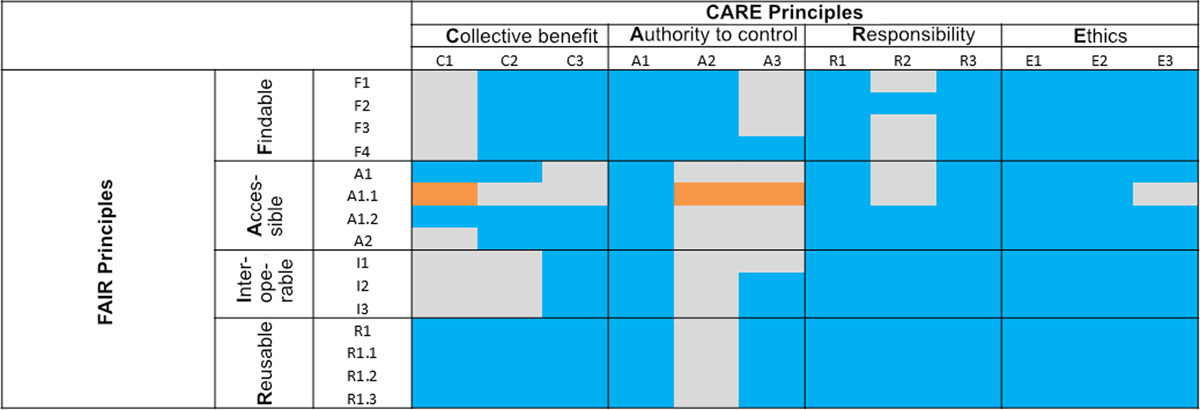
Figure 1
Consolidated results for our evaluation matrix, combinations of FAIR and CARE sub-principles are shown as 1) aligned in blue (78%), 2) independent in grey (21%), and 3) contradictory in orange (2%).
To facilitate the discussion, we have labelled the matrix at the level of the principles with 16 labels (Figure 1).
The template of the matrix used in this study is available (https://github.com/Stokpaardje/FAIRandCARE), and we encourage interested experts, and especially IPLCs to use this approach and determine where the contradictions and alignments may be in their specific organisation (please file an issue to GitHub for any questions and suggestions).
Outcomes
The evaluation matrix in our IPBES specific case shows that two thirds of pairs (138 out of 180 pairs of sub-principles) are in alignment and only 1.7% (three out of 180 pairs of sub-principles) are in contradiction, leaving the rest of pairs tagged as independent.
Alignment and independence of principles
Our results show a high degree of alignment between the FAIR and CARE principles, where the implementation of one sub-principle strengthens the implementation of the other. Out of the 16 principle combinations, six are fully aligned (37.5%; the black bordered cells that are completely blue in Figure 1), while eight show some independent sub-principle combinations (black bordered cells that have blue and grey) where the sub-principles can be implemented without affecting each other. Only three sub-principle combinations were found to be contradictory (shown in orange), where the two sub-principles cannot be implemented together. Therefore, 97.3% of the sub-principle combinations can be implemented without additional challenges.
FAIR’s Reusability is fully in alignment with CARE’s Collective benefit and Responsibility and Ethics, which means that implementing any of these CARE sub-principles enhances the reusability of the data and/or metadata and vice versa. For example, considering the future use of data and acknowledging the provenance in the metadata (CARE’s E3) results in longer term data storage plans, which in turn leads to increased accessibility and reusability, and already covers FAIR’s R1.2 which states that metadata is associated with detailed provenance. CAREs Responsibility and Ethics are in alignment with all FAIR’s Interoperability and Reusability sub-principles, as well-defined metadata will increase the reusability of data: users need to know where and how the data was collected, and under which licences data can be reused and shared (FAIR’s R1.1). For Indigenous data, well-described metadata can ensure that IPLCs’ rights and wellbeing are protected, for example by acknowledging the data provenance, and any limitations to its usage (CARE’s E3). An example of independent sub-principles is CARE’s A3 Governance of data, which affirms the right of IPLCs to establish cultural governance protocols for Indigenous data and FAIR’s F1 (meta)data are assigned a unique and persistent identifier: as these sub-principles do not affect one another.
Contradictions and solutions
The contradicting sub-principles can be attributed to the general conflict between the ‘universally implementable and standardised communication protocols’ requested by FAIR’s A.1.1 and the need for specific communication and Indigenous data governance needs on the side of CARE.
CARE’s sub-principle C1 states that IPLCs not only have the right to access ILK data, but also to develop governance and stewardship protocols for their data. The participation and inclusion of IPLCs in global international organisations is very welcome and necessary but not always established and often not easily accomplished (Ford et al., 2016; Usher, 2000).
Expressing the willingness and importance of the use of ILKs and the participation of IPLCs, as well as establishing policies and protocols to deal with documented ILKs in an appropriate and equitable manner, also demonstrates a willingness to change and to build trusting relationships and collaborations.
Solutions to overcome these contradictions can be conceived but these may be complex and time consuming. Many of the policies and protocols developed to work with IPLCs are developed for researchers working with specific local communities, not for international organisations that may include ILK from IPLCs all over the world. For example, providing hard copies to stakeholders without stable internet connections or computer access as a solution to overcome the contradictions between FAIR’s A1.1 Open, free and universally implementable and CARE’s A2 Data for governance, can be difficult and costly, and might prove impossible when many stakeholders are involved.
Carefully translating ILK-based sections into the language(s) of Indigenous knowledge holders to support IPLCs’ reviews may involve numerous translators in potentially difficult-to-source languages in addition to careful tracking of where knowledge is used. For large international organisations with thousands of contributors, the scale of the problem quickly becomes intractable. Additionally, some dimensions can get lost in translation, especially when dealing with Indigenous languages, both as source and destination language.
Beyond translating ILK-based sections, providing metadata in the Indigenous language of contributors could help reconcile FAIR’s A1.1 Open, free and universally implementable with CARE’s C1 For inclusive development and innovation. While feasible for smaller regional projects, the resource demands (time, staff and money) make translation of metadata exceedingly difficult at larger scales.
Actively inviting IPLCs to review drafts to give them control of the use of their knowledge, as a solution to the contradiction between FAIR’s A1.1 Open, free and universally implementable and CARE’s A3 Governance for data, seems like a method to bridge the FAIR and CARE principles. Nevertheless, review processes are not straightforward for those with a non-academic background or approaching knowledge from a different worldview.
Way Forward
This study is by no means trying to paint a comprehensive and objective picture. It is based on the case study of several IPBES assessments, viewed through our eyes. Nevertheless, it starts the discussion on the challenges and difficulties faced when implementing FAIR and CARE together. Using a structured framework has sharpened our perspective and we encourage other organisations and researchers to adopt a similar approach.
ILK is a dynamic, lived, often oral or tacit knowledge system based on living experience, which changes based on changes in customs, beliefs and conditions (Hill et al., 2020). When deposited, it represents a snapshot in time of ILK, not the actual ILK, as ILK cannot be expressed in numbers but exists in experiences, history and background. In contrast, scientific data, for which the FAIR data principles were developed, are meant to be more static and fixed, and can often be encoded in numbers, photos, maps, etc., and represent a snapshot in time. When multiple snapshots are combined, it gives a more complete picture, but older snapshots are still valid snapshots.
IPLCs, as the holder of Indigenous data and knowledge, are best placed to prevent their data and knowledge from being taken out of context (Mistry and Berardi, 2016; Tengö et al., 2017). While potentially conflicting with FAIRness, acknowledging the dynamic nature of ILK and including IPLCs in their data management is critical to ensure Indigenous knowledge remains relevant and linked to its source.
Conclusion
Opinions and approaches to jointly implement FAIR and CARE will evolve over time, shaped by the nature of ILK as well as ongoing experiences, information and dialogue. Identified solutions must therefore not be considered to be one-size-fits-all, but rather as examples of what will need to be continuously evolving solutions to increase both FAIRness and CAREfulness. Our findings and recommendations should be seen as a step forward in the synergistic usage of multiple knowledge systems, without forcing either one to fit in the patterns, standards and protocols of the other.
ILK and other knowledge systems are invaluable in biodiversity research and multilateral environmental agreements. Ensuring transparency in the use of ILK is essential for making engagements just, respectful and beneficial to Indigenous knowledge holders. Although aligning FAIR and CARE is not always straightforward, dialogue with all stakeholders—including IPLCs—will help address these challenges and support equitable, responsible and sustainable data management and stewardship.
Supplementary materials
The tables with FAIR (Table SM.1) and CARE (Table SM.2) principles, sub-principles, official definitions and definitions used in the matrix.
Table SM.1
The FAIR Guiding principles and sub-principles, their official definitions and the (summarised) definitions used for the evaluation of the joint implementations.
| PRINCIPLES | SUB-PRINCIPLES | OFFICIAL DEFINITION | DEFINITION USED IN MATRIX |
|---|---|---|---|
| Findable | F1 | (Meta)data are assigned a globally unique and persistent identifier | Unique and persistent identifier |
| F2 | Data are described with rich metadata (defined by R1 below) | Rich metadata | |
| F3 | Metadata clearly and explicitly include the identifier of the data it describes | Metadata include identifier of data | |
| F4 | (Meta)data are registered or indexed in a searchable resource | Searchable resource | |
| Accessible | A1 | (Meta)data are retrievable by their identifier using a standardised communications protocol | Retrievable by identifier |
| A1.1 | The protocol is open, free, and universally implementable | Open, free, universally implementable | |
| A1.2 | The protocol allows for an authentication and authorization procedure, where necessary | Authentication and authorisation procedure | |
| A2 | Metadata are accessible, even when the data are no longer available | Metadata remain accessible | |
| Interoperable | I1 | (Meta)data use a formal, accessible, shared, and broadly applicable language for knowledge representation. | Formal, accessible, shared language |
| I2 | (Meta)data use vocabularies that follow FAIR principles | Vocabularies that follow FAIR | |
| I3 | (Meta)data include qualified references to other (meta)data | References to other (meta)data | |
| Reusable | R1 | (Meta)data are richly described with a plurality of accurate and relevant attributes | Rich description of (meta)data |
| R1.1 | (Meta)data are released with a clear and accessible data usage licence | Clear and accessible data usage licence | |
| R1.2 | (Meta)data are associated with detailed provenance | Detailed provenance | |
| R1.3 | (Meta)data meet domain-relevant community standards | Domain-relevant community standards |
Table SM.2
The CARE principles for Indigenous Data Governance and sub-principles, their official definitions and the (summarised) definitions used for the evaluation of the joint implementations.
| PRINCIPLES | SUB-PRINCIPLES | OFFICIAL DEFINITION | DEFINITION USED IN MATRIX |
|---|---|---|---|
| Collective benefit | C1 | For inclusive development and innovation | Active support of use and reuse of data |
| C2 | For improved governance and citizen engagement | Ethical use of open data | |
| C3 | For equitable outcomes | Any value created should benefit Indigenous communities | |
| Authority to control | A1 | Recognising rights and interests | Recognises rights and interests and free, prior and informed consent |
| A2 | Data for governance | Data for governance: right to relevant data | |
| A3 | Governance of data | Governance of data: develop protocols | |
| Responsibility | R1 | For positive relationships | Respectful and dignified |
| R2 | For expanding capability and capacity | Expand capability and capacity of Indigenous Peoples | |
| R3 | For Indigenous languages and worldviews | Respect for languages and worldviews | |
| Ethics | E1 | For minimising harm and maximising benefit | Minimising harm and maximising benefit, no stigmatising |
| E2 | For justice | Justice: address imbalances in power and resources and human rights | |
| E3 | For future use | Future use |
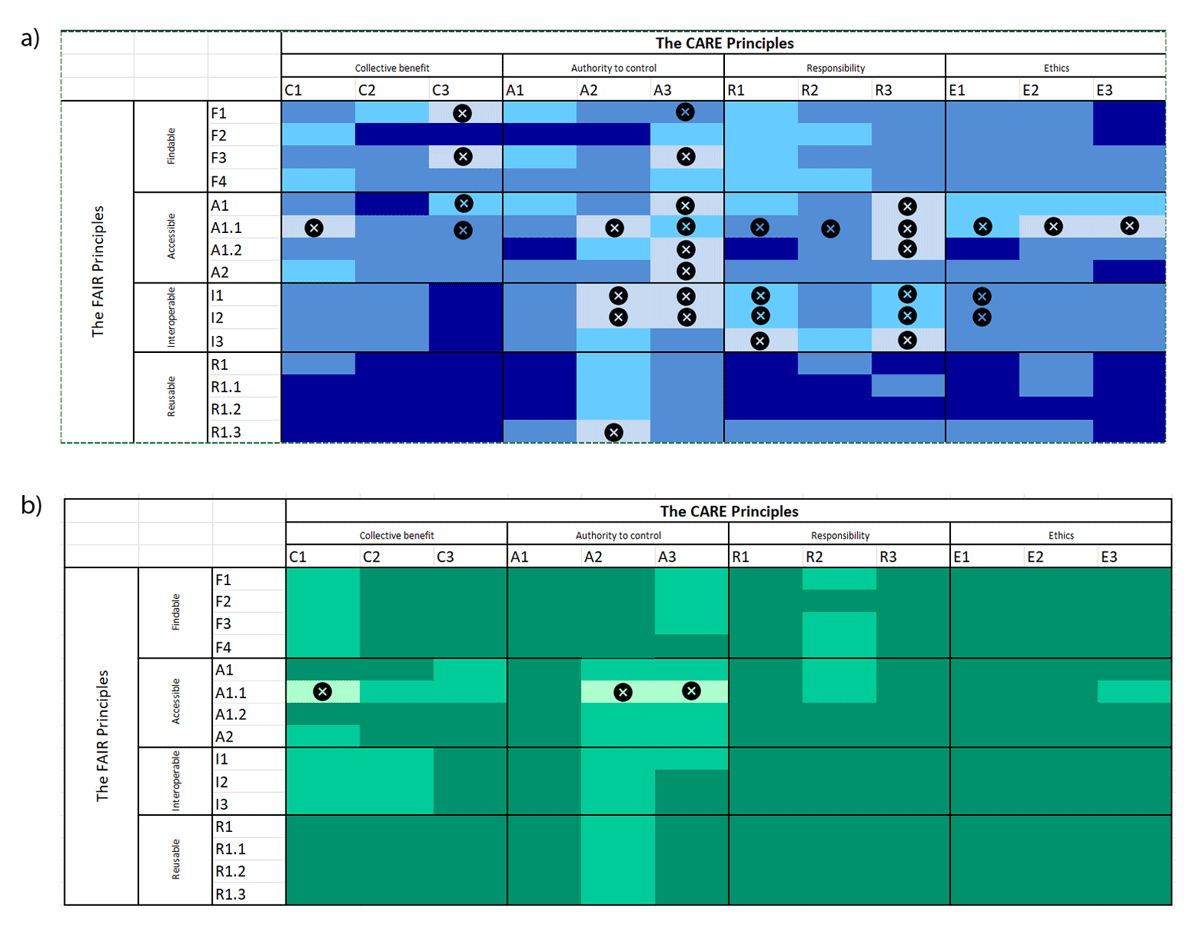
Figure SM.1
Top (1a): Scoring results shown with a colour gradient. Darkest blue indicates unanimous agreement, followed by majority agreement (3 of 4 evaluators), 50–50 choices, and lightest blue where all three options were chosen. Principles and sub-principles are defined in Tables SM.1–SM.2. Circles with crosses mark sub-principle pairs where one or two evaluators judged a contradiction; none had more than two. Bottom (1b): Consensus matrix (step 3). Circles with crosses indicate contradictions at the data level. Darkest cells (sea green) represent alignments, while lighter cells (jade) without crosses represent sub-principle pairs that can be implemented independently.
Acknowledgements
We acknowledge the valuable and useful advice provided by experts of the IPBES task force on data and knowledge management as well as colleagues of the IPBES technical support unit for Indigenous and local knowledge. This manuscript does not constitute an official product of IPBES; and should not be interpreted as representing the views, decisions, or positions of IPBES. The content was prepared by the co-authors solely in their individual capacities. We would like to thank Matthew Mayernik and the two anonymous reviewers for their valuable and constructive comments.
Competing Interests
The authors have no competing interests to declare.
Author Contributions
AN and RMG conceived the idea. RMG designed the study and led the writing. AN, RMG, RMK and YS were the evaluators of the FAIR and CARE matrix and worked together to develop the evaluation matrix. All authors discussed the idea and the study design and revised the manuscript.