
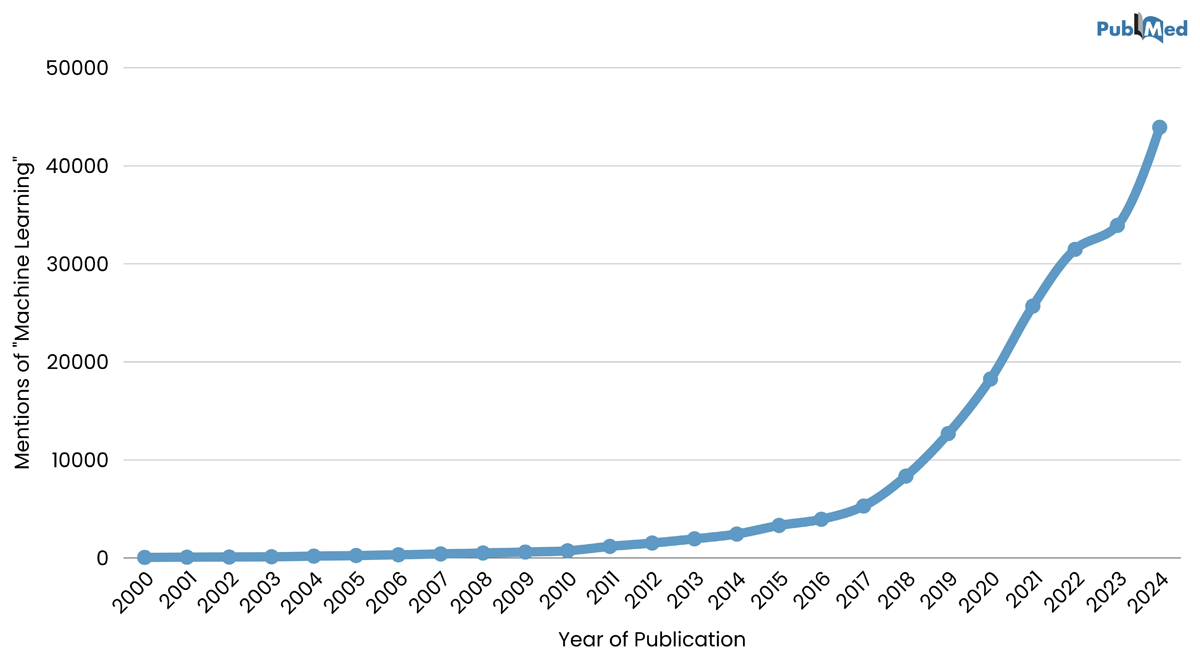
Figure 1
Timeline of publications in PubMed that include the phrase ‘machine learning’ since 2000, demonstrating the rapid rise in these publications across the globe. In 2024 alone, PubMed published a total of 43,931 articles covering ‘machine learning’.
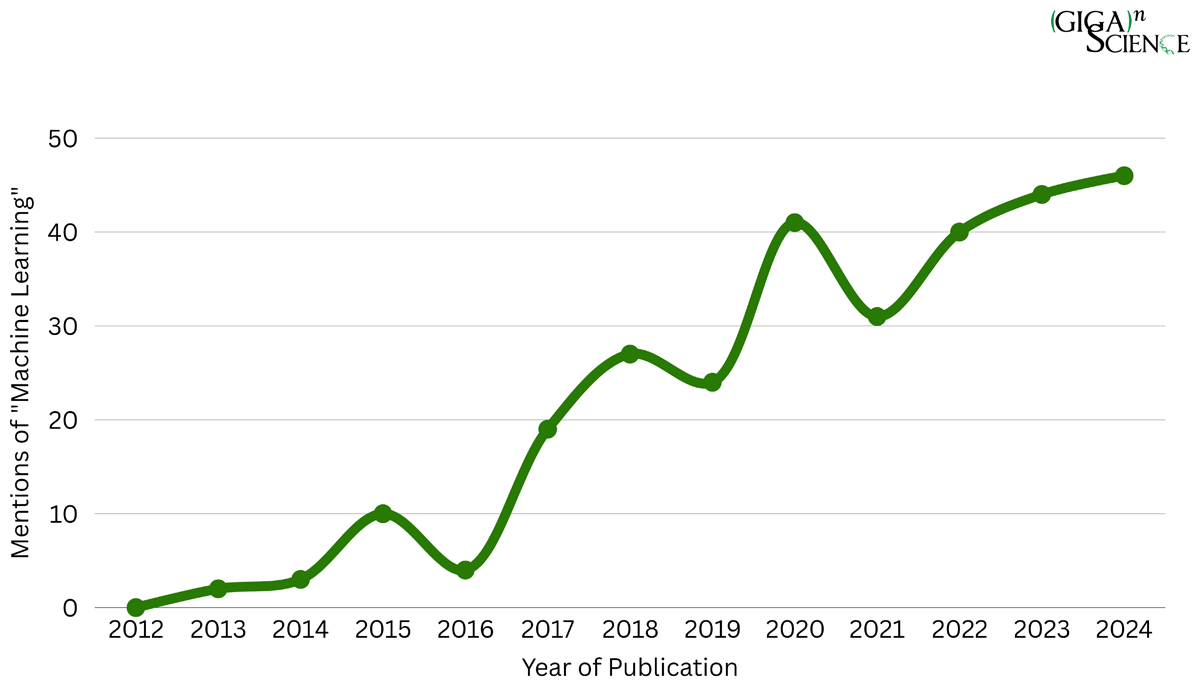
Figure 2
Timeline of publications in GigaScience that include the phrase ‘machine learning’ since the launch of the journal in 2012.
Table 1
Summary of the more general ML standards that go beyond medicine to biological science and beyond, comparing the DOME-ML, REFORMS, AIMe and Heil et al.’s Bronze-Silver-Gold approaches.
| Standard | DOME-ML (Walsh et al., 2021) | REFORMS (Kapoor et al., 2024) | AIMe (Matschinske et al., 2021) | Bronze-Silver-Gold (Heil et al., 2021) |
| Complexity (No. of fields) | 17 recommendations (10 required) | 32 questions (8 modules) | 63 questions (6 optional) | 3 standards (7 criteria) |
| Extensions | No | No | Yes | No |
| Tools | Recommendations + Wizard + Registry | Checklist | Standard + Reporting tool + Registry | Standard |
| Focus | Supervised ML | For ML-based science, not ML methods research | Biomedical AI | Machine-learning analyses in the life sciences |
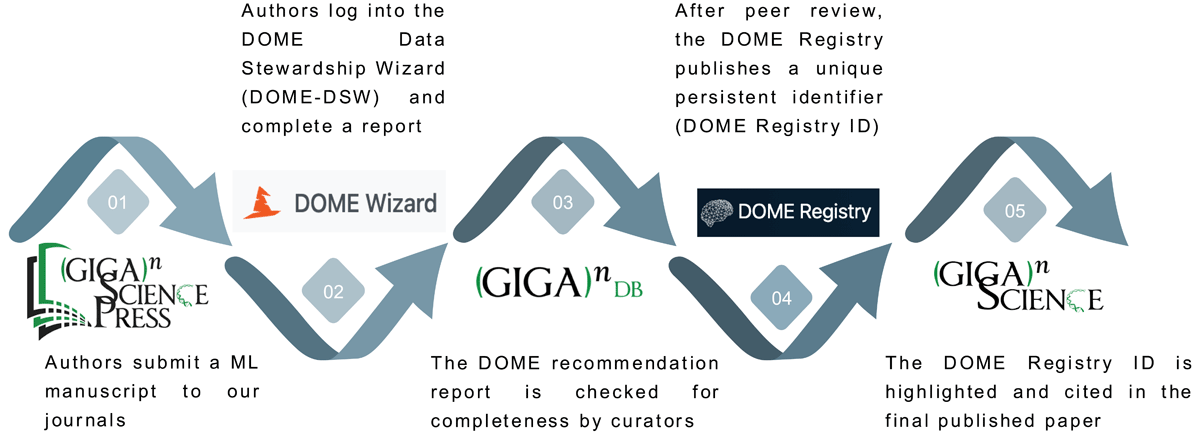
Figure 3
Workflow of the steps taken that utilise the DOME guidelines, DOME-DSW, and DOME Registry to aid the peer review of ML research. Step 1 is using the guidelines during pre-review editorial assessment; Step 2 is the creation of a DOME-DSW entry so authors can begin inputting annotations; in Step 3, the annotations are checked by the in-house curation team; Step 4 is when after review, the DSW annotations are transferred, curated, and published in the DOME registry; and in Step 5, the final DOME Registry ID is cited in the paper, and is then published.