
Introduction
Visualization of stock market data is critical in supporting decision-making for financial advisors (Huang et al., 2022). Stock market visualizations are accurate predictors of portfolio selections and aid in risk reduction (Lurtz et al., 2021). With technological development and a shift toward the digital- and knowledge-based economy (Qureshi and Woo, 2022), financial markets are becoming increasingly complex (Sturgeon, 2021). This complexity is creating a need to address the gaps in current stock market visualization methods (Gower, 2015) and the development of more intuitive stock visualizations to aid decision-making in the financial technology (FinTech) industry (Li and Xu, 2021).
Many metrics and factors affect a stock price; the most important indicators from which you can learn a lot about a company are market capitalization (MCAP), price-earnings ratio, revenue, earnings per share, average volume, and year-to-date change (Snášel et al., 2024). To visualize the performance of various stocks simultaneously, stock market data is typically displayed using stock heatmaps (Hua, Huang and Huang, 2019). Only two metrics are used on one 2D stock heatmap, one of them being MCAP, a fixed metric across all stock heatmaps, and one other variable metric which one can choose and change, and these are known as 2D stock heatmaps (Hua, Huang and Huang, 2019). The limitation of only viewing one new metric per heatmap often necessitates switching among multiple stock heatmaps to gain a comprehensive view of the market (Moomoo, 2023). Such switching can potentially obscure a holistic view of the data, waste time, and result in missed opportunities.
This study explores the use of the 3D stock heatmap in immersive virtual reality using a VR headset. As the digital economy expands into the Metaverse, a virtual world where users interact through digital avatars (Mancuso, Petruzzelli and Panniello, 2023), it is increasingly becoming an important platform for economic activities and business models (Momtaz, 2022). New technologies would likely bring new opportunities, like providing additional dimensions that can display more data easily and provide an additional perspective, therefore improving stock traders’ and analysts’ understanding of the data and their engagement in analyzing it. Additionally, immersive virtual reality market revenue has been increasing over the years (Dzardanova and Kasapakis, 2023). Some estimates project that the immersive virtual reality market will reach $84.09 billion in 2028, from just $6.30 billion in 2021 (Freitas, Gomes and Winkler, 2022). Thus, this study will also test the 3D stock heatmap in this environment. Furthermore, the use of immersive virtual reality in this study has the potential to enhance the 3D stock heatmap and make it more accessible and comprehensible.
This study aims to improve the decision-making processes for users of stock data by incorporating more metrics into a single stock heatmap. In doing so, this study seeks to overcome the limitations of 2D stock heatmaps by proposing and testing a 3D stock heatmap that can display multiple metrics simultaneously. A 3D stock heatmap will reduce the time market strategists spend toggling between stock heatmaps and uncovering correlations between metrics. Therefore, this research hopes to provide a holistic and more comprehensible understanding of the stock market data by developing a 3D stock heatmap.
Literature Review
The challenge of presenting stock data in a tangible and simplistic way has previously been addressed in many studies. Nesbitt and Barrass (2004) introduced a technique called ‘sonification’ that represents stock data in the form of sound, enabling traders to easily identify patterns. Similarly, Keim et al. (2006) used geometric techniques and spatial positioning to represent data, which helps communicate relationships among metrics. Furthermore, Prasanna and Ezhilmaran (2013) demonstrated the application of various data mining techniques, such as decision trees, neural networks, and support vector machines, in predicting stock market trends. This demonstrates the potential value of using sophisticated technical analysis techniques to decipher patterns in stock market data and to make accurate predictions (Borkar et al., 2023). However, predicting stock market movements is difficult because it involves stochastic, dynamic, nonlinear, and time-varying elements without a fixed structure and is influenced by numerous economic and political factors (Rouf et al., 2021).
One important visualization that represents stock data is a stock heatmap, also known as ‘Maps of the Market’, which are a colorful representation of stock market data, where the size of the rectangle means a company’s MCAP and a color gradient represents the increase or decrease of a specific stock metric (Roberts, 2004). Stock heatmaps are an essential financial data visualization tool and a popular choice amongst traders and analysts because of their ability to quickly convey a lot of available information (Chen et al., 2023) and are offered by financial planning websites alongside other charts, to represent stock market data (Ko et al., 2016). Stock heatmaps are similar to rectangular treemaps, which are an area-based hierarchical data visualization (Scheibel et al., 2020) that include heatmap elements (Wang et al., 2023), like color gradients to better differentiate. Despite their usefulness, 2D stock heatmaps are limited to presenting two metrics simultaneously (Moomoo, 2023), necessitating frequent switching among various 2D stock heatmaps to view all relevant metrics.
The virtual reality environment is a digital interface, such as a web page provided on a personal computer (PC), a VR headset, or any other electronic device, and means entering a virtual space designed to present information in a structured way (Makransky, Petersen and Klingenberg, 2020).
The term ‘immersive virtual reality’ (IVR) specifically refers to environments and headsets that provide an immersive and engaging experience (Coban, Bolat and Goksu, 2022). Although ‘immersive virtual reality’ and the abbreviation IVR are more accurate terms for these setups, they are commonly referred to just as ‘virtual reality’ and VR (Hepperle and Wölfel, 2023). Therefore, virtual reality and the abbreviation VR refer to desktop-based and IVR environments, depending on the context. Still, this can cause confusion as virtual reality and VR are often associated predominantly with immersive experiences. Thus, this study specifically uses the term immersive virtual reality (IVR) when referring to environments designed for immersion to reduce ambiguity.
Spatial computing technologies, such as immersive VR headsets, enable users to interact with data in a 3D space (Balakrishnan et al., 2021). Therefore, virtual environments can be used to improve user experiences and provide an immersive and engaging platform for visualizing and analyzing complex datasets (Donalek et al., 2014). Consistently, Nesbitt (2001) recognized the potential of virtual spaces in creating an interactive 3D environment to visualize stock market data. Multidimensional stock data, which may be difficult to interpret using 2D charts and graphs, can therefore be presented in a more intuitive and engaging format to see multiple correlations (Aboura, 2024). The effectiveness of data visualization increases with the number of dimensions that can be represented and, thus, the possibilities for identifying exciting patterns, connections, or outliers increase (Donalek et al., 2014). To represent multidimensional data, they used various elements, such as spatial coordinates, colors, sizes, transparencies, shapes of data points, and even textures, orientations, rotation, and pulsation (Donalek et al., 2014). Such practices have demonstrated the enormous potential of VR in visualizing complex, high-dimensional data, thereby improving the understanding of such data and the enabling of an informed decision-making process (Farhadloo et al., 2023). Kraus et al. (2020) assessed, using immersion techniques, that for some specific tasks like values extraction and property detection tasks, the 3D heatmaps can be better than 2D heatmaps. In immersive environments, using VR headsets can, for example, enable users to ‘walk through’ (Rosenbaum et al., 2011), create a 3D visual representation of the stock market heatmap, and explore different sectors of the Standard and Poor’s (S&P) 500 as if they were physical there. This immersive experience could help make abstract financial data more tangible and, therefore, promote a deeper understanding (Li et al., 2022). These features can significantly increase engagement and motivation (Makransky, Petersen and Klingenberg, 2020) and thus increase productivity (Donalek, et al., 2014).
With its immersive capability, IVR is a potential solution for the data visualization limitations (Farhadloo et al., 2023) of 2D stock heatmaps and has been proposed as an ideal customer service platform (Zhang et al., 2023). Integrating a 3D stock heatmap visualization into the immersive virtual reality environment could provide stakeholders with a more intuitive and immersive experience (Xie et al., 2023). With rapid technological advancements, especially in the areas of immersive virtual reality and augmented reality, there are new avenues to explore and push the boundaries of data visualization (Donalek et al., 2014) furthermore, 3D visualization is a relatively new field that enables the use of an additional dimension to visualize complex data systems (Ugo, Delfina and Luca, 2019). This is particularly true for diverse data with numerous metrics, such as the stock market data (Cai et al., 2019). Xia et al. (2023) have used 3D heatmaps in their research for object detection and found that through 3D heatmaps, they were able to detect objects better. For these compelling reasons and to explore the potential of IVR, the current stock heatmap will be transformed into a 3D stock heatmap.
3D visualizations are often discouraged as they can lead to data occlusion and distortion of data and make it harder to perceive depth (Amini et al., 2015), leading to misinterpretations. Other studies suggest that the issue of depth perception can be mitigated using immersive technologies (Kraus et al., 2022). However, the discussion is still about whether 3D visualizations can be beneficial (Ugo, Delfina and Luca, 2019). Therefore, an emphasis will be placed on the useability and design of the 3D stock heatmap, ensuring that data is not occluded or distorted.
Visual immersion provides many benefits (Wang et al., 2022). Kwon et al. (2016) showed through their findings that working with an immersive 3D spherical layout can lead to faster decisions compared to working with conventional 2D graph visualization. This research will determine whether a 3D visualization of the 2D stock heatmap is beneficial and allows for faster decision-making. This will also allow for a better understanding of 3D data visualizations and advance the field. Additionally, 3D visualization will also be used in the IVR environment, as studies have shown that viewing 3D (depth) visualizations in stereoscopic environments can help better understand them (Belcher et al., 2003). Other studies with evidence have shown that 3D visualizations can offer additional advantages than 2D visualizations (Kraus et al., 2022). Through literature review and research, insights into potential gaps were gathered, leading to a more comprehensive understanding of the need for a 3D stock heatmap as it can assist in the discussion of 2D vs. 3D visualizations, 3D visualizations potential benefits for stock market data analysis, and its usability in emerging platforms.
Methods
It is essential to find those applications that can benefit the most from 3D visualization techniques (Brath, 2014) or those that are not possible without them, like requiring depth information or belonging to a specific niche like movies, video games, medicine, industrial design (3D CAD), military, and more (McIntire, Havig and Geiselman, 2012). As PC performance and devices like IVR headsets have become more available (Kwon et al., 2016), more resources are available to show better quality and improved data visualizations. IVR headsets also provide a broader view, where the entire view around the user can be utilized. Additionally, in the past few years, interactive 3D visualization techniques have become one of the commonly used research tools as they allow for a better understanding of complex structured data. (Pomarède et al., 2017), in addition to 2D visualization tools.
Overview
He et al. (2024) used the 3D density inversion method and achieved good results, showing that the 3D techniques can help advance the field. Another important 3D visualization technique is the cosmic velocity web (Pomarède et al., 2017), which allows the mapping on a galactic scale and a better visual understanding. Other 3D visualization techniques can also help in understanding complex and hierarchical data like Geo data (Kalaitzis et al., 2023). Research conducted by McIntire et al. (2012) has shown that 3D stereoscopic systems are better than 2D ones in 58% of the cases, 14% showed mixed results, and the remaining 28% showed no benefit. Therefore, developing a 3D stock heatmap and testing it in the IVR environment could be beneficial as stock market data is also complex.
Data availability
It is crucial to recognize the broader context of privacy and security in visualization development (Shakeel et al., 2022). The market data for this study was from The Globe and Mail (www.theglobeandmail.com) and is subject to their terms and conditions, including permitted use of their data for personal and non-commercial purposes (The Globe and Mail, 2015). Therefore, the study complies with legal requirements and respects intellectual property rights. Furthermore, selecting publicly available financial data without personal or sensitive attributes ensures a responsible approach to data collection.
Data design
Metrics included the date the data was downloaded, market capitalization (MCAP), earnings per share (EPS), and year-to-date (YTD). MCAP is the aggregated market value of a company and is calculated using the formula below (Seth, 2022):
EPS is a measurement of a company’s profit and is calculated using the formula below (Folger, 2023):
YTD change refers to the value difference between the current value as compared to the start of the year. YTD is calculated using the formula below (Tuovila, 2023):
Data visualization
The data was represented as interactive 3D tree map columns plotted in a 3D space, each representing a company’s stock. The bar height corresponds to the EPS, the color represents the change in YTD stock price, and the base area reflects MCAP. Navigation in the virtual space is facilitated through a keyboard, mouse, and controllers, which enable the user to click the data, rotate and change the view, or move closer to inspect details. Users can select a specific company to display detailed information, such as a line graph. Filters and setting options provide a floating virtual panel, allowing users to customize the view based on selected parameters.
Dashboard and 3D stock heatmap development
A web dashboard page was developed to provide a platform for the 3D stock heatmap and analyze proof of concept. An iterative development approach was utilized, using module integration and testing allowing for gradual features integration (Figure 1). Briefly, data for visualization was acquired and converted to the appropriate file (CSV) and translated into visual elements using Python code for the virtual reality environment (Figure 1). The 3D stock heatmap was then developed using the A-frame library in HTML, which was hosted on a web server using development tools, and URLs were generated to enable the 3D stock heatmap to be viewed on devices, including VR headsets, via the virtual reality rendering module. Finally, software development components that support the project’s complexity, innovation, and user-friendly controls are integrated into the final product (Figure 1). The web dashboard page did not collect, process, or otherwise use personal data, which aligns with a committed approach to data privacy and security.
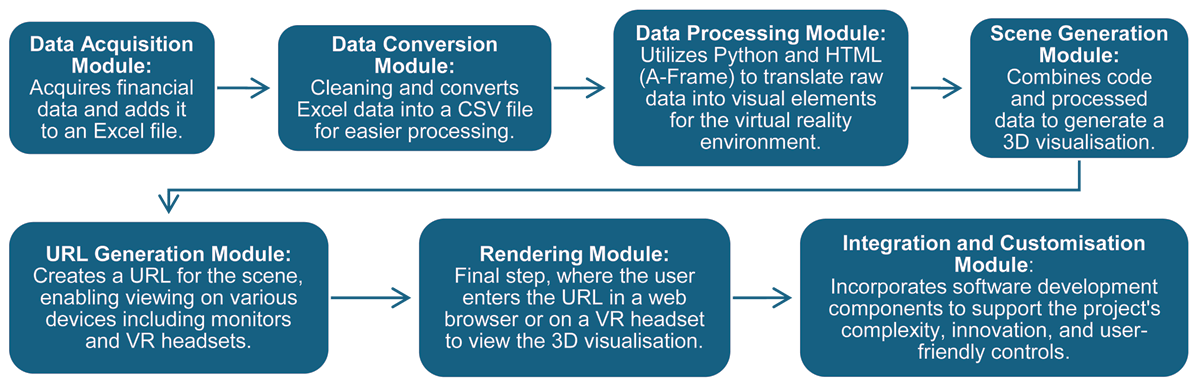
Figure 1
Chart showing the process of functional design for 3D stock heatmap.
The functional components of developing the 3D stock heatmap to deployment, termed modules, from data acquisition to virtual reality scene generation, were designed to handle crucial steps (Figure 1).
After the 3D stock heatmap was developed, the generated visualization is then hosted on a web server using web development tools. The study used WebXR, a platform that allows virtual reality rendering to view the 3D stock heatmap visualization in virtual environments, and a VR headset was used to explore the 3D stock heatmap in an IVR environment and proved functional on PC, smartphone, and with some additional code on a VR and augmented reality (AR) headset too.
Comparison between 2D and 3D stock heatmaps
The 2D and 3D stock heatmaps have many common aspects that can be compared. The first one is usability. Both are user-friendly and easy to use, but it takes some time to get used to the 3D stock heatmap, as it has more information and uses the third dimension. The second aspect is functionality, where the 3D stock heatmap allows for rotation and viewing from different angles, zoom, and showcasing more metrics. The 2D stock heatmap only has a static view from above. The third aspect that can be compared is performance, as the 3D stock heatmap has an additional metric that it can show, this allows it to reduce the time a user needs to look at all the metrics by at least half. This also allows for a more insightful decision-making process as more connections between the metrics can be made. The fourth one is cross-platform availability; although the 2D stock heatmap can be made available in IVR environments through a website on the browser app in VR headsets, it does not feel intuitive and lacks some additional features that you expect when in an IVR environment, whereas the 3D stock heatmap feels more natural in that environment. The fifth one is data representation; the 2D and 3D stock heatmaps have difficulty showing smaller companies, which are usually in the lower right corner. However, the 3D stock heatmap has slightly less of this issue as it uses the height dimension, which allows for easier discernment and differentiation if that metric of a company is doing well.
Challenges and limitations
Challenges were encountered throughout the testing phase as the research used an iterative approach. The user interface development posed a challenge because it is essential to have a viable interface that can represent data in 3D while not distorting data perception, occlusion, or leading to misinterpretation. Therefore, the user interface for the 3D stock heatmap data visualization was designed to be simple and intuitive. However, ensuring a smooth user experience inside the IVR environment was challenging compared to the PC version. The IVR environment required additional surroundings and background images, as well as the positioning of the objects and the user camera (viewing field) in the IVR space. By adding a closed background as an office place to create an immersive experience, the almost infinite void space in the IVR was limited to just a room. At the same time, the iterative approach underlined the need for data filters so the user can adapt the 3D stock heatmap to their needs; however, only a few were added to prove the concept and convey the message. Another challenge was developing an accurate 3D stock heatmap from the raw stock data to a 3D visualization. The visualization developed shows the concept. However, it needs more refinement for commercial use. An additional challenge was to add cross-platform compatibility. Programming in multiple languages like Python, HTML/CSS, and JavaScript was required to achieve this functionality. It also needed rigorous testing to ensure that the visualization worked across platforms. Finally, during testing, some interaction challenges were also encountered. While using the controllers in the IVR environment, it was sometimes difficult to find the exact point on a column, which, when clicked, opened more information.
Results
A 3D stock heatmap that could display more metrics was successfully developed, demonstrating the proof of concept. It also showed that a 3D stock heatmap does not automatically obscure data like many other 3D visualizations. The ability to move around the 3D stock heatmap within the IVR environment enhanced the holistic view of the user by showcasing twice as many stock metrics and the interactive nature of the visualization. This attribute enriches the overall user experience by offering to explore the data from various angles and perspectives, as well as zooming in and out. Movement within the IVR environment added a dynamic dimension to the experience, enabling a more comprehensive understanding of financial metrics. This functionality provides a pathway for individuals seeking to engage and work in the immersive virtual world.
Developing a 3D stock heatmap enabled the analysis and management of stock data, allowing a multi-metric view. Cross-platform deployment of the web-based 3D stock heatmap encountered inconsistent results in visualization quality across browsers on different platforms. For instance, the browsing experience on a conventional PC outperformed that on a VR headset. Additionally, there were technical limitations in rendering complex graphics and achieving smooth performance on a VR headset.
The most easily viewable data presentation method was height. By assigning the metrics like MCAP, EPS, and YTD of different stocks to a column in the 3D visualizations as height, area, and color, the study found that the predominant factor in the 3D stock heatmap for comprehension of the data is the height of the columns (Figures 2, 3, 4, 5), followed by the color of the columns and, lastly, the area of the columns.
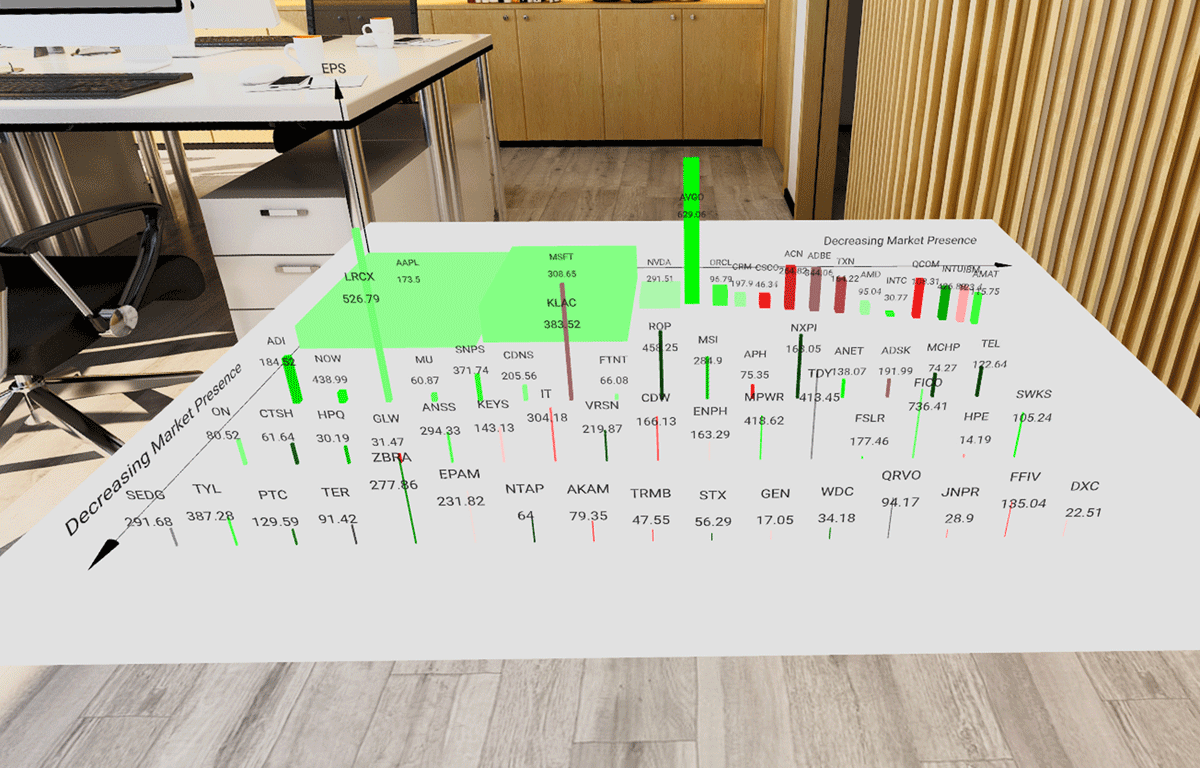
Figure 2
3D stock heatmap.
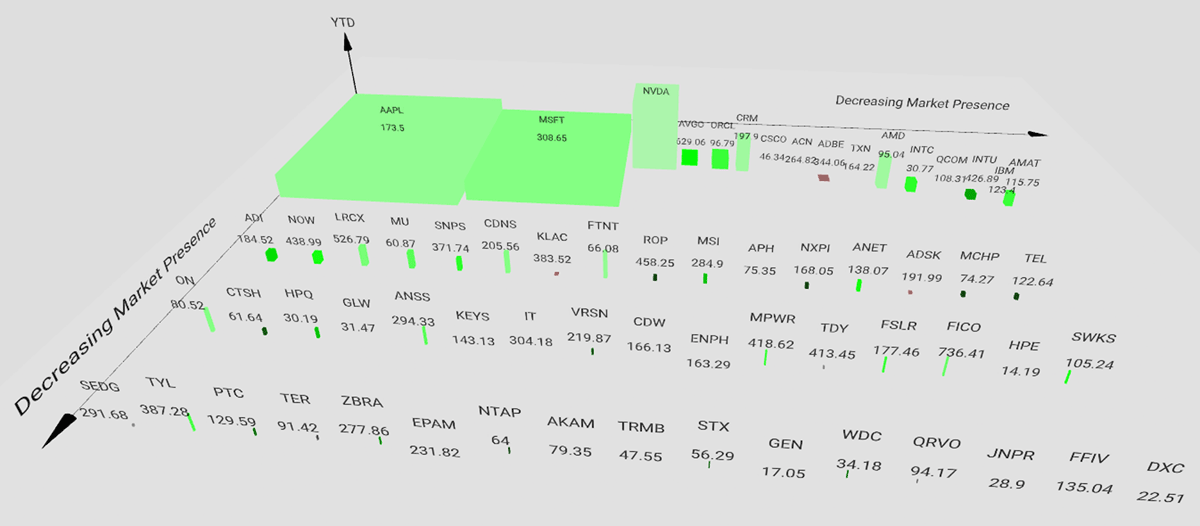
Figure 3
Close-up screenshot of the 3D stock heatmap using YTD as height.
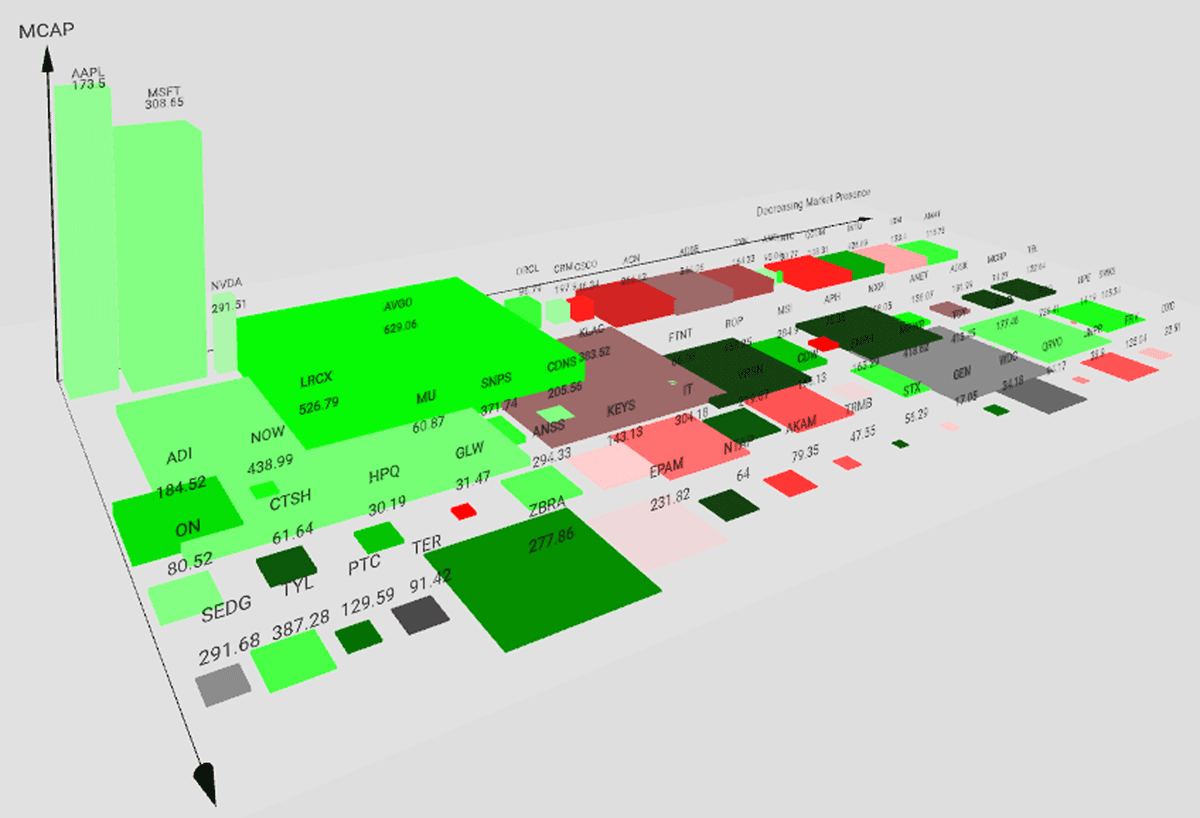
Figure 4
Close-up screenshot of the 3D stock heatmap using MCAP as height.
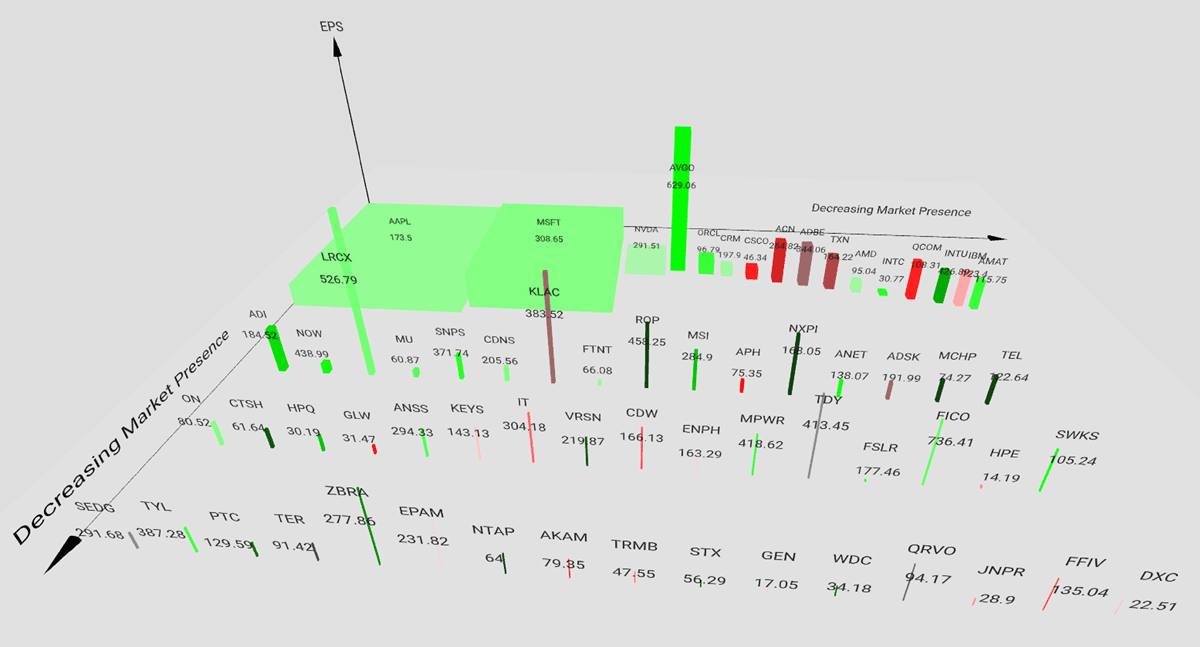
Figure 5
Close-up screenshot of the 3D stock heatmap using EPS as height.
An unexpected finding of the study was that the 3D stock heatmap could use four metrics, which can be done through sorting order of the columns. This distinguishes the 3D stock heatmap from the 2D stock heatmap, where the squares of a stock are sorted in treemap order and looked at from above. This method can help organize the columns, and it shows that the largest companies are in the upper left corner and the smallest companies are in the lower right corner. This is not vital for a 3D stock heatmap as the visualization can be rotated and inspected from various angles. Thus, an additional stock metric can be used to sort the data, for example, from largest to smallest, however, adding more complexity for the user. Depending on the viewing angle, this might not look as neat as a 2D stock heatmap; however, it could make it more detailed.
Discussion
The increasing complexity and volatility of stock market data necessitate traders and analysts to rapidly interpret it (Nong, 2024) and presents the need for more refined visualization methods that present multiple stock market metrics (Berenguer et al., 2024). 3D visualization can allow users to perceive more dimensions of the data simultaneously, which could lead to better understanding and insights (Donalek et al., 2014). A 3D stock heatmap was successfully implemented and tested in virtual reality environments, that is, on the web browser and VR headset. It could, therefore, be used in virtual reality environments, such as web browsers and extended reality platforms, to provide more comprehensive, intuitive, and interactive tools for stock traders and analysts.
The 3D stock heatmap has several key strengths and capabilities useful for visualizing stock market data. However, the 3D stock heatmap exhibits certain differences compared to the 2D stock heatmap. The 3D stock heatmap performs effectively when the user focuses on one industry sector of the stock heatmap, like on finviz.com (Figure 6), or if the user is using a stock heatmap that does not split it by industry sectors, as on marketscreener.com (Figure 7). Otherwise, it may possibly obscure some smaller companies in a different industry sector that are behind a large company in a different sector. However, users might be able to mitigate these issues by rotating the map and viewing it from a different angle or not choosing to sort the columns like in a treemap. Nonetheless, it is worth noting that the users of these maps are usually focused on larger companies. Consequently, this limitation is unlikely to present a substantial hindrance, and the map should still provide users with valuable insights for informed decision-making.
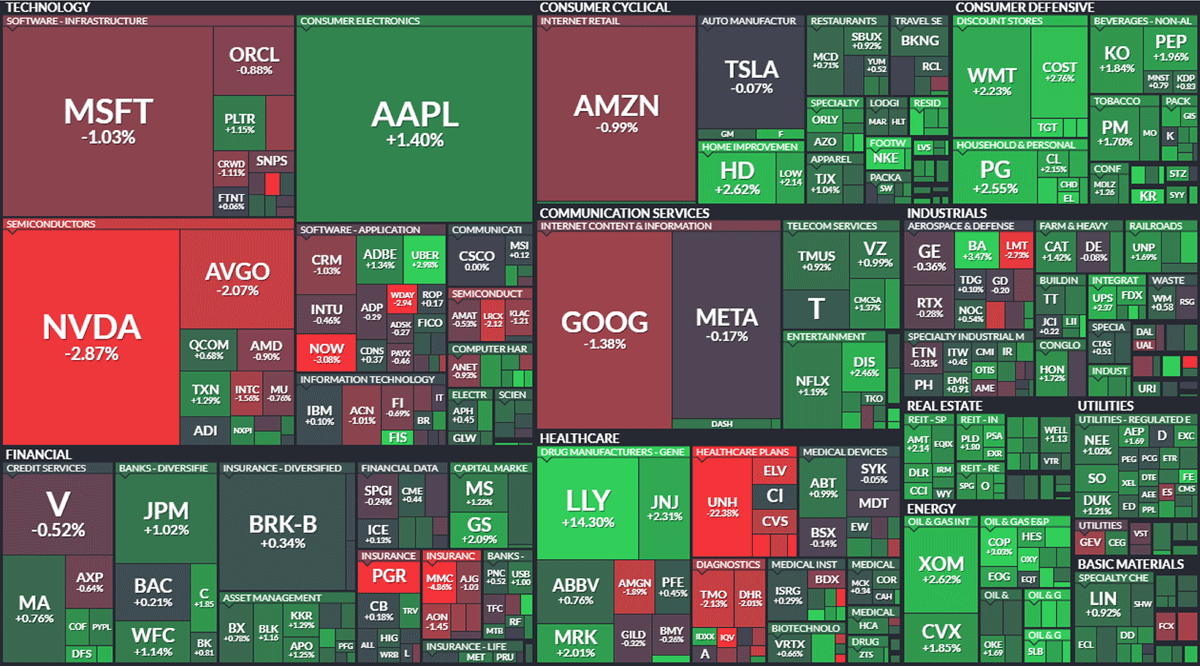
Figure 6
2D Stock market heatmap (source: finviz.com).
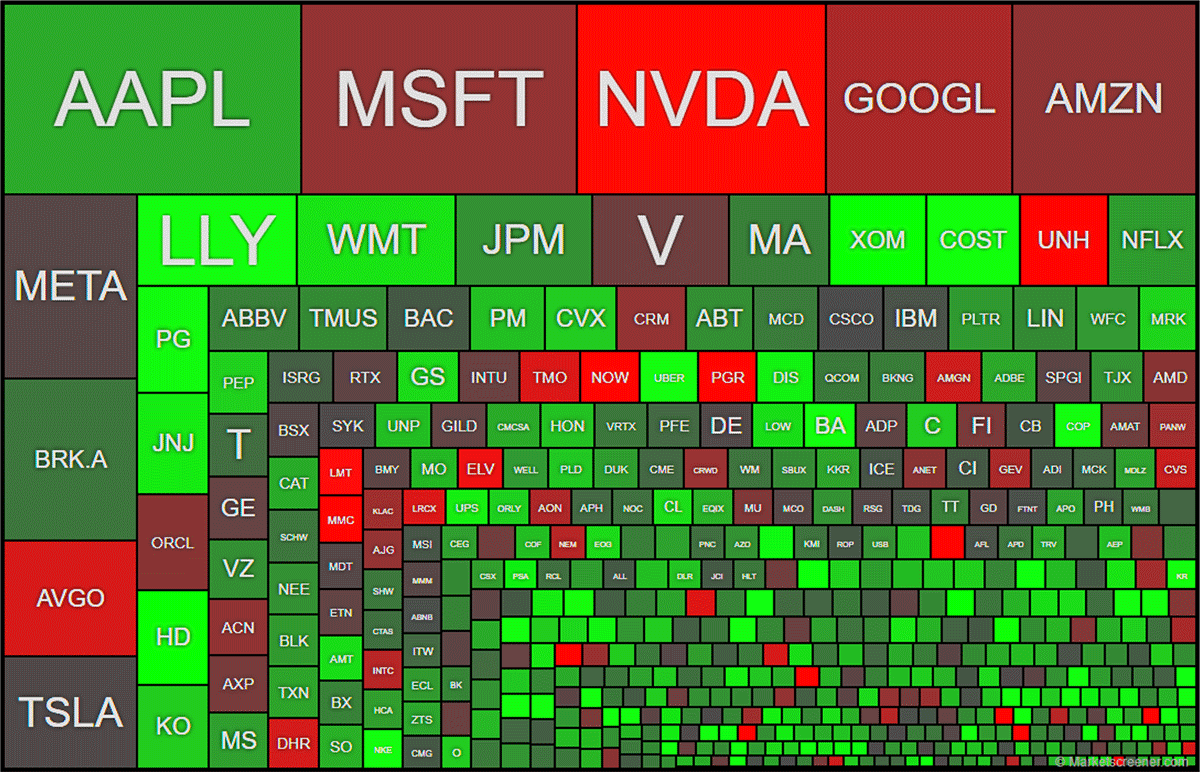
Figure 7
S&P 500 index stock heatmap (source: MarketScreener.com).
Aysan et al. (2023) identified limited literature on the Metaverse and that studies primarily focus on nonfungible tokens (NFTs) and crypto markets; however, there is rapid development of technology and the emerging field of immersive virtual reality.
Stock heatmaps also bear some resemblance to rectangular treemaps that are used to assist in financial decision-making (Laubheimer, 2019). This study found that 3D stock heatmap do not necessarily need to be like rectangular treemap; however, they share similarities in their rectangular shape and functionalities.
Al-Gnbri (2022) explores new accounting and auditing methods in the emerging Metaverse showing how advanced technologies shape traditional practices in various fields, including finance. This study shows a new virtual reality visualization that could address some Metaverse challenges.
Mehandjiev and Saadouni (2018) noted advancements in the integration of information and communications technologies within the financial sector, collectively termed FinTech, which could offer many new opportunities. This study addresses some of the gaps in stock market data applications, like a lack of a holistic 3D visualization, by developing a 3D stock heatmap and a web dashboard page for it.
Some stock market visualizations use 3D effects or extrusion to show the same metric used for the companies’ color to showcase the data in a stock heatmap clearly or filter it (Huang, Liang and Nguyen, 2009). These visualizations still exhibit a considerable degree of simplicity, similar to the 2D stock heatmap, and do not show more than two stock market metrics. Furthermore, none of the studies explored the potential impact that assigning an additional metric or variable to the third dimension would have on stock heatmaps. The study demonstrates a new perspective on stock market data analysis, enabling a multi-metric view of stock data via a 3D stock heatmap. Thus, the development of a 3D stock heatmap in this study, likely can be used to enhance user experience, gives stock traders and analysts an additional perspective, allowing more metrics to be viewed simultaneously in a visually appealing way, compared to the conventional 2D stock heatmap.
The 3D stock market heatmap visualization utility in real-world scenarios could be to bridge the gap between the conventional stock heatmap and multi-metric financial data charts in an intuitive 3D format and user-friendly representation. This additional metric holds the potential to expedite the decision-making process for investors, potentially resulting in heightened returns on investments (Donalek et al., 2014). The 3D stock heatmap could also provide an additional perspective and be a functional tool to aid stock traders and analysts in their decision-making processes. Additionally, refining the visualization for commercial purposes could further contribute to its utility, providing users with tailored insights and analysis. The 3D stock heatmap visualization effectively provides a holistic view of the stocks and a unique perspective of stock data. This could enable 3D stock heatmap users to outperform others.
Visualization challenges and their solutions
According to Besançon et al. (2021), visualizing spatial 3D datasets is mostly challenging, which was also the case in this study. As the base area of all the heatmap columns cannot be the same, which led to, in some cases, when the base of the column was larger than usual, and also the neighboring columns had a large base, to some overlapping. This also happens regularly in other visualization techniques like scatterplots and bubble plots (Brath, 2014) and did not lead to a misunderstanding. Nevertheless, this issue can be mitigated with a more refined visualization code, which automatically keeps the columns apart and/or makes the overlapping area transparent to some extent. Other visualization challenges, like better column detection for interactivity, can be mitigated by adding more detection points or entire surface detection. Other studies also noticed that conveying the depth of the edge in 3D adds an additional challenge (Kwon et al., 2016). This was also apparent in this research; however, as the 3D stock heatmap was rotatable, this issue was not that prevalent. This issue can be mitigated by adding glare to the visualization and slightly shading some sides of the columns.
Cross-Platform Compatibility and Customization
The cross-platform utilization of the 3D stock heatmap required some additional code, as each platform has slight variations that make it unique. Wang et al. (2022) suggest that one can improve the data exploration workflows by having a stereoscopic view, for example, by using augmented reality tools. Thus, besides testing the 3D stock heatmap in the IVR environment, its compatibility with AR headsets and smartphone devices was also checked. Utilizing the 3D stock heatmap in an AR headset and smartphone devices also worked. The experience of the AR headset was like that of the VR headset, with the ability to see through, however, making the experience less immersive. However, the small screen of smartphones did not show all the dashboard elements and 3D stock heatmap in depth. The most immersive experience was in IVR environments with the usage of a VR headset, then an AR headset followed by a PC, and the least on a smartphone. However, the PC experience was better for working with the data and analyzing it as it was more familiar due to its platform diversity. Additionally, while working in the IVR environment, it was much easier to work with data and files on the cloud than using it from a USB, for example. Another challenge linked to visualization quality across different devices is that visualization takes longer to load on other platforms than a PC and has slightly less quality. Future improvements should resolve these issues, ensuring better user experience and decision-making.
Besides minor adjustments and extra code for the specific platform, the interactive web dashboard can be embedded in HTML files, making it versatile and usable with many platforms. Stock data input, metrics output, camera field of view, background, animations, zoom, and data filters are available and can be customized. These customization options can enhance user experience and improve decision-making. The visualization was developed using Python and HTML, making it highly customizable and allowing additional functionalities to be added quickly. While the current state of the visualization design and functionality exhibits robustness, there are some opportunities for enhancements to improve the user experience. For example, customization would offer users more control over the visualization parameters, such as colors, scales, and filters, which could cater to individual preferences and needs. Optimization could lead to seamless rendering on various devices and browsers, ensuring a consistent user experience.
Future work
User testing insights would provide valuable data to improve design decisions and potential refinements. While this research developed and implemented the 3D stock heatmap concept, a more refined prototype will be needed for commercial usage. As the preliminary results are promising, user testing could be done to test the prototype. One suggested evaluation method for the web-based 3D stock heatmap could be usability testing, which includes testing the application functionality (performance), navigation (user interface), interaction mechanisms, and satisfaction (log analysis) (Vogel et al., 2011). The received user feedback can then be implemented in the prototype iteratively.
A study done by Belcher et al. (2003) used an AR head-mounted display (HMD) for path tracing performance on graph visualization. They concluded that the 3D visualization is better than the 2D one in performance, usability, and understanding of the graph structure. However, using an AR HMD did not provide additional benefits. Similar results are hypothesized from future work, such as that the 3D stock heatmap has advantages over the 2D stock heatmap, and using an HMD does not necessarily provide additional benefits, like better perception and functioning that can make a difference.
Future testing could involve testing the 3D stock heatmap with other data sets from different fields, making it the 3D X tree-heatmap where X stands for the field from which the data is being used. Evaluating the full benefits of the visualization will require extensive user studies.
Future work may refine the visualization capabilities to ensure the visualization’s continued effectiveness and relevance for stock traders and analysts by integrating artificial intelligence elements.
In conclusion, the development of 3D stock heatmap visualization effectively meets the goal of providing a holistic view of the stocks and could be an additional perspective for viewing stock data. This addition could enable 3D stock heatmap visualization users to outperform others. While the current implementation demonstrates the successful realization of the concept, it needs to be refined for commercial purposes.
Data Accessibility Statement
Although my research utilized financial data, other datasets could also be used. Since it was open-source data, it should still be available on a financial website.
The methodologies and visualizations are broadly applicable across various datasets with multiple metrics and can be created through various other methods. However, if required, I can provide the code and data on request.
Acknowledgements
The author thanks the reviewers for their feedback, which has improved the article.
Competing Interests
The author has no competing interests to declare.