
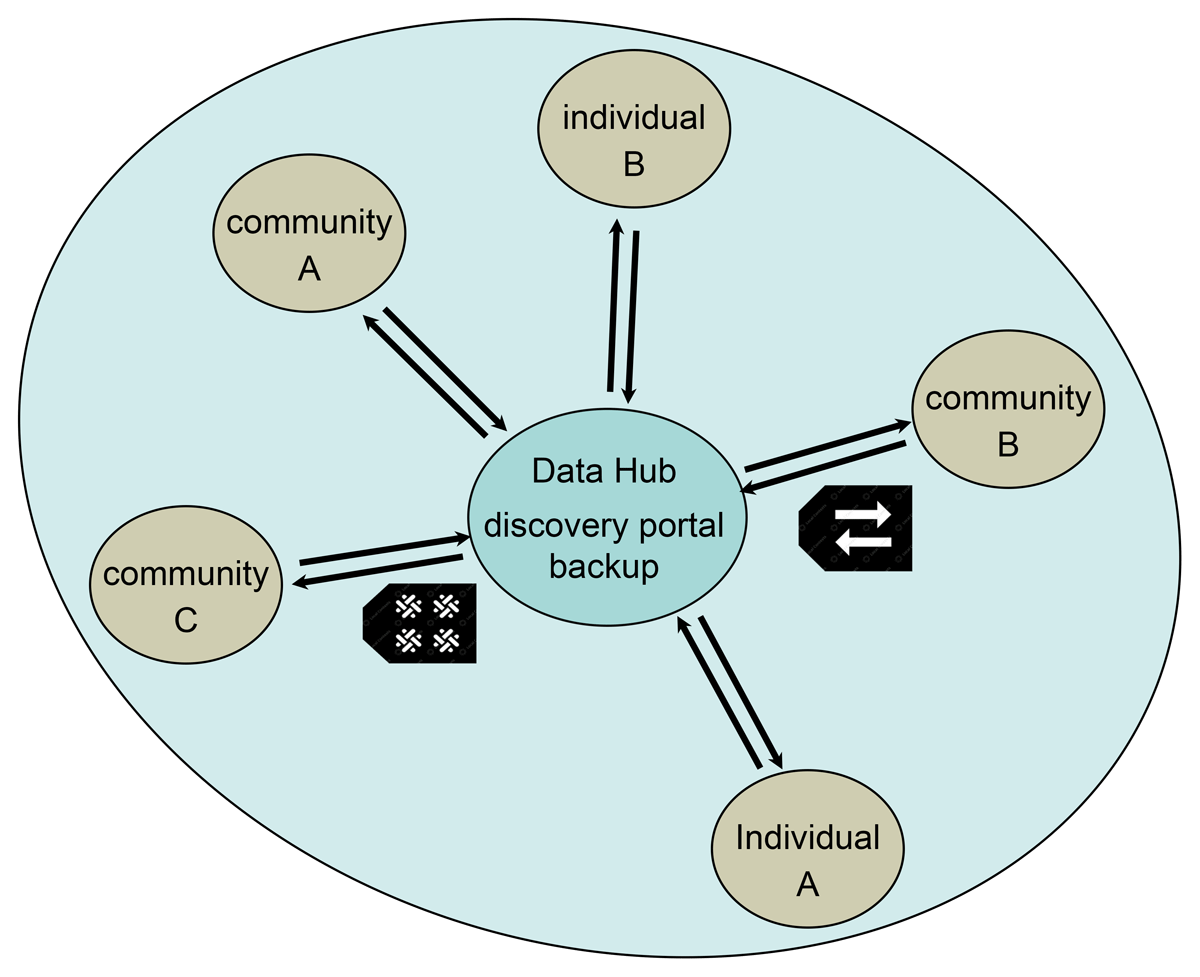
Figure 1
Depiction of a centralised data hub within a locally defined area (e.g., island, group of islands or country). Communities or individuals would assemble their data and metadata, applying local knowledge-type rules to each dataset. Examples of two traditional knowledge labels are shown for ‘attributions’, which need to be set at the community level, and the ‘multiple communities’ label, which indicates knowledge is shared across more than one community (see https://localcontexts.org).
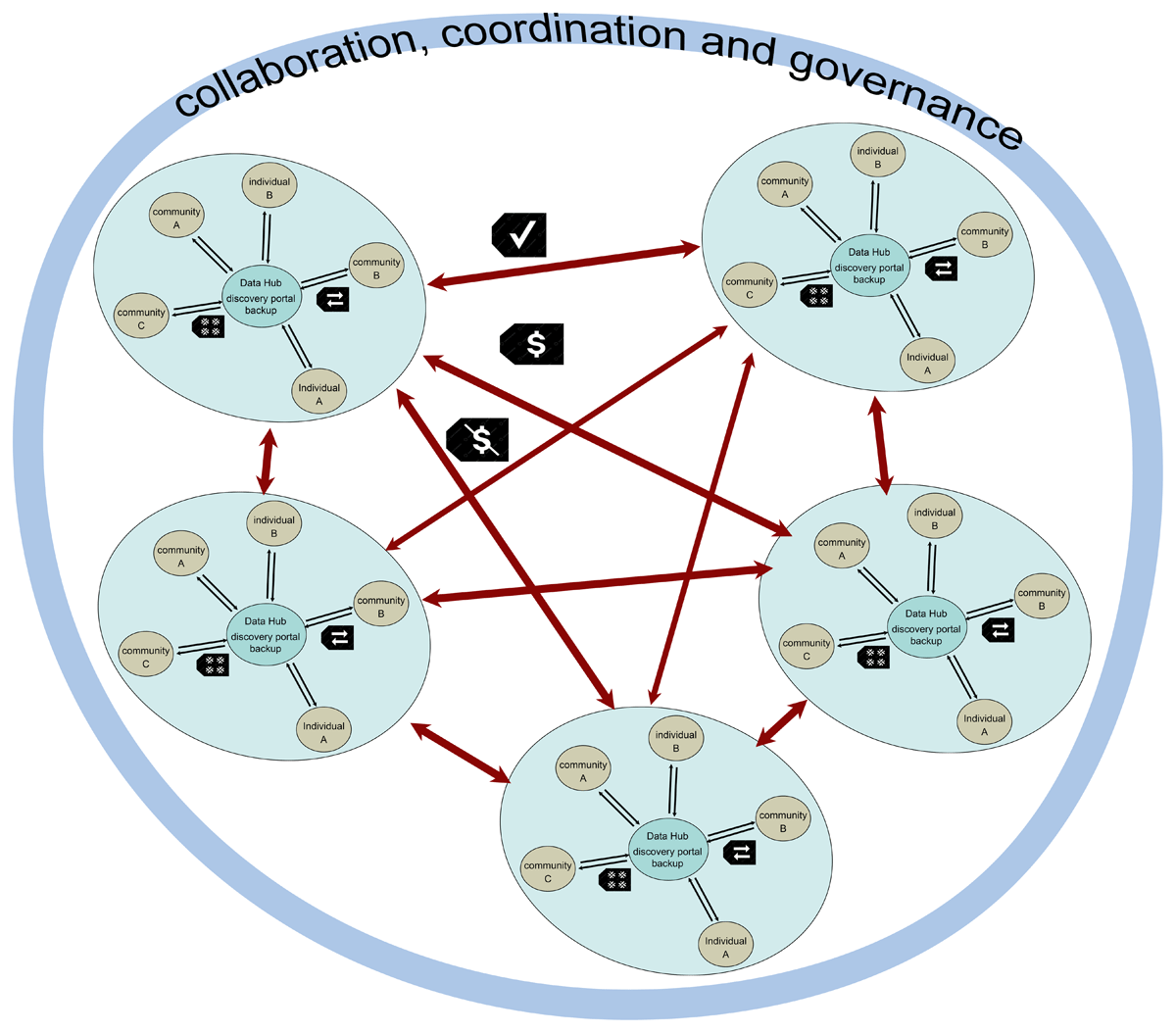
Figure 2
A depiction of collaboration across a suite of organisational units, where information flows between each determined by permissions. The network as a whole takes shared responsibility for setting standards, training, and communication, with a separate set of staff established in a neutral space, financially supported by all the member countries.
Table 1
Key features of blockchain technology.
| BLOCKCHAIN FACILITY | |
|---|---|
| Data Anchoring Critical pieces of data can be linked into a blockchain to ensure their immutability, integrity, and traceability. | The data hashes need only be stored on the blockchain, while the actual data is kept off-chain in centralised databases or distributed storage systems like IPFS (InterPlanetary File System). The hash acts as a unique fingerprint, allowing verification of the data’s integrity without storing it on the blockchain. In doing so, organisations can reduce the costs associated with blockchain’s storage and transaction fees while still benefiting from its security and immutability features (Cao et al., 2021). |
| Proof of data availability Blockchain can be used to timestamp and verify the availability of data at a certain point in time. | Useful for applications like research data, intellectual property, and legal documentation, where proving the existence and availability of a document or work is crucial. |
| Data Access Control Blockchain-based access control mechanisms can be implemented. | With access permissions and logs on the blockchain, organisations can control who can access their data and what it can be used for based on policies/agreements (Lomotey et al., 2022). This can enhance data security and ensure that only authorised parties can access sensitive data. |
| Auditing and Compliance Blockchain’s immutable ledger can be used for auditing purposes. | An immutable audit trail can be maintained on the blockchain. This can be used to track data history, verify data provenance, and ensure compliance with local and international regulatory requirements. |
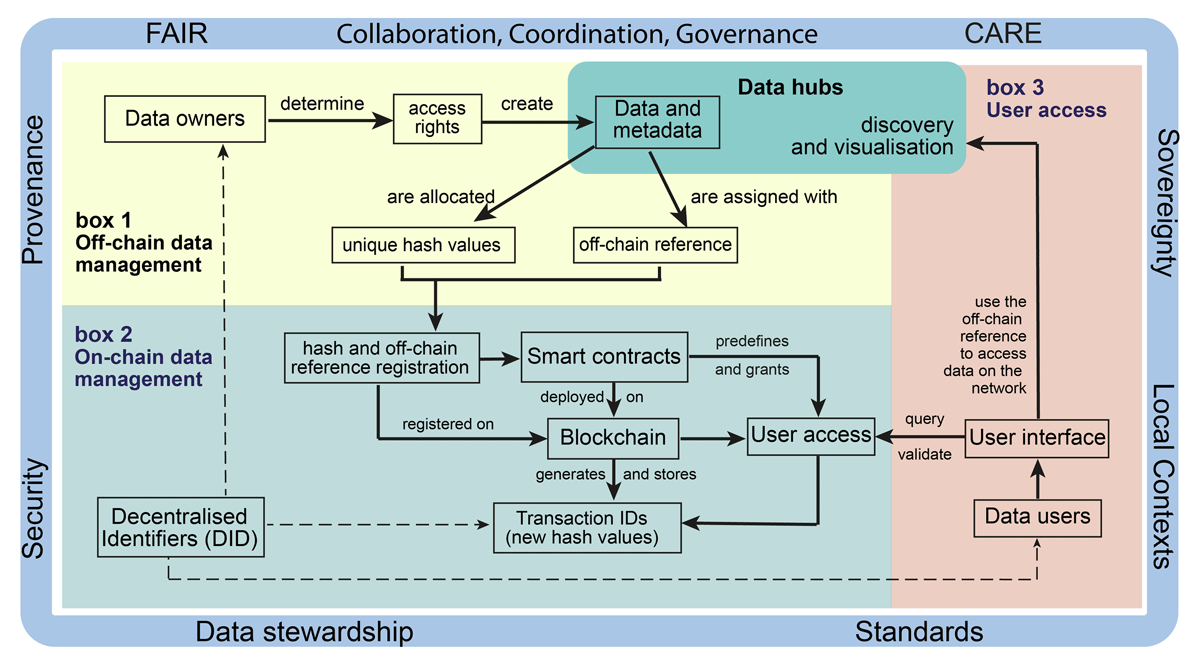
Figure 3
Visualisation of the CREDAN operational architecture.
Table 2
Criteria matching for the proposed network enabled by emerging technologies, including a possible alignment to the FAIR and CARE principles. FAIR acronym codes: Findable, Accessible, Interoperable, Reusable; CARE acronym codes: Collective benefit, Authority to control, Responsibility, Ethics.
| CRITERIA | WHAT CAN THE COLLABORATIVE DATA NETWORK ENABLED BY EMERGING TECHNOLOGIES DELIVER? | FAIR | CARE | ||||||
|---|---|---|---|---|---|---|---|---|---|
| F | A | I | R | C | A | R | E | ||
| Sovereignty | Offers flexible levels of sovereignty. | x | x | x | |||||
| Provenance | Created in the (sub)country hub, gathered by the coordinating group, comparable across network. | x | x | x | |||||
| Governance | The (sub)country hubs will manage their data holdings and permissions, the coordinating group ensuring that the necessary provenance, metadata, and vocabularies are maintained for each data object. | x | x | x | x | x | |||
| Innovation | Each (sub)country hub will remain autonomous but will be linked to others in the network, offering opportunities for regional data-driven innovations. | x | x | ||||||
| Collaboration | This model depends and builds on collaboration at hub level, and through discovery through the distributed network will demonstrate the values of collaboration. The governance group will maintain regular communications with all member hubs. | x | |||||||
| Access and Availability | A combination of controlled and open access allows for fine-tuned usage rules. | x | x | x | x | ||||
| Integrity and accountability | Combines centralised validation and distributed consensus processes. | x | x | x | |||||
| Security | The combination of centralised controls and distributed hubs enhances security. | x | x | ||||||
| Scalability | The distributed network built with on-chain and off-chain capabilities allows enhanced scalability. | x | |||||||
| Interoperability | Interoperability will be enhanced through the establishment of common standards across the network facilitated by the coordinating group(s). | x | x | ||||||
| Cost | Initial setup costs will be at the (sub)country and coordinating group levels, but a shared codebase will reduce development costs. Personnel will be an ongoing cost covered by each hub, and the cost of the coordinating group shared by all members of the network. Countries would be expected to need infrastructure funding, such as for computing hardware or enhanced bandwidth and energy capacity. Using a similar data hosting approach will streamline those requests, e.g., by offering proposal templates. | x | x | ||||||
| Energy Consumption | Data being held off-chain minimises energy consumption. | x | |||||||