Have a personal or library account? Click to login
Engaging with Researchers and Raising Awareness of FAIR and Open Science through the FAIR+ Implementation Survey Tool (FAIRIST) Cover

Engaging with Researchers and Raising Awareness of FAIR and Open Science through the FAIR+ Implementation Survey Tool (FAIRIST)

Open Access
|Sep 2023

Figures & Tables

Table 1

Template that inspired the creation of FAIRIST.

FAIR DIMENSION
Findable
  • Data will be assigned a PID <how?> and will be referenced on the <project website>

  • A catalog entry will be added to <FAIR Data Point or community/institutional catalog>.

  • Metadata and links to related ontologies will be available on the <project website>.

  • Where tags exist, schema.org descriptors will be utilized.

Accessible
  • Available via <storage location>, that doesn’t require specialized software to access. This includes both the raw data and curated or derived data.

  • The surrogate and other ML benchmarks will be deposited in <repository>.

  • Any APIs will be versioned and described, linked from the <project website>.

Interoperable
  • Code stored on github and linked from the <project website>

  • Uses libraries from <project name> that utilize <standard or standard Python libraries, etc.>.

  • Uses standard references for <more here>.

  • Both input and output data are in <specify> format.

Reusable
  • ML model and data will be deposited at <repository>.

  • Notebooks will demonstrate how to assemble model and sample training datasets. Each notebook product will be assigned a DOI using <specify DOI source>.

  • The <project> notebook interface is on <place shared, e.g., github>.

  • Provenance of the simulation creation will be available as part of the metadata.

  • A designation will be added to the website noting that all data as licensed under Creative Commons Attribution 4.0 International License.

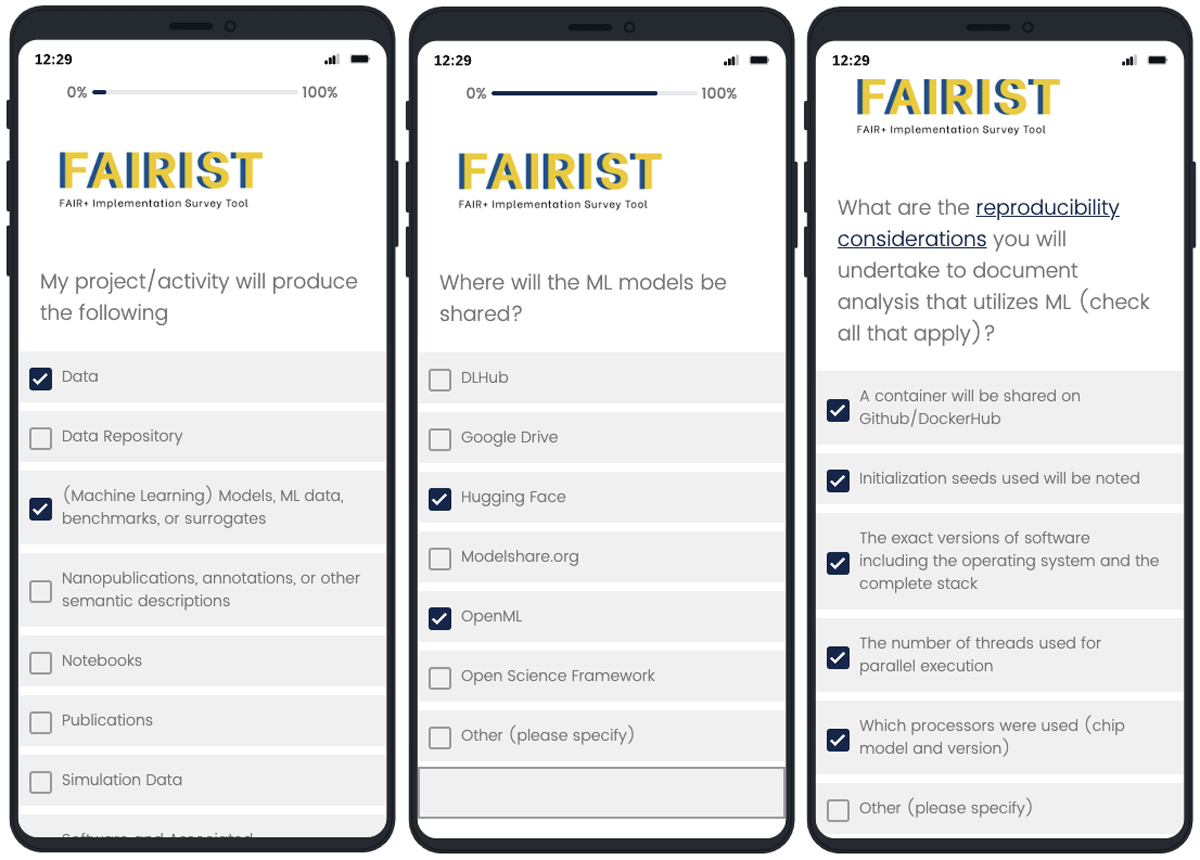
dsj-22-1531-g1.png
Figure 1

Embedded logic in FAIRIST expands the survey questions to fit the project described.

dsj-22-1531-g2.jpg
Figure 2

Outreach and awareness building material that could be used in concert with FAIRIST by libraries, research computing facilitators, and other researcher support personnel.

Table 2

Example Output from FAIRIST Showing Recommendations.

FAIRIST Recommendations
Based on your responses, the following recommendations are included for your consideration and/or inclusion in your project’s Data Management Plan.
Types of Data
Research objects associated with the project can be classified into the following groups:
  • Data

  • (Machine Learning) Models

Data Stewardship Practices Planned
Table 1 shows specific data stewardship actions that will be undertaken during the project as they relate to the high-level goals of FAIR.
FAIR DIMENSIONRESEARCH DATA STEWARDSHIP PRACTICES PLANNED
Findable
  • Research products will be posted to the Project website.

  • Data will be assigned a unique identifier per community best practices and will be referenced on the Project’s website.

  • Metadata and links to related ontologies will be available on the Project website.

  • Where tags exist, schema.org descriptors will be utilized.

Accessible
  • Available via open, web accessible folder.

  • All data is open.

Interoperable
  • Code stored on github (and linked from the Project website).

  • Uses libraries included with the code.

  • Both input and output data are in HDF5 format.

Reusable
  • ML model and data will be deposited at OpenML.org.

  • A notice posted will designate research objects as licensed under CC-BY.

Table 1: Data Stewardship Practices Planned by FAIR Dimension
Language: English
Submitted on: Dec 16, 2022
Accepted on: May 25, 2023
Published on: Sep 6, 2023
Published by: Ubiquity Press
In partnership with: Paradigm Publishing Services
Publication frequency: 1 issue per year

© 2023 Christine R. Kirkpatrick, Kevin Coakley, Julianne Christopher, Inês Dutra, published by Ubiquity Press
This work is licensed under the Creative Commons Attribution 4.0 License.