
Table 1
The data providers and their data products.
| IN-TEXT ABBREVIATION | DATA PRODUCTS’ NAME | DATA PRODUCT TYPE | DATA PROVIDER TO AGREFED (* INDICATES BOTH DATA PROVIDER AND USER OF THE DATASET OR COLLECTION) |
|---|---|---|---|
| SH (Soil Health) | Corangamite Soil Health Monitoring Program Data https://doi.org/10.25955/5c1c6b8f4d8d2 (Corangamite Catchment Management Authority, 2019) | Dataset and service | Federation University, Centre for eResearch and Innovation (CeRDI). |
| SMN-1 (Soil Moisture Network 1) | Soil moisture probe network, SFS (Southern Farming Systems https://doi.org/10.25955/5cdcff6168a76 (Southern Farming Systems, 2011) | Dataset | Federation University, CeRDI. |
| WT (Wheat Trials) | Waite Permanent Rotation Trial https://doi.org/10.4225/08/55E5165EC0D29 (Sanderman et al. 2015) | Dataset | *University of Adelaide, School of Agriculture, Food and Wine |
| NS (NatSoils) | Soil SITES database (NatSoil) https://doi.org/10.25919/5c36d77a6299c (CSIRO 2013) | Dataset and service | Commonwealth Scientific and Industrial Research Organisation (CSIRO) |
| SLG (Soil and Landscape Grid) | Soil and Landscape Grid National Soil Attribute Maps (3” resolution), Release 1 Collection. Sample see Rossel et al. (2014) https://doi.org/10.4225/08/546ED604ADD8A | Data product (maps), collection and service | CSIRO |
| FT (Frost Trials) | Crop Variety Frost Trial data collections https://doi.org/10.26182/5cedf001186f3 (Taylor et al. 2019) | Dataset collection | *University of Western Australia (UWA) and Department of Primary Industries and Regional Development (DPIRD) |
| SMN-2 (Soil Moisture Network 2) | SensorNets – SMART Farms Soil Moisture Network https://doi.org/10.4226/95/5b10d5ca18aef (Schneider et al. 2018) | Dataset | *University of New England (UNE) |
Table 2
AgReFed Version 1 FAIR thresholds for participation (Box et al. 2019a: 22).
| START-STATUS | END-STATUS | |
|---|---|---|
| FINDABLE | ||
| Q1. The data product has been assigned (an) identifier(s) | ||
| No identifier | FT | |
| Local identifier | ||
| Web address (URL) | SH, SMN-1 | |
| Globally unique, citable, and persistent identifier (e.g., DOI, PURL, or Handle) | WT, NS, SLG, SMN-2 | SH, SMN-1, WT, NS, SLG, FT, SMN-2 |
| Q2. The data product identifier is included in all metadata records/files describing the data | ||
| No | SH, SMN-1, FT, SMN-2 | |
| Yes | WT, NS, SLG | SH, SMN-1, WT, NS, SLG, FT, SMN-2 |
| Q3. The data product is described by a metadata record | ||
| Not described | SH, SMN-1, FT | |
| Brief title and description | SMN-2 | |
| Brief title, description, and other fields | WT, NS | |
| Comprehensively1 in a formal metadata schema | SLG | SH, SMN-1, WT, NS, SLG. FT, SMN-2 |
| Q4. The data product is described by a metadata record that is indexed in a searchable registry or repository. | ||
| Not indexed | SH, SMN-1, FT | |
| Local institutional repository | ||
| Domain specific repository | ||
| Generalist public repository | ||
| Discoverable through several places (i.e., other registries, Research Data Australia, Google Data Search) | WT, NS, SLG, SMN-2 | SH, SMN-1, FT, WT, NS, SLG, SMN-2 |
| ACCESSIBLE | ||
| Q5. How accessible is the data? The access method(s) must be explicitly stated in the metadata record e.g., if any authentication is needed, or there are any restrictions to access. | ||
| Not accessible | SH, SMN-1 | |
| Access to metadata only | ||
| Through unspecified access conditions e.g., ‘contact the data custodian to discuss access’ | NS, FT, SMN-2 | SMN-2 |
| Embargoed access after a specified date; or a de identified version of the data is publicly accessible | ||
| Fully accessible public, or to persons who meet and follow explicitly stated conditions and processes, e.g., ethics approval for sensitive data | WT, SLG | SH, SMN-1, NS, FT, WT, SLG, |
| Q6. Data are available for reuse via a standardised communication protocol, such as file download over https, or a web service | ||
| No access to data | SH, SMN-1, FT | |
| By individual arrangement | SMN-2 | SMN-2 |
| File download online | WT, SLG (partial) | |
| Non-standard web service (e.g., OpenAPI/Swagger/informal API) | WT, FT | |
| Standard web service API (e.g., OGC) | NS, SLG (partial) | SH, SMN-1, NS, SLG (full) |
| Q7. The repository/registry agrees to maintain the persistence of the metadata record, even if the data product is no longer available | ||
| No, or not applicable if no metadata record | SH, SMN-1, FT | |
| Unsure | WT | |
| Yes | NS, SLG, SMN-2 | SH, SMN-1, NS, SLG, FT, SMN-2, WT |
| INTEROPERABLE | ||
| Q8. The data products are available in (an) open (file) format(s) | ||
| Data are mostly available only in a proprietary format | WT, FT | |
| Data are available in an open format | SH, SMN-1 | |
| Data are available in an open, documented, widely used standard format (e.g., NetCDF, CSV, JSON, XML) | NS, SLG, SMN-2 | SH, SMN-1, WT, NS, SLG, FT, SMN-2 |
| Q9. The data is machine-readable2 | ||
| The data are unstructured | SMN-1, WT, FT | |
| The data are structured and machine-readable (e.g., csv, JSON, XML, RDF, database files) | SH, NS, SLG, SMN-2 | SH, SMN-1, WT, NS, SLG, FT, SMN-2 |
| Q10. The data are semantically interoperable, because they use standard, accessible ontologies and/or vocabularies to describe the data elements/variables. | ||
| Data elements are not described (i.e., fields or objects are labelled with codes or not at all) | SMN-2 | |
| Data elements are described (so that a human user can correctly interpret the data), but no standards have been used in the description | SH, SMN-1, WT, FT | SMN-2 |
| Recognised standards have been used in the description of data elements, but no published vocabularies with resolvable URIs | NS, SLG | SLG, FT |
| Published vocabularies using resolvable global identifiers linking to explanations are used, so that the data can be read and understood by machines as well as humans. | SH, SMN-1, NS, WT | |
| Q11. The relationships to other data and resources (e.g., related datasets, services, publications, grants, etc) are described in the metadata or data, to provide context around the data | ||
| There are no links to other metadata or data | SH, SMN-1, FT, SMN-2 | SMN-2 |
| The metadata record includes URI links to related metadata, data, and definitions | WT, NS | NS |
| Qualified links to other resources are recorded in a machine-readable format, e.g., a linked data format such as RDF | SLG | SH, SMN-1, WT, SLG, FT |
| Reusable | ||
| Q12. Machine-readable data licenses are assigned to each data product, and are stated in the metadata record | ||
| No licence applied | SH, SMN-1, FT, SMN-2 | FT (standard licence but not in metadata record) |
| Non-standard license applied, with a machine-readable license/license deed URL | WT | |
| Standard license applied, without a machine-readable license deed URL | ||
| Standard license applied, with a machine-readable license/license deed URL | NS, SLG | SH, SMN-1, WT, NS, SLG, SMN-2 |
| Q13. The provenance of the data product is described in the metadata i.e., project objectives, data generation/collection (including from external sources) and processing workflows. | ||
| None recorded | SH, FT, SMN-2 | FT |
| Partially recorded | SMN-1, WT | SMN-2 |
| Comprehensively recorded in a text format (e.g., TXT or PDF) | NS, SLG | WT, NS, SLG |
| Comprehensively recorded in a machine-readable format (e.g., in metadata record’s schema or PROV, or in RDF, JSON, NetCDF, or XML) | SH, SMN-1 | |
| Q14. The preferred citation for the data product is provided in metadata record | ||
| No | SH, FT, SMN-1 | |
| Citation but with no persistent identifiers | ||
| Citation with persistent identifiers | WT, NS, SLG, SMN-2 | SH, SMN-1. WT, NS, SLG, FT, SMN-2 |
[i] Light grey indicates the AgReFed minimum acceptable requirements (‘Minimum thresholds’) and dark grey the ideal (‘Stretch targets’). The start-status and end-status indicate the progression of FAIR maturity. Data products are SH Soil Health; SMN-1 Soil Moisture Network 1; WT Wheat Trials; NS NatSoils; SLG Soil Landscape Grid; FT Frost Trials; SMN-2 Soil Moisture Network 2. 1 The minimum metadata requirement for data collections and services (Box et al. 2019a: 36–37). 2 ‘Machine-readable’ defined in terms of both syntax and structure, that is, as the representation of data products in a standard computer language that is structured in a way that is interpretable by machines.
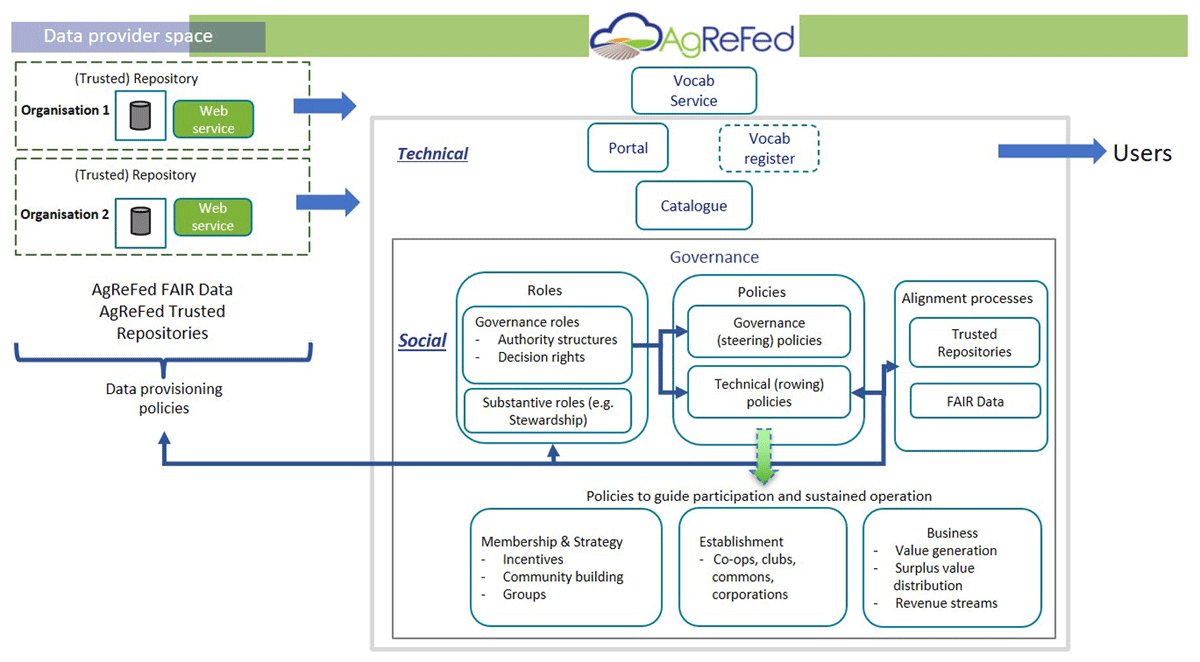
Figure 1
The FAIR alignment process within the AgReFed architecture. FAIR thresholds are part of the alignment process for organisations to participate in the federation. They are integrated into Governance and Technical Policies, and Roles and Responsibilities (Box et al. 2019a: 7).