
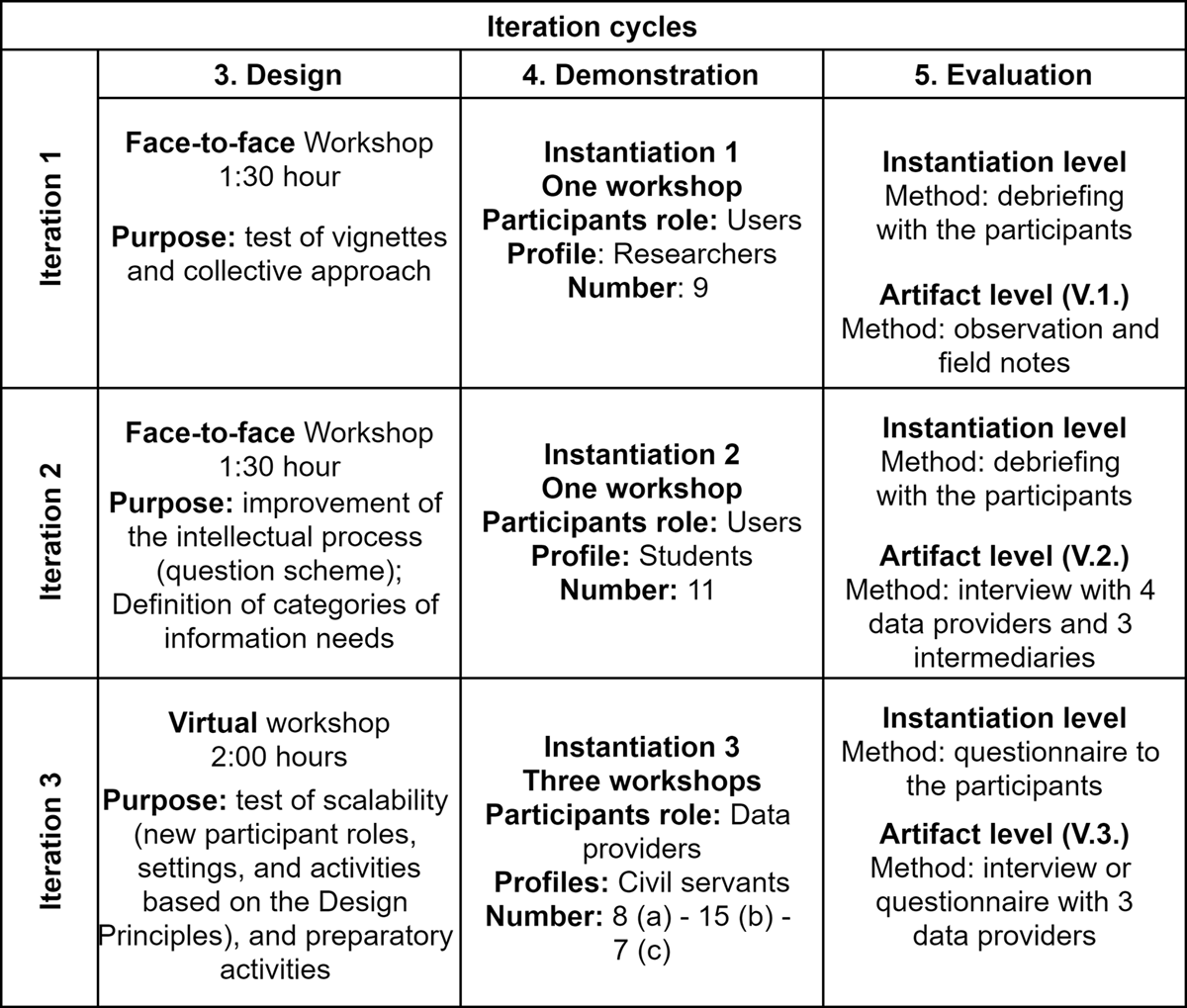
Figure 1
The Three Iteration Cycles.
Table 1
Overview of a mixed method (DP 1): a virtual workshop with data providers.
| PHASES | OBJECTIVES | ACTIVITIES | DELIVERABLES |
|---|---|---|---|
| Phase 1. Preparation | 1. Define a context and issue (DP 5) based on previous knowledge (experience, strategic priorities, literature) 2. Define the profile, roles (DP 8), and categories of situations creating information needs (DP 5) of the users based on previous knowledge 3. Preparing the participants for the workshop (awareness of the topic and concepts) (DP 3, 6) | 1–2. Kit of preparatory activities with clear instructions for the participants to define a problem (trigger questions), the context (mapping exercise), and user group (persona) 3. Previous to the workshop, a short presentation of the concepts (information needs, sources, solutions) given by the implementer | 1. A precise context, problem and group of users with categories of situations creating information needs 2. A kit of preparatory activities for the participants |
| Phase 2. Collaborative workshop (DP 2) | 1. Enable the participants to identify progressively user’ information needs, existing solutions and weaknesses, and possible imagined solutions (DP 7) in a given role and context (vignettes) (DP 4) | 1. Problem situation brought by the participants converted into vignettes, used as a start for a written brainstorming. Use of the participants’ field experience to limit categories of situations of information needs given the context. Brainstorming tool: question scheme written on a canvas, following the track: primary needs in the situation, related user tasks, related information needs, existing solutions and their issues. | 1. New insights: – Information needs (spontaneous and latent) – Overview of the competing solutions – Imagined solutions |
| Phase 3. Analysis + Relevance check | 1. Confirm the ideas and intuitions (imagined solutions) with users and knowledgeable experts (DP 8) 2. Connect the collected information needs with released or releasable OGD (DP 9) 3. Inspire possible developments and OGD intermediaries (DP 9) | 1. Examples of activities and task given to the participants to compare the brainstormed information needs with their user group and colleagues (question scheme in a workshop, interview, or focus group format) 2. Comparison of the categories of data with data owned in their administration 3. Presentation of the projects to developers (intermediaries) in a post-event | 1. A project 2. The identification of information needs and related OGD 3. The identification of future development avenues |