
Table 1
Identified issues of SDI and FAIR digital data repositories when used with Big Earth Data.
| FAIR PRINCIPLES | ISSUES WITH BIG EARTH DATA |
|---|---|
| Findable | |
| F1. (Meta)data are assigned a globally unique and persistent identifier | (1) DOI are not widely used in SDI. (2) Persistent identifiers are not widely used in SDI. |
| F2. Data are described with rich metadata | Metadata in Digital Repositories (usually following DataCite) are not sufficiently detailed to describe EO data |
| F3. Metadata clearly and explicitly include the identifier of the data they describe | SDI and Digital Data repositories provide this capability |
| F4. (Meta)data are registered or indexed in a searchable resource | SDI and Digital Data repositories provide this capability |
| Accessible | |
| A1. (Meta)data are retrievable by their identifier using a standardised communications protocol | (1) In SDI, CSW is the de facto standard (2) In Digital Repositories OAI (3) For data, Digital Repositories do not support OGC standards |
| A1.1 The protocol is open, free, and universally implementable | SDI and Digital Data repositories provide this capability |
| A1.2 The protocol allows for an authentication and authorisation procedure, where necessary | SDI and Digital Data repositories provide this capability |
| A2. Metadata are accessible, even when the data are no longer available | SDI and Digital Data repositories provide this capability |
| Interoperable | |
| I1. (Meta)data use a formal, accessible, shared, and broadly applicable language for knowledge representation. | SDI and Digital Data repositories provide this capability using XML and JSON encodings |
| I2. (Meta)data use vocabularies that follow FAIR principles | This is not yet a widely adopted capability in SDI even if efforts exists such as in INSPIRE (Patroumpas et al., 2015) |
| I3. (Meta)data include qualified references to other (meta)data | SDI and Digital Data repositories provide this capability |
| Reusable | |
| R1. Meta(data) are richly described with a plurality of accurate and relevant attributes | ISO19xxx standards are more suited than those used in Digital Repositories (e.g., DataCite) |
| R1.1. (Meta)data are released with a clear and accessible data usage license | SDI and Digital Data repositories provide this capability |
| R1.2. (Meta)data are associated with detailed provenance | SDI and Digital Data repositories provide this capability |
| R1.3. (Meta)data meet domain-relevant community standards | SDI and Digital Data repositories provide this capability |
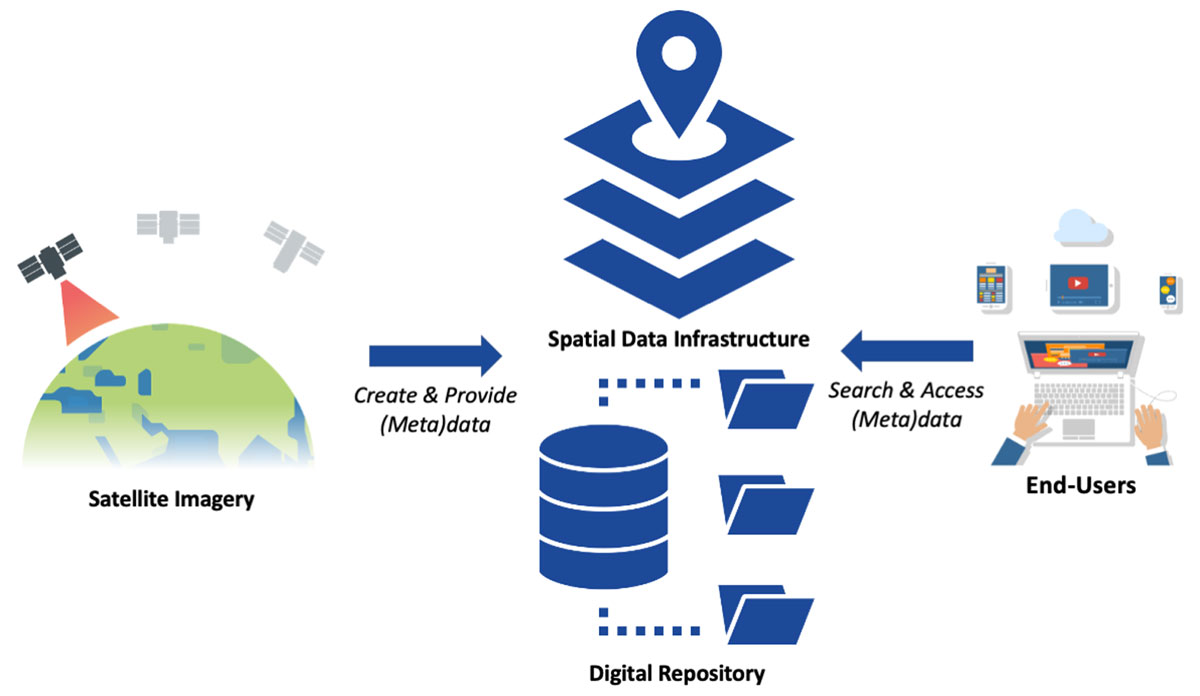
Figure 1
General architecture of a FAIR EO data repository.
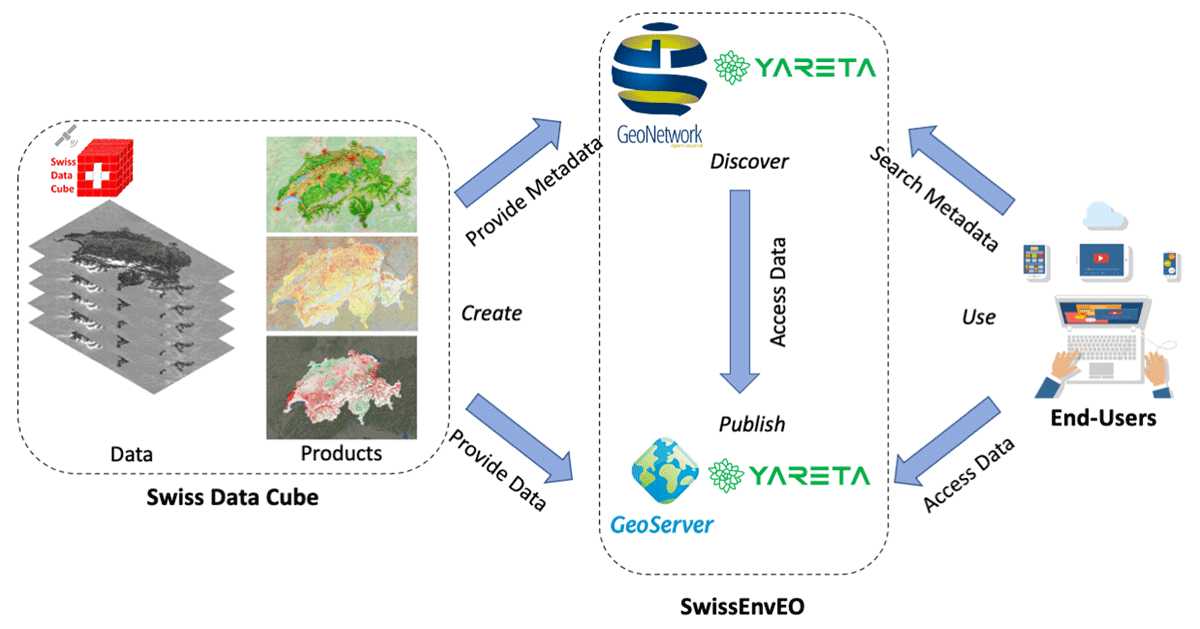
Figure 2
SwissEnvEO Architecture and implemented software components.
Table 2
FAIR principles and implemented solutions.
| FAIR PRINCIPLES | IMPLEMENTED SOLUTIONS |
|---|---|
| Findable | |
| F1. (Meta)data are assigned a globally unique and persistent identifier | DOI [Yareta] & UUID [GeoNetwork] |
| F2. Data are described with rich metadata | ISO19115-2/ISO19139-2 [GeoNetwork] & DataCite [Yareta] |
| F3. Metadata clearly and explicitly include the identifier of the data they describe | Embedded in ISO & DataCite |
| F4. (Meta)data are registered or indexed in a searchable resource | GeoNetwork and Yareta both provide this functionality |
| Accessible | |
| A1. (Meta)data are retrievable by their identifier using a standardised communications protocol | Metadata: OGC CSW, OAI-PMH, Z39.50, THREDDS, Webdav, WAF, OpenSearch Data: OGC WMS, WCS |
| A1.1 The protocol is open, free, and universally implementable | Based on OGC standards |
| A1.2 The protocol allows for an authentication and authorisation procedure, where necessary | True, already supported in OGC standards as well as in the Yareta API |
| A2. Metadata are accessible, even when the data are no longer available | True, using GeoNetwork |
| Interoperable | |
| I1. (Meta)data use a formal, accessible, shared, and broadly applicable language for knowledge representation. | OGC/ISO standards for geospatial data rely on XML and JSON and provide clear usage guidelines |
| I2. (Meta)data use vocabularies that follow FAIR principles | True with the use of Yareta. GeoNetwork has a capability to add vocabularies |
| I3. (Meta)data include qualified references to other (meta)data | True, it feasible both in GeoNetwork and Yareta |
| Reusable | |
| R1. Meta(data) are richly described with a plurality of accurate and relevant attributes | True with the use of ISO 19xxx standards |
| R1.1. (Meta)data are released with a clear and accessible data usage license | In ISO you can easily provide licenses |
| R1.2. (Meta)data are associated with detailed provenance | In ISO, provenance should be provided |
| R1.3. (Meta)data meet domain-relevant community standards | True with OGC and ISO standards |
Table 3
Products with their respective metadata, DOI and DataCite search linkgs.
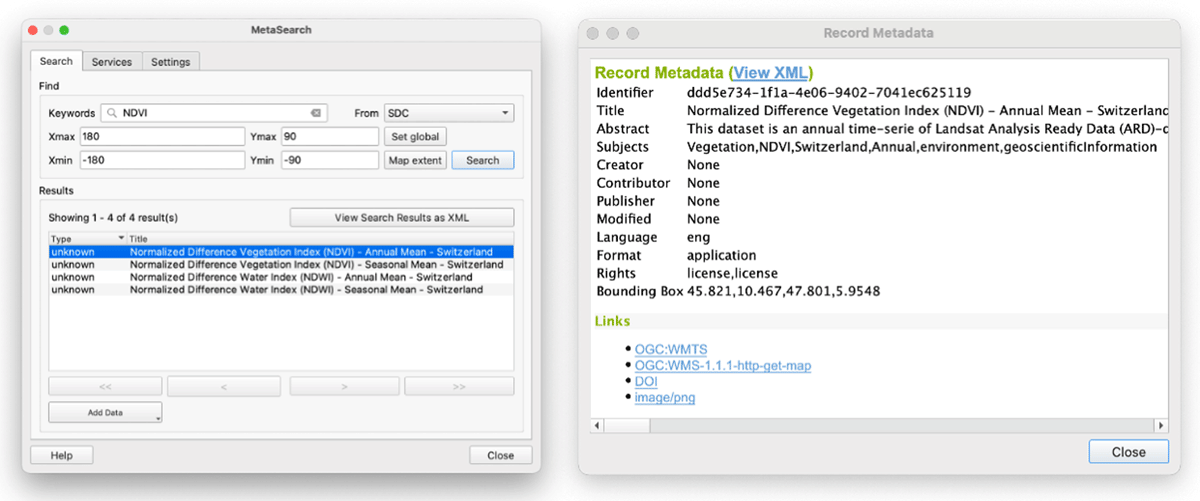
Figure 3
Results of search in MetaSearch using the CSW interface (left) and details on the metadata record with the relevant links for accessing data.
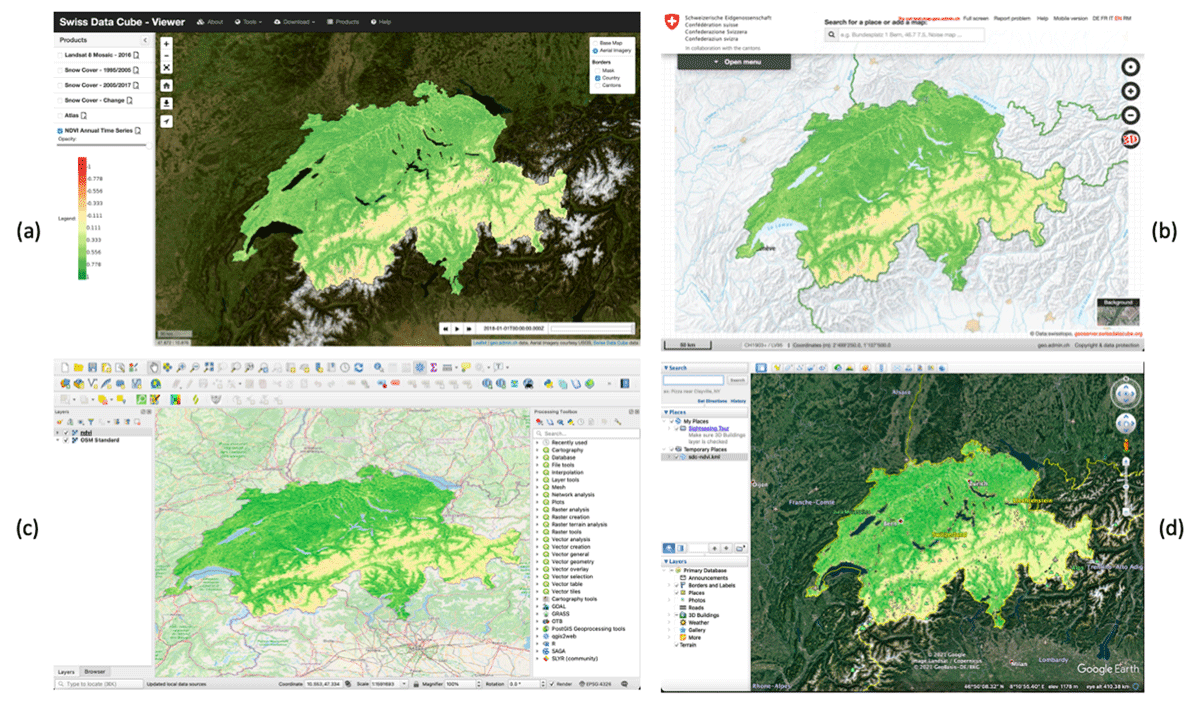
Figure 4
NDVI Annual mean data set served as WMS as seen in (a) the Swiss Data Cube Viewer; (b) the mapping platform of the Swiss Confederation; (c) in a GIS Desktop client and (d) in Google Earth Pro.