
Table 1
License comparison chart.
| Permissions | Requirements | Prohibitions | |||||
|---|---|---|---|---|---|---|---|
| License | Reproduction | Distribution | Derivative Works | Notice | Attribution | Share Alike | Noncommercial |
| Creative Commons Licenses (https://creativecommons.org/licenses/) | |||||||
| CC0 | X | X | X | ||||
| CC-BY | X | X | X | X | X | ||
| CC-BY-SA | X | X | X | X | X | X | |
| CC-BY-NC | X | X | X | X | X | X | |
| CC-BY-ND | X | X | X | X | |||
| CC-BY-NC-SA | X | X | X | X | X | X | X |
| CC-BY-NC-ND | X | X | X | X | X | ||
| Open Data Commons (https://opendatacommons.org/) | |||||||
| ODC-PDDL | X | X | X | ||||
| ODC-BY | X | X | X | X | X | ||
| ODC-ODbL | X | X | X | X | X | X | |
| Government of Japan Standard Terms of Use (https://www.kantei.go.jp/jp/singi/it2/densi/kettei/gl2_betten_1.pdf) | |||||||
| Government of Japan Standard Terms of Use | X | X | X | X | X | ||
Table 2
Summary of the interview survey results.
| Date | 12,12,2017 | 12,18,2017 | 12,20,2017 | 01,30,2018 | 02,01,2018 |
|---|---|---|---|---|---|
| Fields | Space Physics | Environmental Sciences | Social Sciences | Materials Science | Humanities |
| Characteristics | Mostly numerical data | Image data, numerical data, etc.. | Survey data | Measurement data, calculation data, Material Informatics data, software | Image data, bibliographic data |
| Data holder (Representative) | The person(s) who is/are acquired the data | The funder(s) | The data provider | Institution of the data holder (with exception) | uncertain |
| Request for users | None | # Request for user name and purpose of use for searching metadata # Primary data are negotiated on an individual basis | # Only available by the researchers who belongs in the social sciences discipline # Submission of a research proposal is mandatory # Submit usage reports every year/Inclusion in the acknowledgments for using the data | Provide a provenance information of the data as well as literature citations | # The metadata should be CC0 # The conditions of use of the data should be clearly stated by data holder |
| Penal regulations | There are no publishing constraints from a scientific point of view | Under consideration | If the data is passed on to a third party without permission, the use of the data may be suspended | None | Considering the use of rightsstatements in case of publishing data |
| Rights protection | No rights protection is provided for the data to be published | There are two levels of access restrictions on data in the repository, depending on the contents | One-year and indefinite licenses are available according to the wishes of the data holder | Data marked as private will have restricted access | Non-public data will be considered for protection on an individual basis by contract. Among the public data, those with copyright properties will be subject to government of Japan standard terms of use and CC licenses |
| Issues | # There are few explanation for national security related data (especially the description of disclosure period) | # There are no institution to consult about research data rights in Japan | # In addition to an organization that supports data management, data management personnel and personnel who can handle the technical aspects of metadata are needed # The criteria for determining sensitive data change over time, so it cannot provide past data as it is | # A point of contact is needed to receive inquiries about published data | # Licensing standards for publishing non-copyrighted or obscure data # How to develop a culture of data protection, who will bear the cost, and how to spread it The future discussion points are whether or not to do so |
| Aspiration related to conditions of use | Development of data utilization laws | Enhancement of the university’s intellectual property department function |
Table 3
Research fields of respondents (n = 409).
| Research Field | Number | Ratio |
|---|---|---|
| Social Sciences | 71 | 17.4% |
| Earth Sciences | 51 | 12.5% |
| Humanities | 42 | 10.3% |
| Medicine | 35 | 8.6% |
| Engineering | 32 | 7.8% |
| Computer Science | 20 | 4.9% |
| Biological Science | 19 | 4.6% |
| Agricultural Science | 18 | 4.4% |
| Psychology | 16 | 3.9% |
| Physics | 8 | 2.0% |
| Chemistry | 2 | 0.5% |
| Mathematics | 1 | 0.2% |
| Astronomy | 1 | 0.2% |
| Other | 35 | 8.6% |
| I am not currently engaged in any research activities | 58 | 14.2% |
| Total | 409 | 100.0% |
Table 4
Experience in obtaining published data and publishing data by themselves (n = 409).
| Sources | Obtain | Publish | None | No Answer |
|---|---|---|---|---|
| Institutional repositories/data archives | 62.3% | 25.7% | 29.1% | 1.5% |
| Government repositories/data archives | 48.4% | 1.7% | 46.0% | 4.6% |
| Personal/research lab websites or blogs | 47.9% | 23.5% | 41.8% | 2.2% |
| Supplementary materials (in research paper) | 36.7% | 9.3% | 54.3% | 6.8% |
| Academic SNS services (e.g. Mendeley, ResearchGate) | 32.0% | 11.5% | 58.2% | 6.6% |
| Data repositories/archives in specific field | 28.6% | 8.3% | 64.3% | 5.4% |
| Code sharing services (e.g. GitHub) | 24.4% | 8.1% | 69.2% | 5.1% |
| Repositories/data archives by Commercial company | 18.1% | 1.5% | 73.6% | 7.1% |
| Other data publishing services (e.g. figshare, zenodo) | 12.7% | 3.7% | 79.2% | 6.8% |
Table 5
Experience in obtaining published data and publishing data.
| Yes | No/No response | Total | ||||
|---|---|---|---|---|---|---|
| Obtain | 344 | 84.1% | 65 | 15.9% | 409 | 100.0% |
| Publish | 190 | 46.5% | 219 | 53.5% | 409 | 100.0% |
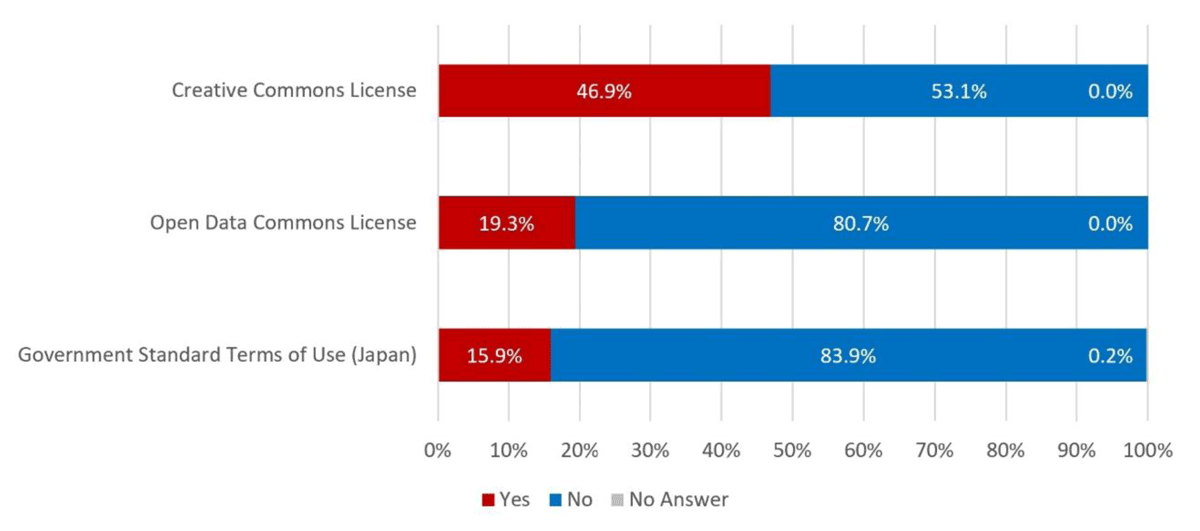
Figure 1
Awareness of existing licenses (n = 409).
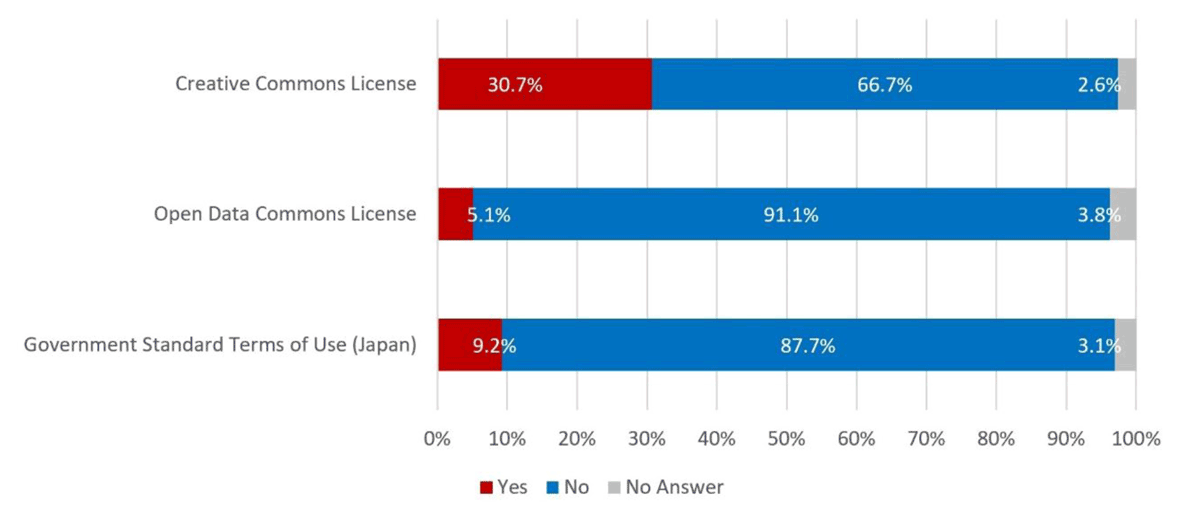
Figure 2
Usage of existing licenses (n = 409).
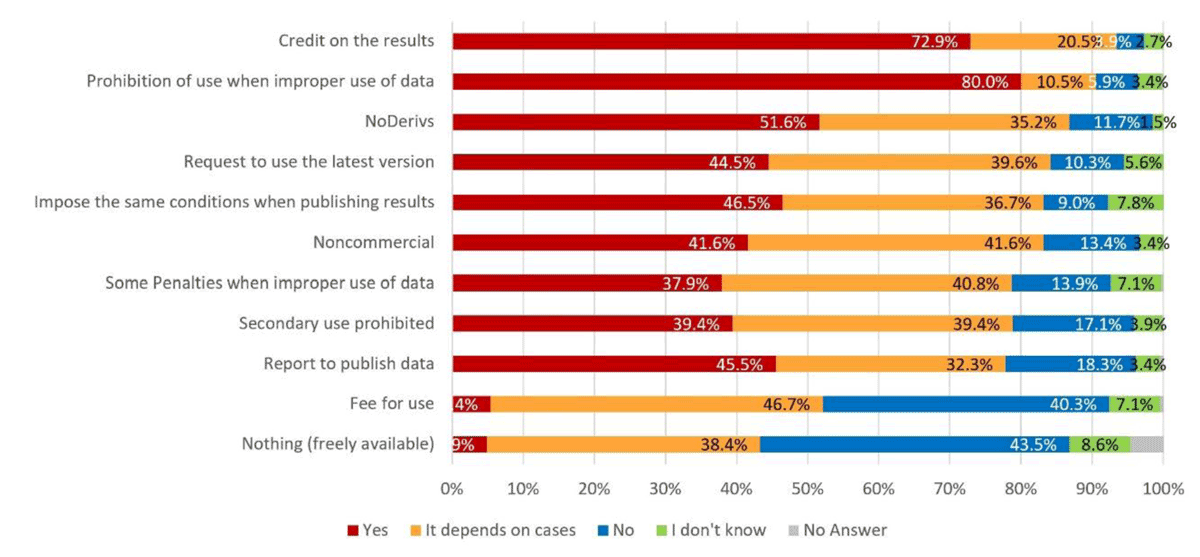
Figure 3
The desired conditions of use when respondent’s publish their research data (n = 409).

Figure 4
License compliance and willingness to publish data (n = 409).
Table 6
Appropriate methods of displaying the use of published data (n = 406).
| Choices | Numbers | Rates |
|---|---|---|
| Cite the source of the data in a paper (include it in the bibliography) | 367 | 90.4% |
| Include source of the data information in the main text | 224 | 55.2% |
| Include source of the data information in the acknowledgment | 99 | 24.4% |
| Add the data holder name as a co-author | 47 | 11.6% |
| It is not necessary to describe the data in a paper | 0 | 0.0% |
Table 7
Desired approach for data use and publishing (n = 404).
| Choices | Numbers | Rates |
|---|---|---|
| Establishment of standard data licenses (conditions of use) | 312 | 77.2% |
| Development of appropriate guidelines for data licensing | 285 | 70.5% |
| Establishment of a data licensing consultation, support, and management department (organization) | 168 | 41.6% |
| Enabling a license to be specified in the data retrieval system | 155 | 38.4% |
| Development of data rights legislation | 148 | 36.6% |
| Establishment of a governing body for data licensing (external organization) | 95 | 23.5% |
| Nothing in particular | 21 | 5.2% |
Table 8
List of external constraints on research data publishing.
| Category | Definition | Subject | Example |
|---|---|---|---|
| Discipline agreement and international treaties | Practices and standards in a specific discipline or research community that limit the data publishing. In some cases this is stated as an international treaty, but in others it is not always explicitly stated. | Disciplines & Norms | Convention on International Trade in Endangered Species of Wild Fauna and Flora (CITES) |
| Convention on the Means of Prohibiting and Preventing the Illicit Import, Export and Transfer of Ownership of Cultural Property 1970 | |||
| Convention Concerning the Protection of the World Cultural and Natural Heritage | |||
| The Convention on the Protection and Promotion of the Diversity of Cultural Expressions | |||
| The Nagoya Protocol on Access and Benefit-sharing | |||
| Recommendation on the Safeguarding of Traditional Culture and Folklore | |||
| Bereaved family’s request | |||
| Personal Information | It stipulates the handling of data that can identify individuals. It includes guidelines that define individual policies on anonymization and information disclosure. | Societies | The Personal Information Protection Commission, Government of Japan. “Laws and guidelines” (only in Japanese) |
| Japan External Trade Organization(JETRO). “About General Data Protection Regulation (GDPR)” (only in Japanese) | |||
| Ministry of Health, Labor and Welfare (Japan). “About research guidelines” (only in Japanese) | |||
| Diplomatic/National security | Research data pertaining to national security. Data related to the development of weapons of mass destruction, etc. (as defined in the Foreign Exchange and Foreign Trade Act) and defense secrets (the Self-Defense Forces). law), important data that may affect national life (e.g., domestic energy (e.g., location of resources, blueprints for critical equipment, etc.). | State | Japan Society for Intellectual Production. “Security Trade Control Guidelines for Researchers in universities and other institutions of higher education. Revised 2nd ed” |
| Agreements, contracts, Intellectual Property rights | An agreement with a research partner, contractor, etc. that restricts the data publishing in joint research or contract research. | Companies, etc. | Ministry of Economy, Trade and Industry (Japan). “Operation guidelines for data management in contract research and development” (only in Japanese) |
| Ministry of Economy, Trade and Industry (Japan). “Contract Guidelines on Utilization of AI and Data. Data Section” | |||
| Data Policy | Where the research funder has a policy on limited data sharing for the research to be funded, or where a strategic business decision restricts the data publishing relating to pending industrial property rights or research data where the commercialization of the research results is envisaged. | Institutions | National Institute for Environmental Studies (Japan). “NIES Data Policy” (only in Japanese) |
| Teikyo University (Japan). “Intellectual Property policy in Teikyo University” (only in Japanese) | |||
| Japan Agency for Medical Research and Development (Japan). “Data sharing policy for realization of genomic medicine” (only in Japanese) |
Table 9
List of each condition of use analyzed from the perspective of expected users, duties, and constraints.
| Condition of use | Expected user | Type of duty | Target of constraint | Compatible with CC licenses | Suggested categories |
|---|---|---|---|---|---|
| 1) Waiver | Public | – | – | CC0 | Preferable |
| 2) Credit on the results (CC license term: Attribution) | Public | Obligation | Redistribution | BY | |
| 3) Impose the same conditions when publishing results (CC license term: ShareAlike) | Public | Obligation | Redistribution and combination | SA (only for redistribution) | Available |
| 4) Noncommercial | Public | Prohibition | Redistribution and data processing | NC (only for redistribution) | |
| 5) NoDelivs | Public | Prohibition | Redistribution and data processing | ND | |
| 6) Improper use of data | Public Specific | Prohibition | Data processing | – | |
| 7) Reporting | Public Specific | Obligation | Continue to use | – | |
| 8) Secondary use prohibited | Specific | Prohibition | Redistribution | – | Not Preferable |
| 9) Request to use the latest version | Public (latest version only) | Obligation | Redistribution | – | |
| 10) Fee for use | Specific | Obligation | Redistribution | – |
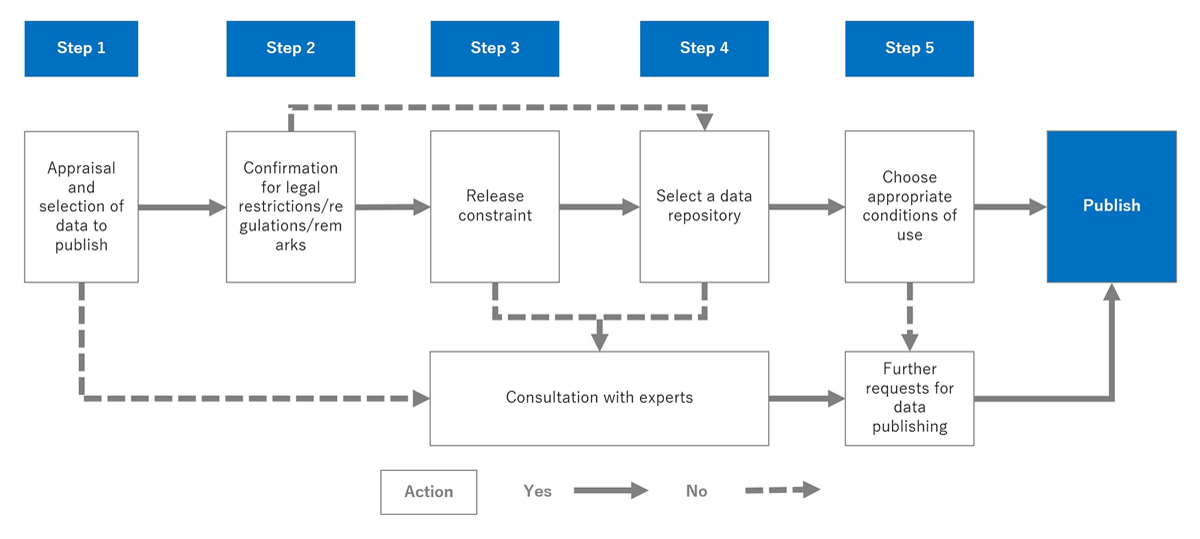
Figure 5
Data Publishing flow with licensing scenarios.