
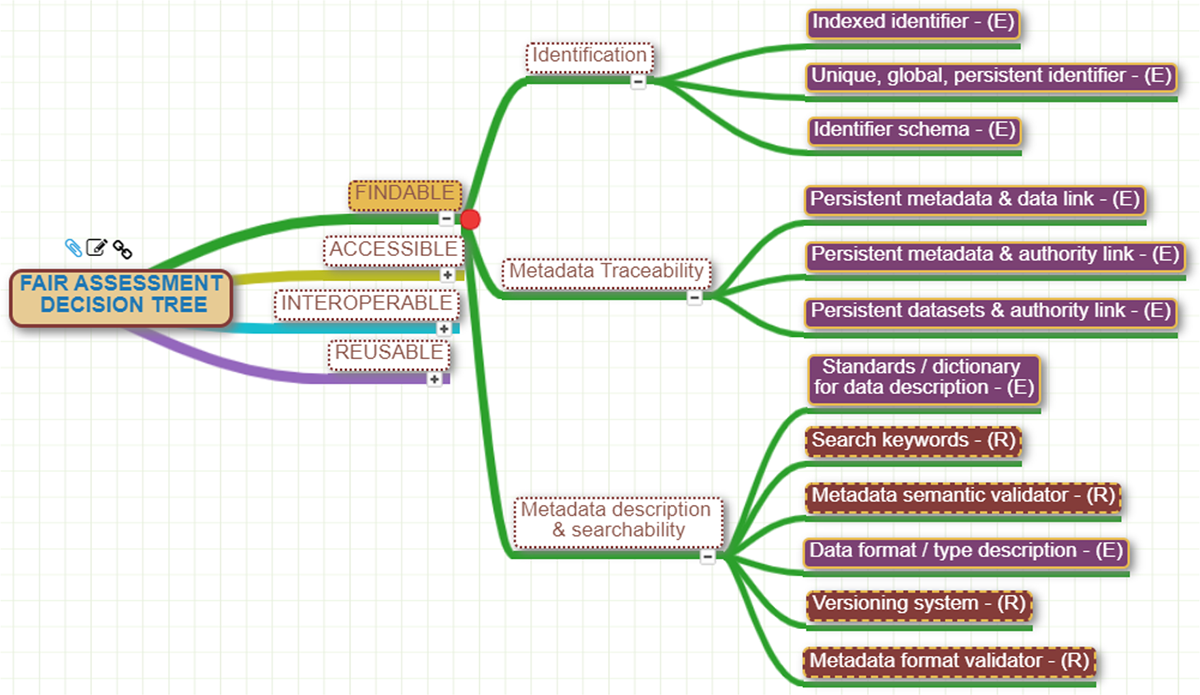
Figure 1
Mind mapping FAIRness assessment criteria. The mind map shows the extensive set of FINDABLE criteria of the FAIR principles (12 criteria). The level of importance of each criteria is divided into three categories (illustrated by three colours), Essential (purple)/Recommended (brown)/Desirable (red).
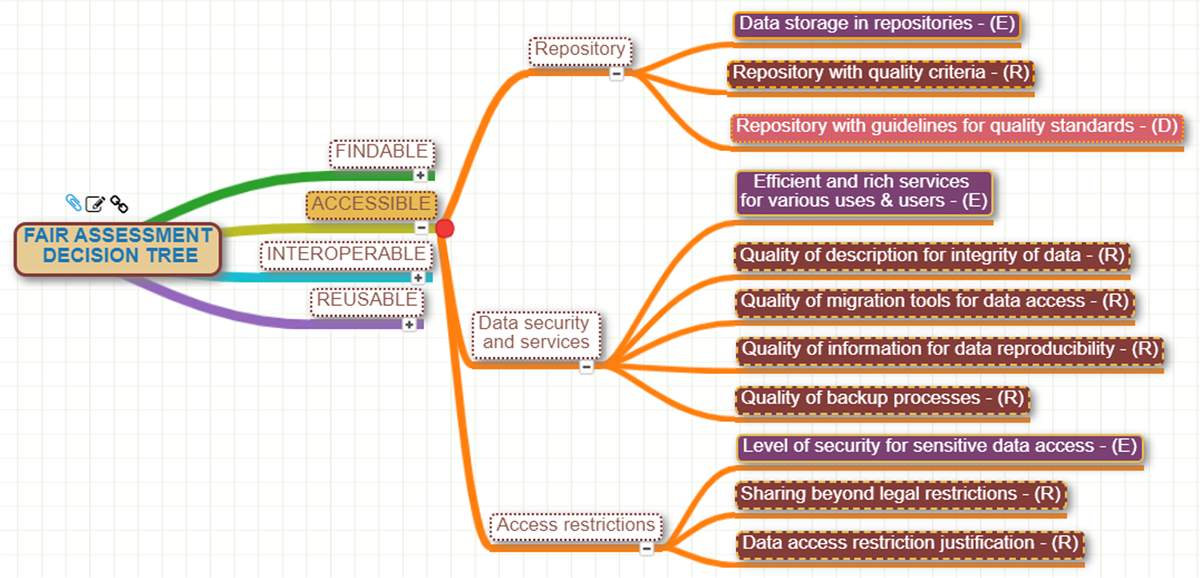
Figure 2
Mind mapping FAIRness assessment criteria. The mind map shows the extensive set of ACCESSIBLE criteria of the FAIR principles (11 criteria). The level of importance of each criteria is divided into three categories (illustrated by three colours), Essential (purple)/Recommended (brown)/Desirable (red).

Figure 3
Mind mapping FAIRness assessment criteria. The mind map shows the extensive set of INTEROPERABLE criteria of the FAIR principles (5 criteria). The level of importance of each criteria is divided into three categories (illustrated by three colours), Essential (purple)/Recommended (brown)/Desirable (red).

Figure 4
Mind mapping FAIRness assessment criteria. The mind map shows the extensive set of REUSABLE criteria of the FAIR principles (17 criteria). The level of importance of each criteria is divided into three categories (illustrated by three colours), Essential (purple)/Recommended (brown)/Desirable (red).

Figure 5
FAIRification can be schematized as a wheel describing iterative quality steps that need to be approved by the community throughout the process. This schema displays the “preparing” and “training” phases as conditions of pre-FAIRification. The pre-FAIRification processes must be community-approved at each iteration. The FAIRification steps ‘check’ and ‘adjust’ implementation must be approved by the community before a new iteration.