
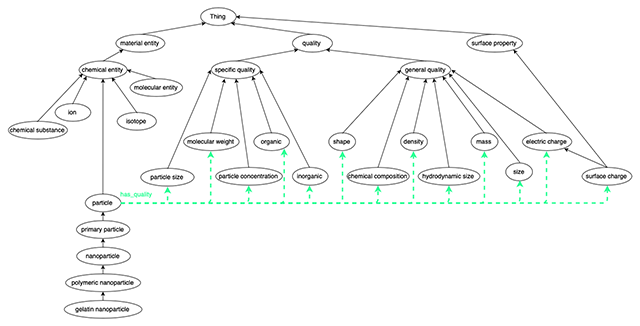
Figure 1
Example from NanoParticle Ontology.
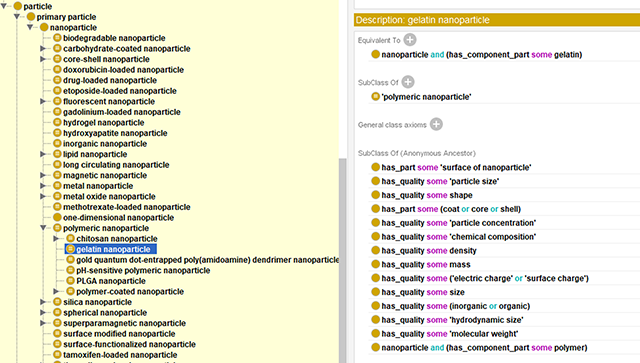
Figure 2
Example from NanoParticle Ontology opened in Protégé.
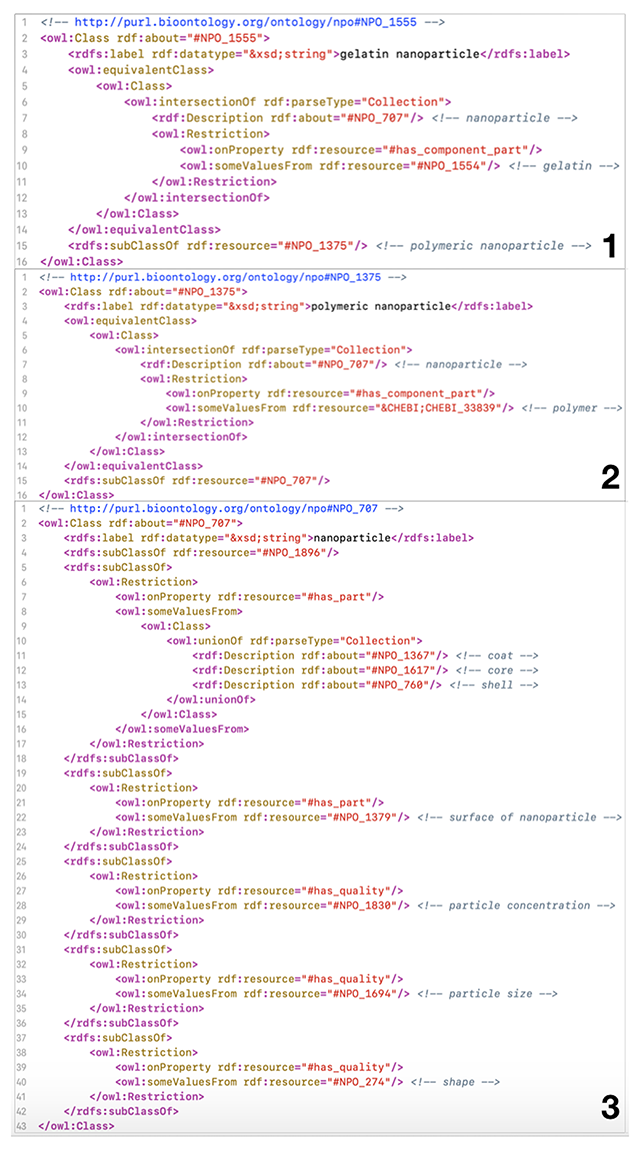
Figure 3
Example from NanoParticle Ontology – OWL/XML Syntax Format.
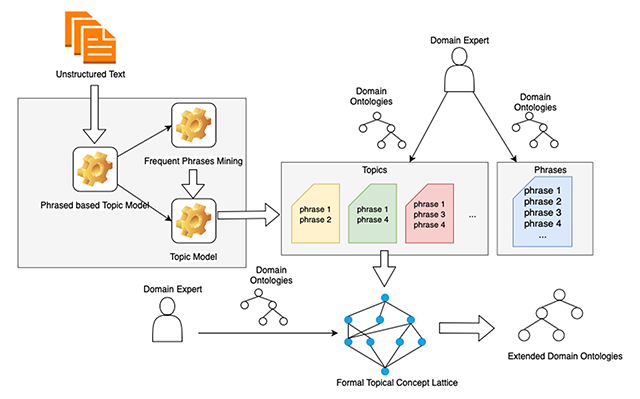
Figure 4
Approach: The upper part of the Figure shows the creation of a phrase-based topic model with as input unstructured text and as output phrases and topics. The lower part shows the formal topical concept analysis with as input topics and as output a topical concept lattice. In both parts a domain expert validates and interprets the results.

Figure 5
Examples of (a) phrase occurrences in topics, (b) Formal Topical Concept Lattice and (c) Formal Topical Concepts.
Table 1
Result of interpreting phrases. The first column defines the case using the number of topics, low or high mining threshold, and ontology. The precision is truncated.
| ADD | ADD-m | EXIST | EXIST-m | No-g | No | precision | |
|---|---|---|---|---|---|---|---|
| 20, low, NanoParticle | 32 | 4 | 26 | 19 | 16 | 9 | 0.91 |
| 20, low, eNanoMapper | 29 | 3 | 24 | 25 | 14 | 12 | 0.88 |
| 30, low, NanoParticle | 30 | 4 | 26 | 18 | 16 | 9 | 0.91 |
| 30, low, eNanoMapper | 28 | 3 | 24 | 26 | 12 | 11 | 0.89 |
| 40, low, NanoParticle | 32 | 4 | 26 | 15 | 16 | 10 | 0.90 |
| 40, low, eNanoMapper | 29 | 3 | 24 | 22 | 14 | 12 | 0.88 |
| 20, high, NanoParticle | 9 | 1 | 14 | 7 | 4 | 0 | 1.00 |
| 20, high, eNanoMapper | 8 | 2 | 12 | 10 | 3 | 0 | 1.00 |
| 30, high, NanoParticle | 8 | 2 | 14 | 8 | 0 | 1 | 0.96 |
| 30, high, eNanoMapper | 7 | 1 | 12 | 10 | 0 | 1 | 0.96 |
| 40, high, NanoParticle | 9 | 2 | 14 | 12 | 4 | 4 | 0.91 |
| 40, high, eNanoMapper | 9 | 2 | 12 | 14 | 2 | 4 | 0.90 |
[i] For the meanings of ADD(-m), EXIST(-m) and No(-g), see Section 3.3.
For ADD and ADD-m, a new concept is defined in the ontology and one or more subsumption axioms are added.
Table 2
The number (and truncated percentage in parentheses) of topics that contribute to extending the ontologies. The first column defines the case using the number of topics, low or high mining threshold, and ontology.
| Contribute to ADD and ADD-m | Contribute to EXIST and EXIST-m | Contribute to No-g | |
|---|---|---|---|
| 20, low, NanoParticle | 18 (90.0%) | 16 (80.0%) | 6 (30.0%) |
| 20, low, eNanoMapper | 18 (90.0%) | 16 (80.0%) | 5 (40.0%) |
| 20, high, NanoParticle | 11 (55.0%) | 13 (65.0%) | 3 (15.0%) |
| 20, high, eNanoMapper | 11 (55.0%) | 13 (65.0%) | 2 (10.0%) |
| 30, low, NanoParticle | 19 (63.0%) | 19 (63.0%) | 11 (36.6%) |
| 30, low, eNanoMapper | 18 (60.0%) | 20 (66.6%) | 11 (36.6%) |
| 30, high, NanoParticle | 10 (33.3%) | 19 (63.3%) | 3 (10.0%) |
| 30, high, eNanoMapper | 9 (30.0%) | 20 (66.6%) | 2 (6.6%) |
| 40, low, NanoParticle | 22 (55.0%) | 21 (52.5%) | 12 (30.0%) |
| 40, low, eNanoMapper | 21 (52.5%) | 23 (57.5%) | 9 (22.5%) |
| 40, high, NanoParticle | 13 (32.5%) | 16 (40.0%) | 4 (10.0%) |
| 40, high, eNanoMapper | 12 (30.0%) | 18 (45.0%) | 3 (7.5%) |
Table 3
Result of interpreting topics. The first column defines the case using the number of topics, low or high mining threshold, and ontology. Note that some topics may be empty and some topics may require several concepts. The values in parentheses show the number of added concepts that were not found in the phrase interpretation phase.
| ADD | ADD-m | EXIST | EXIST-m | No-g | Q | No | precision | |
|---|---|---|---|---|---|---|---|---|
| 20, low, both | 3(1) | 0 | 2 | 0 | 1 | 13 | 0 | 1.00 |
| 30, low, both | 8(2) | 0 | 4 | 0 | 1 | 13 | 0 | 1.00 |
| 40, low, both | 16(1) | 0 | 11 | 1 | 2 | 10 | 5 | 0.88 |
| 20, high, both | 8(1) | 0 | 3 | 2 | 0 | 7 | 0 | 1.00 |
| 30, high, both | 3(2) | 0 | 10 | 2 | 0 | 7 | 0 | 1.00 |
| 40, high, NanoParticle | 10(2) | 0 | 10 | 3 | 2 | 3 | 2 | 0.93 |
| 40, high, eNanoMapper | 10(2) | 0 | 9 | 4 | 2 | 3 | 2 | 0.93 |
[i] For the meanings of ADD(-m), EXIST(-m), No(-g) and Q, see Section 3.3.
For ADD and ADD-m, a new concept is defined in the ontology and one or more subsumption axioms are added.
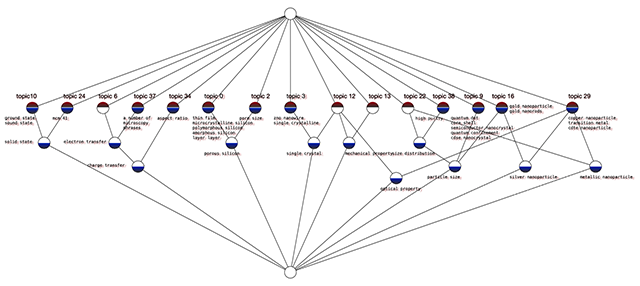
Figure 6
Part of the lattice for the 40 topics and low mining threshold setting. Nodes that contain one topic/one phrase and have as child the bottom node and as parent the top node are not shown.
Table 4
Result of interpreting lattice nodes. The first column defines the case using the number of topics, low or high mining threshold, and ontology. The values in parentheses show the number of added concepts that were not found in the phrase or topic interpretation phases.
| ADD | ADD-m | EXIST | EXIST-m | No-g | Q | No | precision | |
|---|---|---|---|---|---|---|---|---|
| 20, low, both | 1(0) | 0 | 1 | 0 | 2 | 0 | 0 | 1.00 |
| 30, low, NanoParticle | 4(2) | 0 | 3 | 0 | 1 | 0 | 0 | 1.00 |
| 30, low, eNanoMapper | 3(2) | 0 | 4 | 0 | 1 | 0 | 0 | 1.00 |
| 40, low, both | 3(0) | 0 | 1 | 0 | 0 | 0 | 0 | 1.00 |
| 20, high, both | 0(0) | 0 | 1 | 0 | 1 | 1 | 0 | 1.00 |
| 30, high, both | 1(1) | 0 | 1 | 0 | 0 | 0 | 0 | 1.00 |
| 40, high, both | 0(0) | 0 | 0 | 0 | 0 | 0 | 0 | 1.00 |
[i] For the meanings of ADD(-m), EXIST(-m), No(-g) and Q, see Section 3.3.
For ADD a new concept is defined in the ontology and one or more subsumption axioms are added.
Table 5
New concepts for the NanoParticle and eNanoMapper ontologies.
| Concepts | NanoParticle | eNanoMapper |
|---|---|---|
| amorphous silicon | ✓ | |
| band gap | ✓ | |
| Barium Titanate | ✓ | ✓ |
| block copolymer | ✓ | ✓ |
| copolymer | ✓ | ✓ |
| polymer | ✓ | |
| CdSe nanocrystal | ✓ | ✓ |
| CdTe nanoparticle | ✓ | ✓ |
| copper nanoparticle | ✓ | |
| conductivity | ✓ | ✓ |
| electrical | ✓ | ✓ |
| gold nanorod | ✓ | ✓ |
| growth mechanism | ✓ | ✓ |
| resolution | ✓ | ✓ |
| layer by layer growth | ✓ | ✓ |
| liquid solid | ✓ | |
| pressure | ✓ | |
| MCM 41 | ✓ | ✓ |
| mechanical property | ✓ | ✓ |
| viscosity | ✓ | |
| melt spin | ✓ | ✓ |
| mesoporous silica nanoparticle | ✓ | ✓ |
| mesoporous silica nanosphere | ✓ | ✓ |
| microcrystalline silicon | ✓ | ✓ |
| optical property | ✓ | |
| polymorphous silicon | ✓ | ✓ |
| pore size | ✓ | |
| porous silicon | ✓ | ✓ |
| quantum confinement | ✓ | ✓ |
| reverse micelle-type quantum dot | ✓ | ✓ |
| semiconductor nanocrystal | ✓ | ✓ |
| nanocrystal | ✓ | ✓ |
| silicon thin film | ✓ | ✓ |
| thin film | ✓ | ✓ |
| crystallinity | ✓ | ✓ |
| thermal conductivity | ✓ | ✓ |
| tunnel spectroscopy | ✓ | ✓ |
| ZnO nanowire | ✓ | ✓ |
| 35 | 32 |
Table 6
New axioms for the NanoParticle and eNanoMapper ontologies.
| Axioms | NanoParticle | eNanoMapper |
|---|---|---|
| amorphous silicon is a silicon | ✓ | |
| band gap is a quality | ✓ | |
| Barium Titanate is an inorganic compound or molecule | ✓ | |
| Barium Titanate is a chemical substance | ✓ | |
| block copolymer is a copolymer | ✓ | ✓ |
| copolymer is a polymer | ✓ | ✓ |
| polymer is an organic material | ✓ | |
| CdSe nanocrystal is a nanocrystal | ✓ | ✓ |
| CdTe nanoparticle is a nanoparticle | ✓ | ✓ |
| copper nanoparticle is a metal nanoparticle | ✓ | |
| conductivity is an independent general individual quality | ✓ | |
| conductivity is a quality | ✓ | |
| electrical conductivity is a conductivity | ✓ | ✓ |
| gold nanorod is a nanorod | ✓ | ✓ |
| growth mechanism is a process | ✓ | ✓ |
| resolution is an independent general individual quality | ✓ | |
| resolution is a quality | ✓ | |
| layer by layer growth is a mechanism process | ✓ | ✓ |
| liquid solid is a liquid solid interface | ✓ | |
| pressure is an independent general individual quality | ✓ | |
| MCM 41 is a mesoporous silica nanoparticle | ✓ | ✓ |
| mechanical property is a realizable entity | ✓ | |
| mechanical property is a quality | ✓ | |
| viscosity is a mechanical property | ✓ | ✓ |
| melt spin is a technique | ✓ | ✓ |
| mesoporous silica nanoparticle is a nanoparticle | ✓ | ✓ |
| mesoporous silica nanosphere is a nanosphere | ✓ | ✓ |
| microcrystalline silicon is a silicon | ✓ | |
| microcrystalline silicon is a chemical substance | ✓ | |
| nanotube array has part nanotube | ✓ | ✓ |
| optical property is a property | ✓ | |
| polymorphous silicon is a silicon | ✓ | |
| polymorphous silicon is a chemical substance | ✓ | |
| pore size is a nanoparticle property | ✓ | |
| porous silicon is a silicon | ✓ | |
| porous silicon is a chemical substance | ✓ | |
| raman scatter is a synonym of raman spectroscopy | ✓ | ✓ |
| quantum confinement | ✓ | ✓ |
| reverse micelle-type quantum dot is a quantum dot | ✓ | ✓ |
| semiconductor nanocrystal is a semiconductor and is a nanocrystal | ✓ | ✓ |
| nanocrystal is a nano-object and is a crystal | ✓ | ✓ |
| silicon thin film is a thin film | ✓ | ✓ |
| thin film is a fiat material part and one-dimensional nano-object | ✓ | ✓ |
| crystallinity is an independent general individual quality | ✓ | |
| crystallinity is a quality | ✓ | |
| transition metal is a synonym of transition element | ✓ | |
| thermal conductivity is a conductivity | ✓ | ✓ |
| tunnel spectroscopy is a spectroscopy | ✓ | ✓ |
| scanning tunneling spectroscopy is same as tunnel spectroscopy | ✓ | ✓ |
| chemical vapor disposition is a vapor disposition | ✓ | ✓ |
| physical vapor disposition is a vapor disposition | ✓ | ✓ |
| ZnO nanowire is a nanowire | ✓ | ✓ |
| 42 | 37 |
Table 7
Performance of ontology learning systems in different domains (Wong et al. 2012). (Precision is truncated).
| System | Domain | Precision |
|---|---|---|
| ASIUM | French journal Le Monde | 0.86 |
| CRCTOL | Patterns of Global Terrorism | 0.92 |
| OntoGain | Computer Science corpus | 0.86 |
| Medical corpus | 0.89 | |
| OntoLearn | Tourism | 0.85 |
| Text2Onto | Text from the paper (Navigli & Velardi 2004) | 0.61 |
| Patterns of Global Terrorism | 0.74 |
Table 8
The results of Text2Onto with different algorithms and different number of returned candidates. (Precision is truncated).
| # of elements | Algorithm | ADD | ADD-m | EXIST | EXIST-m | No-g | No | precision |
|---|---|---|---|---|---|---|---|---|
| 100 | Entropy | 5 | 0 | 39 | 19 | 4 | 33 | 0.67 |
| C-value/NC-value | 5 | 0 | 39 | 19 | 4 | 33 | 0.67 | |
| Relative term frequency | 5 | 0 | 39 | 20 | 4 | 32 | 0.68 | |
| TF-IDF | 17 | 0 | 22 | 12 | 6 | 43 | 0.57 | |
| 200 | Entropy | 7 | 1 | 63 | 43 | 8 | 79 | 0.60 |
| C-value/NC-value | 7 | 1 | 63 | 43 | 7 | 79 | 0.60 | |
| Relative term frequency | 7 | 1 | 63 | 42 | 8 | 79 | 0.60 | |
| TF-IDF | 24 | 1 | 38 | 19 | 19 | 99 | 0.50 | |
| 300 | Entropy | 12 | 1 | 80 | 52 | 16 | 139 | 0.53 |
| C-value/NC-value | 12 | 1 | 80 | 52 | 16 | 139 | 0.53 | |
| Relative term frequency | 13 | 1 | 78 | 52 | 16 | 140 | 0.53 | |
| TF-IDF | 28 | 1 | 58 | 36 | 29 | 148 | 0.50 | |
| 400 | Entropy | 18 | 1 | 98 | 62 | 20 | 199 | 0.50 |
| C-value/NC-value | 18 | 1 | 98 | 62 | 20 | 199 | 0.50 | |
| Relative term frequency | 19 | 1 | 100 | 61 | 20 | 199 | 0.50 | |
| TF-IDF | 36 | 1 | 70 | 44 | 38 | 211 | 0.47 |
Table 9
Results for Text2Onto using all algorithms per setting and our method for extending NanoParticle Ontology. (Precision is truncated).
| ADD | ADD-m | EXIST | EXIST-m | No-g | No | precision | |
|---|---|---|---|---|---|---|---|
| Text2Onto-100 | 20 | 0 | 51 | 27 | 11 | 71 | 0.60 |
| Text2Onto-200 | 29 | 1 | 84 | 55 | 26 | 164 | 0.54 |
| Text2Onto-300 | 39 | 1 | 118 | 78 | 44 | 266 | 0.51 |
| Text2Onto-400 | 41 | 1 | 120 | 73 | 47 | 313 | 0.47 |
| Our Method | 32 | 3 | 25 | 18 | 14 | 22 | 0.80 |
Table 10
New concepts found by our method and Text2Onto for the NanoParticle Ontology.
| Concepts | Our method | Text2Onto |
|---|---|---|
| acid group | ✓ | |
| activation energy | ✓ | |
| amorphous silicon | ✓ | |
| band gap | ✓ | ✓ |
| Barium Titanate | ✓ | ✓ |
| Barium Titante nanowire | ✓ | |
| block copolymer | ✓ | ✓ |
| boron nanowire | ✓ | |
| catalyst | ✓ | |
| cluster | ✓ | |
| copolymer | ✓ | ✓ |
| crystallite | ✓ | |
| crystallinity | ✓ | |
| CdSe nanocrystal | ✓ | |
| CdTe nanoparticle | ✓ | |
| copper nanoparticle | ✓ | ✓ |
| conductivity | ✓ | ✓ |
| diblock copolymer | ✓ | |
| electrical conductivity | ✓ | |
| esterification | ✓ | |
| ethylene oxide | ✓ | |
| gold nanorod | ✓ | ✓ |
| growth mechanism | ✓ | ✓ |
| intensity | ✓ | |
| resolution | ✓ | |
| layer by layer growth | ✓ | |
| liquid solid | ✓ | |
| pressure | ✓ | |
| MCM 41 | ✓ | |
| mechanical property | ✓ | |
| melting | ✓ | |
| melt spin | ✓ | |
| mesoporous silica nanoparticle | ✓ | |
| mesoporous silica nanosphere | ✓ | |
| microcrystalline silicon | ✓ | ✓ |
| nano colloid | ✓ | |
| nano composite | ✓ | |
| nanocrystal | ✓ | ✓ |
| nano crystalline silicon particle | ✓ | |
| nanogrid | ✓ | |
| nano ribbon | ✓ | |
| nanotube array | ✓ | ✓ |
| nanowire array | ✓ | |
| oxidation | ✓ | |
| photo activity | ✓ | |
| polyelectrolyte | ✓ | |
| polymorphous silicon | ✓ | |
| pore size | ✓ | ✓ |
| porous silicon | ✓ | |
| pressure | P | |
| quantum confinement | ✓ | ✓ |
| reverse micelle-type quantum dot | ✓ | |
| semiconductor nanocrystal | ✓ | ✓ |
| silicon thin film | ✓ | |
| silica nanosphere | ✓ | |
| silicon nanowire | ✓ | |
| silicon nanowire array | ✓ | |
| superlattice nanowire | ✓ | |
| thin film | ✓ | |
| titanium nanotube | ✓ | |
| thermal conductivity | ✓ | |
| tunnel spectroscopy | ✓ | |
| ZnO nanowire | ✓ | |
| 35 | 42 |