
Table 1
Model scenarios A B, C, and D.
| Scenario | Dataset Description | Time for sharing | Time for reuse | Time for producing a dataset | Time to write a paper | Dataset decay rate |
|---|---|---|---|---|---|---|
| A | Easy share Easy to reuse | 1 day | 1 day | 73 days | 47 days | 10% per year |
| B | Easy to share Hard to reuse | 1 day | 15 day | 73 days | 47 days | 10% per year |
| C | Hard to share Easy to reuse | 15 days | 1 day | 73 days | 47 days | 10% per year |
| D | Hard to share Hard to reuse | 15 days | 15 days | 73 days | 47days | 10% per year |
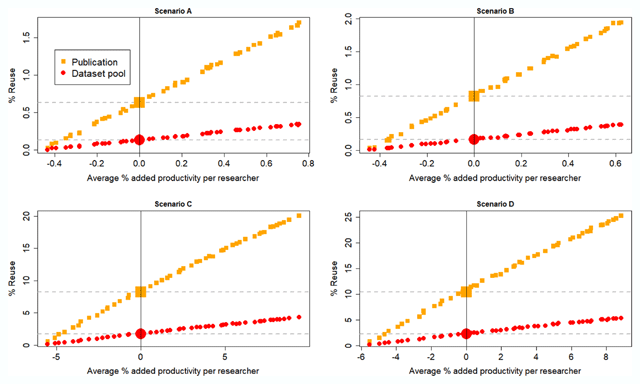
Figure 1
The influence of reuse, in percentages of either publications or available datasets, on average net efficiency (productivity) for the different scenarios at 50% sharing researchers. The large points represent the reuse at which a break-even point is reached. See Table 1 for an explanation of the scenarios.
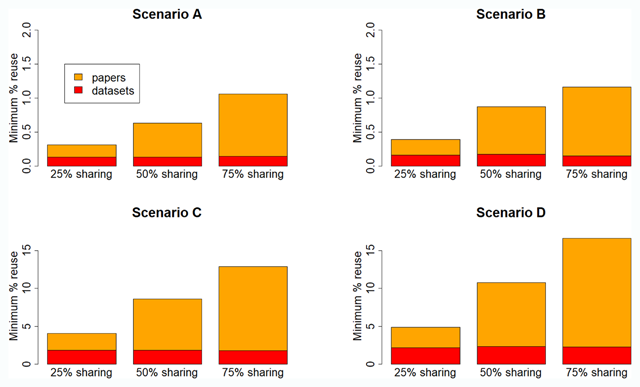
Figure 2
The minimum reuse, in terms of either publications or available datasets, needed for a break-even point in time invested in sharing and time gain by reuse, for different scenarios and for different percentages of researchers in a scientific community that are sharing. See Table 1 for an explanation of the scenarios.
Table 2
Net time efficiency of the scientific community in the case that 5% of papers are based on a reuse dataset, for different scenarios and different sharing rates. See Table 1 for an explanation of the scenarios.
| 25% sharing | 50% sharing | 75% sharing | |
|---|---|---|---|
| Scenario A | 3.5% | 3.2% | 2.9% |
| Scenario B | 2.6% | 2.3% | 2.1% |
| Scenario C | 0.6% | –2.6% | –5.8% |
| Scenario D | 0% | –3.2% | –6.6% |