
Table 1
Cross-case comparison of contextual factors associated with environmental engagement outcomes across schools.
| PARTICIPANT GROUP | NUMBER OF MEASUREMENTS | RIVER IN LAKE SEVAN ECOSYSTEM | SAMPLING LOCATION (IN RELATION TO SETTLEMENTS) | THE PROXIMITY OF RIVER TO STUDENTS’ HOUSES OR EVERYDAY ROUTES | KNOWLEDGE ABOUT THE IMPACT OF POLLUTION SOURCES ON RIVER QUALITY | SENSE OF OWNERSHIP/RESPONSIBILITY | SELF-EFFICACY | PRO-ENVIRONMENTAL BEHAVIOR | PERCEIVED CIVIC ROLE | ACTIVITIES BEYOND MEASUREMENTS |
|---|---|---|---|---|---|---|---|---|---|---|
| AS students | 4 | Not flowing | Within | No | Average | Not fully formed/Yes | Not fully formed | Yes | Yes | Planned |
| AT teacher | _ | _ | _ | Yes | _ | Yes | ||||
| BS students | 6 | Outflowing | Within | Yes | Average | Yes/No | No | No | No | Planned |
| BT teacher | _ | _ | _ | No | _ | No | ||||
| CS students | 23 | Inflowing | Upstream | No | Low | Abstract/Yes | Yes | Yes | Yes | Done |
| CT teacher | _ | _ | _ | Yes | _ | Yes | ||||
| DS students | 16 | Inflowing | Upstream | No | Average | Abstract/Yes | Yes | Yes | Yes | Done |
| DT1 teacher | _ | _ | _ | N/A | _ | N/A | ||||
| DT2 teacher | _ | _ | _ | Yes | _ | Yes | ||||
| ES students | 17 | Inflowing | Within | Yes | High | Yes/Yes | Yes | Yes | Yes | Done, planned |
| ET teacher | _ | _ | _ | Yes | _ | Yes | ||||
| FS students | 15 | Inflowing | Within | Yes | High | Yes/Yes | Yes | Yes | Yes | Planned |
| FT teacher | _ | _ | _ | Yes | _ | Yes | ||||
| GS students | 13 | Inflowing | Within | Yes | High | Yes/Yes | Yes | Yes | Yes | Done, planned |
| GT1 teacher | _ | _ | _ | Yes | _ | Yes | ||||
| GT2 teacher | _ | _ | _ | Yes | _ | Yes | ||||
| HS students | 8 | Inflowing | Within | Yes | Low | Yes/Yes | Yes | Yes | Yes | Done, planned |
| HT teacher | _ | _ | _ | Yes | _ | Yes | ||||
| IS students | 8 | Inflowing | Within | Yes | Low | Yes/Yes | Yes | Yes | Yes | Done, planned |
| IT teacher | _ | _ | _ | Yes | _ | N/A |
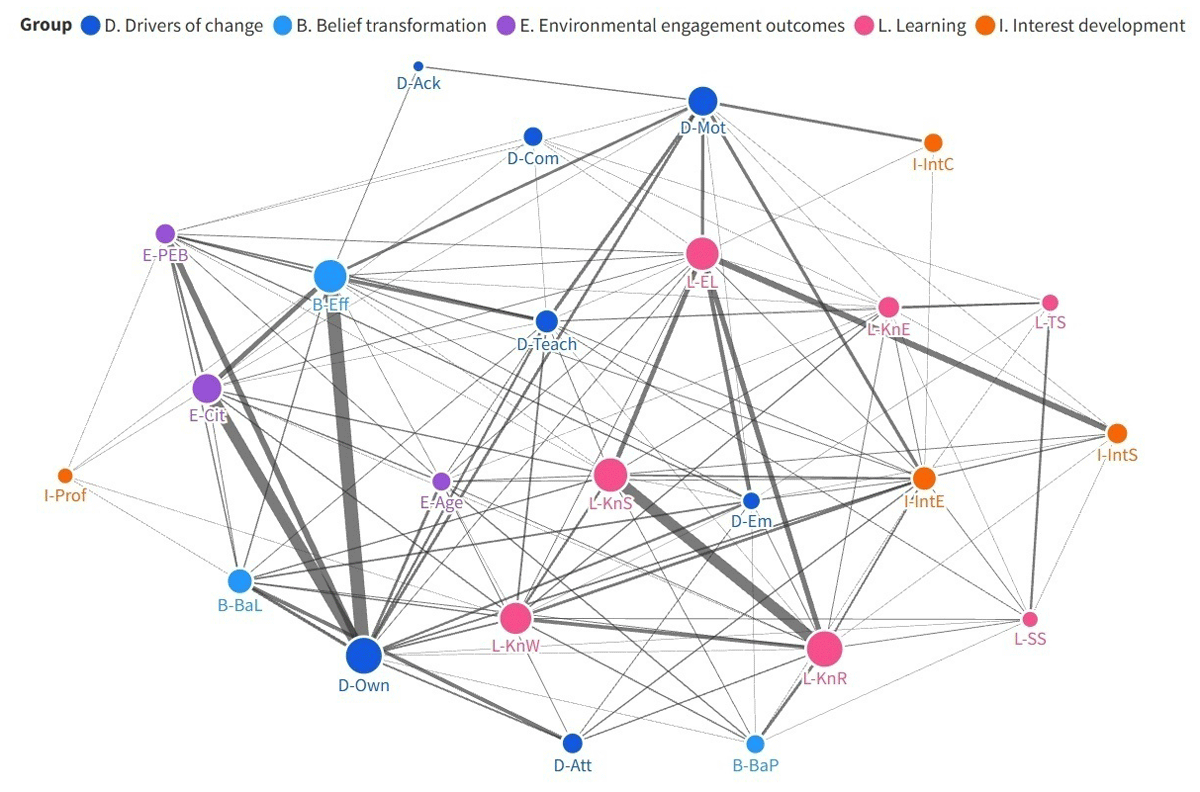
Figure 1
Network graph of thematic interconnections among participant outcomes and learning processes. Node abbreviations—D-Ack: Acknowledgement of efforts, D-Att: Attitude toward river site, D-Em: Learning through emotions, D-Mot: Motivation to join/participate, D-Own: Sense of ownership/responsibility, D-Com: Formation of friendship/community, D-Teach: Teachers’ influence on students, B-Eff: Self-efficacy, B-BaP: Belief revision about pollution levels, B-BaL: Belief revision about littering practices, E-Age: Environmental agency, E-Cit: Perceived civic role, E-PEB: Pro-environmental behavior, L-EL: Experiential learning, L-KnR: Knowledge of the local river, L-KnS: Knowledge of natural sciences, L-KnE: Subject-matter knowledge/prior experience, L-KnW: Knowledge of water issues, L-SS: Scientific skills, L-TS: Transferable skills, I-Prof: Chosen profession, I-IntE: Interest in the environment, I-IntS: Interest in natural science, I-IntC: Triggered interest in the broader school/community.
Table 2
Summary of factors contributing to different forms of environmental engagement.
| INDIVIDUAL PRO-ENVIRONMENTAL BEHAVIOR | COLLECTIVE ENVIRONMENTAL AGENCY INITIATED BY A TEACHER | COLLECTIVE ENVIRONMENTAL AGENCY INITIATED BY STUDENTS | EMERGING ENVIRONMENTAL CITIZENSHIP | |
|---|---|---|---|---|
| Contextual relationship of the sampling site | _ | _ | _ | ✓ |
| Sense of ownership/responsibility | ✓ | _ | ✓ | ✓ |
| Local environmental knowledge | ✓ | _ | ✓ | ✓ |
| Self-efficacy | ✓ | ✓ | ✓ | ✓ |
| Sense of community | _ | ✓ | ✓ | ✓ |
| Teacher’s influence (motivation, self-efficacy, responsibility) | _ | ✓ | ✓ | ✓ |
[i] ✓ indicates that the factor was consistently associated with the corresponding form of environmental engagement across the groups; – indicates that no consistent association was identified.