
Introduction
Citizen science (CS), commonly defined as public participation in scientific research in which non-professional scientists contribute to data collection, analysis, and dissemination (Bonney et al. 2009), has become an increasingly prominent approach in research and public engagement. Its key strength lies in enabling large-scale spatial and temporal data collection in a cost- and time-efficient manner through volunteer mobilization (Theobald et al. 2014; Chandler et al. 2016).
Beyond its contribution to data generation, CS is widely recognized for its educational (Wals et al. 2014; Dunkley 2017) and transformative potential (Phillips et al. 2014), producing a range of individual-level outcomes, including increased knowledge, skill development, heightened awareness, attitude shifts, behavior change, and increased civic participation (Jordan et al. 2011; Hsu et al. 2019; Aguirre and Kovács 2023; Janssen et al. 2025).
As studies assessing participant outcomes continue to grow, so does the need for a systematic understanding of these outcomes (Peter et al. 2019). Several frameworks have been developed to structure and guide the evaluation of CS impacts, including holistic approaches (Kieslinger et al. 2017; Shirk et al. 2012; Wehn et al. 2021) and participant-centered models, such as the Individual Learning Outcomes (ILO) framework developed by Phillips and colleagues (2018). The latter identifies six key outcome domains for CS participants: interest, motivation, self-efficacy, knowledge, skills, and behavior and stewardship. Practitioners consistently identify outcome evaluation as a high priority, but also as one of the most challenging aspects of CS practice (Phillips et al. 2014; Kieslinger et al. 2017).
Recent literature suggests that structured frameworks risk simplifying or fragmenting relational and context-dependent experiences by sometimes overlooking nuanced participant experiences and struggling to capture outcomes that do not neatly align with predefined categories (Janssen et al. 2025). Similar concerns have long been raised in the constructivist tradition, which argues that evaluations based on predetermined criteria may fail to adequately capture contextual and participant-defined experiences (Stake 1975; Guba and Lincoln 1989).
These conceptual challenges are compounded by methodological limitations in the existing literature. Quantitative studies often report statistically non-significant changes in attitudes and behaviors (Brossard et al. 2005; Wichmann et al. 2022), providing limited explanations and opportunities to examine the processes underlying these outcomes. Others examine participant outcomes separately (Peter et al. 2019) or describe them without exploring interrelationships among them (Wichmann et al. 2022; Christ et al. 2022; Olson and Colston 2024). This narrow focus obscures potential relational pathways, limiting understanding of how learning, beliefs, emotions, and social dynamics jointly support environmental engagement. Qualitative methods can address this limitation by capturing participants’ experiences and exploring interrelationships among them (Silva et al. 2023; Janssen et al. 2025), including less tangible processes such as ownership, belief revision, and social influence.
This study employs a qualitative approach to examine interconnections among individual learning outcomes in the school-based CS project Recording Impacts on Vital Ecosystems through Responsible Water Stewardship (RIVERS). Implemented within the EU-funded OTTERS project and financially supported by ProBleu, RIVERS involved nine schools in the Gegharkunik province of Armenia (OTTERS 2025). Each school adopted a local river and conducted weekly water quality measurements over a period of two to four months, commencing in spring 2025. Measured parameters included water temperature, pH, electroconductivity, water flow rate, ammonia, nitrite, phosphates, and water color and odor. The goal was to investigate pollution pathways affecting Lake Sevan—the largest freshwater lake in Armenia and the Caucasus—and the role of tributary rivers in contributing to its degradation. RIVERS concluded with a final event where schools presented and compared their findings.
The project was facilitated by the introduction of mandatory project-based learning requirements in Armenian schools (No. 699-N 2026). Primary and secondary school teachers were trained in water quality monitoring and provided with freshwater test kits, educational toolkits, and instructional videos. Teachers independently selected sampling locations and classes. In total, approximately 100 students from grades 5–12 participated. Schools were involved in multiple stages of the research process, from project design to basic data analysis, corresponding to Haklay’s “participatory science” level of citizen engagement (Haklay 2018).
Although water quality monitoring is a well-established domain of CS internationally (Cook, Abolfathi, and Gilbert 2021), opportunities in Armenia for public participation in science remain limited to occasional birdwatching activities (NABU Armenia n.d.; ArAves NGO 2024). The Ecoserv project is the only CS initiative known to the author that has systematically engaged schools in Armenia with freshwater ecosystem assessment (Ecoserv n.d.). In this sense, RIVERS provides a distinct context to examine participants’ learning and environmental engagement.
Guided by the ILO framework (Phillips et al. 2018), I explore how participant outcomes emerge and interact. Because learning in CS involves reflective, experiential, and social processes, the analysis draws on complementary insights from Experiential Learning Theory, Transformative Learning Theory, and Social Learning Theory. These theories are used as interpretive lenses for explaining the mechanisms through which learning fosters environmental engagement.
Experiential Learning Theory views learning as knowledge created through the transformation of experience (Kolb 2014). Transformative Learning Theory conceptualizes learning as critical examination and revision of existing frames of reference through reflection following a disorienting dilemma (Mezirow 1991). Social Learning Theory emphasizes learning through observation, social interaction, and social reinforcement, highlighting the roles of modeling and self-efficacy (Bandura 1971). Herein, Experiential Learning Theory provides a lens for understanding how hands-on water quality monitoring translated direct experience into knowledge and revised understanding of pollution. Transformative Learning Theory helps explain how encounters with local pollution prompted critical reflection on littering practices and supported engagement. Social Learning Theory provides insight into how teachers and peers influenced participants’ motivation, confidence, and environmental responsibility through modeling and social reinforcement.
This study addresses the aforementioned conceptual and methodological gaps through an inductive qualitative analysis of how learning and environmental engagement emerge and relate to one another within a school-based CS project. Particular attention is given to how outcomes may change function during participation, becoming conditions that shape subsequent outcomes. Accordingly, the guiding research question is: What individual learning outcomes emerge among participants in school-based CS, and how do their interrelationships contribute to learning and environmental engagement?
Methods
Data collection
This study is based on a secondary analysis of qualitative data collected by the author during the evaluation of the RIVERS project to explore participants’ experiences and project outcomes. The original data were collected through voluntary online interviews with teachers and in-person focus group discussions with students, conducted in Armenian. Prior to participation, written informed consent was obtained from teachers, and written parental consent and student assent from students. All teachers participating in the project were interviewed. Students were selected using purposive, criterion-based sampling. They were selected by teachers based on their involvement in project activities and availability for focus group discussions, which may have favored students who were more actively engaged in the project. To partially overcome this bias and capture a diversity of experiences, students who participated in the final project event, as well as those who did not, were included in the discussions. Sampling sought to maximize variation in participant experiences rather than achieve statistical representativeness. Three to six students per school acted as key informants. In total, 11 interviews and nine focus group discussions were conducted, lasting approximately 40–70 minutes.
Both interviews and focus groups followed semi-structured guides divided into thematic sections (Supplemental File 1: Appendix A). Initially developed for project evaluation, these guides were sufficiently broad to support the secondary analysis presented in this study. The focus group guide covered emotions and attitudes toward the river, interest in natural science subjects, knowledge, behavior, and willingness to act. Teacher interviews included questions on motivation and values, knowledge, student experiences, integration of project activities into classroom practice, perceptions of CS, feedback on the project, and reflections on the final event.
Data analysis
Audio-recorded interviews and focus group discussions were transcribed verbatim. De-identified transcripts were imported into Atlas.ti (version 25) for thematic analysis. Schools and participants were represented using coded identifiers, with the first letter indicating the assigned school code and the second denoting the participant role (e.g., student or teacher; see Table 1).
Table 1
Cross-case comparison of contextual factors associated with environmental engagement outcomes across schools.
| PARTICIPANT GROUP | NUMBER OF MEASUREMENTS | RIVER IN LAKE SEVAN ECOSYSTEM | SAMPLING LOCATION (IN RELATION TO SETTLEMENTS) | THE PROXIMITY OF RIVER TO STUDENTS’ HOUSES OR EVERYDAY ROUTES | KNOWLEDGE ABOUT THE IMPACT OF POLLUTION SOURCES ON RIVER QUALITY | SENSE OF OWNERSHIP/RESPONSIBILITY | SELF-EFFICACY | PRO-ENVIRONMENTAL BEHAVIOR | PERCEIVED CIVIC ROLE | ACTIVITIES BEYOND MEASUREMENTS |
|---|---|---|---|---|---|---|---|---|---|---|
| AS students | 4 | Not flowing | Within | No | Average | Not fully formed/Yes | Not fully formed | Yes | Yes | Planned |
| AT teacher | _ | _ | _ | Yes | _ | Yes | ||||
| BS students | 6 | Outflowing | Within | Yes | Average | Yes/No | No | No | No | Planned |
| BT teacher | _ | _ | _ | No | _ | No | ||||
| CS students | 23 | Inflowing | Upstream | No | Low | Abstract/Yes | Yes | Yes | Yes | Done |
| CT teacher | _ | _ | _ | Yes | _ | Yes | ||||
| DS students | 16 | Inflowing | Upstream | No | Average | Abstract/Yes | Yes | Yes | Yes | Done |
| DT1 teacher | _ | _ | _ | N/A | _ | N/A | ||||
| DT2 teacher | _ | _ | _ | Yes | _ | Yes | ||||
| ES students | 17 | Inflowing | Within | Yes | High | Yes/Yes | Yes | Yes | Yes | Done, planned |
| ET teacher | _ | _ | _ | Yes | _ | Yes | ||||
| FS students | 15 | Inflowing | Within | Yes | High | Yes/Yes | Yes | Yes | Yes | Planned |
| FT teacher | _ | _ | _ | Yes | _ | Yes | ||||
| GS students | 13 | Inflowing | Within | Yes | High | Yes/Yes | Yes | Yes | Yes | Done, planned |
| GT1 teacher | _ | _ | _ | Yes | _ | Yes | ||||
| GT2 teacher | _ | _ | _ | Yes | _ | Yes | ||||
| HS students | 8 | Inflowing | Within | Yes | Low | Yes/Yes | Yes | Yes | Yes | Done, planned |
| HT teacher | _ | _ | _ | Yes | _ | Yes | ||||
| IS students | 8 | Inflowing | Within | Yes | Low | Yes/Yes | Yes | Yes | Yes | Done, planned |
| IT teacher | _ | _ | _ | Yes | _ | N/A |
The analysis followed the six-phase thematic analysis approach outlined by Braun and Clarke (2006). I adopted an inductive coding approach, allowing themes to emerge directly from the data. Codes were assigned to the smallest meaningful unit of text that represented a complete idea relevant to a theme. Depending on the responses, coded segments ranged from one to several consecutive sentences when participants discussed a single experience or reflection. Initial open coding resulted in a set of subcodes, which were iteratively compared and clustered into higher-level codes. To avoid constraining interpretation, no predefined framework was applied during the early stages of coding. In later stages, the emerging codes were compared with the ILO framework and refined where appropriate. Trustworthiness was enhanced through repeated comparison of codes with the transcripts and iterative refinement of assigned codes where necessary. This process yielded 9 main codes and 26 subcodes based on the interview material, which is reflected in the codebook (Supplemental File 2: Appendix B). Because the study followed an interpretive thematic analysis, inter-rater agreement statistics were not calculated.
Although interview questions primarily elicited participants’ experiences rather than being developed to capture relationships among them, interconnections emerged inductively during the thematic analysis. To explore potential relationships among themes, a code co-occurrence table was generated using Atlas.ti (Supplemental File 3: Appendix C). Code co-occurrence reflects how frequently codes appeared within the same textual segments and was used as an exploratory tool to identify potential interconnections that required further qualitative interpretation. The co-occurrence matrix was used to sensitize the analysis to patterns that might otherwise have remained unnoticed and to guide subsequent examination of participants’ narratives (Scharp 2021). The analysis focused on the most frequently co-occurring code pairs. Given that code co-occurrence reflected thematic association but did not capture variation across schools or differences between teacher and student accounts, an additional comparative analytic table was developed to support systematic comparison across schools and participant groups (Table 1). The table summarizes patterns identified through iterative analysis of the narratives, supporting cross-case comparison and interpretation of how combinations of factors were associated with environmental engagement outcomes (See full table in Supplemental File 4: Appendix D).
Analysis of adolescent data was conducted with attention to age-related modes of expression and contextual interpretation, in line with qualitative research standards for working with minors (Christensen and Prout 2002).
Visualisation
The square code co-occurrence table was restructured in RStudio (version 2024.12.0 + 467) to generate an edge list suitable for network visualization. Data transformation was performed using the tidyverse collection of packages, particularly dplyr. A network graph was then created using the Flourish data visualization platform to display prominent interrelationships among codes.
Results
Co-occurrence analysis and a detailed thematic analysis of interview transcripts indicated that the RIVERS project was associated with a range of participant outcomes, including increased interest and knowledge of natural science concepts and the local environment; development of scientific and transferable skills; motivation; self-efficacy; and three forms of environmental engagement, with variation across participants in the strength of these outcomes. Participants also described several other processes linked to these outcomes, including experiential learning; belief revision; strengthened social networks; and a sense of ownership and responsibility toward the local environment.
Figure 1 illustrates the frequencies and interrelationships among themes identified through the co-occurrence analysis. Knowledge and sense of ownership/responsibility were among the most discussed themes, followed by self-efficacy and experiential learning. Higher-frequency themes showed more co-occurrences with other frequently coded themes. Two main clusters of interrelationships emerged. The first cluster comprised knowledge of the local river and natural sciences, experiential learning, and interest in science. Experiential learning co-occurred particularly frequently with interest. The second cluster connected ownership and responsibility with self-efficacy and three environmental engagement outcomes. Belief revision about pollution occupied an intermediate position between experiential learning and knowledge, whereas belief change about littering practices appeared closer to the second cluster. Motivation and teacher influence were linked to different nodes of both clusters.
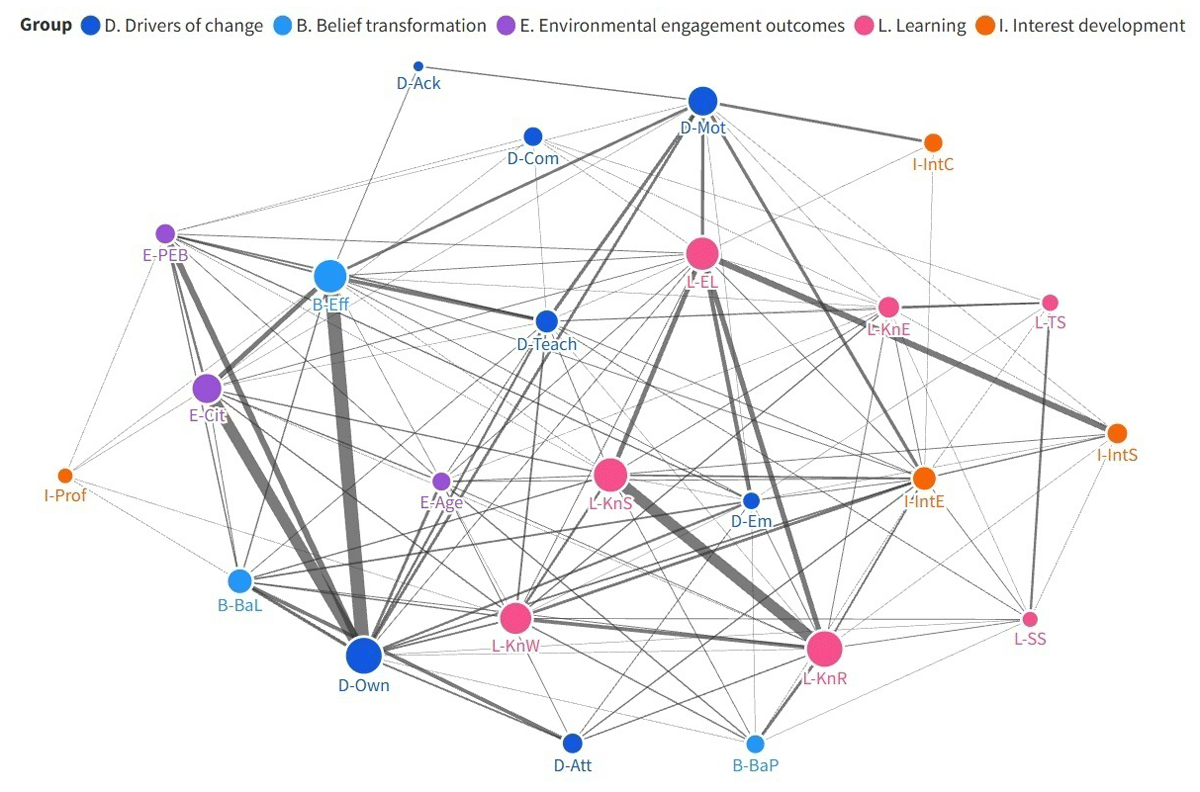
Figure 1
Network graph of thematic interconnections among participant outcomes and learning processes. Node abbreviations—D-Ack: Acknowledgement of efforts, D-Att: Attitude toward river site, D-Em: Learning through emotions, D-Mot: Motivation to join/participate, D-Own: Sense of ownership/responsibility, D-Com: Formation of friendship/community, D-Teach: Teachers’ influence on students, B-Eff: Self-efficacy, B-BaP: Belief revision about pollution levels, B-BaL: Belief revision about littering practices, E-Age: Environmental agency, E-Cit: Perceived civic role, E-PEB: Pro-environmental behavior, L-EL: Experiential learning, L-KnR: Knowledge of the local river, L-KnS: Knowledge of natural sciences, L-KnE: Subject-matter knowledge/prior experience, L-KnW: Knowledge of water issues, L-SS: Scientific skills, L-TS: Transferable skills, I-Prof: Chosen profession, I-IntE: Interest in the environment, I-IntS: Interest in natural science, I-IntC: Triggered interest in the broader school/community.
The cross-case comparison table, which was used to examine relationships between teacher and student responses and to identify engagement patterns across schools, is shown below (Table 1). Derived from iterative examination of interview transcripts, it explores how different combinations of contextual factors (e.g., number of measurements, sampling location, river proximity, ownership/responsibility, knowledge, and self-efficacy) corresponded with variation in environmental engagement outcomes across schools. Dashes indicate information that was not collected from teachers as these questions were designed to capture only students’ experiences. A more detailed table is available in Supplemental File 4: Appendix D.
Learning outcomes
Knowledge gain occurred at multiple levels. Students reported increased understanding of environmental processes and their local river ecosystems; some learned the river’s name or location for the first time. While many were aware that sewage entered the river, none initially understood its impact on water quality. Through participation, both students and teachers identified multiple pollution sources and their ecological consequences. As one student explained:
“The main cause of pollution is sewage and solid waste that is dumped into the river. There is also a greenhouse. During the fertilization period, those materials come and flow into the river. Phosphorus comes from chemical fertilizers, which are not good; they cause color change and algal blooms.” (GS)
Several students demonstrated an advanced understanding of eutrophication processes due to measurements. Although most students remained unfamiliar with national or global water issues, as these were not directly targeted, comparison across schools’ results during the final event fostered broader ecosystem-level understanding of regional waters.
All student groups expressed positive attitudes toward experiential learning, describing it as more convincing, memorable, and engaging. They expressed willingness to integrate experiential learning into regular classes. Reagent color changes and flow rate measurements were frequently mentioned as particularly interesting. A teacher (ET) recounted how students traced unexpectedly high pH measurements to a sampling site affected by wastewater discharge. Discussion of the results helped students interpret anomalous values by linking them to local pollution sources identified through their own investigation.
The code co-occurrence analysis revealed links between knowledge and experiential learning:
“We had looked at [the river] from above; we didn’t think it would be so dirty, but as we went deeper, the measurements were terrible… especially after we saw a lot of changes in the indicators. To put it bluntly, we understood from the contact.”
Another example shows how experiential learning co-occurred with interest in science:
“Before measurements, I honestly couldn’t stand chemistry at all. After measurements, I started to love chemistry very much, and right now my favorite subject is chemistry… working with those materials, delving into the particles: what we can add, what we can subtract, or what can happen if we pour this material on top of that. Before that, I wasn’t interested in all that, but after I tried it once, I realized that you really have to try it and then express your opinion.” (ES)
Students and teachers most frequently reported an increased interest in chemistry and geography. One student even considered a career in conservation, sharing her hesitation between the already chosen surgical medicine and conservation of Lake Sevan (FS).
Knowledge categories also co-occurred with belief revision about pollution. Teachers and students reported two major revisions of former beliefs. Some participants discovered that rivers were more polluted than expected, while others were surprised by better-than-anticipated results: “We knew that sewage was coming from above. We were assuming it [the river] was dirty, but we didn’t imagine it was that dirty.” (DS) In contrast to this statement, another mentions: “I imagined that the pollution would be at a higher level than it actually was. I imagined the situation to be very, very bad, but it didn’t turn out as I had imagined.” (CS)
Many also shifted from viewing pollution as purely physical to recognizing chemical contamination. A teacher reflected:
“In our communities, when we say polluted, we mean solid waste, especially. To say that, I must have much knowledge, no. Even though I am a teacher, [I would assume] it is a river, it flows, it will bring solid waste with it on its way, it will go and be dumped into Lake Sevan. I could not imagine it in reality. [I would assume] it is water, it comes from the mountains, it must be clean without the influence of any chemical elements.” (DT1)
Environmental engagement outcomes
Measurement activities shaped three forms of environmental engagement ranging from individual behavioral changes to collective action and perceived civic responsibility. First, all student groups except one reported individual pro-environmental behaviors, such as refraining from littering and encouraging others to do so (Table 1). Second, collective environmental agency as one form of stewardship was evident in voluntary activities beyond the assigned measurements, which included river clean-ups, testing water quality in additional water bodies, and comparing results across sites. The environmental agency here refers to participants’ perceived capacity and willingness to initiate environmental action beyond project requirements. Most groups either implemented or planned activities beyond routine monitoring. Third, emerging environmental citizenship, the second form of stewardship, concerns participants’ recognition of their own civic role and responsibility in addressing environmental problems. It varied from emphasizing one’s own responsibility to deferring responsibility to authorities, or expressing it as shared responsibility. Environmental citizenship differed more substantially across schools and appeared alongside differences in responsibility, self-efficacy, and sampling location.
Sense of ownership and responsibility varied by sampling location. Ownership here refers to participants’ perceived connection to the river or local environment, whereas responsibility reflects their perceived obligation toward its protection and their role in contributing to environmental problems. Students measuring rivers within their settlements often referred to “our river,” whereas those working upstream or outside the village used more detached language, referring to “that river” but emphasizing responsibility toward their village: “The fact that the river passed through our village was already of great interest to study it and understand whether the water quality is good or not, to get to know our village better.” (CS)
Although closely related, ownership and responsibility did not always co-occur. The cross-case comparison (Table 1) showed that ownership was strongest in five communities where the river formed part of participants’ everyday environment. It often coincided with responsibility when pollution was perceived as resulting from local practices. By contrast, in two other communities where rivers bypassed settlements or sampling sites were located upstream, students expressed little ownership. Their responsibility was directed toward the local environment rather than the river itself because pollution was perceived to originate elsewhere. In another community where the river originated from Lake Sevan and flowed through the settlement (BS), students expressed ownership without responsibility because they did not perceive local communities as contributors to pollution. Conversely, AS expressed responsibility without strong ownership despite the river flowing through the settlement. Students who expressed both ownership and responsibility also demonstrated stronger motivation and more sustained engagement in monitoring activities. By contrast, where ownership was absent and responsibility remained abstract, motivation for continued fieldwork was generally lower.
As Figure 1 shows, ownership and responsibility frequently co-occurred with self-efficacy:
“This work was important because, firstly, it was for us, for our learning. Secondly, although not big, at least we were able to be useful in some way to our river, to our Lake Sevan, to our country. It was important because we learned much more than we knew, and our ideas were expanded.” (GS)
Ownership and responsibility also co-occurred with all three environmental engagement outcomes, with emerging environmental citizenship being the most frequent. Students proposed awareness-raising campaigns and cleaning activities as solutions for pollution prevention in which they could play a role. The students who demonstrated a sense of responsibility reflected: “We can warn all the teachers and our parents so that everyone knows about this pollution, and the issue is raised.” (CS) In contrast, the ones who lacked responsibility for causing the pollution, noted:
“The school can’t change that much. We need financial resources to build the sewage system. The community leader must do it. The Armenian government should do it, we should do it with our community, unite the communities, and clean it from above. I would like the issue to be addressed to the government, to clean it up, not just talk about it. We can’t do anything because it comes from above. If they come cleaning from above, people will be inspired here too by the idea that they can bring back the river, its cleanliness; and the river will be cleaned.” (BS)
Cross-cutting processes linking learning and environmental engagement
Motivation to participate showed frequent co-occurrences with different categories in both clusters. Students mentioned both personal and socially influenced reasons for sustained participation, such as interest in experiments, understanding pollution causes, real-life relevance, contributing to the community, and teachers’ encouragement. These patterns reflect a close association of motivation with both learning and environmental engagement categories, as shown in Figure 1. Teachers’ influence is reflected by reciprocal motivation between teachers and students: “If we don’t have the motivation to work, our teacher always guides us, and we always find motivation thanks to her.” (ES) And the teacher says, “I always manage to transfer my motivation to the children fully, and then I get that motivation back. When I get tired, they push me.” (ET)
Teachers emphasized additional reasons for motivation in their students, including curriculum alignment, absence of homework, and opportunities for fieldwork. Two teachers (AT, BT), whose students took measurements at rivers not flowing into Lake Sevan, observed declining motivation among a subset of students due to task repetition. Others noted sustained interest driven by curiosity about changing parameter values. Teachers who involved different age groups in the team observed that the younger students were more motivated throughout the project, whereas the older ones showed a higher level of understanding of the processes.
Teachers’ influence also emerged as an important factor associated with both clusters, with more pronounced links with environmental engagement outcomes. As the network graph depicts, it served as a connecting link between motivation, ownership, responsibility, and self-efficacy (Figure 1). One teacher’s (GT2) belief that individual actions can contribute to environmental improvement was reflected in her students’ accounts, who expressed a desire to make a positive contribution to their local river (GS).
In expressions of environmental agency, social influence was most evident when teachers led cleaning activities. Student-initiated activities, by comparison, were additionally supported by knowledge, ownership, responsibility, self-efficacy, and shared values.
Students’ expressions of civic responsibility consistently reflected how teachers framed monitoring activities. When teachers emphasized the value of awareness-raising or environmental protection, students were more likely to express self-efficacy and agency, whereas framing monitoring primarily as a classroom exercise was associated with limited agency and attributing responsibility to external actors. Notably, even students who doubted their ability to influence adult behavior still articulated their own role in addressing local environmental problems when a strong sense of community was present.
Finally, belief revision regarding littering practices co-occurred with increased knowledge in the learning cluster, and a strengthened sense of ownership and responsibility in the environmental engagement cluster, suggesting a potential bridge between the two (Figure 1).
Discussion
Revisiting the Individual Learning Outcomes framework
The individual learning outcomes observed in this study align with those proposed by Phillips and colleagues (2018). At the same time, several outcomes reflected more differentiated expression of the ILO framework categories. In particular, the behavior and stewardship domain was expressed through three forms of environmental engagement, namely pro-environmental behavior, collective environmental agency, and an emerging sense of environmental citizenship. This finding is broadly consistent with Phillips et al. (2018), who conceptualize stewardship as a multidimensional outcome comprised of five categories. The pro-environmental behavior identified in this study corresponds most closely to global stewardship, and environmental agency to place-based behaviors and new participation. Emerging environmental citizenship, in turn, is related to community and civic action but represents recognition of civic responsibility rather than enacted participation.
Another distinction concerns self-efficacy. While Phillips et al. (2018) operationalized self-efficacy more narrowly, referring to participants’ confidence in performing scientific research, participants in this study more frequently discussed the perceived effectiveness of their contribution—that is, whether their monitoring activities could contribute to environmental improvement or influence others.
Furthermore, participants articulated experiences of ownership, responsibility, and community belonging, not explicitly represented within the ILO framework, but described in other studies. Haywood (2016) identified the development of social connections and place attachment (a concept related to ownership) among project volunteers. These were reflected in the formation of friendships among participants and expressions of belonging through references to “our beach.” The formation of social connections has also been highlighted by Peter et al. (2021) and supported by Janssen et al. (2025).
This discrepancy points to challenges in categorizing participants’ experiences into discrete outcome categories. Several concepts commonly treated as outcomes in CS literature, particularly motivation, knowledge gain, self-efficacy, sense of community, and sense of ownership (Phillips et al. 2018; Haywood 2016; Peter et al. 2021; Janssen et al. 2025), functioned in this study not only as outcomes of participation but also as factors shaping subsequent learning and engagement. Motivation provides the clearest example; it was often present before participation and appeared to sustain engagement throughout the project, corroborating Phillips et al. (2018), who treated motivation both as a pre-existing condition for participation and an outcome reinforced through project involvement. Together with teacher influence and often reinforced by it, motivation also appeared as a cross-cutting category shaping both learning outcomes and environmental engagement. A similar shift in function was also evident in other outcomes listed above. These observations suggest that participant outcomes are not always independent endpoints; their role could shift across participation. This process-oriented perspective complements the ILO framework by adding another analytical dimension that explores not only what outcomes emerge, but also how they subsequently function in relation to one another. This also helps explain why similar concepts are categorized differently across studies.
Beyond atomistic evaluation: pathways linking learning and environmental engagement
Experiential learning as a pathway to belief revision and interest development
Experiential learning through CS activities appeared to ground newly acquired knowledge in a real-world context. Direct experience enabled participants to compare their prior assumptions with evidenced river conditions. This finding suggests a pathway from experience to knowledge construction and subsequently to epistemic belief revision, enabling participants to reinterpret their understanding of local pollution in light of new evidence (Kolb 2014). At the same time, limited awareness of national or global water issues indicates that learning gains were context-bound to the experiences supported by the project, suggesting that concrete experience provides the basis for knowledge construction.
Further, the observed relationship between experiential learning, knowledge, and interest indicates that meaningful, discipline-relevant fieldwork may extend learning beyond knowledge acquisition by strengthening interest in science. Considering conservation-related careers further suggests that such experiences could influence long-term orientations toward environmental science.
Transformative learning as a pathway to environmental engagement
Derived from iterative thematic analysis and cross-case comparison, Table 2 synthesizes patterns of environmental engagement outcomes across participant groups, highlighting the factors consistently associated with each form of engagement.
Table 2
Summary of factors contributing to different forms of environmental engagement.
| INDIVIDUAL PRO-ENVIRONMENTAL BEHAVIOR | COLLECTIVE ENVIRONMENTAL AGENCY INITIATED BY A TEACHER | COLLECTIVE ENVIRONMENTAL AGENCY INITIATED BY STUDENTS | EMERGING ENVIRONMENTAL CITIZENSHIP | |
|---|---|---|---|---|
| Contextual relationship of the sampling site | _ | _ | _ | ✓ |
| Sense of ownership/responsibility | ✓ | _ | ✓ | ✓ |
| Local environmental knowledge | ✓ | _ | ✓ | ✓ |
| Self-efficacy | ✓ | ✓ | ✓ | ✓ |
| Sense of community | _ | ✓ | ✓ | ✓ |
| Teacher’s influence (motivation, self-efficacy, responsibility) | _ | ✓ | ✓ | ✓ |
[i] ✓ indicates that the factor was consistently associated with the corresponding form of environmental engagement across the groups; – indicates that no consistent association was identified.
Compared with the explicit links observed among learning outcomes, pathways connecting learning with environmental engagement were more complex. The findings suggest that knowledge became relevant to engagement when it prompted participants to reconsider accepted practices, such as littering and wastewater discharge. This represented normative belief revision, a further stage of critical reflection beyond epistemic belief change, as participants moved from understanding pollution to reconsidering the acceptability of the practices contributing to it. Engagement became more evident when participants reconsidered socially normalized practices alongside heightened responsibility toward the local environment. From the perspective of Transformative Learning Theory, repeated and unexpected encounters with pollution can be interpreted as disorienting experiences that prompted critical reflection on previously accepted practices (Mezirow 1991).
Knowledge also supported collective agency and environmental citizenship by enabling students to connect pollution causes with appropriate responses. Students with a deeper understanding of causal relationships were more likely to propose solutions addressing these underlying causes. They were also more inclined to articulate both their own role and the role of authorities in addressing pollution, indicating an emerging environmental citizenship. This observation is consistent with Fielding and Head (2012), who found that young people with greater environmental knowledge and concern were more likely to attribute responsibility for environmental protection to the community than to the government.
Knowledge therefore appeared to support environmental engagement partly by strengthening participants’ understanding of environmental responsibility. However, responsibility alone did not consistently translate into action. Self-reported behavioral shifts were most evident when participants also believed they could make a meaningful contribution (Table 2), whereas groups expressing little responsibility also tended to doubt their ability to contribute to river conservation. The observation of self-efficacy linking responsibility toward the environment and pro-environmental behavior is consistent with other studies; Tabernero and Hernández (2011) identified self-efficacy as a key predictor of pro-environmental behavior, and Fielding and Head (2012) found that positive environmental intentions and actions were associated with environmental responsibility, greater environmental knowledge, and internal locus of control—a concept closely related to self-efficacy.
For collective and civic forms of environmental engagement, responsibility appeared to operate together with ownership toward the river or the local environment. Their contribution to engagement, however, reflected different underlying patterns; ownership was associated primarily with spatial proximity and the river’s salience in everyday life, whereas responsibility was more strongly influenced by perceived contribution to pollution. Environmental agency and emerging citizenship were most evident when ownership and responsibility co-occurred alongside self-efficacy and motivation. This finding, suggesting that engagement depended on combinations of enabling factors rather than a single outcome, is consistent with environmental psychology, which emphasizes that environmental action emerges through multiple interacting determinants (Bamberg and Möser 2007). Previous studies have examined several of these relationships, but often separately rather than in combination (Scannell and Gifford 2010; Fielding and Head 2012; Haywood 2016; Ballard et al. 2017; Daryanto and Song 2021).
Social reinforcement, reflected through teacher influence and sense of community, represented another important condition supporting environmental stewardship. The influence of teachers and peers on environmental engagement and participants’ understanding of the purpose and potential impact of participation can be interpreted through Social Learning Theory. Consistent with its emphasis on observation, modeling, and social reinforcement, teachers’ motivation, responsibility, and self-efficacy shaped students’ engagement with monitoring activities and beliefs about their capacity to contribute (Bandura 1971). At the group level, such an environment fostered collective efficacy—the shared belief that joint efforts can contribute to environmental protection (Bandura 2000). Similarly, Haywood (2016) highlighted the importance of social relationships in sustaining participant motivation. These findings suggest that environmental stewardship is shaped not only by individual learning but also by socially constructed beliefs about the value and effectiveness of collective action.
Ultimately, a more pronounced role of sampling location in the emergence of environmental citizenship shows that while ownership and responsibility could remain abstract in motivating behavior and environmental agency, articulation of a civic role required a more concrete spatial relationship to the river. In downstream communities, students who perceived pollution as originating outside their settlement were more likely to assign responsibility to community leaders or higher authorities, regardless of whether the river flowed through or bypassed the village.
Overall, environmental engagement emerged through the interplay of cognitive, emotional, and social processes, in which knowledge construction, belief revision, ownership, responsibility, self-efficacy, and social reinforcement jointly shaped participants’ environmental action and civic engagement.
Limitations
This study has several limitations that should be considered when interpreting the findings. First, students were selected by teachers both for participation in project activities and for focus group discussions. Although efforts were made to include students with different levels of participation, teacher selection may have favored more engaged students, while those who discontinued participation were not represented.
Second, participant outcomes, particularly behavior and stewardship, were assessed through self-reports and may therefore be influenced by social desirability or participants’ perceptions of change. However, several reported experiences were corroborated by teachers, providing some triangulation across data sources.
Third, focus groups emphasized shared school experiences and may have underrepresented individual perspectives, although within-group variation was documented where evident.
Fourth, the code co-occurrence analysis served only as an exploratory tool to identify themes that frequently appeared together; therefore, potential interrelationships were further examined through qualitative interpretation and cross-case comparison.
Finally, this study adopted a constructivist, interpretive approach in which findings represent the researcher’s interpretation of participants’ accounts rather than objective measurements of learning outcomes. Consequently, the identified interrelationships are context dependent and may not apply to other CS settings.
Conclusion
This study examined participant outcomes associated with the school-based CS project RIVERS. The ILO framework was used to guide the identification of participant outcomes, while learning theories informed the interrelationships among them.
Overall, the findings broadly aligned with the ILO framework, particularly concerning knowledge, skills, motivation, sustained interest, self-efficacy, and engagement-related outcomes. However, the study revealed greater nuance within broad categories. Stewardship, for instance, was expressed through collective environmental agency and an emerging sense of environmental citizenship, and self-efficacy extended beyond confidence in conducting scientific research to students’ confidence that their contributions could make a difference. Participants also emphasized ownership, responsibility, and social reinforcement—categories not represented in the ILO framework—as important contributors to environmental engagement.
Beyond identifying participant outcomes, this study demonstrated that their functional roles may change during participation; experiences that emerge as outcomes can support subsequent learning and engagement. The three learning theories provided complementary explanations for this process, highlighting learning and environmental engagement through direct experience, critical reflection on accepted practices, and social influence. These findings suggest that participant outcomes in CS are better understood as interconnected processes than as isolated categories, highlighting the value of complementing outcome-based evaluation with a process-oriented perspective.
Future research should investigate how these interconnected outcomes emerge and interact across diverse CS settings, age groups, and domains, and how project design and social contexts influence their formation.
Supplementary Files
Supplemental File 4
Cross-case comparison of participant experiences. DOI: https://doi.org/10.5334/cstp.998.s4
Data Accessibility Statement
The interviewees did not explicitly provide consent to publish complete transcripts online. Anonymized Armenian-language transcripts are available upon request.
Ethics and Consent
The study received Institutional Review Board exemption from the American University of Armenia (IRB #1) under 45 CFR 46.104(d)(4). Written informed consent was obtained from all adult participants. For student participants, written parental consent and student assent were obtained before participation.
Acknowledgements
I extend my gratitude to the project participants who agreed to participate in interviews and focus group discussions.