
Introduction
Use of community-generated data to support science and policy is a highly desirable impact of community science programs, and a growing body of literature demonstrates successful applications (Andrews et al. 2019; Rome and Lucero 2019). Yet, lingering perceptions that community-generated data are of lower quality than other potential data sources remain a barrier to broader use (Turbé et al. 2019; Fischer, Gerber and Wentz 2021). While much needed attention has been paid to advancing the actual quality of community-generated data, less studied is an understanding of what shapes perceptions of data quality. Consequently, there is a need to understand how and why participatory science data are perceived as trustworthy—or not—by those who engage with and rely on the data to support science and policy decisions.
Prior work has demonstrated that community scientists trust the results of their research, application of the information, and professional scientists more so than those that had no active role in the research (Bedessem et al. 2021; Vegt et al. 2023). Under certain conditions, the impact of participatory research can extend beyond the direct participants, facilitating broader community trust in science (Millar et al. 2023). However, community scientists and those in their networks often play a limited role in determining whether data are actively used in decision-making, as many science and policy decisions are made by career professionals downstream of community involvement. To better facilitate trust-building and use of community science data, work is needed that expands beyond the perspective of participants, toward the broader systems in which participatory research is embedded. In this piece, we respond to this need by reporting on a system-level assessment of trust within a participatory science program that has been used to support state government decision-making for nearly a decade. We use a mixed methods approach to understand trust in and use of data from the perspectives of volunteers and professionals, interpret the results using existing models for trust in information, and make recommendations for those interested in evaluating trust as part of their own impact assessments.
Trust in information
Research on trust as a theoretical construct is rich, and definitions of trust vary across disciplines. Shared among definitions is that trust requires a trustor (subject) and a trustee (object) to be evaluated or relied upon (PytlikZillig and Kimbrough 2016). In this way, trust is relational and requires some degree of dependence between the trustor and trustee (i.e., vulnerability or risk). While trust can occur in a variety of relationships, it is most commonly considered as occurring interpersonally, between individuals or organizations (PytlikZillig and Kimbrough 2016).
Characteristics of the trustor and trustee are fundamental to explaining trust (Hancock et al. 2023). Research has demonstrated that a trustor’s basic propensity to trust (i.e., dispositional trust) and their perceptions of a trustee’s trustworthiness are the primary antecedents of trust (Mayer and Davis 1995). Also influential is a trustor’s perception of whether the trustee is trusted by others (i.e., social trust; Hancock et al. 2023). Relationships between the trustor and the trustee are dynamic and play out over time, with outcomes of previous interactions having an important role (Mayer and Davis 1995). Notably, trust is context dependent and not generalizable to other situations (Balliet and Van Lange 2013).
Researchers have extended these concepts of interpersonal trust to trust in technology or information (Kelton, Fleischmann, and Wallace 2008; Li, Hess and Valacich 2008). Figure 1 shows a conceptual model of trust in information adapted from Kelton et al. (2008), who define trust as confidence in and willingness to act upon information. The trustor (potential user of the information) assesses the trustee’s (the information) trustworthiness. Kelton et al. (2008) identify four elements of information trustworthiness including: 1) accuracy, or freedom from error, 2) validity, or soundness of the methods used, 3) consistency, or stability, and 4) objectivity, or freedom from bias. Along with trustworthiness, others’ perceptions of information and individual dispositions are factors that influence trust in information (Kelton, Fleischmann, and Wallace 2008). Similar to interpersonal trust, Kelton et al. (2008) suppose that these relationships are dynamic, as experience and consistency with other information sources impacts trust. Kelton et al. (2008) suggest that the contextual nature of trust is akin to information relevancy. In this way, the degree to which the information matches the needs of the information user drives perceptions of trust.
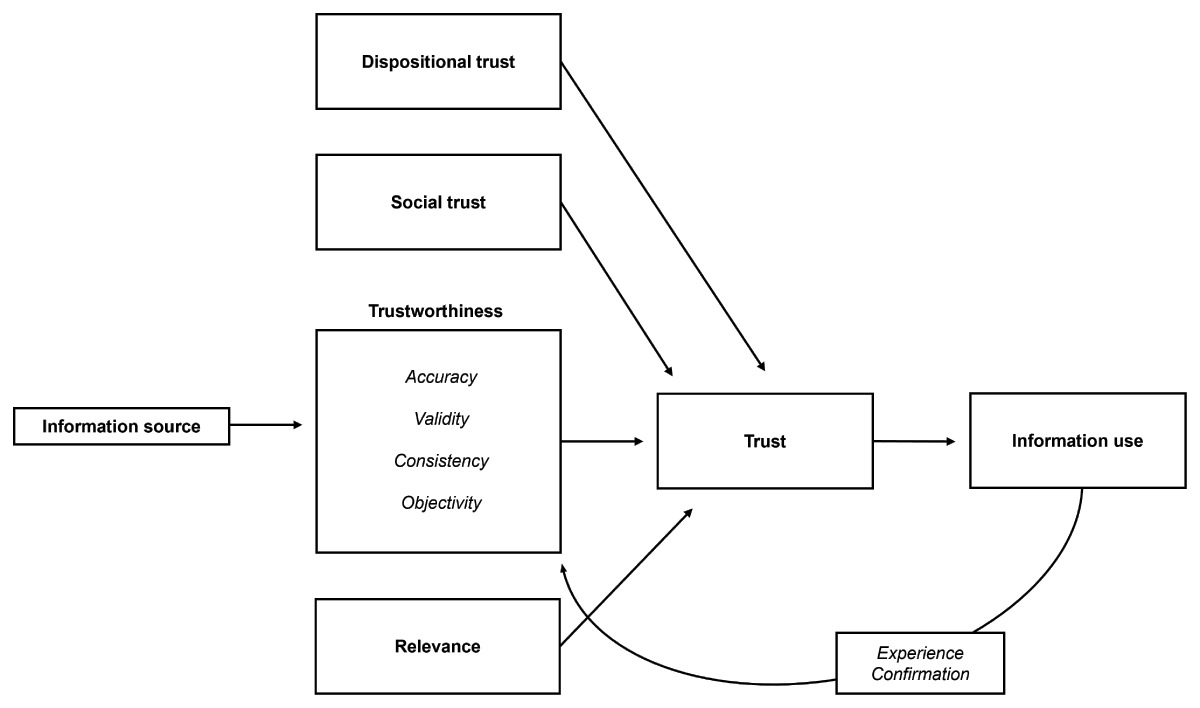
Figure 1
Conceptual model for trust in information adapted from Kelton et al. (2008) where dispositional trust, social trust, trustworthiness, and relevance are antecedents to trust and information use.
Systems approach to understanding trust in community science
To date, work to understand perceived trust in community science has been largely limited to the perspective of the volunteer. However, volunteers may not be in a position or empowered to play a role in relying on the data to support research or policy—particularly for contributory projects, where those roles may fall to professional scientists or government officials. These individuals have a different relationship to the data and different information needs. It stands to reason that these professionals’ perspectives on community science data may be influenced by unique factors.
Beyond the need to understand trust from multiple perspectives, we expect an interconnectedness between volunteers and professionals, in that their interactions and perspectives likely influence one another. This systems approach to research, examining component parts and their connections, aids in identifying the emergent properties of a system and can provide a holistic understanding of a system (Arnold and Wade 2015). Trust is particularly well suited to a systems approach, with many stakeholders and interdependencies within the Ecosystem of Trust in science (Gurzawska, Yalaz, and Barrios 2026). We expect that examining the broader system related to trust in community science data will generate findings that would not emerge from studying only one perspective and may result in more actionable insights to improve both the design and evaluation of such programs.
The current study
In this study, we take a systems approach to exploring trust in wildlife monitoring data generated from community science. Specifically, our objectives are to understand 1) volunteers and professionals’ level of trust in community science data, 2) the primary factors influencing trust, including perceptions of trustworthiness (i.e., data quality), and 3) how these actors influence each other’s perspectives.
To address these questions, we leverage Snapshot Wisconsin (Snapshot, hereafter), a community science project managed by the Wisconsin Department of Natural Resources (DNR) in Wisconsin, USA. Snapshot is a wildlife monitoring program, launched in 2016, that leverages a statewide network of nearly 2,000 trail cameras hosted by community volunteers. Project volunteers, including educators, deploy and maintain trail cameras that take photos of wildlife as they pass by. Volunteers upload photos and assist in identification of the species photographed. Snapshot employs robust quality control measures (e.g., photo encryption, proprietary decryption software, combined crowdsourcing, and expert classification processes) that have been evaluated elsewhere (e.g., Clare et al. 2019). Snapshot data have been used to inform numerous ecological research studies including those on wildlife behavior (e.g., Clare et al. 2023) and population indices (e.g., Butkiewicz et al. 2025). Photos with species identified are also analyzed to generate spatial and temporal trends of wildlife populations that are managed by Wisconsin DNR.
Methods
We employed an explanatory sequential design (Ivankova, Creswell, and Stick 2006) in which we first conducted quantitative evaluation of Snapshot volunteers’ perceptions of (1) trustworthiness of Snapshot data and (2) trust in the data for applications to management decisions via a survey of all trail camera volunteers. Following evaluation of these data, we conducted qualitative semi-structured interviews with a subset of volunteers. To explore perspectives of multiple actors within this system, we also interviewed a full census of agency professionals who use Snapshot data in decision-making.
Survey
We surveyed all Snapshot volunteers who joined the project between February 2020 and June 2025. An online questionnaire was delivered to 1,174 volunteers after they were accepted into the program and completed the required online training. During the study period, we also delivered an online questionnaire to 1,276 volunteers who had reached their one-year anniversary in the project. A total of 486 individuals received both an initial and follow-up questionnaire during the study period. For both surveys, non-respondents received one reminder email seven days following the initial contact. On both the initial and follow-up survey, trustworthiness was evaluated using five items, and trust was evaluated using three items, all on a 7-point Likert-type scale. The items were designed to provide a parsimonious, unidimensional measure of these constructs as articulated in Kelton et al (2008). For full survey items, see Supplemental file 1: Appendix A.
Interviews
To better understand factors influencing trust, we conducted semi-structured interviews with Snapshot volunteers in November and December 2025. Because the purpose of the interviews was to provide depth of information around the quantitative results, we attempted to interview individuals for whom the topic of trust in Snapshot data use was particularly relevant. In this case, because Snapshot data are primarily used in making decisions related to recreational harvest, we invited individuals who had self-identified as hunters in the program application. We contacted nine individuals and six agreed to participate. Interviews were conducted via phone and lasted between 15 and 60 minutes.
We also conducted semi-structured interviews with a full census of the eight professionals who use Snapshot data in decision-making. Professionals included species specialists and scientists employed by the Wisconsin DNR who participate in Species Advisory Committees. Species Advisory Committees are made up of interest groups, stakeholders, and agency staff who make annual decisions related to managed species, including recommendations for harvest quotas or season lengths. Species specialists chair these committees and guide group decision-making, while scientists generate and communicate relevant scientific information for the committees but do not participate in making management recommendations.
Four species specialists and four scientists from all four Advisory Committees that use Snapshot data for annual decision-making were contacted with a request for an interview. All eight professionals accepted the request and took part in a 30-to-60-minute interview between November and December 2025. Seven interviews were conducted via video call and one interview was conducted in person.
Audio recordings of all interviews were transcribed to text for analysis. For a full list of interview questions, see Supplemental file 1: Appendix B (volunteers) and Appendix C (professionals).
Analysis
To assess quantitative data from volunteer surveys, we calculated a composite score for perceived trustworthiness and trust from the initial and follow-up survey. The composite was calculated by summing the score from each individual item and dividing it by the total number of items. We used listwise deletion to deal with missing data and assessed internal reliability using Cronbach’s alpha (Cronbach 1951). Finally, we made comparisons between composite scores of trustworthiness and trust pre- and post-participation using a paired t-test. All quantitative analyses were conducted in R (4.3.3).
To assess qualitative data from interviews, we employed a combined inductive and deductive thematic analysis approach (Ahmed et al. 2025). Initial evaluation of volunteer interviews was conducted by CA and professional interviews by KS. We noted initial impressions of salient topics which served as initial inductive thematic codes. After recording initial themes separately, we came together to discuss and revise themes based on areas of overlap and difference between the two interview types. Finally, we employed a deductive approach by connecting the inductively derived themes to the conceptual model of trust in information from Kelton et al. (2008).
Results
In total, 467 individuals returned the initial questionnaire (40% response rate), and 763 returned the follow-up questionnaire (response rate 60%). A total of 160 volunteers returned both the initial and follow-up questionnaire during the study period. Respondents were on average 52 years old (SD = 14.4), and majority male (66%). Most respondents (62%) had a four-year college or graduate degree, lived in rural areas (54%) outside towns or cities, and identified as hunters (64%).
Survey
For the single items making up the trustworthiness scale on the initial survey, respondents (n = 399) anticipated that Snapshot would provide a consistent (89% somewhat, mostly, or entirely agree) and accurate (84% agree) way to monitor wildlife (Supplemental file 1: Appendix D). Similarly, a majority of respondents agreed with having a clear understanding of Snapshot data (79%) and a sense that data were shared openly (70%). Respondents expressed some doubt that Snapshot would provide a complete picture of wildlife in the area (26% somewhat, mostly, or entirely disagree). The composite scores for initial trustworthiness ranged from 1.8 to 7 (M = 5.38, SD = 0.91) and had high Cronbach’s Alpha (0.79) indicating good internal reliability.
For items making up the trust measure, respondents to the initial survey (n = 403) largely agreed with statements about confidence in (81%), trust in (75%), and willingness to rely (74%) on data generated by Snapshot for use in wildlife management decisions (Supplemental file 1: Appendix E). The composite scores for initial trust ranged from 1.67 to 7 (M = 5.39, SD = 1.03) and were also reliable with a Cronbach’s Alpha of 0.91.
Volunteers’ perceived trustworthiness scores were significantly higher (t (152) = 3.78, p < 0.001) after participation (M = 5.69, SD = 0.95) compared with their perceptions at the start (M = 5.38, SD = 0.91). However, volunteers’ perceived trust was no different (t (159) = -0.04, p = 0.97) after participation (M = 5.39, SD = 1.23) compared with their perceptions at the start (M = 5.39, SD = 1.03).
Volunteer interviews
Trustworthiness
Interviews with volunteers revealed additional detail around the perceived quality, or trustworthiness, of Snapshot data (Figure 2). Interviewees spoke to how various elements of the technology, methodology, and program design contributed to their perceptions of accuracy, validity, consistency, and objectivity of the data.
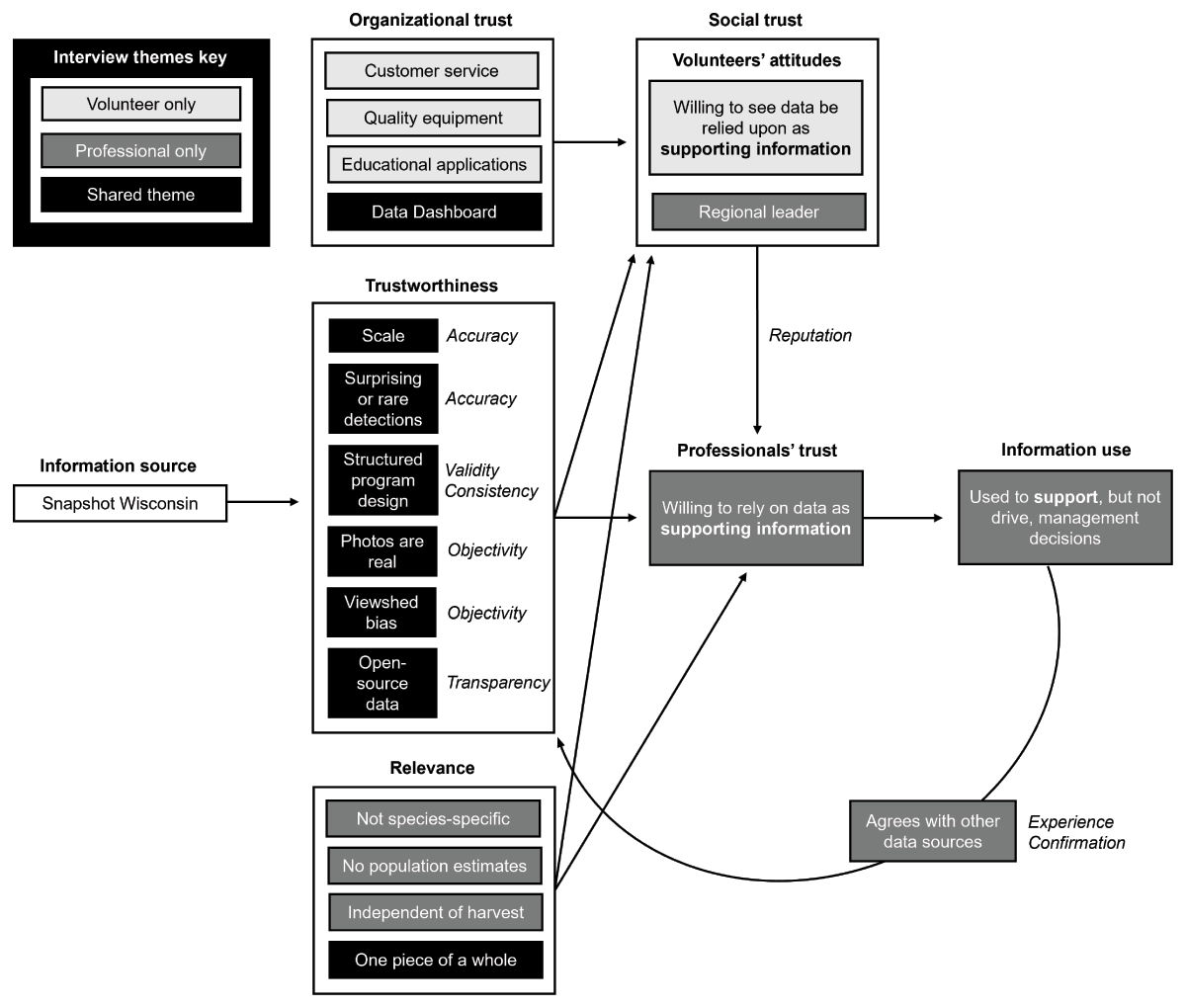
Figure 2
Conceptual model of system-level trust in Snapshot Wisconsin data from volunteers and professionals. Inductively derived interview themes (e.g., “scale”) are represented in boxes, while deductively derived connections to the theoretical model presented in Figure 1 (e.g., “accuracy”) are represented as bold or italicized text.
The scale of the program was universally mentioned by interviewees as having a positive impact on their perceptions of data quality. Specifically, volunteers spoke to the widespread distribution of cameras and overall volume of data as leading to greater accuracy. One volunteer explained, “There’s such a volume of photos that inconsistency get[s] diluted.”
Particular species captured in photos bolstered interviewee perceptions of data accuracy further. Interviewees described seeing wildlife they had not anticipated seeing and did not realize were living in the area. These unexpected or surprising findings seemed to contribute positively toward perceptions of data quality. One interviewee described observations from their own property:
“I wouldn’t [have] realized that every month just about – bobcats are walking by. Just about every month, wolves and coyotes are walking by. I don’t know that I would’ve realized that if we did not have the Snapshot camera in the backwoods…. It made me more confident because… it’s hard to know what’s out in the woods if you don’t have cameras to see it.”
Multiple volunteers described how the specific camera technology and standardized methodology contributed to positive perceptions of the data. Trail cameras used in Snapshot are pre-set to standard settings, and volunteers can change only the date and time. One interviewee spoke to how standardized settings led to consistency in implementation across the entire project.
“That everyone is set up the same way, and they can’t alter that it is a big deal…. They’ve done a great job at… setting up all of the equipment so that it can’t really be tampered with to change those settings.”
Most volunteers interviewed saw the photos themselves as concrete, reliable sources of evidence. The photos were described as “real” and objective. In several cases, volunteers drew a contrast between photo data and anecdotal evidence. One described:
“I think that you hear so much anecdotal information… and when you have a camera and you’ve got a picture of it, nobody can argue. That’s… part of the reason why I’m so excited about [the project].”
While cameras objectively see the landscape and capture tangible information, interviewed volunteers consistently recognized potential bias related to camera placement. Within the Snapshot program, each volunteer has flexibility to place a camera anywhere within their assigned survey block. Volunteers note that an individual camera may not provide a complete picture of the species in a particular region.
“If you’re someone that has your camera set up specifically more towards something. Let’s say, a beaver slide that’s into a creek, you just have a much lower chance of getting deer there… than somewhere else. That could lead to some inconsistent data… but overall that could be washed out by if you have [a] significant number [of cameras]”
Discussion of the project’s online data visualization tool, the Data Dashboard, revealed that volunteers’ saw the product as providing access and contextualization, building confidence in the wider Snapshot dataset. One interviewee stated that after viewing the Dashboard, they realized that “we’re really gathering things and being able to piece things together that I wouldn’t have imagined from just the photos.” They went on further to say:
“The Dashboard reminds me that I’m… part of a larger program…. When I look at… the Dashboard, and I see bear or beaver activity… I’ve never had any of those on my camera, but other people have.”
Organizational trust
Interviews revealed that volunteers’ trust in Snapshot as an organization shaped their attitudes toward data use. Without prompting, most volunteers made a point to mention their positive experience or satisfaction with the program operations and management. This included quick customer service, quality equipment, improvements to program technology, and communication and outreach efforts. Interviewees also spoke positively about the use of Snapshot by educators.
“In the beginning, I was kind of not sure where all this was going. As I move forward and see just some of the things on your website that the data is being used for… even Snapshot in classrooms. I mean, that’s brilliant. To get kids excited about the outdoors.”
Attitudes toward data use
Volunteers had not spent much time considering the uses of the data or the consequences of data quality downstream from their own involvement. Multiple interviewees referred to the limits of their role within the project and a willingness to rely on others to carry the analysis and application of data forward. One volunteer noted, “I didn’t think about it because I trust that I did my part right… and hopefully I did it well enough that now the people that need to use it can use it.”
When pressed directly, volunteers expressed a moderate willingness to see the data be relied upon for wildlife management decision-making. They described Snapshot data as “another tool in the tool belt” and as “rounding out the picture” when it comes to an understanding of wildlife populations. Volunteers were willing to see Snapshot data be used to support other methods for wildlife monitoring, but, as one stated, “Having it as the sole source for decision-making, maybe not.”
Professional interviews
Trustworthiness
While offering valuable insight into perceptions of data quality and levels of trust, volunteers do not directly use Snapshot data to make wildlife management decisions, as instead this role falls to agency professionals. Interestingly, interviews with these professionals revealed substantial overlap with the perspectives of volunteers regarding which elements of the program influenced perceptions of data trustworthiness. Like volunteers, professionals universally acknowledged the spatial and temporal scale of Snapshot as contributing positively to perceptions of data accuracy. As described by one professional, “The power in Snapshot is that we now have a statewide grid of cameras, and we’re not confined to one particular management zone or management area unit.”
Several professionals also said that instances of rare or cryptic species detections contributed to perceptions of data accuracy, similar to volunteer comments about surprising wildlife detections. One professional described:
“I believe we have high detection probability through Snapshot and through public reports outside of Snapshot, when one of these rare species comes through, sooner or later, we know about it. And Snapshot is a big part of that.”
When prompted, professionals shared some concerns regarding the quality of community-generated data in general, describing hesitations related to lack of quality control measures and expert oversight. However, these concerns were described as being alleviated in the case of Snapshot due to the robust photo identification process, dedicated staff to train and coordinate with volunteers, and published evaluations of data quality.
“The system that they have for taking on the data, and cleaning the data, and archiving the data, that’s pretty dialed in, so that’s a nice strength that our program’s able to take that massive volume of photos and convert that to data.”
The tangible or objective nature of photo data was viewed by professionals as contributing to high public trust, particularly in contrast to less straightforward information such as estimates derived from statistical modeling. This property of high public confidence was described by professionals as adding to their credibility when engaging with the public.
“To probably quote someone on our committee, the proof is in the pudding, right?… I think it’s easily comprehended by people, that it’s a photo. It’s there. This is the proof. Easy to understand.”
Similar to volunteers, professionals described that individual camera placement could bias the data. As explained by one professional who is also a Snapshot camera host, “If I point [the camera] at a river, probably not going to get a bear. And I’m probably not going to get a whooping crane on mine, because I’m in the woods.”
The Data Dashboard and open-source nature of the data were also cited by professionals as contributing to perceptions of transparency.
“This is where the public struggles. Too often, in terms of science and biology, do we go the Wizard of Oz route and, ‘just ignore the man behind the curtains, just trust us, It’s good.’ And so, I think that’s also the nice thing about Snapshot, is that it’s open-source, it’s data that anybody can look at and typically understand.”
Several professionals described that the iterative process of using Snapshot data and seeing it line up with trends in existing data served as a source of confirmation that Snapshot is producing high-quality data, feeding back into perceived trustworthiness.
“Snapshot matches up pretty close with [the staff-based survey]. Okay, now you have two sources of data that are relatively close, and if they’re in the same direction at least, or if they’re saying the same thing, okay, well, what’s the expertise you have that’s going to refute that?”
Social trust, public attitudes, and reputation
Professionals discussed public attitudes as being important to consider in decision-making, and the public’s perceptions of Snapshot contributed to their willingness to use Snapshot data. As stated by one interviewee, “I think being able to incorporate Snapshot into management decisions is going to be a big deal for the general public.”
The publicly available Snapshot products were described as helping to build a positive organizational reputation. One professional also described that having Wisconsin-specific data through Snapshot contributed positively to public trust, which benefits professionals by allowing them to build credibility with the public:
“People just trust it, if it’s the project in Wisconsin…. It gives us a lot of credibility and helps us build rapport with the public that way.”
A unique theme within professional interviews was that Snapshot was viewed as a source of pride and as a leader in wildlife camera trap monitoring. One interviewee noted, “This is the most advanced, impressive camera trapping array in the world, to my knowledge, and that’s amazing.” Others described interactions with colleagues who were interested in developing similar monitoring networks, and they were excited to share the opportunities afforded by Snapshot:
“I think it’s great whenever I hear from colleagues from other parts of the country who are really interested in the work and are thinking about if they can apply that to their own state or region…. I think Snapshot should be proud of that.”
Relevance
Professionals described that the relevance of Snapshot data affected their willingness to rely on it for decisions. Notably, Snapshot takes a generalist approach and is not designed to capture images of specific species. This multi-species approach captures a broad picture of Wisconsin wildlife, yet management decisions must be tailored to specific species. This mismatch in program design and management requirements was noted by all professionals and exemplified by one interviewee:
“The biggest [weakness] as far as my position as the [species] technical advisor is that there’s that trade-off of general versus specialized. And Snapshot is more generalized…. There are just limitations where, if Snapshot was developed specifically for [species], we would be able to use it and produce more products than we can currently…. But it’s funny, though, because to me, in my role, that’s limitation. But again, you expand out, when you think about for science, that’s really its strength, too, right?”
Due in part to the generalist design, much of the data provided by Snapshot to advisory committees is based on spatial and temporal trends. Several professionals noted that, while this trend data is valuable, challenges in producing concrete population estimates limits practical application to management decisions. As explained by one interviewee, “Without actual good hard numbers, it’s tough to use the data.” Another professional suggested that this desire for population estimates is a cultural expectation relevant to Wisconsin specifically:
“I feel like trend information is probably sufficient, but the demand and the expectation from our committees is to have a number. They’re not satisfied, at least for the committees I work with, on trend data…. It’s just that it’s that cultural expectation that can make it a tough match.”
One aspect of Snapshot data that contributed positively to decision-making relevance was the opportunity to consider a data source that is independent of harvest, because harvest data are inherently biased by hunter selectivity. Professionals also noted different stakeholders hold different values related to harvest, as described by one interviewee:
“There’s different values coming from our stakeholders on the committee and from the general public. And so, [Snapshot data] is independent of harvest… that population metric meets or matches some of the values of the stakeholders that we attend, where we definitely have some stakeholders that don’t believe that trapping or hunting should exist on the landscape. So, showcasing that we acknowledge that and we’re utilizing both harvest and non-harvest data, can kind of give that insight and that comfortability to them, too.”
Trust
Overall, professionals were willing to rely on Snapshot data as a supporting resource among multiple data sources, but did not appear willing to rely on it primarily. Mirroring perspectives from volunteers, Snapshot data were largely described by professionals as a valued “double check.” Using similar language to volunteers, professionals described Snapshot data as “another piece of the puzzle” and one part of the “full picture.”
“It is just a snapshot. And so, that’s ultimately the important thing, is that we don’t put too much emphasis on it. I think that it’s never going to be the end all be all, but if it can be a piece that is added to another piece that’s added to another piece to ultimately paint a picture, that’s great.”
Discussion
We built on an existing framework to understand trust in the use of data generated by a community science program. In doing so, we revealed the roles of organizational trust, trustworthiness, relevance, and the interconnectedness of volunteer and professional perspectives toward trust in applications to science and policy.
Organizational trust conveys trust in data stewardship
Interviews revealed that volunteers’ trust in the Snapshot organization directly influenced their willingness to see the data be relied upon to support decision-making. Interestingly, when prompted for their attitudes toward the data, volunteers cited several program operations factors seemingly unrelated to data quality or use (e.g., customer service, quality of equipment provided, educational applications), highlighting how their overall experience with the organization was perhaps the most salient factor when considering their attitudes toward data application. This compliments other work which has found that, from the volunteer perspective, trust in community science data is driven largely by interpersonal or organizational trust (Thornton and Leahy 2012).
The reliance on organizational trust may be explained in part by the contributory model of Snapshot, where volunteers actively participate in generating data, yet volunteers themselves are not ultimately data users in the context of management decisions. One precondition of trust in information is that the trustor is free to accept or discard the information when making a decision (Kelton, Fleischmann, and Wallace 2008). This may help to explain why trust in the data did not shift over time in volunteer surveys, despite positive shifts in perceived trustworthiness.
Perhaps related to their high trust in the Snapshot organization and low levels of control in information use, volunteers had not spent much time considering data applications beyond their own involvement. When personal control is lacking, individuals must instead rely upon trust in an individual or institution to use the data on their behalf (Currall and Epstein 2003; ter Huurne and Gutteling 2009). Relatedly, higher levels of social or institutional trust are important predictive factors in determining lower perception of risk, greater perception of benefits (Siegrist, Cvetkovich, and Roth 2000), and higher levels of perceived information sufficiency (ter Huurne and Gutteling 2009). Trust in the Snapshot program to steward the data appropriately may have reduced any perceived risks where volunteers were not involved, increasing their comfort with focusing only on “doing their part well.”
Public perceptions influence professionals’ willingness to use the data
Professionals described a perception that members of the public hold the Snapshot program in high regard (a perception validated by attitudes of volunteers), which influenced their willingness to integrate Snapshot data in decision-making. This finding agrees with previous work that has asserted both social and technical components of science as being necessary to build credibility (Freitag, Meyer, and Whiteman 2016). Here, professionals’ consideration of social trust is also reflective of the political and cultural influences of being government officials, as natural resource agencies in the USA have a duty to uphold public trust (Decker et al. 2014). Furthermore, professionals also reflected on their pride in the Snapshot program as a regional and national leader in the field. These perceptions of external public and professional trust in Snapshot contributed positively toward professionals’ willingness to use the data in decision-making.
Volunteers and professionals are aligned on what constitutes trustworthiness
Themes related to trustworthiness or data quality aligned closely with existing theory on trust in information (Kelton, Fleischmann, and Wallace 2008). For example, the use of photos as data positively influenced perceptions of trustworthiness because it increased a sense that the data were free from bias (i.e., objective; (Kelton, Fleischmann and Wallace 2008). Yet, knowledge that cameras could be placed at the discretion of the volunteer decreased perceptions of trustworthiness, as concerns were raised regarding lack of objectivity in the image viewshed due to potential bias of the volunteer—a data quality concern often raised for community science projects (Gouveia et al. 2004; Nature 2015). Professionals also articulated how experience using the data and confirmation that it aligned with existing data sources fed back into their perceptions of high data quality, highlighting the importance of iteration in building trustworthiness over time. Repeated experience with information increases perceptions of trustworthiness (Kelton, Fleischmann, and Wallace 2008), which is also reflected in follow-up surveys from volunteers, which showed positive shifts in perceptions of trustworthiness. Notably, the same themes related to trustworthiness were raised by both volunteers and professionals, indicating that the same factors appear to be salient regardless of how people are engaging with the data.
One theme related to trustworthiness that was not reflected in the original Kelton et al. (2008) model, yet was highlighted in interviews by both volunteers and professionals, was the contribution of perceived transparency towards trustworthiness. Transparency here is related to the perception of honesty, ethics, and integrity, which are required for trust in scientists (Intemann 2023). The original integrated model of trust proposed by Kelton et al. (2008) incorporates ethics under the construct of validity, which considers issues such as the appropriateness of methods. While validity was discussed by interviewees (e.g., belief that the methods were sound and produced verifiable data), transparency was a distinct theme more closely related to honesty. To trust a scientific expert or institution, the public must believe that the institution is disposed to tell the truth (Goldenberg 2023). The addition of transparency here may also be related to the nature of the information as coming from a public agency, where transparency is expected as one of the precepts of good governance (Decker et al. 2014).
Data must be both trustworthy and relevant to be trusted
The applicability of Snapshot data toward the decisions being made was described by interviewees as being an important influence on perceptions of trust. While the methodology and program design were viewed as being appropriate for generating program data (i.e., valid), key mismatches in relevance (e.g., not species-specific) reduced professionals’ willingness to rely on it when making decisions. Indeed, despite positive influences from other trust antecedents (trustworthiness, social trust, and organizational trust), neither professionals nor volunteers appeared willing to rely on Snapshot as a primary data source to drive decision-making. This seems to suggest that hesitation to rely on Snapshot data stems primarily from limitations in relevance. Previous work has also noted the importance of relevance in acceptance of scientific information; whereas accuracy is required, it is not sufficient, as relevance is required to make predictions about future states and take appropriate actions (Intemann 2023). There is increasing recognition that relevance is a critical area for facilitating policy applications of community science data (Turbé et al. 2019). In response to this need, some researchers have begun to develop tools to evaluate the relevance of participatory science data to demonstrate its value to scientists (Fischer, Gerber, and Wentz 2021).
Volunteers and professionals alike described Snapshot data as “one piece of the puzzle” or “one tool in the toolbelt,” pointing toward the complexity of the decisions being made and the need to synthesize multiple data sources to arrive at those decisions. In the North American Model of Wildlife Conservation followed in the USA, management decisions must be responsive to multiple, sometimes conflicting values (e.g., related to recreation, conservation, or disease management; Kisonak et al. 2023). Consequently, multiple types of information must be integrated into decision-making to reflect multiple priorities, reducing professionals’ willingness to rely solely on any one data source.
Limitations and additional considerations
We built on an existing framework of trust in information (Kelton, Fleischmann, and Wallace 2008), adding context specific to the participatory sciences by including the influence of organizational trust on volunteer attitudes, the relationships between different actors (e.g., volunteer and public attitudes influencing professional trust), and transparency as an aspect of data quality. Using an explanatory sequential (quantitative-first) design, our conceptual model was developed from qualitative interviews to provide depth and context surrounding our quantitative assessments of trust and trustworthiness. Therefore, we caution that our quantitative measures, designed according to the existing Kelton et al. (2008) model, would require adaptation and further validation for use elsewhere.
There are likely more antecedents to information use that we did not measure and are not reflected in our conceptual model. For example, our model centers primarily around professional trust as the driver of information use, yet other stakeholders on advisory committees are involved in making recommendations. Priorities of other committee members, as well as their knowledge of and attitudes towards Snapshot data, are likely playing a role in data use and decision-making which are not reflected here. Additionally, we did not capture the role of dispositional trust, or an individuals’ personality-level propensity to trust (Kelton, Fleischmann, and Wallace 2008), for surveyed or interviewed participants. Understanding additional social, political, and dispositional factors that are acting alongside trust to influence data use will be important avenues for future work to build on this conceptual model of trust in community science data for policy applications.
It is important that our findings and conceptual model of trust be interpreted in the context of Snapshot Wisconsin: a large-scale, USA state government–run, long-standing, contributory project. It engages many volunteers who are hunters, a demographic unique within community science, and results from the project are actively used by the state in wildlife management. As such, these findings may not be generalizable to programs with different designs, sizes, and goals. For example, community-led projects may find very different models of system-level trust, particularly in cases where community members are involved in research and policy decisions. Nonetheless, we believe participatory science programs of all kinds can draw value from this system-level evaluation and approach to understanding trust.
Conclusions
Trust and its antecedents directly influence use of community-generated data in science and policy, a sought-after impact of participatory research. Trust can also be an important impact in and of itself, as trust is a component of social capital, helping to build strong communities (Bhandari and Yasunobu 2009). Therefore, trust is a valuable element to include in impact assessment of community science. The conceptual model of trust presented here can be used to support other participatory science programs seeking to understand who trusts their data, for what purpose, why they trust it, and how that trust influences data applications. It can also help to pinpoint specific areas of strength and weakness; for example, a program encountering resistance to data use might use this framework to evaluate where precisely trust is breaking down, while a trusted program could use this framework to identify and lean into areas where they are especially successful. Overall, this model provides a theoretically and empirically supported framework for trust evaluation which is specific to the interconnected systems in which participatory sciences are embedded.
Supplementary File
The supplementary file for this article can be found as follows:
Supplemental File 1
Supplementary methodological information and results. DOI: https://doi.org/10.5334/cstp.995.s1
Data Accessibility Statement
The data used in this study are not publicly available to protect participant confidentiality. Anonymized data may be shared at reasonable request by contacting the authors directly.
Ethics and Consent
We followed all protocols outlined in the Wisconsin Department of Natural Resources’ Surveys Clearinghouse Manual Code (MC1511.1) and Scientific Integrity Handbook. The Surveys Clearinghouse serves as a review board for quantitative and qualitative social science performed by or funded by the DNR. The Clearinghouse reviewed the research and determined that no oversight was required and was informed that the data are being submitted to a peer-reviewed journal that produces generalizable knowledge. Participation in the study was voluntary, and informed consent was verbally obtained for all participants prior to the collection of any data, including permission for inclusion of direct quotes.
Acknowledgements
We are grateful for the time and insights offered by the study participants including Snapshot Wisconsin volunteers and Wisconsin Department of Natural Resources professionals. Thank you to Jennifer Stenglein, David MacFarland, Stephen Parkinson, and three anonymous reviewers for your valuable feedback and suggestions. Snapshot Wisconsin is made possible by thousands of volunteers.
Author Contributions
CA and KS contributed equally to conception, design, data collection, analysis, and writing.