
Publisher’s Note: A correction article relating to this paper has been published and can be found at https://theoryandpractice.citizenscienceassociation.org/articles/10.5334/cstp.1114.
Background and Public Health Context
Mosquito-borne diseases, including malaria and viruses such as dengue, Zika, chikungunya, and West Nile, are a significant and growing threat worldwide, due especially to climate change and geographic shifts of vector populations; they cause more than 700,000 deaths each year (Ryan et al. 2019; Franklinos et al. 2019). The Missouri Department of Health and Senior Services (MDHSS) notes that surveillance of mosquito species that carry Zika is an agency priority (MDHSS 2023). Low-income neighborhoods have heightened risk of vector-borne disease, with higher densities of mosquito populations leading to greater possible exposure to disease-carrying mosquitoes in these communities (LaDeau et al. 2013).
Critical responsibilities of public health agencies are to monitor mosquito populations, reduce the risk of disease transmission, and prevent the spread of potential human illness (Campbell-Lendrum et al. 2015; MDHSS 2023). Traditional vector surveillance relies on dedicated personnel and sufficient funding, and as of 2019, only eight states had more than 75% of counties with reported vector control districts, while most states reported less than 25% (Association of State and Territorial Health Officials 2019). Consistent with this report, some local health departments in Missouri have active programs for mosquito surveillance and control, while others have more limited resources. This represents a significant area for investment as routine mosquito control is far less costly than outbreak response. Reports on county vector control activity show that capacity for nearly all mosquito surveillance and control-related components had decreased from 2020 to 2023 (Roy et al. 2024). Citizen science can support disease surveillance by public health agencies, as traditional mosquito surveillance methods are financially and logistically demanding (Braz Sousa et al. 2022). Some of the most successful citizen science programs involve the monitoring of insects and wildlife (Braz Sousa et al. 2022). A Canadian study, for example, established evidence of effectiveness of public participation in mosquito surveillance, showing that citizen scientists provided mosquito samples from remote and rural areas effectively and at low cost, adding to understanding of spatial distribution of both invasive and native species (Hollett et al. 2025).
One platform is the Global Learning and Observations to Benefit the Environment (GLOBE) initiative. Launched in 1995, it allows users to submit breeding sites and larvae for identification, prior to screening from subject matter experts (Carney et al. 2022). Similarly, the iNaturalist project has garnered more than 3 million unique contributions since its inception in 2008, with much of this data finding reproducibility in many fields, as well as use in the tracking of invasive species movements (Carney et al 2022). In short, citizen science has the potential to expand surveillance reach by leveraging the operational capacity of the public, particularly in areas with limited governmental resources.
Our study assesses Mosquito Alert, a participatory surveillance mobile phone application developed in Barcelona, Spain at the Universitat Pompeu Fabra in 2016. Initially designed to address the possible spread of Zika virus, focusing on Aedes albopictus, Ae. aegypti, Ae. japonicus, Ae. koreicus, and Culex species (Carney et al. 2022). The app allows citizen scientists to report photos of mosquitoes, bites, and breeding sites, which are reviewed by entomologists and public health officials (Virgillito et al. 2024).
Mosquito Alert has been shown to contribute to vector-borne disease surveillance by public health agencies in Spain (Palmer et al. 2017). It has received more than 82,000 reports from nearly 33,000 citizen scientists across 168 countries as of 2022, and has been utilized as a tool for mosquito-vector surveillance (Carney et al. 2022). In Italy, low-cost dissemination strategies (e.g., press releases) led to high recruitment and download of the app, but with limited engagement and rapid fall-off of app use (Virgillito et al. 2024).
A study of the demographics and motivations of citizen science participants compared users of the Mosquito Alert app with a project that used physical trapping of mosquitoes. Results showed that users of the app were more likely to be female, younger, with lower levels of education, and more focused on disease prevention than ecology and biodiversity compared with analog participants. App participants were more motivated by antipathy to mosquitoes and concern about environmental decline and public health, and they emphasized mosquito control rather than biodiversity. Authors noted that ease of use and low cost of the app led to greater potential for a more diverse user base, including greater likelihood of less privileged groups participating as citizen scientists, more representative reports of mosquitoes, and enhanced data quality for surveillance purposes (Dekramanjian et al. 2023).
Our study extends this research by assessing outreach efforts and participation in a setting in the United States. We explore new evidence about partnership strategies to amplify outreach of citizen science projects through allied community organizations.
The Mosquito Alert St. Louis Initiative
Mosquito Alert STL (MASTL) is a collaboration of the St. Louis County Department of Public Health (DPH), the City of St. Louis Department of Health (DOH), the Saint Louis University College for Public Health and Social Justice (CPHSJ), and the Missouri Botanical Garden (MBG). MASTL seeks to bolster the capacity of health department staff and amplify success of agency efforts by inviting the participation of community residents. We seek to leverage community action in vector control using the Mosquito Alert app and promote public participation in research. Outreach education from MASTL seeks to enhance knowledge about mosquito vectors, preventing mosquito bites, and promoting ecologically sound strategies to prevent mosquito reproduction.
Since 2021, MASTL has developed and implemented a communication strategy to promote adoption and use of the app and engage St. Louis residents in a citizen science network to support local health department efforts. Public engagement and outreach has sought to expand agency capacity, educate residents and social networks about mosquito control and biodiversity initiatives, and empower them to protect neighborhoods through ecologically-informed action. The MASTL initiative serves as the first effort to promote adoption and use of the app in the US.
Dissemination and outreach of MASTL began with engagement through coalition building among community organizations and participation at community events for neighborhood residents. Media outreach centered on a project website, hosted by the MBG website; social media platforms; and email distribution via community partners, supplemented with earned media through press releases to local news outlets.
Based on the universal interest in mosquitoes we encountered at outreach events, we developed communication strategies to engage with our audience. A combination of message prioritization and print material gave the MASTL team consistent opportunities to educate adults and youth about basic mosquito biology and options to protect oneself and community from mosquito bites and reproduction, while at the same time promoting use of the app.
Figure 1 displays the project logic model for MASTL (WK Kellogg Foundation 2004). MASTL inputs include project partners and resources noted above. Activities include the partnership and outreach strategies discussed previously, and planned outputs, including engagement with community members. The logic model posits that engagement by community members and organizations with these inputs, activities, and outputs will contribute to priority program outcomes. Short-term outcomes include perceptions and beliefs about the app, ecologically sound insect control, and citizen science. Intermediate outcomes include adoption and use of the app and organizational and community capacity for its sustained promotion. Long-term outcomes include community adoption of ecologically sound vector control practices and consequent reduction in mosquito populations and disease morbidity.
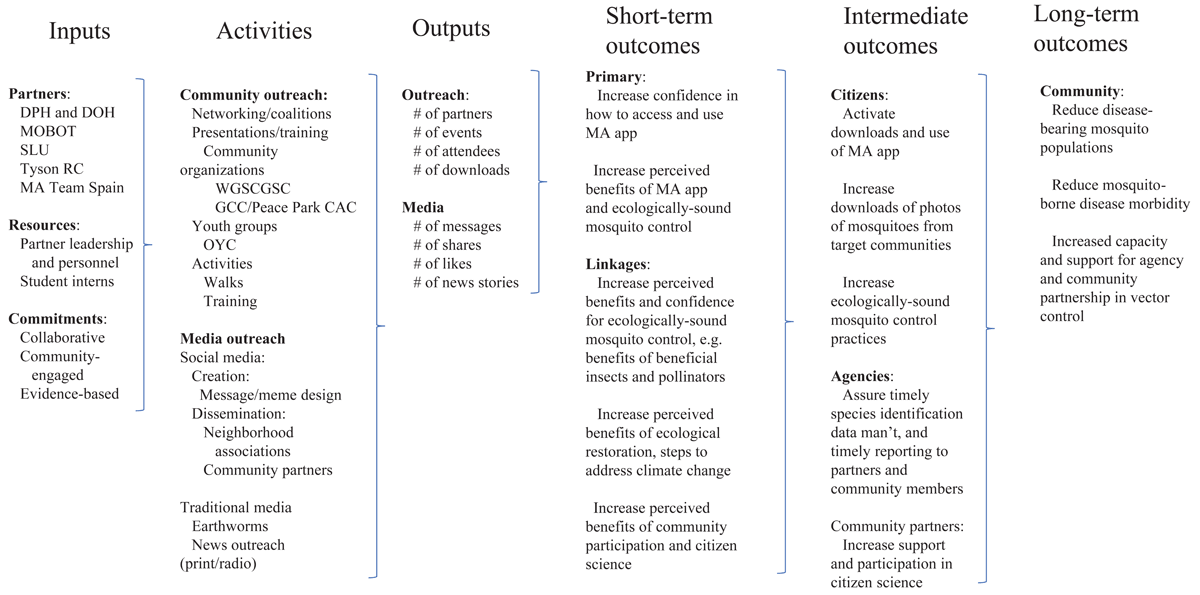
Figure 1
Mosquito Alert STL Communication Plan Logic Model.
The logic model informs our evaluation study design via process and impact assessment to establish preliminary evidence of program implementation and effects.
Herein, we report on our evaluation of the implementation of MASTL. Specifically, we examined (1) the processes and effects of the MASTL project and (2) factors related to adoption and implementation of the project by community partners.
Methods
This study applied an exploratory mixed methods approach, including surveys of residents and in-depth interviews with community partners. For the first aim, we conducted online surveys with residents who had engaged with the project through attendance at community outreach events and webinars or via community partners. We conducted in-depth interviews with community partners to address the second aim. The protocol for the study was approved by the Saint Louis University Institutional Review Board (#32900).
Quantitative survey
Following the logic model, we assessed whether engagement with our project contributed to perceptions and beliefs leading to use of the app and ecologically sound mosquito control practices, consistent with psychosocial theories of behavior. To examine effects of engagement with the project among members of the public, we conducted an anonymous survey on Qualtrics. Invitations were sent to individuals who provided their information on our signup sheet at community events, via emails shared with community partners and forwarded to members, and via notifications sent from the app. We also administered the survey, adapted to match specific content, as pre- and post-tests at a webinar led by a MASTL team member. At the beginning of each survey, participants were required to affirm their informed consent in order to participate in the survey. As the number of invitations sent to individuals was uncertain, we were unable to calculate a response rate for the survey.
The survey included variables assessing project outcomes displayed in the logic model. All scales were developed by the MASTL team except for the citizen science learning outcomes scale (Phillips et al. 2014) and the Six America’s climate change concern scale (Chryst et al. 2018).
Data were cleaned and analyzed in R version 4.3.2 (R Core Team 2023) using the dplyr, flextable, and stats packages. Descriptive statistics summarizing sample characteristics, including counts, percentages, means, and standard deviations, were generated using the “tableone” package in R (Yoshida and Bartel 2022). Bivariate analyses were conducted to explore associations between app use and participant characteristics, using chi-squared tests for categorical variables. Significance was assessed at the α = 0.05 level, and all tests were two-sided. Small cell sizes and limited power were considered in interpretation.
For the webinar survey data, differences between pre- and post-webinar responses were analyzed using Fisher’s exact test or Pearson’s chi-squared test for categorical variables and the Wilcoxon rank-sum test for Likert-scale items. Statistical analyses of pre-/post-data were unpaired, as it was not possible to link responses for participants before and after the webinar. A p-value of less than 0.05 was considered statistically significant.
Qualitative interviews
We conducted in-depth interviews to gain an understanding of community partners’ thoughts regarding MASTL and potential recommendations they had about collaboration. A total of 11 key informant (KI) interviews were conducted with program or executive leaders from current and prospective community partners including public agencies and organizations, a private broadcaster, and nonprofits.
Individuals were recruited via email with an IRB-approved recruitment statement attached. KI interviews were conducted on Zoom, lasting 45–60 minutes, and began with a discussion of the recruitment statement and assurance of informed consent from all participants. The discussion guide then addressed lines of inquiry reflecting conceptual distinctions in implementation science for institutional settings, program characteristics, and implementation process considerations (Damschroder et al. 2022). Each interview was recorded and transcribed and was then independently coded using the codebook based on the discussion guide (see Supplemental File 1). This study used a deductive approach to data analysis, with codes developed from the structure of the discussion guide. Parent codes corresponded to main themes of the discussion guide, each with distinct child codes. For example, one of the questions from the discussion guide was “How might MASTL fit within your organization’s programs and activities?” This question fit under the MASTL Integration parent code (INT) and was coded under the child code of Fit (F)—how well MASTL fit with the organization’s mission, programs, and activities. To ensure intercoder reliability, all interview transcripts went through a consensus coding process with two coders to verify agreement. Finally, the pair of coders created a summary of key takeaways describing the main themes along with exemplar quotes for each parent code.
Results
Aim 1: Assessment of process and effects of the Mosquito Alert St. Louis project
Table 1 summarizes demographic characteristics of survey participants (N = 37). Across a range of ages, participants with interpretable responses were more likely to be female (57%), predominantly white (84%), college or graduate school educated (97%), and liberal (79%), with 13% of participants making under $50k. By comparison, within the St. Louis Metropolitan Area (the target area for the project), residents are approximately half female (51%), majority white (71%), with 39.5% holding a Bachelor’s degree or higher, and 30% of residents making under $50k (U.S. Census Bureau 2024). Ten of the 37 participants (27%) reported downloading and using the app. No statistically significant differences were observed between app users and non-users across age, gender, race, education, income, or political views (p > 0.05 for all comparisons).
Table 1
Sample characteristics overall, and for app users and non-users.
| CHARACTERISTIC | OVERALL | APP USERS | NON-USERS | P-VALUE |
|---|---|---|---|---|
| n | 37 | 10 | 27 | |
| Age | 0.129 | |||
| 18–28 | 4 (10.8) | 3 (30.0) | 1 (3.7) | |
| 29–39 | 6 (16.2) | 1 (10.0) | 5 (18.5) | |
| 40–49 | 6 (16.2) | 1 (10.0) | 5 (18.5) | |
| 50–60 | 2 (5.4) | 0 (0.0) | 2 (7.4) | |
| 61–71 | 6 (16.2) | 3 (30.0) | 3 (11.1) | |
| 72+ | 6 (16.2) | 0 (0.0) | 6 (22.2) | |
| NA | 7 (18.9) | 2 (20.0) | 5 (18.5) | |
| Gender | 0.378 | |||
| Female | 16 (43.2) | 3 (30.0) | 13 (48.1) | |
| Male | 12 (32.4) | 3 (30.0) | 9 (33.3) | |
| Prefer not to answer | 3 (8.1) | 2 (20.0) | 1 (3.7) | |
| NA | 6 (16.2) | 2 (20.0) | 4 (14.8) | |
| Race | 0.707 | |||
| Asian or Pacific Islander | 2 (5.4) | 0 (0.0) | 2 (7.4) | |
| Black or African American | 1 (2.7) | 0 (0.0) | 1 (3.7) | |
| Prefer not to answer | 2 (5.4) | 0 (0.0) | 2 (7.4) | |
| White or Caucasian | 26 (70.3) | 8 (80.0) | 18 (66.7) | |
| NA | 6 (16.2) | 2 (20.0) | 4 (14.8) | |
| Education | 0.383 | |||
| High school graduate or GED | 1 (2.7) | 1 (10.0) | 0 (0.0) | |
| Bachelor’s degree | 12 (32.4) | 3 (30.0) | 9 (33.3) | |
| Graduate degree | 18 (48.6) | 4 (40.0) | 14 (51.9) | |
| NA | 6 (16.2) | 2 (20.0) | 4 (14.8) | |
| Income | 0.655 | |||
| $25,000 to $49,999 | 3 (8.1) | 1 (10.0) | 2 (7.4) | |
| $50,000 to $74,999 | 3 (8.1) | 2 (20.0) | 1 (3.7) | |
| $75,00 to $100,000 | 7 (18.9) | 1 (10.0) | 6 (22.2) | |
| More than $100,000 | 10 (27.0) | 2 (20.0) | 8 (29.6) | |
| Prefer not to answer | 7 (18.9) | 2 (20.0) | 5 (18.5) | |
| NA | 7 (18.9) | 2 (20.0) | 5 (18.5) | |
| Political View | 0.219 | |||
| Conservative | 2 (5.4) | 0 (0.0) | 2 (7.4) | |
| Moderate | 4 (10.8) | 1 (10.0) | 3 (11.1) | |
| Liberal | 15 (40.5) | 7 (70.0) | 8 (29.6) | |
| Very liberal | 8 (21.6) | 0 (0.0) | 8 (29.6) | |
| Not sure | 1 (2.7) | 0 (0.0) | 1 (3.7) | |
| NA | 7 (18.9) | 2 (20.0) | 5 (18.5) |
[i] Note. NA represents missing information.
Table 2 presents only participants who reported downloading the app, tracking key activities and perceptions. App users reported high engagement with app-based features, for example, engaging with MASTL online, and confidence using the app, for example, finding it easy to use. Ratings of personal benefits (e.g., learning about mosquitoes) and public health benefits (e.g., prevents mosquito-borne disease) were also high, with all items averaging between responses of agree and strongly agree. Few respondents reported submitting photos of mosquitoes, but more than half reported submitting photos of breeding sites.
Table 2
App users’ activities and perceptions.
| SCALE | ITEM | VALUE N (% YES)/MEAN* (SD)** |
|---|---|---|
| App activity | Submitted photos of mosquitoes | 1 (10%) |
| Reported mosquito bites | 2 (20%) | |
| Submitted photos of breeding sites | 6 (60%) | |
| Joined MASTL Facebook Group | 9 (90%) | |
| Joined MASTL Instagram | 9 (90%) | |
| Viewed MASTL website | 9 (90%) | |
| Confidence and ease of use | App is easy to find | 4.22 (0.97) |
| App is easy to download | 4.11 (1.05) | |
| App is easy to use | 4.11 (1.17) | |
| App is enjoyable to use | 4.11 (1.36) | |
| Easy to take photos and post | 4.11 (1.36) | |
| Perceived public health benefits | Supports local public health agencies | 4.11 (1.54) |
| Prevents mosquito-borne disease | 4.33 (1.41) | |
| Keeps community healthy | 4.33 (1.32) | |
| Empowers mosquito control | 4.33 (1.32) | |
| Raise community awareness | 4.33 (1.32) | |
| Perceived personal benefits | Happy to help public health agencies | 4.11 (1.54) |
| Happy to help prevent disease | 4.33 (1.41) | |
| Happy to contribute data | 4.33 (1.32) | |
| Happy to learn about mosquitoes | 4.33 (1.32) | |
| Happy to learn about mosquito-borne diseases | 4.33 (1.32) |
[i] *Mean for Likert scale where 1 is Strongly disagree and 5 is Strongly agree. **Standard deviation.
As shown in Table 3a, participants report a range of accurate knowledge about mosquito control, ranging from 49% for safety of larvicides for people and pets, to 87% for efficacy of dumping water and applying larvicides to control mosquitoes. App users exhibited higher proportions of correct responses across most mosquito control knowledge items compared with non-users; none of the differences were statistically significant.
Table 3a
Correct knowledge about mosquito control.
| ITEM | OVERALL | APP USERS | NON-USERS | P-VALUE |
|---|---|---|---|---|
| N (% YES) | N (% YES) | N (% YES) | ||
| N = 32 | N = 9 | N = 23 | ||
| Larvicide kills mosquitoes before adulthood | 24 (72.7) | 7 (77.8) | 17 (70.8) | 1.000 |
| Fogging kills pollinators like bees | 24 (72.7) | 6 (66.7) | 18 (75.0) | 0.677 |
| Fogging does not stop breeding | 21 (63.6) | 8 (88.9) | 13 (54.2) | 0.107 |
| Ecological methods are effective | 28 (84.8) | 9 (100.0) | 19 (79.2) | 0.290 |
| Standing water collects in many places | 27 (84.4) | 9 (100.0) | 18 (78.3) | 0.288 |
| Dumping water or larvicides control mosquitoes | 29 (87.0) | 9 (100.0) | 20 (83.3) | 0.555 |
| Larvicides do not harm people/pets | 16 (48.5) | 4 (44.4) | 12 (50.0) | 1.000 |
Table 3b displays that survey respondents reported strong perceptions, knowledge, and concern regarding ecology and climate change overall, with all items ranging between responses of agree and strongly agree. App users demonstrated higher levels of concerns with ecological health and public health impacts of climate change compared with non-users across all items. Statistically significant differences were observed for three items: “Pollinator health signals ecosystem health” (p = 0.045), “Climate change will impact my daily life” (p = 0.019), and “Climate change may increase mosquito-borne disease” (p = 0.020) with app users showing higher mean scores.
Table 3b
Climate concern and ecosystem beliefs.
| ITEM | OVERALL | USERS | NON-USERS | P-VALUE |
|---|---|---|---|---|
| MEAN* (SD)** | MEAN (SD) | MEAN (SD) | ||
| Pollinator health signals ecosystem health | 4.58 (1.12) | 5 (0) | 4.43 (1.27) | 0.045 |
| Biodiversity supports healthy ecosystems | 4.68 (1.01) | 5 (0) | 4.57 (1.16) | 0.086 |
| Ecosystems and biodiversity support human health | 4.71 (0.90) | 5 (0) | 4.61 (1.03) | 0.083 |
| Ecosystems support communities and society | 4.65 (1.05) | 5 (0) | 4.52 (1.20) | 0.069 |
| Climate change will affect my health | 4.35 (1.05) | 4.62 (0.52) | 4.26 (1.18) | 0.244 |
| Climate change will affect my family/community | 4.39 (0.99) | 4.75 (0.46) | 4.26 (1.10) | 0.093 |
| Climate change will impact my daily life | 4.4 (0.97) | 4.88 (0.35) | 4.23 (1.07) | 0.019 |
| Climate change may increase mosquito-borne disease | 4.39 (1.02) | 4.88 (0.35) | 4.22 (1.13) | 0.020 |
[i] *Mean for Likert scale where 1 is Strongly disagree and 5 is Strongly agree. **Standard deviation.
As shown in Table 3c, study participants indicated enacting behaviors to varying degrees—highest for dumping standing water. A higher proportion of app users reported using larvicide (66.7% versus 47.8%), but reported dumping of standing water was equivalent (88.9% versus 87%); neither difference was statistically significant. App users only reported posting to the app (67%) as expected. Importantly, both groups reported zero use of fogging services from either public or private sources, suggesting limited reliance on chemical interventions across the sample.
Table 3c
Ecological mosquito control behaviors.
| ITEM | OVERALL | APP USERS | NON-USERS | P-VALUE |
|---|---|---|---|---|
| N (%YES) | N (%YES) | N (%YES) | ||
| N = 32 | N = 9 | N = 23 | ||
| Used larvicide (dunks) in standing water | 17 (53.1%) | 6 (66.7%) | 11 (47.8%) | 0.444 |
| Dumped standing water in neighborhood | 28 (87.5%) | 8 (88.9%) | 20 (87.0%) | 1.000 |
| Requested fogging from local health department | 0 (0) | 0 (0) | 0 (0) | 1.000 |
| Requested fogging from private company | 0 (0) | 0 (0) | 0 (0) | 1.000 |
| Posted to Mosquito Alert app to support public health | 6 (19.4%) | 6 (66.7%) | 0 (0%) | 0.000 |
Table 3d shows that survey respondents overall reported that they practice all measures to prevent mosquito bites occasionally or often. App users tended to report higher use of these practices, but only use of Environmental Protection Agency (EPA)-approved repellant was statistically significant (p = 0.011).
Table 3d
Personal mosquito control practices.
| ITEM | OVERALL | APP USERS | NON-USERS | P-VALUE |
|---|---|---|---|---|
| MEAN* (SD)** | MEAN (SD) | MEAN (SD) | ||
| Wear long sleeves/pants in mosquito-prone areas | 1.91 (0.68) | 1.67 (0.50) | 2 (0.72) | 0.149 |
| Wear light-colored clothes | 1.42 (0.66) | 1.44 (0.53) | 1.42 (0.72) | 0.905 |
| Use mosquito repellent with DEET | 1.39 (0.97) | 1.78 (0.97) | 1.25 (0.94) | 0.183 |
| Use repellent with EPA***-approved ingredients | 1.39 (0.90) | 2 (0.71) | 1 .17 (0.87) | 0.011 |
| Test repellents to find what works | 1 (0.90) | 1.44 (0.88) | 0.83 (0.87) | 0.096 |
| Use fans while outside | 1.12 (0.86) | 1.67 (1.00) | 0.92 (0.72) | 0.063 |
| Go fragrance-free during mosquito season | 1.52 (1.18) | 1.78 (1.09) | 1.42 (1.21) | 0.424 |
| Avoid areas with high mosquito activity | 1.67 (0.78) | 1.67 (0.87) | 1.67 (0.76) | 1.000 |
[i] *Mean for scale item response options where 0 is never, 1 is occasionally, 2 is often, and 3 is always. **Standard deviation. ***Environmental Protection Agency.
As shown in Table 3e, participant perceptions about benefits of community participation and citizen science were more tempered. App users consistently reported higher agreement across all items measuring support for and interest in citizen science. Notably, App users reported stronger interest in participating in community science initiatives (mean = 4.38 vs. 3.13, p = 0.021).
Table 3e
Community participation and citizen science.
| ITEM | OVERALL | APP USERS | NON-USERS | P-VALUE |
|---|---|---|---|---|
| MEAN* (SD)** | MEAN (SD) | MEAN (SD) | ||
| I can make a difference by contributing to science | 2.77 (1.15) | 2.38 (1.19) | 2.91 (1.12) | 0.286 |
| Community participation improves public health | 4.32 (1.11) | 4.62 (0.52) | 4.22 (1.24) | 0.209 |
| Citizen science helps solve local problems | 3.93 (1.26) | 4.38 (0.52) | 3.77 (1.41) | 0.098 |
| Citizen science is worth investing in | 3.61 (0.95) | 4.12 (1.13) | 3.43 (0.84) | 0.144 |
| I want to participate in community science | 3.45 (0.89) | 4.38 (1.19) | 3.13 (0.46) | 0.021 |
[i] *Mean for Likert scale where 1 is Strongly disagree and 5 is Strongly agree. **Standard deviation.
We received a total of 98 survey responses at the webinar, with 54 surveys completed before the webinar and 44 after. As shown in Table 4a, knowledge regarding mosquito breeding habits and mosquito feeding behavior was high and remained consistently high post-webinar. The proportion of participants planning to use larvicide dunks to prevent mosquito breeding increased substantially from 54% pre-presentation to 90% post-presentation (p < .001). Intentions to request fogging services from local health departments increased from 2% to 20% (p < .01), however; plans to request fogging services from private companies declined from one to zero respondents.
Table 4a
Mosquito knowledge and practices: pre- and post-webinar results.
| ITEM | OVERALL | PRE | POST | P-VALUE |
|---|---|---|---|---|
| N (% Yes) | N (% Yes) | N (% Yes) | ||
| N = 98 | N = 54 | N = 44 | ||
| Mosquitoes lay eggs in stagnant water | 96 (99.0%) | 52 (98.0%) | 44 (100%) | >0.9 |
| Mosquitoes bite for protein to develop eggs | 90 (95.0%) | 48 (94.0%) | 42 (95.0%) | >0.9 |
| Plan to use dunks | 64 (70.0%) | 27 (54.0%) | 37 (90.0%) | <0.001 |
| Plan to request health department fogging | 9 (9.9%) | 1 (2.0%) | 8 (20.0%) | 0.010 |
| Plan to request private pest control fogging | 1 (1.1%) | 1 (2.0%) | 0 (0%) | >0.9 |
As shown in Table 4b, attitudinal scores on the ecological effectiveness of insect control methods and understanding the role of larvicide significantly improved, with post-presentation mean scores notably higher (p < 0.05). Statistically significant differences were observed for two items: “Larvicide kills mosquitoes before adulthood” (p = 0.001), and “Dumping standing water and larvicide are effective” (p = 0.021). Already high, perceptions about citizen science benefits and participation did not change from pre- to post-test.
Table 4b
Ecological mosquito control perceptions: pre- and post-webinar results.
| ITEM | OVERALL | PRE | POST | P-VALUE |
|---|---|---|---|---|
| MEAN* (SD)** | MEAN (SD) | MEAN (SD) | ||
| N = 98 | N = 54 | N = 44 | ||
| Fogging threatens pollinators | 4.71 (0.83) | 4.70 (0.79) | 4.73 (0.90) | 0.5 |
| Ecological approaches can control insects | 4.49 (1.06) | 4.34 (1.15) | 4.68 (0.91) | 0.045 |
| Larvicide kills mosquitoes before adulthood | 4.19 (1.26) | 3.80 (1.34) | 4.66 (0.96) | <0.001 |
| Dumping standing water/larvicides effective | 4.59 (0.89) | 4.48 (0.89) | 4.73 (0.90) | 0.021 |
| Plan to participate in citizen science | 4.36 (0.86) | 4.45 (0.69) | 4.25 (1.03) | 0.6 |
| Public participation improves research | 4.84 (0.53) | 4.85 (0.36) | 4.83 (0.68) | 0.5 |
| Community benefits from citizen science | 4.75 (0.61) | 4.77 (0.48) | 4.73 (0.75) | 0.7 |
| Citizen science opportunities contribute to monarch/mosquito control | 4.70 (0.73) | 4.66 (0.73) | 4.75 (0.74) | 0.3 |
| Biodiversity supports ecosystems | 4.94 (0.44) | 4.98 (0.15) | 4.90 (0.63) | > 0.9 |
[i] *Mean for Likert scale where 1 is Strongly disagree and 5 is Strongly agree. **Standard deviation.
Aim 2: Assessment of community partners’ perspectives about collaboration with Mosquito Alert St. Louis
Eleven interview participants from a range of stakeholder groups held diverse roles including development manager, biologist, meteorologist, program facilitator, and director, which enabled understanding of how MASTL integrated into their existing missions. Findings represent themes across six domains: organizational background, integration with MASTL, anticipated effects with MASTL, institutional considerations, sustainability of collaborations, and recommendations for project implementation.
Organizational background
Mission: All organizations emphasized conservation, education, community engagement, and environmental stewardship with varying missions. These shared values aligned with empowering individuals and fostering sustainable communities.
“We are a volunteer organization to promote conservation in the state of Missouri, and our three mission goals are education, citizen science and stewardship.” – KI 4
Role: KIs held roles that bridged education, outreach, and science communication. While some roles required direct public engagement, others supported conservation efforts through fieldwork and educational content creation.
“The focus is trying to help people understand how weather, how science, how STEM fields, impacts them.” – KI 3
Integration with Mosquito Alert St. Louis
Fit: Most Kis thought that MASTL aligned well with their values and missions.
“I think it aligns well with what we’re doing and is a great connection. To take some of the conservation work and help the public find ways that they can participate in conservation work.” – KI 5
Support: Several collaborators shared that ongoing conversations and meetings with their superiors would be most effective for MASTL integration. The most common suggestion for support was passing along informational materials, such as a one-page MASTL information sheet, that these organizations could distribute to provide more information on MASTL to members and constituents.
“Just passing along the information that you all have like that one-pager, I would have some copies of that, so I can pass it out to the different farmers and residents that I work with just any information that you have around. This is crucial.” – KI 10
Anticipated effects of Mosquito Alert St. Louis
Outcomes: Some of the anticipated outcomes noted by community partners were increased awareness and education for people about local mosquitoes and their ecosystem, and potential use of the app. Informants discussed a bigger picture of One Health, a public health concept that wildlife can be connected to disease, resonating well with community as a citizen science initiative because everyone is affected by mosquitoes (Poh et al. 2022).
“People will understand the ecosystems of the mosquitoes more, and we won’t have quite as many mosquito-borne illnesses around, I mean the community would just be safer overall.” – KI 11
Benefits: For the partner organizations, some felt that it would be beneficial to be associated with MASTL lead partners because of the significance of that collaboration. Ecosystem benefits were a big priority, providing residents with tools to mitigate mosquito breeding sites in their community, and potentially advanced notice if there is a vector-borne illness around St. Louis.
“It would be a big priority for us, you know, in reducing disease and benefiting the ecosystem. I think it’s kind of a win-win.” – KI 4
Institutional considerations
Barriers: Primary barriers expressed by community partners were the capacity to implement MASTL, financing, staffing, and time and resources needed for collaboration. Additionally, there was hesitation regarding the picture-taking process and its steep learning curve.
“I would see the barrier being focus and time needed to facilitate using the app.” – KI 1
Adoption: Community partners wanted a thorough understanding of the benefits of a MASTL collaboration for them and the communities that they serve, before proceeding with adoption.
“We’d need to figure out if we were going to incorporate it into the program in some way or in multiple ways. What kind of time is that gonna take for us? The team who might implement those things?” – KI 11
Messaging content: By utilizing the community partners as resources for information dissemination, and incorporating real-life stories into social media campaigns, MASTL can better resonate with the target audience and produce more relevant and successful messaging content that will be useful for partners.
“If we want to reach low-income communities, people of color, you want it to come from a person that looks like me. That goes a long way if I get this information from you all and pass it to my people.” – KI 10
Sustainability of collaboration
Prospects for sustainability: KIs expressed optimism about the sustainability of collaboration with MASTL. Several participants felt the citizen science aspect of MASTL was significant and that it encouraged their interest in sustained partnership. Suggestions to help sustain collaboration included a participation pledge to formalize partners’ ongoing involvement in education and outreach activities; a clear articulation of how the app benefits St. Louis communities, particularly in terms of public health and environmental outcomes; and a commitment to maintain consistent communication and provide partners with the tools to be active and engaged throughout mosquito season.
“Being on the forefront of this possibility of the citizen science stuff and being able to make a commitment to say we will participate in this for five years, I think kind of having that participation pledge can be effective specifically for an organization like ours where we can discuss it with our supporters and with our community.” – KI 1
Assisting sustainability: KIs emphasized that it is important that the MASTL team share new information about mosquitoes and about MASTL initiatives with partners to keep them and the communities that they serve as up to date as possible. Providing partners with educational material, presentations, signage, and other targeted materials assures they have the resources necessary to disseminate information about MASTL.
“If there’s new research, if there is a development and you’ve seen a trend, like there’s gonna be more mosquitoes this week, coming to us with that notification will kind of help to revamp the partnership, and then we could get the ball rolling on potentially more stories or more information that could be available on our digital platform.” – KI 3
Recommendations for project implementation
Reaching disadvantaged communities: KIs provided suggestions for messaging strategies to reach disadvantaged communities that could be disproportionately impacted by mosquitoes.
“Keeping quality habitat for birds and pollinators and things, because that’s not the messaging people want to hear in North City. They’re scared of pollinators most of the time, unless it’s a butterfly, there’s a lot of work that needs to happen for people to feel comfortable with that level of prairies and pollinators.” – KI 7
Other partners: KIs mentioned numerous potential partners that may fit well with the mission of MASTL. Some of these included community gardeners and clubs, educational farms and community colleges, and flood mitigation organizations.
“Lewis and Clark Community College has a sustainability, ecological restoration certificate or program, so that might be good.” – KI 11
Other recommendations: KIs gave recommendations for enhancing the app, including incorporating gamification features, for example, photo submission incentives, visualizing user submissions by zip code, and introducing seasonal countdowns with mosquito safety tips. Outreach-focused recommendations emphasized the importance of community engagement through tabling, clean-up events, and partnerships with local media, as well as distributing mosquito repellants, installing bat motels in gardens to decrease the mosquito population, offering app training tailored to varying literacy levels, and mentioning data transparency regarding how user data would be used and protected.
“If we can find [the mosquito repellent products] at low cost or giveaway for these folks to try that will go a long way. I suggest, maybe if folks come in and learn about what you do and maybe leave with a product to try.” – KI 10
Discussion
People who engaged with MASTL represent a cross-section in terms of age, with somewhat more women than men, tending toward higher education and greater household income, are more liberal, and more concerned about climate change. Respondents generally had high levels of knowledge and perceptions related to mosquitoes and mosquito control, consistent with an alignment with environmental education messages conveyed in the project. App users reported greater concern with the ecological and public health effects of climate change compared with non-users. These findings are consistent with a claim that engagement with the MASTL project and the app may contribute to increased environmental and climate concern. However, downloads and use of the Mosquito Alert app itself remained limited, with only 106 submissions of mosquitoes, breeding sites, and bites in 2024.
Webinar results showed an increase in knowledge and perceptions about mosquitoes and mosquito control consistent with our messaging. The pre- and post-test comparison of respondents before and after a webinar showed increases in knowledge of mosquitoes and support for ecologically sound mosquito control. There was also an increase in respondents who said they would seek adulticiding, an unexpected result counter to the educational content of the webinar. This may have been a result of the explanation in the webinar describing the context in which adulticiding is appropriate—that is, when mosquito species have been encountered harboring pathogens harmful to humans. It is possible that webinar participants understood the potential benefits and balance of safety and risk represented in this targeted use of stronger pesticides. It’s worth noting that plans to engage private pest control companies remained negligible.
A conventional impact assessment study design seeks to assess effects of an intervention on psychosocial and behavioral outcomes of people exposed to the intervention (Valente 2002). Our findings are consistent with our hypothesis that engagement with MASTL led to an increase or reinforcement of knowledge, perceptions, and behaviors promoted by the intervention. An alternative explanation—selective exposure—also seems reasonable. That is, people who engage with MASTL are already aligned with the effort in terms of environmental attitudes and ecologically sound mosquito control. We conclude that our findings are consistent with a claim that while engagement with the MASTL project was highest among environmentally conscious community members, engagement with our educational outreach served to reinforce and heighten awareness and perceptions consistent with our outreach messages.
To assess factors related to adoption and implementation of MASTL, we explored opportunities for collaboration and sustainability with community partners. Findings were encouraging, with KIs indicating a strong alignment of the MASTL mission with their organizations’ varied missions and goals related to environmental education and conservation. The KIs offered strong strategies for integration of MASTL activities with their programs and for sustaining collaboration. KIs had specific recommendations for effectively reaching underserved communities in St. Louis, including emphasizing messages promoting prevention of mosquito bites and reproduction. Our study introduces new evidence informed by implementation science and offers insights into how a citizen science initiative like MASTL can anticipate institutional considerations of community partners and derive implementation strategies to optimize community-based partnerships and reach disadvantaged communities.
Our study indicates limited success in terms of the priority outcomes of total numbers of people reached, responding to the survey, and downloading and using the app. One explanation for the limited downloads and use of the app itself may be a function of app fatigue, such that people may not be interested in using mobile phone apps as much as they did when they were more novel. Additionally, in the Missouri context, the threat of vector-borne disease is limited, which may have limited participation in the project. Even though West Nile virus can be a serious and disabling illness, the number of residents in Missouri affected by West Nile is small—numbering in the dozens each year (CDC 2023). The more substantial effects in terms of interest in mosquito reproduction and bite prevention make sense in light of an expected concern with mosquitoes as a pest, rather than as a disease vector.
These findings extend prior evaluation research and are consistent with results of the evaluation of the Mosquito Alert efforts in Italy (Virgillito et al. 2024) as our results also show that among survey respondents, less than half had downloaded and used the app.
In addition, characteristics of our respondents reflect those found in the study by Dekramanjian et al. (2023), with young adults and females most likely to participate. In contrast, however, our sample had a substantially higher level of education than the Mosquito Alert users in that study. Our study was also consistent with past research on citizen science participation in the US as our participants tended to represent more advantaged groups, that is, more white, educated, and well off compared with the population in the St. Louis region (Blake, Rhanor, and Pajic 2020). This finding signals a need to boost efforts to collaborate with community partners working with and serving disadvantaged neighborhoods, and to tailor materials to these audiences. The study has several limitations. The sample size for the first aim is small, with limited power to assess effects of engagement with the project, and to assess effects of engagement with app use. The community survey enables us only to characterize the people who engaged with the project and agreed to participate in the survey.
In sum, it is clear that MASTL aligns best with residents who are already oriented toward outdoor activities and conservation. Overall, our study suggests that the MASTL project can reinforce perceptions, environmental awareness, and science literacy of residents who engage with the project. MASTL also has the potential to raise awareness about the work of public health officials in monitoring and controlling vector-borne diseases. The MASTL project and the app itself provide an important opportunity for individuals concerned about the environment and the climate to take initiative as citizen scientists. We concur with the argument of Dekramanjian et al. (2023) that the ease of use of the app has strong potential for adoption by disadvantaged segments of the community, given appropriate community-informed outreach. We also agree with Hollett et al. (2025) that success is predicated on a tangible public health threat to motivate community residents to participate in the project.
Conclusion
This study provides insights into the potential of app-based citizen science as a tool for mosquito surveillance and community engagement in the US. While app users demonstrated high levels of participation and ecological concern, our findings suggest that passive digital engagement alone may not be sufficient for improvement in knowledge about mosquitoes and ecological mosquito control behaviors. Incorporating educational interventions such as targeted webinars were more effective in increasing behavioral intentions and awareness, indicating the importance of multi-layered learning strategies within citizen science initiatives. Qualitative interviews with KIs suggest a strong alignment of MASTL with their organizational missions as well as willingness for strong collaboration that provides clear communication, training, and sustained support.
We conclude that this citizen science platform can play a major role in expanding vector surveillance capacity, raising ecological awareness, and increasing knowledge about mosquito control behaviors. To maximize its effectiveness and equity, future efforts should focus on building long-term community partnerships with strategies targeting underserved communities and longitudinal impacts of app use with educational engagement. Embedding educational content with the citizen science application can aid in user understanding of risks and protective behaviors while sustaining overall engagement with the platform. Such approaches will be essential for participatory surveillance in addressing both environmental and public health challenges due to climate change.
Supplementary File
Supplemental File 1
Qualitative Codebook for Key Informant Interviews. DOI: https://doi.org/10.5334/cstp.986.s1
Data Accessibility Statement
Due to privacy concerns of our KIs, we are not making the qualitative data available. The data set from the survey is available on request to the first author.
Ethics and Consent
The study was approved by the Saint Louis University Institutional Review Board (#32900). Participants were required to affirm their informed consent after reviewing a recruitment state at the beginning of the online survey.
Acknowledgements
Thanks to entomologists James Sayers, Anthony Patullo, and Dr. Katie Westby who identified mosquito species posted to the app, and to Brooke Dedrick, Justin Hauser, Patrick Nabien, and Alex Bingham Schneider for their support with project implementation and outreach. Thanks also to MA leadership in Barcelona: John Palmer Ross, Roger Eritja, and team. Finally, we are grateful for institutional support and feedback from community partners and survey participants for their time and invaluable insights.
Author Contributions
RW, AN, VP, RA, MH, JP, and JA implemented the project; RW and MM designed the study; RW, MM, AN, VP, RA, and MH collected the data; MM, AN, RA, and VP analyzed the data; RW, MM, AN, VP, RA, JP, and JA contributed to manuscript writing.
Publisher’s Note
A correction article was published on 23/09/2026 that accurately names all organizations and institutions involved in the development of the Mosquito Alert app. For more information, see DOI: 10.5334/cstp.1114.