
Introduction
Citizen or community science, wherein actors outside the professional research community contribute to a research project, is recognized as a pathway for facilitating public engagement in scientific research (Dickinson et al. 2012) and knowledge exchange between professional scientists and the public (Wagenknecht et al. 2021). Participation in a community science project has also been shown to improve attitudes towards science (Bruckermann et al. 2021), increase science literacy (Ballard, Dixon, and Harris 2017), and provide agency to participants to advocate for local policy changes (Turrini et al. 2018). While many community science projects are unidirectional, with members of the public primarily contributing data (“contributory science” as defined in Bonney et al. 2009), the projects that appear to provide the most benefit to participants and center a justice and equity approach are more collaborative (“participatory science”; Bonney et al. 2009). These collaborative projects provide greater agency to the community to address research questions that are of concern to them, increase community engagement, and build relationships that enhance knowledge sharing (Mackenzie et al. 2012; Ramirez-Andreotta et al. 2015).
In practice, participatory science projects are difficult to develop and implement for a number of reasons. One major barrier is public awareness and engagement; community members, especially of under-resourced communities, may be unaware of scientific projects and/or unsure of the benefits they could derive from participating (West and Pateman 2016). The tripartite model (Salmon et al. 2021) may assist in generating participatory projects. In this model, the relationship between the community and scientists is moderated by an “enabler” or “facilitator.” Facilitators can be individual people, but are often not-for-profit, nongovernmental, or community-based organizations (Gresle et al. 2021; Salmon et al. 2021). Community science projects hosted through a facilitator organization are receiving increasing attention as a way to diversify who participates in community science projects (Lin Hinter, Johnson, and Cooper 2023) and improve community access to participation opportunities (Smith et al. 2026). Engaging with a facilitator organization should provide benefits to all involved in a community science project: Community members gain opportunities to engage in research activities that have been vetted by a trusted organization; scientists gain the opportunity to engage with the community; and the facilitator organization can ensure the scientific validity of their project (Salmon et al. 2021).
The benefits of this tripartite model are most frequently investigated for their impacts on participants, such as increasing participation by specific groups (e.g., children/youth; Golumbic et al. 2025) or demonstrating increased civic engagement as a result of participating (Smith et al. 2024). Some literature exists, especially as case studies, that examine scientist (e.g., Trøttrup et al. 2025) or facilitator (e.g., Smith et al. 2026) motivations for engaging in facilitated community science projects. However, less attention has been paid to the post-project perceptions of the benefits and/or costs of engaging in community science through this facilitated model. Although the outcomes for community participants tend to be demonstrably positive, do scientists and facilitators also perceive the efforts of cross-organization relationship building and shared project management responsibilities as worth the substantial investment?
Here, we present a case study analysis (Yin 2009) of the tripartite model of a community science project in San Diego, California. This project, documenting air quality in the majority Black and Latino neighborhoods of the Chollas Creek Watershed, involved three parties: the San Diego Natural History Museum (hereafter “The Nat”; scientists), Groundwork San Diego - Chollas Creek (hereafter “Groundwork”; community-based organization/“facilitator”) and the participants of “Community Science Saturdays” (hereafter “community participant(s)”; the members of these neighborhood communities). We investigated participation in a community science project on science understanding, STEAM identity, sense of empowerment, and connection to nature in community participants. Based on previous literature (Ballard, Lindell, and Jadallah 2024), we expected community participants to report increased understanding and empowerment, and stronger STEAM identities and connection to nature. We also investigated how the tripartite model facilitated these goals from the perspective of the facilitator and scientists. Based on other case studies (Trøttrup et al. 2025; Smith et al. 2026), we expected to experience considerable benefits to the facilitated community science model. We discuss project ideation and implementation, include testimony from adult community participants on their experience in the program, and present survey results documenting change in community participant comfort and knowledge on project-related scientific themes. We also discuss our perspectives on the organizational challenges of working with communities, examine the benefits and limitations of the tripartite model, and offer recommendations for strengthening collaborative partnerships.
Methods
Context
The tripartite initiative was formed through a collaboration between The Nat and Groundwork to engage with community members in the Chollas Creek Watershed communities of southeastern San Diego. Groundwork works at the intersection of social, environmental, and climate justice, grounded in strong university and community partnerships, to deliver education, green infrastructure, and climate-safe neighborhoods. When co-designing a community science project with their community to better understand the environmental conditions and opportunities around the Chollas Creek Watershed, Groundwork sought to partner with The Nat to bring scientific resources to the community science initiative (Table 1). The Nat aimed to integrate community science into a research and conservation project in urban greenspaces, with a focus on engaging low-income communities near study locations. The Chollas Creek Watershed was an ideal setting for this work. Groundwork has community programs in the area, and the two organizations had previously collaborated, making it a logical partnership. The collaboration was a 10-month initiative centered around “Family Saturday” workshops organized by Groundwork. Workshops took place on the first Saturday of each month from September 2024 to April 2025 at Millennial Tech Middle School, a public school in the San Diego Unified School District. Groundwork recruited community participants through their high school environmental justice internship, known as Green Team, and from their after-school program at Millennial Tech Middle School, where Groundwork’s 1.6 ha outdoor learning space, EarthLab, is located.
Table 1
A summary of the steps taken in developing a tripartite community science project by the San Diego Natural History Museum (“The Nat”) and Groundwork San Diego – Chollas Creek (“Groundwork”).
| STEP | ACTIVITY | TIMING | DESCRIPTION |
|---|---|---|---|
| Program design | Partner meetings | July 2024–September 2024 | Established partnership, defined goals, and project planning |
| Relationship building | Presentations and discussions | September 2024–December 2024 | The Nat supported community science projects at existing community program, Family Saturdays, led by Groundwork and used lessons learned to co-develop a plan for the Outdoor Air Quality Community Science Project. |
| Recruitment | Presentation | January 4, 2025 | Verbal notification, written flyers describing the research project to community participants, and explanation of project with a PowerPoint presentation |
| Outdoor air quality community science project | Pre-survey | January 4, 2025 | During registration at Family Saturday community event, assessed baseline knowledge, attitudes, and perceptions of outdoor air quality through survey |
| Knowledge gaining and creative activity | January 4, 2025 | Introduced project goals, scientific concepts, and data collection methods with PowerPoint presentation and instruction sheets, followed by a creative family activity | |
| Independent data collection | January 2025–March 2025 | Community participants collected air quality data on their own | |
| Group data collection | March 1, 2025 | Facilitated air quality data collection during nature walk in local greenspace during one Family Saturday | |
| Presentation of results and discussion | April 5, 2025 | Discussed project results and related scientific concepts with PowerPoint presentation and discussion, followed by a creative family activity | |
| Post-survey | May 3, 2025 | Assessed knowledge, attitudes, and perceptions of outdoor air quality through survey (same as pre-survey) | |
| Community outreach and empowerment | Outreach table | April 26, 2025 | Community participants developed and shared outreach materials to share with the broader community |
| Evaluation | Interviews | May 3, 2025 | Semi-structured interviews to explore community participant experience and take-aways |
| Facilitator/scientist reflections | August 2025–September 2025 | The Nat and Groundwork completed written reflection questionnaires |
Each Family Saturday combined creative activities (e.g., cooking, T-shirt making), expert-led presentations, data collection training, and bilingual, intergenerational dialogue. Community participants were then instructed to use knowledge learned from the trainings to carry out community science data collection on their own between program meetings. Community participants returned the data to Groundwork via paper data collection sheets or uploaded their data through an online form (Jotform, Inc., San Francisco, CA). Groundwork provided raw data to The Nat, who then analyzed the community science data and presented the results during discussions at the Family Saturday sessions. Groundwork already had long-term roots in the community, relationships with participating families, and some community science project ideas. While The Nat had previously collaborated with Groundwork in the past, it had far less experience and presence in the neighborhood. As a result, the role of The Nat evolved over the course of the Family Saturday Program.
The program was broken into three modules. In September and October 2024, community participants were instructed on how to use an energy meter (SURAIELEC Watt Meter Model UPWMA01A, Montgomery, AL; SURAIELEC n.d.) to collect data on energy usage of small appliances in their homes. In November and December 2024, participants were instructed on how to use an AirBeam3 (HabitatMap, Brooklyn, NY; HabitatMap n.d.) to collect data on indoor air quality. During the first two modules, The Nat primarily provided data and science communication support while working to build relationships with the community participants. As such, The Nat was primarily responsible for preparing graphs and tables of the community participant’s collected data (e.g., energy usage of appliances; indoor particulate matter pollution readings) which were presented in PowerPoint slides (Microsoft, Redmond, WA) at the Family Saturday meetings. By January 2025, this relationship-building had laid the foundation for The Nat to take a more active role in the collaboration of the design and implementation of the outdoor air quality module. Community participants were instructed to use their Airbeam3 to collect outdoor air quality data as part of their daily routines (e.g., walking a dog or walking children to school). The Airbeam3 were set to record a GPS coordinate and concentrations of three different size classes of particulate matter pollution (PM1.0, PM2.5, and PM10) every second for as long as the device was running. In addition to data collection as part of daily routines, on March 1, 2025, The Nat led the community participants on a guided hike through a nearby greenspace so that community participants could collect data in a naturally vegetated location for comparison, and provided maps to encourage community participants to repeat routes through local greenspaces on their own.
We used GIS software (ArcGIS Pro version 3.5.3; ESRI, Inc., Redlands, CA) to visualize the data points collected by participants on a map of San Diego. We calculated the difference of each data point from the mean particulate matter pollution levels in the city of San Diego as measured by the San Diego County Air Pollution Control District’s monitoring sites (California Air Resources Board 2025) and represented points further from the mean in either direction with a more saturated color (Figure 1). Groundwork and the community participants were given electronic access to the map files and raw data to aid in developing outreach materials regarding outdoor air quality to present at an Earth Day community event on April 26, 2025. Community participants from the Family Saturdays put together an outreach booth to share information about the community science project with attendees of the event, mainly other community members who did not participate in the Family Saturdays. This event facilitated information-sharing within the community, including explaining the scientific process of collecting the data and what the results imply for the health and wellbeing of the community, and providing information about improving air quality (e.g., switching to energy-efficient appliances, reducing single-occupancy car travel).
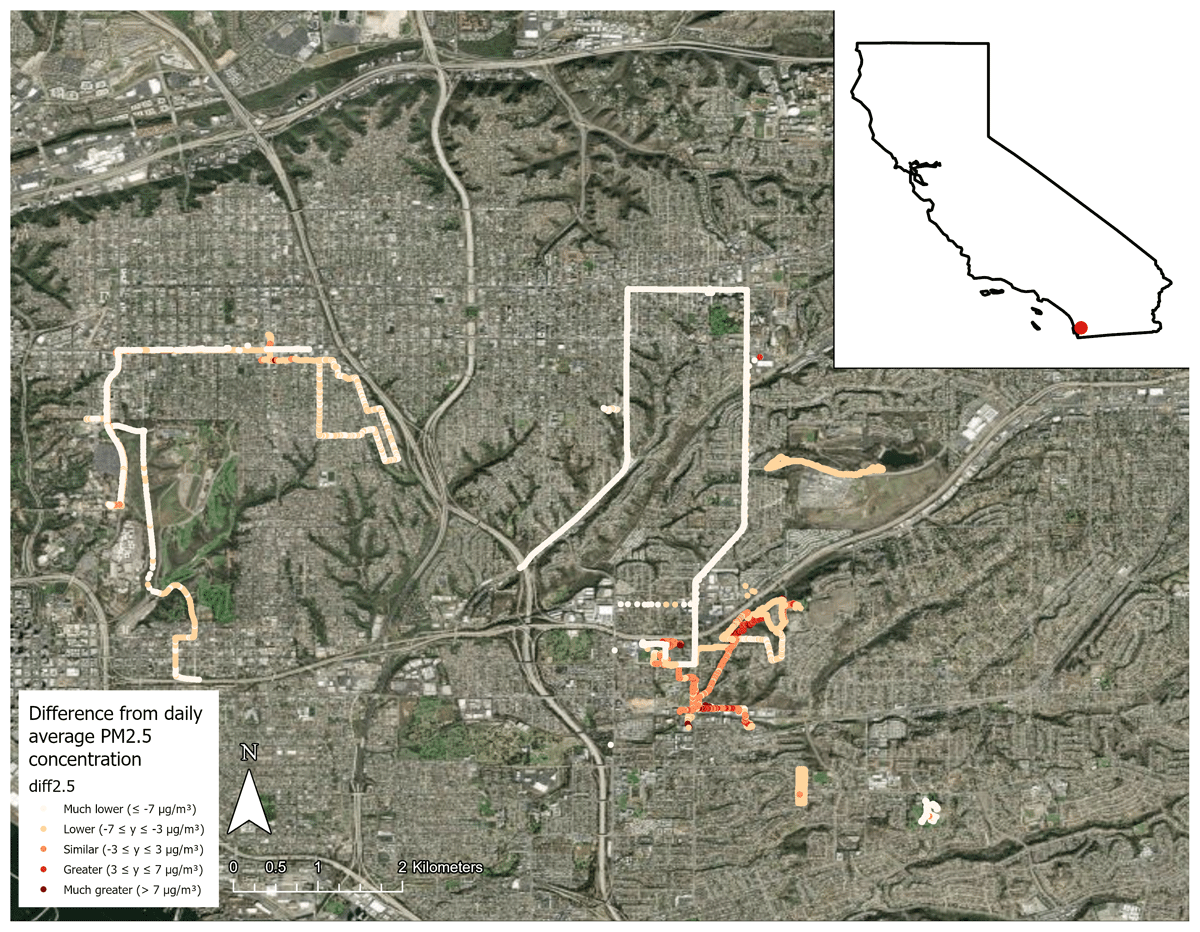
Figure 1
An example of a map of the outdoor air pollution data collected by community participants of the Family Saturdays community science program used during a peer-to-peer outreach and education event (referred to as “Earth Day community event” in text). This map displays all air quality data collected for the entire duration of the study. The color of the dots indicates differences in concentration from the average concentration of PM2.5 for the City of San Diego on the same day the data were collected. The inset shows the location of San Diego within the US state of California.
Ethics and community participant selection
All research on human subjects was approved by the TIER Institutional Review Board (protocol #1241231). Because we recruited community participants from an ongoing community program hosted by Groundwork, our participant pool may not be entirely representative of the broader community. We acknowledge that people already participating in community programming may bias the sample to those that are more aligned with these types of projects or topics. However, many of the family program participants belong to racial and economic minority groups, which is representative of the local community. Many potential community participants were Spanish-speaking with limited English literacy; therefore, a Spanish speaker was always present to translate materials and discussions, and all written materials were provided in both English and Spanish.
Adult (at least 18 years old) participants were targeted for inclusion if they regularly attended the family program. During a community programming event hosted by Groundwork, we verbally notified and provided written flyers describing the research project to these family groups, and explained the project with a PowerPoint presentation. Individuals were allowed to self-select into the project by asking the researchers for a consent form; individuals that did not ask to view and/or did not sign a consent form were assumed to not consent to participate in the research study.
Participant data collection and analysis
To assess the program’s impact, we implemented a multi-method approach focused on adult community participants, including: pre- and post-program surveys for the outdoor air quality project; semi-structured interviews; and field observations during Family Saturday workshops and community events. Administered at the beginning and end of the Outdoor Air Quality module, the pre- and post-survey consisted of a 4-question Likert scale topic-based attitudinal survey on outdoor air quality and its connection to nature and climate change; 1 multiple-choice question, and 1 True/False question to assess content acquisition (see Figure 2 and Supplemental File 1 for the wording of the questions). We tracked individual-level outcomes to determine whether community participants’ self-reported knowledge and STEAM identity/comfort improved, had no change, or declined after participating in the community science project by analyzing the pre- and post-survey data for the Likert-scale questions. Responses were coded and paired at the community participant level, and we determined the direction of change (increase, decrease, or no change). For the factual knowledge questions (5 and 6), we summarized percent correct responses pre- and post-survey.
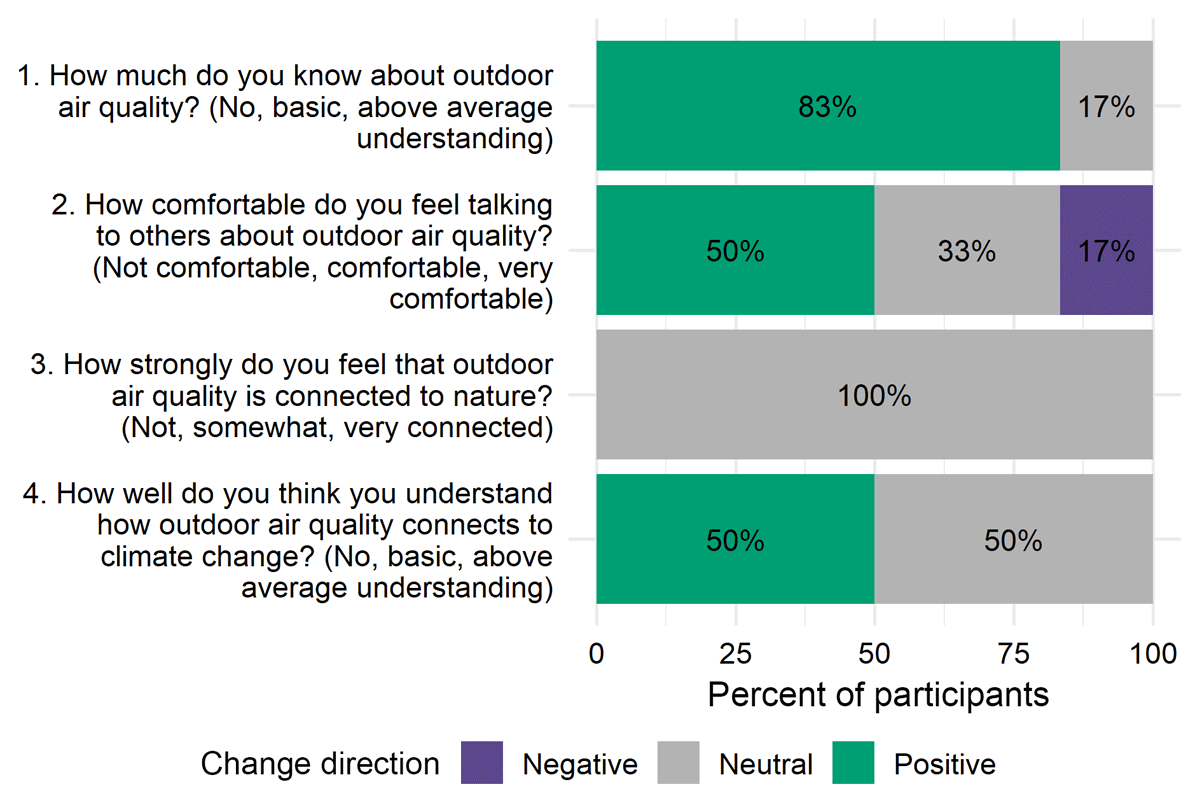
Figure 2
The proportion of community participants that changed their responses on an air quality survey (increased or “positive”; decreased or “negative”; no change or “neutral”) as a result of participating in a tripartite community science project (i.e., a project organized by scientists, a facilitator organization, and community members). The text of the specific question is to the left of the data for that question.
We conducted individual and group semi-structured interviews with adult community participants. The pre-set interview questions are available in Supplemental File 2, and explored the community participants’ levels of participation, overall experiences, shifts in environmental awareness and perspective, behavioral changes, and key takeaways from the program. All interviews were audio recorded and transcribed. Author CC interviewed all community participants and manually coded the results using inductive methods (Merriam and Tisdell 2015). CC developed in-vivo codes that explored the above themes and any other recurrent themes across interviews.
Scientist and facilitator reflections
In addition to community participant interviews, The Nat and Groundwork each completed written reflection questionnaires at the conclusion of the project (see Table 1 for the project timeline). The questionnaires consisted of 7 open-ended questions on benefits and challenges experienced during the project. Authors MET and RNL jointly completed the questionnaire for The Nat, and authors JC and AM jointly completed the questionnaire for Groundwork. MT used inductive coding (Merriam and Tisdell 2015) to identify major themes present in our responses, including challenges and recommendations associated with each theme, and RNL, JC, and AM reviewed the resulting themes and gave feedback that informed the final reflection results. Text of the questionnaires and our responses are available in Supplementary File 3.
Results
Participation in the community science program consisted of 13 families with an average of 25 community participants per Family Saturday. Of the 13 families who participated, most attended either 1–2 workshops (n = 4) or 7–8 workshops (n = 6). Families included at least 1 caregiver and their child; on average, 1 caregiver and 2 children attended sessions. Children included elementary, middle, and high school students. Although present, children were not given surveys or interviewed in compliance with our IRB protocol. Most participating families were non-native speakers of English.
Pre- and post-surveys
Of the approximately 25 community participants, six people took both surveys (Supplemental File 4). The proportion of respondents answering the multiple-choice content-acquisition question (Question 5) correctly increased from the pre (33%) to the post (50%) survey. However, the proportion of people correctly answering the true/false content-acquisition question (Question 6) decreased from the pre (67%) to the post (33%) survey. Most attitudinal measures showed positive movement (Figure 2). Respondents showed the greatest improvement in self-reported knowledge of outdoor air quality (Question 1), with 83% reporting an increase in understanding (“No” to “Basic” or “Basic” to “Above Average”). Half of the respondents reported an increase in their comfort talking to others about outdoor air quality (Question 2), as well as an improvement in their understanding of how outdoor air quality connects to climate change (Question 4). All respondents reported that air quality is very connected to nature and post-activity responses did not change (Question 3).
Community participant interviews
Four adult community participants were interviewed, consisting of one individual interview and one group interview with three community participants. All the interviewees had attended all eight Family Saturday workshops. Three community participants also volunteered at the Earth Day community event. The individual interview included an American Sign Language – English translator, and the group interview included a Spanish – English translator.
Major themes identified from the interviews included “content acquisition/learning,” “application of new knowledge,” and “family/community connections.” Community participants described that they appreciated learning about air quality, especially how it varies with season, weather conditions, and local factors like wildfires. Many found it insightful to understand the differences in air quality across socioeconomic areas and how this impacts community health and well-being, particularly for vulnerable groups such as children with compromised immune systems. Community participants appreciated expert presentations that translated technical ideas into understandable terms:
“They explained it [air quality and air pollution] in a way I could really understand. Even when it was complicated, they made it feel like something we could do something about.” – Community participant
Overall, community participants enjoyed gaining and applying practical knowledge about pollution, ozone, and their own role in protecting air quality, highlighting both the educational and empowering aspects of the workshops. All three community participants in the group interview reported altering behaviors to improve air quality based on knowledge and skills gained during the project:
“Before, I didn’t think much about what was in the air. Now, I know how to open windows the right way, what to turn off, and how to keep the air inside my home cleaner for my kids.” – Community participant
The community participants’ reported increases in knowledge and confidence in discussing outdoor air quality and climate change led to community education. Several community participants reported discussing air quality with other community members and teaching others ways to improve indoor air quality:
“Now, I make different choices – not just for me, but to teach my children, too.” – Community participant
All four interviewed participants also commented on the shared learning environment. They valued the way the program involved families and supported cross-generation knowledge transfer as parents and children learned and participated in activities together.
Discussion and Recommendations
We present this case study as an example of the implementation of the tripartite model of community science with a facilitator organization (Figure 3) and the impacts of the facilitated community science model from the perspectives of the three entities (scientist, facilitator, community participant). Overall, we found that the division of labor allowed each organization to leverage their strengths and resulted in positive perceived outcomes for the community participants. Although direct evidence of content acquisition was mixed, community participants generally reported feeling that they had increased knowledge and felt comfortable sharing this knowledge with others. However, we also discovered limitations to the model. Consistent participation in the Family Saturdays was still only a handful of community participants, and both organizations had difficulty translating the scientific findings into actionable steps community members could take to improve air quality. In Table 2, we summarize our experiences and recommendations for others in implementing the tripartite model for community science and for strengthening collaborative partnerships.
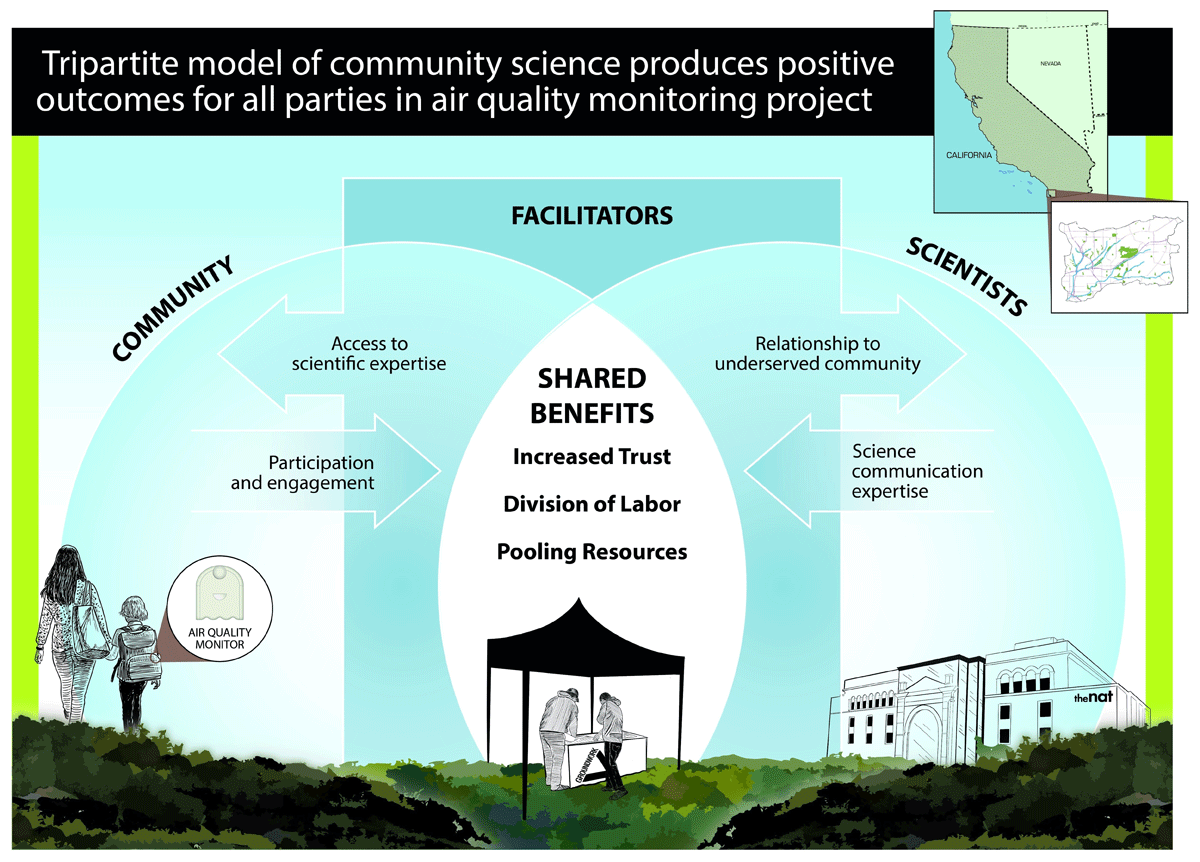
Figure 3
A visual abstract of the tripartite model of community science (Salmon et al. 2021) as applied to an outdoor air quality community science project. The facilitator (rectangle) mediates the relationship (arrows) between scientists and the community participants (circles) and all parties reap the shared benefits. Inset map shows the location of the Chollas Creek Watershed, the primary mission area of Groundwork and the neighborhoods of the study participants, in southern California.
Table 2
A summary of lessons learned and recommendations for improvement in implementing a tripartite model of community science that includes scientists, community members, and a facilitator organization that helps to bridge the gap between scientists and the community. Challenges, benefits, and recommendations are grouped under four overarching themes.
| THEMES | CHALLENGES | BENEFITS OF TRIPARTITE MODEL | RECOMMENDATIONS |
|---|---|---|---|
| Bandwidth | Staff at organizations are stretched thin | Allows facilitator and scientist to split tasks in a way that focuses on their strengths | Clearly designate roles and responsibilities of each organization |
| Recruitment | Sustained recruitment at scale, especially in communities that already lack bandwidth (e.g., economically disadvantaged) | Facilitators can leverage ongoing relationships with the community; community may be more likely to participate in “vetted” projects | Continued engagement with community Encouraging participation by family groups |
| Science communication | Translating scientific findings into practical actions | Scientists can support data analysis and communication of results | Time investment of co-creation to avoid potential mismatches in relevance of project outcomes to organizations and communities |
| Increased effort into developing actions, steps, and training for community participants to share findings | |||
| Funding | Funding tied to predefined activities or themes | Facilitator and scientist can leverage different strengths in funding networks; different sources of funding | Advocate for funders to understand importance of co-creation with facilitator organizations and the community from the start; build this into the funding structure (e.g., grant applications) |
| Lack of funding | Facilitator and scientist can combine funds to increase spending |
Bandwidth
Staff at not-for-profit and community-based organizations are often pressed for time with an overwhelming number of job responsibilities. Working together on community science projects allows the scientists and facilitators to spread labor across organizations and leverage strengths. Both our organizations found that working together allowed each organization to focus on their area of expertise:
“The Nat providing data analysis made the results easier to interpret for the [participants] since we were not having to learn how to understand the data and organize the program at the same time.” – Groundwork
As a museum, The Nat was able to provide scientific expertise (i.e., data analysis and interpretation) as well as science outreach and communication experience to translate the research data into forms understandable by a wide variety of audiences. Groundwork was thus able to devote their energy to their expertise in community recruitment and engagement (Figure 3). Community participants acknowledged and appreciated the care that this entailed, citing appreciation of the work taken to clearly explain scientific topics. This division of labor is thus a form of capacity building that increases the ability of partner entities to engage in community science (Richter et al. 2018). Without partnership with Groundwork, and the trust the community puts in this organization, The Nat likely would have struggled to secure adequate participation in a similar community science project in this community. Groundwork, like other community-based organizations such as public libraries (Smith et al. 2026), provides an avenue for connecting community members opportunities for learning and STEM identity growth. Thus, a clear division of roles and responsibilities among organizations allows for efficient use of limited resources and staff time to provide maximum benefit to community members and achieve project goals.
Recruitment
Recruiting community participants into a community science project can be difficult even under the best circumstances, but this is especially true when working in communities that are under-resourced (e.g., lack of economic and social investment by local government). Consistency in participation was somewhat low in our study; 4 out of the 13 families attended 2 or fewer workshops (out of a total of 8 workshops). This is especially concerning given our pool of community participants was possibly biased towards engagement, as they had already elected to participate in Groundwork’s community programming. Retention of community participants is a complex issue given the myriad motivations of community participants for engaging in community science (reviewed in Robinson et al. 2021). The co-created nature of our project addresses some of these motivations, such as providing relevance to everyday lives and creating a sense of community. However, our approach was unable to address all features a project needs to retain community participants. While both organizations would have liked to develop more opportunities to engage with community members more frequently, they often do not have the bandwidth to do so amid other projects and responsibilities:
“I think the community should be engaged more than once per month, but that is hard given the busy lives of most people (staff and community).” – Groundwork
However, despite limitations of staff time, Groundwork was able to leverage its strong relationships with its middle- and high-school interns to encourage their adult guardians to participate in the program. Thus, our case study aligns with other studies on the key role that facilitator organizations play in engaging youth to participate in community science (Smith et al. 2024; Golumbic et al. 2025; Trøttrup et al. 2025). Continued engagement with community members, from both the scientists and facilitator organizations, could encourage continued participation by improving the momentum of the project and increasing the number of times the community participants thought about the project (i.e., keeping it “top of mind”).
Science communication
Translating scientific findings into policy decisions and community actions is challenging. Community members, who are often not professional scientists, may struggle to understand how to interpret and use data to make real-world changes. This can hamper the dissemination of research findings to the broader community and society:
“One of the [community participants] told me she tried to talk to her neighbor about energy and air quality, but the neighbor didn’t really understand or wouldn’t engage in that conversation. I think we need more action steps that are tied to things people care about: for example, public health or cost of living.” – Groundwork
The tripartite model allows the facilitator and the community participants to access the expertise of scientists to aid in interpretation of data (Figure 3). As mentioned above, Groundwork was grateful for The Nat’s expertise to not only analyze the data, but to communicate the real-world meanings and applications of those data. Our results are similar to others, such that community participants demonstrated increased knowledge and reported changing their behaviors as a result of participating (Varaden et al. 2021; Van Brussel and Huyse 2019), but, as quoted above, engagement with community members who did not participate was still limited. Tailoring community science programs to encourage and support participation by family units is a potential avenue, as all four interviewed community participants positively mentioned the family aspect of our project. Some issues still remain, such as the mismatch between the scale of the community’s ability to change and the level at which differences would be experienced:
“Folks can use these data on outdoor air quality to advocate for themselves, but ultimately policy needs to change or businesses need to make better decisions on their own.” – The Nat
“I want to help others learn, too. But it’s hard; some people just don’t have the time or don’t believe it makes a difference” – Community participant
Investing time to co-create community science project objectives with community members and scientists can help avoid these mismatches. Additionally, scientists and facilitators can invest time into developing action steps for the community that relate to the data collected.
Funding
Funding for community science projects is often competitive and not available in large enough sums to cover all of a project’s needs. Working in the tripartite model allows the partner organizations to combine grant sources to further support community science projects. For example, The Nat and Groundwork combined funding from different grant agencies to provide stipends to the community participants (US$ 50 gift cards) to improve retention of participants. Additionally, some funders require their money to be spent on specific objectives or activities. As another example from our work, The Nat’s funder wanted to support projects improving access to nature, while Groundwork’s funder wanted to increase awareness and adoption of climate-sensitive behaviors. Our joint project on outdoor air quality combined both themes and increased our ability to support this community science project. Despite creative ways of distributing money, some funders can still be rigid and prescriptive in how their funds are spent. We recommend bringing potential funders in early to the community science process and present a joint front illuminating the importance of co-creation of projects with the facilitator organizations and community.
Conclusions
We present this case study on the tripartite model of community science to examine how this model might work in practice and to provide our experiences so that others may learn from them. Overall, collaboration between a facilitator organization and a scientific organization produced beneficial outcomes for the community participants, including increased scientific confidence and a desire to share their findings with other community members. While the experience was beneficial for the host organizations, primarily through a division of labor/expertise, there were still perceived barriers to implementation, including difficulty in retaining community participants and translating scientific findings into actions to improve the community for those who did not participate in the project. We advocate co-creating research endeavors with both community organizations and the community at the outset of the project to improve the implementation of the tripartite model.
Supplementary Files
The supplementary files for this article can be found as follows:
Supplemental File 2
Semi-structured interview questions for the community participant interviews. DOI: https://doi.org/10.5334/cstp.985.s2
Supplemental File 3
Facilitator and scientist reflection questions and answers. DOI: https://doi.org/10.5334/cstp.985.s3
Data Accessibility Statement
The authors confirm that the data supporting the findings of this study are available within the article and its supplementary materials.
Ethics and Consent
This project was approved by TIER’s Institutional Review Board (IRB), protocol number 1241231.
Acknowledgements
We would like to thank all of the community participants in the Family Saturday community science program for their participation and diligence in air quality data collection.
Author Contributions
JC and AM developed the project idea, gathered funding, and recruited participants. RNL analyzed the air quality data and created Figure 1. CC analyzed the pre- and post-surveys and interviewed community participants. MET created Figure 2. RNL and MET wrote the initial draft; all authors edited subsequent drafts and approved the final submission.