
Table 1
The inclusion and exclusion criteria used in the systematic literature review.
| CRITERIA | INCLUSION | EXCLUSION | JUSTIFICATION |
|---|---|---|---|
| Time period | Until 2024 (no lower limit: from database inception to 2024) | Studies outside these dates | No lower limit was applied, in order to capture the full historical development of the CBPR literature on peace and conflict, an emerging area of research. |
| Language | English, Spanish | Non-English or Spanish studies | English and Spanish are the working languages of the review team and cover most of the peacebuilding literature relevant to the geographical contexts examined. |
| Type of article | Empirical research, published in a peer-reviewed journal | Books, book chapters, conference papers, reports, review papers, and other types of material | Restricting the sample to peer-reviewed empirical studies ensures methodological rigor and comparability of findings across the reviewed literature. |
[i] Note: Authors’ creation.
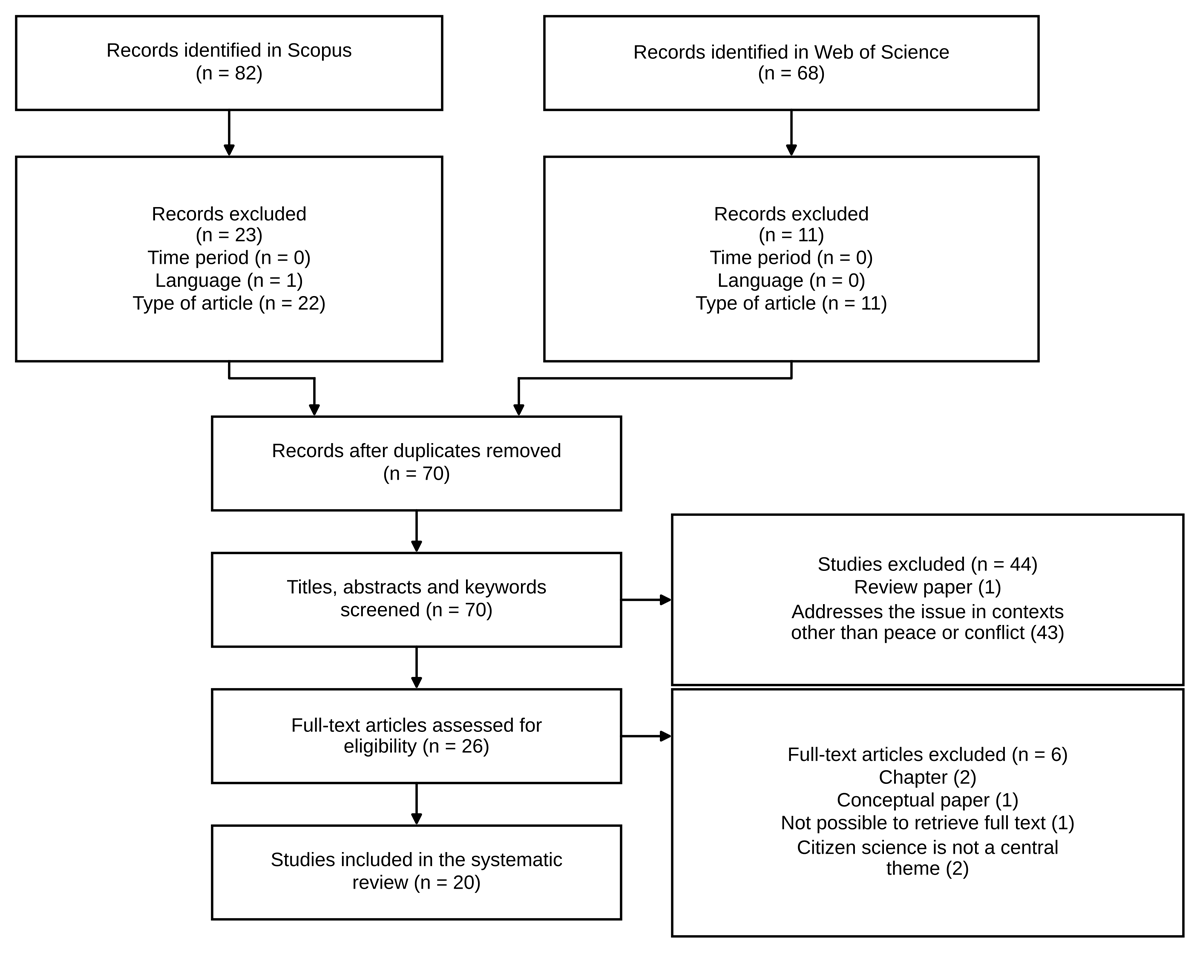
Figure 1
PRISMA (Preferred Reporting Items for Systematic Reviews and Meta-Analyses) flow diagram of papers included in the systematic literature review.
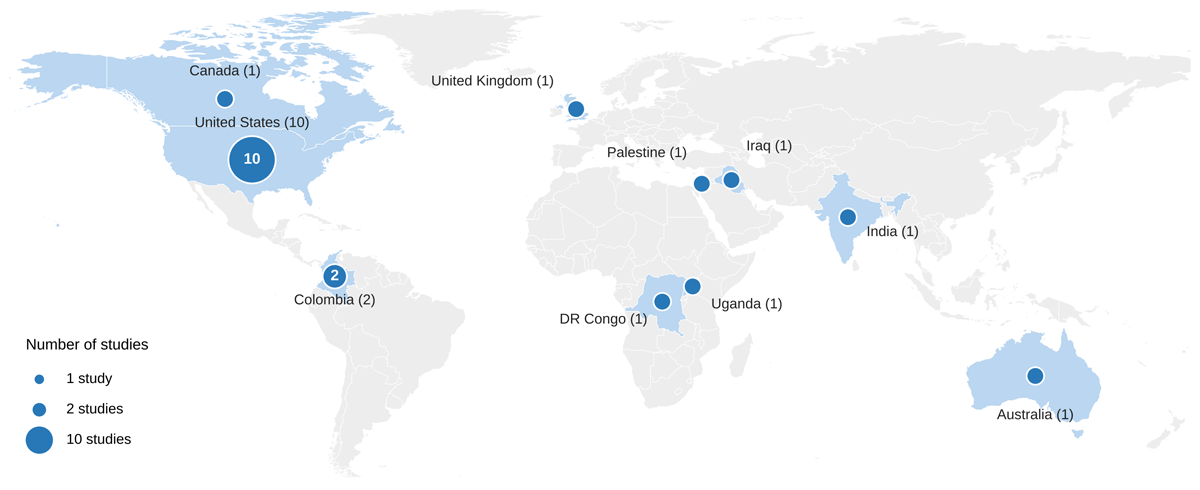
Figure 2
Geographic distribution of the included studies. Source: Authors’ creation. Ferrari et al. (2023) is counted in both countries where the study was conducted; Hancock (2023), which addresses international settings, is not mapped.
Table 2
Overview of thematic categories and codes derived from the analysis.
| RESEARCH QUESTION/CATEGORY | CODES/SUBTHEMES IDENTIFIED | NO. OF CODES |
|---|---|---|
| Objectives | Resilience in conflict contexts; governance and peacebuilding mechanisms; participatory interventions in gender violence; design of youth violence programmes; community experiences of overcoming conflict; participatory interventions for peace in the school context; development of instruments from participatory approaches | 7 |
| Methodological tools | Dialogic and creative techniques; quantitative and evaluative designs | 2 |
| Benefits | Trust and empowerment; community ownership and sustainability; skills and resilience; policy influence; peacebuilding strategies; academia–community bridging | 6 |
| Challenges | Time/personnel demands; rigour versus community needs; balancing objectives with urgency; emotional/ethical cost; limited generalisability; logistical coordination; social-desirability bias; weak follow-up mechanisms; power asymmetries; administrative/financing constraints | 10 |
[i] Note: Authors’ creation.