
Introduction
Community-based participatory research (CBPR) emerged in the 2000s (Yau et al. 2024) as a collaborative research approach that engages academic researchers and community actors equally at all stages of research to address community concerns and bring about social change (Hausman et al. 2013; Mayan et al. 2016; Blanchard et al. 2017; Stalker et al. 2020; Lozano et al. 2023; Huang, He, and Jiang 2024; Zhang et al. 2024). This implies two-way learning between researchers and community members, exchanging skills and perspectives (Blanchard et al. 2017; Wolferman et al. 2019; Ozano et al. 2024; Yau et al. 2024), equitably sharing decision-making in the research process, sharing ownership of research products (White et al. 2013; Blanchard et al. 2017; Goodman et al. 2018; Wolferman et al. 2019), and seeking to balance the power dynamics among all participants (Nnawulezi et al. 2019).
However, there are different challenges for its development (Leff et al. 2010; Mayan et al. 2016; Blanchard et al. 2017; Heiss and Matthes 2017; Goodman et al. 2018; Huang, He, and Jiang 2024; Ozano et al. 2024; Pidoux and Boullier 2024; Yau et al. 2024), related to three issues: a lack of competencies for the co-production of knowledge and frameworks enabling all partners to contribute meaningfully and equitably to the process (Ozano et al. 2024); the need for more evidence regarding the reliability of participatory methods and the added value of citizen cooperation (Pidoux and Boullier 2024); and the need for further studies that elaborate on the development of processes and the obstacles encountered within this research approach (Nnawulezi et al. 2019; Yau et al. 2024).
Citizen science is broadly understood as the involvement of non-professional participants in the production of scientific knowledge, ranging from contributory projects, in which the public mainly collects or processes data, to co-created projects, in which community members participate across all stages of the research (Heiss and Matthes 2017; Pidoux and Boullier 2024). CBPR sits at the more collaborative, co-created end of this spectrum: It shares with citizen science the commitment to engaging non-academic actors in knowledge production, but places particular emphasis on equitable partnership, shared decision-making, and social change in and with a specific community. Examining CBPR in peace and conflict settings is therefore relevant to the citizen science community because it foregrounds the relational, ethical, and political dimensions of knowledge co-production under conditions of insecurity (Fernando and Tajan 2024).
Thus, CBPR is increasingly recognized for its potential to contribute to peacebuilding (Lozano et al. 2023), as well as to contribute in contexts of violence and conflict (Blanchard et al. 2017; Nnawulezi et al. 2019). In peacebuilding in particular, evidence indicates that initiatives promoted by external actors often fall short of their goals and lack legitimacy among conflict-affected populations (Hancock 2023). In addition, the production of knowledge in relation to peace is not a topic that is much debated in the conventional literature on peace and conflict studies, and there is no single and univocal conceptual framework for analysing the ways in which knowledge production affects research on peace (Nupia and Valencia Espinosa 2023).
Consequently, community-based participatory research (CBPR) is one of the most widely used community engagement frameworks to promote change in vulnerable populations (Riccardi et al. 2023), generating knowledge and transformation (Blanchard et al. 2017; Nnawulezi et al. 2019; Stalker et al. 2020; Lozano et al. 2023), and reducing inequalities (Blanchard et al. 2017; Yau et al. 2024).
The expansion of CBPR is reflected in the many literature reviews published in the past two years across diverse fields, including health (Ashgar 2025; Ko and Song 2026; Rodriguez et al. 2026; Tavoulari et al. 2026), participatory methods and engagement (Lee et al. 2025; Nelson et al. 2025; Wagman et al. 2025; Wu, Robinson, and Silberberg 2026), and education (Hajar, Yulianti, and Nur 2026). However, none of these reviews addresses peacebuilding or conflict-affected settings, which confirms that the use of CBPR in contexts of peace and conflict remains unexamined in the review literature and justifies this study.
Indeed, to date, systematic literature reviews related to CBPR focus on analysing the efficacy of CBPR interventions on mental health outcomes (Yau et al. 2024), define the concept of cooperation and the key characteristics of citizen science practices (Pidoux and Boullier 2024), establish an implementation framework to guide the use of CBPR approaches in vaccination promotion (Zhang et al. 2024), and explore the use of participatory research (PR) in education for sustainable development (ESD) among university students and adults (Fernando and Tajan 2024). To our knowledge, there is no literature review that addresses the implementation of community-based participatory research in peacebuilding. In accordance with the above, the following research questions arise:
What objectives do CBPR-based interventions address in contexts of peace and conflict?
What are the methodological tools used for CBPR in contexts of peace and conflict?
What are the main benefits and limitations of implementing CBPR in contexts of peace and conflict?
For clarity of presentation, the third research question, which spans both benefits and limitations, is addressed in the Results through two dedicated subsections rather than one.
Methodology
This review followed the PRISMA (Preferred Reporting Items for Systematic Reviews and Meta-Analyses) protocol. To answer the research questions, a systematic literature review (SLR) was developed (Tranfield, Denyer, and Smart 2003; Thorpe et al. 2005). The inclusion and exclusion criteria used in the review are found in Table 1.
Table 1
The inclusion and exclusion criteria used in the systematic literature review.
| CRITERIA | INCLUSION | EXCLUSION | JUSTIFICATION |
|---|---|---|---|
| Time period | Until 2024 (no lower limit: from database inception to 2024) | Studies outside these dates | No lower limit was applied, in order to capture the full historical development of the CBPR literature on peace and conflict, an emerging area of research. |
| Language | English, Spanish | Non-English or Spanish studies | English and Spanish are the working languages of the review team and cover most of the peacebuilding literature relevant to the geographical contexts examined. |
| Type of article | Empirical research, published in a peer-reviewed journal | Books, book chapters, conference papers, reports, review papers, and other types of material | Restricting the sample to peer-reviewed empirical studies ensures methodological rigor and comparability of findings across the reviewed literature. |
[i] Note: Authors’ creation.
Identification of keywords and specification of search engines
Identifying evidence in systematic literature reviews requires establishing a search strategy with the right databases and keywords (Gusenbauer and Haddaway 2020). These terms were obtained from the review of previous studies (Joseph, Katsos, and Van Buren 2023; Yu et al. 2025).
The search was conducted in the electronic databases Scopus and Web of Science, considering that previous methodological studies on systematic literature reviews, originally developed in the management field, claim that they are the largest and most important databases of peer-reviewed journal articles (Gough, Oliver, and Thomas 2017; Page et al. 2021). Additionally, these databases are suitable for the synthesis of evidence in the form of systematic reviews (Gusenbauer and Haddaway 2020). The following is the search string used: TITLE (“citizen science” OR “data collective” OR “participatory research” OR “community-based participatory research” OR “community-based science” OR “knowledge co-production” OR “knowledge coproduction” OR “community science” OR “community-based monitoring” OR “participatory monitoring” OR “volunteer monitoring”) AND TITLE (“peace*” OR “conflict” OR “conflict resolution” OR “conflict alleviation” OR “war*” OR “violen*” OR “conflict zone” OR “conflict region” OR “conflict area” OR “post-conflict” OR “post conflict”).
Selection of studies and PRISMA flow
Once the search was run and the inclusion and exclusion criteria were applied, all records and their bibliographic information were imported into Mendeley and duplicates were removed. The remaining records were screened independently by two reviewers by title, abstract, and keywords; those potentially relevant to the research questions were retained for full-text assessment, and the studies meeting all criteria after full-text reading were included in the review. The complete selection process, with the number of records at each stage, is summarised in Figure 1.
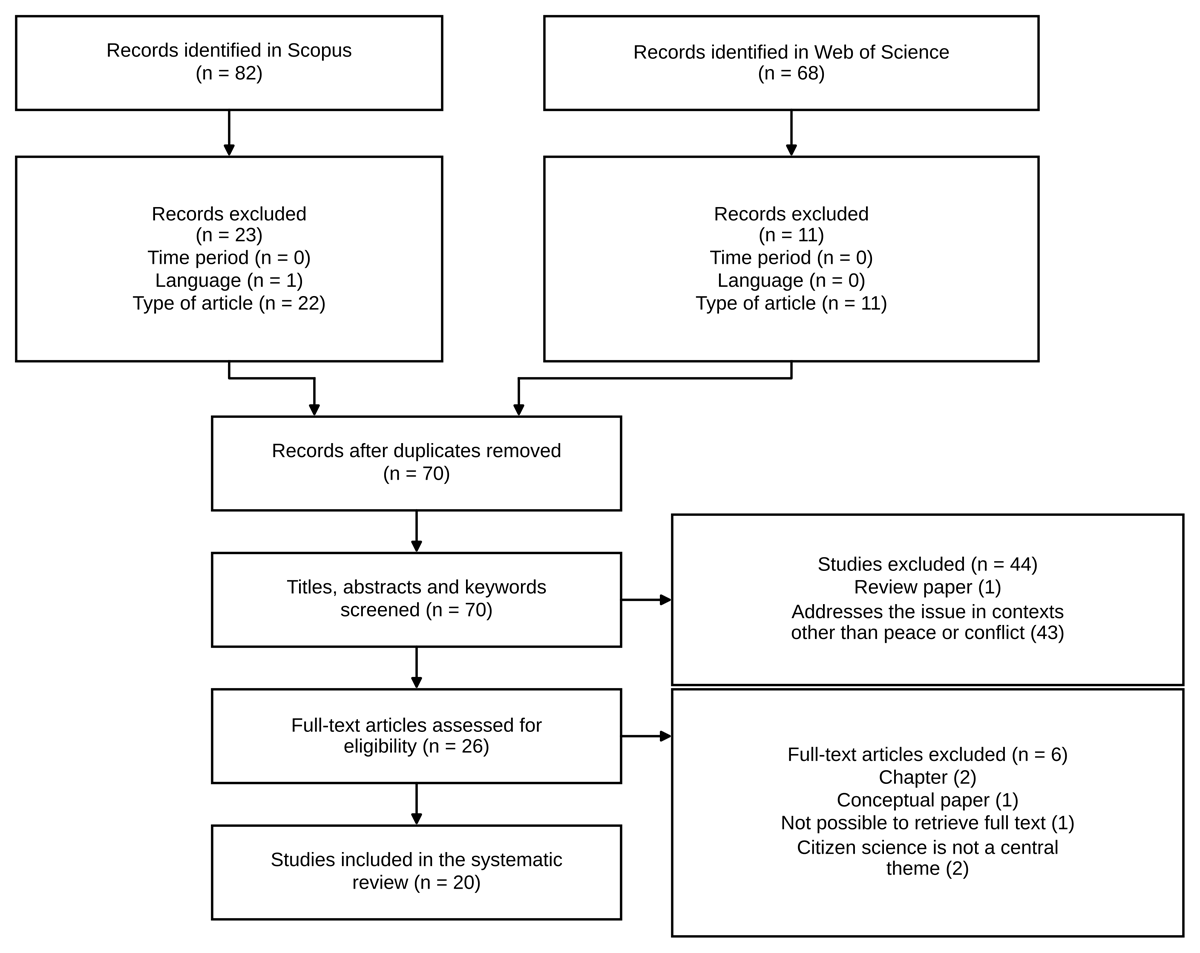
Figure 1
PRISMA (Preferred Reporting Items for Systematic Reviews and Meta-Analyses) flow diagram of papers included in the systematic literature review.
Descriptive analysis
Specifically, for each study, the following attributes were extracted and tabulated in a spreadsheet: year of publication, geographical context (country or region), type of conflict or peacebuilding setting, study population, CBPR approach, and main methodological tools. The study-by-study synthesis of these characteristics is provided in Supplemental File 1: Supplemental Table 5.
Thematic analysis
According to the methodology, from the included articles, a thematic analysis of each article was carried out to answer the research questions. The thematic analysis was inductive: topics were not defined in advance but were derived from the data, organised around the three research questions (objectives, methodological tools, and benefits and challenges). The full text of each article was read and coded manually in a spreadsheet (Microsoft Excel), in which relevant text segments were extracted, labelled with descriptive codes, and progressively grouped into broader categories and themes. Coding was carried out independently by two researchers; the resulting codes and themes were then compared, and discrepancies were discussed and resolved by consensus until a shared coding scheme was reached. A worked example of the coding process is provided in Supplemental File 1: Supplemental Table 6.
Results
In accordance with the proposed methodology, the descriptive analysis and thematic analysis of the publications included in the literature review are presented below. First, the included studies are characterised; then the findings are organised by research question.
Descriptive analysis
As seen in Figure 1, 20 articles are included in the systematic literature review, published between 2000 and 2024. The articles present cases of implementation of participatory methodologies in different geographical contexts: Colombia (Lozano et al. 2023; Nupia and Valencia Espinosa 2023), the United States (Hausman and Becker 2000; Kataoka et al. 2006; Leff et al. 2010; Le et al. 2011; Hausman et al. 2013; White et al. 2013; Poleshuck et al. 2018; Nnawulezi et al. 2019; Wolferman et al. 2019; Stalker et al. 2020), international United Nations Peacebuilding Fund settings (Hancock 2023), Uganda (Vindevogel et al. 2015), Australia (Vaughan et al. 2015), Palestine (Veronese et al. 2022), England (Warrington, Langhoff, and Warnock 2024), Democratic Republic of Congo and Iraq (Ferrari et al. 2023), India (Blanchard et al. 2017), and Canada (Snider et al. 2010). The geographic distribution of the included studies is shown in Figure 2.
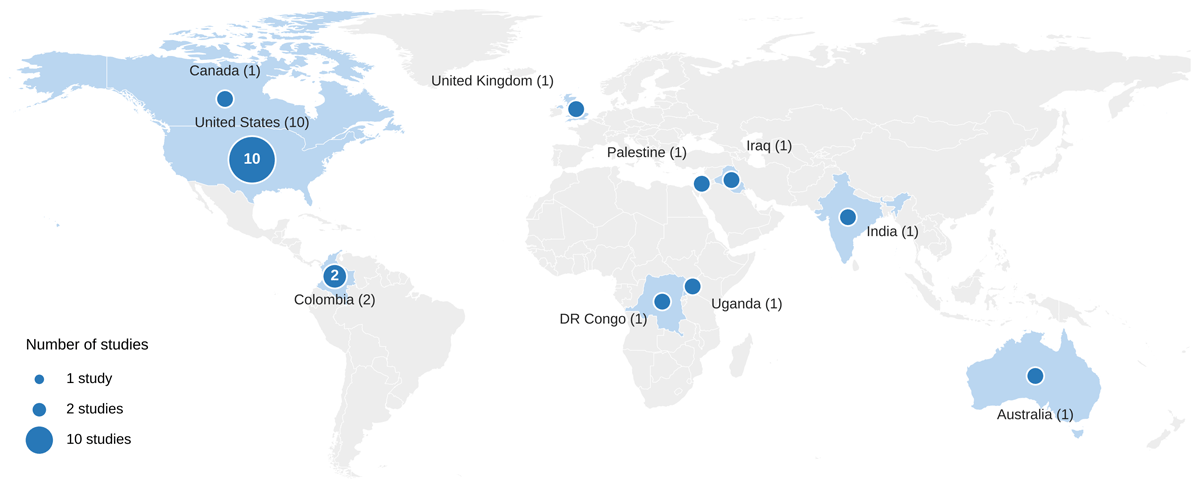
Figure 2
Geographic distribution of the included studies. Source: Authors’ creation. Ferrari et al. (2023) is counted in both countries where the study was conducted; Hancock (2023), which addresses international settings, is not mapped.
Thematic analysis
The thematic analysis is based on the research questions posed. Table 2 gives an overview of the thematic categories and codes.
Table 2
Overview of thematic categories and codes derived from the analysis.
| RESEARCH QUESTION/CATEGORY | CODES/SUBTHEMES IDENTIFIED | NO. OF CODES |
|---|---|---|
| Objectives | Resilience in conflict contexts; governance and peacebuilding mechanisms; participatory interventions in gender violence; design of youth violence programmes; community experiences of overcoming conflict; participatory interventions for peace in the school context; development of instruments from participatory approaches | 7 |
| Methodological tools | Dialogic and creative techniques; quantitative and evaluative designs | 2 |
| Benefits | Trust and empowerment; community ownership and sustainability; skills and resilience; policy influence; peacebuilding strategies; academia–community bridging | 6 |
| Challenges | Time/personnel demands; rigour versus community needs; balancing objectives with urgency; emotional/ethical cost; limited generalisability; logistical coordination; social-desirability bias; weak follow-up mechanisms; power asymmetries; administrative/financing constraints | 10 |
[i] Note: Authors’ creation.
Objectives of the implementation of community-based participatory research in contexts of peace and conflict
Resilience in conflict contexts
CBPR is implemented to identify culturally rooted indicators of youth resilience in post-war from the perception of young people and their communities (Vindevogel et al. 2015). Likewise, CBPR can promote a sense of security, psychological well-being, and resilience in children in situations of structural violence (Veronese et al. 2022).
Governance and peacebuilding mechanisms
Participatory methodologies allow for the configuration of shared accountability structures to evaluate peacebuilding interventions, favouring empowerment as a basis for sustainability and local ownership (Hancock 2023). Similarly, they promote the co-production of knowledge between scientific and local actors to strengthen peacebuilding processes, emphasizing the role of international cooperation (Nupia and Valencia Espinosa 2023).
Participatory interventions in gender violence
Findings reveal that CBPR helps to:
Understand intimate partner violence in specific cultural contexts, and strengthen the community’s capacity to address it (White et al. 2013).
Design interventions that respond to the needs of survivors of gender-based violence (Poleshuck et al. 2018).
Explore the intersection of intimate partner violence and HIV vulnerability among sex workers (Blanchard et al. 2017) and domestic violence care programs (Nnawulezi et al. 2019).
Analyse the experiences of family violence of immigrant and refugee women in different contexts (Vaughan et al. 2015).
Develop accessible and effective interventions to address sexual violence through community engagement (Wolferman et al. 2019).
Design of youth violence programmes
CBPR is used in the co-design of youth violence prevention programs with community leaders (Leff et al. 2010), the development of a hospital intervention to reduce the recidivism of youth violence from hospital emergency services (Snider et al. 2010) and evaluation of youth violence prevention programs co-created with immigrant communities (Le et al. 2011). The literature also explores the role of participatory creative methods in helping young people affected by sexual violence understand and present their experiences (Warrington, Langhoff, and Warnock 2024).
Community experiences of overcoming conflict
CBPR is used in the evaluation and planning of the Thrive initiative, aimed at reducing violence and improving health determinants in a community with high crime rates (Stalker et al. 2020). CBPR is also used to understand armed violence from the experience of the community (Hausman and Becker 2000) and to identify the triggers of violence in medical settings, co-creating a code of conduct for health facilities (Ferrari et al. 2023). It should be noted that Ferrari et al. (2023) is a trial protocol rather than a completed evaluation.
Participatory interventions for peace in the school context
Lozano et al. (2023) address the role of teachers as peacebuilding agents in schools located in conflict zones, since the implementation of CBPR, while Kataoka et al. (2006) implement, in the school context, a faith-based mental health intervention, based on participatory methodologies, for Latino immigrant children exposed to community violence.
Development of instruments from participatory approaches
Hausman et al. (2013) use CBPR to adapt psychometric scales used in youth intervention and violence prevention programs, determining indicators of success from the perspective of communities.
Methodological tools for the implementation of community-based participatory research in contexts of peace and conflict
Different methodological tools are identified for the implementation of CBPR in contexts of peace, which can be organised into two complementary groups according to their epistemological orientation. The first, dialogic and creative tools, includes individual and collective biographical narratives (Lozano et al. 2023), participatory art-based workshops (Vaughan et al. 2015; Warrington, Langhoff, and Warnock 2024), transect routes (Vindevogel et al. 2015; Veronese et al. 2022), interviews (Hausman and Becker 2000; Vaughan et al. 2015; Nnawulezi et al. 2019; Stalker et al. 2020; Veronese et al. 2022; Ferrari et al. 2023), structured observation (Stalker et al. 2020; Ferrari et al. 2023), collaborative thematic analysis (Snider et al. 2010; Blanchard et al. 2017), brainstorming (Snider et al. 2010), ethnography (Wolferman et al. 2019), surveys (Le et al. 2011; Wolferman et al. 2019), interactive mapping in communities (Hausman and Becker 2000; Snider et al. 2010; Vindevogel et al. 2015; Stalker et al. 2020; Veronese et al. 2022), longitudinal qualitative case study (Blanchard et al. 2017), formation of committees with community representation (Kataoka et al. 2006; Blanchard et al. 2017; Poleshuck et al. 2018; Wolferman et al. 2019), focus groups (Kataoka et al. 2006; Leff et al. 2010; Hausman et al. 2013; Vaughan et al. 2015; Vindevogel et al. 2015; Poleshuck et al. 2018; Wolferman et al. 2019; Stalker et al. 2020; Ferrari et al. 2023), pilot tests and evaluations at intervention sites (Leff et al. 2010), and workshops with researchers (Nupia and Valencia Espinosa 2023).
A second group of studies incorporates quantitative and evaluative tools to measure and validate the participatory work carried out in contexts of peace and conflict. These include surveys and adapted psychometric scales (Hausman et al. 2013; White et al. 2013), clinical and stepped-wedge trials (Kataoka et al. 2006; Ferrari et al. 2023), cost-effectiveness analyses (Ferrari et al. 2023), mapping (Hausman and Becker 2000; Snider et al. 2010; Vindevogel et al. 2015), community-based monitoring and evaluation (Hancock 2023) and iterative participation methods, with validation sessions to align results with community priorities (Hausman and Becker 2000; Snider et al. 2010; Hausman et al. 2013; Wolferman et al. 2019; Hancock 2023). Rather than replacing the participatory component, these instruments are generally used to test or assess interventions that were themselves co-designed with the community, combining the contextual sensitivity of CBPR with the rigour and comparability of more conventional designs.
Overall, dialogic and creative techniques—focus groups, community committees, interviews, participatory mapping, transect routes, and arts-based and biographical methods—predominate because relationship-building, trust, and safe spaces for disclosure are decisive in sensitive settings.
Benefits of implementing community-based participatory research in contexts of peace and conflict
Fosters trust, collaboration, and community empowerment through participation and dialogue
It should be noted that Ferrari et al. (2023) is a trial protocol; wherever it is cited in the sections on benefits and challenges, the outcomes and difficulties described are anticipated rather than empirically demonstrated. Findings reveal that CBPR strengthens community participation and creates bonds of trust between local actors (White et al. 2013; Wolferman et al. 2019; Stalker et al. 2020; Warrington, Langhoff, and Warnock 2024), while promoting constant dialogue, shared understanding (Hausman and Becker 2000; Le et al. 2011), respect (Wolferman et al. 2019), and collaboration (Vaughan et al. 2015; Nnawulezi et al. 2019) between researchers and communities. It also integrates continuous feedback mechanisms (Leff et al. 2010) and validates community voices through inclusive and participatory research designs (Nnawulezi et al. 2019), which strengthen trust and community participation, and improve understanding of the social phenomena analysed—an outcome anticipated, rather than demonstrated, in a trial protocol (Ferrari et al. 2023).
Promotes greater community ownership, sustainability and relevance of results by integrating local perspectives and partnerships between different actors
CBPR improves community engagement and ownership of the process (Le et al. 2011; Blanchard et al. 2017; Poleshuck et al. 2018; Hancock 2023; Lozano et al. 2023), which allows interventions to be aligned with local needs and priorities, favouring their long-term sustainability and effectiveness (Kataoka et al. 2006; Leff et al. 2010; Hausman et al. 2013; White et al. 2013; Poleshuck et al. 2018; Stalker et al. 2020; Hancock 2023). It also favours the effective dissemination of findings among various stakeholders, consolidating the impact of research processes (Hausman et al. 2013). Moreover, it facilitates local acceptance of programmes through participatory design experiences from the community bases, a benefit anticipated in a trial protocol (Ferrari et al. 2023), and by strengthening community networks and associations that develop local capacities and reinforce existing networks through coordinated action (Hausman and Becker 2000; White et al. 2013).
In addition, CBPR encourages local actors to take ownership of the knowledge they help produce (Nupia and Valencia Espinosa 2023), the community to participate in information collection, the design of shared protocols that respect the local context (Blanchard et al. 2017), the elevation of voices of immigrant and refugee women (Vaughan et al. 2015), and collective resilience among children (Veronese et al. 2022) and young people (Vindevogel et al. 2015; Warrington, Langhoff, and Warnock 2024) in contexts of violence and insecurity.
Strengthens skills development and community resilience through the participatory research process itself
CBPR strengthens the understanding of the role of actors with respect to the phenomena analysed, for example, the role of teachers and schools in the post-conflict context (Lozano et al. 2023), the understanding of violence, and the strengthening of the social fabric (Snider et al. 2010; Stalker et al. 2020; Ferrari et al. 2023). This makes it possible to identify culturally sensitive indicators of youth resilience in post-war contexts (Vindevogel et al. 2015) and to develop effective and culturally appropriate responses, as anticipated in a trial protocol (Ferrari et al. 2023).
Contributes to the development of policies, programmes, and interventions based on locally identified needs
CBPR enables informed policy development and service delivery with evidence-based and context-sensitive recommendations (Kataoka et al. 2006; Leff et al. 2010; Vaughan et al. 2015; Blanchard et al. 2017; Ferrari et al. 2023), ensuring that community-driven recommendations are translated into policies and practices for better program adoption (Snider et al. 2010; Le et al. 2011), improving the collective ownership of initiatives (Veronese et al. 2022). This allows the design of personalised interventions based on locally identified needs (Snider et al. 2010; Poleshuck et al. 2018; Stalker et al. 2020; Veronese et al. 2022; Ferrari et al. 2023), generating co-created results from the collaboration and needs of participants (Warrington, Langhoff, and Warnock 2024) and promoting ethical and culturally appropriate research practices through shared decision-making (Blanchard et al. 2017).
Improves peacebuilding strategies through interdisciplinary and context-sensitive approaches
Hybrid knowledge production, with the participation of communities and non-academic actors, generates more relevant and context-applicable results (Nupia and Valencia Espinosa 2023), providing practical tools to design peacebuilding initiatives (Lozano et al. 2023) and community ownership in peacebuilding (Hancock 2023).
Promote the closing of the gap between academic and community knowledge through participatory techniques by generating culturally relevant data
The implementation of participatory techniques such as knowledge networks, community workshops, and cartographies ensures local participation in data collection and interpretation (Nupia and Valencia Espinosa 2023).
Challenges of implementing community-based participatory research in peace and conflict contexts
High demand for time, personnel, and training by stakeholders, which could affect their continued participation in the process
Participatory approaches require a significant investment of time, staff, training, and long-term commitment from all stakeholders, which could affect community participation in the long term (Hausman and Becker 2000; Snider et al. 2010; White et al. 2013; Poleshuck et al. 2018; Nnawulezi et al. 2019; Wolferman et al. 2019; Nupia and Valencia Espinosa 2023). Likewise, there are challenges in the training and capacity development of the actors involved in community-based participatory processes (Blanchard et al. 2017; Poleshuck et al. 2018).
Challenges in reconciling scientific rigour with community knowledge
The implementation of community-based participatory research could imply tensions between scientific rigor and authentic participation, considering that achieving meaningful community collaboration could generate tension with academic standards of quality in research (Blanchard et al. 2017). Thus, there are difficulties in balancing the rigor of academic standards with the need to adapt interventions to community contexts (Leff et al. 2010).
Difficulty in balancing research objectives with the urgent needs of the community
Participatory research initiatives in contexts of peace and conflict face multiple tensions derived from the interaction between actors with different interests, time availability, and priorities. One of the most frequent challenges is the influence of donor priorities in the formulation of programme objectives, which do not always align with the concerns identified by the participating communities (Hausman and Becker 2000). Furthermore, findings reveal that there are limitations inherent to participatory approaches, such as the difficulty of adapting empirically validated interventions to the immediate needs and capacities of the community, as well as in balancing research objectives with local priorities (Leff et al. 2010).
Emotional and ethical cost to staff and participants
Participatory processes come at an emotional and ethical cost to staff and participants. Here, the emotional cost is understood as the psychological burden borne by participants and staff when engaging with traumatic experiences, including distress, re-traumatisation, and vicarious trauma. Biographical writing, for example, represented a significant challenge for many teachers in post-conflict contexts, due to the emotions that emerge when narrating experiences linked to violence (Lozano et al. 2023). This type of research usually involves a high emotional burden for the personnel involved, given the sensitive nature of the contexts and phenomena addressed (Nnawulezi et al. 2019). Thus, the emotional and ethical demands inherent in this approach represent challenges (Snider et al. 2010; Le et al. 2011; Ferrari et al. 2023; Warrington, Langhoff, and Warnock 2024).
Limited generalization due to context-specific findings
In the implementation of CBPR, the generalizability of findings is limited due to the small size of the communities involved in these processes, so more research is required for their validation (Vaughan et al. 2015; Vindevogel et al. 2015).
Logistical challenges in coordinating activities with community participation
There are logistical challenges in coordinating CBPR activities in the contexts of intervention (Kataoka et al. 2006; Leff et al. 2010; Snider et al. 2010; Lozano et al. 2023). For example, there are structural and environmental challenges in connecting with transient and marginalized populations (Stalker et al. 2020), and data collection can be hindered by the migration or death of participants, affecting the continuity of community-based participatory processes (Blanchard et al. 2017).
Possible cultural or social desirability biases that affect participants’ responses, interactions, and interpretation of participatory exercises
In the implementation of group interviews, social desirability bias may influence participants’ responses (Vindevogel et al. 2015). Additionally, the presence of some actors can generate biases; for example, when police participate, although it can provide valuable data, it can also generate distrust and limit the participation of local actors (Stalker et al. 2020). Additionally, there are possible biases derived from the use of Western academic frameworks, which could influence interactions with, for example, Palestinian children, and the interpretation of the results (Veronese et al. 2022).
Limitations in the establishment of mechanisms for the long-term monitoring of community initiatives
Difficulties are recorded in demonstrating measurable short-term impacts in the context of community initiatives (Hausman and Becker 2000; Le et al. 2011), taking into account that actors recognize that significant changes take time to consolidate in communities (Hausman and Becker 2000). Likewise, there are challenges to ensure the long-term sustainability of interventions (Le et al. 2011) and to establish databases for longitudinal monitoring of implemented initiatives (Hausman and Becker 2000). This is because traditional evaluation systems prioritize accountability to funders, making it difficult to include beneficiary communities (Hancock 2023).
Persistence of power asymmetries despite participatory objectives between the different actors
Despite the joint and collaborative design of the projects, power asymmetries persist between researchers, policymakers, and local actors that influence interventions (Blanchard et al. 2017; Ferrari et al. 2023; Hancock 2023; Nupia and Valencia Espinosa 2023; Warrington, Langhoff, and Warnock 2024). In addition, there is dependence on the priorities of funders, which do not always coincide with the concerns of the community (Hausman and Becker 2000).
Administrative and financing difficulties limiting the flexibility and adaptation of participatory methodologies
In participatory projects, institutional difficulties are evident (Warrington, Langhoff, and Warnock 2024), for example, approval of ethical aspects (Kataoka et al. 2006) and limitations in funding that affect the scalability of the programs (Kataoka et al. 2006; Ferrari et al. 2023). In addition, although international cooperation has facilitated connections and resources, it has also influenced the definition of meanings, classification of knowledge, and direction of projects according to the liberal peace model (Nupia and Valencia Espinosa 2023).
Conclusions
This systematic literature review examines how community-based participatory research (CBPR) has been implemented in contexts of conflict and peacebuilding.
The reviewed work pursues a recurring set of objectives: building resilience in conflict-affected populations, strengthening governance and peacebuilding mechanisms, mitigating gender-based and youth violence, and co-designing interventions and indicators that are meaningful in each local context. Dialogic and creative techniques predominate, complemented by a second, smaller group of studies using quantitative and evaluative designs, as detailed in the section on methodological tools. Its main benefits are correspondingly relational: It fosters trust and sustained dialogue between researchers and communities, promotes community ownership, and empowers local actors through shared reflection and the co-production of knowledge. These gains, however, come with real challenges, namely the high demand on time and personnel, the emotional and ethical cost borne by participants and staff, and the difficulty of balancing research objectives with community needs.
CBPR occupies the most collaborative, co-created end of the citizen science spectrum, and its application in peace and conflict settings makes visible dimensions that remain less salient when citizen science is practised in stable environments: the management of power asymmetries, the protection of participants’ safety and well-being, the avoidance of re-victimisation, and the reconciliation of donor agendas with community priorities. This review therefore indicates that, in fragile contexts, the quality of co-production is determined above all by trust, equity, and care, and that the most productive applications of CBPR are those oriented towards defining locally relevant indicators, co-designing interventions, and evaluating peacebuilding initiatives through community-based monitoring, rather than towards data extraction.
This study is subject to several limitations. The corpus is small (twenty studies), reflecting the still-narrow intersection between CBPR and peace and conflict research. Moreover, relevant work published as books, chapters, or grey literature, or indexed outside Scopus and Web of Science, may not have been captured, and the review was restricted to studies in English and Spanish. In addition, the notion of “conflict” is heterogeneous across the included studies, ranging from post-war and politically violent settings to interpersonal, gender-based, and community violence. Finally, no verification step beyond the systematic database search was carried out (such as backward and forward citation chasing, cross-checking against recent reviews, or consultation with experts in the field), and no subject-specific databases in peace and conflict studies or citizen science were searched; the comprehensiveness of the corpus therefore rests on the breadth of the search string and on the coverage of Scopus and Web of Science.
Future research could broaden the evidence base by incorporating additional databases, languages, and forms of grey literature.
Supplementary File
The Supplementary file for this article can be found as follows:
Supplemental File 1
Supplemental Tables 1–6. Coding framework, study-level synthesis, and worked coding examples supporting the review. DOI: https://doi.org/10.5334/cstp.970.s1
Data Accessibility Statement
This study did not generate primary data. The data supporting the findings of this systematic review (the corpus of reviewed articles) are publicly available through the Scopus and Web of Science databases using the search string reported in the Methodology. The classification of the reviewed studies according to the thematic categories (objectives, tools, benefits and challenges) is provided in Supplemental File 1: Supplemental Table 5. Supplemental Tables 1–6 are provided together in Supplemental File 1.
Ethics and Consent
As a secondary analysis of previously published literature, no ethical approval was required for this review. All data come from publicly available databases (Scopus and Web of Science), which were not created for this study. The authors are nonetheless aware that several of the included studies involve vulnerable populations affected by violence and conflict, and the synthesis was conducted with attention to the ethical sensitivities this entails.
Declaration of the Use of AI
During the preparation of this work, the authors used Mendeley for citation management. No generative AI tools were used for preparation, writing, analysis, or interpretation of this manuscript.
Acknowledgements
The authors gratefully acknowledge the support from the Ministry of Science, Technology and Innovation of Colombia (Convocatoria Orquideas: Mujeres en la Ciencia 2024), and from the Universidad Nacional Abierta y a Distancia (UNAD).
Author Contributions
All authors contributed to the conception and design of the review, the interpretation of the findings and the drafting of the manuscript, and gave final approval of the version to be published. VP designed the search strategy and carried out the database search, screening and selection of studies. VP and AA performed the full-text reading, thematic coding and data analysis, and VP wrote the first draft of the manuscript.