
Introduction
Young people are increasingly involved as co-researchers in mental health and participatory research, with the aim of making research more relevant, inclusive, and responsive to those whose lives it concerns (Hart 1992; McCabe et al. 2023; Spencer et al. 2023; Watson et al. 2023). Yet young people’s own accounts of how these projects should be organised, resourced, supported, and safeguarded remain under-represented. This creates a practical problem: Projects may be described as participatory or co-produced while key decisions continue to be shaped largely by adult researchers and institutional systems (Izzidien et al. 2024; Soklaridis et al. 2024).
These tensions are especially important in citizen mental health science, which seeks to involve people with lived experience as active contributors across different stages of research (Batty et al. 2024; Todowede et al. 2023). Youth involvement can broaden the perspectives represented in research, improve its relevance, and create greater ownership of research questions and outputs (Powers and Tiffany 2006; McCabe et al. 2023; Watson et al. 2023). However, meaningful involvement also requires attention to power, safety, wellbeing, consent, and the institutional procedures through which participation is enabled or constrained (Tauginienė et al. 2021; Bowman 2024; Paterson-Young et al. 2024).
The practical organisation of youth involvement is therefore central to whether participation is meaningful rather than symbolic. Flexible and accessible approaches can support participation across changing circumstances, and digital platforms can enable remote collaboration and communication (Donnan et al. 2025), but they also raise questions about platform suitability, privacy, moderation, and safeguarding (Windler et al. 2019; Smith et al. 2025). Reflection and evaluation can help projects identify and respond to issues, but these processes are often led by academic teams. Less attention has been paid to how youth co-researchers themselves assess the everyday organisation of a project and translate their experiences into guidance for future practice (Powers and Tiffany 2006; Izzidien et al. 2024; Montrosse-Moorhead et al. 2024).
This practice-oriented case study uses these reflections to identify transferable recommendations for meaningful, safe, and equitable youth involvement in citizen mental health science. We focus on four practice areas: building the space; communication and adaptability; creating boundaries; and informed and accessible ownership. Together, these areas provide youth-authored guidance on practical decisions that are often controlled by researchers and institutions, including project timing, facilitation, digital platforms, payment, consent, safeguarding, and attribution.
Youth LIVES and the Collaborative Reflection process
Case context: The Youth LIVES project
Youth LIVES (Youth LIVed experience of Evidence Synthesis) was a UK-based citizen mental health science project conducted between 2021 and 2025. The project supported young people to identify priorities for youth mental health research, working with researchers and mental health professionals to develop research questions, evidence-informed proposals, and accessible outputs. In total, 37 youth co-researchers aged 14–21 joined Youth LIVES, although participation changed over the course of the project (Archer et al 2024).
Youth LIVES took place across three phases. In the first phase, 14 youth co-researchers participated in 12 facilitated question-and-answer sessions with researchers and professionals working across mental health and related fields. Young people asked questions, discussed topics they considered important, and identified areas for further exploration.
In the second phase, 33 youth co-researchers worked alongside researchers and mental health professionals in four topic-based research teams: access to mental health support in schools, neurodiversity and youth mental health, pets and animal companions, and suicide and self-harm. Across approximately monthly meetings lasting 60–90 minutes, the teams developed questions for evidence-gap mapping, considered possible methods, mapped the lived experience and research knowledge available within each team, reviewed evidence-gap mapping results, and co-wrote research proposals.
The project did not proceed according to its original plan, which had been to undertake the research that was developed through the co-written research proposals. Periods of staff sickness, turnover, limited project time, and delays while appropriate safeguarding support was put in place meant that the project instead concentrated on developing the proposals and associated outputs. These changes formed part of what 11 youth co-researchers and three project facilitators subsequently reviewed through a collaborative reflection process in phase three, which is the basis of this article. A separate evaluation of the wider Youth LIVES project was conducted through interviews with youth co-researchers and will be reported in a future article.
Youth co-researchers, facilitators, and roles
Young people with lived experience relevant to youth mental health were recruited to Youth LIVES through our partner, Leaders Unlocked, across two recruitment periods. Herein, “youth co-researchers” is the youth-preferred term for the young people who contributed to the research activities and decisions undertaken through Youth LIVES. We use the term “youth contributors” or “contributors” to refer to the eleven youth co-researchers who contributed to this article. “Project facilitators,” or “facilitators” refers to three adult academic researchers who managed and delivered Youth LIVES and are included in the authors of this paper. “Lead project facilitator” refers to RA, who ran the sessions. “Collaborators” refers to all who took part in Youth LIVES, adult and youth researchers alike. The wider project team also included academic advisors, Leaders Unlocked, and a representative of the Mental Health Foundation.
Demographic information was collected on an optional basis within the wider Youth LIVES project, but contributors did not consent to the publication of these characteristics herein. Given the small group, reporting this information could increase the risk of identification for those who have chosen not to have their full name as author.
At the end of phase two, 29 youth co-researchers were invited to participate in the collaborative reflection and co-writing process, 16 of whom initially expressed an interest, with 11 subsequently contributing. The contributors were aged 16–22 during the writing of the paper.
Collaborative reflection and co-writing process
The collaborative reflection and co-writing process took place through three two-hour Zoom sessions held in late 2024, followed by six months of asynchronous contribution through a shared Google document. Eight youth contributors attended the first session, four the second, and five the third. All 11 youth contributors contributed asynchronously.
The first two sessions supported structured reflection on 13 facilitator-chosen topics that had shaped Youth LIVES. The first session considered eight topics: timeline, terminology, logistics and communication, session content, resourcing and facilitation, technology, outputs, and evaluation. The second focused on formal ethics processes, the use of online tools, safeguarding processes and support, payment, and attribution and consent. Both sessions were recorded and transcribed to allow those who could not attend to catch up.
For each topic, the facilitator provided an account of what had occurred during the project. Youth contributors were then invited to discuss four questions:
What was good?
What did not work?
How could it be improved?
Are there any other thoughts?
Contributors could respond verbally, through the chat function, or by writing directly in the shared document, which was distributed by email and accessible throughout the writing period. The sessions included periods of private writing for the youth contributors and group check-ins to discuss the developing material and review additions or changes.
After the first two sessions, the lead project facilitator organised the contributions into four broader areas: building the space, communication and adaptability, informed and accessible ownership, and creating boundaries (see Figure 1). She also drafted connecting paragraphs from the session notes, retaining contributors’ wording wherever possible. The third session focused on reviewing, consolidating, and editing the writing. Contributors were able to correct any wording that did not represent their intended meaning, add missing perspectives, and suggest changes to the structure of Figure 1 and the paper. Figure 1 and the recommendations in Table 1 were reviewed and edited by youth contributors.
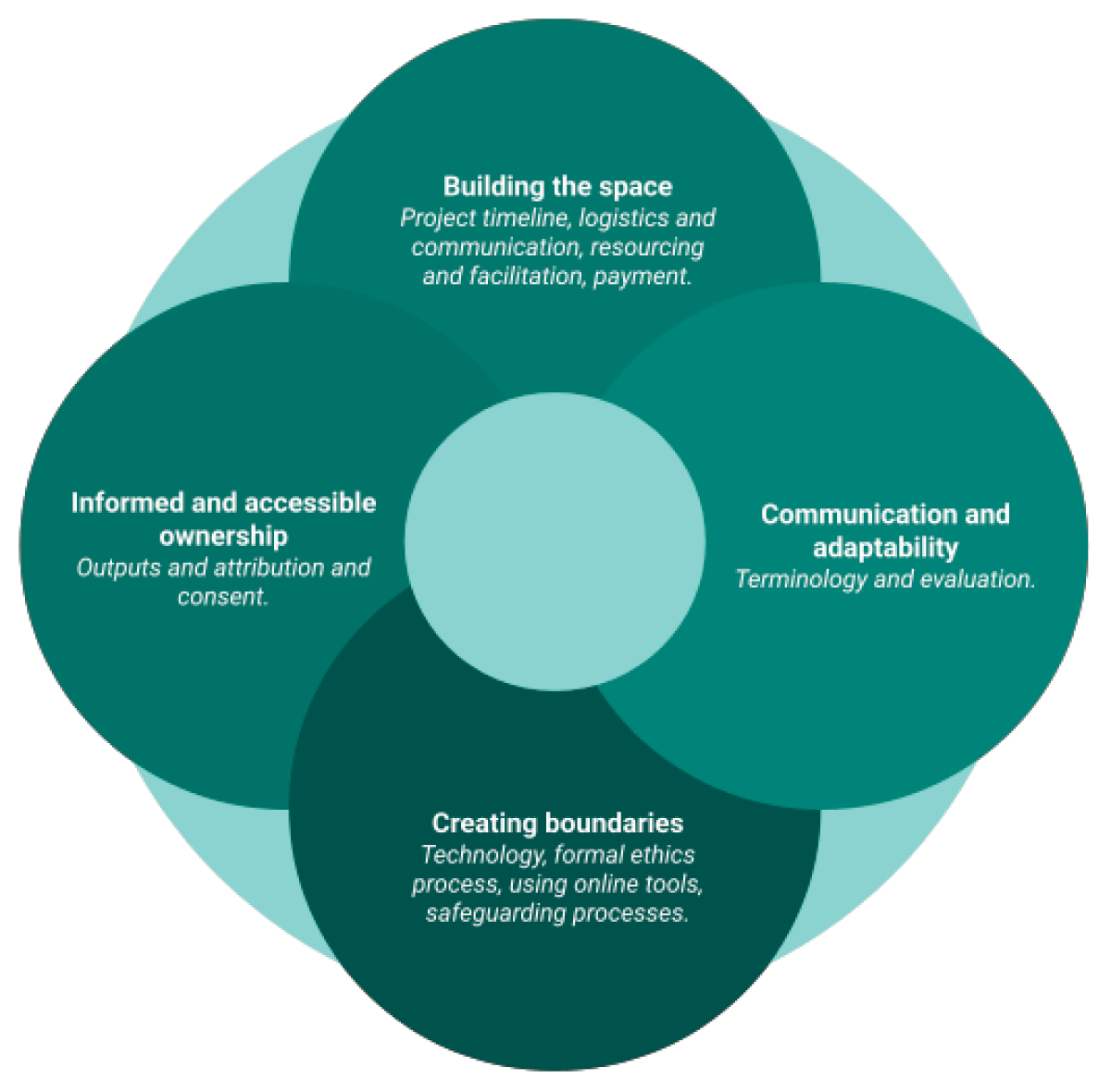
Figure 1
Four practice areas developed through collaborative reflection, grouping, and co-writing in Youth LIVES.
Table 1
Youth recommendations for future citizen mental health science projects.
| AREA | YOUTH RECOMMENDATIONS |
|---|---|
| Building the space |
|
| Communication and adaptability |
|
| Informed and accessible ownership |
|
| Creating boundaries |
|
No formal framework was used to analyse the insights from the youth contributors. The process was designed to produce a collaboratively authored practice account rather than to establish the prevalence of particular views or to evaluate the effectiveness of Youth LIVES. The four practice areas and recommendations represent the collective reflections of the team, while not suggesting that every contributor held identical views on each issue, or that they represent all those involved with Youth LIVES.
Ethics, safeguarding, and data
Ethical approval was granted for the Youth LIVES project, for its evaluation, and for this collaborative reflection.
Written informed consent was obtained from youth contributors for participation. Parental or guardian information and consent forms were also completed for contributors aged under 18. Contributors were informed that participation was voluntary and that they could withdraw from the process or request that their contributions not be used unless they had already been published.
Consent for attribution was treated as a continuing decision rather than a single choice made at recruitment. Contributors could choose not to be identified, to use an alias, to be credited by first name, or to use their full name. These choices could be changed before submission. Contributors were informed of the possible identifiability associated with attribution and co-authorship. All draft outputs, quotes, and attribution decisions were shared for review before submission.
Safeguarding responsibilities lay with the lead facilitator who was trained as an NSPCC Designated Safeguarding Officer and followed University of York safeguarding procedures if a concern or disclosure arose. This included seeking advice from the University safeguarding team and discussing appropriate support or escalation with the youth contributor.
Youth recommendations for future practice
The collaborative reflection and co-writing process produced four interrelated practice areas and 16 recommendations for future citizen mental health science projects. The sections that follow explain the Youth LIVES experiences supporting each recommendation.
Building the space
This group of reflections relate to the practical conditions that shaped whether youth co-researchers could participate consistently and meaningfully. They include the pace and timing of the project, communication and logistical arrangements, facilitator approach, and payment for contributions.
Timeline
Participation in the project was designed to be flexible, ensuring that young people could engage at their own pace without feeling undue pressure to prioritise sessions over other commitments. This reflected recommendations that youth research facilitation should accommodate changing availability, and life-stage demands (Spuerck et al. 2023). This approach worked well, as some joined from the beginning while others entered partway through. Thanks to tools like recorded sessions, written notes, and visual aids such as Jamboards (a sticky-note board now decommissioned by Google) it was easy to catch up and contribute actively. One contributor highlighted that “the recordings, written notes, and short breakdowns were really helpful” for staying on track. Another shared that transitioning into the group was seamless because “all the recordings and notes were so clear,” and the breakdown of sessions made it simple to stay informed and involved. These efforts felt inclusive and showed that the project was designed with collaborators’ needs in mind.
The use of monthly meetings was another key strength. This gave space to balance involvement with other aspects of life, such as school, work, or personal commitments. One youth contributor noted, “The monthly meetings were good because they were easier to balance with other commitments than more regular meetings would’ve been.” This pacing also encouraged deeper engagement with the research questions, allowing ideas to be refined thoroughly. Another contributor reflected, “If it had done the original timeline, we wouldn’t have got the same knowledge and understanding from it as we did.” As one contributor put it, “Life happens! I liked the fact it went slower than originally intended… It allowed us to thoroughly break down the question we were being asked and figure out exactly what we wanted to say.”
The structure of the research team meetings was widely praised for its balance of flexibility and focus, enabling meaningful discussions while “moving at a good pace,” and avoiding the frustration of lingering on one task for too long.
Contributors enjoyed the project’s mixture of question-and-answer sessions (Q&As) and group discussions, which added variety, gave space for everyone’s questions and answers, and kept the process engaging. Alongside this, there were regular check-ins by project facilitators.
Flexibility was key to enabling participation and reflects other literature that notes that participatory research should accommodate young people’s different time commitments rather than assume a linear timeline (Rosen 2023; Humphrey and Coleman-Fountain 2024). In our case, institutional delays reduced what the project could deliver.
Logistics and communication
The project’s approach to logistics and communication was widely appreciated for its flexibility and inclusivity. Given the diverse group of collaborators, ranging from teenagers to older adults with varying schedules and commitments, the structure prioritised accommodating as many people as possible.
Meeting dates and times were chosen collaboratively using Doodle polls. One contributor noted, “The variety of timeslots for the schedule was great as it allowed everyone to have their say in this project.” Another reflected that the way dates were spread out and communicated made it easier to stay engaged without feeling overwhelmed.
Regular reminders about upcoming sessions were appreciated by contributors, as these kept the project on their radar, helped them stay organised, and reduced the likelihood of missed meetings.
Suggestions for improvement included offering multiple sessions for collaborators to choose from to increase attendance and provide more flexibility. Unfortunately, resource constraints made that difficult to implement, but it could be feasible for future projects with more resources.
The length of the meetings, which began as an hour and were extended to around an hour and a half following feedback, was also a point of discussion. Many felt this duration struck the right balance, allowing enough time to explore ideas thoroughly without feeling overly long. Some contributors suggested extending to two hours might have allowed for even deeper engagement, particularly when the discussions became especially engaging or complex. However, one contributor highlighted that this may not be inclusive for all, and that “if sessions in the future were to be extended to two hours, then an option of being able to leave/join, when necessary, should be emphasised.”
Regular communication, advance scheduling, reminders, transcripts, and recordings helped youth contributors understand what had happened and re-enter the work when they could not attend live. This supports research showing that digital inclusion depends not only on the tools used, but also on the organisational support surrounding them (Izzidien et al. 2024; Donnan et al. 2025).
Resourcing and facilitation
The resourcing and facilitation provided throughout the project played a crucial role in creating an environment where youth co-researchers felt supported and engaged. This reflects research that emphasises that meaningful youth engagement requires skilled facilitation, rapport, clear communication, and sufficient time to build trusting relationships (Spuerck et al. 2023; Nguyen et al. 2024). Contributors particularly valued the warmth, friendliness, and rapport established by the research facilitators. As one contributor expressed, “having facilitators like Rhys and Sarah, who were consistently approachable, made the project feel lovely” and encouraged them to contribute more ideas than they might have otherwise. This warmth was essential, especially when discussing sensitive mental health topics, where contributors emphasised the need for a comfortable, non-intimidating space. The facilitators’ ability to maintain a casual and relaxed yet focused environment helped contributors feel at ease, and many appreciated that the facilitation was “not too overwhelming” but rather supported their engagement. The facilitators were felt to have taken a backseat and gave the floor to the co-researchers to give their ideas, ensuring everyone had chance to speak and was listened to. They helped to spark ideas in the co-researchers or encouraged discussion about a certain point but allowed youth co-researchers to decide on the ideas. Facilitators asked each youth co-researcher to contribute (by writing or speaking) in turn, which although one contributor said could “sound like a negative as the floor wasn’t necessarily open… it was a huge positive as it gave everyone a chance to speak and contribute. This approach ensured that everyone felt their contributions were valued without fear of judgment or being rushed.
The balance between structure and flexibility was another strength in the facilitation. One contributor noted that the structure of the meetings helped them stay on track and remain engaged with the material. The facilitation team’s ability to guide discussion whilst allowing space for contributors to express themselves was recognised as a key factor in maintaining productive, open discussions, and built a safe space. For the purposes of Youth LIVES, “safe space” referred to a deliberately supported environment with clear expectations, choices over participation, facilitation, and routes to seek help or raise concerns. The concept of “brave spaces” has also been proposed to emphasise honest engagement, shared responsibility, and the possibility of challenge rather than promising complete safety (Arao and Clemens 2013). Research with young people addressing sensitive topics stresses that safety must be actively produced through relationships, methods, and continuing facilitation rather than assumed from the setting alone (Warrington, Langhoff, and Warnock 2025). A Youth LIVES contributor said the meetings felt like a “safe space” where people could speak freely, especially about challenging subjects. Facilitators were adept at bringing the conversation back on track if needed, offering support, and following up with additional resources when needed.
An area where the format could have been improved was greater interactions with other team members, which one contributor felt could have helped give a clearer sense of the broader project’s direction. An optional “festive” online meet-up in December 2023 was praised as helping improve connections and fostering a sense of camaraderie. Other researchers have found that informal socialising, networking, and unstructured interaction can support rapport and relationship-building within collaborative research groups, including in online settings (Li et al. 2023; Nguyen et al. 2024).
Our reflections suggest that warmth and approachability were a key part of enabling participation. Recent youth mental health research similarly describes meaningful involvement as relational and caring, grounded in empathy, flexibility, dialogue, and researchers’ willingness to engage with young people as whole persons rather than simply as sources of knowledge (de Alcântara Mendes et al. 2025). Through Youth LIVES, care was enacted through invitations to contribute without pressure, attentive listening, follow up, continuity, and maintaining a relaxed but purposeful environment.
Payment
Youth co-researchers were given £25 Amazon vouchers for each session they attended. Payment prompted discussion about fairness, autonomy, and recognition. Financial or material compensation can recognise contributors’ time and effort, but ethical concerns can arise if incentives encourage participation against a person’s better judgement (Różyńska 2022). Facilitators assured youth co-researchers that they didn’t need to contribute any more than they felt comfortable with, with one contributor noting, “You were never required to share anything or take part in ways that made you uncomfortable.” This emphasis on choice helped mitigate the risk of coercion and reinforced the idea that payment should be viewed as a token of appreciation, rather than a condition for involvement.
Vouchers did help contributors participate: “I love this project and discussions, but the £25 gift card has helped prioritise this over other stuff.” They noted that the payment played a role in their ability to engage fully without neglecting other responsibilities.
The choice of payment method also sparked reflections on the fairness of compensating collaborators. As one contributor noted: “These [vouchers] are good for under18s, particularly with minimum wage for young people being so low.” This comment highlights the financial challenges faced by some younger contributors, making payment an important tool for ensuring equitable participation. The concern around low wages was further echoed by another contributor, who remarked, “This policy is better than minimum wage.”
Other reflections raised questions about whether contributors’ time, expertise, and labour were being adequately recognised. Other participatory research literature notes that nominal payments and restricted payment methods may undervalue lived experience contributions (Frances and Lucas 2024; Lambley 2025). As one youth contributor reflected, “Some adults in the project, however, compared this to regular work, and the use of vouchers didn’t feel like it adequately reflected the value of contributions.” This highlights the tension between recognising contributions and working within institutional payment systems that may not reflect their perceived value.
Communication and adaptability
Communication and adaptability were closely connected because terminology and feedback shaped how youth contributors understood their roles and influenced the project.
Terminology
The terminology used in the project was an important topic of discussion, as labels can communicate different expectations about contributors’ roles, expertise, agency, and influence within the research process (Gibson et al. 2017; Gupta et al. 2023; Spuerck et al. 2023). Early on in Youth LIVES, we discussed terminology and revisited this during reflection sessions. The youth contributors agreed that the term “patient” did not feel appropriate, as it carried clinical connotations that didn’t align with the collaborative and empowering nature of their involvement. As one youth contributor explained, “Patient makes me feel like I played no research part in this study.” While the process could feel cathartic and even healing at times, it was clear to everyone that the project wasn’t about receiving treatment but about meaningful collaboration.
The term “co-production” resonated most strongly. Contributors emphasised that it reflected the collaborative dynamic of the project, highlighting that everyone was working together toward a shared goal. The term “collaborator” was important because it made everyone feel equal, and that all thoughts and opinions were welcome. One contributor noted, “We’re constantly working with each other and the researchers. It always felt like we’re all working together to the same goal.”
“Co-producers” and “co-researchers” were particularly favoured by contributors to describe their role: “the terms ‘co-producer and co-researcher’ definitely made me feel as though I was a part of the project from the get-go, and that my opinions would be valued.” These terms captured the active and engaged nature of their involvement, as opposed to terms like “public” or “citizen,” which some felt didn’t accurately describe the group. For example, one contributor observed that “public” suggested random individuals, whereas the youth co-researchers had been carefully selected and had a specific relationship to the work. Similarly, “citizen science” didn’t feel quite right, as for them, it evoked unrelated ideas of participating in less collaborative ways (contributory citizen science) and didn’t fully convey the depth of their collaborative role in the project.
Terminology is not neutral; it communicates the role and expertise that a project recognises. In this project, “co-researcher” and “co-producer” were preferred because they reflected the work undertaken, whereas “patient,” “public,” and “citizen scientist” did not fit all contributors identifies or experiences. Erwin et al (2024) notes the importance of describing young people’s research roles in ways that recognise their existing expertise.
Evaluation
The evaluation process at the end of the project was designed to ensure that youth co-researchers felt comfortable and confident in how their input was handled. Before data collection, youth co-researchers were provided with an information sheet outlining how their data would be used. It was emphasised that, while feedback would be used for evaluation purposes, responses would be anonymous, unless they chose to be named. This approach created a sense of security, allowing contributors to share their thoughts freely without fear of being singled out.
Evaluation considered different preferences for providing feedback, with the option of doing a survey instead of interviews at the end of the project. This was viewed as an inclusive way to capture feedback from a broader range of collaborators, as people often have different comfort levels when it comes to providing feedback verbally versus in writing.
Our reflections highlight the importance of giving contributors clear information about how their feedback will be used, stored, anonymised, and reported. Offering a choice between interviews and written surveys recognises that contributors differ in how comfortable they feel providing feedback verbally or in writing. Ideally, young people should be involved in shaping evaluation processes and methods rather than being treated only as sources of evaluation data (Powers and Tiffany 2006; Montrosse-Moorhead et al. 2024).
Creating boundaries
This group of reflections show how technology, ethics, online safety, and safeguarding shaped the conditions within which youth contributors could make choices, raise concerns, and participate meaningfully.
Technology
The choice of technology significantly shaped how the project facilitated communication and collaboration. Discord, initially selected for its Q&A capabilities and group interaction features, received mixed feedback. While some valued its flexibility, others found it less suitable for professional use and challenging to manage multiple accounts for personal, academic, and work purposes.
Later, Zoom was used, which contributors appreciated, finding it easier to navigate and better suited for formal discussions.
The interactive tools of Jamboard and Google Docs played a vital role in keeping youth co-researchers engaged, helping them map out ideas and fostering a sense of ownership and teamwork. Activities like editing documents in different colours stood out as a favourite: “I LOVED the tasks where you had a Google Doc and just went through it, editing and adding your thoughts. It felt like such a good way of getting a say.”
The use of multiple platforms was both a strength and a challenge. While these tools offered valuable interactivity and real-time collaboration, the variety sometimes felt overwhelming. Switching between platforms added complexity and occasionally made it difficult to keep everything organised. Similar tensions have been reported in digital collaborative research, where multiple tools can facilitate engagement while also increasing cognitive and organisational demands (Li et al. 2023; Łobacz et al. 2023).
Our mixed experiences show that familiarity with a platform is not the same as suitability. In Youth LIVES, suitability depended on access, privacy, moderation, the subject matter, and contributors’ preferences. This is consistent with research showing that young people’s online experiences are shaped by platform governance, moderation structures, and the degree of control given to users, and that young people should be involved in decisions about online spaces (Yoon, Zhang, and Seering 2025).
Formal ethics process
Youth contributors described the project’s ethical approach as supporting respect, agency, and ownership. Ethical practice in citizen science extends beyond formal approval to continuing consideration of relationships, power sharing, whose knowledge is recognised, and how decisions are made (Groot and Abma 2022). Our discussions highlighted tensions between conventional formal ethics processes and the evolving nature of participatory research, which may not fit approval and governance systems developed for more traditional research (Goodyear-Smith, Jackson, and Greenhalgh 2015; Bussu et al. 2021). Delays in approval, including questions about how youth co-researchers should be represented within the bounds of conventional ethics processes (for instance, a preference to always anonymise rather than use informed dynamic consent) were experienced as frustrating. These reflect the challenges of integrating newer, more inclusive research methodologies within traditional ethical frameworks. One contributor expressed frustration with the slow progress in shifting ethical paradigms: “It’s a long time to be doing this work to still get these viewpoints. Our understanding of ethics should have moved along now.” However, one contributor expressed, “I’m just grateful that you guys took the time and effort to put in all these extra ethics… I don’t think I’d enjoy it half as much with the bare minimum.” The ability to control their level of involvement and visibility ensured that the research process felt collaborative rather than exploitative.
A contributor’s comment about the potential stigma of having mental health issues publicly linked to an individual was a poignant reminder that ethical considerations should also include emotional and social dimensions, such as the impact of revealing personal information. “I think there is something to say about having a public document which could imply that you have had mental health issues and that being attached to you. But by not giving us the chance to have ownership, it perpetuates the stigma of mental health.”
These reflections distinguish formal ethical approval from ethical practice throughout a project. Approval was necessary, but it did not resolve continuing questions about power, attribution, emotional risk, or responsibility. This aligns with MacLachlan et al. (2024), who describe the need to have ongoing ethical discussions following formal approval to address persistent power differences between young people and researchers, and review involvement and boundaries as contributors’ circumstances change.
Using online tools safely
Online safety was a central concern, particularly as the project involved discussing sensitive topics in digital spaces. Contributors reflected on what constituted a safe digital space and how different tools shaped their sense of security.
One contributor shared a humorous but pointed comment, saying, “Discord and safeguarding are two words that I never thought I’d hear in the same sentence.” Despite initial concerns about the suitability of Discord, the consensus seemed to be that “safety was fine” indicating that, with proper measures in place, even less conventional platforms could be used responsibly.
WhatsApp was mentioned as a tool that could have been used more extensively: “WhatsApp could have been good, it helped people share things and give out information,” while another echoed this sentiment, saying, “I second more use of WhatsApp too.” These comments support the platform’s potential to facilitate casual communication, brainstorming, and logistical coordination, while remaining user-friendly and familiar.
However, online safety was still a topic of concern, particularly regarding exposure to harmful material and maintaining privacy. As one contributor explained, “In theory, anywhere can be used safely with enough safeguards, but on the whole, when talking about something like this [mental health], there’s very few places,” emphasising the need for intentionally designed digital spaces, especially for sensitive topics. They stated, “Online safety, to me, more so refers to limiting exposure to harmful material (in this context), and providing an air-gapped forum, so one has to jump through a hoop or two to get in and of course have moderators.”
Overall, the discussion emphasised that online safety in research extends beyond choosing an appropriate platform and depends on intentional safeguards. As one youth contributor observed, “If people can talk to each other, it is unsafe immediately.” Safety was supported through controlled access, permissions, moderation, clear expectations, and restricting some platforms or documents to authorised team members. As on other projects (Bellini et al. 2024; Yoon, Zhang, and Seering 2025), the risks and safeguards associated with each digital spaces were explained and reviewed whenever the platform, activity, or contributors’ circumstances changed.
Safeguarding process and support
The safeguarding process was a key topic of discussion throughout the project, and a recurring theme was the need for clear responsibility and support structures to ensure the safety and well-being of all.
One contributor emphasised the importance of having clear points of contact and a team with adequate knowledge and appropriate training: “There should be points of call especially for young people. I think at least some knowledge is good like the training you received as researchers.”
Another contributor added that, while the researchers bear ultimate responsibility for safeguarding, especially when it comes to escalations and disclosures, it’s crucial that others, like the funder and university, take an active role in supporting the process. One contributor also stressed the importance of signposting to appropriate persons who can help in safeguarding instances: “the importance of the collaborators knowing who else [other than project facilitators] they can go to when extra safeguarding is in place—since not knowing is really dangerous and can make someone feel trapped.”
The importance of pastoral care and emotional support for the research team, especially when working on sensitive topics, was also highlighted. One contributor stated, “I definitely think that there should be people there for you guys [facilitators] pastorally too, to ensure that you’re alright as you’re under a lot of pressure.”
A recent Wellcome report stated, “while safeguarding citizen scientists, especially those with lived experience of mental health challenges is essential, stakeholders should avoid overestimating vulnerability, which could unnecessarily restrict engagement and contributory opportunities” (Batty et al., 2024, p.6). However, the views of the youth contributors’ contrast with this, noting that safeguarding concerns should not be seen as a hindrance to the continuation of projects but should instead be seen as a necessary element for the safety and success of such initiatives. One contributor said that “to avoid projects like this due to safeguarding concerns would eventually make mental health worse, since there’d be such little knowledge surrounding it. You need to do more research like this to actually protect people’s wellbeing in future.”
Our reflections suggest that shared involvement does not require equal safeguarding responsibility. Youth co-researchers should have clear roles, meaningful influence, and appropriate support, while trained adults remain responsible for research delivery, young people’s wellbeing, and safeguarding. This aligns with MacLachlan et al. (2024), who argue that meaningful youth involvement need not involve equal sharing of all responsibilities, and that researchers retain accountability to academic institutions and funders.
Informed and accessible ownership
The reflections below show that ownership involved both influence over the project and control over how contributions were represented in its outputs. Accessibility, attribution, authorship, consent, and public visibility were therefore closely connected.
Outputs
The project placed strong emphasis on producing accessible outputs for a variety of audiences, which was highly appreciated by contributors. In terms of the project’s digital presence, the importance of accessibility was a recurring theme. One contributor suggested incorporating accessibility features for the website, such as options for different fonts, text sizes, and colour changes, to ensure that it was inclusive for a wide range of users. Other research has emphasised the importance of involving contributors in designing outputs. For example, youth with dyslexia identified important design requirements relating to fonts, colour combinations, formats, and screen-reader accessibility (Faux-Nightingale et al. 2024). Contributors can help decide on the mechanisms for disseminating research outputs, and produce materials in accessible forms for their intended audiences (Bailey et al. 2024; Benz et al. 2024).
Attribution and consent
The process of dynamic consent and attribution in the Youth LIVES project was designed to prioritise youth co-researchers’ autonomy and preferences, allowing them to have control over how their contributions were acknowledged in different outputs. One contributor enthusiastically expressed their satisfaction with this approach: “IT’S PERFECT, LOVE THE DYNAMIC CONSENT.” This response shows the importance of giving collaborators agency in deciding how much visibility they wanted in the project. Another contributor also appreciated this flexible approach, noting that it gave them the opportunity to choose “based on the quotes or based on the outputs,” rather than forcing a blanket decision of approving everything or nothing. This option not only respected individual preferences but also accommodated diverse comfort levels and professional goals. Another contributor reflected “There can be lots of reasons you don’t want your name on the paper, for example, you might not be planning to work in this area.” Youth co-researchers were informed that if they used their real names, these would be publicly associated with the research, potentially remaining on the internet indefinitely.
Discussion was had around full name versus first name attribution, which revealed the complexities of balancing visibility with privacy. One contributor, working in cybersecurity, shared, “Having my name as an author on a paper in general would be really nice… but just thinking out loud, I wonder about what impact it could have on my career.” Similar tensions have been reported elsewhere: Publication can provide recognition and strengthen contributors’ voices but may also require decisions about personal disclosure and create possible professional or privacy risks (Dahlberg et al. 2024; Savarese et al. 2025).
In Youth LIVES, consent to participate, consent to publish a contribution, and consent to be publicly identified were treated as related but distinct decisions with different levels of attribution, consistent with dynamic informed consent, in which consent is revisited as a project and its uses develop (Tauginienė et al. 2021). This also reflects citizen science authorship guidance emphasising fair recognition of qualifying contributions while acknowledging that some contributors may have good reasons to decline authorship or public attribution (Sandin et al. 2024).
Implications for citizen science theory and practice
Across the four practice areas, the Youth LIVES reflections show that meaningful youth citizen science depends not only on inviting young people to contribute, but also on the conditions under which participation takes place. Time, communication, facilitation, ethics, safeguarding, accessibility, and control over attribution all shaped whether youth co-researchers could exercise meaningful influence.
Flexible pacing, accessible records, and asynchronous contribution helped youth co-researchers remain involved alongside changing educational, employment, health, and personal commitments. Rosen (2023) argues that participatory research must recognise differences between institutional timescales and peoples lived experiences. Youth LIVES experienced staff changes and institutional delays (especially around ethical approval and ensuring safeguarding measures were in place), and whilst individual facilitators were flexible, there was only so much they could do. Funders and institutions need to support by providing realistic timescales, contingency arrangements, and processes that can accommodate the non-linear development of youth citizen science.
Care and warmth were substantive aspects of facilitation. Approachability, continuity, attentive listening, invitations to contribute without pressure, and follow-up support allowed youth co-researchers to express ideas and concerns. This is consistent with youth mental health research describing meaningful involvement as relational and caring rather than simply procedural (de Alcântara Mendes et al. 2025). Facilitation and emotional support should therefore be planned and resourced rather than treated as personal qualities that individual researchers are expected to provide without additional support.
Additionally, clear ethical and safeguarding boundaries can support agency by helping contributors understand which choices they control, where confidentiality has limits, and who they can approach for help. Responsibility for disclosures, escalation, and access to appropriate support must remain with trained adults and accountable institutions. Boundaries can enable participation when they are transparent, proportionate, and open to review; they become restrictive when imposed without dialogue or used to exclude young people from sensitive research.
Finally, ownership included control over accessibility, attribution, authorship, and public visibility. Dynamic consent enabled youth co-researchers to reconsider how they wished to be identified before publication. Citizen science scholarship emphasises that substantial intellectual contributions should receive appropriate recognition, while the Youth LIVES reflections highlight that ethical recognition must also include the right to limit or decline public attribution (Tauginienė et al. 2021; Sandin et al. 2024).
Taken together, these insights give attention to the conditions under which participants can have meaningful influence. Responsibility for creating those conditions cannot rest solely with individual facilitators. Funders, institutions, ethics committees, publishers, and safeguarding bodies also shape the time, resources, payment systems, approval processes, and forms of recognition available. Whilst the recommendations in Table 1 were developed to be broadly transferrable principles developed through reflection on one case, we recognise that not all young people or citizen science projects will share the same experiences and priorities.
Conclusion
The reflections gathered from the Youth LIVES project show that meaningful youth involvement in citizen mental health science depends on how participation is structured. Flexible contribution routes, clear communication, supportive facilitation, appropriate safeguarding, fair recognition, and continuing choices about consent and attribution shaped whether youth co-researchers could participate on their own terms.
The recommendations developed through this collaborative reflection and co-writing process offer practical guidance for future projects. They also underline that institutions, funders, ethics committees, and publishers all influence the conditions under which participation takes place. Future initiatives should develop these conditions with young people from the outset and revisit them as circumstances and preferences change.
Ethics and Consent
Ethics approval for the Youth LIVES project was granted by University of York Health Sciences Research Governance Committee, Reference HSRGC/2022/537/D, and University of York Biology Ethics Committee, Reference SW202408. All youth contributors as authors provided consent, or parental consent if the youth co-researcher was under 18 during the project. Contributors reviewed their preferred form of attribution and approved the use of their contributions before submission.
Acknowledgements
We would like to extend our deepest thanks to all the youth co-researchers who generously contributed their time, insights, and perspectives to the Youth LIVES project. We are also grateful to all researchers involved in the project for their collaboration and dedication. We thank Professor Rachel Churchill and Dr David Marshall (Centre for Reviews and Dissemination, University of York) and Dr Debbie Maxwell (School of Arts and Creative Technologies, University of York) and Sophia Collins for their guidance as project team members. We are grateful to the Leaders Unlocked team for supporting the young people throughout the project, and to the Mental Health Foundation for their input into the project design. Finally, we acknowledge the Young Foundation for bringing together all the projects funded through the UKRI Citizen Science Collaboration grant.
Data Accessibility Statement
The materials underpinning this case study are not publicly available because they contain sensitive and potentially identifiable contributions from a small group of youth co-researchers.
Author Contributions
Rhys Archer and Sarah Knowles led the reflective process and the youth contributors actively contributed by sharing their perspectives and reflections on each aspect of the project. Over three collaborative writing sessions, Rhys Archer, Sarah West, Sarah Knowles, and the youth co-collaborators jointly wrote, reviewed, and refined the manuscript.