Have a personal or library account? Click to login
Building Bridges Through Infrastructure: Citizen Science and Institutional Integration in Air Quality Monitoring Cover

Building Bridges Through Infrastructure: Citizen Science and Institutional Integration in Air Quality Monitoring

Open Access
|Oct 2026
Read online

Figures & tables

Figure 1

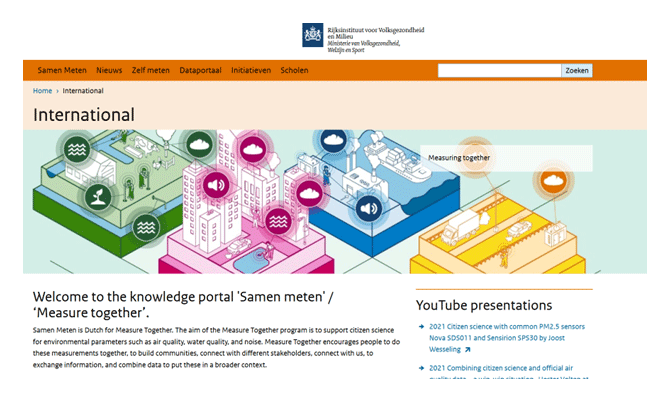
May 2026 knowledge portal of Measure Together. www.samenmeten.nl/international.
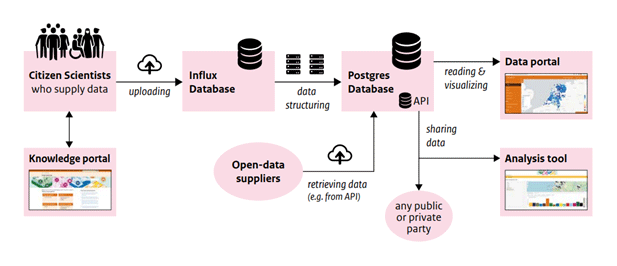
Figure 2

General outline of the Measure Together infrastructure. Obtained from de Ruiter et al. 2025. API: Application Programming Interface.

Table 1

Star and Ruhleder’s dimensions of infrastructure applied to citizen science (CS) infrastructure, official monitoring infrastructure, and hybrid infrastructure.

DIMENSIONDESCRIPTIONCITIZEN SCIENCE INFRASTRUCTUREOFFICIAL MONITORING INFRASTRUCTUREHYBRID INFRASTRUCTURE
EmbeddednessIntegration into technical, social, and institutional systems
  • - Not part of formal frameworks

  • - Short history limits legitimacy

  • - Emerging signs of integration

  • - Embedded in institutional governance/regulations (e.g., EU Air Quality Directive)

  • - Deep historical continuity

  • - Efforts like EU FAIRMODE demonstrate CS data calibration/benchmarking for indicative standards and improve modelling

TransparencyAccessibility of processes, tools, and outcomes
  • - Participatory data analysis tools, like Analyse Together

  • - Enables shared sense-making and engagement

  • - Inclusive transparency

  • - Public reports provide accountability

  • - Limited process visibility

  • - Lacks citizen participation

  • - Measure Together combines official and citizen data in dashboards

  • - Tools for both institutional and citizen-generated data

Reach/scopeGeographical and institutional coverage
  • - Mostly local or regional; Sensor.Community is global but formed by grassroots communities

  • - Often fragmented

  • - National/global focus, standardised approaches enforced at EU level

  • - Standardised, policy-relevant outputs

  • - Hybrid projects like Measure Together aggregate data across scales

  • - Sensor.Community’s data is linked to official data fusion efforts

Learned as part of membershipHow users gain expertise and competencies
  • - Informal, peer-to-peer learning, “learning-by-doing”

  • - Requires formal education and qualifications

  • - Hybrid initiatives offer events/workshops, bridging informal and institutional learning

Links to conventions of practiceAlignment with established norms, standards, and conventions of practice
  • - CS data can yield new insights (e.g., peaks), but lack official integration

  • - Efforts are mostly project or community specific

  • - Standardised workflows aligned with EU regulations

  • - Consistent, formalised reporting

  • - Emerging initiatives (e.g., FAIRMODE and CEN protocols) develop standards for low-cost sensors, offering ways to gradually integrate CS data

Embodiment of standardsPractices and processes defined by shared conventions
  • - Lacks universal data quality/metadata standards

  • - Qualitative data underutilised, no integration protocols

  • - Formal standards like EU Air Quality Directive guide calibration/reporting

  • - Reliability and reproducibility depend on these standards

  • - Sensors calibrated to institutional standards help bridge accuracy gaps between CS and official data (e.g., through benchmarking at EU level),

  • - Some CS projects add contextual data to complement official measurements

Built on installed baseFoundation from investment and legacy systems
  • - Fragmented/limited base due to funding, short projects, low-cost sensors

  • - Community-driven resilience emerging

  • - Decades of investment, regulations, calibrated instruments and institutional continuity

  • - Hybrid initiatives like Measure Together leverage institutional resources while fostering community engagement

Becomes visible upon breakdownHow failures become apparent to users
  • - Individual sensor failures often unnoticed; platform outages (e.g., Sensor.Community) trigger community mobilisation

  • - Failures highly visible at institutional levels, disrupt regulatory requirements, often only representation of air quality for large areas

  • - Hybrid infrastructures use redundancy (e.g., institutional back-up); community aids quick recovery of CS platforms

DOI: https://doi.org/10.5334/cstp.961 | Journal eISSN: 2057-4991
Language: English
Page range: 30 - 30
Submitted on: Dec 5, 2025
Accepted on: Sep 3, 2026
Published on: Oct 6, 2026
Published by: Ubiquity Press
In partnership with: Paradigm Publishing Services

© 2026 Henri de Ruiter, Kirsten Vegt, Hester Volten, Margaret Gold, Janneke Elberse, published by Ubiquity Press
This work is licensed under the Creative Commons Attribution 4.0 License.