
Introduction
Citizen Science (CS) involves the active participation of lay people in scientific endeavours that generate new knowledge or understanding (Robinson et al. 2018). For environmental monitoring, it is a transformative approach enabling the collection of data with greater temporal and spatial resolution (Chen et al. 2017; Cooper et al. 2007). The concept of “citizen sensing” is hereby particularly relevant, as it takes the motivations of citizens more explicitly into account. Citizen sensing extends beyond passive data gathering, emphasising the co-production of environmental knowledge and action-oriented approaches (Coulson et al. 2021). It represents an evolving set of practices that shapes how people make sense of their surroundings and take action. These practices are often messy, collaborative, and political (Pritchard and Gabrys 2016). Citizen sensing for urban air quality is especially prevalent, due to the ease of measurement and its relevance for human health (English et al. 2018; Oyola et al. 2022).
The contribution of citizen scientists’ measurements using low-cost sensors can complement and challenge traditional centralised air quality monitoring systems. CS initiatives can drive decentralised, community-driven air quality monitoring and influence local policies (Bonney et al. 2014). However, their integration into official environmental monitoring and policy frameworks still faces substantial barriers (Hecker et al. 2019; Mahajan et al. 2022; Turbé et al. 2019). CS data is often critiqued for its (perceived) lack of scientific rigour, lack of measurement quality, lack of representation, and misalignment with official monitoring practices (Jiang et al. 2018). Official monitoring systems are trusted for their robustness but are limited in spatial coverage, slow to adapt, and may not reflect local priorities. These limitations suggest that neither CS nor institutional systems alone can adequately address air quality monitoring complexities. A hybrid system combining the strengths of CS with the rigour of official frameworks may offer a more comprehensive approach.
Herein, we present the Dutch project Measure Together as a case study that shows how hybrid infrastructures can develop at the intersection of CS and institutional monitoring, and we reflect on how this relates to the theoretical concepts of boundary organisations (Guston 2001) and infrastructure (Star and Ruhleder 1996).
Initiated in 2016 by RIVM, the Dutch Institute for Public Health and the Environment, and funded by the Ministry of Infrastructure and Water Management, Measure Together supports citizen air quality monitoring through technical infrastructure and social activities. While the project’s primary aim is to investigate CS air quality data, the development of underlying data infrastructure has become a complementary focus area (Volten et al. 2023). Because RIVM is the national authority responsible for air quality monitoring in the Netherlands, Measure Together is positioned between local CS efforts and centralised official measurements. It thus demonstrates how the combination of boundary and infrastructural work can facilitate the emergence of hybrid infrastructures, enabling the integration of CS data into official monitoring practices.
Our presentation of this case is informed by more than eight years of involvement with Measure Together and various associated CS air quality initiatives. Our sustained involvement provides insider knowledge into the practicalities of building a sociotechnical infrastructure. Our empirical basis includes public and internal project documents, social events, interviews (e.g., Blokhuis et al. 2019), internal and external discussions, and reports (e.g., RIVM 2016; RIVM 2017; de Ruiter et al. 2025), documenting the evolution of Measure Together’s sociotechnical infrastructure since 2016. We connect these insights to theoretical frameworks as reflective practice, aiming to draw insights that extend beyond our case. The author team reflected on how Measure Together can function as a hybrid infrastructure using an analytical framework (see below). The author team consists of researchers with different scientific backgrounds and positions: the project leader who is responsible for strategy and development of Measure Together; a project member experienced in citizen sensing and air quality; two researchers with experience in trust and the social dimensions of CS; and an academic researcher, outside of RIVM and Measure Together, involved with multiple CS projects, who is able to provide an outsider’s perspective. Our own involvement in this project shapes the interpretation of this project and its development. As we are embedded within the institutional context of RIVM, our analysis may reflect institutional priorities and assumptions. To mitigate this, we included an external researcher in our author team and refer to earlier interviews with citizen scientists to include their viewpoints.
Analytical framework: infrastructures and boundary organisations
The concepts of infrastructures (Star and Ruhleder 1996) and boundary organisations (Guston 2001) provide complementary perspectives for understanding the sociotechnical systems that underpin CS and its (potential) connections with institutional systems. The infrastructural lens highlights the technical and social practices that make CS data meaningful and comparable, whereas boundary organisations illustrate collaboration and negotiation between different systems. Together, they account for how hybrid infrastructures emerge.
Relational and emergent infrastructures
Star and Ruhleder (1996) describe infrastructure as relational and emergent, gaining significance only when integrated into specific social and technical systems (Bowker and Star 2000; Edwards et al. 2007). For example, in citizen sensing, sensors become infrastructure only when embedded in a network of actors and used for collective knowledge development. The concept of infrastructure as relational and emergent has direct implications for CS, where alignment between CS tools and institutional systems is critical for data integration into formal workflows. As Ottinger (2022) emphasises, CS data must be embodied in routine practices for successful integration, and infrastructure becomes only usable through participation in the social world that the infrastructure supports (Star and Ruhleder 1996).
The relational view of infrastructure complicates boundaries between infrastructures like Measure Together and official monitoring infrastructures such as those surrounding RIVM’s official data sets. Both are sociotechnical, involving human actors, sensors, technologies, and protocols. Nonetheless, CS infrastructure is more participatory and decentralised, relies on low-cost technology, and is driven by different logics, like the co-production of knowledge and community interaction. Official infrastructures are more formalised and centralised to ensure high standards and accountability. These differences significantly affect how infrastructure features develop. We distinguish between CS infrastructure, comprising participatory and technical elements, and official infrastructure, which is institutionalised, standardised, and geared towards formal reporting. We conceive of hybrid infrastructure as the sociotechnical systems that emerge at the interface of CS and institutional monitoring. Hybrid infrastructure denotes the (sometimes partial and evolving) integration of practices, data flows, and organisational routines from both CS and institutional domains, resulting in new forms of collaboration and knowledge production.
Boundary organisations and hybrid management
Boundary organisations are crucial in mediating these interactions. Guston (2001) describes boundary organizations as entities at the interface of distinct social worlds, facilitating collaboration while addressing differing needs. They create boundary objects, shared artifacts, or tools flexible enough for various stakeholders but coherent enough to provide common ground (Star 2010).
Measure Together acts as a boundary organisation, providing tools and resources to connect participatory CS initiatives with formalised institutional systems. This unique role helps to foster “Civic Intelligence” (Mahajan et al. 2022, p. 11), a form of data literacy that empowers individuals and communities to make sense of environmental information and use it effectively. This emerges from experience and know-how shared in online communication channels and in-person events, and from data analysis and visualisation tools. These in turn serve to build trust between citizen scientists, scientists, policymakers, and other stakeholders as well as in the data itself (Vegt et al., 2023).
Miller (2001) extends boundary organisation theory to more complex, contested, and multi-stakeholder settings through the concept of hybrid management: Boundary organisations must continuously negotiate their position through strategies of hybridisation, boundary work, and cross-domain orchestration. It is less explicit about the material and technical conditions that make these strategies viable. In the context of CS, where data is generated by heterogeneous communities using low-cost technologies, infrastructural work is essential to make heterogeneous data comparable and usable across institutional boundaries. The Measure Together case suggests that infrastructural work is an integral part of boundary work and deserves recognition as a fifth function of hybrid management. Boundary organisations in CS contexts increasingly act as infrastructure assemblers (Johnson et al. 2021), building the sociotechnical systems that make mediation possible in the first place.
Finally, the Measure Together case also points towards time as an important factor when considering infrastructure and boundary organisations. It suggests a temporal misalignment where two infrastructures with different timelines must be aligned. In the context of CS and official monitoring, these differences are significant: citizen scientists operate on action-oriented timelines, while institutional processes of standardisation and policy integration move much more slowly. How a boundary organisation navigates this tension, that is, how long it can sustain a mediating role before pressures from either side become destabilising, is a central question.
Case context: citizen science air quality data in practice
The need for infrastructural work becomes apparent when considering the nature of CS air quality data itself. The number of low-cost air quality measurements and community-based monitoring initiatives has grown rapidly, highlighting their potential for standardising methods in air quality monitoring, particularly for particulate matter (PM10 and PM2.5). At the start of Measure Together in 2016, there were a few dozen PM sensors in the Netherlands, growing rapidly to almost 4,000 in 2025, amassing more than 5 billion measurements. Air quality data is obtained from a wide range of projects. In 2025, about two-thirds of sensor data is obtained from Sensor.Community, an international citizen sensing community, and one-third is of sensor data from local Dutch CS initiatives. Less than 5 percent of all sensors have been distributed by RIVM itself.
Therefore, Measure Together is not a bounded project with a defined system design, participant recruitment, and so on. It represents an emerging infrastructure, emphasising Star and Ruhleder’s point that infrastructures emerge relationally and incrementally and are not designed upfront (Millerand and Baker 2020).
Calibration to improve data quality
PM sensors are sensitive to external conditions because they use optical systems to detect particles, which manufacturers’ proprietary algorithms translate into mass concentration estimates. As a result, calibration is key for improving sensor data (Jayaratne et al. 2018). While collocation is standard in scientific projects, CS initiatives often lack access to costly reference instruments. RIVM adopts a network calibration approach for sensors due to the impracticality and cost of individual calibration (Wesseling et al. 2024). The approach assumes uniformity in sensor setups, which is not always the case, and thus some sensors are excluded from the calibration algorithm. This reflects a tension between localised solutions and the standardisation needed for integration. At the same time, for integration within official framework, these calibration processes are necessary to ensure comparability and reliability.
Case study: Measure Together
Measure Together emerged to meet citizen scientists’ demand for a centralised knowledge and data portal. Citizen scientists wanted to learn from other initiatives and compare data but lacked resources to develop a central platform. Simultaneously, RIVM sought greater insight into the activities and findings of these CS projects, recognising their increasing relevance in the field of air quality monitoring.
The founding symposium for Measure Together in 2016 illustrates this. It brought together a wide range of organisations: policy makers, citizen scientists, knowledge institutes, and universities. Importantly, RIVM’s director explicitly expressed the need for a “network approach,” noting that the relationship between institutions and citizens is changing (RIVM 2016). This illustrates that boundary work within Measure Together was envisioned from the very beginning, and that the community was seen as much broader than just RIVM itself.
At this founding symposium, a knowledge portal (Figure 1) was launched to exchange information. The next year, a data portal (see https://sensors.rivm.nl) was launched to compare data across different initiatives, and to solve several data-related issues at national scale (data storage, visualisation, etc.).
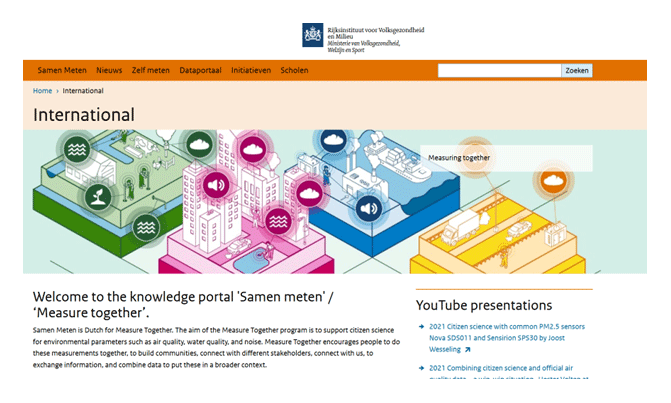
Figure 1
May 2026 knowledge portal of Measure Together. www.samenmeten.nl/international.
A data portal requires reliable mechanisms for integrating data from various projects into a centralised system (see Figure 2). Several methods have been employed to gather data from CS initiatives, ranging from DIY-kits of Sensor.Community, where citizens connect to their home WiFi and transmit data to Measure Together via a public Application Programming Interface (API), to commercial “plug-and-play” sensor kits that automatically send data via narrowband IoT. These varied approaches reflect both the grassroots innovation and the increasing professionalisation of CS air quality monitoring.
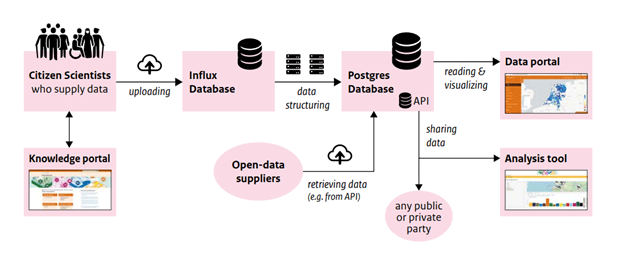
Figure 2
General outline of the Measure Together infrastructure. Obtained from de Ruiter et al. 2025. API: Application Programming Interface.
Measure Together facilitates community interaction through events, forums, and communications. The annual Clean Air Agreement Participation Day organised by RIVM is particularly important. It involves sharing updates on RIVM’s work on its CS activities and on the official air quality monitoring tasks. Held at RIVM, the event provides the opportunity to view official measurement equipment and meet people responsible for official air quality monitoring. Discussions are used to guide further development of Measure Together, such as enhancing data portal functionalities for higher-resolution measurements. In addition, Measure Together project members attend community events (an estimated 10–20 events annually) in varying roles, from giving general advice to becoming part of data analysis.
From parallel to hybrid: citizen science and official air quality monitoring infrastructure
Measure Together develops a sociotechnical infrastructure for CS data to standardise and integrate it into official air quality monitoring. However, many processes remain separate, limiting full integration and institutionalisation. To explore this further, we draw on Star and Ruhleder’s (1996) dimensions of how infrastructure emerges. These dimensions help identify where CS infrastructure aligns with, or diverges from, established institutional systems. The following section (summarised in Table 1) uses these dimensions to descriptively compare CS and official infrastructures, and highlights areas where integration is beginning to occur. In the subsequent reflection section, we build on this comparative analysis to draw out broader analytical insights and discuss implications that extend beyond Measure Together.
Table 1
Star and Ruhleder’s dimensions of infrastructure applied to citizen science (CS) infrastructure, official monitoring infrastructure, and hybrid infrastructure.
| DIMENSION | DESCRIPTION | CITIZEN SCIENCE INFRASTRUCTURE | OFFICIAL MONITORING INFRASTRUCTURE | HYBRID INFRASTRUCTURE |
|---|---|---|---|---|
| Embeddedness | Integration into technical, social, and institutional systems |
|
|
|
| Transparency | Accessibility of processes, tools, and outcomes |
|
|
|
| Reach/scope | Geographical and institutional coverage |
|
|
|
| Learned as part of membership | How users gain expertise and competencies |
|
|
|
| Links to conventions of practice | Alignment with established norms, standards, and conventions of practice |
|
|
|
| Embodiment of standards | Practices and processes defined by shared conventions |
|
|
|
| Built on installed base | Foundation from investment and legacy systems |
|
|
|
| Becomes visible upon breakdown | How failures become apparent to users |
|
|
|
Embeddedness
Official infrastructure is embedded in the social and technical systems of air quality monitoring. European Union (EU) air quality monitoring is highly regulated, particularly through the Ambient Air Quality Directives 2008/50/EC and 2024/2881/EU. These directives set limit values for regulated pollutants and measurement uncertainties, specify the number and locations of required sampling points, and incorporate mechanisms to advance air quality monitoring through scientific and technical development. For instance, the Forum for Air Quality Modelling in Europe (FAIRMODE) supports the harmonised use of air quality models by facilitating cross-national cooperation. This ensures that air quality monitoring is continually improved, further reinforcing the embeddedness of official infrastructure across EU member states.
Embeddedness is rooted in the historical continuity of air quality monitoring. RIVM’s air quality data archives date back to 1976. This history has entrenched official air quality infrastructure in institutional routines, reinforcing its legitimacy and authority. This provides a trusted basis for interpreting long-term trends and enforcing regulatory compliance.
CS measurements and data currently sit outside this regulatory framework, partly because many techniques are new and not addressed in EU guidelines. Efforts by institutions like RIVM are helping to bridge this gap at the European level. For example, RIVM assesses sensor data quality after calibration to determine if low-cost sensors can achieve indicative measurement status—the minimum threshold for regulatory recognition (Hoogerbrugge et al. 2025). While calibration efforts can correct systematic biases, addressing random biases is more challenging. The limited history of CS air quality data also affects its current status, as it limits the demonstration of long-term reliability, which is critical for the trust and legitimacy required for regulatory frameworks.
By systematically evaluating CS data quality and applications, pathways are created for air quality modelling and the gradual acceptance and incorporation of CS data into air quality governance. Embedding CS data within formal data would further strengthen its credibility, while also enriching official data with local context.
Transparency
Transparency is a critical infrastructure dimension, making processes and outputs visible and accessible to users without requiring deep technical expertise. Measure Together supports participatory approaches to transparency by involving participants in open data sharing and data analysis. An example is the Analyse Together tool (Tenner et al. 2024), an open-source tool allowing citizen scientists to collaboratively explore and interpret their data alongside data from official sources. Participants can engage with patterns and sources of air pollution, fostering shared ownership of the process and results. This approach breaks down barriers between data producers and data interpreters, making analyses more inclusive (Haklay 2012). The transparency fostered by Analyse Together is both technical and social, integrating citizens into knowledge-making and valuing their contributions. In this regard, Analyse Together, “might be regarded the most explicit instrument that RIVM employees have developed to enable (or even provoke) ‘civil investigation’” (Kolks 2024, p. 139). Analyse Together shows how CS infrastructure distributes participation in data interpretation.
Transparency in official monitoring is linked to institutional accountability and scientific credibility. RIVM reports are thoroughly documented and publicly accessible, supporting public trust and regulatory scrutiny. Although being public, the processes of selecting, analysing, and interpreting data often remain opaque because they are communicated in terms difficult for non-experts to interpret or engage with. This limits the opportunities for participation. Official infrastructures thus excel at producing authoritative results, but often lack the participatory dimensions of CS initiatives.
Reach or scope
Official European air quality monitoring is standardised and operates at (inter)national scales. CS projects typically operate at local or regional scales such as neighbourhoods or cities. Measure Together bridges these scales by collecting data from various CS initiatives. A notable example is data from Sensor.Community, a decentralised network where individuals contribute air quality data from low-cost sensors worldwide, potentially by-passing many national or European standards. Despite its global reach, or maybe because of its global nature, efforts to integrate Sensor.Community data with official national monitoring networks are limited, with Measure Together being one of the few projects exploring how such data might complement official monitoring. RIVM also participates in European projects aimed at integrating CS data from community-based Citizen Observatories (WeObserve 2021) with official data, such as in the EU CitiObs and the Flemish Samen voor Zuivere Lucht project. Thus, there are ongoing efforts to align CS contributions with institutional frameworks at different geographical scales.
Learned as part of membership
Expertise with official air quality monitoring systems is usually acquired via formal education and training. For instance, many experts at RIVM completed specialised academic training.
CS projects cultivate expertise through participatory, hands-on learning. While many citizen scientists have technical backgrounds, they usually learn informally through community engagement, experimentation, and collaboration. As people become members of CS communities, they familiarise themselves with the tools and practices in use, though this process is less standardised and more dependent on trial, error, and peer learning. CS initiatives often prioritise democratising knowledge. Unlike formal institutional education, this approach emphasises participation and collaboration. Measure Together tries to bridge these two approaches by events like the annual Participation Day, where experts and citizen scientists meet to exchange ideas and knowledge.
Links to conventions of practice
Official systems closely follow governmental workflows to ensure consistency from data collection to public communication. RIVM’s annual air quality report follows a well-established process, relying on input from various stakeholders like municipalities. This standardised approach defines clear responsibilities for all stakeholders, ensuring that the results are comparable over time and easier to interpret, and that reporting is in line with the EU Air Quality Directive. Breaching EU limit values requires counteractive policies, and the focus on annual average concentrations—based on scientific and policy considerations—guides monitoring and reporting. However, these averages may not reflect citizens’ lived experiences, particularly with localised or time-bound issues like wood burning or industrial emissions.
CS initiatives often emerge independently, and rarely align with institutional processes. While CS efforts can provide complementary data, such as capturing peak concentrations, they lack systematic integration with official monitoring or policy making processes. For example, there is currently no structured process similar to RIVM’s annual reporting that incorporates CS data into official workflows. Interpretability of CS data is further complicated by issues such as sensor downtime, suboptimal mounting locations, and unexplained data peaks lacking metadata, often leading to the peaks being viewed as outliers. Efforts to address these issues vary significantly and remain project specific or ad hoc. To improve consistency, RIVM works with European partners in FAIRMODE to benchmark and standardise approaches, helping to unify sensor data handling.
As low-cost sensors become more common, the European Committee for Standardisation (CEN) has developed protocols for their evaluation. According to CEN, “a protocol will enable exhaustive and transparent evaluation of sensor systems that can be an important step towards including sensor system measurements into the monitoring of air quality for regulatory and non-regulatory purposes” (CEN 2024). These protocols establish methods for testing sensor performance, and ensuring transparent, consistent data handling. However, they do not yet address network calibration, acknowledging that “new technologies are evolving rapidly,” nor do they resolve the need for “a common terminology and transparency in data processing.” These protocols are an important step towards integrating sensor data into official frameworks but are mainly designed for regulatory robustness. Testing processes are time-consuming, expensive, and reliant on reference-grade instruments, putting them well beyond the reach of most CS efforts.
Nevertheless, a promising hybrid approach is emerging, where official institutions test sensors against reference-grade instruments and develop network calibration methods. These steps are now being implemented within Measure Together as part of RIVM’s work to improve CS data quality. This highlights an important route through which CS data can be used in official frameworks: air quality modelling. Low-cost sensors make quality control challenging at the sensor level, but modelling at the network level is possible due to large sensor numbers. This enables CS data to be integrated into air quality modelling and aligned with institutional frameworks.
Embodiment of standards
Institutional systems exemplify the embodiment of standards, relying on well-defined conventions for instrument calibration, data formats, and modelling protocols to ensure consistency and reliability. These formalised standards give official infrastructure stability and authority.
CS initiatives struggle to integrate their data into official monitoring frameworks due to the lack of universal standards, including hardware specifications, calibration methods, data connectivity and metadata requirements. These issues fuel debates about data sharing, licensing, and recognition of contributors. Privacy concerns include what metadata should be shared, such as location or sensor placement. Currently, many citizen sensor measurements submitted to Measure Together lack such contextual details. Although this simplifies data ingestion, it hinders contextualising and validating the data, which limits integration into institutional systems and the potential to inform decision-making.
CS initiatives often enrich sensor data with self-reported contextual information, like emission sources or perceived health effects, which are relevant to individuals monitoring their local air quality. However, no standardised method exists to incorporate such qualitative information as metadata or otherwise. This limits the systematic, reliable use of CS’s localised, context-rich contributions.
Built on an installed base
Official air quality infrastructure benefits from decades of public investment and robust standards. These investments provide a deeply embedded installed base, ensuring continuity and reliability. This base ensures consistency and enables governments to meet regulations, enforce policies, and adapt to new challenges like measuring ultrafine particles (UFP).
CS measurements lack a comparable base. Low-cost sensors have been widely deployed only in the past decade across various projects. However, many of these projects have ended or paused, often due to funding limitations, a lack of long-term support, or disillusionment amongst participants when policy impacts don’t materialise. While their low cost is critical for widespread adoption, it makes it difficult to develop a strong installed base. Minimal sunk costs mean little incentive for continuous investment, risking fragmentation and short project lifespans.
Despite these challenges, some larger initiatives show continuity. For instance, Sensor.Community has slowly built a truly international infrastructure. Its growing network, supported by community engagement, exemplifies how coupling participatory approaches with low-cost technology can create long-term resilient infrastructures. Consequently, CS infrastructures might gradually evolve into installed bases despite their current fragility. Though lacking the scale, investment, and institutional backing of official infrastructures, their strength lies in adaptability, accessibility, high levels of intrinsic motivation, and sense of community.
Becomes visible upon breakdown
Official air quality monitoring systems typically fade into the background when working properly, remaining invisible as integral components of governance. They become visible only during breakdowns or failures, such as outages in data availability or errors during critical moments, like smog alerts. For example, a malfunction at an EU-mandated reference station can disrupt compliance reporting. Thus, official air quality stations are routinely monitored, and resolving issues is prioritised.
CS infrastructure functions very differently regarding breakdown visibility. When individual sensors go offline or lose data, it often goes unnoticed by the public or institutions (or even the sensor owner). In these cases, there is little external pressure to address this interruption, and trouble-shooting is the responsibility of the sensor owner. However, when popular CS data sharing platforms like Sensor.Community go down, this is noticed very quickly by the community, which often rallies to resolve the issue.
Reflection: hybrid Infrastructures and the future of environmental monitoring
The previous section contrasted key infrastructure dimensions between official air quality monitoring infrastructure and emerging CS infrastructure. However, as our case has shown, these infrastructures are increasingly intertwined, paving the way for a more hybrid infrastructure. Measure Together exemplifies hybridisation between CS and official infrastructures, seen in air quality modelling integrating calibrated CS data, and in the growing interactions between citizens and institutions through shared platforms and events. Hybridisation is also emerging in open and transparent data analysis involving both communities, using tools like Analyse Together.
In this discussion, we focus on several key issues raised by this evolving relationship: (1) the ongoing negotiation of standards and relevance, (2) the combination of boundary and infrastructural work, (3) the temporality tension, and (4) implications of hybrid infrastructures for future environmental monitoring.
Ongoing negotiation of standards and relevance
Efforts to align or merge the two systems are being undertaken on both sides. Institutionally, sensor testing protocol and data integration are advancing at the EU level, particularly via FAIRMODE, enabling sensors to complement official monitoring systems. On the CS side, community-led initiatives push for data more relevant to lived experiences. Wood burning is one example where CS sensors capture peak concentrations that official networks miss. Such peaks matter to citizens who feel their lived experiences are overlooked in aggregated annual averages in official reports, especially regarding health. Recognising this gap, and despite initial reservations from RIVM experts, the Measure Together data portal now includes higher time-resolution data, allowing users to examine short-term peaks in air pollution levels, identify causes, and take preventative actions.
Boundary and infrastructural work
Coordination, standardisation, and validation of CS air quality data by Measure Together offers a path to build CS infrastructure, bringing coherence to otherwise messy data. Yet, it also introduces a degree of institutional detachment; its flexible, participatory model does not fully align with the established structures and priorities of official infrastructures. While boundary organisations like Measure Together enhance CS data’s legitimacy, they also challenge assumptions about standardisation and alignment. Here, standardisation is a double-edged sword: It facilitates data integration and policy impact, but risks disempowering the community and excluding local insights that make CS valuable in the first place.
However, this tension also fosters synergy. Measure Together illustrates how boundary organisations can simultaneously fulfil infrastructural roles while challenging notions of infrastructure as static. Whereas formalised infrastructures necessarily operate within established, often top-down decision-making frameworks, Measure Together encourages participatory monitoring, involving citizens in producing, interpreting, and contextualising air quality data.
This reflects Miller’s (2001) hybrid management, with Measure Together blending CS and official data (hybridisation); explicitly acknowledging that official monitoring is not capturing the full lived experiences of citizens (deconstruction); challenging boundaries (boundary work); and producing outputs that are credible to both policy makers and citizen scientists (cross-domain orchestration). We argue that, in the context of CS, infrastructural work emerges as an additional, crucial function. Measure Together shows this through the development of a data portal, calibration procedures, data analysis tools, and shared data standards, but also social activities, allowing fragmented CS initiatives to contribute to a shared sociotechnical infrastructure. Thus, boundary organisations like Measure Together act as infrastructure assemblers, enabling coordination and data flow across fragmented systems, and extending boundary work into building the sociotechnical infrastructures that make mediation and integration possible (Johnson et al. 2021).
Temporality tension
Boundary organisations like Measure Together may have a critical period of stability in their mediating role, valued by both official institutions and citizen scientists. However, this may not be stable due to pressures experienced from both sides. Institutional pressure to align CS data with official monitoring drives sensor and data standardisation, especially since Measure Together’s funding depends on the eventual formal utility of CS data in official monitoring. RIVM and Measure Together also face broader constraints, such as government style guides, data policies, and legal requirements like the Open Government Act. These constraints limit the flexibility needed to effectively support CS initiatives. Simultaneously, Measure Together faces bottom-up pressure from local CS initiatives that may resist formalisation that limit their agency or reduce their contributions into just institutional data. Citizen scientists often question the relevance of official reports for their local context, criticising them as overly generalised and primarily serving institutional rather than community interests (Berti Suman and Van Geenhuizen 2020; Vegt et al. 2023; Vegt et al. 2025). This creates tensions between top-down institutional priorities and bottom-up community expectations (Kimura and Kinchy 2016). Others call this the “Catch-22” of CS, where CS groups need “to adopt many of science’s epistemic norms, values and framings to construct their claims” (Cooker et al. 2023).
Thus, a key challenge to sustaining CS efforts lies in balancing the action-oriented nature of many CS initiatives with slow institutional timelines. Citizen scientists’ participation relies on believing their contributions will ultimately influence actions, policies, or outcomes (Skarlatidou et al. 2024). Without this feedback loop from data to action, there is a growing risk of disillusionment and disengagement. While infrastructure debates often focus on “upstream” questions of data collection, standardisation, and validation, for CS, the key “downstream” question is whether data and insights drive real change. One possible way to resolve this, or at least hold it productively, is to address it explicitly: In local contexts, one might focus on quick wins for a problem through sustained attention on the issue, which helps to put it on the policy agenda, while emphasising that data also improves long-term monitoring. Crucially, a hybrid infrastructure might allow the tension between action-oriented and institutional timelines to be sustained over a longer period. Because Measure Together is not dependent on any individual project, citizen engagement can vary without the hybrid arrangement collapsing, resonating with Karasti et al.’s (2010) distinction between “project time” and infrastructure time.” How long such arrangements remain viable is still an open question, but the Measure Together case shows that temporality is an important factor to consider (Sareen et al. 2021).
Hybrid infrastructures for future environmental monitoring
Hybrid infrastructures exists across monitoring fields (Palmer et al. 2017; Hsu et al. 2020), combining institutional expertise with local knowledge to produce monitoring systems that are both rigorous and socially meaningful. However, the nature of CS data and the regulatory context shape the specific infrastructural demands that may vary across domains. Two factors are particularly relevant in the air quality context.
First, CS air quality data is not yet formally part of regulatory frameworks or systematically used for policy applications. What exists are promising inroads rather than accomplished integration. This reflects a regulatory context organised around EU compliance that shapes measurement requirements and a focus on annual averages that were not designed with CS in mind. This may be different in other domains, where the regulatory context is less explicit about the measurement requirements.
Second, the quality of low-cost PM sensors is such that calibration is essential. This calibration—via co-location or data science—has to be anchored in institutions with technical capacity and legitimacy to make it credible. The legitimacy of air quality CS data cannot be established at the point of collection only, but emerges through the processes of calibration after collection. This is recognised by citizens and municipalities who see RIVM’s role as essential for establishing the credibility of CS data (Blokhuis et al. 2019). Without this institutional anchor, participants perceive the scientific value of local measurements as limited. Infrastructural work thus becomes particularly critical when CS data does not necessarily speak for itself and raw measurements require processing, calibration, or institutional validation before they can be meaningfully integrated into official frameworks. This may be different for other fields, where volunteer training and standardised protocols might be sufficient to produce data that is credible and usable, and where infrastructural demands are primarily social and organisational.
Finally, the shift towards hybrid infrastructures requires moving beyond the narrative that CS infrastructures need to improve data quality to influence policy. Instead, a more complex and nuanced narrative is necessary, where official monitoring infrastructures also evolve to reflect the changing expectations of a more engaged, data-literate public. CS initiatives highlight the needs for official systems to diversify not just their data streams but also their modes of engagement ensuring that both local experiences and institutional outputs meaningfully coexist (Bakker and Ritts 2018). Ultimately, hybrid infrastructures thus enable the alignment of the shared motivations of both formal institutions and citizens to work towards improving air quality, even though the timelines may remain misaligned.
Conclusion
We have shown how efforts to make sense of messy CS approaches and data have produced an emerging hybrid infrastructure, one that sits at the intersection of CS and official air quality monitoring, combining local data, local knowledge, and flexibility with institutional rigour and legitimacy. Measure Together exemplifies this: Acting simultaneously as a boundary organisation and infrastructure assembler, it collects and harmonises data from diverse CS projects, calibrates sensor types, and provides analysis tools, making CS data more suitable for use within official monitoring frameworks.
Producing this hybrid infrastructure requires both boundary work and infrastructural work, and our case suggests these cannot be separated. This is particularly true for air quality monitoring, where the regulatory context and calibration of low-cost sensors make infrastructural work a structural requirement. A persistent challenge remains: the mismatch in timelines between action-oriented CS projects that seek to bring about change, and the long-term, methodical nature of institutionalisation efforts. Crucially, it is the hybrid infrastructure itself that allows this tension to be held. Whether integration is ultimately achievable depends on whether this critical period can be sustained long enough. The future success of hybrid infrastructures will depend on their ability to balance these priorities while promoting mutual learning and responsive adaptability.
Data Accessibility Statement
No new datasets were generated for this study. Quantitative details are drawn from the Measure Together database. All data collected through Measure Together is publicly available: https://api-samenmeten.rivm.nl/v1.0.
Ethics and Consent
Ethical approval was not sought for this paper. It does not involve primary data collection from human participants. Our analysis draws on publicly available documents, published reports, and the authors’ own professional experience as practitioners involved in Measure Together.
Acknowledgements
Measure Together is funded by the Dutch Ministry of Infrastructure and Water Management. Some ideas have originally been presented at the Lorentz workshop “Evaluating emerging knowledge infrastructures:” https://doi.org/10.5281/zenodo.14946534.
Author Contributions
Henri de Ruiter was primarily responsible for the conception of the manuscript and the theoretical analysis and writing. Kirsten Vegt contributed to the writing and refinement of the text. Hester Volten developed some of the initial ideas for the conceptualisation of citizen science infrastructure and contributed to the refinement of the text. Margaret Gold participated in the workshop from which this manuscript emerged, provided an outsider’s perspective on this case, and contributed to the refinement of the text. Janneke Elberse provided critical review and contributed to the refinement of the text.