
Introduction
Citizen science (CS), defined here as the participation of non-professional scientists in one or more stages of the research process, has been widely recognized for its impact in science and on society. It has the potential to advance education and scientific literacy (Brandt et al. 2022; Ramirez et al. 2026; Tøttrup et al. 2025), generate research data at scales unattainable by scientists alone (Perelló et al. 2021; Svenningsen et al. 2021, 2024; Gąsiorek et al. 2024; Ramirez et al. 2026), and shape public attitudes, on-the-ground actions, and policy (Bonney et al. 2016; Ballard et al. 2017; McKinley et al. 2017; Isley et al. 2022; Pocock et al. 2023). A growing literature also explores the development of the CS practice itself, from co-creative processes and recruitment strategies to communication and engagement methods (Phillips et al. 2019; Dittmann et al. 2023; Iwanycki Ahlstrand and Tøttrup 2023; Robinson, Delany and Sugden 2024; Schumann et al. 2024; Tøttrup et al. 2025). CS has also become a research subject in its own right within the social sciences, particularly in relation to learning outcomes, behavioural impacts, and in understanding individual and community participant motivation (Aristeidou et al. 2021; Richter et al. 2021; Allf et al. 2022). Nevertheless, significant gaps remain in understanding how CS practices translate into meaningful outcomes for the institutions that support them.
Initiatives to track success and evaluate the outcomes of CS projects have largely focused on societal, scientific, or policy-level impacts (Turbé et al. 2019; Wehn et al. 2021; von Gönner et al. 2023; Kirschke, Glahe, and Kirschke 2025). These assessments commonly examine contributions to scientific knowledge production, environmental management, education, governance, and public attitudes. With respect to scientific outcomes, studies have shown that only a subset of CS-generated data in biodiversity and environmental science projects ultimately leads to peer-reviewed publications, yet those that do can make a substantial contribution to scientific knowledge (Theobald et al. 2015; Davis, Zhu and Finkler 2023; von Gönner et al. 2023). At the same time, a growing body of work emphasizes that scientific outputs alone are insufficient for evaluating CS impact, highlighting the importance of education, policy influence, and changes in environmental attitudes, behaviours, and knowledge (Bonney et al. 2016; Ballard et al. 2017; Turbé et al. 2019; Somerwill and Wehn 2022).
To address this complexity, frameworks have been developed to systematize CS impact assessment. For example, Wehn et al. (2021) propose principles based on five impact domains: society, economy, environment, science and technology, and governance, allowing for comparison across projects and contexts. While such frameworks have advanced the field by broadening the scope of what counts as impact, they largely evaluate outcomes external to the host institutions. Comparatively little attention has been paid to how CS projects contribute to the core functions and responsibilities of the institutions that design, host, and sustain them, such as museums. This represents a gap, particularly for institutions that are legally mandated to deliver on specific functions beyond research alone (Ishida 2024).
In this article, we take a different perspective: We evaluate how CS project outcomes contribute to the institutional mandates of museums. Specifically, we develop a framework consisting of a rubric and mapping exercise to assess how CS projects deliver on four mandated areas in museums: research, collections, education, and public engagement. We test this rubric on a portfolio of citizen science projects initiated at the Natural History Museum Denmark (NHMD). By mapping nine museum-led CS projects (Figure 1), including both short-term initiatives and long-standing programmes, using our rubric, we provide a structured process to evaluate how CS project outcomes align with and strengthen a museum’s core responsibilities each in their individual ways. We also outline our museum’s institutional commitment to citizen science, through the establishment of a CS research unit, placing CS on equal ground with other research units common in natural history museums. We highlight how the unit’s evolution, supported by external funding, has positioned it as an integral part of the museum’s strategic priorities and discuss the benefits and limitations of a scoring rubric developed for the evaluation exercise.
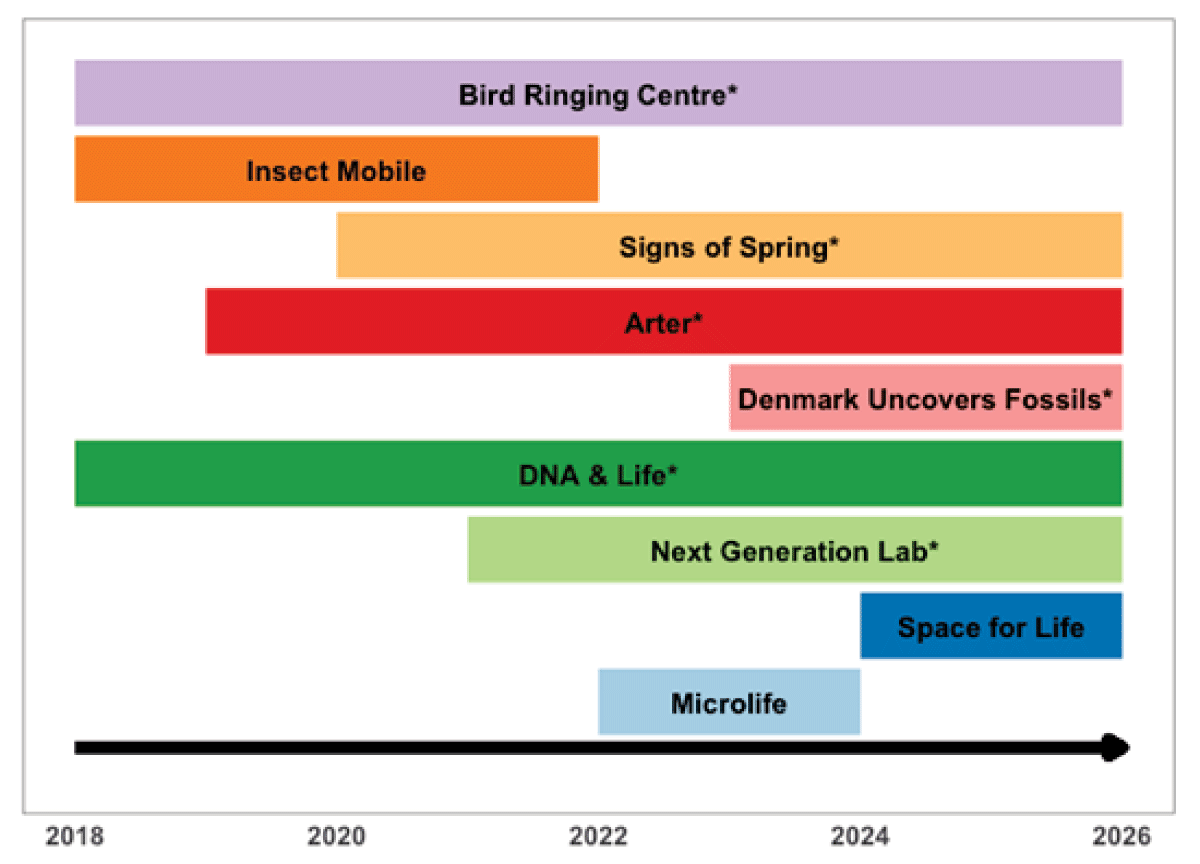
Figure 1
Timeline presenting duration the nine case projects at the Natural History Museum Denmark. Asterisk* indicates that the project is ongoing.
Institutional mandates
Museums around the world have several universally recognised core responsibilities including collecting, conserving, researching, and interpreting/exhibiting (International Council of Museums 2022). As a national museum in Denmark, the NHMD is governed by the Danish Museum Act (“Museumsloven”) (Kulturministeriet 2025). According to § 1 of the Act, the museum sector’s purpose is to operate via key institutional functions: collection, registration, conservation, research, and public engagement (Table 1).
Table 1
Areas mandated under the Danish Museums Act (“Museumsloven”) (Kulturministeriet 2025).
| MANDATE AREA | DESCRIPTION |
|---|---|
| Collection | Safeguarding and curating physical or digital heritage items |
| Registration/documentation | Recording and cataloguing museum materials |
| Conservation/preservation | Physical upkeep and long-term care of collections |
| Research | Conducting basic and applied scholarship using collections |
| Public engagement and outreach | Sharing knowledge through exhibitions, educational programming |
The evolution of a citizen science research unit
At NHMD, our vision is “to empower connection between people and nature.” With respect to CS, the museum has actively involved the public in research projects for over a decade. While major initiatives such as the bird ringing (bird banding) scheme have relied on volunteer participation for over a century, the more formal development of citizen science at the museum began to flourish in 2012.
The first major project, DNA & Life (“DNA & Liv”) was initiated by the museum’s public engagement staff, inviting high school students to our museum labs to analyse water samples they collected using a newly developed research method to detect environmental DNA (eDNA; Box 1). The project sparked further initiatives, including a family-oriented CS experiment designed to understand food choices in ants (The Ant Hunt [“Myr Jagten”]; Sheard et al. 2018, 2021), and a nationwide biodiversity monitoring scheme designed for untrained participants (described in Geldmann et al. 2016). These early projects demonstrated potential to support both research and engagement at the museum.
Box 1 The evolution of the project DNA & Life—from research-informed education to citizen science and community driven co-creation
The DNA & Life project (“DNA & Liv”) is one of our museum’s oldest and longest running citizen science (CS) projects and it is given special attention here to illustrate the changes made, and spin-off projects that we implemented over time. It was launched in 2012 after an initiative by the museum’s public engagement staff. DNA & Life built on a new research method that was at the time developed at the University of Copenhagen—detecting traces of DNA from water sampled in aquatic habitats (eDNA) (Knudsen et al. 2023). A pilot study was initially conducted to assess whether high school students could collect freshwater samples in their local environment and carry out DNA analysis in the laboratory at the NHMD. This pilot laid the foundations for the teaching program DNA & Life, which was developed in close collaboration with researchers at the museum. The project later expanded to include sampling from marine environments, DNA analysis of a diverse marine community, and new partnerships with broader networks (including researchers, educational institutions, and authorities) to develop a framework that combines high school teaching and science (Leerhøi et al. 2024). Funding was raised to cover the project’s annual costs including two and a half (2.5) full time equivalent (FTE) staff (with expertise as educators and in laboratory skills), a student helper, and laboratory materials.
The logistical and applied experience from DNA & Life, led to the development of the Next Generation Lab (NGL) – a project that aims for a better understanding of the use of animal resources in late medieval period and early Renaissance in Copenhagen. The framework for engaging high school students and teachers was inspired by the DNA & Life project, where students carried out most of the laboratory analysis. These experiences helped shape the co-creation of the NGL laboratory protocol, in which students conduct advanced protein analysis to identify the species origin of archaeological leather material.
NGL later expanded to also include the analysis of archaeological bone material, collaborations with additional cultural historical museums and research groups, and co-creation projects with high school teachers and students. Participants outside the NMHD playing a key role in shaping NGL’s scope and content.
In 2022, the project DNA & Life developed further by establishing local DNA laboratories at four high schools far from the original DNA laboratory at NHMD in Copenhagen. This enabled high school students located far from our museum to participate in the project, reducing the barriers for them to engage in a CS-based research project. Here, participating high school teachers play a role in facilitating, conducting, and communicating the research methods and activities.
In 2018, the launch of Insect Mobile (Svenningsen et al. 2021) marked a turning point, showcasing the scientific and strategic value of citizen science for museum leadership. In 2019, citizen science was formally elevated as a project-based activity to a dedicated research unit, placed on an equal level with traditional natural history research units in botany, geology, and zoology. This institutional prioritization reflected the growing recognition of citizen science not only as a public engagement tool, but as a driver of research.
At this time, the CS research unit consisted of a researcher/unit leader, a PhD student, a couple of postdocs, and five educators/project managers. In 2023, it was re-named “Science and Society,” with a core citizen science group consisting of researchers, educators, and project managers, and expanding to researchers in the data sciences. The continued development of the research unit depended largely on external funding, supported by active fundraising and the dissemination of CS projects. On average, our activities have attracted €1.4 million annually, enabling both the continuation of well-established projects such as DNA & Life and the development of new initiatives (Table 3). Over time, funding applications increasingly included budgeting for research positions (i.e., postdocs, PhD students), and cross-disciplinary collaborators beyond the museum, including partnerships in archaeology, social sciences, and with NGOs and governmental agencies (i.e., Brandt et al. 2022; Iwanycki Ahlstrand, and Tøttrup, 2023). While much of our research is rooted in natural history data, the unit increasingly contributes methodological research on how CS projects are designed and implemented.
Table 2
Rubric to score and map strengths for each citizen science project.
| MANDATED AREA | SCORING RUBRIC |
|---|---|
| Research | 1 = collection of research grade data, but no peer-reviewed outputs, not designed for immediate research 2 = project generates data that feeds indirectly to research (e.g., GBIF integration, student projects) 3 = direct peer-reviewed publications led by NHMD, novel methods and/or addresses research gaps related to natural history mandate |
| Collections | 1 = no physical specimen collections contribution 2 = digital data or limited specimen integration to collections 3 = significant specimen/materials added, long-term curated collections |
| Education | 1 = incidental use in teaching or outreach 2 = structured learning materials 3 = formal curriculum integration, large number of students reached, skills training |
| Public engagement | 1 = limited number of participants; short term engagement, low external visibility 2 = established engagement base, moderate participation, some public/media visibility 3 = national reach, strong volunteer networks, high visibility/media coverage |
[i] Notes: Global Biodiversity Information Facility (GBIF), Natural History Museum Denmark (NHMD).
Table 3
Results of project mapping using the 4-pillar rubric presented in Table 2.
| PROJECT | RESEARCH | COLLECTIONS | EDUCATION | PUBLIC ENGAGEMENT |
|---|---|---|---|---|
| Insect Mobile (2017–2021) | 6 peer-reviewed papers; reused in 17+ papers (3) | Bulk insect samples + DNA extracts (3) | Volunteer training, informal (2) | Hundreds of volunteers; national reach; media (3) |
| DNA & Life (year) | 3 peer-reviewed papers (3) | None (1) | High school students trained in DNA/PCR analysis (3) | National reach in schools and labs (2) |
| Microlife (Mass Experiment) (2023) | 2 peer-reviewed papers (3) | Tardigrade/moss/lichen specimens including type material (3) | 30,000+ students; Astra collaboration (3) | Nationwide participation; media; exhibitions (3) |
| Next Generation Lab (NGL) (2021-present) | 3 peer-reviewed papers (3) | No specimens (1) | Thousands of high school students; strong lab training (3) | Wide youth reach; less general public (2) |
| Denmark Uncovers Fossils (Danmark Udforsker Fossiler) (2023-present) | No research yet; fossil data in platform for research (1) | Digitizing fossil collections; citizen fossils (1) | KU university teaching (2) | FossilFestival across Denmark, MitFossil platform, fossil gallery (3) |
| Arter (Biodiversity Portal) (year) | Biodiversity data in platform used in red list & invasive monitoring; no publications yet (2) | Digital records (1) | University teaching; student field courses (2) | 43,000+ users; specialist councils (3) |
| Space for Life (Plads til liv) (year) | Biodiversity data (in Arter) (1) | No specimens (1) | Youth habitat creation and biodiversity learning (2) | Targeted youth clubs; interpretive signage for passive garden visitors (2) |
| Signs of Spring (Find Foråret) (2020–2021; 2023–2025) | 2 peer-reviewed papers (3) | No specimens (1) | Posters used as teaching tools in museums and schools (1) | Broad national participation; 5,000+ reports; media, libraries (3) |
| Bird Ringing Centre (150 years) | 5–10 papers annually; 30–50 datasets/yr; EURING (3) | ~100,000 records/yr databank; some specimens (3) | Intensive training, KU courses; nature schools (3) | 240+ volunteer ringers; public reports; media coverage (3) |
A recently adopted museum strategy (2025–2030) embraces citizen-involved research as a core future direction (“3.4 Citizen-involved research”). The Strategic Action Plan for Research linked to this strategy clearly states the museum’s objective to “engage the broader public in research via CS and other participatory methods.” Specifically, this plan states: “We will enable more citizens to contribute to research by participating in our CS programmes and by reporting data to publicly accessible databases” (Action Item 3.4). Museum leadership views this participation as including specimen collection, biodiversity data collection, and involvement in processing digital specimen data via crowdsourcing initiatives. CS is also recognised in our Strategic Actions for Public Engagement; for example, we address 3.6.1 “Easy access to contribute and get involved” and the “Continued development of a visible, easily accessible and informative website with easy access to be an active participant in our citizen science programmes.”
We attribute the institutional adoption of CS by our museum leadership to the successes of our projects in advancing the museum’s core mandate areas, and in particular research and public engagement. However, this has not been demonstrated in a strategic way. Such an approach is useful internally to highlight the varying strengths of our CS initiatives and may also prove as inspiration to other museums and cultural institutions striving to do the same.
Rubric Development
To systematically assess how CS projects contribute to institutional mandates, we developed a structured evaluation framework based on a scoring rubric. The rubric enables comparison across projects (Figure 1) by assessing each initiative against a predefined set of criteria (Table 2), focusing on the core functions most relevant to the museum’s structure and outputs.
The rubric focuses on mandated areas identified in Table 1: research, collections, outreach, and public engagement. Two additional mandated areas, registration/documentation and conservation/preservation, were not included in this exercise because none of the CS projects with measurable outputs currently contribute to these museum functions. Crowd-sourcing initiatives related to registration and documentation are under development, but they haven’t reached a stage where outcomes can be measured.
Danish museum legislation typically treats education as part of the broader mandate of communication and public access, yet we distinguish education from public engagement in this rubric. As a university museum, formal education and the training of future professionals are central components to our activities. This warrants separate consideration from broader public-facing engagement, such as the numbers of individuals we reach in our projects.
The rubric and scoring criteria were developed by the lead authors and refined through an initial trial scoring exercise including staff participants from the CS group. Project managers and research staff involved in each CS project first compiled qualitative summaries of the project-specific outputs for each of the mandated areas (Table 3). Each project was then assessed against these outputs using a three-point ranting scale, from 1 (low) to 3 (high), to evaluate the extent of its contribution to each mandate area. Given the diversity of project types, their duration and maturity, and their objectives, a three-level scale provided a common comparative framework that could be applied consistently across projects without privileging particular forms of output. Final scoring was conducted during a plenary discussion involving approximately 15 museum staff members and collaborators directly involved in the design and implementation of these projects. Scores for each project were discussed collectively and interpreted qualitatively in relation to each project’s objectives, duration, and complexity, as well as in relation to the other projects. Consensus scores are the only resulting scores, and no individual scores were retained. This framework ensured that scoring incorporated broad institutional perspectives and detailed project-level knowledge. The scoring exercise is not intended to rank or devalue some projects, but more so highlight how projects can be developed in different ways to target institutional mandates. Importantly, our projects evolve over time (see Box 1: A Case study of the project DNA & Life).
Framework Testing and Application
Using the framework described above, we assessed nine citizen science projects (Figure 1). While all projects are rooted in natural history and broadly address our museum’s vision to empower the connection between people and nature, we note that the individual aims of each project differ widely, and at the set-up stage, did not intentionally target each of the mandated areas. The results of our scoring exercise are presented in Table 3 and are graphically shown in Figure 2.
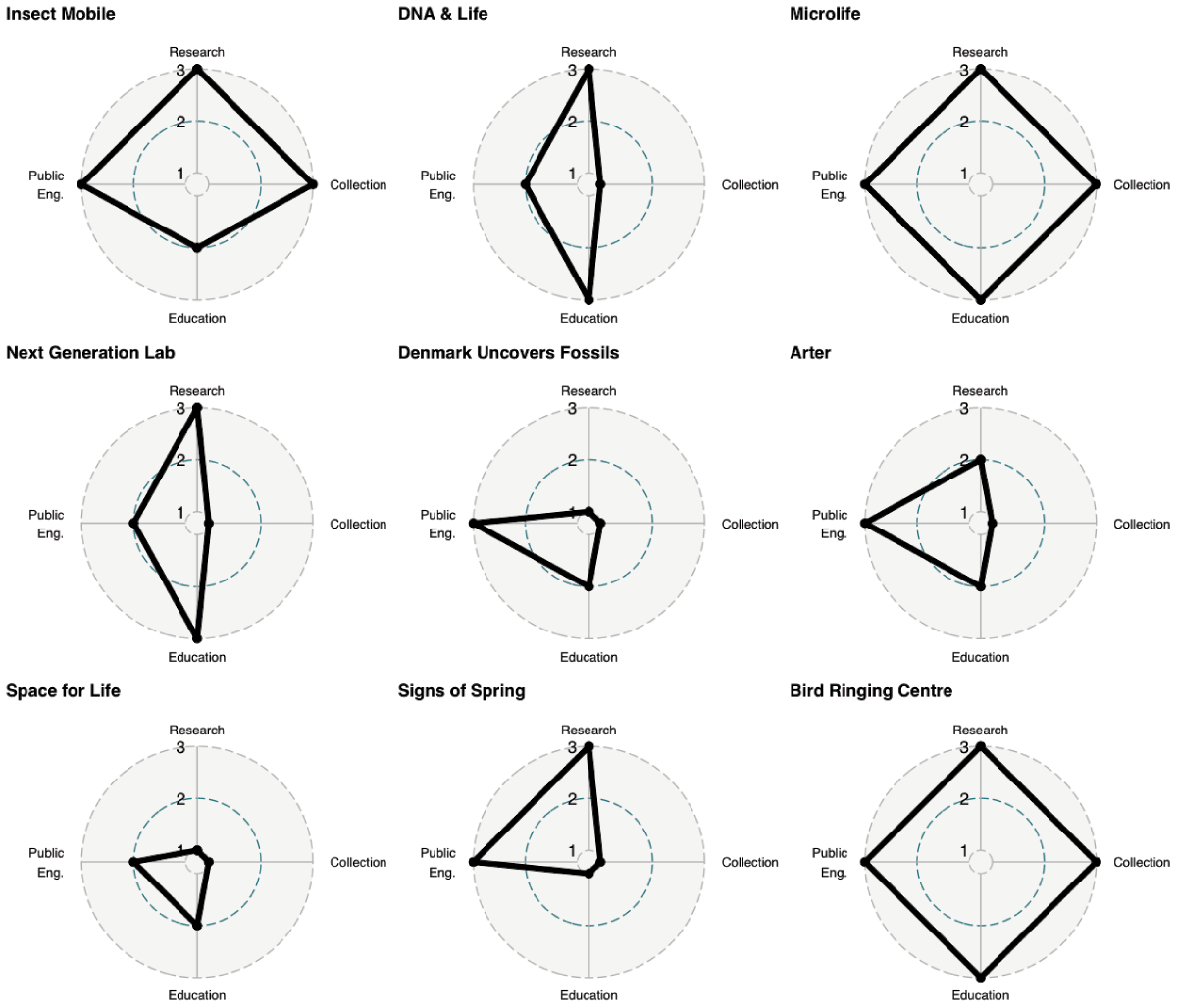
Figure 2
Nine citizen science projects and their various strengths in meeting mandated areas in research, collections, education, and public engagement (Public Eng. in figure) at the Natural History Museum Denmark.
Research
CS offers novel ways to advance our museum’s core research agenda by filling critical gaps in our natural history knowledge and support large-scale biodiversity monitoring. Projects have addressed gaps in our understanding about poorly known organisms, and expanded biodiversity monitoring through innovative citizen-enabled methods, for example insect car-nets for bulk insect sampling, and environmental DNA sampling and analysis. Research outputs span four areas: (i) natural history, cultural heritage, and bio-/geo-diversity studies (Tøttrup et al. 2021; Iwanycki Ahlstrand, Primack, and Tøttrup, 2022; Knudsen et al. 2023; Gąsiorek et al. 2024), (ii) data quality (Tøttrup et al. 2021), (iii) participant motivations (Sheard et al. 2018; Richter et al. 2021), and (iv) methodological development, including co-creative processes and large-scale engagement strategies (Iwanycki Ahlstrand and Tøttrup, 2023; Leerhøi et al. 2024; Tøttrup et al. 2025). With respect to methodological development, some projects necessitated the development of research methods such as sampling workflows and data processing pipelines that provide solutions to the immense numbers of samples obtained through CS initiatives. An example is the development of a data handling pipeline for Next Generation Lab (NGL), which has solved issues regarding large data sets acquired using ZooMS (Zooarchaeology by Mass Spectrometry) and the central protein-based identification method used in NGL (Richter et al. 2022). Another example is the adjustment of the DNA extraction method for eDNA used by student participants in DNA & Life. These methods, while developed specifically in the context of citizen science projects, have been adopted by researchers elsewhere because they require less time and a lower budget (Knudsen et al. 2023).
Not all projects were set up to generate direct research outputs: Some, such as Bird Ringing, Arter (the national biodiversity portal), and Denmark Uncovers Fossils, primarily function as national infrastructures and/or long-term monitoring schemes that allow participants to contribute key data that underpin research agency services, national and regional biodiversity monitoring, and future research. The National Bird Ringing Centre remains a cornerstone, being the longest running volunteer programme at NHMD and maintaining one of the country’s largest biodiversity datasets (~100,000 records annually). The programme has contributed substantially to scientific outputs and to European-wide databases (e.g. www.migrationatlas.org). The strongest direct research contributions have come from Insect Mobile (Richter et al. 2021; Svenningsen et al. 2021, 2022, 2024), Microlife (Gąsiorek et al. 2024), and NGL (Luise Ø. Brandt et al. 2022; Luise Ørsted Brandt et al. 2022; Tøttrup et al. 2025), each producing 2 to 6 peer-reviewed publications or large-scale datasets within short timeframes of one to three years (Table 3). DNA & Life, a project running since 2012, has only recently been generating a high number of publications (Tøttrup et al. 2021; Knudsen et al. 2023; Leerhøi et al. 2024), while newer projects like Space for Life are still in early phases, producing smaller biodiversity datasets using novel means of engagement, but not yet producing peer-reviewed outputs.
Collections
CS projects offer modern approaches to collecting and curating specimens, including through specimen collection blitzes covering spatial areas not previously sampled. Not all projects were designed to collect physical samples that can augment our museum collections. However, our projects indirectly demonstrate that CS can contribute to growing museum collections, while curating those and providing inputs to exhibitions as well. Insect Mobile and Microlife have made the strongest specimen-based contributions to date (insects, moss/lichens, tardigrades). The Bird Ringing project also contributes to specimens for our physical bird collections by birds recovered from volunteer ringers. In addition, bird ringing data contributes to a continuously growing digital data collection effort, complementing some of our oldest museum archival records.
Current initiatives in crowdsourcing are also underway to include volunteers in curatorial activities for newly digitized specimens. For example, a portal for transcribing specimen labels and collecting data is being developed to support the curation and collection of new data from digitised museum objects. In addition, Denmark Uncovers Fossils will focus on digitizing geological collections and citizen-sourced fossils (still in development stages). Through Denmark Uncovers Fossils, several fossils from the Danekræ fossil trove (fossils protected by Danish law), a collection based largely on findings made by the public, has been digitized and made publicly available on the project website (mitfossil.dk). These efforts are strengthening the bond between the museum and the public as well as creating a shared feeling of ownership, which is a key aspect of the Danekræ concept. By uploading fossil finds to the website, the public can help identify potential new Danekræ finds. Space for Life, Signs of Spring, NGL, DNA & Life, and Arter contribute little to collections directly. The physical material collected in some of these projects (i.e., eDNA samples) may one day be recognised as part of the museum’s physical collections.
Education
CS offers meaningful ways to deepen the museum’s education mandate—providing hands-on experiences to museum visitors. NGL and DNA & Life offer intensive school-based lab experiences, training thousands of students (from primary school to university students) in research methods—both on site and more recently through local teaching labs in other regions of the country (Leerhøi et al. 2024). The project trains around 2,200 students every year, of which 650 visit the NHMD and 1,550 visit satellite laboratories. Many of our projects include considerable effort in the development of education material to assist participants with data collection (i.e., Microlife). Microlife can boast the largest student reach (30,000+) in a single year through curriculum-based activities. Space for Life integrates youth engagement and habitat creation and monitoring, where youth can engage with professional biologists. The Bird Ringing Centre is actively educating volunteer ringers through a peer mentor-mentee training, where experienced ringers guide new volunteers in conducting ringing activities. Furthermore, the Bird Ringing Centre supports university education, such as demonstrating the method in several university courses.
On the lower end of education, Signs of Spring was implemented to minimize the level of training and/or skills needed to participate (Ahlstrand et al. 2022). All necessary materials are self-guiding and available online; however, some of these resources have been used in schools as a teaching tool. Arter and Denmark Uncovers Fossils serve as supporting educational initiatives (fieldwork integration, case studies) and are useful tools that are especially important in university teaching activities.
Public engagement
All projects engage the public, but they do so in diverse ways and target very different audiences. Most initiatives aim for national reach, even those projects rooted in our museum laboratories, such as the NGL and DNA & Life. Among them, Microlife stands out for its extraordinary reach: More than 30,000 schoolchildren have participated nationwide in a single month, thanks to a strong partnership with Astra, the Danish National Centre for Science Education, and their long-standing experience in involving schools in participatory research, including extensive media campaigns to facilitate recruitment (Gąsiorek et al. 2024). Other projects engage more specialized audiences. Insect Mobile gained national visibility, but because of the specialized equipment required, it worked intensively with only around 200 volunteers each year (Svenningsen et al. 2024). NGL focuses primarily on Danish high school students participating in activities in our museum laboratories; however, a growing online presence is now extending participation to Greenland and the Faroe Islands in coming years. DNA & Life similarly involves high school students in our on-site labs but has evolved to include a greater reach through locally established satellite laboratories across the country (Leerhøi et al. 2024).
Some projects are designed for more focused or niche communities. Space for Life works closely with youth clubs within the urban area in Copenhagen, Denmark, but because of its demonstration site in the Botanical Garden, it also passively engages thousands of garden visitors. Signs of Spring engages a broad cross-section of the public and has benefitted from wide media coverage (Ahlstrand et al. 2022). The Bird Ringing Centre maintains a large and dedicated volunteer network of ringers, with training and specialist knowledge transfer forming a core part of the programme (Madsen et al. 2023). Beyond these expert volunteers, the public reports the findings for ringed birds. This broadens the scope of citizen involvement and reach in the ringing project.
Digital platforms play a central role in extending our engagement. Arter attracts more than 43,000 registered users, mainly nature enthusiasts. Similarly, Denmark Uncovers Fossils connects fossil hobbyists and museum visitors through its online platform (mitfossil.dk) and coordinates the annual Fossil Festival hosted by museums, geology institutions, and rock societies across Denmark.
Across all projects, recruitment and visibility are supported by a combination of national media, social media, and collaborations with specialist interest groups. Together, these diverse approaches illustrate how CS projects can mobilize engagement from highly specialized volunteers to the broadest segments of the general public, while also supporting both short- and long-term volunteer involvement.
The results of our rubric provide a basis for reflecting on how citizen science contributes to institutional mandates and how such contributions can be assessed more broadly.
Discussion
To our knowledge, this is one of the first systematic analyses of the institutional contributions that CS projects can make. We present a replicable framework consisting of a rubric and mapping exercise that other museums or cultural institutions could adapt. Our rubric-based approach complements existing citizen science impact frameworks by translating broad impact domains (e.g., science, society, governance) into institutionally actionable categories aligned with museum mandates. While frameworks such as those proposed by Wehn et al. (2021) and von Gönner et al. (2023) focus on important outcomes at societal or system levels, our rubric reveals how CS contributes to the legally and strategically defined responsibilities of museums. This enables institutions to assess where and how that impact strengthens institutional functions.
The framework we present can be adapted by other natural history museums or even art/history museums, since most must balance research, collections, education, and engagement. Similar functional mandates are evident in museum frameworks internationally, including core functions of collecting, researching, conserving, and communicating heritage (International Council of Museums 2022).
Our projects were not specifically designed to address each of the mandated areas, and our rubric scoring openly reveals the different strengths across projects. Some projects are highly driven by research questions (Insect Mobile, Micro Life, and NGL) and are strong on outputs, even after a short period of time, but may be weaker on fulfilling other mandated areas. Other projects are engagement- or education-led (Space for Life), with an impressively low specialist-to-participant ratio, though feature less traditional natural history research. Our projects that are based on digital infrastructures and/or long-term biodiversity monitoring (Arter, Denmark Uncovers Fossils, Bird Ringing) are critical for supporting research but are not intended to address specific research questions at their onset. This diversity of strengths demonstrates that only a few CS projects can deliver across all mandates; instead, the diversity of the portfolio of projects matters. This variability mirrors findings identified in broader citizen science impact assessments, which consistently show that projects differ markedly in the types of impacts they generate depending on their design, maturity, and organizational support (Turbé et al. 2019; Wehn et al. 2021; von Gönner et al. 2023). As highlighted by Pateman and West, the level of impact can be shaped by project goals, participant roles, and context.
Benefits and limitations of the approach
We find our approach useful in making the institutional value of our CS projects explicit by revealing how different projects contribute unevenly but complementarily to core museum mandates. Beyond evaluation, the rubric has potential as a strategic planning tool. Mapping projects across the rubric helped clarify our project-specific strengths and gaps, and will inform decisions about where to invest in new initiatives and where to strengthen existing ones, helping us shape future plans for CS initiatives. Importantly, it assists us in articulating the value of CS projects.
This approach can also contribute to international debates on the evolving role of museums in society, where increasingly museums are recognised for not only safeguarding heritage, but also producing knowledge and fostering public participation (Schilthuizen et al. 2015; Sforzi et al. 2018; Ishida 2024). By aligning CS outcomes with institutional mandates, the framework makes these changing roles visible and assessable at the organisational level.
We recognize, however, that our scoring rubric overly simplifies complex project contributions, and thus, subjective elements remain despite efforts at transparency. Some projects are still developing, so their long-term contributions may be underestimated in our assessment. From our experience, it can take several years before research is published in peer-reviewed journals (Sforzi et al. 2018). Projects that are infrastructure-heavy rather than research-question driven (Arter, Denmark Uncovers Fossils) have strengths as future enablers rather than immediate producers. At the same time, we are getting better at publishing results and attracting external funding, and are building institutional expertise. As a result, newly established projects may receive higher scores based on our collective project experience and learnings over time. Also, not all our museum mandated areas are equally measurable; some areas lend themselves more to quantitative metrics while others are more qualitative (e.g., “number of specimens” versus “quality of engagement”). We also point out that using this approach carries a potential risk of overemphasizing mandates at the expense of innovation, experimentation and other societal benefits of CS.
With the right institutional and external support, CS can directly support core museum mandates, not just external outcomes. The CS projects at the Natural History Museum Denmark are reshaping how the museum’s mandates are fulfilled. Many of these projects are interdependent, building on the infrastructure and expertise developed through previous initiatives. This collaborative foundation enables us to pursue more complex and ambitious goals that align closely with our institutional priorities. However, this interdependence also presents challenges, particularly in securing sustainable funding, not only for new projects but also for the essential supporting infrastructure that underpins them such as digital apps and tools that require continual maintenance. Additionally, the themes and focus areas of our projects are shaped by the contemporary cultural and societal context of Denmark. To engage the public effectively, it is crucial that we design CS initiatives that resonate with the evolving interests of our communities. By remaining responsive to these shifting interests, we ensure that our projects remain relevant and impactful while fostering meaningful participation. Given our inherent adaptability as a research unit, it is essential that we remain at the forefront of the rapidly evolving field of CS, which seeks co-creative processes and new ways of involving society in research.
Future directions
Future work should continue to explore synergies between ongoing and emerging citizen science initiatives, particularly through shared infrastructures such as Arter, which can serve as a common platform supporting multiple projects across disciplines. Developing standardized, quantitative metrics to evaluate museum-level contributions of CS will be essential to move beyond qualitative assessments and enable comparative analyses of impact for museum leadership—an area that remains underdeveloped but will be increasingly important as museums continue to grow as citizen science practitioners (Sforzi et al. 2018; Ishida 2024). Expanding our collaborations with social scientists will theoretically enrich understanding of participation dynamics, motivation, and societal outcomes. Finally, a key research area lies in assessing the long-term institutional impacts of embedding CS within museums—specifically, how sustained engagement shapes a museum’s identity, public perception, and funding landscape.
Conclusions
This study demonstrates how citizen science can function as a bridge across the core museum mandates. At the Natural History Museum Denmark, the evolution of CS from individual projects to an institutional research unit has allowed us to connect traditional disciplinary research in botany, zoology, and geology, while simultaneously strengthening collections, education, and public engagement. A dedicated research unit on par with other traditional museum research units provides a model for embedding CS structurally into our museum rather than ad hoc or project-by-project, as is now evidenced in our recent museum strategic plans. By applying a mandate-based rubric across a diversity of projects, we provide a practical framework for museum leadership to assess, plan, and embed participatory research within long-term institutional priorities. More broadly, this study contributes to debates about the important role museums play in participatory knowledge production. Embedding CS within museum research structures not only enhances core museum functions, but can also ensure their ongoing societal relevance and sustainability as participatory institutions.
Acknowledgements
First and foremost, we extend our heartfelt thanks to all participants in our citizen science projects — from those with lifelong engagement to those who contributed over shorter periods. We are deeply grateful to every one of you. We also wish to thank our many collaborators and partners for their invaluable contributions and for co-developing citizen science initiatives with us. Finally, this work would not have been possible without the generous support of numerous foundations. We gratefully acknowledge funding from the Aage V. Jensen Naturfond, Novo Nordisk Foundation, Villum Foundation, Nordea Foundation, Leo Foundation, and 15. Juni Fonden.
Data Accessibility Statement
No individual scoring data are available, as assessments were conducted through a consensus-based workshop process and no individual scores were recorded. Active and concluded citizen science projects are described on the NHMD’s webpages (https://forskning.snm.ku.dk/research/citizen-science/).