
Figure 1
Search steps for the rapid qualitative review.
Table 1
Inclusion and exclusion search criteria.
| INCLUSION | EXCLUSION |
|---|---|
|
|
Table 2
Case studies: summaries.
| CASE STUDY | ABOUT | LOCATION | CITIZEN PARTICIPATION | DIGITAL PLATFORMS | OUTCOMES |
|---|---|---|---|---|---|
| AirLouisville (Barrett et al. 2018) | A community program that used smart inhalers to help improve the asthma problem in Louisville | Jefferson County, Louisville, Kentucky, USA | 1,147 Louisville residents aged five and above took part in monitoring using smart inhalers | Smart inhalers; mobile phone app Website: https://www.airlouisville.com/ | Identified alternative truck routes away from high-risk neighborhoods; increased tree coverage; developed and tested an asthma forecast alert system |
| AirRater (Workmanet al. 2021) | A study that evaluated user perceptions of AirRater’s usability and effectiveness to help inform decisions about managing exposures to environmental health hazards | Australia: Tasmania; The Australian Capital Territory; and Port Macquarie, New South Wales | 42 existing AirRater users participated in a pre-interview questionnaire, and semi-structured interviews | AirRater smartphone app Website: https://airrater.org/ | Collected population health data via the app were utilized by AirRater collaborators with policy-making capacity in environmental health |
| CANAirIO (Valencia and Fonseca 2019) | A citizen science project that used mobile phones and low-cost technology to measure air pollution and other air indicators | Bogota, Columbia | Citizens assembled sensing devices, tracked air pollution episodes, and participated in raising awareness | The CANAirIO app and sensor kit Website: https://canair.io | Promoted citizen participation in air pollution monitoring; policy action towards reduction of fleet buses using diesel. |
| CAPTOR (Collective Awareness Platform for Tropospheric Ozone Pollution) (Schaefer et al. 2020) | An air quality research project that measured ozone levels, funded under the European Horizon 2020 Programme. | Italy; Austria; and Spain | Citizens engaged in three testbed regions in which 46 low-cost ozone measurement devices were installed outside citizens’ houses to collect ozone pollution data | Monitoring stations; low-cost ozone measurement devices and apps, e.g., AirACT. Website: https://www.captor-project.eu/en/ | Aggregated 5 actions by CAPTOR partners addressing priority challenges of EU environmental policies; 11 reports on air pollution and solutions, and advocacy |
| Citizen science for Air Quality Policy in Germany and Niger (Lepenies and Zakari 2021) | A multidisciplinary project that used citizen-generated data as an input for air quality policy and sustainable development goals (SDGs) | Leipzig, Germany; and Niamey, Niger | University of Niamey students responded to online quizzes and 10 surveys about air quality and SDGs and were involved in data/photo crowdsourcing campaigns on cooking technologies and fuels; small scale sensing and campaigning project in Leipzig | Multiple digital platforms, such as Google forms; portable low-cost sensors Website: https://globalyoungacademy.net/activities/interdisciplinary-grant-2019-20-citizen-science-for-reducing-exposure-to-urban-air-pollution/ | Raised awareness that SDGs-aligned citizen science projects could close policy gaps; generated plans for upscaling and involving citizens in more phases of future projects |
| Citizen Sense (Gabrys 2017) | A project that documented the practices of residents engaged in monitoring air pollution near fracking sites in the US, as well as participatory research undertaken by the Citizen Sense project | Marcellus Shale region, Northeastern Pennsylvania, US | 30 members of the public affected by the fracking industry in NortheasternPennsylvania engaged in air pollution monitoring and piloting different modes of data collection | DIY environmental and air pollution monitoring kit Website: https://citizensense.net/ | Collected more than 5 million data points, and experiences of exposure to fracking sites; data used to lobby local government to address health impacts; created communities of care through multimodal ways of sensing and perceiving |
| Greater London Schools (Varaden et al. 2021) | A study that monitored air quality exposure of children wearing backpacks with special sensors, on their way to school and in the classroom | Greater London, UK | 258 children (aged 7–11) from five London primary schools attended air pollution education sessions and measured air pollution using backpacks with built-in air quality sensors | Portable air pollution monitors and GPS tracking devices Website: https://www.london.gov.uk/WHAT-WE-DO/environment/environment-publications/breathe-london-wearables-study | Increased children’s awareness of air pollution and led to adoption of positive behaviour changes |
| Swinomish Indian Tribal Community (Rohlman et al. 2019) | A community-based and Indigenous initiated study that measured personal exposure to polycyclic aromatic hydrocarbons (PAHs) and evaluated changes in knowledge related to air pollution | Southeastern Fidalgo Island, Puget Sound, Washington State, USA | 25 adult non-smoking SITC Reservation residents (American Indian/Alaska Native) volunteered to wear a silicone wristband to learn about their personal exposure to PAHs and contribute data on PAH exposures in their community | A silicon-based passive chemical absorption wristband and automated ambient temperature collector Website: https://swinomish.org/resources/environmental-protection/dep-programs/air-quality.aspx | Increased awareness of ambient and indoor air pollution sources in the home, improved environmental literacy, and led to positive behaviour change to reduce possible exposures |
| PRAISE-HK (Personalized Real-time Air-quality Informatics System for Exposure – Hong Kong) (Che et al. 2020.) | A study that measured fine-scale air quality variations between streets and collected personal air pollution exposure details | Hong Kong (SAR) | Citizens and residents of Hong Kong region monitored and analysed their personal air pollution exposures. | PRAISE-HK app Website: http://praise.ust.hk | Resulted in a personalized air pollution tracking app helping users analyze their personal air pollution exposures from outdoors, and indoors and on different modes of transport, in support of Hong Kong’s Climate Action Plan. |
| Schools and Weather Air Quality Network (SWAQ) (Ulpiani et al. 2022) | A citizen science project that placed meteorological and air quality sensors in its schools and engaged students in data analysis to improve urban weather and air quality measurements | Greater Sydney, New South Wales, Australia | Students collected and analysed research quality data for use in science and geography curriculum-aligned classroom activities | Distributed weather stations and sensors collecting and transmitting data Website: https://www.swaq.org.au/ | Improved assessment of air quality impacts on Sydney schools from the Black Summer Bushfires in 2019–2020 |
| Smell Pittsburgh (Hsu et al. 2020) | A study that crowdsourced smell reports to better track how odors from pollutants travel through the air across the Pittsburgh region | Pittsburgh and Allegheny County, USA | Residents of Pittsburgh and Allegheny County used the Smell Pittsburgh app to report outdoor odor pollution | Smell Pittsburgh app Website: https://smellpgh.org/ | Generated more than 50,000 reports indicating odor pollution events in the Greater Pittsburgh region are related to the joint effect of wind directions and high hydrogen sulfide readings |
| Youth Engaged Participatory Air Monitoring: A Day in the Life (Johnston et al. 2019) | A community-driven participatory air monitoring program that focused on youth engagement | Los Angeles County, California, USA | 18 high school participants from three community-based organizations wore portable personal monitors for a day, documenting and mapping their exposure to PM2.5 during their daily routine | AirBeams and AirCasting app; StoryMap for digital storytelling Website: https://keck.maps.arcgis.com/apps/MapJournal/index.html | Increased environmental literacy and enhanced knowledge of environmental justice among participants, including impacts of air pollution on humans and animals |
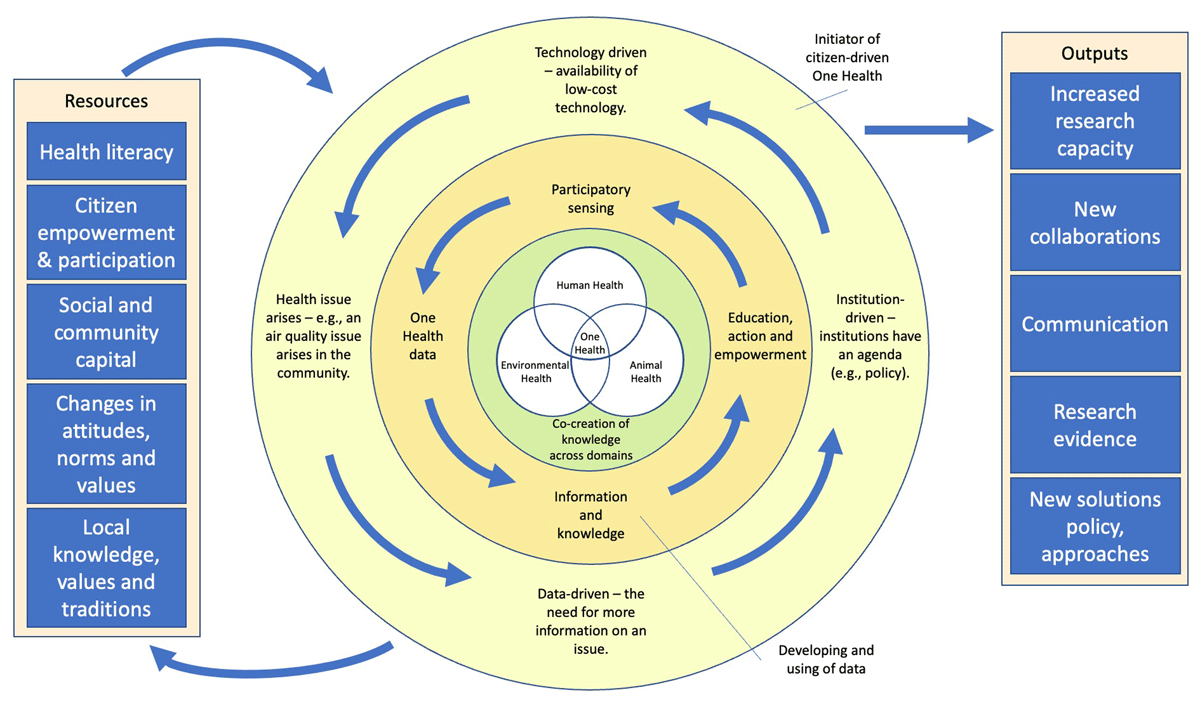
Figure 2
Conceptual model for citizen-engaged and digitally-enabled One Health.