
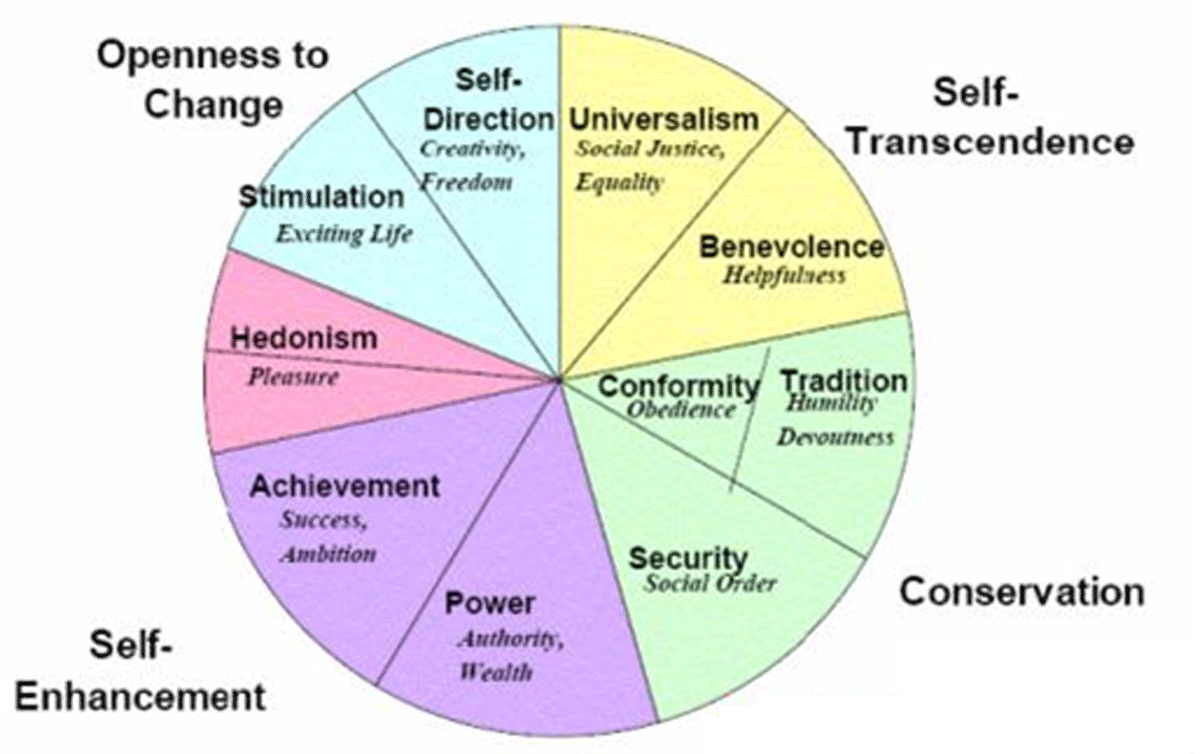
Figure 1
The set of ten values all individuals share according to the theory of basic human values (Schwartz, 1992) and their corresponding four higher-order values, which constitute two bipolar dimensions.
Table 1
Definition of the 15 motivational categories measured in the citizen science motivation scale (CSMS) and examples of CS items. The first 11 categories are theory driven and represent basic values based on Schwartz (1992) and Schwartz et al. (2012), whereas the last four (marked with *) are data-driven categories based on previous CS research.
| MOTIVATIONAL CATEGORY | DEFINITION IN TERMS OF MOTIVATIONAL GOALS | EXAMPLE OF A CS ITEM |
|---|---|---|
| Self-direction | Independent thought and action—choosing, creating, exploring | “I am interested in the topic of this project.” |
| Stimulation | Excitement, novelty, and change | “I strive to challenge myself.” |
| Hedonism | Pleasure and sensuous gratification | “I want to have fun.” |
| Achievement | Personal success through demonstrating competence according to social standards | “It’s an opportunity to perform better than others.” |
| Power | Power through exercising control over people, material, and social resources | “I want to gain recognition and status.” |
| Face | Security and power through maintaining one’s public image and avoiding humiliation | “I want to enhance my reputation.” |
| Security | Safety, harmony, and stability of society, of relationships, and of self | “I want to live in secure surroundings”. |
| Conformity and tradition | Restraint of actions, inclinations, and impulses likely to upset or harm others and violate social expectations or norms | “Other people I know are participating.” |
| Benevolence | Preservation and enhancement of the welfare of people with whom one is in frequent personal contact | “I want to contribute to my community.” |
| Universalism-social | Commitment to equality, justice, and protection for all people | “I want to make the world a better place.” |
| Universalism-nature | Preservation of the natural environment | “I want to protect the environment.” |
| Routine* | Everyday, ordinary, and regular | “I was doing this activity anyway.” |
| Social expansion* | Expand social groups, create and belong to a new community, meet new people | “I want to be part of this volunteers’ community.” |
| Help with research* | Contribution to science | “I want to contribute to science.” |
| Teaching* | Providing an educational opportunity to others | “I want to provide learning opportunities to others.” |
Table 2
Mean scores (SD) of motivational categories for participation in the three CS projects: backyard nature observation (sample 1), bird counting (sample 2), and quality-of-life improvement (sample 3). Each sample’s five top-rated motivational categories are in bold; the bottom four are in grey italic.
| MOTIVATIONAL CATEGORY | MEAN (SD) | ||
|---|---|---|---|
| SAMPLE 1 | SAMPLE 2 | SAMPLE 3 | |
| Self-direction | 3.71 (.77) | 4.07 (.91) | 4.16 (.59) |
| Stimulation | 3.15 (1.04) | 3.56 (1.07) | 3.81 (.94) |
| Social expansion | 2.65 (1.08) | 2.76 (1.31) | 3.64 (1.14) |
| Hedonism | 3.90 (.73) | 3.91 (.88) | 3.42 (.67) |
| Achievement | 1.28 (.54) | 1.79 (1.27) | 2.49 (1.50) |
| Power | 1.51 (.65) | 1.83 (.93) | 1.92 (.88) |
| Face | 1.66 (.86) | 2.09 (1.17) | -- |
| Routine | 3.30 (1.01) | 3.16 (1.07) | 2.46 (.98) |
| Conformity | 1.51 (.77) | 1.88 (.94) | 1.32 (.58) |
| Benevolence | 4.02 (.81) | 4.24 (.75) | 4.07 (.78) |
| Universalism-social | 3.67 (.85) | 4.19 (.86) | 4.19 (.70) |
| Universalism-nature | 4.61 (.54) | 4.69 (.62) | -- |
| Help with research | 4.25 (.82) | 4.30 (.87) | 4.11 (.78) |
| Security | 3.64 (1.41) | 3.52 (1.37) | 3.84 (1.08) |
| Teaching | 3.48 (1.10) | 3.77 (1.16) | 3.63 (1.20) |
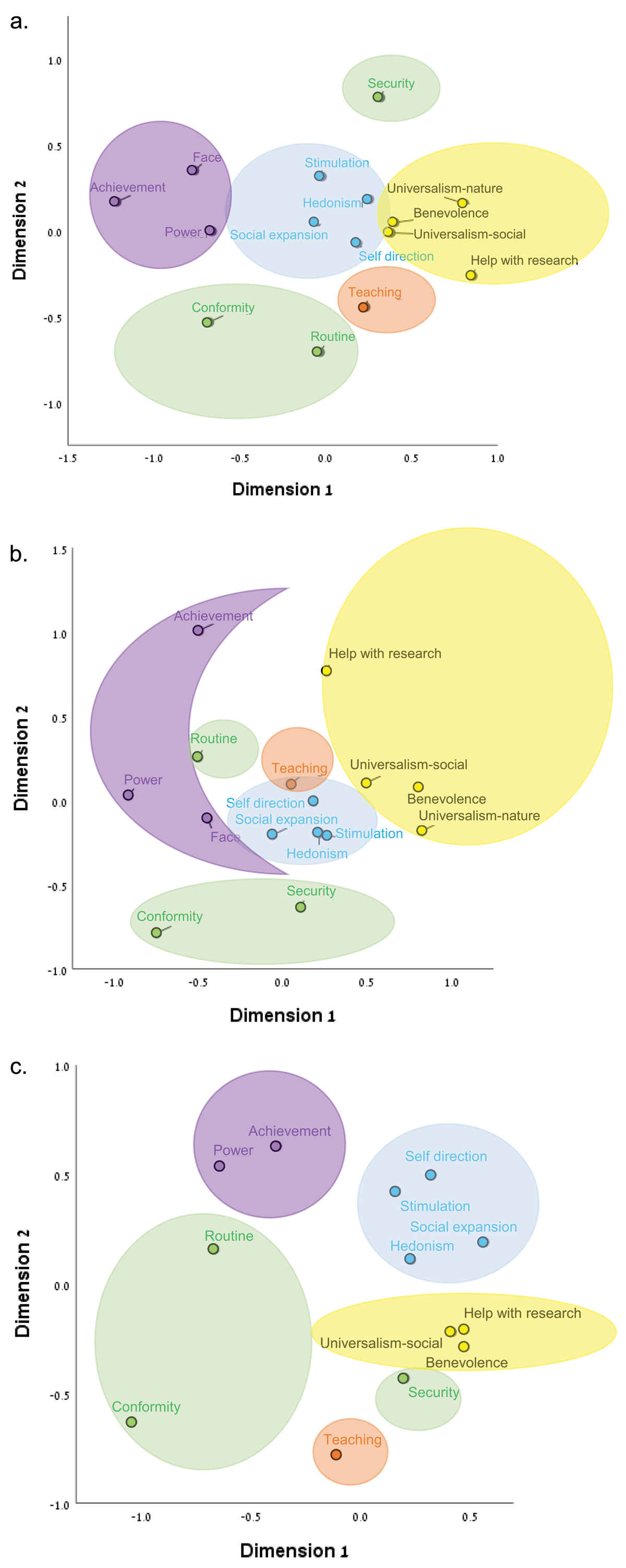
Figure 2
Results of multidimensional scaling (MDS) analyses of citizen science motivations in a two-dimensional space for sample 1, (a) backyard nature observation; for sample 2, (b) bird counting; and for sample 3, (c) quality-of-life improvement.
Table 3a
Stepwise regression predicting participation duration in sample 1.
| MOTIVATIONAL CATEGORY | B | SE | ß | t | p | LLCI | ULCI |
|---|---|---|---|---|---|---|---|
| Routine | .38 | .11 | .24 | 3.60 | < .001 | .17 | .60 |
| Benevolence | .29 | .12 | .16 | 2.39 | .018 | .05 | .53 |
[i] R2 = .117; F(2, 238) = 15.71, p < .001.
SE: Standard Error, LLCI: Lower-level confidence interval, ULCI: Upper-level confidence interval.
Table 3b
Stepwise regression predicting participation duration in sample 2.
| MOTIVATIONAL CATEGORY | B | SE | ß | t | p | LLCI | ULCI |
|---|---|---|---|---|---|---|---|
| Routine | 1.76 | .46 | .41 | 3.84 | < .001 | .85 | 2.68 |
| Stimulation | –1.97 | .51 | –.47 | –3.89 | < .001 | –2.98 | –.96 |
| Universalism-Nature | 2.65 | .82 | .37 | 3.22 | .002 | 1.01 | 4.29 |
[i] R2 = .279; F(3, 73) = 9.417, p < .001.
SE: Standard Error, LLCI: Lower-level confidence interval, ULCI: Upper-level confidence interval.
Table 3c
Stepwise regression predicting willingness to participate in additional volunteering activities, sample 3.
| MOTIVATIONAL CATEGORY | B | SE | ß | t | p | LLCI | ULCI |
|---|---|---|---|---|---|---|---|
| Self-direction | .34 | .13 | .19 | 2.71 | .007 | .09 | .58 |
| Social expansion | .16 | .07 | .18 | 2.54 | .012 | .04 | .29 |
[i] R2 = .092; F(2, 219) = 11.08, p < .001.
SE: Standard Error, LLCI: Lower-level confidence interval, ULCI: Upper-level confidence interval.