
Table 1
Preparatory, funding, and national instruments supporting the institutionalisation of citizen science (CS) in Spain.
| INSTRUMENT/MILESTONE | LEVEL, TYPE, AND SCOPE | CONTRIBUTION TO INSTITUTIONALISATION |
|---|---|---|
| FECYT calls for the Promotion of Scientific, Technological, and Innovation Culture, from 2013 onwards | National funding instrument/Scientific culture and public engagement | Explicitly recognised CS in national funding calls as active participation in research beyond conventional outreach. |
| FECYT-Ibercivis Action Plan (2017–2018) and Agreement (2018–2019) | National coordination and consultation instruments/CS ecosystem | Recognised CS actors, organised consultation processes, identified funding and sustainability needs, connected actors and initiatives, and established CS as a recognisable policy field. |
| Dedicated CS funding line within the 2019 FECYT call | National dedicated funding instrument/CS projects | Created a distinct funding category for CS beyond its generic inclusion within scientific culture and outreach. |
| CS and Universities Steering Group, 2022 | National institutional coordination mechanism/University system | Addressed CS integration, recognition, evaluation, incentivisation, and funding across university functions, directly informing the inclusion of CS in the LOSU. |
| Two-year singular CS projects introduced in the 2022 FECYT call | National funding instrument/CS projects and communities | Recognised that CS initiatives may require longer periods to build trust, sustain communities, develop infrastructures, and consolidate collaboration. |
[i] Note: Authors’ elaboration based on the funding, coordination, strategic, and territorial policy instruments analysed.
Table 2
Key policy documents for citizen science (CS) structural integration in Spain.
| POLICY DOCUMENT | NATURE AND REGULATORY STATUS | SCOPE WITHIN THE RESEARCH AND INNOVATION SYSTEM | INCORPORATION OF CS AND RESULTING TRANSFORMATION |
|---|---|---|---|
| State Plan for Scientific and Technical Research and Innovation 2017–2020 | Strategic and administrative planning instrument | National R&I system, particularly scientific culture, responsible research, and societal challenges | Incorporated citizen participation in R&I, linked to societal challenges, scientific culture, responsible research, and open research. Its role was primarily programmatic and legitimising, without establishing binding legal obligations. |
| Spanish Science, Technology and Innovation Strategy (EECTI) 2021–2027 | General R&I strategy | Entire national R&I system: universities, research centres, technology centres, health centres, companies, industry and other actors | Incorporated CS into the system’s strategic orientation, linking it to social responsibility of R&I, co-creation, open access, and alignment with societal needs. CS thereby gained strategic and cross-cutting status. |
| State Plan for Scientific and Technical Research and Innovation 2021–2023 | Strategic and administrative planning instrument | National R&I funding calls, research organisations, and universities | Operationalised the high-level goals of the EECTI 2021–2027 by introducing priorities for scientific culture, responsible research, and active citizen participation across national R&I programmes. |
| Law 17/2022 reforming the Science Act | Legislation | Statutory framework of the national R&I system | Provided a legal basis for citizen participation in R&I, embedding CS into the statutory architecture beyond temporary funding. |
| Organic Law 2/2023 on the University System (LOSU) | National/Organic law | University system and higher education | Explicitly promoted CS and university-society collaboration, extending its recognition across university functions: research, education, knowledge transfer, and societal engagement. |
| National Open Science Strategy 2023–2027 | National/Administrative strategy | Universities, public research organisations, funding agencies, research infrastructures, and the research community | Integrated CS into open science policy, linking it to knowledge democratisation, co-creation, open access, and changes in research culture. |
| Royal Decree 678/2023 on state accreditation for university teaching positions | National/Royal Decree | Access to tenured university positions (Associate and Full Professor) | Required accreditation criteria to incorporate CS and applicants to demonstrate the scientific, social, or local impact of their contributions, providing a regulatory basis for its recognition in academic career assessment. |
| 2023 CNEAI ANECA research assessment criteria | National/Administrative research-assessment framework | Academic and research careers, particularly university teaching and research staff | Recognised contributions generated through citizen and community science in research assessment. This connected CS with professional incentives and the recognition of research outputs in the assessment of six-year research periods. |
[i] Note: Authors’ elaboration based on the strategic and regulatory documents analysed. CS: citizen science; R&I: research and innovation.
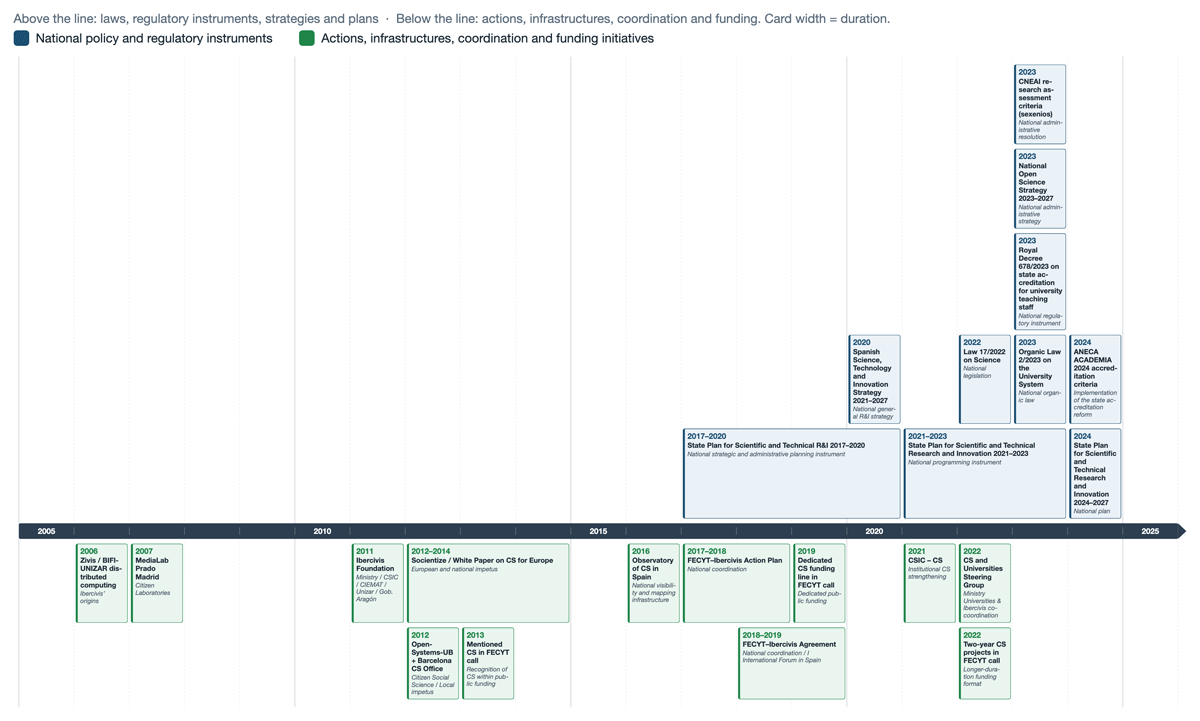
Figure 1
Timeline of milestones for the citizen science institutionalisation in Spain. BIFI: Institute for Biocomputation and Physics of Complex Systems; Unizar: University of Zaragoza; CSIC: Spanish National Research Council; CIEMAT: Centre for Energy, Environmental and Technological Research; CS: citizen science; UB: University of Barcelona; FECYT: Spanish Foundation for Science and Technology; R&I: research and innovation; CNEAI: National Commission for the Evaluation of Research Activity; ANECA: National Agency for Quality Assessment and Accreditation.