
Introduction
Over the past decade, citizen science (CS) impact evaluation has increasingly adopted multidimensional frameworks: Kieslinger et al. (2017, 2018) distinguish scientific, participant-related, and socio-ecological/economic dimensions, while Wehn et al. (2021) identify five impact domains—society, economy, environment, science and technology, and governance—noting that these remain unevenly assessed.
Particular attention has been paid to the relationship between CS and public policy, including how policy documents conceptualise CS (Hecker et al. 2019), how CS may contribute throughout the policy cycle (Schade et al. 2017), and how these contributions may operate in specific fields such as environmental policy (e.g., Turbé et al. 2019) and public health (e.g., Den Broeder et al. 2018). This study examines a different but related level of impact: the structural integration of CS into a national research and innovation (R&I) system.
Structural R&I policy impact, here understood as system-level policy impact, refers to changes in the institutional arrangements, incentives, and capacities within the R&I system, associated with the recognition and integration of CS into its strategies, legislation, funding instruments, infrastructures, and research-evaluation systems. This system-level perspective is also reflected in the Organisation for Economic Co-operation and Development (OECD)’s framework for embedding CS in research policy (OECD 2025). Just as publication patterns can be used to trace the scientific development and visibility of CS (Kullenberg and Kasperowski 2016; Bautista-Puig et al. 2019; Pelacho et al. 2021a), its presence across policy and institutional frameworks can trace its structural recognition within the R&I system.
This article addresses that institutionalisation as a co-evolutionary process between CS practices and policy (Schade et al. 2021). It considers both the extent of structural integration and the pathway through which it developed. This interpretation is consistent with Hölscher et al.’s (2025) comparative study of CS mainstreaming in environmental policy across five European countries, including Spain, which highlights the institutional adaptations required in policy and science systems. Our study also responds to calls to assess the engagement of societal actors through both project-level outcomes and changes in the institutions, practices, and relationships that structure R&I systems (Wehn et al. 2024).
Spain offers a relevant case for examining this pathway. Participatory scientific practices long predate the widespread adoption of the term “citizen science.” At the same time, the past two decades have brought greater community articulation, sectoral and dedicated funding, participation infrastructures, intermediary capacity, and explicit policy recognition. This trajectory preceded the incorporation of CS into central components of the national R&I framework, including the 2022 reform of the Science Act (Ley 17/2022),1 the 2023 Organic Law of the University System (Ley Orgánica 2/2023),2 and the research-evaluation criteria introduced from 2023 onwards, and may inform the evaluation of CS institutionalisation in other national contexts. The case examined here covers the period from the mid-2000s to 2023, and subsequent developments in research and academic assessment. The analysis is based on a selective review of laws, strategies, plans, funding calls, administrative and institutional documents, reports, and academic literature.
The remainder of the article first develops the conceptual framing of system-level policy impact and co-evolution. It then presents the Spanish case, from its historical background to institutional and regulatory integration, before examining the depth, limitations, and broader implications of this trajectory for Spain and beyond.
Conceptual Framing: Practices and Sectoral Impacts Co-evolving with the Structural Integration of Citizen Science into Research Policy
CS and public policy co-evolve through interactions between practice, recognition, support, and institutional governance. This interaction operates in a bidirectional manner (Schade et al. 2021). CS for policy concerns the contribution of CS practices and outputs to public action across the policy cycle, including problem identification, agenda setting, policy formulation, implementation, monitoring, and evaluation. Policy for CS implies the institutional conditions that enable, support, regulate, or constrain participatory research through funding, infrastructures, training, legislation, evaluation systems, standards, and governance arrangements. Together, these directions describe an iterative process in which practices contribute to policy and policy instruments reshape the conditions for subsequent practice. Building on this bidirectional relationship, institutionalisation is understood here not as the one-way incorporation of CS into formal structures, but as a reciprocal process in which research and policy systems should themselves adapt, thereby strengthening the conditions for such practices to persist, evolve, retain meaningful autonomy, and influence research and policy.
The policy significance of CS extends beyond the instrumental and relevant use of citizen-generated results in decision-making. By distributing knowledge-production capacities and responsibilities across society, CS reshapes the entangled epistemic and political relationships among citizens, civil-society organisations, researchers, and public authorities (Pelacho et al. 2021b). This broader understanding is consistent with the UNESCO Recommendation on Open Science and its emphasis on the open engagement of societal actors as part of a wider transformation of knowledge production and governance (UNESCO 2021; Wehn et al. 2024).
This bidirectional co-evolution often begins at the micro level, where CS projects—whether initiated by civil-society organisations, research groups, local communities, or public institutions—generate knowledge and impact within specific sectors. As these contributions gain recognition and are incorporated into public policy, institutional frameworks can, in turn, legitimise, support, and expand the practices that produced them. In Spain, this interaction can be observed through initiatives with different institutional origins. Some examples are provided.
InvaPlant illustrates a State-led pathway. Promoted by the Ministry for the Ecological Transition and the Demographic Challenge (MITECO), this national initiative involves citizens in recording invasive alien flora through the global CS platform iNaturalist. These observations contribute to assessing the status, distribution, and trends of invasive alien plants and to Spain’s reporting obligations under EU Regulation (MITECO n.d.-a; Regulation (EU) No 1143/20143). Public policy thus establishes a formal channel for citizen participation, while citizen-generated evidence contributes to policy implementation. Mosquito Alert represents a research-led pathway. Developed by a consortium of professional research institutions, the initiative was already collaborating with national, regional, and local health authorities by 2016 (Mosquito Alert 2017). Its incorporation into the Spanish National Plan for the Prevention, Surveillance and Control of Vector-Borne Diseases in 2023 marked a further stage of institutional recognition, integrating citizen observations into the national epidemiological-surveillance framework (Ministry of Health 2023). A third pathway is driven by civil-society organisations. Five regional entities illustrate this trajectory through Fluviatilis, a project connecting participatory environmental knowledge with river stewardship, ecological restoration, and shared management involving citizens and public administrations (Grup de Natura Freixe 2022). In this case, five third-sector intermediaries connect local participation with territorial conservation and public management.
These examples show how CS may contribute evidence to administrative reporting, enter public surveillance systems, or support participatory arrangements for territorial governance. Sectoral recognition can feed back into practice through collaboration, legitimacy, funding, continuity, or replication, while the form and degree of institutionalisation vary with each initiative’s origin and policy domain. In fact, sectoral processes generate evidence, experience, capacities, and institutional relationships, but their wider significance depends on recognition across the research system. R&I policy operates horizontally, shaping the general rules, priorities, infrastructures, funding mechanisms, institutional responsibilities, and incentives that apply across scientific fields (Edquist 2005). Structural integration develops when experiences generated in areas such as biodiversity, health, environmental management, education, or territorial governance are acknowledged as evidence of a broader capacity for participatory knowledge production.
This transition involves documenting, aggregating, communicating, and translating experience across projects and sectors. Hölscher et al. (2025) describe the mainstreaming of CS through three closely connected developments: alignment with policy priorities and processes, establishment as an integral component of the science system, and sustained collaboration among CS actors, researchers, and policymakers. Their analysis is consistent with the co-evolutionary pathway examined here, and clarifies the conditions under which recognition becomes durable. Mainstreaming may require adaptations in rules and standards, funding, shared infrastructures, professional capacities, institutional cultures, evaluation systems, and mechanisms for collaboration. Co-evolution explains the feedback through which practices and public policies shape one another over time; mainstreaming concerns the institutional changes through which these interactions become more stable, reproducible, and embedded across policy and R&I systems.
Intermediary organisations are important in this process. Individual projects, participants, and local communities rarely have sustained access to the arenas in which national research priorities, funding programmes, legislation, or evaluation systems are designed. Intermediaries can connect dispersed initiatives, maintain communities of practice, coordinate actors and resources, provide shared infrastructures, aggregate evidence across sectors, and translate practical experience into proposals that public institutions can recognise and operationalise. They thus perform systemic intermediary functions by connecting actors and processes operating at different levels of an innovation system (Kivimaa et al. 2019). These functions can be performed by public institutions, research organisations, civil-society actors, networks, or multi-actor organisations. They do not replace the responsibilities of governments, funders, research institutions, participating communities, or civil society, but support interaction and the circulation of knowledge, resources, expectations, and policy objectives across institutional levels.
Research funding, national legal and policy frameworks, institutional research cultures, capacity-building and networks, supporting infrastructures, and societal dialogue have also been identified as interconnected conditions for embedding CS in research policy (OECD 2025). These conditions develop through combinations of bottom-up and top-down dynamics and provide the institutional dimensions through which the Spanish case is examined below.
The Spanish Case: A Structured Synthesis
This section synthesises the evolution of CS in Spain from early collaborative practices to its current institutionalisation. It traces this trajectory across historical antecedents, key twenty-first-century milestones, and recent regulatory developments.
Historical background
CS has deep historical roots in Spain, evidenced by collaborative research practices that predated and accompanied the institutionalisation of modern science, particularly within natural history and geographical-historical research. As Clavero and Revilla (2014, p. 35) emphasise, “historical data on biodiversity have been widely collected over several hundred years through initiatives that today would be described as citizen science,” providing records that remain invaluable for ecology, evolutionary biology, and heritage studies. An early example is the Relaciones Topográficas (1575), a series of questionnaires commissioned by King Philip II through which local inhabitants compiled knowledge on their natural, cultural, economic, geographical, and legal environments. The resulting archives include 637 questionnaires containing over 4,300 records on approximately 190 species of wild flora and fauna (Clavero and Revilla 2014).
This tradition persisted through the 19th century, most notably with Pascual Madoz’s Diccionario geográfico-estadístico-histórico (1845–1850), compiled with the assistance of twenty correspondents and more than one thousand collaborators. Its data continue to inform modern biodiversity research (Clavero et al. 2017). Although these historical initiatives should not be equated uncritically with modern professional science, these efforts underscore a long-standing Spanish institutional culture of leveraging data provided by the populace (Sanz-García et al. 2021).
In the early 20th century, scientific collaboration shifted toward permanent observation networks composed of non-professional contributors. The Secondary Climatological Network, established in 1911, expanded meteorological observation through data collected by these collaborators (Núñez Mora 2011). That same year, the Astronomical Society of Spain and America was created to facilitate cooperation between amateur and professional astronomers (Ruiz-Castell 2017). A further milestone in citizen observation was the creation of the National Phenological Network in 1942 by the National Meteorological Service. This initiative documented the relationship between climate and recurrent natural phenomena, such as migratory bird patterns and plant flowering. By the 1950s, it included hundreds of participants, including naturalists and rural residents, and extended to North Africa (De Cara García 2006).
During the mid-20th century, scientific associations actively supported the study and protection of natural and cultural heritage. Examples include the Aranzadi Science Society, founded in 1947 to promote multidisciplinary research in areas such as archaeology, palaeontology, and the natural sciences, and the Spanish Ornithological Society (SEO), founded in 1954. This tradition later supported large-scale biodiversity monitoring programmes such as SACRE (Seguimiento de Aves Comunes Reproductoras en España, Monitoring of Common Breeding Birds in Spain), established in 1996 by SEO/BirdLife and considered the most extensive national-level biodiversity survey in Spain (Sociedad de Ciencias Aranzadi n.d.; SEO/BirdLife n.d.-a; Seoane and Carrascal 2008).
The emergence of the web in the mid-1990s enabled the scaling of CS methodologies through digital platforms. This shift led to reference platforms like Biodiversidad Virtual—formalised in 2008 by the Fotografía y Biodiversidad Association but rooted in 1990s digital photography networks—which established large-scale crowdsourced biodiversity mapping in Spain (Biodiversidad Virtual n.d.). This infrastructure later allied with the Spanish node of Observation.org, while other projects in Spain leverage the international platform iNaturalist.
Given the complexity and highly decentralised nature of the field, this article does not aim to provide an exhaustive census of projects, initiatives, or entities. Instead, it highlights selected milestones that help explain the institutionalisation of CS within the Spanish R&I system.
Twenty-first-century milestones: towards a visible and connected field
During the first decades of the twenty-first century, CS in Spain became a more visible and connected field. Participatory practices continued across many disciplines and territories, while new digital infrastructures, organisations, and European cooperation increased their scale and visibility. Professional researchers, civic organisations, educators, public institutions, and independent groups gradually became recognisable as part of a shared field, even when many did not initially use the term “citizen science.”
An early milestone occurred in Zaragoza with the launch of Zivis in 2006. Led by the Institute for Biocomputation and Physics of Complex Systems (BIFI) at the University of Zaragoza, the CIEMAT Fusion Laboratory, and Zaragoza City Council, Zivis enabled citizens to contribute unused computing capacity to scientific research (Antolí et al. 2007; BIFI n.d). The initiative demonstrated that citizen participation could be integrated into advanced research infrastructures through cooperation among universities, research centres, and local governments. This model evolved into a wider project, Ibercivis, connecting research groups across Spain and tens of thousands of participants worldwide. BIFI activities progressively extended beyond distributed computing to participatory experiments, methodological development, training, and support for projects led by other organisations. The subsequent establishment of Ibercivis as a foundation in 2011 was the result of efforts by various actors, including the Ministry of Science (under various names), the University of Zaragoza, the Spanish National Research Council (CSIC), the Centre for Energy, Environmental and Technological Research (CIEMAT), and the Government of Aragon, all of which now form its board of trustees (Ibercivis n.d.-a). Ibercivis combined three functions: conducting CS, promoting and supporting it, and researching its practices and effects (Ibercivis n.d.-b). Its official recognition as an agent of the Aragonese R&I system embedded these activities within the regional scientific ecosystem (Ley 17/2018).4
The European Socientize project (2012–2014), led by the University of Zaragoza and Ibercivis within an international consortium, consolidated this expansion through participatory experiments, networking, consultation, and policy work (European Commission 2014). Its White Paper on Citizen Science proposed shared definitions and recommendations (Serrano Sanz et al. 2014), contributing to the European policy debate on CS, with the white paper later endorsed by ECSA (ECSA 2016). Ibercivis also gained national recognition. State support identified the articulation of projects across Spain, their European development, and support for internally and externally led initiatives as functions of Ibercivis (Real Decreto 788/20205; Real Decreto 732/20226). The Ministry of Science, Innovation and Universities (Ministerio de Ciencia, Innovación y Universidades, MICIU) further described Ibercivis as providing a transversal service to the Spanish science and technology system through projects, participation infrastructures, support for the CS field, and international representation (MICIU 2024a).
Barcelona developed a complementary academic and local pathway that later expanded to a European scope. The OpenSystems research group at the Universitat de Barcelona (UB) developed participatory methods in areas including urban mobility, collective behaviour, and public experimentation (OpenSystems-UB n.d.-a). Initiatives such as experiments on collective decision-making demonstrated the viability of co-created research in public and urban settings (Perelló et al. 2012; Sagarra et al. 2016). OpenSystems-UB also played a central role in the development and coordination of the Barcelona Citizen Science Office. Promoted by Barcelona City Council, the Office connected academic research, municipal priorities, citizen participation, and projects from universities, CSIC institutes, and other research organisations in Catalonia, forming a community of practice (OpenSystems-UB n.d.-b).
From 2007, Medialab-Prado Madrid functioned as a citizen laboratory and meeting infrastructure (Psegiannaki and García-Triviño 2024). Three national CS meetings organised there in collaboration with Ibercivis brought together projects, research organisations, associations, public institutions, cultural mediators, independent practitioners, and international participants, making dispersed initiatives visible to one another and supporting methodological exchange and community formation (Ibercivis 2016b).
At a different institutional scale, CSIC has long played an important role in the development of CS in Spain through a broad network of institutes and research groups working in marine observation, biodiversity, environmental monitoring, archaeology, or the social sciences (Consejo Superior de Investigaciones Científicas [CSIC] n.d.-a). In 2021, CS gained explicit institutional recognition within the remit of CSIC’s Deputy Vice-Presidency for Scientific Culture and Citizen Science (CSIC n.d.-b).
The launch of the Spanish Citizen Science Observatory (https://ciencia-ciudadana.es/) in 2016 marked an important step in this process. Developed by Ibercivis with support from the Spanish Foundation for Science and Technology (FECYT), the Observatory aimed to identify, investigate, promote, and increase the visibility of CS conducted in and from Spain (Ibercivis 2016a). Its platform maps projects across disciplines, territories, and participatory models, combining this mapping with research, communication, resources, events, and collaboration (Ibercivis n.d.-c). It therefore operates as an infrastructure for mutual recognition and community articulation, contributing to the configuration of a de facto national network. Although this network has not acquired a legal structure yet, sustained cooperation among CSIC, CIEMAT, Ibercivis, OpenSystems-UB, Fundación Descubre, diverse universities, and many other entities is creating a relational infrastructure towards stronger national coordination. Furthermore, the Observatory’s open-source architecture and conceptual model later informed the European CS platform (https://citizenscience.eu/) and have been adapted by other international organisations (Ibercivis 2023), extending the influence of the Spanish experience beyond the national context.
European articulation was reinforced through COST Action CA15212. Josep Perelló (OpenSystems-UB) and Fermín Serrano (Ibercivis) represented Spain on its management committee. Their participation connected trajectories to a wider European network and contributed to developments later gathered in The Science of Citizen Science (COST Association n.d.; Vohland et al. 2021).
By this stage, visible communities, territorial nodes, intermediary organisations, research and participation infrastructures, and European connections provided the basis for national institutional articulation.
Institutional momentum
An early sign of explicit policy recognition came in 2013, when FECYT introduced CS into its annual call for the promotion of scientific, technological, and innovation culture. Established in 2007 to support science communication and outreach, the call encouraged active public participation in research through activities such as data collection and analysis (FECYT 2013). Similar wording remained in subsequent calls until 2017, gradually stabilising CS as an administratively recognised form of science–society engagement.
This was not, however, the beginning of public funding for participatory knowledge production. Sectoral ministries and agencies had long supported activities now commonly recognised as CS. In biodiversity, for example, environmental authorities had financed bird-monitoring and conservation programmes implemented by SEO/BirdLife through volunteer networks since at least the mid-2000s. These instruments are generally framed as environmental monitoring, conservation, or support for civil-society organisations, despite relying on large-scale public participation in data collection and observation (MITECO n.d.-b; SEO/BirdLife n.d.-b). By 2016, the Biodiversity Foundation, a public foundation under Spain’s environmental ministry, was explicitly promoting CS through collaboration with scientific societies (Fundación Biodiversidad 2016). CS support therefore developed through parallel policy routes, some explicitly using the term and others embedded in sectoral programmes.
FECYT’s explicit recognition coincided with broader community articulation. Meetings held in Madrid since 2013 brought together Medialab-Prado, Ibercivis, CSIC researchers, CIEMAT, civic organisations, projects, and other actors from across Spain, helping dispersed practices become mutually visible (CIEMAT 2013). Interinstitutional communities were also developing elsewhere, including through the Barcelona Citizen Science Office.
A more coordinated phase began when FECYT and Ibercivis started working together expressly to promote CS nationally. Their first joint instrument was the FECYT–Ibercivis Action Plan for CS (2017–2018). Between October 2017 and March 2018, three meetings in Madrid and Zaragoza brought together academia, public administrations, civil-society, cultural institutions, and CS communities to address the diversity of practices, funding sustainability, and national coordination. This work continued through the FECYT–Ibercivis Agreement for 2018–2019, which extended consultation thematically and territorially. Meetings across Spain addressed biodiversity and heritage, astronomy, maker culture, communication, and transversal issues (FECYT 2018; Sanz-García et al. 2020). The cycle culminated in the First International Forum on CS in Spain in March 2019, primarily connecting the broad national ecosystem and incorporating international experience.
Funding instruments also evolved through this coordination process. At the 2019 Forum, the Secretary General for Innovation announced the creation of a specific CS funding line within the FECYT call. This gave CS a distinct place in the funding structure beyond the framework for scientific culture and outreach (FECYT 2019). Institutional momentum subsequently extended into higher education with the creation of the Citizen Science and Universities steering group, coordinated by the Ministry of Universities and Ibercivis. The group examined how CS could be integrated into university research, teaching, knowledge transfer, and social engagement, along with questions of recognition, incentives, evaluation, and appropriate funding mechanisms. Beyond yielding immediate operational results—such as FECYT’s 2022 introduction of dedicated two-year CS projects—the Ministry explicitly framed this steering group as a strategic precursor to integrate CS and open science into the Organic Law on University System (LOSU) (Ministry of Universities 2022; FECYT 2022).
These developments created shared agendas, consultation mechanisms, more differentiated and local funding instruments, and institutional relationships through which CS could subsequently enter national strategies, legislation, open-science policy, and research-evaluation frameworks. Table 1 summarises preparatory, funding, and territorial instruments supporting the institutionalisation of CS in Spain.
Table 1
Preparatory, funding, and national instruments supporting the institutionalisation of citizen science (CS) in Spain.
| INSTRUMENT/MILESTONE | LEVEL, TYPE, AND SCOPE | CONTRIBUTION TO INSTITUTIONALISATION |
|---|---|---|
| FECYT calls for the Promotion of Scientific, Technological, and Innovation Culture, from 2013 onwards | National funding instrument/Scientific culture and public engagement | Explicitly recognised CS in national funding calls as active participation in research beyond conventional outreach. |
| FECYT-Ibercivis Action Plan (2017–2018) and Agreement (2018–2019) | National coordination and consultation instruments/CS ecosystem | Recognised CS actors, organised consultation processes, identified funding and sustainability needs, connected actors and initiatives, and established CS as a recognisable policy field. |
| Dedicated CS funding line within the 2019 FECYT call | National dedicated funding instrument/CS projects | Created a distinct funding category for CS beyond its generic inclusion within scientific culture and outreach. |
| CS and Universities Steering Group, 2022 | National institutional coordination mechanism/University system | Addressed CS integration, recognition, evaluation, incentivisation, and funding across university functions, directly informing the inclusion of CS in the LOSU. |
| Two-year singular CS projects introduced in the 2022 FECYT call | National funding instrument/CS projects and communities | Recognised that CS initiatives may require longer periods to build trust, sustain communities, develop infrastructures, and consolidate collaboration. |
[i] Note: Authors’ elaboration based on the funding, coordination, strategic, and territorial policy instruments analysed.
Regulatory codification: from strategic recognition to structural integration
From 2020 onwards, CS acquired a new position within Spanish R&I policy. Earlier programmes had supported projects and public engagement, but CS remained associated mainly with scientific culture, responsible research, or specific societal challenges. Structural integration began when it entered the strategies, laws, and evaluation mechanisms governing the research system itself.
The transition was gradual. The State Plan for Scientific and Technical Research and Innovation 2013–2016 did promote the active participation of society in R&I, but in a limited way (Ministry of Economy and Competitiveness 2013). The State Plan 2017–2020 made citizen participation in R&I visible and linked it to societal challenges, scientific culture, responsible research, and open research (Ministry of Economy, Industry and Competitiveness 2017). A more substantial shift occurred in the Spanish Strategy for Science, Technology and Innovation 2021–2027, which associated the social and economic responsibility of R&I with CS, co-creation, open access, and the alignment of research with societal needs (Ministry of Science and Innovation [MICI] 2020). The State Plan 2021–2023 subsequently translated this orientation into programming measures related to scientific culture, responsible research, and citizen participation (MICI 2021). In the current Plan 2024–2027, CS is widely promoted alongside open science, knowledge transfer and shared responsibility (MICIU 2024b).
Legal codification followed with the 2022 reform of the Science, Technology and Innovation Act, which incorporated citizen participation into the national framework governing R&I. The subsequent year, the LOSU extended this recognition to higher education by explicitly promoting CS and collaboration between universities and social actors. CS thus moved beyond temporary programmes and became part of the normative architecture of the research and university systems.
The National Open Science Strategy 2023–2027 reinforced this development by connecting CS with the democratisation of knowledge, co-creation, open access, and changes in research culture (MICI 2023). Recognition also reached research assessment, within a broader reform of evaluation that the National Agency for Quality Assessment and Accreditation (ANECA) joined in 2023 (National Commission for the Assessment of Research Activity [CNEAI] 2023; Paneque 2026). The 2023 research assessment criteria (sexenios) introduced an “Open Science to Society” dimension that values contributions generated with the active involvement of citizens in the research process (citizen, participatory, or community science) (CNEAI 2023). The new state accreditation criteria for university teaching bodies, issued under Royal Decree 678/2023 (Real Decreto 678/2023),7 extended this approach to academic careers, explicitly recognising the promotion of CS among knowledge transfer and exchange merits (ANECA 2024; Paneque 2025). Building on these developments, ANECA’s 2025 framework on knowledge transfer and exchange for social value further included CS within knowledge co-creation with non-academic actors (Ramos-Vielba and Paneque 2025), reinforcing its recognition in the evaluation and progression of academic and research careers.
Across these instruments, CS enters complementary layers of the R&I system—strategic direction, programming, legislation, and research evaluation—providing evidence of its system-level policy impact. This codification emerged from a co-evolutionary process involving practices, sectoral impacts, public support, community development, European cooperation, and mediation between practitioners and institutions. Policy recognition, in turn, strengthened legitimacy and created conditions for further development.
Regional frameworks further reflect this structural codification. Aragón established active societal participation as a principle of its R&I system (Ley 17/2018), explicitly including CS in its regional plan (Gobierno de Aragón 2022). In Catalonia, sectoral recognition of CS appeared in a 2018 environmental funding call (Resolución de 10 de mayo de 2018)8 and in the Nature Agency Act (Ley 7/2020),9 followed by broader recognition of citizen participation in research under the regional science law (Ley 9/2022).10
These national and regional developments place CS within the strategic, legislative, funding, and evaluative architecture of the Spanish R&I system. This growing normative presence provides an observable indicator of system-level policy impact and reflects the co-evolution of CS practices and research policy. Table 2 includes key policy documents in the structural integration of CS into the Spanish R&I system.
Table 2
Key policy documents for citizen science (CS) structural integration in Spain.
| POLICY DOCUMENT | NATURE AND REGULATORY STATUS | SCOPE WITHIN THE RESEARCH AND INNOVATION SYSTEM | INCORPORATION OF CS AND RESULTING TRANSFORMATION |
|---|---|---|---|
| State Plan for Scientific and Technical Research and Innovation 2017–2020 | Strategic and administrative planning instrument | National R&I system, particularly scientific culture, responsible research, and societal challenges | Incorporated citizen participation in R&I, linked to societal challenges, scientific culture, responsible research, and open research. Its role was primarily programmatic and legitimising, without establishing binding legal obligations. |
| Spanish Science, Technology and Innovation Strategy (EECTI) 2021–2027 | General R&I strategy | Entire national R&I system: universities, research centres, technology centres, health centres, companies, industry and other actors | Incorporated CS into the system’s strategic orientation, linking it to social responsibility of R&I, co-creation, open access, and alignment with societal needs. CS thereby gained strategic and cross-cutting status. |
| State Plan for Scientific and Technical Research and Innovation 2021–2023 | Strategic and administrative planning instrument | National R&I funding calls, research organisations, and universities | Operationalised the high-level goals of the EECTI 2021–2027 by introducing priorities for scientific culture, responsible research, and active citizen participation across national R&I programmes. |
| Law 17/2022 reforming the Science Act | Legislation | Statutory framework of the national R&I system | Provided a legal basis for citizen participation in R&I, embedding CS into the statutory architecture beyond temporary funding. |
| Organic Law 2/2023 on the University System (LOSU) | National/Organic law | University system and higher education | Explicitly promoted CS and university-society collaboration, extending its recognition across university functions: research, education, knowledge transfer, and societal engagement. |
| National Open Science Strategy 2023–2027 | National/Administrative strategy | Universities, public research organisations, funding agencies, research infrastructures, and the research community | Integrated CS into open science policy, linking it to knowledge democratisation, co-creation, open access, and changes in research culture. |
| Royal Decree 678/2023 on state accreditation for university teaching positions | National/Royal Decree | Access to tenured university positions (Associate and Full Professor) | Required accreditation criteria to incorporate CS and applicants to demonstrate the scientific, social, or local impact of their contributions, providing a regulatory basis for its recognition in academic career assessment. |
| 2023 CNEAI ANECA research assessment criteria | National/Administrative research-assessment framework | Academic and research careers, particularly university teaching and research staff | Recognised contributions generated through citizen and community science in research assessment. This connected CS with professional incentives and the recognition of research outputs in the assessment of six-year research periods. |
[i] Note: Authors’ elaboration based on the strategic and regulatory documents analysed. CS: citizen science; R&I: research and innovation.
Figure 1 synthesises the contemporary Spanish trajectory described in the preceding subsections, showing how interactions among multiple actors contributed to a visible and connected field, growing institutional coordination, and the integration of CS into strategic, funding, legislative, and research-evaluation frameworks.
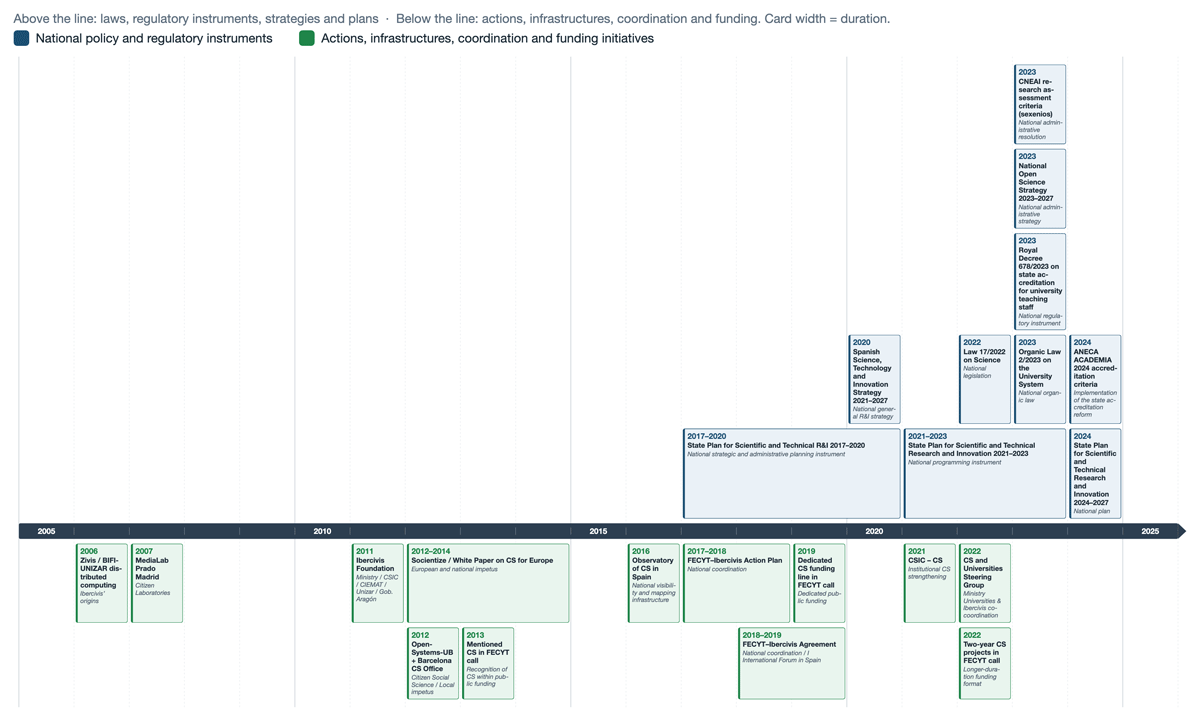
Figure 1
Timeline of milestones for the citizen science institutionalisation in Spain. BIFI: Institute for Biocomputation and Physics of Complex Systems; Unizar: University of Zaragoza; CSIC: Spanish National Research Council; CIEMAT: Centre for Energy, Environmental and Technological Research; CS: citizen science; UB: University of Barcelona; FECYT: Spanish Foundation for Science and Technology; R&I: research and innovation; CNEAI: National Commission for the Evaluation of Research Activity; ANECA: National Agency for Quality Assessment and Accreditation.
Implications for Spain and Beyond
The Spanish trajectory shows broad structural integration across science legislation, university law, open-science policy, funding, participation infrastructures, and research evaluation, while reflecting European and UNESCO open-science priorities. It illustrates the reciprocal relationship between CS and policy described by Schade et al. (2021). This bidirectional and dynamic interaction is interpreted here as a co-evolutionary process involving sectoral practices, public support, community development, consultation, intermediary action, and institutional adaptation.
Cooperation among public authorities, funding bodies, research-performing organisations, civil-society organisations, and multi-actor intermediaries was crucial in connecting this distributed ecosystem with research-policy institutions. FECYT, CSIC, CIEMAT, Ibercivis, OpenSystems-UB, Fundación Descubre, universities and research groups, environmental organisations, municipal and regional authorities, schools, and citizen communities contributed through complementary roles. Public bodies provided legitimacy, resources, and access to policymaking; research organisations contributed scientific capacity and infrastructures; and civil-society actors provided communities, situated knowledge, continuity, and infrastructure, as well. Ibercivis performed a bridging role by linking projects, research institutions, administrations, and communities, while its collaboration with public bodies helped translate accumulated experience into consultation processes, funding instruments, strategies, legislation, and research-evaluation criteria. Current efforts to establish more stable coordination seek to strengthen continuity, collective capacity, and representation, consistent with Wehn et al.’s (2024) emphasis on sustained coordination across actors and institutions. The transferable lesson is not the replication of a particular organisation or legal form, but the development of equivalent intermediary capacity adapted to each national context.
Viewed against the OECD’s (2025) framework, Spain combines several conditions identified as central to embedding CS in research policy: legislative recognition, a national open-science strategy, dedicated and sectoral funding, infrastructures, intermediary capacity, recognition in research evaluation, and a comparatively high volume of CS publications. Yet Spain is absent from the OECD’s country notes and illustrative policy cases, none of which clearly documents the same combination. Its inclusion in future comparative analysis could broaden the framework’s empirical basis, particularly regarding the connections among legislation, funding, intermediation, open science, infrastructures, and research evaluation.
Funding has developed through dedicated CS instruments and sectoral programmes in areas such as biodiversity monitoring, conservation, scientific culture, and civil-society action. Despite the effort, funding cycles must still provide the time required to sustain communities, maintain infrastructures, and consolidate collaboration, as Hölscher et al. (2025) highlight. Further institutionalisation requires durable resources, organisational capacities, responsibilities, and incentives. The European RIECS-Concept project, led by Ibercivis with twelve other institutions, including ECSA as technical coordinator and CSIC as another relevant actor in Spain, seeks to design a research infrastructure based on shared resources, quality standards, ethical protocols, and technical interoperability (RIECS-Concept 2024). It will enable CS to operate at scale and as a stable component of the European Research Area. Regarding research incentives and responsibilities, recognising the broader impacts of CS in research assessment can further support its institutionalisation. Spain’s engagement with the reform agenda of the Coalition for Advancing Research Assessment (CoARA), in which ANECA has been a driving force (Paneque 2026), offers a further channel for consolidating this recognition.
The Spanish case shows how system-level policy impact develops through the connection among practices, sectoral contributions, communities, intermediaries, public instruments, and institutional reforms. CS can influence research organisation by contributing to changes in its rules, resources, relationships, and research-evaluation systems. For other national contexts, the question is how these connecting and intermediary functions can be developed within their own research and civil-society ecosystems.
Notes
[3] Ley 17/2022, de 5 de septiembre, por la que se modifica la Ley 14/2011, de 1 de junio, de la Ciencia, la Tecnología y la Innovación (2022) Boletín Oficial del Estado, 214, pp. 123852–123922. Available at: https://www.boe.es/eli/es/l/2022/09/05/17 (Last accessed 28 October 2026).
[4] Ley Orgánica 2/2023, de 22 de marzo, del Sistema Universitario (2023) Boletín Oficial del Estado, 70, pp. 43267–43339. Available at: https://www.boe.es/eli/es/lo/2023/03/22/2 (Last accessed 28 October 2026).
[5] Regulation (EU) No 1143/2014 of the European Parliament and of the Council of 22 October 2014 on the prevention and management of the introduction and spread of invasive alien species (2014) Official Journal of the European Union, L 317, pp. 35–55. Available at: https://eur-lex.europa.eu/eli/reg/2014/1143/oj (Last accessed 28 October 2026).
[6] Ley 17/2018, de 4 de diciembre, de Investigación e Innovación de Aragón (2019) Boletín Oficial del Estado, 24, pp. 7351–7385. Available at: https://www.boe.es/eli/es-ar/l/2018/12/04/17 (Last accessed 28 October 2026).
[7] Real Decreto 788/2020, de 1 de septiembre, por el que se regula la concesión directa de diversas subvenciones para el impulso de proyectos en materia de investigación y el fomento de acciones innovadoras (2020) Boletín Oficial del Estado, 235, pp. 73184–73191. Available at: https://www.boe.es/eli/es/rd/2020/09/01/788 (Last accessed 28 October 2026).
[8] Real Decreto 732/2022, de 6 de septiembre, por el que se regula la concesión directa de subvenciones a diversas entidades para el desarrollo de actuaciones que son exponentes de la dimensión social y económica de la ciencia (2022) Boletín Oficial del Estado, 215, pp. 124273–124282. Available at: https://www.boe.es/eli/es/rd/2022/09/06/732 (Last accessed 28 October 2026).
[9] Real Decreto 678/2023, de 18 de julio, por el que se regula la acreditación estatal para el acceso a los cuerpos docentes universitarios y el régimen de los concursos de acceso a plazas de dichos cuerpos (2023). Boletín Oficial del Estado, 213, pp. 122924–122953. Available at: https://www.boe.es/eli/es/rd/2023/07/18/678/con (Last accessed 28 October 2026).
[10] Resolución de 10 de mayo de 2018, de convocatoria de subvenciones a asociaciones y fundaciones del tercer sector ambiental de Cataluña para la financiación de proyectos de educación y sensibilización ambiental llevados a cabo en régimen de colaboración, para los años 2018 y 2019 (2018). Boletín Oficial del Estado, pp. 57584–57589. Available at: https://www.boe.es/diario_boe/txt.php?id=BOE-A-2018-7393 (Last accessed 28 October 2026).
[11] Ley 7/2020, de 2 de julio, de la Agencia de la Naturaleza de Cataluña (2020). Boletín Oficial del Estado, 194, pp. 52001–52012. Available at: https://www.boe.es/eli/es-ct/l/2020/07/02/7 (Last accessed 28 October 2026).
[12] Ley 9/2022, de 21 de diciembre, de la ciencia [Cataluña] (2023) Boletín Oficial del Estado, 6, pp. 3228—3297. Available at: https://www.boe.es/eli/es-ct/l/2022/12/21/9 (Last accessed 28 October 2026).
Acknowledgements
The authors would like to thank the editorial team and the two anonymous reviewers for their valuable guidance. We express our gratitude to the entire community in Spain doing citizen science, whether under this or other names, In particular, we thank all those who contributed to the various actions aimed at strengthening CS in Spain that are addressed in this article. Additionally, Maite Pelacho acknowledges support from the Ministry of Science, Innovation and Universities of the Government of Spain, the State Research Agency, and the European Regional Development Fund – MICIU/AEI/10.13039/501100011033/FEDER, UE (Grant no. PID2024-155808NB-I00). Financial support for publication was partially covered by this grant.
Author Contributions
Maite Pelacho and Francisco Sanz-García conceptualised the study and drafted the core manuscript. Fermín Serrano-Sanz, Pilar Paneque-Salgado, Núria Bautista-Puig, and Mar Leza provided critical feedback and contributions. All authors approved the final manuscript.