
Introduction
Community science is a research collaboration that is driven by the desires of community members and seeks to improve community well-being (e.g., Wandersman 2003; Cooper et al. 2021; Pandya, Giampoala, and Hanson 2021). These efforts often focus on critical environmental issues that negatively impact human health, particularly among economically disadvantaged populations and people of color (Davis and Ramírez-Andreotta 2021; Parrish 2022). Community science differs from the longstanding academic notion of “contributory” citizen science, where volunteers collect data following research questions and protocols determined by professional scientists (Shirk et al. 2012). Instead, in community science efforts, members come together in a coordinated manner to design and implement a systematic research study using new or existing data to address a specific local issue and inform decision-making (Cooper et al. 2021). Community science shares a commitment to research for community benefit with community-based participatory research (CBPR) and participatory action research (PAR). However, it differs from CBPR, which requires equitable partnerships between scientists and community members throughout the research process (Israel et al. 2005), and from PAR, which centers on community leadership and experiential knowledge (Cornish et al. 2023). In community science, the positioning of scientists and community members is not prescribed and can vary considerably across projects (Wilderman 2007)—including projects in which the role of scientists is minimal (Haklay 2013). Growing interest in community science is evidenced by the uptick in related articles (e.g., Davis and Ramírez-Andreotta 2021; Parrish 2022; Raheja et al. 2022) and the launch of the relatively new journal Community Science alongside its companion online exchange hub (Pandya, Giampoala, and Hanson 2021). However, questions remain about what constitutes success in community science and what can be learned from challenges faced during project implementation. Such understanding is critical to helping community members address systemic disparities and improve the quality of their environment and their lives.
Evaluating community science poses a significant challenge: Many sought-after goals are aspirational, defined as broad, complex, and multidimensional concepts that lack quantifiable metrics to assess progress. For example, Jordan, Ballard, and Phillips (2012) offered general descriptions of community science goals in terms of enhanced social capital (coordination and sharing of resources for mutual benefit), community capacity (leveraging human, organizational, economic, or social capital to improve and maintain quality of life), and trust between different community members including scientists. Likewise, in a study on community-based forest organizations, Fernandez-Gimenez, Ballard, and Sturtevant (2008) highlighted trust- and relationship-building among members, as well as shared ecological understandings and social learning.
Beyond operationalization challenges, community science goals, such as policy change, tend to require extended periods. Davis and Ramírez-Andreotta (2021) underscored the extended period required to implement participatory methods and work across different jurisdictions, emphasizing that these timeframes are necessary to develop genuine partnerships. Such extended timeframes are illustrated by Shapiro et al. (2023), who described a 16-year process to close a polluting industrial plant, while also seeking accountability and prosecution of the polluters.
To evaluate impact in community science, long-term or conceptual goals need to be broken into smaller, measurable outcomes for participants, their communities, the environment, and scientific research (Jordan et al. 2012). Outcomes are often described using the SMART approach; that is, they are specific, measurable, attainable, relevant, and timely achievements that indicate progress toward one or more large project goals (from Doran 1981; Phillips, Bonney, and Shirk 2012). In participatory science projects, goals often center on advancing science or increasing public science literacy, while outcomes focus narrowly on a specific science question or a change in individual volunteers’ knowledge, interest, motivation, or skill proficiency (National Academies of Science, Engineering, and Medicine 2018). Numerous studies and resources have defined and evaluated individual-level outcomes of participatory science (e.g., Phillips et al. 2018; Aristeidou and Herodotou 2020; Peter et al. 2021; Davis et al. 2022; Becker-Klein et al. 2023; Del Bianco et al. 2023). By contrast, community science efforts require evaluation frameworks that extend beyond these individual-level metrics to capture outcomes that align with the broader, more complex community-based goals. However, there is a lack of clarity around evaluating community science goals, which has resulted in calls to better define them and develop rigorous ways to assess them (e.g., Stepenuck and Green 2015; National Academies of Sciences, Engineering, and Medicine 2018; Davis and Ramírez-Andreotta 2021; Gibson et al. 2022).
To bridge the gap between aspirational community science goals and their evaluation, we conducted an exploratory study to (1) identify goals relevant across multiple community science projects and (2) define and codify outcomes of these goals in concrete and measurable ways. We gathered and synthesized knowledge from community science and evaluation practitioners across a range of topic areas. From these interviews, we built and refined the Goal-Outcome Typology coupled with supporting vignettes to contextualize each goal, its outcomes, and possible evaluation measures. Here, we present the Typology, discuss how it complements existing literature, and review its strengths and limitations. We also outline how practitioners can tailor the Typology for their own context, embedding it within a logic model, and developing measures of their outcomes to understand and share the progress and impact of their efforts.
Methods
Our initial team consisted of four researchers with expertise in social science research and evaluation of participatory science. We expanded to include a set of 12 experienced practitioners. All 12 participated in interviews and reviewed draft documents; seven also joined as co-authors of this manuscript. For clarity, we refer to all interviewees as “practitioners.”
The research proceeded in two phases—practitioner interviews and a subsequent four-step process to develop and refine a typology based on the interview data (described below).
Phase I: interviews with practitioners
Our team first recruited four practitioners identified through peer-reviewed literature (i.e., authors on community science publications) and the Thriving Earth Exchange database, an American Geophysical Union program that provides resources, training, and guidance on advancing community science (https://thrivingearthexchange.org). Using their collective network and snowball sampling, we expanded the group to 12 practitioners. The final sample size was not determined a priori; rather, recruitment proceeded iteratively and ceased when thematic saturation was reached with successive interviews yielding no substantially new goals, outcomes, or perspectives. Together, these practitioners represented a diversity of lived experiences and geographies, having worked with marginalized communities and others in the United States, the United Kingdom, and Madagascar. Eleven managed community science projects focused on socio-environmental issues associated with soil, air, noise, and water pollution; one worked on natural resource management. Several also possessed extensive research experience. All practitioners were offered a modest honorarium for their time.
In preparation for semi-structured interviews, we emailed interview questions to the practitioners and asked them to provide written responses. For this study, these questions addressed the following: What did their community science project(s) seek to achieve (i.e., goals)? and What evidence of progress toward reaching those goals have they witnessed (i.e., outcomes)?
Two to three researchers from our team conducted the interviews, during which practitioners expanded on their written responses using examples from current and past projects. Three practitioners participated in a group interview, while the remaining nine participated in individual interviews to accommodate their availability. Although the use of both interview formats may introduce some methodological variation, all participants were asked the same semi-structured questions and were given opportunities to elaborate on their responses. We recognize that group dynamics can shape discussion by encouraging participants to build on one another’s ideas while potentially discouraging the expression of dissenting views. To minimize these effects, facilitators encouraged contributions from all participants, and practitioners were invited to provide additional comments following the interview via email. During each interview, we compiled a running list of goals and outcomes and asked practitioners to verify its accuracy before concluding. All recorded interviews lasted 30–60 minutes, were conducted via Zoom in March and April 2023, and were transcribed using the Otter.ai software (https://otter.ai).
Phase II: synthesis to build the Goal-Outcome Typology
The second phase of the research consisted of a four-stage process to synthesize the interview data into a typology of goals and associated outcomes. In the first stage, we (four researchers) conducted an inductive thematic analysis following Ahmed et al. (2025) to document common and lived experiences of the practitioners without overriding them with our own disciplinary lenses. One of us compiled and grouped similar statements regarding goals from the interviews, referring to the transcripts and recordings for clarification. Then, all four of us reviewed this list, coded the statements into 17 broad goal themes, and evaluated them to ensure each theme was singularly focused, distinct, and clearly aligned with a specific goal. This recategorization resulted in eight goals, which we named and defined to form the foundation of our Goal-Outcome Typology.
In the second stage, we identified and described possible incremental outcomes for each of the eight goals. We used content analysis to make “…replicable and valid inferences from texts (or other meaningful matter) to the contexts of their use” (Krippendorff 2004, p. 18). To ensure consistency, researchers independently reviewed outcome placement and phrasing, then discussed disagreements until consensus was reached (Boeije 2002). Specifically, two of us reviewed the outcome list generated during the interviews and mapped each item to one or more of the eight goals. Then, all four of us reviewed, discussed, and agreed on the initial draft. In this process, we removed redundancies and replaced project-specific language with more generalized statements. For example, we generalized “meet with decision makers about air quality” to “members build relationships with people in positions of power” (see Supplemental File 1: Typology).
In the third stage, we refined the draft Typology using the SMART method to ensure outcomes were specific, measurable, attainable, relevant, and timely (from Doran 1981). For example, under the goal “improved community identity,” practitioners emphasized efforts to maintain ongoing community involvement. We articulated this as the outcome: “members encourage each other to stay engaged.” This outcome fulfills the SMART criteria because it targets a single behavior (specific); can be assessed by asking members if and how they demonstrated encouragement (measurable); represents a realistic action for community science (attainable); directly contributes to the broader goal of improved community identity (relevant); and can occur early on in the project process (timely). Next, we shared the draft Typology with the 12 practitioners to identify missing goals or outcomes and clarify ambiguities. To ensure external validity, we also cross-referenced the literature for parallel examples of outcomes in community science practice (examples provided in the Discussion). All practitioners provided feedback, which was used to finalize the Goal-Outcome Typology.
In the fourth and final stage, we developed vignettes to illustrate the practical relationship between goals and outcomes. Each vignette describes a hypothetical community science context, a desired goal, a corresponding outcome, and examples of metrics that practitioners could develop to measure those outcomes. The vignettes were inspired by actual practitioner projects but we adapted them based on practitioner feedback to maximize their illustrative value.
Results: Goal-Outcome Typology for Community Science
The following section describes each of the eight goals, their associated outcomes, and the illustrative vignettes. Terminology is intentionally consistent across descriptions and vignettes, though communities will naturally adapt language in practice (addressed more fully in the Discussion). Figure 1 provides an overview of links between goals, outcomes, and evaluation measures in the Goal-Outcome Typology, while the complete Typology, including specific outcomes for each goal, is provided in Supplemental File 1.
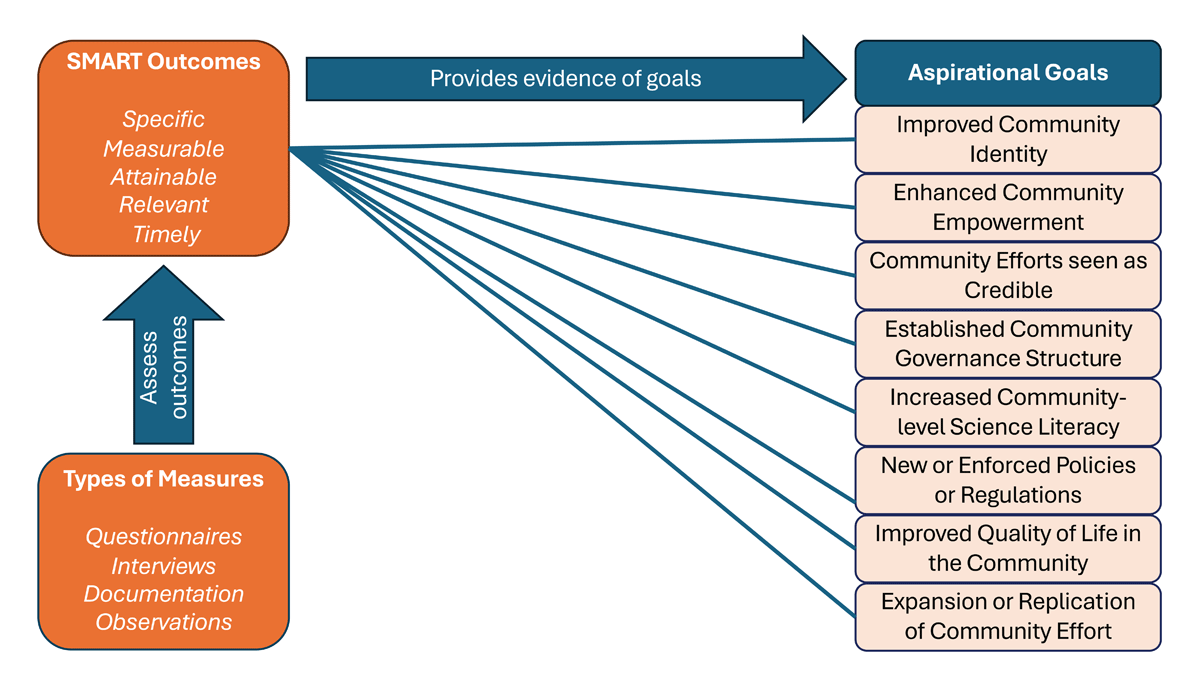
Figure 1
Structure of the Goal-Outcome Typology for community science. Evaluation measures assess SMART (specific, measurable, achievable, relevant, and timely) outcomes, which provide evidence of progress toward aspirational (conceptual and/or long-term) goals. See Supplemental File 1 for the complete typology including specific outcomes for each goals.
Goal: improved community identity
This goal is achieved when individuals living and/or working in a common region build a strong identity as members of the community. Community identity can be defined as the degree to which individuals identify with and feel connected to a particular community; this often incorporates shared values, practices, and a sense of place (McNamara, Stevenson, and Muldoon 2013). It is associated with increased social support, community pride, resilience, sense of belonging, collective efficacy, bonding with others, and enhanced well-being (Smith and Silva 2011; McNamara et al. 2013; Heath, Rabinovich, and Barreto 2017). There is also a high level of trust and commitment among members (Kalkbrenner and Roosen 2016), who strive to work together in an equitable, fair, and inclusive way. Outcomes include community members communicating frequently, celebrating small achievements, and encouraging each other to remain engaged.
Vignette: In a bustling commercial district, apartment residents who have immigrated to the U.S. from different countries rarely interact with neighbors; but they share concerns about poor local air quality due to heavy vehicle traffic. These renters feel isolated in their worries and doubtful that improvements are possible. To address this issue, the residents seek improved community identity. In this context, this means they develop trust, a sense of belonging, and connection with one another around their shared concerns. Measurable outcomes toward this goal occur when residents (1) communicate frequently with each other about their air quality concerns and (2) celebrate small achievements such as the transition from occasional conversations to regular meetings and the development of preliminary plans to measure air quality. The residents can evaluate these outcomes with records of meeting attendance and minutes; questionnaires on connections among residents (e.g., frequency of conversations about traffic and air quality); and documentation of outreach efforts for non-English-speaking renters.
Goal: enhanced community empowerment
This goal is achieved when community members feel they are well-equipped to study and act to improve and manage their environment. Community empowerment can be defined as a “group-based, participatory, developmental process through which marginalized or oppressed individuals and groups gain greater control over their lives and environment, acquire valued resources and basic rights, and achieve important life goals and reduced societal marginalization” (Maton 2008, p. 5; also see Benyei et al. 2023). Outcomes include increased confidence to plan a study with scientists, awareness of resources to study and address the community issues, and willingness to take on important roles in the study and the community.
Vignette: In a rural, traditional community within a tropical forest, community members have a deep knowledge of native fish populations and believe that their fishing practices support a healthy and sustainable fishery. While their practices align with traditional knowledge, they conflict with government restrictions, leading to regular fines. Members are hesitant to approach local authorities because they feel their concerns will be ignored. To address this issue, the community seeks enhanced community empowerment. In this context, this means they feel well-equipped to challenge government restrictions using evidence from their own research. Measurable outcomes toward this goal occur when community members (1) build confidence working with a local university scientist to systematically gather fish population data and (2) take on important roles and responsibilities in the project, such as adapting a data protocol for this context and presenting the findings to authorities. The community can evaluate these outcomes with documentation of members’ roles in the study design; records of meetings with the scientist; and questionnaires or interviews on members’ confidence in conducting research and communicating findings to authorities.
Goal: community efforts seen as credible
This goal is achieved when those outside the community believe a community’s data collection methods and resulting findings are of high quality. As such, people in positions of power value community members’ efforts, as well as their local knowledge (Benyei et al. 2023). Consequently, community findings are regarded as acceptable to inform natural resource decisions, develop policy, guide future studies, and publish in peer-reviewed journals (Shapiro et al. 2023). Outcomes include the use of proven methods for data collection and the establishment of relationships between community members and people in positions of power (Stepenuck and Green 2015).
Vignette: Community members are concerned about potential connections between rising local cancer rates and poor air quality due to nearby industrial plants. To address this issue, the community seeks to have their efforts seen as credible by people in positions of power. In this context, this means local officials value their methods and use their data to revise emissions regulations. Measurable outcomes toward this goal occur when community members (1) use proven methods to collect air quality data and (2) establish relationships with local officials by regularly meeting with them to share their data collection methods and discuss how their findings might inform emissions regulations. The community can evaluate these outcomes with logs of meetings with officials; questionnaires assessing officials’ perceptions of data quality; records of officials’ use of community data in decision making; and documentation that demonstrates use of proven methods and data quality assurance protocols.
Goal: established community governance structure
This goal is achieved when members establish and sustain systematic features that increase their group’s capacity to address local issues (Davis and Ramírez-Andreotta 2021). Establishing a governance structure may involve creating a formalized process for making decisions, outlining procedures for communication, obtaining financial representation to manage funds, becoming a legal entity (e.g., a nonprofit organization), and sustaining key partnerships. Example outcomes are holding regular meetings to discuss the project, taking initial steps to formalize processes and procedures, and filling out organizational tax forms.
Vignette: In a rural coastal area, residents are concerned about the impact of poor water quality on shellfish that they depend on for food. They want to apply for a grant to purchase water-testing equipment but discover that they will have to go through an external organization to manage the funds, limiting their autonomy. To address this issue, the residents seek to establish a community governance structure—specifically, to attain nonprofit status so they can apply directly for grant funds. Measurable outcomes toward this goal occur when the residents (1) take initial steps to formalize their processes and procedures, including developing bylaws covering decision-making, communication, roles and responsibilities, and fund management; and (2) fill out the appropriate tax forms for their new organization. The residents can evaluate these outcomes with documentation of bylaws and organizational structures, tax filings, and questionnaires or interviews on members’ sense of ownership over and clarity about the governance processes.
Goal: increased community-level science literacy
This goal is achieved when community members leverage each other’s knowledge, skills, and abilities as they address local issues. Community-level science literacy centers on collective action and social learning (learning through observation and imitation of others, extending beyond what any individual could achieve alone; see Reed et al. 2010). Knowledge can include Western science literacy, as well as traditional ways of knowing and knowledge derived from lived experiences (Benyei et al. 2023). It can center on a wide range of topics, such as personal health, public health, environmental health, and data literacy. This goal “does not require each individual to attain a particular threshold of knowledge, skills, and abilities; rather, it is a matter of a community having sufficient shared resources that are distributed and organized in such a way that the varying abilities of community members work in concert…” (National Academies of Sciences, Engineering, and Medicine 2016, p. 74). While the goal is at the community scale, outcomes occur at the individual level, including gains in individual awareness of a community issue, in knowledge and skills related to the project, and in appreciation for science and its relevance in their daily lives. Cumulatively, these individual gains contribute to a community’s shared understanding of a local issue and the collective capacity to address it.
Vignette: Residents in a low-income neighborhood read a newspaper article on high soil lead levels surrounding older homes in their area. To address this issue, the residents seek to increase community-level science literacy. In this context, this means residents develop shared knowledge to understand and reduce their exposure to lead. Measurable outcomes toward this goal occur when residents (1) become aware of possible elevated lead levels in their neighborhood as they share their concerns with others at a local community center—drawing on their firsthand knowledge of the neighborhood (e.g., homes with a vegetable garden and deteriorating external paint) and (2) gain deeper knowledge as they regularly convene at the community center to discuss their growing understanding and share relevant resources. Together, these individual gains contribute to the community’s collective understanding of lead exposure risks. The residents can evaluate these outcomes with questionnaires on members’ self-assessed understanding of soil lead pollution and perceptions of overall community knowledge; records of resource distribution; and records of frequency and attendance at community center gatherings.
Goal: new or enforced policies or regulations
This goal is achieved when policies or regulations are created, revised, and implemented in ways that positively impact the community. Examples include improving infrastructure, establishing protected natural areas, fining violators, and ratifying new policies to reduce pollution (Stepenuck and Green 2015; Davis and Ramírez-Andreotta 2021). Community-collected data, findings, and other inputs are used to inform these policies and regulations. Outcomes include identifying relevant policymakers or regulators to contact and providing testimony using study findings, as well as the use of these findings by policymakers to inform policy decisions.
Vignette: Residents use the local beach for recreation and, for some, as a source of food. During regular water quality monitoring, they discover high levels of E. coli, indicating fecal contamination. They conduct a study that determines large duck flocks are the contamination source, likely attracted by visitors who feed them. To address this issue, the residents seek new or enforced policies or regulations. In this context, this means getting city officials to adopt an ordinance restricting duck feeding at the beach. Measurable outcomes toward this goal occur when residents (1) identify which city officials to contact and (2) provide testimony to city officials using their study findings, recommending a “Do Not Feed the Ducks” ordinance. The residents can evaluate these outcomes with documentation of the relevant policymakers who were contacted; logs of community-member testimony at public meetings; copies of presentations for city officials; and signed petitions from community members.
Goal: improved quality of life in the community
This goal is achieved when environmental conditions, public health, or infrastructure are improved because of community science efforts. This may address systemic disparities and violations of community rights, and thus includes direct improvements, such as pollutant removal, and indirect benefits, such as localized economic growth (Stepenuck and Green 2015; Benyei et al. 2023). Outcomes include changes in polluting practices and initial evidence of environmental improvements.
Vignette: Urban residents are concerned that children and neighbors with respiratory conditions are exposed to dangerous particulates from weekly street sweeping, which coats cars and doorsteps with dust. Nearby emergency room data show respiratory issues well above regional averages. To address this issue, residents seek improved quality of life in the community. In this context, this means fewer people experience breathing problems, and associated hospital visits decline. Residents collect air quality data, research alternative street sweeping equipment, and present their findings to city officials and the street sweeping company. Measurable outcomes toward this goal occur when (1) officials and the company agree to change polluting practices by upgrading street sweeping equipment and (2) residents gather initial evidence of environmental improvements, such as reductions in dust and other particulates in their community. Residents can evaluate these outcomes with air quality data metrics; official documentation verifying changes in street sweeping equipment; and questionnaires on members’ attitudes about air quality.
Goal: expansion or replication of community effort
This goal is achieved when the community science project is expanded or replicated elsewhere. For example, a study on dust and air quality might be expanded to consider other airborne pollutants or to examine soil quality in areas with poor air quality. Likewise, another community might access project methods and apply them to collect similar data in their region. Both expansion and replication result in more community groups carrying out effective community science, which can build or strengthen partnerships among groups interested in community science (Benyei et al. 2023). Outcomes include thorough documentation of project processes, procedures, and findings; sharing these with others; and groups outside the community reaching out to learn more about the project.
Vignette: For over a decade, a well-established community organization has monitored soil quality in neighborhood yards and worked with large farms to reduce pollution. To maximize their impact, the organization seeks expansion or replication of their community effort. In this context, this means other communities use the organization’s methods to study soil pollutants in their own region. Measurable outcomes toward this goal occur when the organization (1) maintains thorough documentation of their study, including data collection methods, key partner agreements, and strategies for maintaining productive dialogues with farms and (2) disseminates this documentation via a project website and presentations at public events. The organization can evaluate these outcomes with evidence of publicly accessible documentation; formalized communication channels to handle requests for protocols and data; and logs of outreach events held with the general public and local media.
Discussion
Improving the well-being of residents and their surrounding environment is central to community science efforts, particularly for underserved and marginalized populations. However, the lack of evaluative frameworks makes it difficult for groups to know if such efforts are on the path to success in reaching aspirational goals. Such goals, like improvements in community identity, empowerment, and credibility, have been described in the literature but are conceptual or occur over long time periods. What is lacking are incremental outcomes, which denote small but significant steps toward conceptual or long-term goals. Articulating goals with measurable outcomes is important for guiding community science efforts and ultimately increasing their chances of success.
In this study, we identified, defined, and codified common conceptual or long-term goals and measurable outcomes that contribute to improved community well-being. We combined an evaluative lens with insights from community science practitioners to co-produce a typology of eight community science goals, each coupled with a set of example outcomes and an illustrative vignette (see Figure 1 and Supplemental File 1: Typology). The resulting Goal-Outcome Typology does not present an exhaustive list but offers a broad representation based on experienced practitioners and relevant literature. Furthermore, goals in the Typology are not mutually exclusive; rather, overlapping relationships exist between some of the goals. For example, significant interplay occurs between community identity, community-level literacy, and community empowerment, as building trust promotes members to learn from each other and empowers them to engage with people in positions of power (Pretty 2003). Likewise, when community efforts are seen as credible, they are more likely to inform policies and regulations (Cacari-Stone et al. 2014).
Our practitioner-informed Typology builds on the existing literature describing goals in community science. Both Wehn et al. (2021) and Groulx et al. (2017) used literature reviews to identify individual- and community-level achievements across the broad field of participatory science (note that different authors use different terms; we will continue to use “goals” and “outcomes” as defined earlier in this paper). For example, “established community governance structure” in our Goal-Outcome Typology aligns with Groulx et al.’s goal on social organization and mobilization. Likewise, our “improved community identity” goal aligns with four Groulx et al. goals: “new social interactions and community engagement,” “social cohesion around ideas,” “development of trust of others,” and “development of social capital.” Additionally, our “new or enforced policies or regulations” goal and associated outcomes (e.g., members provide testimony for policy-related hearings) fit with Wehn’s goal “stakeholder interactions with decision-making process…” under their Governance domain.
Stepenuck and Green (2015) and Davis and Ramírez-Andreotta (2021) also used literature reviews but focused directly on community science. All four of Stepenuck and Green’s outcomes appear in our Goal-Outcome Typology. For example, their goals “increased awareness of ecosystems” and “changes in attitudes and behavior” appear in the Goal-Outcome Typology as “increased community-level science literacy” and “enhanced community empowerment.” Interestingly, these authors also highlighted a few interim achievements like increased communication—reinforcing the importance of outcomes. Within environmental health, Davis and Ramírez-Andreotta (2021) argued that “structural change” is the most essential goal as it drives “…macro- or meso-level determinants of health (Wilson 2009), such as zoning policy, economic policy, political power, built environment, public service provisions, or environmental policy enforcement” (p. 2). While the Goal-Outcome Typology is not organized in this way, structural change appears in multiple outcomes: “new or enforced policies or regulations,” “community efforts seen as credible,” “improved quality of life in the community,” and “enhanced community empowerment.” Finally, there is also considerable overlap with the 16 community-level goals (called “impacts”) identified by Benyei et al. (2023) in their survey with coordinators of marginalized and indigenous community projects. For example, their “including and valuing marginalized knowledge,” “knowledge generation - scientific production,” and “community’s external recognition” align with the Typology goal “community efforts seen as credible.” Likewise, their “improve scientific/environmental awareness,” “increased participant curiosity,” and “traditional ecological knowledge preservations” align with the Typology’s “increased community-level science literacy.” Benyei et al. (2023) note that surveyed coordinators believe cited impacts are important, but these authors reiterate that the impacts are not typically measured.
The Goal-Outcome Typology presented here builds on and extends beyond these studies by offering a comprehensive set of concrete goals with measurable outcomes that are applicable to a wide array of community science projects. Community science groups and (ideally) partnering evaluators can apply the Typology to create customized versions to identify dimensions of success within their projects. To do so, we recommend groups start by reviewing the Typology as they are initiating a project. From this review, they should determine which of the goals are relevant to their context, and select and adapt outcomes relevant for each selected goal, adding any appropriate outcomes not provided in the Typology. Note SMART outcomes are intended to be well-aligned with associated goals. Thus, any additions or revised outcomes or goals should be carefully reviewed to ensure (1) there is strong alignment between goals and outcomes, and (2) outcomes meet the SMART criteria. The resulting customized version of the Typology can then be used to create a logic model, which is a graphical representation that illustrates the links between community science resources, activities, SMART outcomes, and the intended goals (W.K. Kellogg Foundation 2004). The Typology and logic model serve as living documents; as the community members advance their project, outcomes and goals may need to be added or dropped to fit the evolving work.
Once customized, communities can use the Typology to ensure project activities align with outcomes and to evaluate these outcomes. As shown in the vignettes, various measures may be used for this evaluation (also see Stepenuck and Green 2015). For example, document reviews of media coverage, policy reviews, community science datasets, and more might be most appropriate for assessing outcomes associated with “new or enforced policies or regulations” and “community efforts seen as credible” goals. Interviews and questionnaires might be most effective to assess outcomes associated with multiple goals including “improved community identity,” “enhanced community empowerment,” “increased community science literacy,” and “improved quality of life in the community.” Some measures will be simple to implement (e.g., documentation of meeting attendance) but others will take more time (e.g., interviews or observations of shifts in members’ behavior) and may require support from an experienced evaluator.
The literature offers concrete examples of what outcomes from the Typology might look like in practice. Overdevest et al. (2004) documented outcomes associated with the “improved community identity” goal in a volunteer water monitoring program, finding that experienced volunteers showed stronger personal connections and greater participation in political action than newer volunteers. The “enhanced community empowerment” goal is illustrated by an air quality monitoring program in which community members took on key roles such as collecting data and interacting with local decision makers; this work ultimately influenced government attitudes (Hsu et al. 2017). The “community efforts seen as credible” goal is illustrated by community members in the Wolf Bay Watershed of Alabama, who collected water quality data across more than 60 sites for more than a decade, and leveraged that data to gain credibility among local officials. This resulted in the state designating the bay as an outstanding resource and enacting land use restrictions to protect water quality (Deutsch et al. 2007; McKinley et al. 2015). A case study of a clean air coalition in western New York exemplifies the “new or enforced policies or regulations” goal. Community members monitored local air quality and shared findings with state and federal agencies, which prompted follow-up monitoring by the state regulatory agency and changes in operations by the polluting business (McKinley et al. 2017). Additionally, community efforts in Alaotra, Madagascar’s largest lake, informed major conservation and fisheries policy reforms. Volunteer monitoring data led to bans on marsh burning, fish-retaining fences, and hunting of endemic species. The results also supported community marsh management, habitat mapping, regional zoning, and the establishment of a protected area (Andrianandrasana et al. 2005). Finally, the “expansion or replication of community effort” goal is illustrated by the Freshwater Watch program, which has been replicated worldwide with thorough documentation as a key outcome enabling that replication (Scott and Frost 2017; Bishop et al. 2025).
Developing and applying a customized version of the Goal-Outcome Typology offers multiple benefits for community science and other participatory science efforts (see Davis et al. 2022). Creating a logic model informed by a project’s customized typology can help ensure project activities align with desired goals and outcomes, and point to adjustments when needed. Evaluating outcomes in a project’s typology can help recruit and retain community members and other partners, as measures of outcomes provide evidence of small but important steps toward conceptual or long-term goals. Likewise, a customized typology and associated measures can help acquire funding and expand partnerships by demonstrating a clear articulation of success, a pathway for achievements, and robust evidence of initial progress. This can be particularly useful for community science taking place in sacrifice or fenceline zones, where heavy-polluting facilities are built and maintained adjacent to homes of people of color and/or low-income residents (Bullard 1990; Lerner 2010). Because the Goal-Outcome Typology focuses on goals that directly address environmental injustices and improve well-being—such as “new or enforced policies or regulations” and “improved quality of life in the community”—measurement of outcomes in a customized typology provides these communities with concrete evidence toward meaningful change. Overall, findings from the Typology’s application can support communities in effectively addressing environmental issues and associated social impacts, and advance field-wide understanding of how community science achieves social and environmental change.
While the Goal-Outcome Typology offers significant benefits, we also acknowledge its limitations. First, we drew from the viewpoints of community science practitioners, but this was confined to 12 individuals. Future efforts should include more practitioners’ voices, especially those working and living in economically disadvantaged neighborhoods. Second, the SMART outcomes in the Typology have the potential to be measured, and we provide examples of ways outcomes might be measured. However, it is beyond our study scope to provide additional resources, such as validated instruments specific to community contexts. We acknowledge such instruments are needed to support community members and evaluators in assessing projects within the context of their desired goals and outcomes. Third, the vignettes we provided seek to illustrate the connection between incremental outcomes and long-term goals. They are not meant to suggest that community science efforts experience only positive progress (see London et al. 2020) or do not face significant challenges in achieving their ultimate goals (Davis and Ramírez-Andreotta 2021). Fourth, to create the Typology, we assumed members of the communities would have capacity (e.g., time, access to resources) to engage in research, monitoring, and evaluation to address a local issue. This may not always be the case. Vulnerable communities first require that their basic needs are met before they are able to address a local issue, including those associated with health and safety, data privacy, ownership, access, and more (de Weger et al. 2022; Benyei et al. 2023). Finally, our typology was developed from environmental contexts and from primarily United States–based projects; thus, scholars and practitioners should employ the typology in their own community science contexts to assess its generalizability in other locations and across other topic areas.
Conclusion
The Goal-Outcome Typology offers an important step toward addressing calls for robust tools to evaluate community-level outcomes (e.g., Davis and Ramírez-Andreotta 2021). It couples an evaluative framework capable of capturing both incremental and aspirational achievements with a practitioner-centered perspective of what is relevant and meaningful in community science. Building on lessons from community health coalitions (Granner and Sharpe 2004), greater investment is needed to develop accessible, practitioner-oriented tools for measuring community-level goals and outcomes. Continued engagement with practitioners will be essential to ensure that the Typology and related measurement tools remain grounded in real-world practice.
Supplementary File
Data Accessibility Statement
Human subject data from this study are not available in accordance with IRB regulations; any questions may be directed to Dr. Davis.
Ethics and Consent
The University of Maryland IRB Office provided oversight and approved this research (IRB #1072528), and we obtained recorded oral consent from all practitioners.
Acknowledgements
We thank Louise Francies, Margaret Gordon, Muki Haklay, Jackie James, and Jules Vastine for sharing their expertise and providing feedback on the Typology and this manuscript. The authors used Claude (Claude.ai) to identify grammatical errors, inconsistencies, and lack of coherence in manuscript drafts. The authors reviewed and edited all generated material.
Author contributions
CMD, TP, VDB, and JBL conceived the idea and design, collected and analyzed the data, and drafted the Typology. HTA, CEBC, KC, JKL, GR, MDR-A, and KFS, along with LF, MG, MH, JJ, and JV (see Acknowledgements), edited and refined the Typology. CMD led the writing of the paper with all other authors providing text and edits and providing final approval.