
Introduction
Informal science education can occur in a variety of settings (Miller 2010; Alpert 2018), including museums (Van Schijndel, Franse & Raijmakers 2010), aquaria (Matsumoto 2003), parks (Clary & Wandersee 2014), visitor centers (LeBron Santos & Pantoja 2021), and field trips to university natural history museums (Diamond 2000). In venues like aquaria and museums, a free-choice learning environment (Falk & Diering 2002, 2012) is present, where self-directed exploration and learning takes place within the confines of the architecture and displays (many interactive) of these venues. Techniques for informal science education range from hands-on activities, e.g., directed activities using advanced technology such as underwater robots (Patterson, Niebuhr, & Elliott 2012), serious games on issues such as climate change (Undorf et al., 2020), citizen science data collections like BioBlitz (Agersnap et al., 2022), and pop-culture themed talks (Burks, Deards, & DeFrain 2017), to online materials developed specifically for a target audience, e.g., children (Bednarz et al., 2021). Cosplay is a technique that has not been explored well in marine science education and outreach. In contrast, interpreters at museums or visitor centers with a human-history focus are often in costume and many actively engage in role-playing (Oppegaard & Adesope, 2013).
Cosplay is a role-playing activity that has increased in popularity, particularly over the last 20 years (Lamerichs, 2014; Mountfort, Peirson-Smith & Geczy 2018) in part because of the investment in character franchises by major entertainment corporations (Mountfort, Peirson-Smith & Geczy 2019). Cosplayers usually model their costumes after identifiable, although often minor, characters in a particular genre. Subcultures for genres exist both online and in real life (IRL), and cosplayers often participate in several (sub)genres or emulate multiple characters within a genre (Winge, 2019). Although a large commercial marketplace exists for cosplay costumes (Yoko & Groot, 2017), many participants create their costumes themselves as this creative activity is highly valued among serious cosplayers (Crawford & Hancock, 2019).
In 2015, one of the authors (MP) received an invitation from the program team of DC Comics to present experiences living and working in underwater laboratories on a panel at Comic-Con International, held in San Diego, CA. MP had spent 89 days living underwater over 10 missions in the Hydrolab and Aquarius habitats, that were formerly funded by the National Oceanic and Atmospheric Administration. Panels are popular events at cosplay conferences as they allow fans an opportunity to connect with actors, writers, and producers of pop culture (Jenkins, 2012). The panel topics are usually related to something in comics or pop culture. Our panel on the ‘Rise of Aqua(wo)man’ was tied to the then upcoming major motion picture Aquaman by Warner Brothers, starring Jason Momoa, that was released in 2018.
Subject matter experts were invited to provide fans of the Aqua(wo)man franchise insights into living and exploring Aqua(wo)man’s world. The panel description was written for the cosplay attendees and highlights expectations of the general Comic-Con audience: ‘As millions have seen via free diving videos on YouTube, humans have never been closer to becoming aquatic beings, reminiscent of the ideal set by Atlanteans like Aquaman, Namor, and other subsea heroes. The world record for breath holding is now an astonishing 22 minutes, thanks to breakthroughs in physiology and technology, there are now humans like panelist Mandy-Rae Krack (world champion free-diver and record-holder) who have descended to 289 feet on one breath. James Leichter (professor, Scripps Institution of Oceanography-UCSD), Liz Parkinson (dive instructor, Stuart Cove’s Dive Bahamas), Mark Patterson (professor, Northeastern University), and moderator Steve Broback (co-founder, Dent the Future) will discuss with panelists how divers are living undersea for extended periods, how science is extending the abilities of humans, and what tips and techniques can make us all a bit more like Aquaman and Aquawoman.’ (Comic-Con, 2015).
Co-author Edson had just received a major research award at Northeastern (O’Connell, 2015) for his work developing an autonomous optical method for detecting microplastics in the ocean (Edson & Patterson, 2015), dubbed ‘MantaRay’. We decided to capitalize on our lab’s presence at Comic-Con International by developing a set of costumes to allow two of us (MP and SP) to conduct outreach on the problem of microplastics and the novel methods for quantifying them using new sensing techniques being developed at Northeastern University.
Microplastics, operationally defined as plastic particles 1–5 mm in dimension, are an insidious pollution issue for marine life (Stubbins et al., 2021) as they can be ingested by many organisms (Carbery, O’Connor & Palanisami 2018). Suspension feeding and deposit feeding organisms are particularly at risk as microplastics can be mistaken for food (Hall et al., 2015). Ingestion reduces caloric intake per unit time, and wastes energy in handling and processing these indigestible particles (Savinelli et al., 2020). Even brief exposures can elevate respiration rates in some species, like blue mussels that also suffer reductions in attachment strength when exposed to microplastics (Green et al., 2019; Waters, 2017). Popular press articles at the time of our Comic-Con experiment were warning of these adverse effects of microplastics on organisms like corals (Milman, 2015) and were followed by reports in the science literature (Rotjan et al., 2019). Our team decided that because coral ecophysiology under climate change had been a focus of the lab’s research (Carpenter, Patterson & Bromage 2010; Certner et al., 2017; Williams & Patterson, 2020), the focus of the primary costume would be the threat posed by microplastics to corals, and the unique solution devised at Northeastern to measure microplastics concentrations.
Methods
The primary costume (Figure 1) was modelled after a single polyp of the scleractinian Montastraea cavernosa, a Caribbean species adept at catching larger zooplankton (Porter, 1974) that is known to ingest microplastics (Hankins, Duffy & Drisco 2018). We used a public domain diagram of coral polyp anatomy (NOAA, 2015) for the overall geometry of the costume. Microplastics pieces were included inside a transparent cutaway of the gastrovascular (digestive) cavity of the polyp costume, located at chest and stomach level on the cosplayer. We also included stuffed animal representations of zooplankton such as copepods – Centropages hamatus, (Figure 2) designed by a marine biologist/artist Stephanie Wilson (VIMS, 2005) for Giant Microbes (2013). The inclusion of these elements in the costume allowed us to discuss how microplastics are not typical food, and to allow further discussion of the importance of zooplankton to coral health in the era of global warming (Dwyer, 2019; Palardy, Rodrigues & Grottoli 2008).

Figure 1
Co-author M. Patterson in coral polyp costume, with microplastics detection instrument as an accessory, at a major cosplay convention to conduct informal science outreach.
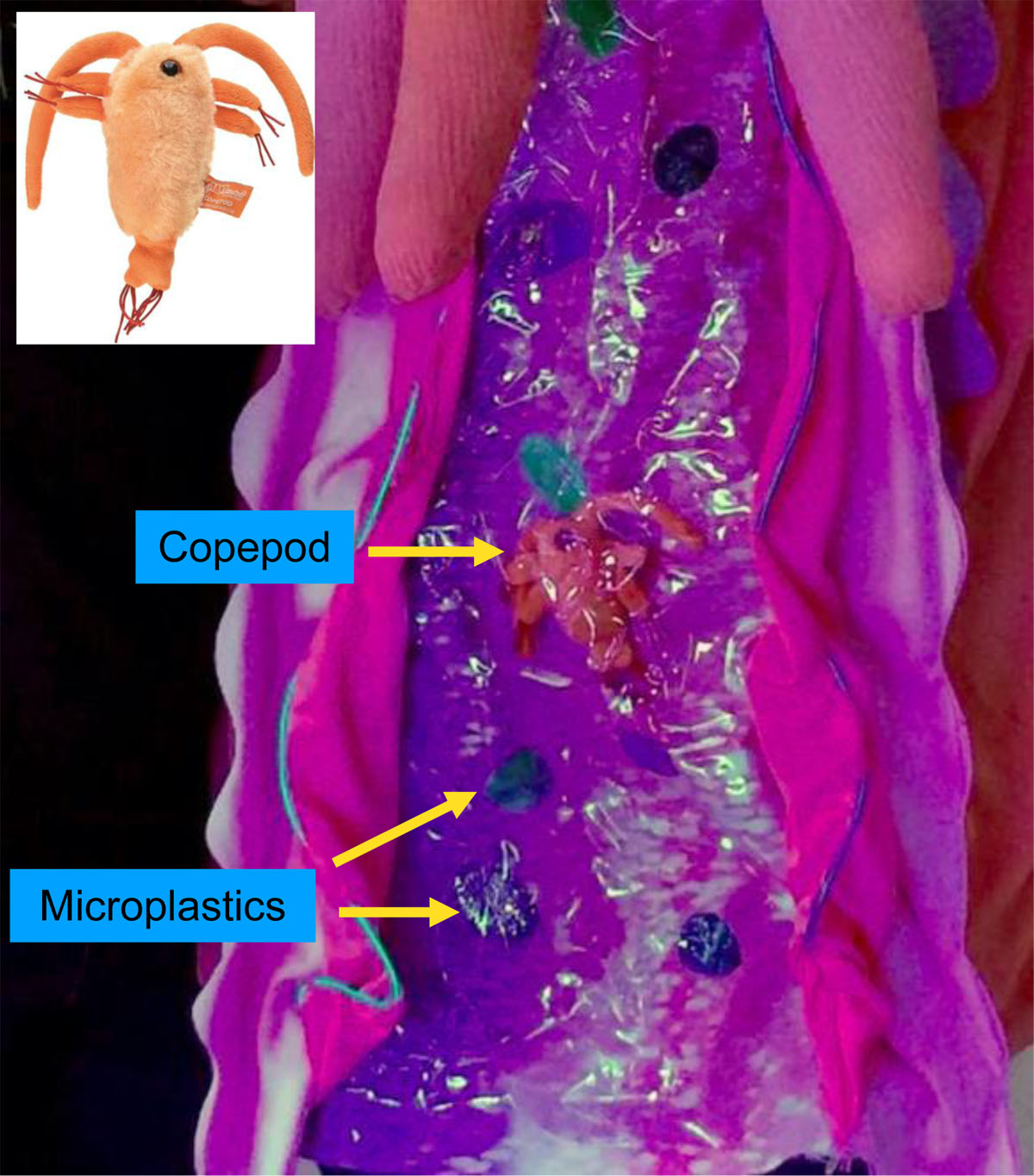
Figure 2
Close up of coral polyp costume showing microplastics and zooplankton (copepod) trapped in the digestive system (gastrovascular cavity). Inset: Commercially available stuffed toy representing the copepod Centropages hamatus.
To further draw attention to the polyp costume’s digestive system, we used plastic fiberoptic cables that emit bright light driven by LEDs (available from a variety of online vendors, e.g., Amazon). The cables (1.6 mm diameter) were sown into flaps representing the sheets of tissue (mesenteries) that partition the interior of a typical coral polyp. The LED lighting was multi-colored, and the controller could be set to flash quickly, slowly, or to stay on all the time. The overall proportions of the costume ensemble were within 15% of the actual proportions of a coral polyp. The polyp costume was approximately 100X life size, assuming a typical polyp height of 1 cm. The zooplankton and microplastics were also approximately 100X actual size.
Most cosplayers carry accessories of some sort that tie into the theme of the character they are depicting, often a weapon of some kind (Mishou, 2021). Because our lab had been developing new technology to address microplastics pollution, we accessorized the costume with a ‘MantaRay’ microplastics detector as a ‘sword’ for the coral character to wield, the prototype of which is shown in Figure 3. We created a PVC tube mockup that could be quickly opened to reveal a scale model resembling the inner workings of the actual prototype. This costume accessory was used to answer questions on how to address the lack of knowledge of where microplastics concentrate in the world ocean because current methods are so labor intensive (Hidalgo-Ruz et al., 2012). To better explain the inner workings of the prototype device, including its principle of operation, the back panel of the polyp costume showed an engineering diagram of the instrument (Figure 4).
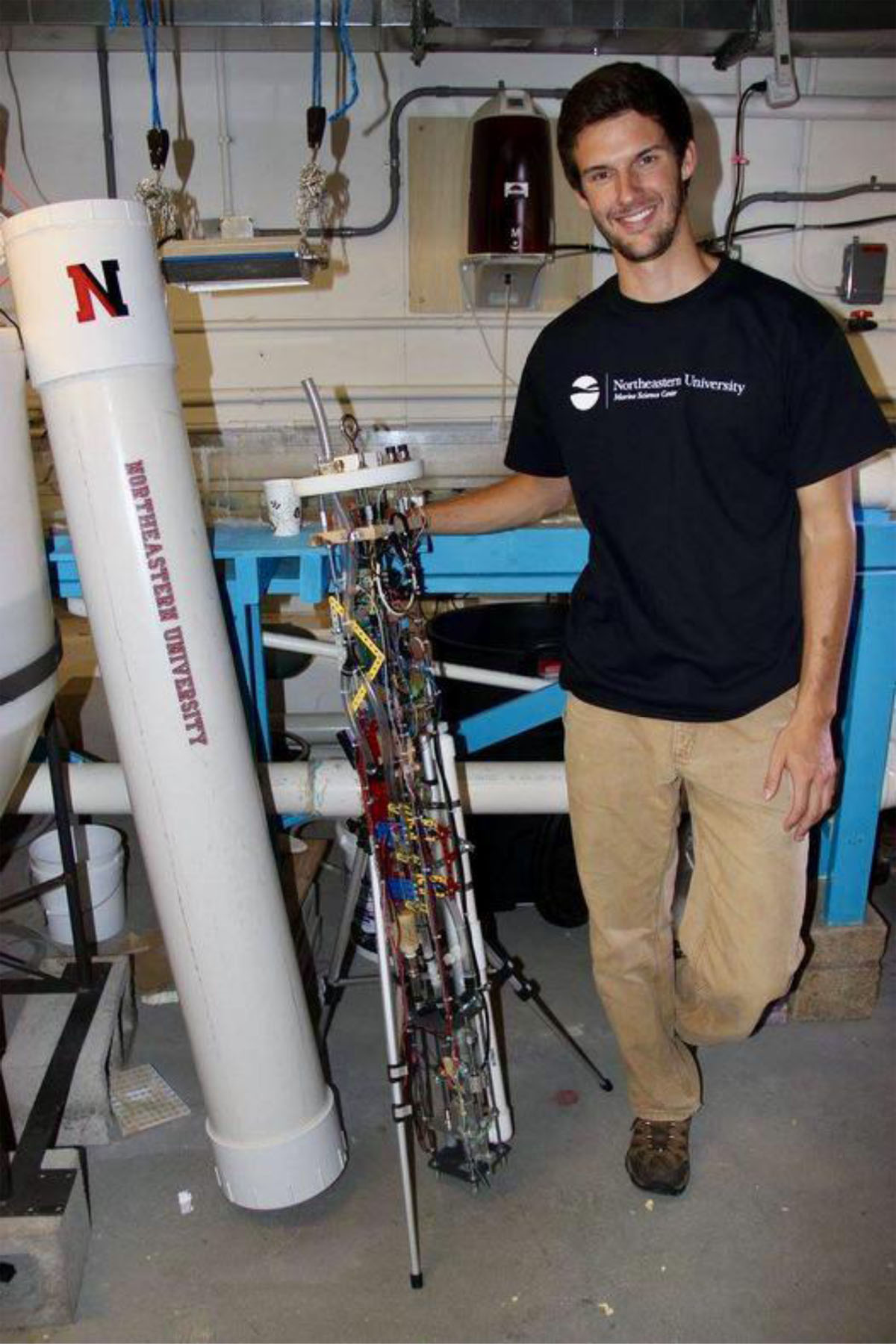
Figure 3
Prototype of microplastics detection instrument (‘MantaRay’) developed by co-author Edson, shown with its deployment housing. The accessory for the polyp costume was based on this instrument, and a diagram of the instrument was silk-screened on the back of the polyp costume (Figure 4), and included in the informational flyer (Appendix A).

Figure 4
Left: Costume accessory (‘MantaRay’ microplastics sampler) alongside the informational flyer (Appendix A). Right: Silk-screen diagram of the instrument on the back of coral polyp costume.
The second costume we developed was Amphitrite (Figure 5, lower), a Greek goddess who was the daughter of Nereus and Doris (Roman & Roman, 2010). Amphitrite came to symbolize saltwater (the ocean) itself under Roman mythology where she was known as Salacia (Demicheli 2007). Amphitrite was chosen to represent the environment in which the coral lives because the world ocean has been polluted at an unimaginable scale with microplastics, with an estimated > 24 trillion pieces thought to be present in the ocean (Isobe et al., 2021). We constructed this costume as a shiny blue/green dress with microplastics mixed into her dress layers, accessorized with a crown ensnared in macro-plastics (e.g., a plastic pop bottle). This provided a natural connection to address how macroplastics break down into microplastics when we engaged with cosplayers about the design of our costumes. We also discussed how much of the microplastics in the coastal ocean are synthetic fibers from clothing (Mathalon & Hill, 2014). Our costumes were designed over two meetings of the research team, and assembly took place over a 4-day period once costume elements had been procured. The main online source for our costume materials and accessories was Amazon.

Figure 5
The novelty factor of unknown costumes at a cosplay convention attracts attention and facilitate outreach. Top: Coral polyp character being ‘attacked’ by cosplayers. Bottom: Cosplayers with co-author S. Patterson in the Amphitrite costume representing the scope of the microplastics pollution problem in the world ocean. Note the plastic pieces throughout her crown and dress material.
We prepared an informational flyer about the microplastics problem and our research to distribute to attendees as we engaged them in conversation about microplastics pollution, and how our research was addressing the measurement issues surrounding quantification. When emotional connection, and/or entertainment are used in a short, easy-to-follow narrative, the audience is more likely to retain the message. These principles were codified in a new method known as the And-But-Therefore (ABT) framework to package messaging (Olson 2019).
We used this ABT framework during our communications with cosplayers: The ocean is filled with microplastics causing problems for marine life, including corals who eat them accidentally, AND we don’t have a complete understanding of microplastics pollution because counting microplastics using older technology was time-consuming and tedious. BUT, at Northeastern we have invented a new way to quickly measure the extent of microplastics pollution. THEREFORE, we can now (more easily) determine where the microplastics are accumulating so that we can provide better advice on how to manage this pollution source and stressor for marine life.
Results
We discovered that our costumes attracted attention during our 6-hour period spent in the Exhibition Hall and in the corridors linking panel venues (Figure 5). Attendees sought us out spontaneously when they could not identify which genre of characters we were representing. Almost all encounters were driven by cosplayers asking us who we were. Our costumes allowed us to introduce the problem of microplastics pollution in an entertaining way and offer information about what can be done to help manage the problem (St. Martin, 2015). Previous research has shown that providing “hope” about serious environmental issues is key to audience engagement and information retention (Park, William, & Zurba 2020).
Over the course of six hours, we distributed all 240 flyers. We had 96 encounters in the Exhibit Hall. Although some children were present, all encounters were with adults. The longest interaction time was c. 10 minutes, and the minimum interaction time was c. two minutes. We noted time to the nearest half minute by looking at our wristwatches as an encounter began and ended. Group size ranged from 1–9 persons, with an average of three people per encounter. There were also numerous encounters outside the Exhibit Hall but we did not track these, as we had exhausted our supply of informational flyers prior to exiting.
Discussion
‘In a media environment saturated with information, simply providing facts, no matter how well researched, will not be enough to persuade and inform citizens. Adopting the techniques of interpretation and engagement will help entomologists create more compelling messaging.…My wearing a very large fluffy green bug costume at a Science-Fiction Convention showed my audiences that I shared a social identity with them, and helped me become a “Nerd of Trust”.’
Pearson (2019) believes science as an enterprise has a communications problem. Trust and respect are both necessary aspects of communicating to audiences about science (Fisk & Dupree, 2014). A detailed and amplified critique for how to remedy this failure to communicate by practicing scientists is given by Randy Olson in his critically acclaimed book, Don’t Be Such a Scientist: talking Substance in an Age of Style (Olson, 2009). Olson makes a case that in any field where jargon is used to convey specialized knowledge, an ingroup mentality arises that frustrates clear communication with the outgroup (the lay public). Eschewing jargon and embracing narrative is the first step to more effective communication.
Co-author M. Patterson has conducted several hundred outreach events during his academic career at schools, public aquaria, museums, scientific conferences, and marine labs, including 55 live one-hour broadcasts from the underwater habitat Aquarius during the JASON project (JFE, 2000). In contrast to his previous outreach experiences, he found this experiment using cosplay to be the most intense outreach experience he has experienced to date. The cosplayers engaged were uniformly very focused and intent on assessing the costume elements and listening to our message, and the pace of interactions in the Exhibit Hall was relentless. Users of cosplay for marine education outreach at cosplayer gatherings like comic conventions should be ready to ‘be on’ for the duration of the event and to be fatigued by the end. Given the energy and time needed to prepare for cosplay, a short period of engagement does not make sense and educators should be prepared to spend ample time interacting with the other cosplayers.
In addition to the intensity of interactions, we predict marine science outreach cosplayers will enjoy the general positive and welcoming environment. Cosplay differs significantly from the western tradition of masquerade where costume wearers viewed themselves as their original persona under the costume (Geczy, 2016). Cosplayers see themselves as having a different personality when in costume (Mountfort, Peirson-Smith, & Geczy 2018), and this could explain the lack of conflict we observed in this setting, as it would break the illusion of their focused personae.
Subsequent use of the polyp costume by co-author Williams (Figure 6) at the Marine Science Open House Day, an annual event at Northeastern’s Marine Science Center attended by over 800 people, provided another opportunity to engage attendees in a more traditional setting for informal science education. Because the polyp costume showed a cutaway gastrovascular cavity, she was able to use it to explain research she was conducting on understanding the environment inside the polyp, where microplastics and zooplankton are processed. When designing a cosplay costume, we recommend considering use beyond the cosplayer events, such as outreach at marine labs or in school settings. Attention to scientific accuracy will enhance the costume’s continued use as a teaching tool in a non-cosplay setting.
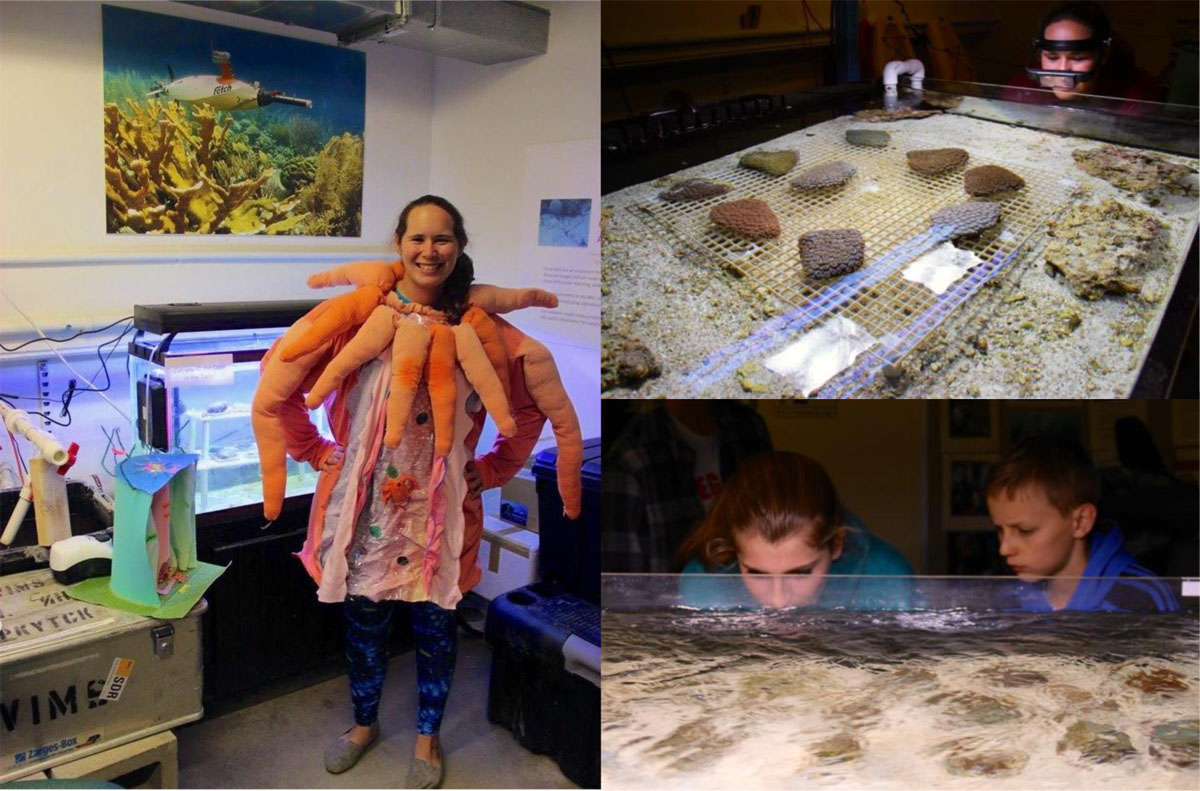
Figure 6
A well-designed costume can be used repeatedly in non-cosplay settings. Left: Co-author Williams using the coral polyp costume during the Annual Open House, Marine Science Center, Northeastern University, to conduct outreach on threats posed to corals by global change. Right top: Coral mesocosm with colonies of Montastrea cavernosa that served as the target species for the costume, providing a living example of coral anatomy and physiology to > 800 attendees. Right lower: Visitors inspect the coral colonies up close after engaging with Williams in costume.
The motivation for participating at a cosplay convention was to informally gauge whether outreach at this type of event was possible, i.e., can we present scientific material in a fun way in this setting? An important motivation for us was the sheer size of the cosplay event. Although we were unable to find in the literature best practices for science outreach conducted using cosplay, educators in the field of paleontology have recognized that dinosaur franchises like the Jurassic Park series offer a way to use pop-culture narratives to make science more relatable (Santos et al., 2019). To further the goal of using cosplay as a tool for making science accessible we offer five recommendations based on our experience:
The costume should be simple enough to quickly explain the topic, yet have enough complexity (flashing lights, removable parts, colorful artistic elements) that it draws attention. Cosplayers pride themselves on hand-fabricated efforts that they often spend considerable time assembling, so they will instinctively know whether yours’ was thrown together quickly or had real effort behind its construction.
A memorable accessory, in our case a scale model of the MantaRay microplastics sensor, is worth some thought. Many attendees asked what it was and how it worked; therefore, having a prop as part of the costume can help tell a compelling story.
Using a two-part message wherein a problem facing the ocean is presented, followed by a solution, or at least novel research to help find a solution, is a good idea. Much research has shown that public audiences are overwhelmed by the scope of the problems facing the ocean under climate warming and other serious issues, and that without some messaging on ‘hope’ (solution to the problem), they tune out. Using the ABT messaging framework developed by Olson (2019) is advised for conciseness, as interactions are time-limited at cosplayer gatherings.
A single page or postcard worth of information that repeats the central messages succinctly, ideally using the ABT format of Olson (2019), and includes your contact info, can be a graceful way to end each encounter. Some cosplayer conventions prohibit the distribution of ‘promotional material,’ but if contact info is provided, then your outreach material can be construed as a ‘business card’, not promotional material.
A successful outreach event will provide opportunities to gather photographs for your use later in science communication and reporting to others about the event. Remember it is important and courteous to ask for consent to take photographs of any cosplayers with whom you interact, and to obtain written permission if you anticipate using photos in published works, or for institutional publicity. Check with your own organization’s policies for such use. Furthermore, permission to take someone’s photo is often codified in the code of conduct or the admission policies at cosplayer conventions, and failure to comply can lead to ejection from these events.
The outreach message or science education goal of your cosplayer costume will vary greatly, but this approach has great potential for sharing knowledge about topics in marine science such as the impact of global change in the ocean, how to achieve sustainable fisheries, the value of marine protected areas and biodiversity, the invasive species problem, among others. This outreach method scales as well: with more cosplayers, the team can interact as part of a larger narrative. A multiple-person team can also split up and maximize engagements/hour while minimizing fatigue. Schools could involve students working with teachers using this method, or an entire research group could produce and wear costumes for an event.
The question remains about how this method compares with other strategies of informal science education, as measured by impact metrics (NASEM, 2018; Habig et al., 2020). We encourage readers to experiment with this outreach method to see if the ‘single exposure’ inherent in this approach leads to meaningful retention of the science message (Falk & Dierking, 2010). In other words, can marine science educators become ‘Nerds of Trust’ (McClain, 2017) using cosplay?
Additional File
The additional file for this article can be found as follows:
Appendix A
Screen shot of flyer designed to raise awareness about microplastics pollution and a new invention measuring microplastics, distributed at Comic-Con International 2015 by authors S. Patterson (Amphitrite) and M. Patterson (Coral Man) to attendees in the Exhibit Hall, San Diego Convention Center. (Older contact details for author Edson redacted.) DOI: https://doi.org/10.5334/cjme.80.s1
Acknowledgements
We thank S. Broback, co-founder at Dent, who extended the invitation to one of us (MP) to present at the Comic-Con International panel on Aquaman, and co-panelists M.-R. Krack (Performance Freediving Academy), J. Leichter (Scripps Institution of Oceanography, University of California San Diego), and L. Parkinson (Stuart Cove’s Dive Bahamas). L. Torossian and P. Welman provided expert design advice and sewed costume elements. Northeastern University provided travel support, and accommodations at the venue were graciously provided by J. Leichter and D. Stokes. B. Helmuth and C. McCauley provided helpful input on science outreach strategies in informal settings, and R. Olson inspired us to include narrative structure in our messaging. We thank the cosplayers who gave their consent for photographs taken by us at the convention, and for their attentive engagement during our encounters. We thank M. Schrope and Schmidt Marine Technology Partners, a program of the Schmidt Family Foundation, who became aware of our unusual approach to science communication and outreach from press generated by the team at News@Northeastern, and who subsequently funded further development of the microplastics sampling device. We thank the Proteus Ocean Group and Fabien Cousteau for support, and for discussions about how cosplay can be incorporated into messaging involving marine conservation. We thank two anonymous reviewers and the corresponding editor who made numerous suggestions that greatly improved the manuscript.
Competing Interests
The authors have no competing interests to declare. Co-author Dwyer statement: The results and conclusions, as well as any views or opinions expressed herein, are those of A. Dwyer, and do not necessarily reflect the views of the National Oceanic and Atmospheric Administration, or the Department of Commerce.
Author Contributions
M. Patterson led the project that evolved out of an invitation to him to speak on a panel at Comic-Con International. He helped construct the coral polyp costume, helped draft the informational flyer, and presented the costume while conducting outreach at the convention. He wrote the manuscript with editorial suggestions from the co-authors.
S. Patterson contributed ideas to the design of both costumes, helped construct them, and presented the Amphitrite costume while conducting outreach at the convention.
E. Edson developed the microplastics sampling technology, made the diagram for the costume, provided design input into the costumes, refined the prose on the flyer, and constructed the costume accessory representing the microplastics sampling device.
S. Williams contributed ideas to the design of both costumes, helped construct them, advised on the presentation of the gastrovascular cavity and mesenteries, and conducted follow-on use of the polyp costume during an open house held at Northeastern University’s Marine Science Center.
J. Torossian contributed ideas to the design of both costumes, helped construct them, and arranged for detailed fabrication work by L. Torossian.
A. Dwyer contributed ideas to the design of both costumes, helped construct them, and advised on the inclusion of zooplankton model toys in the gastrovascular cavity.