

Figure 1
Map of Ocean Outreach Institutions (Red are responders, Blue are non-responders).
Table 1
Institutions Surveyed for Science Education Outreach.
| INSTITUTION NAME | LINK |
|---|---|
| California Academy of Sciences | https://www.calacademy.org/ |
| An aquarium, planetarium, rainforest, and natural history museum in the heart of San Francisco’s Golden Gate Park—and a powerful voice for biodiversity research and exploration, environmental education, and sustainability across the globe. | |
| Hopkins Marine Station and Stanford Center for Ocean Solutions | https://hopkinsmarinestation.stanford.edu/ |
| Hopkins Marine Station is the marine laboratory of Stanford University. It is located ninety miles south of the university’s main campus, in Pacific Grove, California on the Monterey Peninsula | |
| Hubbs-SeaWorld Research Institute | https://hswri.org/education-and-outreach/ |
| Hubbs SeaWord is a scientific research organization committed to conserving and renewing marine life to ensure a healthier planet. A team of experts provides innovative and objective scientific solutions to challenges threatening ocean health and marine life in our rapidly changing world. | |
| Lawrence Hall of Science | https://lawrencehallofscience.org/ |
| A public science center at the University of California, Berkeley that aims to make science, technology, engineering, and mathematics (STEM) accessible to all. The center is known for its innovative programs, exhibits, and resources for educators and policymakers. | |
| Marine Mammal Care Center | https://marinemammalcare.org/ |
| The Marine Mammal Care Center is a non-profit organization that inspires ocean conservation through marine mammal rescue (mainly seals and sea lions) and rehabilitation, education, and research. They respond to marine mammals in distress year-round, and they have a S.E.A. Lab (Science, Exploration, and Action for Ocean Conservation), which is a hands-on STEM program that immerses participants in marine science through interactive activities. | |
| Ocean Guardian Program | https://sanctuaries.noaa.gov/education/ocean_guardian/ |
| This program encourages children to explore their natural surroundings to form a sense of personal connection to the ocean and/or watersheds in which they live. | |
| Pacific Grove Museum of Natural History | https://www.pgmuseum.org/ |
| The Pacific Grove Museum of Natural History is an award-winning museum that opened in 1883, making it one of the oldest natural history museums in the United States. The museum’s mission is to inspire people to explore and protect the natural and cultural wonders of the Central California Coast. | |
| Santa Cruz Museum of Natural History | https://www.santacruzmuseum.org/ |
| The Santa Cruz Museum of Natural History (MNHC) is a nonprofit organization that aims to connect people with nature and science, and inspire stewardship of the natural world. The museum’s exhibits and educational programs focus on the natural and cultural history of the Monterey Bay region, from the shoreline to the Santa Cruz Mountains. | |
| Save the Whales | https://savethewhales.org/ |
| A nonprofit organization that works to protect marine life and the ocean. Founded in 1977 by Maris Sidenstecker, the organization focuses on educating the public, especially children, about marine mammals and the ocean environment. They believe that children can promote change and that education is key to saving the ocean and whales. | |
| Surfrider Foundation Monterey County | https://www.surfrider.org/ |
| The Surfrider Foundation is a non-profit organization that works to protect and preserve the world’s oceans, waves, and beaches. Founded in 1984 by surfers in Malibu, California, the organization has over 50,000 members and 90 chapters worldwide. | |
| University of Southern California Sea Grant | https://seagrant.noaa.gov/ |
| Sea Grant is a federal-university partnership program that works to create and maintain a healthy coastal environment and economy. The program was established by the U.S. Congress in 1966 and is inspired by the success of the Land Grant Program. Sea Grant’s network includes 34 university-based programs, the National Sea Grant Library, and hundreds of research institutions. | |
Table 2
Comparison between the Chi-Square test and Fisher’s Exact Test.
| FEATURE | CHI-SQUARE TEST | FISHER’S EXACT TEST |
|---|---|---|
| Assumptions | Expected counts ≥ 5 in most cells | No minimum expected count requirement |
| Method | Approximate test (uses chi-squared distribution) | Exact test (calculates true probabilities) |
| Best for | Larger samples with balanced data | Small or sparse samples, especially with many 0 s |
| Performance | Fast, even on large tables | Slower on large tables, may not run on big ones |
Table 3
Student responses by major and earliest grade level recalling Science learning.
| MAJORS/GRADES | PREK | ELEMENTARY | MIDDLE_SCHOOL | HIGH_SCHOOL | N/A | TOTAL |
|---|---|---|---|---|---|---|
| Biological Studies | 4 | 21 | 4 | 3 | 0 | 32 |
| Business and Marketing | 0 | 0 | 1 | 0 | 1 | 2 |
| Environmental Studies/Science | 2 | 9 | 4 | 3 | 0 | 18 |
| Humanities | 0 | 3 | 0 | 0 | 0 | 3 |
| Kinesology | 0 | 0 | 0 | 2 | 0 | 2 |
| Mechanical | 0 | 1 | 1 | 1 | 0 | 3 |
| Marine Science | 4 | 26 | 4 | 1 | 2 | 37 |
| Psychology | 0 | 1 | 1 | 0 | 0 | 2 |
| Statistics | 0 | 0 | 0 | 1 | 0 | 1 |
| TOTAL | 10 | 61 | 15 | 11 | 3 | 100 |

Figure 2a
Box Plot of Students and Exposure to Science. This box plot indicates how many undergraduate students were first exposed to science by grade level. The highest number of students selected elementary (K-5) as their early exposure to science.
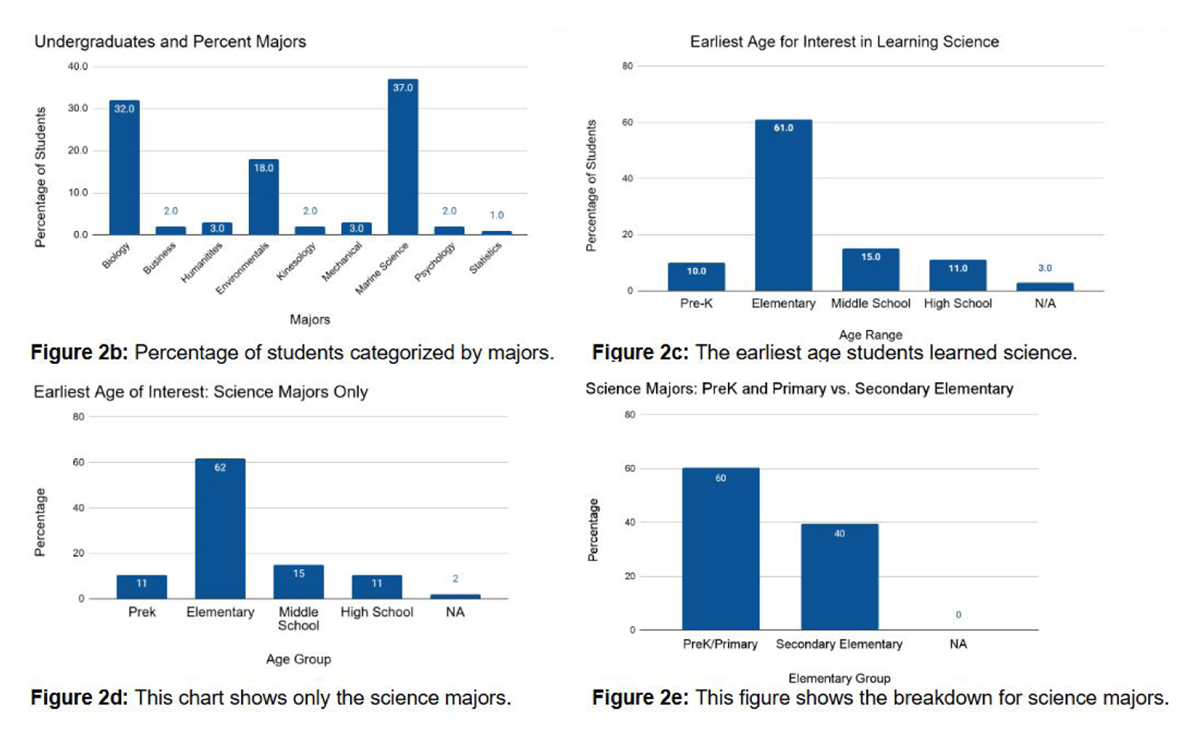
Figures 2b–2e
Summary of responses from undergraduates surveyed.
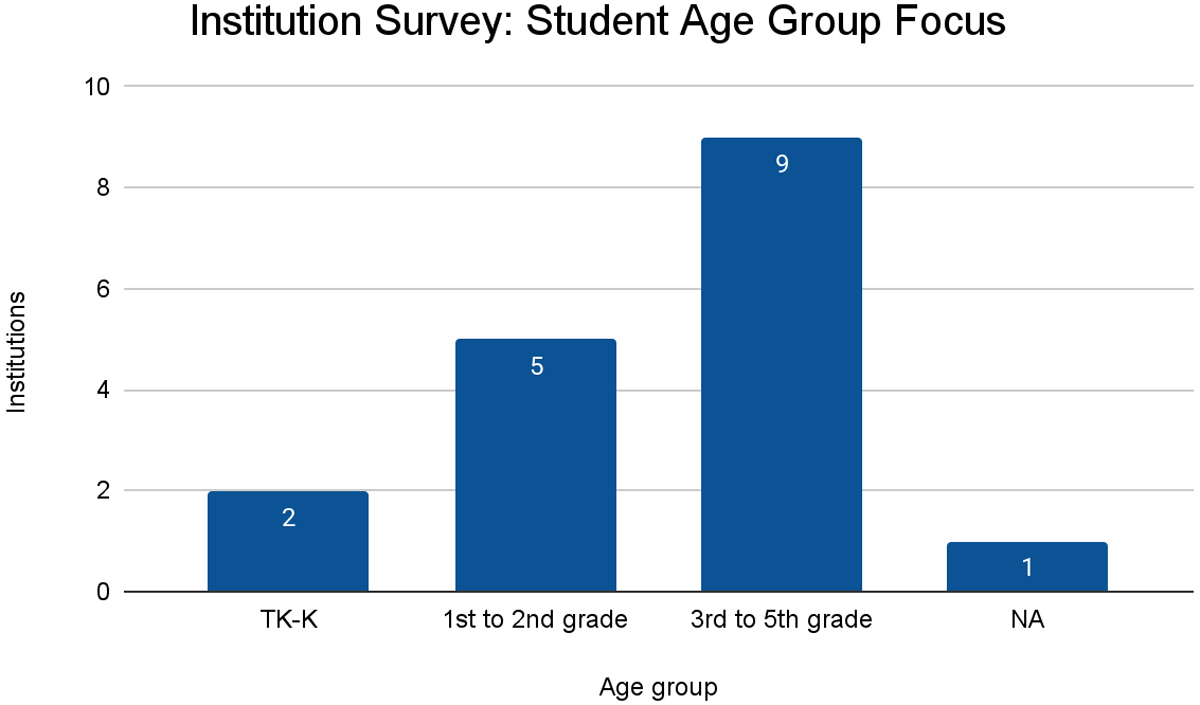
Figure 3a
11 Institutions were surveyed. This graph shows that 9 of the 11 (81%) targeted 3rd to 5th graders. Only 5 institutions of the 11 targeted 1st to 2nd grade and only 2 targeted TK–K.
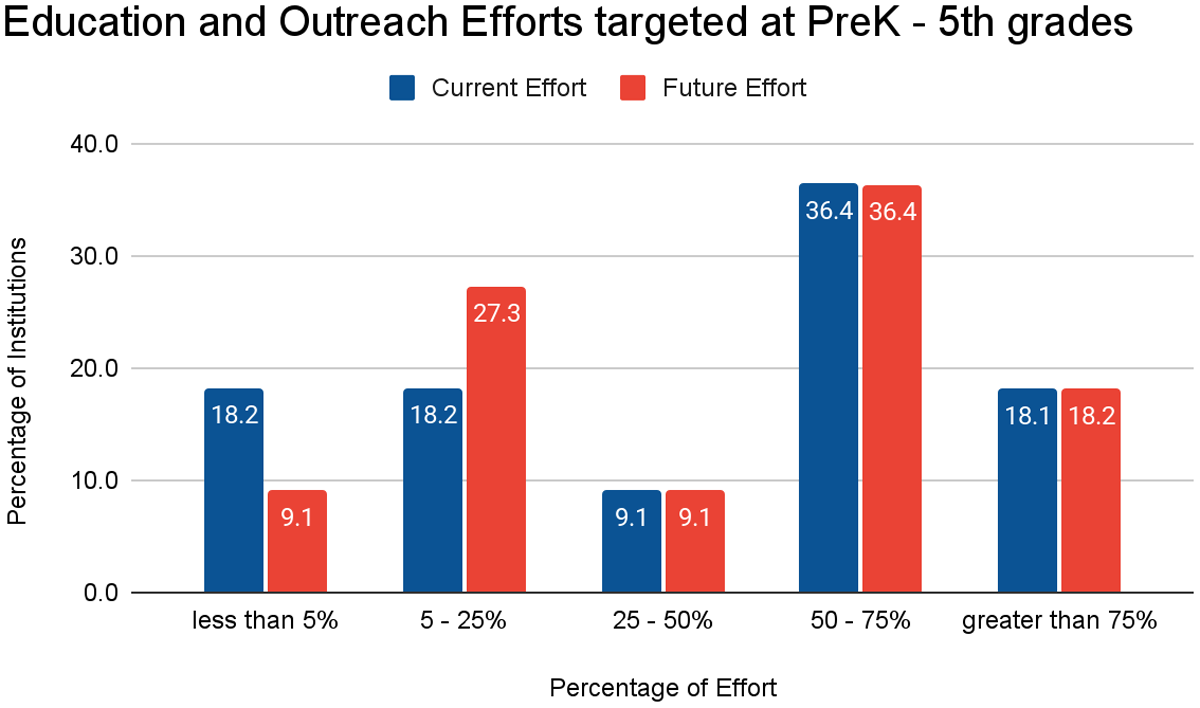
Figure 3b
The percent of effort by institutions (out of 11) targeting PreK–5th grade students when it comes to education and outreach. The blue bars represent the current effort by institutions to target PreK–5th grade, while the red bars represent the future effort or the intention to target PreK–5th grade. While almost all institutions do some outreach in the PreK to 5th grade, about 46% spent less than 50% of their outreach efforts in this age group.

Figure 4
Schematic depiction of values as the overarching guidance for decisions in research and education that can guide research or education projects in alignment with these values (Perdrial et al. 2023).
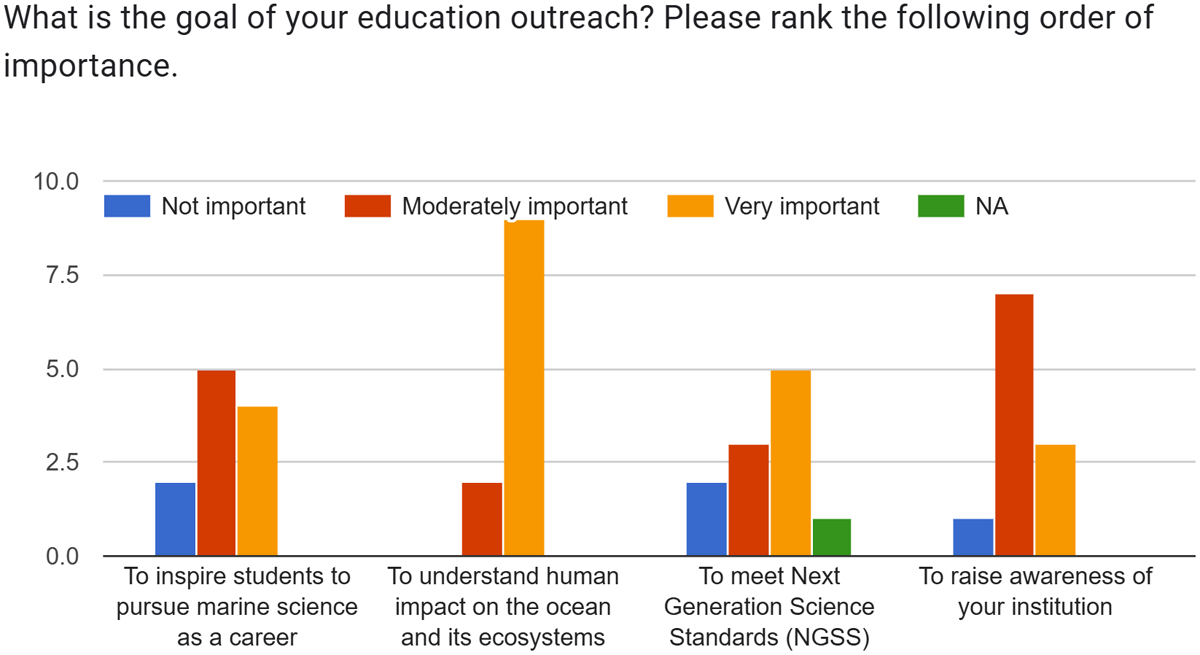
Figure 5
Institutional survey of goals of education and outreach.

Figure 6
Institutional survey of where institutions sourced their content for TK – 5th grade students.