
Table 1
Survey questions used for assessing knowledge of ocean literacy. Questions were taken from questions validated by Chen et al. 2020, as indicated after each question.
| OCEAN LITERACY PRINCIPLE | QUESTION | CHOICES (* = CORRECT) |
|---|---|---|
| The Earth has one big ocean with many features | 1. Which of the following most influences the depth at which organisms live in the open ocean (away from the shoreline)? [Q#023 from Chen et al. 2020] | a. Salinity levels b. Crashing waves c. *Light levels d. Human Activity |
| 2. Where is most of the water on Earth? [Q#007 from Chen et al. 2020] | a. In the atmosphere b. In polar ice caps c. In rivers and lakes d. *In the ocean | |
| The ocean and life in the ocean shape the features of the Earth | 3. Rivers supply most of the salt to the ocean. The salt in the rivers comes from: [Q#010 from Chen et al. 2020] | a. Mountain ice melting b. *Erosion of land c. Rainfall in the rivers d. Human caused pollution |
| 4. Sea level changes have: [Q#030 from Chen et al. 2020] | a. Reversed the direction that some rivers flow b. Changed global temperatures c. *Changed the shape of the coastline d. Increased fish populations | |
| 1. The ocean is a major influence on weather and climate | 5. Because the ocean covers most of the Earth: [Q#002 from Chen et al. 2020] | a. *It has the most dominant influence of Earth’s weather and climate b. Most living things are concentrated on land c. Most of the earth is not useful for humans d. It generates most of the Earth’s greenhouse gases |
| 6. If there was no ocean, the Earth’s surface temperatures would be: [Q#039 from Chen et al. 2020] | a. *More extreme around the world b. Less extreme around the world c. Cooler in the summer and warmer in the winter d. About the same as they are now | |
| 2. The ocean made the Earth habitable | 7. Both land and ocean provide space for organisms to live. How much of Earth’s living space is found in the ocean? [Q#021 from Chen et al. 2020] | a. Only a little bit (less than 10%) b. About half (40–60%) c. More than half (60–80%) d. *Nearly all (more than 90%) |
| 8. Most rain that falls on land originally evaporated from: [Q#013 from Chen et al. 2020] | a. *The ocean near the equator b. The middle of each ocean basin c. Nearby lakes and rivers d. The nearest ocean basin | |
| The ocean supports a great diversity of life and ecosystems | 9. Which of the following is true about ecological relationships in the ocean? [Q#036 from Chen et al. 2020] | a. They are very similar to those in land, including similar food webs, life cycle, and symbiotic relationships b. They are mostly unknown since so much of the ocean has not been explored c. They are mostly very simple compared to those in land d. *There are unique features of food webs, life cycles, and symbiotic relationships in the ocean that are not found on land |
| 10. Which of the following marine ecosystems is the most important nursery areas for many marine species? [Q#026 from Chen et al. 2020] | a. Coral reefs (reefs formed by living corals) b. The deep sea (more than 100 m below the ocean surface) c. The open ocean (away from the shoreline) d. *Estuaries (where rivers meet the ocean) | |
| The ocean and humans are inextricably interconnected | 11. Absorption of carbon dioxide (CO2) by the ocean has a direct influence on which of the following? [Q#034 from Chen et al. 2020] | a. The greenhouse effect and dead zones in the ocean b. Acid rain and harmful algal blooms c. Acid rain and ocean acidification d. *The greenhouse effect and ocean acidification |
| 12. The use of satellites, buoys, and remotely-operated vehicles improve our understanding [Q#029 from Chen et al. 2020] | a. Reduce errors from human measurements of the ocean b. Cause less disturbance to the marine environment c. Are cheaper than previous tools d. *Collect much more data than scientists on ships can | |
| The ocean is largely unexplored | 13. Scientists are discovering that more species than they expected live in the deep sea. These discoveries are only being made now because: [Q#031 from Chen et al. 2020] | a. Environmental conditions are causing species to migrate to the deep sea b. Deep sea species evolve more rapidly than shallow water species c. Shallow water species have been overfished d. *Scientists are just beginning to explore the deep sea |
| 14. Which of the following is true concerning the exploration of the ocean? [Q#037 from Chen et al. 2020] | a. People have been exploring the ocean for thousands of years and most of it has been explored b. Almost all of the ocean has been explored in the last 50 years because of the new technology c. *Most of the ocean is still unexplored despite improvements in technology in the last 50 years d. Most of the ocean is still unexplored because scientists focus on the areas where most organisms live | |
| Interest question 1 | How important is the ocean to you? | 1. Not at all 2. A little 3. Some 4. Quite a bit 5. A lot 6. Mostly 7. Completely |
| Interest question 2 | Would you be interested in learning more about ocean-related jobs? | 1. Not at all 2. A little 3. Some 4. Quite a bit 5. A lot 6. Mostly 7. Completely |
Table 2
Daily programming for the 4-day Junior Aquarists Camp for Kids at the INSTITUTION Oceanarium, summer 2023.
| DAY | OCEAN LITERACY PRINCIPLE(S) | DESCRIPTION |
|---|---|---|
| 1 | The Earth has one big ocean with many features | 1. Administered the pre-workshop knowledge survey 2. Covered the key features of the ocean: temperature, salinity, light levels 3. Activity: completed a scavenger hunt to orient students to the lab 4. Activity: learned about salinity and temperature |
| 2 | The ocean and life in the ocean shape the features of the Earth The ocean is a major influence on weather and climate | 1. Covered the geology of the ocean 2. Covered how rocks are formed 3. Covered how the oceans became salty 4. Covered the effect of the ocean on weather and climate 5. Activity: Sand Identification, El Niño and La Niña |
| 3 | The ocean makes the Earth habitable The ocean supports a great diversity of life and ecosystems | 1. Covered how the ocean makes the Earth habitable 2. Covered different kinds of biodiversity found in the ocean 3. Activity: Ocean zones and Tank Exploration |
| 4 | The ocean and humans are inextricably interconnected The ocean is largely unexplored | 1. Covered how oceans and humans are interconnected, as well as how the ocean is largely unexplored 2. Activity: Interactive activity on litter 3. Administered the post-workshop knowledge survey |
Table 3
Distribution of demographic data among survey respondents with respect to grade level they will enter in the fall (Grades 4 to 8, ages 9–14 years old), sex, experience with oceans, and type of school attended.
| GR4 | GR5 | GR6 | GR7 | GR8 | TOTAL | |
|---|---|---|---|---|---|---|
| Female | 5 | 1 | 4 | 5 | 2 | 17 |
| Male | 4 | 1 | 3 | 4 | 2 | 14 |
| Ocean: Never | 2 | 0 | 2 | 1 | 1 | 6 |
| Ocean: Once | 3 | 2 | 0 | 3 | 1 | 9 |
| Ocean: > Once | 2 | 0 | 3 | 1 | 1 | 7 |
| Ocean: > 5 times | 2 | 0 | 2 | 4 | 1 | 9 |
| Public school | 7 | 1 | 5 | 7 | 3 | 23 |
| Private school | 2 | 1 | 2 | 2 | 0 | 7 |
| Home schooled | 0 | 0 | 0 | 0 | 1 | 1 |
| Total | 9 | 2 | 7 | 9 | 4 | 31 |
Table 4
Tests of data validity measured as bivariate Pearson correlations between responses on individual questions and their overall score on the survey.
| AREA OF OCEAN LITERACY | QUESTION | PRE-JACK SURVEY | POST-JACK SURVEY | ||
|---|---|---|---|---|---|
| r | p | r | p | ||
| One big ocean | 1 | 0.437 | 0.070 | 0.486 | 0.041 |
| 2 | –0.012 | 0.961 | –0.112 | 0.659 | |
| Ocean shapes Earth | 3 | 0.483 | 0.042 | 0.625 | 0.006 |
| 4 | 0.349 | 0.156 | 0.367 | 0.134 | |
| Ocean influences climate | 5 | 0.320 | 0.196 | 0.384 | 0.115 |
| 6 | 0.535 | 0.022 | 0.354 | 0.150 | |
| Ocean makes Earth habitable | 7 | 0.594 | 0.009 | 0.417 | 0.085 |
| 8 | 0.490 | 0.039 | 0.309 | 0.212 | |
| Ocean has a great diversity of life | 9 | 0.459 | 0.064 | 0.367 | 0.134 |
| 10 | 0.594 | 0.009 | 0.503 | 0.033 | |
| Ocean and humans are interconnected | 11 | –0.088 | 0.727 | 0.655 | 0.003 |
| 12 | 0.113 | 0.655 | 0.500 | 0.035 | |
| Ocean is largely unexplored | 13 | 0.529 | 0.024 | 0.574 | 0.013 |
| 14 | 0.585 | 0.011 | 0.667 | 0.003 | |

Figure 1
Individual ratings on interest questions “How important is the ocean to you?” and “Would you be interested in learning more about ocean-related jobs?” (Likert ratings: 1 = Not at all, 2 = A little, 3 = Some, 4 = Quite a bit, 5 = A lot, 6 = Mostly, 7 = Completely) and ocean literacy knowledge score before and after the JACK workshop. Heavy black lines represent mean responses. There was a significant increase in ratings for the importance of oceans and a significant increase in knowledge about the seven principles of ocean literacy.

Figure 2
Changes in ratings for ocean importance and interest in ocean jobs between before and after the JACK workshop. (Likert ratings: 1 = Not at all, 2 = A little, 3 = Some, 4 = Quite a bit, 5 = A lot, 6 = Mostly, 7 = Completely).

Figure 3
Score on pre- and post-workshop ocean literacy knowledge survey as predicted by pre-workshop ranking of the importance of oceans. Knowledge gain on areas of ocean literacy was even across all rankings of the importance of oceans.
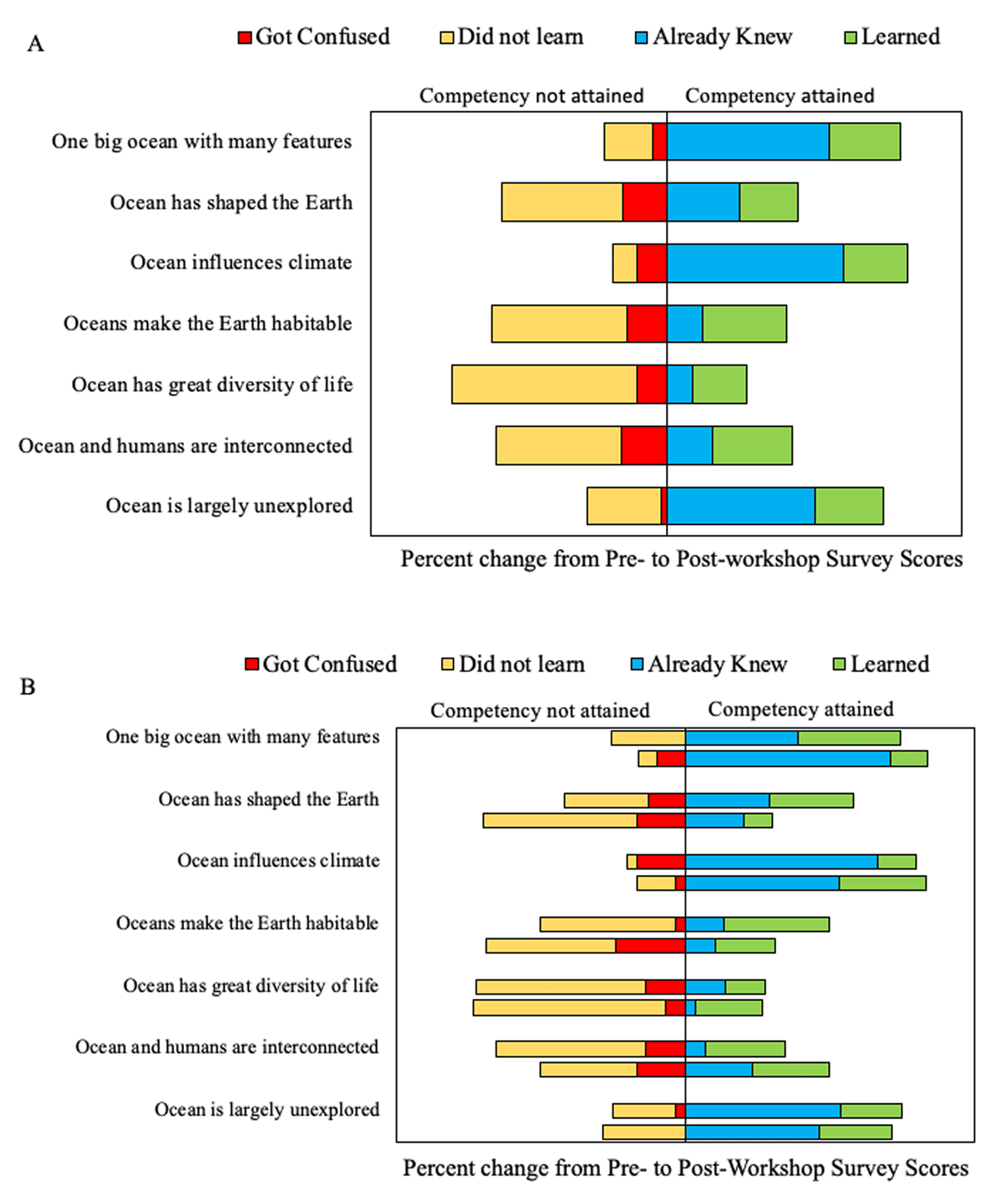
Figure 4
Summary of responses organized by (A) principle of ocean literacy, and (B) by question on the survey (questions 1 through 14). Bars represent percent change from pre- to post-workshop scores on the knowledge survey about ocean literacy. There were two questions per ocean literacy principle that are combined in (A) and parsed in (B).
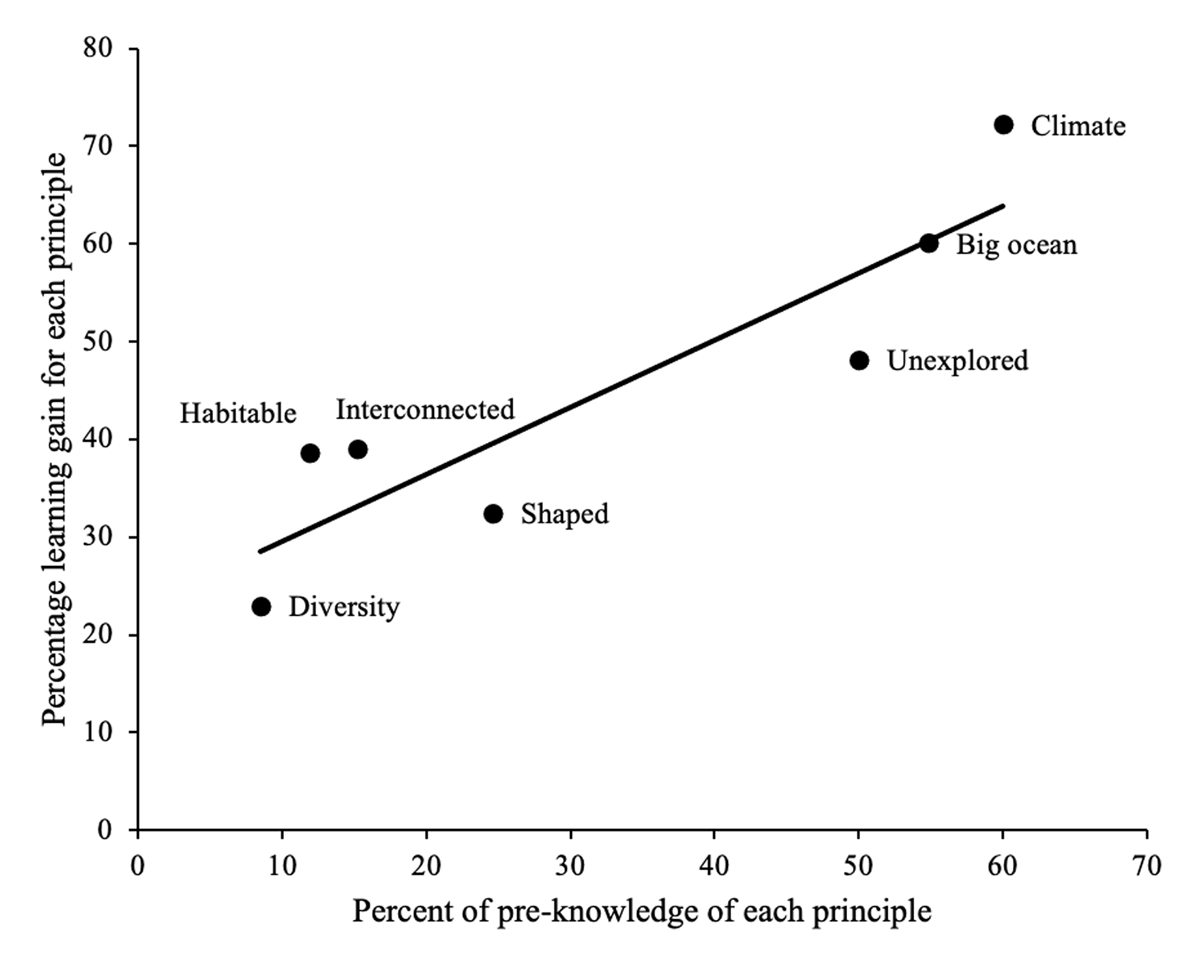
Figure 5
Relationship between level of pre-knowledge for each area of ocean literacy by some participants and learning gain by their classmates.

Figure 6
Percent of respondents with pre-knowledge of the concepts of ocean literacy (A) and those that made learning gains as a result of the workshop experience (B), as a function of grade level, sex, and ocean experience.