
Introduction
The purpose of a book review was to provide an overview of contents and assess the merit of the book or author, but they also served a vital social function for scholarly groups.3 Book reviews defined who was in the community, their shared values and characteristics. They helped to shape and maintain the community by re-iterating the group’s aims and interests. Reviewers also influenced subject methodology by promoting those features that were seen as ‘good scholarship’. This paper will show the potential of such evidence for adding to our understanding of the development of archaeological communities and their priorities.
Antiquarianism was born out of a pastime for the leisured gentleman, but by the early nineteenth century was attracting increasing numbers of the professional middle classes including architects, doctors and the clergy.4 Book reviews exposed the underlying tensions between the different social groups involved and revealed who reviewers believed should be included in the community.5 The existing, extensive antiquarian community in Britain had a shared intellectual outlook, with regular meetings and social gatherings that created a sense of camaraderie.6 By the 1840s, however, a group emerged that preferred to focus primarily on excavation and material evidence. They wanted ‘archaeology’ to be seen as a scientific endeavour, distinct from antiquarianism.7 This study will consider how reviewers dealt with these different approaches to studying the past and how they helped to formulate protocols on conducting research and presenting findings.8
In a period without institutional support, archaeologists had to consider how to gain credibility and secure funding. The British government did not provide money for excavation or research.9 Its attitude towards heritage and the preservation of monuments was heavily influenced by the sanctity of private property.10 The British Museum was equally reluctant to offer support. The trustees’ narrow view of antiquity was centred on the Mediterranean world and there was no place for national antiquities in this narrative.11 The Museum’s continued funding for overseas projects caused indignation amongst British archaeologists, forcing them to either self-fund, cultivate relationships with wealthy individuals or reach out to the wider public for a subscription campaign.12 The public’s understanding of archaeology, therefore, became increasingly important and reviewers found themselves in a position of influence, playing a key role in building reputations and establishing ‘experts’.
Britain’s first literary review journal, The Monthly Review, emerged in 1789, aiming to summarise all new books. By the early nineteenth century, new technological processes reduced production costs, making print available to a wider audience for the first time.13 With comprehensive reviewing no longer feasible, the review provided a way of navigating through the unwieldy mass of literature. The monthly Gentleman’s Magazine (established 1731) had always included antiquarian content, but from 1782 under the editorship of John Nicols (1745–1826), it became the leading publication for communicating antiquarian research, including book reviews.14 By the early decades of the nineteenth century, however, as the number of relevant publications increased,15 antiquarians realised they needed their own specialist review journal.16 The year 1840 is an appropriate starting point for this research because, with the establishment of the British Archaeological Association (BAA) in 1843 and the Archaeological Institute (AI) in 1845, this decade saw book reviews in national society journals for the first time. During this period, Britain was also experiencing industrialisation and urbanisation which led to a construction boom. New housing, sewerage systems and the development of the railway network caused major disturbance to the archaeological remains below. These disturbances led to finds, many of which were Roman. The discovery of Roman roads, coins, villas and the exploration of Hadrian’s Wall, created a momentum in interest and this generated a wave of new publications on Roman Britain, many of which were reviewed. A combination of keyword searching, using indexes and systematic browsing was required to find these book reviews. Journals were chosen to represent the main types of review: the high-culture quarterlies, the weekly/monthly general publications and the specialist society periodicals. In total 184 Romano-British reviews were found between 1840 and 1860 (Appendix 1).
Readers of Reviews
Archaeological book reviews were written first and foremost for antiquarians; those most likely to purchase the book. However, the society journals which were important for disseminating and validating research amongst peers, did not contain the most reviews. The Archaeological Journal and the Journal of the British Archaeological Association (JBAA) are both mid-table (Figure 1). A survey of all reviews in these publications over the time period shows that those on Roman Britain were infrequent and sporadic (Figures 2 and 3). This was a reflection of society interests, which were more focussed on the Middle Ages and ecclesiastical architecture, and is entirely consistent with studies of the overall content of these journals during the nineteenth century. Both Van Riper17 and Evans18 found that 60–70% of articles covered the medieval period, whilst Roman content accounted for less than 20%.
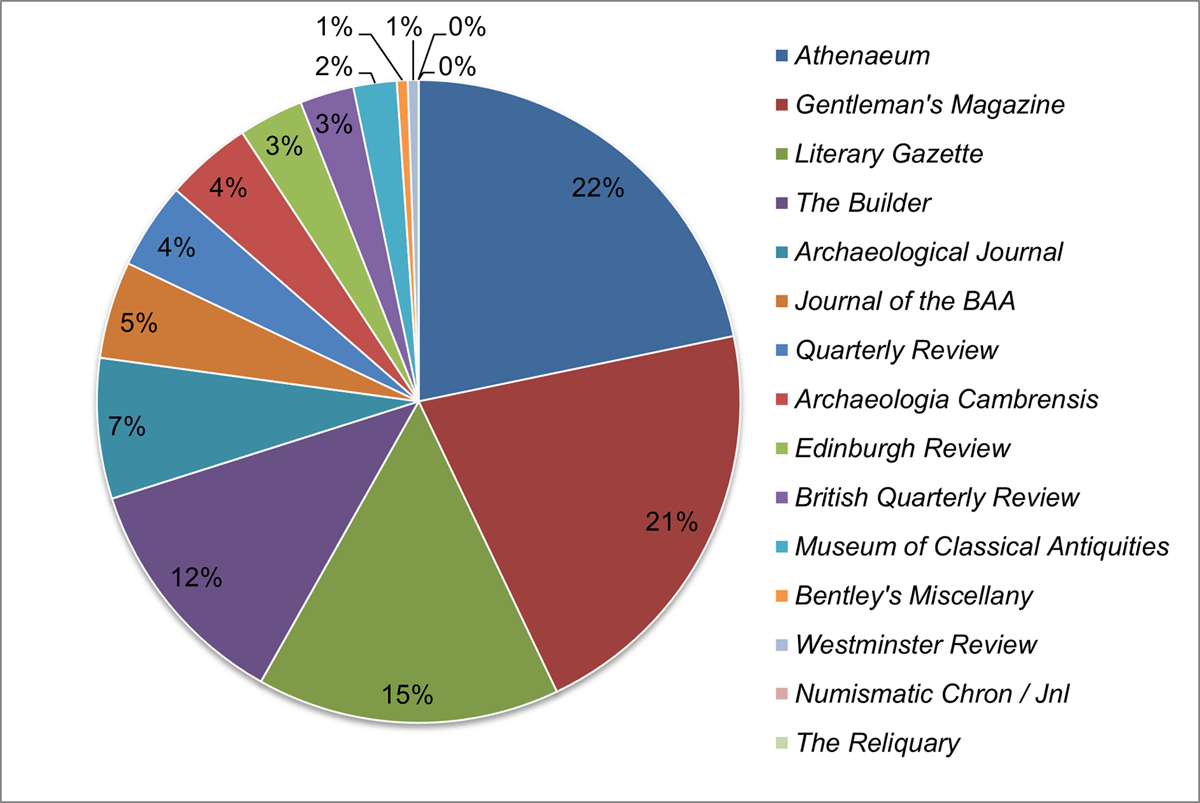
Figure 1
Pie chart of Romano-British reviews by publication 1840–60.
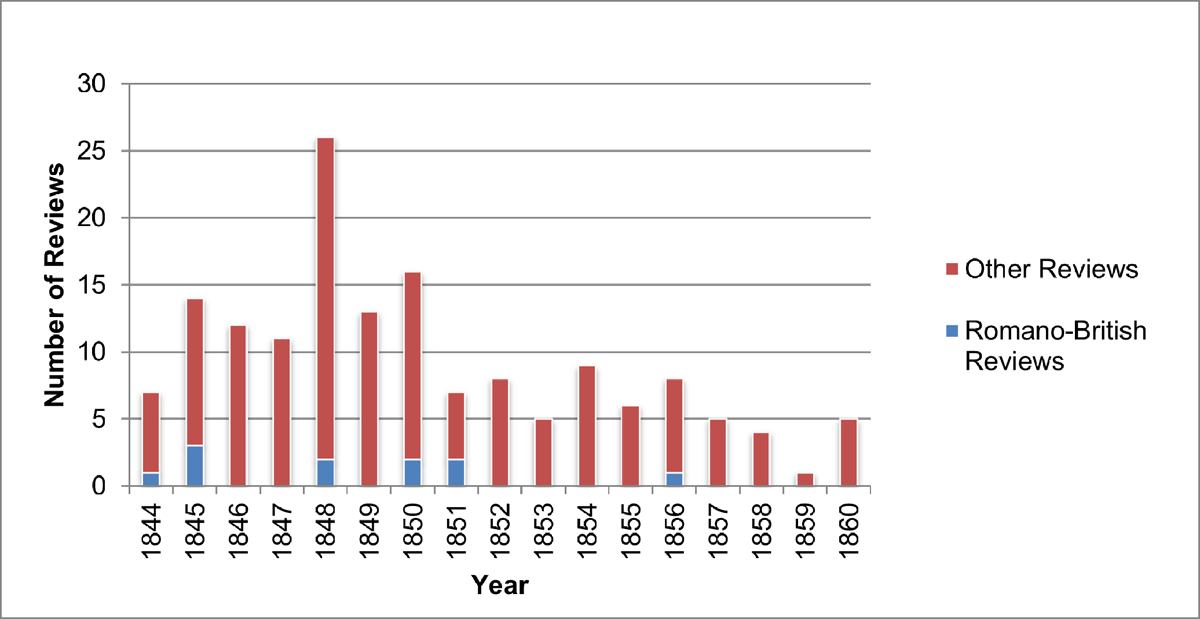
Figure 2
Bar chart of Romano-British reviews compared with all Archaeological Journal reviews 1840–60.
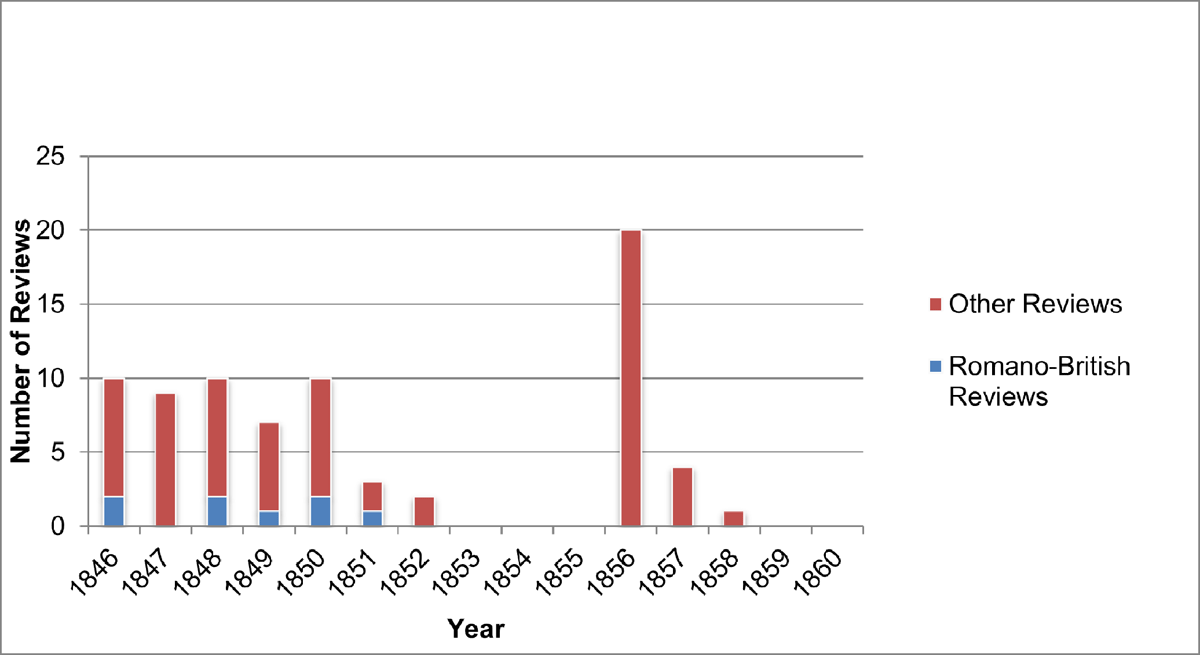
Figure 3
Bar chart of Romano-British reviews compared with all JBAA reviews 1840–60.
It was the general weekly and monthly publications that carried the majority of Romano-British reviews, which were being deliberately targeted beyond traditional antiquarians. Reviews in these mass periodicals catered for the public’s growing appetite for reading material, particularly amongst the middle classes. They often included long excerpts, which were attractive to those who could not afford to purchase the whole book.19 The lack of governmental and institutional assistance for archaeology meant that it was critical for archaeologists to galvanise a wider readership and support network. Book reviews provided a communication route to these non-buyers, allowing reviewers to influence the public’s understanding of archaeology and raise the profile of its practitioners. The potential benefit of this could be seen in Charles Roach Smith’s (1806–90) excavations at Lymne, which became the first to be funded through public subscription.
Despite the apparent lack of interest in Roman Britain projected by the society journals, Appendix 2 lists 50 individuals who were reviewed between 1840 and 1860. Those near the top of the table were well known within archaeological circles at the time, but the author with by far the largest number of reviews is Charles Roach Smith. He requires further investigation to understand why there is such a difference between him and the other authors.20 Seventy titles with substantial Romano-British content were reviewed over this time period (Appendix 3). They are a reminder of the numerous authors, many of whom are now forgotten, who contributed to the body of knowledge on Roman Britain. Their efforts reflect the rise of local archaeology, which is often overshadowed in histories of the subject by that from overseas.21 The formation and popularity of county societies have been described as ‘an alternative cultural force’; a link between past glories and current success, similar to civic pride.22 This sense of local identity coincided with a surge of accidental discoveries and Roman finds were particularly useful for generating support because they were tangible.23 An association with a classical Roman past was also attractive as it confirmed the social standing of those involved.24 It is interesting to note, however, that of the 70 book titles only two were fiction. Whilst the public was reading about Roman Britain through new discoveries in newspapers and reviews, the subject had not yet provided inspiration for literary authors. It certainly did not promise the mystery or exoticism of other locations being explored by British archaeologists at the time, such as Greece and Turkey.
The Identity of Reviewers
Reviewers undoubtedly had influence over readers and this naturally led to the mystery of who were they and what were their credentials. Readers were right to be wary because reviews were not just for evaluating an author’s work, but also a means of selling books.25 During the eighteenth century, enlisting employees, friends and relations to write favourable pieces or ‘puffs’ was commonplace. By the nineteenth century, such practices had become more sophisticated, with advertisements masquerading as news items and publishers even establishing newspapers and journals in order to recommend their own books.26 Awareness of this corruption meant that one of the re-occurring questions was whether reviews should be signed. Anonymity allowed reviewers to express their true feelings without retribution, but critics argued that it protected incompetence and encouraged log-rolling; the practice of writing reciprocal flattering reviews.27 Despite this, anonymity was the norm and 95% of Romano-British reviews followed this trend. The reviews themselves, however, offer clues about the identity of reviewers, suggesting they were not just ‘men of letters’ with a classical education. References to supplementary texts, including specific pages and plate numbers, suggest that reviewers were well-read in archaeology and had access to their own copies of books. When discussing particular sites or artefacts, they provided comparative examples from the United Kingdom and abroad, including recent discoveries. They also showed an awareness of the latest archaeological ideas discussing, for example, the ‘Three Age System’: ‘The Scandinavian antiquaries have very generally adopted this nomenclature, and some speculative people have tried to introduce it into this country’.28 Reviewers had personally visited the sites being written about: ‘We ourselves remember the flanking towers in the walls of Caerwent’.29 They moved within antiquarian circles commenting how they had been to see the Wall and made antiquarian friends up in the North.30 One article was used to remember a deceased friend: ‘We will take this opportunity to express our great regret for the loss of Mr. Croker, with whom we were long on intimate terms’.31 This all suggests that it was antiquarians writing the reviews.
Within the anonymous review, personal responsibility was subsumed by collective authority. The reviewer was not ‘I’ but the ‘we’ of the publication itself and archaeological book reviews were no exception to this. Their turn of phrase reinforced the collective voice: ‘We are somewhat staggered at reading…’32 and ‘In our eyes…’.33 A reviewer amending an erroneous translation of a Roman inscription, added to this air of authority: ‘We think the third word should be corrected to hastata.’34 However, there was a fine line between writing with authority and slipping into the role of a teacher marking a pupil’s work: ‘One cautionary hint we must venture…the introduction of slang terms into an essay of this kind must tarnish the character of its diction’.35 The Gentleman’s Magazine seemed particularly prone to this tone: ‘Whilst we consider Mr. Akerman’s work as a great acquisition and a great boon to the inquiring antiquary, we think it is still capable of much improvement’.36 Such language left no doubt as to who was the expert and this certainty may have stemmed from the fact that editor John Gough Nicols (1806–1873) was a member of the Society of Antiquaries (SoA), the BAA and then the AI. Through the Attributions of Authorship database, we also know that the antiquarian Alfred John Kempe (c.1785–1869) wrote several of the Romano-British reviews in this period.37 Similarly, William Jerdan (1782–1869) editor of the Literary Gazette, belonged to the SoA and the BAA. In his autobiography he listed contributors including Sir Richard Westmacott, Captain Smyth and Crofton Croker, confirming that antiquarians did indeed write for this journal.38 The editor of The Athenaeum, Charles Wentworth Dilke (1789–1864) and the editor of The Builder, George Godwin (1813–1888) also both belonged to antiquarian societies. Looking at Figure 1, therefore, the majority of Romano-British reviews appeared in publications connected to the antiquarian community.
Added to this were the specialist periodicals. The 5% of Romano-British reviews which were signed all appeared in the Archaeological Journal and the JBAA. This seems at odds with the idea of collective responsibility, but adding initials (which could often be linked with a particular member) was proof that the reviewers had been chosen for their knowledge and expertise. For example, ‘J.M.K.’ is John Mitchell Kemble (1807–57), an Anglo-Saxon specialist asked to review Inventorium Sepulchrale (1856) which documented Kentish antiquities, many of which were Anglo-Saxon. It seems likely that reviews were tasked to a core active group within the societies, as initials do re-occur. Apart from Kemble, the only other name associated with Roman reviews was ‘C. R. S.’ or ‘C. R. Smith’, referring to Charles Roach Smith. Most active antiquarians knew each other personally or through correspondence.39 If reviewers were antiquarians writing about fellow antiquarians’ publications, this had profound consequences for the use and possible manipulation of the reviewing system. Personal networks and alliances took on extra importance.
Reviewers Encouraging Good Practice
Reviewers were consistent in what they believed were the essential components of a ‘good’ archaeological book. By selecting elements for praise, they were promoting their preferred methodologies for conducting and presenting archaeological research. The feature most often commented upon was the illustrations.40 When the role of photography in archaeology was undetermined and decades before photographs could be reproduced in print, hand-drawn illustrations were essential to record sites and antiquities.41 Ground plans, maps and vistas were usually produced as black and white woodcuts which set the scene. The Reverend John Collingwood Bruce (1805–92) was praised for their inclusion: ‘The numerous representations of the remains, of which original and accurate drawings have been obtained, add most essentially to the value of the work’.42 Other illustrations were created using lithographic plates, developed with layers of coloured inks. Mosaics were particularly suited to this type of print, as one reviewer commented: ‘These three pavements are drawn, engraved and coloured…with such distinctness, that we can, as it were, count every tessellar, and form an opinion ourselves on the character of the representations’.43 Accurate illustrations enabled readers to draw comparisons between artefacts which they may not have seen in person. Observations, even from illustrations, helped to form the basis of the classification of objects which was required to move archaeology forward.
Unlike other sciences such as botany and anatomy, archaeology had not developed its own graphic language and standards were still being established.44 Some illustrations continued to suffer from “false artistic embellishments…lessening the value and the utility of such representations’.45 Talented artists were in demand, none more so than Frederick William Fairholt F.S.A. (1813–66) who combined his skill at draftsmanship with antiquarian knowledge. Reviewers on several occasions singled him out for praise: ‘The illustrations of the volume are by Mr. Fairholt, and it is therefore almost superfluous to add that they are skilfully and faithfully executed’.46 Illustrations were an expensive outlay,47 but they could bring vitality and better understanding to a dry text and reviewers agreed they were important in reaching a broader readership: ‘The able pencil of Mr. Fairholt is the most effective instrument for compassing this end’.48 The power of illustration can be seen in the first archaeological best-seller, Austen Henry Layard’s Nineveh and its Remains (1849). Images showing an exotic location with Layard standing aloft directing excavators, were key to its success, helping to fire the imagination and fix Nineveh in the consciousness of the British public.49 Antiquarians were eager to share their findings and illustration was one method of clearly showing results and engaging with the public.
Reviewers were also seeking original content. In an 1847 article, the Edinburgh Review believed that eighteenth-century antiquarian research was characterised by the desire to make new discoveries fit with vague historical traditions, but now the expectation was that authors would not simply repeat old ideas.50 Those who followed servilely in the wake of others were merely ‘closet-antiquaries’.51 John Yonge Akerman (1806–1873) was praised for having ‘studied to avoid perpetuating error and perceived opinions set forth by learning unconfirmed facts’.52 Similarly, Thomas Wright (1810–1877) was commended for rigorously correcting previous authors.53 Reviewers agreed that publication of new discoveries and excavation results should be timely: ‘Mr. Lee has earned our grateful thanks for promptly recording, in a desirable and efficient manner, the Roman antiquities discovered of late years in Caerleon’.54 By contrast, The Yorkshire Philosophical Society was criticised for taking too long in publishing a selection of its papers: ‘That the Society has been seven years in concocting its volume does not speak well for its diligence’.55
Another way of achieving originality was to produce fresh observations on known artefacts and sites. A reviewer highlighted that Charles Merivale (1808–93) had included ‘abundant traces of independent comparison,’56 and Robert Stuart’s (1812–48) writing was enhanced ‘by patient and careful comparison’.57 This type of work formed the basis of the systematic international comparative study of provincial Roman archaeology that would follow.58 Comparison was possible using faithful illustrations, but examining an object or location first-hand was preferable. The Quarterly Review expressed this neatly: ‘“Solivitur ambulando” is the best of maxims for the investigation of antiquarian puzzles,’ i.e. it is solved by walking, or actually seeing the place yourself.59 Reviewers were keen to point out when an author had done his own fieldwork. It was noted that William Smith (1813–93) ‘has investigated the remains of Roman antiquity on the spot,’60 and Wright’s research was based on ‘the results of the author’s personal examination of localities’.61
This idea of the ‘active researcher’ had a physical manifestation. Reviewers believed that some archaeological books were made to accompany explorations, for example, Bruce’s The Roman Wall (1851): ‘Its portability and the clear arrangement of the subject matter should introduce it as a companion to all who may desire to study fully one of the noblest monuments of our country’.62 There was a similar design for Wanderings of an Antiquary (1854) when the reviewer suggested ‘Mr. Wright in his portable octavo conveys sound antiquarian information at every step’.63 Octavo sized books were approximately 200 mm × 250 mm; large enough for clear illustrations yet small enough to be carried. In Scott’s analysis, the majority of archaeological books were produced in octavo format.64 Bruce went on to publish an even smaller version of his book ‘intended for the field, not the library table’.65
Several reviewers commented upon the style of archaeological writing. Romano-British reviews from the Gentleman’s Magazine during the 1820s and 1830s have been considered to determine whether these features were gradually changing or a new introduction (Appendix 4). The most recognisable hallmark of antiquarianism was its ‘promiscuous mix of sources,’66 which often resulted in writing that was lacking in sequence. In the preface to his Londiniana (1829), Edward Brayley openly stated that “diversity of information” had been a leading object and that “no particular classification or arrangement has been observed.”67 Antiquarians were also known for embellishing their research with imagination, helping to establish a reputation for reckless theorising: “Mr. Britton has collected a mass of information and speculation…He is not to blame; for it is usual, but it is injurious to Literature”.68 Even by 1840, it was suggested that speculation was almost inevitable: ‘We must be contented that archaeological facts should occasionally be accompanied by the surmises of ingenious and imaginative editors’.69 St. Clair has noted that reviews are useful for reconstructing the ‘historical horizons of expectations’; the preconceptions of the reviewer against which new books are judged.70 An 1847 Literary Gazette review revealed the sort of books still produced for a wider reading public. In a piece on the History of the Ancient Britons the reviewer sounded surprised and almost relieved:
‘The title is one which leads us, at first glance, to expect we are going to be introduced to all those interminable and unsatisfactory discussions about Celtic and Druidical antiquities, which have employed the fertile imaginations of so many ingenious antiquaries during several past generations’.71
The middle decades of the nineteenth century, however, saw a move away from these antiquarian traditions. Rather than trying to incorporate as much varied evidence as possible, the specialist reviews believed the best books now displayed ‘acute archaeological discrimination.’72 Even the popularist Literary Gazette called for a ‘diligent and judicious selection of facts’.73 Antiquarians had a tendency to wander in their thoughts and write in a prose style that did not fit with the rigour of the new archaeology. Reviewers now wanted a neutral tone and remarks written with ‘candour and dispassionate judgement’.74 Through reviews, a small number of individuals were directing how they believed archaeological books should be written. It took time, however, for this transition in style to be adopted by all writers. Bruce was criticised for being out of step:
‘What we see most reason to complain of is…certain observations, reflections, and insertions, where Mr. Bruce speaks in his own person, which have little or no connexion with his subject, and which in some places are in their character entirely inconsistent with the plainness, calmness and sobriety of historical and antiquarian disquisition’.75
Archaeology was not an academic subject at this point, but writing conventions were already being set. Conducting background reading was briefly mentioned in the Gentleman’s Magazine reviews during the 1820s and 1830s76, but it was given more prominence from the 1840s. Stuart was commended for his ‘extensive classical reading,’77 and the Reverend Wellbeloved (1769–1858) for his ‘well digested learning’.78 A feature not previously discussed in earlier decades was that this reading had to be fully referenced. Wright was reproached for his lack of thoroughness: ‘He shows that he has resorted to most of the best sources; but we are not quite sure that he quotes, or refers to, his authorities as often as could be desired’.79 The Athenaeum was also critical of Bruce’s ‘loose’ citations, which they attributed to lack of experience and precision.80 It was true that Bruce was inexperienced,81 but it must have been dispiriting to have it pointed out in a national publication. His second edition (1853) included the necessary amendments. By repeatedly promoting certain features, reviewers were setting out and communicating the requirements of ‘good scholarship’. In following their guidelines, an author was demonstrating that they belonged in the community which shared these methods.
Reviewers Maintaining the Community
Book reviews helped to shape a community by defining the qualities and traits expected of the membership. This was especially important when antiquarianism was facing a challenge from a new set of middle-class participants. The characteristic most frequently highlighted in reviews was ‘zeal’; the enthusiasm and commitment with which antiquarians approached a task. Publication required an investment in time and money and several reviewers thank the author for their liberality: ‘We are again reminded how much we owe Mr. Neville for taking upon himself the expense of publishing what is of so much general interest’.82 For those without personal wealth, publishing was particularly difficult. Many authors chose to publish independently through subscription, thus spreading the financial risks involved.83 An alternative was to find a patron who could cover the initial costs. Thomas Wright, son of a bookseller and printer, was one of the few antiquarians who tried to make a living through writing. His output was prolific, but he relied heavily on the support of philanthropist Joseph Mayer (1803–86).84 It is perhaps in knowing these difficulties that reviewers highlighted when an author was not from the usual antiquarian background. Henry Ecroyd Smith (1823–89) was described as ‘walking in a comparatively humble path of life,’85 and ‘of limited pecuniary means’.86 Such authors were not excluded from the community because of their social position. Reviewers felt they deserved extra credit because they had managed to publish despite their background.
The majority of reviews were positive (69%, Figure 4) offering encouragement to authors and recommending the book for reading. As fellow antiquarians, it was generally in the reviewers’ best interests to be positive. They aimed to boost the community, making research appear credible and helping the subject to progress in a constructive way. This was not about making vast profits, especially as so many archaeological books were printed by subscription, breaking the link between reviews and sales. It was about the promotion of a subject that reviewers had a vested interest in. Continued, positive praise was instrumental in establishing the experts in the field. Charles Roach Smith, for example, was named ‘the soundest scholar of the day in the Roman antiquities of Britain’.87 A further 20% of reviews had some negative aspect but often this was just a minor comment amongst a generally complimentary piece.
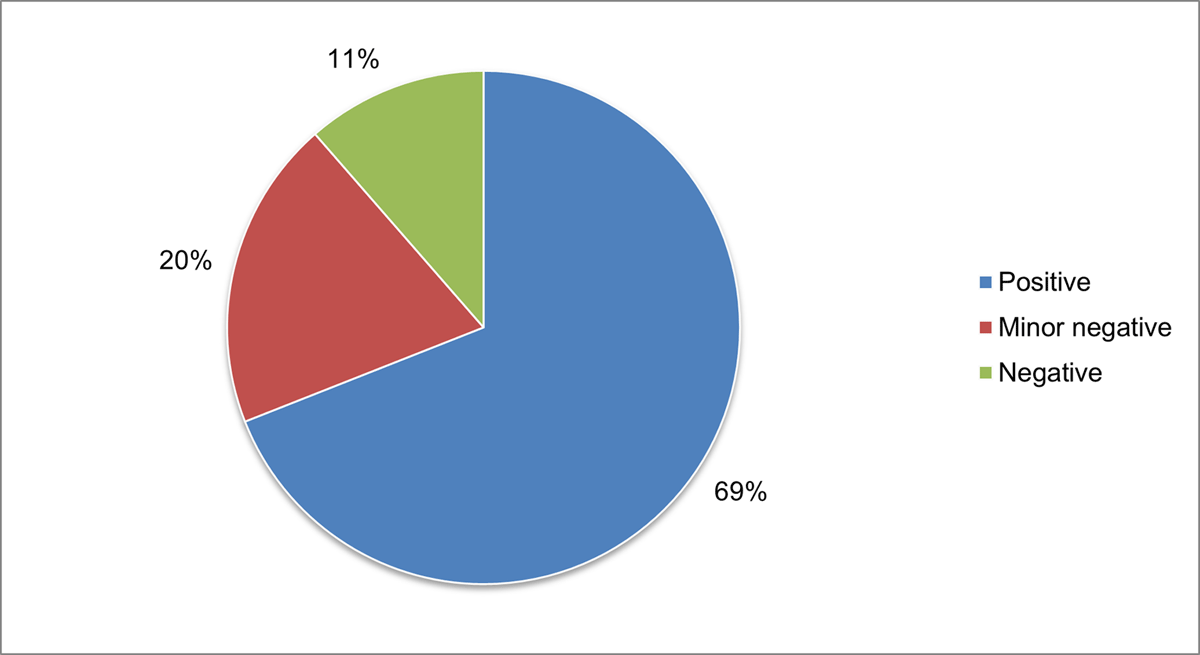
Figure 4
Pie chart of the overall rating of Romano-British reviews 1840–1860.
There were only 21 genuinely negative reviews over the twenty-year period of this study. Authors not exhibiting the expected zeal were castigated. Thomas Lewin (1805–77) was heavily criticised for suggesting that his research was for his own amusement: ‘The preface breathes little of antiquarian spirit…We dislike this apologetic tone. A real, genuine antiquary should always be in earnest’.88 The Quarterly Review also felt the need to condemn an author’s treatment of his fellow writers: ‘He has secured himself a reputation…which can only be marred by indications of jealousy or ill-temper towards his rivals’.89 For these reviewers, it was the behaviour of authors that engendered comment. The early split of the BAA in 1845 was not an auspicious start for the fledgling subject of archaeology and the Edinburgh Review warned that it had set the wrong tone:
‘The subject is surrounded with many risks…The very animation with which, both home and abroad, purely archaeological researches are pursued at this moment…has its danger; for it may tend at the first to withdraw attention from the higher branches of the science’.90
The manner in which authors conducted themselves was crucial for a subject aiming for credibility.
Book reviews reveal that the years 1852–3 were particularly contentious. In 1852 Robert Bell read a paper at the SoA, Newcastle-upon-Tyne, claiming Severus as the builder of the wall, and directly challenging the leading authority Reverend Bruce. The Gentleman’s Magazine noted the character of Bell’s paper in which he ‘ridicules Mr. Bruce’s notion…’.91 The Athenaeum was disconcerted by Bruce’s response: ‘We venture to hint a doubt whether antiquarian science is likely to be so well advanced by the tone and style which he has assumed…[and] the sort of triumphant air which pervades this pamphlet’.92 Both reviewers were in favour of free discussion, but the lack of respect shown for their opposition was not acceptable. The Athenaeum also intervened when an argument began about whether Colchester Castle was Roman, resulting in an exchange of increasingly bitter letters in the Essex and West Suffolk Gazette:93 ‘Once more we find men of talents and attainments forgetting their position, and waxing not only warm, but almost red-hot on a mere topic of antiquarian investigation’.94 It did not take much for a disagreement to descend into public bickering and this did little to change the image of antiquarians, who were still ridiculed in literature and the press.95 A third disagreement flared when the Reverend Thomas Surridge communicated his thoughts on a Roman inscription to the Newcastle Journal and was met by a series of condescending letters from ‘A Southern Member of the Archaeological Institute’: ‘No one in his sober sense could possibly have propounded and persisted in so absurd and preposterous a reading of a plain inscription’.96 Surridge’s reviewer reprimanded the rancorous spirit of these inquiries:
‘Why should not a gentleman and scholar attempt the reading and explanation of [a Roman inscription] without the danger of incurring attacks of a character almost personal?…Why is he to be met, not only with hostility, but with ridicule, as if he were an interloper?’97
The reviewer stood as arbiter, reminding readers there was no excuse for a breach of good manners.
The Athenaeum was the most critical of the publications covering archaeology (Figure 5). The first half of the nineteenth century may have been the heyday of puffing, but by the 1830s there were calls by some critics to cleanse the system. As editor of The Athenaeum, Charles Wentworth Dilke, made efforts to print reviews with integrity, even shunning society to avoid pressure from colleagues and friends.98 The number of negative reviews may, therefore, be a reflection of Dilke’s attempts to be ‘above puffery’ and his legacy to the journal after he had left the editorship. The Athenaeum’s comments could be witty and amusing. Stonehenge; or, The Romans in Britain (1842), one of the two works of fiction under review, was a strange mix of antiquarian notes and romance. It inspired the reviewer to remark ‘Misraim Mouldy the defunct, however learned as an antiquarian was no romancer…[it is] utterly wearisome.99 The Literary Gazette agreed with this opinion: ‘We are at a loss to conceive what could have induced the publication of this work’.100
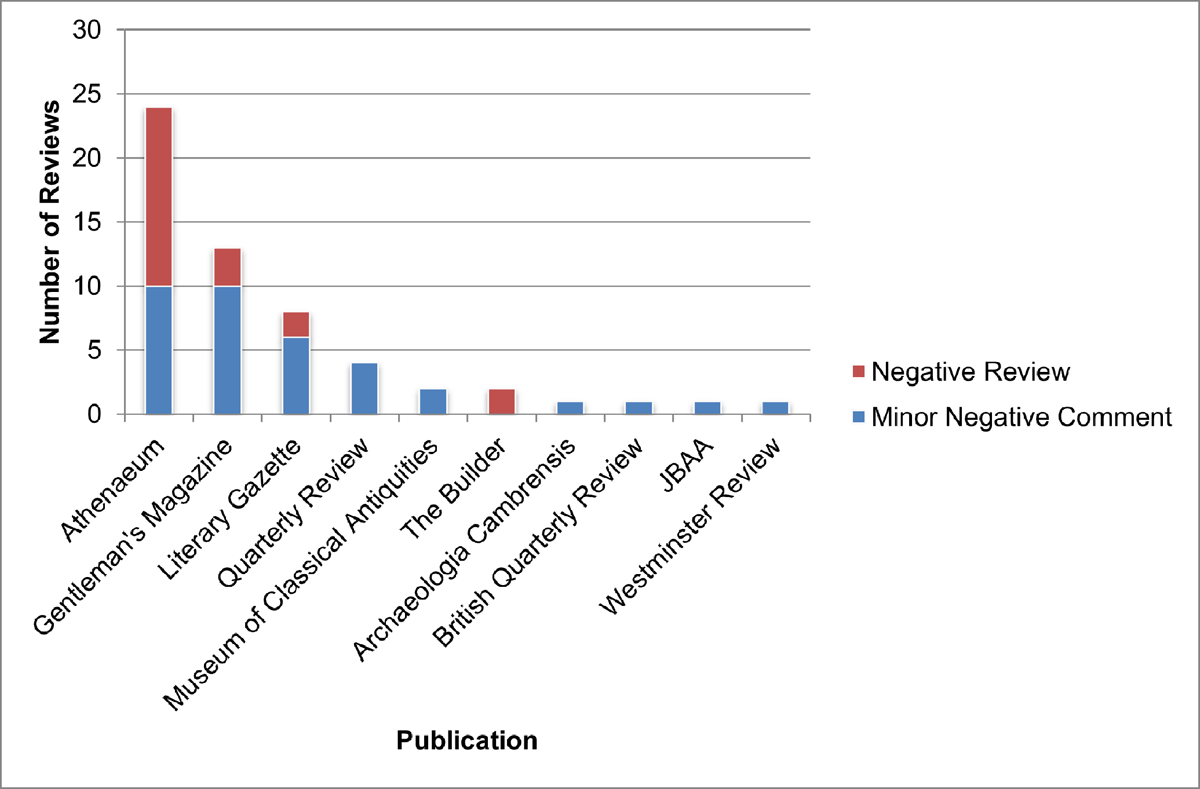
Figure 5
Bar chart showing negative reviews of Romano-British books by publication 1840–1860.
On a more serious level, however, The Athenaeum’s remarks could be cutting: ‘Mr. Saull is one of the Pegge genus, but of an inferior species, since the latter did know something of what he was writing about’.101 They were particularly outspoken against authors who they thought were becoming overly confident, such as Thomas Wright: ‘We cannot make out why, or by what pretentions he takes upon himself to assert that the most celebrated antiquaries of the day, English or foreign, are in the wrong, and that he only in the right’.102 They also took a stand against authors who aggrandised their discoveries: ‘There prevails such a disposition to exaggerate and over-state excellences’.103 They were consistent, however, approving of John Edward Lee when he did not inflate his excavation results: ‘We feel bound to give it especial praise because we see in it no attempt to attach undue importance to trifling discoveries — or to trump up as works of High Art objects that have really little intrinsic merit’.104
The book that most offended The Athenaeum, seemingly due to its price, was Thomas Wright’s The Archaeological Album (1845): ‘Five sheets only of letter-press, and large type, for five shillings… We think [the reader will] agree with us that probably no other antiquarian volume of equal extent — certainly not of equal price —, contains so little to interest or to instruct’.105 In their opinion, The Album was not only bad value for money:
‘It may have its uses for a third class — such as have not leisure to read, or opportunity of consulting, more elaborate sources. It appears…to be peculiarly adapted for ‘drawing-room’ purposes. Perhaps the editor’s great object may have been to inspire young ladies with a taste for such pursuits’.106
Table books left out on public display, often beautifully bound and illustrated, were a reflection of the family that owned them,107 but to call The Album fit for the drawing room implied it was all embellishment and no content, completely de-valuing the book for archaeological purposes. The review may have hinged its argument on the price, but there is an unsettling undercurrent which reads like a personal grudge, most likely related to the origins of the book.108 Dilke was a member of the new AI, whilst Wright led the opposing faction. The main consequence of reviewers coming from within the scholarly community was that it left the review system open to personal vendettas.
Conclusion
Despite 95% of Romano-British reviews being anonymous, evidence suggests that reviewers were likely antiquarians and often they were working for an editor with antiquarian connections. A relatively small group of individuals, mostly from within the scholarly community, were helping to define, shape and maintain the community itself. By the 1840s they were making increased demands for a shift in content, style and tone, away from traditional antiquarian works. In praising certain features, reviewers were promoting the way they thought archaeological research should be written, favouring clear statements supported by judicious facts and dispassionate judgement. They did not distinguish between antiquarian and archaeological methodology; original research could be fieldwork or a comparative study based on illustrations. Rather, reviewers were setting general standards of scholarly excellence that would eventually form essentials in academic writing, decades before archaeology appeared in the university sector.
Reviewers helped to maintain the community by repeating their shared aims and interests. They emphasised a belief in disseminating knowledge, free discussion, collaboration and liberality in publishing. They also promoted key character traits, such as absolute commitment and zeal in approaching all tasks. It may be because of its gentlemanly roots, or the propensity for minor disputes to escalate into personal rivalry, that reviewers were so concerned about how individuals behaved. The Athenaeum was particularly outspoken about manners, and they used their book reviews to police the community.
Practitioners had to be image conscious because the role of the public was increasingly important, especially for raising archaeology’s profile and funding excavations. With more reviews in the weekly and monthly publications than the specialist journals, authors and publishers were aiming beyond society members. Reviewers took the opportunity to reach and influence the public’s understanding of archaeology. By being supportive, reviewers were boosting an author’s reputation and validating them for their next project. Book reviews in newspapers were likely to be read by an even wider audience, which is an area that requires further investigation.
Forster states that with the rise of a consumer society in the late 18th century, insider log-rolling of a book progressed from a corruption of friendship and became more about making money.109 The reviewing of archaeology books, however, never made that shift. It was always about friendship; who you knew and who supported your work. This may be why 89% of reviews were largely positive. Most authors wrote archaeological books for the advancement of knowledge, not for financial gain. With a few rare exceptions, publishers were not going to make vast profits and so employing elaborate, sometimes underhand, methods to promote these books may not have seemed worth it. The system was, however, open for those with a grudge to publicly admonish and humiliate. It is clear that The Athenaeum did not think everyone should be in the community, particularly those whom they considered ‘upstarts’ such as Thomas Wright, who challenged the status quo. Widening the scope of this research would reveal whether this was also true for reviews for other archaeological time periods.
Book reviews were instrumental in shaping and maintaining the archaeological community during the mid-nineteenth century. They were central to the scholarly scene as publication was increasingly important, and their power to establish reputations meant their opinion mattered to authors. It was reviewers who took the many contributions and guided archaeology forward. They also provided a crucial link to the wider public. Book reviews, therefore, are a valuable source of information, providing a unique commentary and this research has shown their potential for further insight into the development of archaeology, not just what has been remembered for prosperity.
Data Accessibility Statement
All data are included within the manuscript, accessible via https://doi.org/10.5334/bha-728.s1.
For the purpose of open access, the author has applied a Creative Commons Attribution (CC BY) licence to the Author Accepted Manuscript version arising from this submission.
Notes
[1] Victorian Periodicals Review 55, no. 2 (2022): 155–314.
[2] Sally Shuttleworth and Geoffrey Cantor, “Introduction,” in Science Serialized: Representations of the Sciences in Nineteenth–Century Periodicals, ed. Geoffrey Cantor and Sally Shuttleworth (Cambridge, MA: MIT Press, 2004), 1, https://doi.org/10.7551/mitpress/6080.001.0001.
[3] Christiaan Engberts, “Scholarship, Community Formation and Book Review: The Literarisches Centralblatt as Arena and Meeting Place,” Studia Historiae Scientiarum 20 (2021): 651–79, https://doi.org/10.4467/2543702XSHS.21.019.14050.
[4] Sarah J. Speight, “A Gentlemanly Pastime: Antiquarianism, Adult Education and the Clergy in England c. 1750–1960,” History of Education 40, no. 2 (2011): 143–55, https://doi.org/10.1080/0046760X.2010.518633.
[5] Similarly, Alison Moulds and Beth Gaskell, “Crafting the Professional Reader in the Military Press,” Victorian Periodicals Review 55, no. 2 (2022): 217–36, https://doi.org/10.1353/vpr.2022.0014, found reviews in the military and medical press exposed tensions between professional, paid work and a gentlemanly lifestyle.
[6] Gabriel Moshenka, “Performance and Display at the First Meeting of the British Archaeological Association, Canterbury 1844,” World Archaeology 49, no. 2, (2017): 226–36, https://doi.org/10.1080/00438243.2016.1274236.
[7] Archaeology was not alone in seeking specialisation. Phillipa Levine, The Amateur and the Professional: Antiquarians, Historians and Archaeology in Victorian England, 1835–1886 (Cambridge: Cambridge University Press 1986), traces the separation of historians, antiquarians and archaeologists during the middle decades of the nineteenth century.
[8] Porscha Fermanis, “‘Literary Dealers in the Rococo of History’: book reviews and historical specialisation, 1820–50,” Victorian Periodicals Review 55, no. 2 (2022): 237–56, https://doi.org/10.1353/vpr.2022.0015, found reviewers engaging with the issues of disciplinary identity and specialisation, articulating technical vocabulary and methodology years before the establishment of professional academic journals.
[9] Amara Thornton, “‘…A Certain Faculty for Extracting Cash’: Collective Sponsorship in Late 19th and Early 20th Century British Archaeology,” Present Pasts 5, no. 1 (2013): 2, https://doi.org/10.5334/pp.55.
[10] Sir John Lubbock finally succeeded in introducing a private member’s bill in 1882, but it had little power over the owners of ancient monuments.
[11] The British Museum collections represented the progress of art, with classical Greece as the pinnacle form. See Ian Jenkins, Archaeologists and Aesthetes in the Sculptural Galleries of the British Museum 1800–1939 (London: British Museum Press, 1992), 63–5.
[13] Mechanised paper making with wood pulp, steam presses, stereotyping and cloth case bindings all reduced costs and sped up print production. See Patricia Anderson, The Printed Image and the Transformation of Popular Culture 1790–1860 (Oxford: Clarendon Press, 1991).
[14] Julian Pooley, “‘A Laborious and Truly Useful Gentleman’: Mapping the Networks of John Nicols (1745–1826), Printer, Antiquary and Biographer,” Journal for Eighteenth-Century Studies 38, no. 4 (2015): 499, https://doi.org/10.1111/1754-0208.12344. The Society of Antiquaries were not always able to publish even one volume a year of its Archaeologia.
[15] Sarah Scott, “Pioneers, Publishers and the Dissemination of Archaeological Knowledge: A Study of Publishing in British Archaeology 1816–1851,” Internet Archaeology 35 (2013), https://doi.org/10.11141/ia.35.1, has identified 316 archaeological titles published between these years.
[16] Archaeologia did not include reviews. The Archaeologist and Journal of Antiquarian Science, established in 1841, reviewed new publications, but it folded the following year.
[17] A. Bowdoin Van Riper, Men Amongst Mammoths: Victorian Science and the Discovery of Human Prehistory (London: University of Chicago Press, 1993), Appendix 1, 229–231.
[18] Christopher Evans, “‘Delineating Objects’: Nineteenth-Century Antiquarian Culture and the Project of Archaeology,” in Visions of Antiquity: The Society of Antiquaries of London 1707–2007, ed. Susan Pearce (London: Society of Antiquaries, 2007), Table 8, 291.
[20] Heather D. W. Keeble, “How to Get Ahead in Archaeology: Reviewing as a Strategy for Nineteenth-Century Archaeologists,” Internet Archaeology (forthcoming).
[21] Brian F. Cook, “British Archaeologists in the Aegean,” in The Study of the Past in the Victorian Age, ed. Vanessa Brand (Oxford: Oxbow Monograph 73, 1998), 139–54.
[23] Heather D. W. Keeble, “Roman Archaeology in the News: the Contribution made by the Provincial Press to the Dissemination of Roman Archaeological information in Nineteenth–Century Britain” (PhD diss, University of Leicester, 2019).
[24] Virginia Hoselitz, Imagining Roman Britain: Victorian Responses to a Roman Past (Woodbridge: Royal Historical Society, 2007), 56.
[25] Tara Moore, “Christmas Books and Victorian Book Reviewing,” Victorian Periodicals Review 45, no. 1 (2012): 60, https://doi.org/10.1353/vpr.2012.0007.
[26] Nicholas Mason, “‘The Quack Has Become God’: Puffery, Print and the ‘Death’ of Literature in Romantic-Era Britain,” Nineteenth-Century Literature 60, no. 1 (2005): 13, https://doi.org/10.1525/ncl.2005.60.1.1.
[27] Oscar Maurer, “Anonymity vs. Signature in Victorian Reviewing,” Studies in English 27, no. 1 (1948): 21, https://www.jstor.org/stable/23309508.
[34] “Delineations of Roman Antiquities Found at Caerleon, the Ancient Isca Silurum, and the Neighbourhood,” Gentleman’s Magazine, November 1845, 490.
[35] Alfred John Kempe, “Sylva Antiqua Iscana, Numismatica, Quinetiam Figulina,” Gentleman’s Magazine, May 1841, 510.
[36] “An Archaeological Index to Remains of Antiquities of the Celtic, Romano-British, and Anglo-Saxon Periods,” Gentleman’s Magazine, January 1848, 64.
[37] This database identifies the authors of over 25,000 articles, letters, poems, reviews and other content that appeared in the Gentleman’s Magazine 1731–1868 and were originally anonymous or written under pseudonym. https://bsuva.org/bsuva/gm/gm-intro.html.
[38] William Jerdan, The Autobiography of William Jerdan: with his Literary, Political, and Social Reminiscences and Correspondence during the Last Fifty Years, 3 (London: Arthur Hall, 1852): 283.
[40] By the late eighteenth century accurate recording of remains was seen as essential, championed by the director of the SoA, Richard Gough (1735–1809). Early nineteenth-century exemplary works include Samuel Lysons’ (1763–1819) excavation and publication of Romano-British antiquities. See Sarah Scott, “Samuel Lysons and His Circle: Art, Science and the Remains of Roman Britain,” Bulletin of the History of Archaeology 23, no. 2 (2013): 1–22.
[41] Mirjam Brusias, “Photograph’s Fits and Starts: The Search for Antiquity and its Image in Victorian Britain,” History of Photography 40, no. 3 (2016): 262.
[43] “Illustrations of the Remains of Roman Art in Cirencester,” The Museum of Classical Antiquities 1 (1851): 197.
[44] Judith Dobie and Chris Evans, Archaeology and Illustrators: A History of the Ancient Monuments Drawing Office, Research Department Research Series, 33 (London: Historic England, 2010), 2.
[45] “Description of a Roman Building and other Remains lately discovered at Caerleon,” The Athenaeum, January 4, 1851, 14.
[47] Fairholt’s bill for Inventorium Sepulchrale was £221 10s, see David Wright, Bryan Faussett: Antiquary Extraordinary (Oxford: Archaeopress, 2015): 237.
[49] Shawn Malley, “Austen Henry Layard and the Periodical Press: Middle Eastern Archaeology and the Excavation of Cultural Identity in Mid–Nineteenth Century Britain,” Victorian Review 22 (1996): 155.
[52] Charles Roach Smith, “An Archaeological Index to Remains of Antiquities of the Celtic, Romano-British, and Anglo-Saxon Periods,” Journal of the British Archaeological Association 3 (1848): 192.
[54] Charles Roach Smith, “Delineations of Roman Antiquities found at Caerleon, (the ancient Isca Silurum): and the Neighbourhood,” Journal of the British Archaeological Association 1 (1846): 370.
[58] Daffyd Kidd, “Charles Roach Smith and his Museum of London Antiquities,” in Collectors and Collections, The British Museum Yearbook 2, ed. Richard Camber (London: British Museum, 1977): 124.
[65] Rev. John Collingwood Bruce, The Wallet-Book of the Roman Wall: A Guide to the Pilgrims Journeying Along the Barrier of the Lower Isthmus (London: Longman, 1863): iii.
[67] “Londiniana; or Reminiscences of the British Metropolis, Volume 1,” Gentleman’s Magazine, June 1829, 515–519.
[68] Rev. Thomas Dudley Fosbroke, “The Beauties of Wiltshire, displayed in Statistical, Historical, and Descriptive Sketches, Volume 3,” Gentleman’s Magazine, Dec 1825, 526.
[69] Alfred John Kempe, “On the Ancient British, Roman, and Saxon Antiquities of Worcestershire,” Gentleman’s Magazine, November 1840, 512.
[70] William St. Clair, The Reading Nation in the Romantic Period (Cambridge: Cambridge University Press, 2004): 285.
[71] “History of the Ancient Britons, from the Earliest Period to the Invasion of the Saxons,” Literary Gazette, November 6, 1847, 780.
[76] “The History and Antiquities of Northampton,” Gentleman’s Magazine, July 1826, 34; Alfred John Kempe, “The History and Antiquities of Somersetshire,” Gentleman’s Magazine, February 1836, 180.
[81] Bruce had only edited school textbooks and written a guide to Newcastle castle, see David J. Breeze, “The British Archaeological Association and the Genesis of J.C. Bruce’s The Roman Wall,” Journal of the British Archaeological Association 170 (2017): 201.
[82] Charles Roach Smith, “Antiqua Explorata,” Journal of the British Archaeological Association 3 (1848): 178.
[93] Letters are reprinted in Rev. Edward L. Cutts, Colchester Castle: Not a Roman Temple (London: George Bell, 1853).
[95] Levine, “The Amateur,” 17; Sarah Scott, “‘Gratefully Dedicated to the Subscribers’: The Archaeological Publishing Projects and Achievements of Charles Roach Smith,” Internet Archaeology 45 (2017): 40.
[96] Southern Member of the AI, “The Roman Altar Found at Rochester,” Newcastle Journal, Oct 9, 1852, 5.
[98] Laurel Brake, “Literary Criticism and the Victorian Periodicals,” The Yearbook of English Studies 16 (1986): 108.
[101] “Notitia Britannica,” The Athenaeum, September 6, 1845, 876. Samuel Pegge (1704–1796) was a clergyman and antiquary, renowned for his ability to write about a great number of topics, from Anglo-Saxon jewellery to Roman roads, wine and cookery.
[103] “Illustrations of the Remains of Roman Art in Cirencester,” The Athenaeum, October 12, 1850, 1067. Objects from Roman Britain were seen by some antiquarians as inferior to those from countries nearer to the seat of Empire.
[108] After the BAA’s first national conference in Canterbury in 1844, the committee voted not to include a report of the meeting in the Archaeological Journal. Wright published his own account which became embroiled within wider arguments about society membership and led to the split of the Association the following year. See David Wetherall, “From Canterbury to Winchester: The Foundation of the Institute,” in Building on the Past: Celebrating 150 Years of the Royal Archaeological Institute, ed. Blaise Vyner (London: Royal Archaeological Institute, 1994), 8–21.
[109] Antonia Forster, “Avarice or Interest: The Secrets of Eighteenth-Century Reviewing,” The Yale University Library Gazette 81, no. 3 (April 2007): 175.
Acknowledgements
I would like to thank Professor Sarah Scott FSA SFHEA for her advice and moral support in conducting this piece of research.
Competing Interests
The author has no competing interests to declare.