
Introduction
The past two decades have witnessed the slow emergence of a scholarly literature that, with various methodological and disciplinary approaches, explores the role of indigenous workers in archaeology, often situating it in the context of imperial and colonial power relations and systems of knowledge-making.1 Histories of archaeology and excavation have taken a few steps beyond being a story of lone white males ‘exploring’ new territories in search of spectacular finds, and instead acknowledging the collective labour involved in building images of, and gathering information on, past civilisations. Narrowing the focus to the Middle Eastern region, studies have uncovered the roles of educated Egyptian and Ottoman men in nineteenth and twentieth century antiquities departments (and often their battles for status and recognition in the face of colonial European and later North American domination of the discipline).2 The importance of narratives of ancient peoples and control of their material remains in building the postcolonial nations of the Middle East have been highlighted.3 And the extent to which archaeology was carried out not just by white visitors but by local people, often in their hundreds, has been exposed from new readings of archaeological archives, where they can be found performing tasks including hard digging and spoil-moving, sieving, cleaning and mending finds, organising and overseeing daily operations and, occasionally, even being acknowledged as playing a part in interpreting and understanding the remains excavated.4
In many respects, however, this is still a nascent area of study. It is, perhaps, comparable to the early days of women’s studies in the 1960s and 70s, when individual lives or single organisations or institutions were uncovered one at a time, slowly building up a broader picture and a body of knowledge from which generalisations could be drawn. At the moment, most studies or projects focus on single archaeological sites or biographies of particular individuals whose life stories may well be accessible as accidents of archival preservation, or because of the particular scholars with whom they worked and interacted.5 There is another similarity with the academic position of women’s studies in its early years. The engagement of most of the studies of indigenous archaeological labour in the Middle East are, to at least some extent, restricted to the field of archaeological history or historiography, where they ‘fill in the gaps’ between the white men (and occasionally women) who ran the discipline in the nineteenth and early twentieth centuries. Indigenous labour is thus still primarily conceived of in relation to the activities of archaeologists and orientalists who, often entangled with imperial and colonial endeavours, came to the region to build narratives interwoven with their own Biblical and antiquarian interests. Rarely do these approaches delve into the economic, social and political environments in which this archaeology took place.
This article thus attempts to take a slightly different tack. This arises firstly from the fact that I am not an archaeologist or, primarily, a historian of archaeology, but a social and cultural historian of late Ottoman and Mandate Palestine. My interest in archaeological labour mainly stems from the possibilities that exist to use the archives of archaeological excavations and related activities as sources for social and labour histories of this place and period. In prior studies of the role of women workers on excavations in late Ottoman Palestine, my main concern has been to focus on why hundreds of women performed hard manual labour on Palestine Exploration Fund digs, hauling the thousands of baskets of spoil generated by the huge, destructive excavations that scooped immense holes out of tells at sites such as Tell el-Hesi and ‘Ayn Shams (see Figure 1). I have argued that, in contrast with what the European men who employed them thought, it is vital to think of these women as rational economic and social actors, making active choices within the constraints of contingent political, regulatory and socioeconomic conditions.6 What were the circumstances that drew large numbers of women into the cash labour economy, working for foreign archaeologists, and how did this fit into their wider experiences of work and pay? How did their experiences change after World War I, when the region came under European colonial rule and excavation practices started to change, but when we still find women workers at sites such as Wadi al-Mughara and Tell al-Nasbeh? And, to move on from the kind of gap-filling approach mentioned above, what were the gendered narratives – incorporating notions of masculinity as well as femininity – that helped to shape the organisation of labour and the relations between local workers and foreign archaeologists? We know that men were routinely paid more than women,7 and that the few indigenous workers who rose through the ranks to work as overseers or in other supervisory roles were, as far as it is possible to tell, exclusively male. But whether that is because of local cultural rules around gender, or notions of male and female work imported from Europe and North America, is not wholly clear, and detailed, granular research is needed to answer such questions.
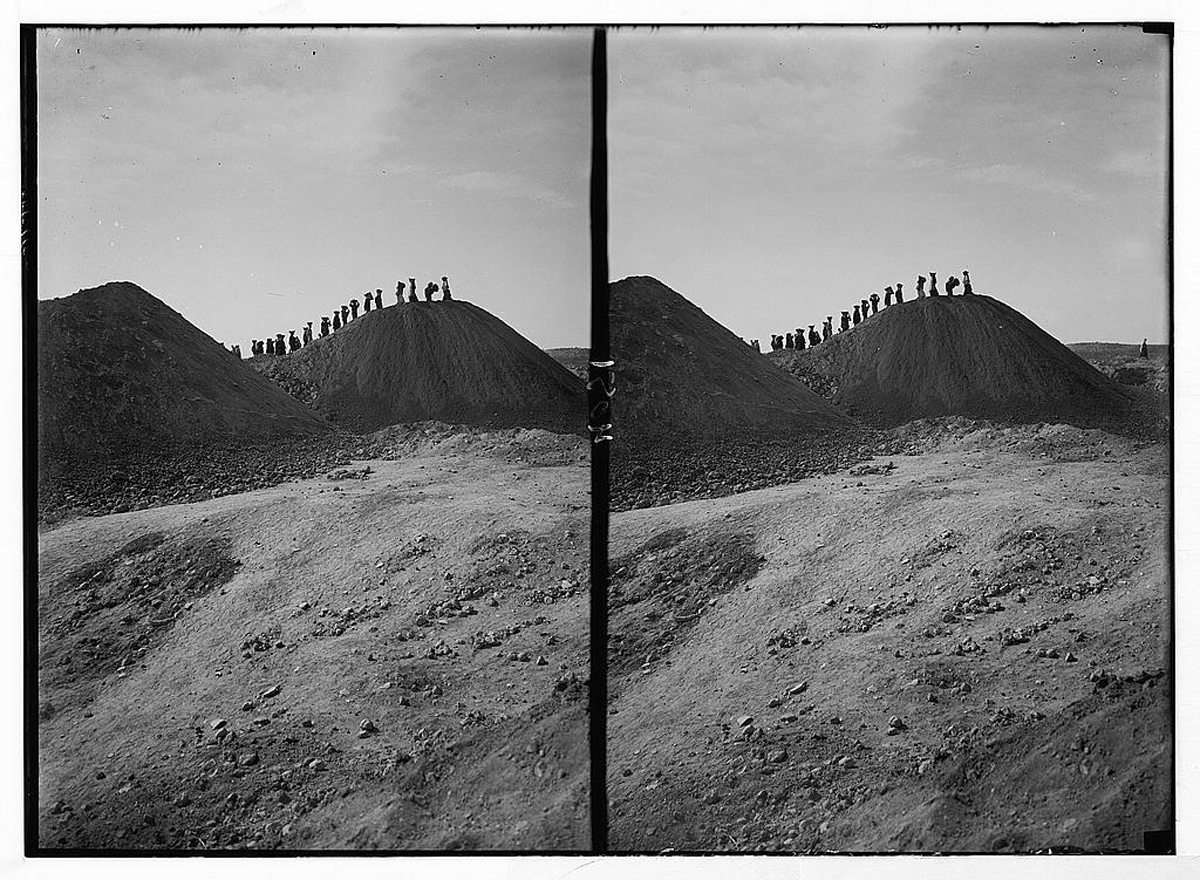
Figure 1
women workers carrying spoil to the dump at the ‘Ayn Shams excavation, probably between 1920 and 1933. G. Eric and Edith Matson Photograph Collection, Library of Congress.
As such, this article treats the archaeological excavation not so much as a space for knowledge production, but as a workplace more akin to a factory or a quarry, where labour was organised according to a number of assumptions and values, including imperial racism, gendered social norms and capitalist-inspired notions of efficiency and discipline,8 and where workers – just like those in other proletarian spaces – were subject to processes of alienation and trauma.9 Among the key questions that this article seeks to raise, if not answer, are the extent to which gender differences in archaeological labour are the product of Western assumptions about Levantine culture, or of Levantine cultural attitudes themselves; and, the ways in which it is possible – or not – to extract insights into the experiences of Palestinian women labourers from an archive almost exclusively composed of writings by white men from Europe or North America.
The three main archival sources are those of the Palestine Exploration Fund (PEF), which include field notes, letters and publications by the organisation’s archaeologists from 1890 until WWI, covering multiple sites across Palestine; the Harvard Museum of the Ancient Near East’s holdings of field diaries and administrative documents from the excavation at Samaria, in the village of Sebastia, just prior to WWI; and the records of the Department of Antiquities of Palestine during the Mandate period, some of which are held at the British National Archives but in the majority of which were left in the Palestine Archaeological Museum in 1948. The latter fell under Israeli control with the occupation of East Jerusalem in 1967, and some have been digitised and made available online by the Israeli Antiquities Authority.10 In addition are various collections of images such as those of the American Colony in Jerusalem, which produced huge numbers of photographs under contract or for public sale.11 Added to this are materials (primarily photographs and film) from the Badè Museum’s archive of the dig at Tell en-Nasbeh during the Mandate period, made available via an online exhibition in 2021,12 and on workers on Dorothy Garrod’s excavations at Wadi el-Mughara. The use of these collections, and the resulting article, are only a small start in what must be a larger project of understanding archaeological labour in terms of various dynamics of power and exploitation, and they raise as many questions as they answer. Nevertheless, in what follows I present an attempt to consider archaeological sites as places of labour and to consider how a gendered perspective on them can help us to understand how they fit into the world of work more generally in late Ottoman and Mandate Palestine.
Archaeology as a workplace
The booming silk factories of Mount Lebanon during the final decades of the nineteenth century may seem an unlikely place to begin a discussion of female archaeological labour in Ottoman Palestine. In this section, however, I want to compare an account of the silk industry, and particularly of the gendered labour conditions in it, with some of what is known of archaeological labour at an overlapping, but slightly later, period in the Ottoman Empire and Mandate Palestine. At this time, the regions that after WWI would become the British Mandate of Palestine and the French Mandate of Lebanon were both part of the same political entity and the border between them, now so fixed by the conflict between Israel and Lebanon, did not formally exist, and was probably unimaginable to the communities that lived in the area.13 Granted, there were many variations across the Bilad al-Sham (Greater Syria) region and between communities – the female workers in the silk industry described below, for instance, were almost entirely Maronite Christian women, with the Druze women and men from the same area mainly refusing to engage in outside work.14 Many other studies, however, describe commonalities deriving from class, rurality and ethnicity, as well as the shared impacts of changing Ottoman laws, which meant that similar social, economic and political changes affected society in Lebanon, and a little to the south in Palestine.15 I suggest, then, that a comparison of the experiences of working-class and peasant labour has the potential to provide at least some illumination.
The silk boom that occurred between the 1860s and 1890s – caused by, amongst other things, economic forces in Western Europe and disease amongst European silkworms – imposed a rapid and major shift in employment patterns on Mount Lebanon. At its height, around a fifth of young women in the area were employed in dark, sweaty factories, often living away from home and working alongside a small number of male colleagues. Female silk workers were certainly looked down upon and denigrated by many others in their society, but the sheer numbers of girls who were sent by their families, or even chose, to work in the silk industry highlights the extent to which women’s labour was far from strange. What attracted opprobrium was not that these women were engaging in manual labour, which was the norm (see Figure 2) but the fact that the labour was away from home, and in mixed environments that potentially threatened family honour. The other major social and economic change that hit Mount Lebanon in this period – the large-scale emigration of young people to the Americas to earn money for themselves and their families – was also not a solely male phenomenon. Granted, many of the women who made this journey were following husbands who had asked their wives to join them, but women who decided the make their (and their families’) fortunes on the other side of the Atlantic were not unknown.16
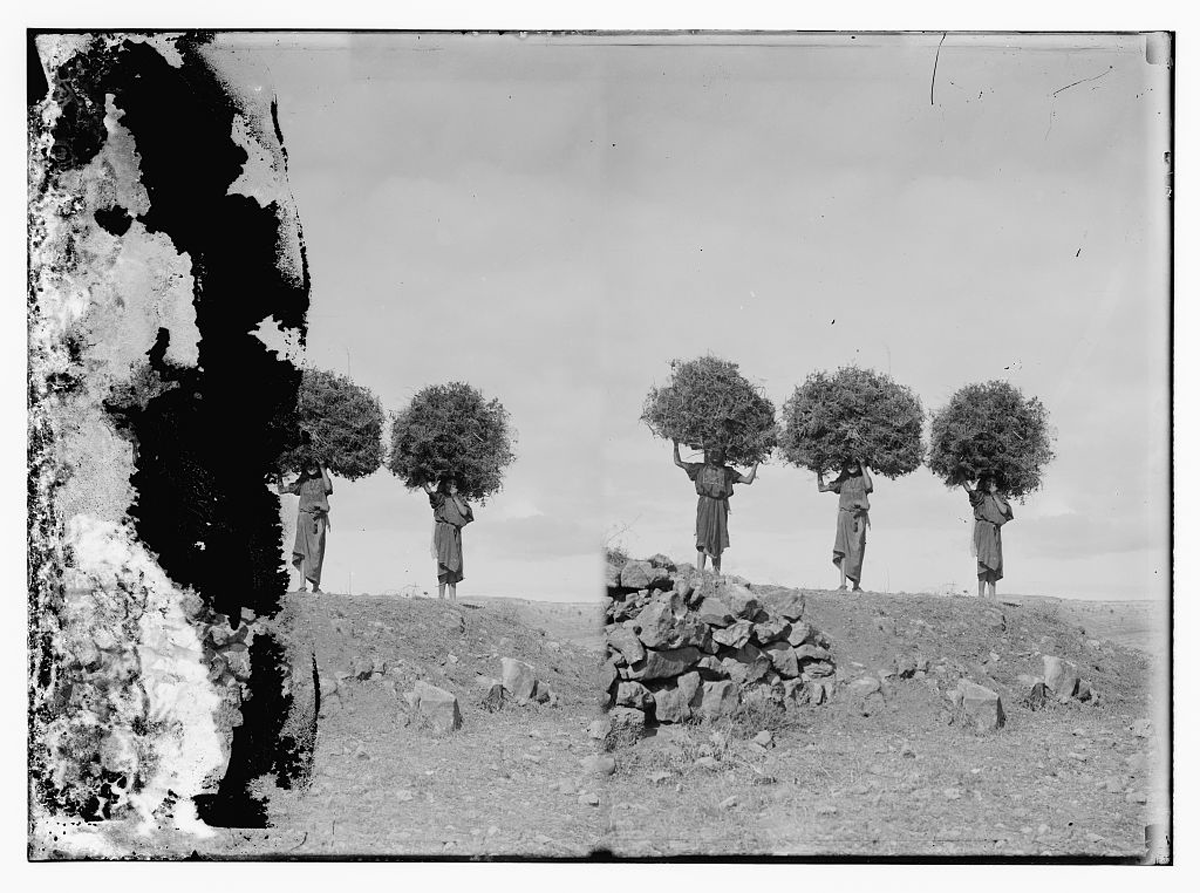
Figure 2
An image recorded as ‘Arab peasant women carrying brush collected as fuel,’ taken sometime between 1898 and 1946, a name which itself highlights the generic way in which Palestinian rural women were viewed by the Western gaze. G. Eric and Edith Matson Photograph Collection, Library of Congress.
I started this section with Akram Khater’s work on female silk factory workers in nineteenth-century Lebanon because, to most non-specialists on the region, the idea that women in late Ottoman Syria (which included both Palestine and Lebanon) were no strangers to paid manual labour is a surprise. Whilst most studies of archaeological labour in this period centre the specific context of archaeology, in this discussion I want instead to consider the mass work undertaken by Palestinian women as part of the wider culture of paid employment which has been largely erased by Western histories of the region, and the Orientalist assumptions that underpin many of them. Women workers were a common sight on archaeological excavations in Palestine in the Late Ottoman and Mandate periods, employed in their dozens or hundreds as carriers of spoil baskets, but sometimes in more skilled roles.17 On different digs their presence makes itself known in different ways: through anecdotal and ethnographic descriptions; via the names in wage lists; or in the photographic archive. And these traces highlight the fact that introducing questions of gender into archaeological work and knowledge production needs not only to engage with histories of educated female Euro-American archaeologists, but also of a range of indigenous women workers. Although archaeological labour might seem like a very niche type of work to consider in this way, the numbers involved were not insignificant in relation to their Palestinian setting. Alexander Schölch – drawing on various consular and traveller sources – cites numbers such as 100 people employed in soap production in the city of Lydda and fewer than this in the same industry in Jerusalem; 5,000 in the hugely important citrus-packing season of 1879; around 70 bakers and their assistants and apprentices in Jerusalem in the late 1860s or 1870s; 300 peasants living in the city of Nazareth in 1890; or in Bethlehem 400–500 craftsmen – including those making souvenirs for the pilgrim trade – between the late 1840s and 1880.18
The boom and bust of Lebanese silk were closely tied up with global production and markets, from France to Japan, and the lives of young village women on Mount Lebanon were thus clearly entangled with global capitalism,19 whilst also being subject to economic pressures stemming from reforms in the Ottoman Empire. As such, there are visible parallels with the erratic, seasonal nature of excavation work. Silk factory working conditions were heavily gendered, with large numbers of women working together in order to placate church strictures against mixing with men,20 and yet factory girls were still perceived as dangerous to the family honour and faced difficulties in finding husbands – and similar questions of honour and respectability often appear in descriptions of working arrangements on excavations, even though many of the women on digs were labouring alongside male relatives.21 Like the European and North American archaeologists who employed hundreds of workers in Ottoman and Mandate Palestine, the factory owners whose demands for profit shaped the working conditions in the factories were not Lebanese: most were French (and some British), and when the Maronite Church became most concerned about the morals of working women, it was the French consul they approached.22 Whilst values of decency and modesty were undoubtedly important in local culture, therefore, it is far from sure that in either context they were correctly ‘read’ by the people making the biggest decisions about working conditions.
But despite the pressures exerted by both patriarchal family structures and capitalist labour relations, cash work in silk factories did bring about some shifts in social hierarchies, as female labour changed from the unremunerated agricultural work performed in a setting where all members of the family contributed labour. For Khater, despite the working conditions and the impact on their position within village society, paid employment resulted in both financial and social power, as well as a changing female subjectivity which included a greater sense of the individual self and its worth.23 By the end of the nineteenth century, this sense was visible in the increasing number of women who negotiated their own employment contracts, rather than male family members sending daughters or sisters in pre-arranged deals. Even more radical, once workers built up a set of desirable skills, they might even play factory owners off against one another to raise their wages, and take industrial action in the shape of go-slows and even strikes to improve their pay and conditions, including paid holidays.24 Along with these social changes and the rise of a cash economy came effects such as shifts in taste, causing rising imports of former luxuries such as sugar and rice,25 and changing marriage patterns.26 Again, we can find instructive parallels in mass archaeological labour, where both male and female workers made decisions to withdraw their labour – because they wanted to prioritise the harvest, because it clashed with the Ramadan fast, or, as PEF archaeologist Duncan Mackenzie complained, because better pay could be found picking pebbles for the railway lines, collecting herbs and flowers for making tourist souvenirs, or distilling the same into essences for export.27
Sources for women’s labour in the late Ottoman Levant – and how they might be read
Despite these examples of what we (think we) know about women workers in Lebanese silk factories and in archaeology in Palestine, as implied by Gayatri Spivak’s discussion of the subaltern’s ability to speak – of whether we can ever truly ‘hear’ the subjective voice of a woman oppressed by colonialism and colonial gender norms as well as by the strictures of her own society – finding ways to know anything about the lives of working-class women in colonised societies can be extraordinarily difficult.28 In late Ottoman Palestine, female literacy was probably in the region of five per cent, and in rural areas and amongst peasants even lower.29 It seems profoundly unlikely that any woman who laboured on archaeological sites in the late nineteenth or first half of the early twentieth centuries ever wrote her own memoirs or diaries, and the length of time involved means that oral histories, even of descendants, are likely only to reach subjects from the latest part of this period.30 We are thus largely dependent on the accounts of just those elite white men that studies such as this aspire to decentre.31 Women workers appear in these for various reasons. Sometimes their appearance or actions are picturesque or unusual enough to be written about in letters or even in published reports, albeit ones often redolent of the orientalist, racialised and/or sexualised gaze and abounding with stereotypes.32 Less descriptive but informative in different ways are the more mundane documents of daily operations: lists of workers hired or payments issued.33 And importantly, there are the visual records that played an important part in the documentation of many digs, where it is possible to witness the large numbers in which peasant women came to work on archaeological sites.34
Alongside the problems that attend all attempts to extract information on the lives of colonised women from colonial documents, knowing about the lives of female workers from Palestine comes with its own special difficulties. Some of these lie in the production of knowledge: whilst most (if not all) visual or written descriptions by white observers of women from colonised peoples come with deep distortions and exploitations, in Palestine it is necessary to factor in the impacts that Biblical obsessions had on the perceptions and portrayals of women by most European and North American visitors and scholars. Biblical names in the captions to generic photos of female Palestinian peasants (see Figure 3), or the breathless accounts of rural scenes and the Bible stories they evoke for Western writers, are the most obvious examples; in archaeology, the dogged quest to match up Ottoman and Mandate Palestinian villages, tells and remains with Biblical sites and events also highlights the ways in which religious concerns shaped the archaeological project and its interpretations and conclusions.35 But even where direct parallels are absent, a blend of orientalist and Biblical preconceptions can often be seen underlying, shaping and constraining the ways in which Euro-American visitors saw and produced knowledge about Palestinian people, especially women.36
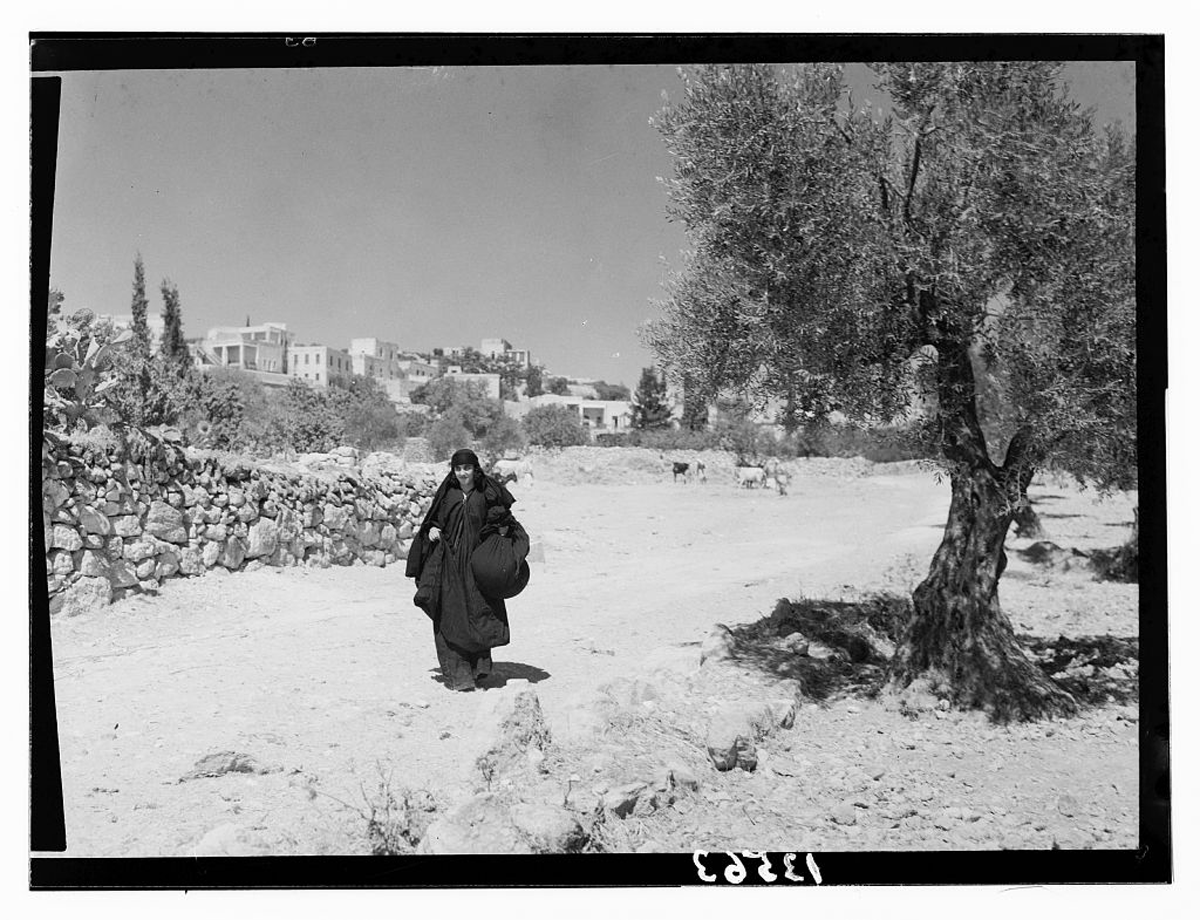
Figure 3
‘Ruth carrying off wheat measured by Boaz’: one of a series of images by the American Colony, a major tourist business in Mandate Palestine. The series, which depicts a Palestinian woman in dress common in the late Ottoman period, was sold as showing the Biblical story of Ruth. G. Eric and Edith Matson Photograph Collection, Library of Congress.
Alongside the circumstances of the production of Western sources on Palestine and its people are the specific problems that occur further down the archival timeline. It is, of course, not uncommon for the archival record of once-colonised countries to be affected by politics and conflict. It is far from unusual for colonial powers to take all or most of their records with them, despite the difficulties this might pose to postcolonial states and institutions; also common is the destruction of papers by colonial regimes fearing the legal or political repercussions of hard evidence of their activities; and where colonial rule has ended with war or revolution, records may have been lost, burnt, flooded or stolen.37 All of these factors affect the archives available to scholars studying Palestine. The British exit from mandatory rule in 1947–48 was chaotic and hurried, so that large amounts of documents were lost and destroyed. Some were left to the new state of Israel in parts of Mandate Palestine, whilst those relating to what is now the West Bank or Gaza were sometimes handed to local municipalities or to the Jordanian and Egyptian states, where after Six Day War of 1967, they went through another sequence of appropriation or dispersal by the Israelis. During the conflict of 1948 – dubbed the ‘Nakba’ or ‘catastrophe’ by Palestinians – many personal and family archives were also lost, left behind by some of the hundreds of thousands of refugees who thought that they would return after a few weeks or months, or looted by Israeli soldiers with a semi-official aim of acquiring intelligence materials or archives for the new state.38 Finally, the State of Israel has also sought to actively erase Palestinian history or hide events from within it, when collections of documents have been deliberately taken from Palestinian institutions such as the Palestine Research Centre in Beirut or Orient House in East Jerusalem.39
Building a gendered account of archaeological labour in Ottoman and Mandate Palestine
Drawing on the sources, critical approaches and analogies from other workplaces, described above, the beginnings of a general, gendered image of archaeological labour can be sketched. Clearly, the numbers of workers involved were fairly substantial. Whilst they did not meet the thousands in Lebanon’s silk industry, digs often employed numbers in the dozens or low hundreds, representing a significant proportion of the labour force of one or more villages in the neighbourhood of an excavation. If PEF and Harvard expeditions were typical, the manual labour on the archaeological site itself was split between men and women, with men and older boys using mattocks, picks and spades to dig, whilst women and children carried the filled baskets of spoil away to be dumped.40 By the early 1900s, women on some sites were also sieving the spoil for small finds, a job perceived by PEF archaeologists as requiring more skill than carrying earth and thus perhaps on a par with men’s work, which also entailed spotting finds as well as simply shifting soil. The language used to describe this job, however, was highly gendered, almost reminiscent of the ideas of ‘nimble fingers’ used to describe women and child labourers in modern sweatshops. A complex range of gendered norms governed the male and female workforces on some of the large-scale, pre-WWI excavations. Whilst men carried out the work perceived as most physically demanding, the women’s working day was often longer. Under both Palestinian and Western senses of morality, male workers could, at the end of the day, camp on the site, sleeping on the ground or under canvas and wrapped in blankets. Women, on the other hand, could not sleep in the open in mixed company, and perhaps were also expected to keep up with domestic duties as well as paid work, and in some cases (such as from the village of Burayr to Tell el-Hesi) this meant a walk of several miles each way in the morning and evening.41
Beyond the large numbers of local male and female workers employed to do the heavy manual labour were a number of other roles which were usually performed by Arab workers. The most visible of these was the position of overseer or site foreman. These performed a range of tasks on the digs themselves, watching over the labourers to ensure that they were excavating correctly, were not talking or taking too many breaks, and were not pocketing small finds. Outside of the archaeological site itself, they might carry out other roles based on their language skills and local knowledge, such as negotiating the price of access to the land to be dug and compensation for the crops it would usually bear; managing pay; organising logistics such as the purchase and movement of tools; and helping to select and hire labourers.42 Until women workers were promoted into such roles on Garrod’s excavations, beginning in 1929,43 these were exclusively male roles. They were often performed not by local Palestinians but by outsiders. Some excavators hired experienced Egyptian supervisors, including the famous Quftis, depending on the fact that large-scale European-led excavations had been carried out in Egypt for much longer than in Palestine.44 Frederick Bliss, meanwhile, a Lebanese-born American who was the PEF’s first field archaeologist in Palestine, employed a Lebanese Christian named Yusif Khazine who he presumably knew through Beirut Protestant circles and who apparently had some excavation experience; when Khazine died, he was replaced by another man from the same religious community, Yusif Kana’an.45
The domination of such senior roles by men likely stems from a combination of factors, including both Western and Levantine assumptions about gender and authority (including whether male labourers would have taken orders from a woman), and the much lower rates of female education in the region during this period, which would have excluded most women from positions that involved literacy and numeracy. On the other hand, the question of female education is further complicated by the fact that, when girls’ schools became available, Palestinian villagers usually grasped the opportunity, and women who wanted to become teachers – which entailed living away from home to study and work – were often supported by their immediate families.46 Their absence from the educated workforce can thus be read as the result of an absence of schools and other state education policies as much as one of social norms. The presence of women who were keen to train in new skills and even study abroad amongst the workers at Dorothy Garrod’s excavations also highlights the fact that assumptions about the constraints on Palestinian women are often just as much a matter of Western assumptions as of women’s lived experiences.47 In addition, though, is the fact that excavations in this period were largely carried out by a defined team, in the mode of an expedition, who lived and worked together in tents or rented houses. Conceptions of honour and decency would, therefore, have meant that even if women wanted to do such a job, they would often have been unable to travel, live or work in a mixed group, unless their husband was also able to detach from the land-based peasant economy and take up such seasonal, peripatetic work. This dynamic can also be seen at play in the fact that where tasks such as cooking are visible, they are also done by men, hired as part of the expeditionary team and living on-site. Indeed, Bliss’ second overseer, Yusif Kana’an, who ultimately became one of the longest-serving staff of the PEF, started out as the cook and kitchen boy at the age of 16.48
The exclusion of women from senior roles on-site, and the lower value given to their manual work, even if it was ultimately as gruelling as that of men, was reflected in the lower pay they received. At Tell el-Hesi, for instance, Bliss raised the wages from ‘9 piastres (a Gaza piastre is about one penny) to 11 ¾ for a man and from 5 to 6 ½ for a girl’ in 1892.49 At Gezer/Tal al-Jazar, the villagers from Abu Shusheh were paid ‘Men… two beshliks (five piasters per day); Boys and women… one beshlik; Water-carrier… three beshliks (including hire of donkey)’.50 This ratio seems to have been standard at PEF excavations, and seems to have been agreed collectively with village mukhtars or other (male) community leaders, with negotiations taking place at each new site. Despite this, women do seem to have acted collectively on the issue of pay, such as when those from the village of Artuf, digging at ‘Ayn Shams, voted with their feet, leaving the excavation for employers such as the railway or the flower-distillation business at the Jewish colony at Hartuv, which, whilst also sporadic, paid twice as much.51 The same pattern of payment appears to have applied amongst the villagers of Sebastia, where the Harvard expedition pay registers indicate rates for men doing manual labour of 6.25–7.5 piastres per day, with some whose roles were listed as foreman, cook, soldier or courier paid over 10 or even 20 piastres daily; women were remunerated at an apparently fixed rate of 3.75 piastres, and boys at 2.5.52
As well as the basic questions of how roles and tasks were allotted and remunerated, other considerations common to mass labour environments were also a feature of archaeological work. Dynamics of alienation and fashionable ideas about efficiency and mechanisation, which might be more often associated with Western factories, arose on excavations in Palestine, such as when PEF archaeologist Duncan Mackenzie experimented with replacing the teams of women and children who shifted spoil with smaller numbers of boys pushing the earth in wheelbarrows.53 Like the silk factory workers described by Khater, though, both male and female archaeological labourers were willing and able to demand certain rights. It is not uncommon to find mentions in diaries and letters of entire workforces absenting themselves for reasons ranging from religious festivals to bringing in the harvest.54 And Mackenzie’s (ultimately unsuccessful) flirtation with wheelbarrows was partly inspired by the fact that the female portion of the workforce at ‘Ayn Shams chose, with apparent regularity, to do better paid or less physically arduous work when it was available. Although Mackenzie railed against these absences as ‘capricious’, they were actually the result of the village women’s rational calculations about the nature and value of their work.55 Whilst, therefore, the fact that large numbers of Palestinian peasants, particularly women, felt compelled to do backbreaking work for low pay on archaeological sites because of larger structural oppressions – flawed Ottoman land reforms and taxation systems, local dynamics of class and gender, and the growing impacts of imperialism – they were still able to exercise at least some agency, and to locate their archaeological work within a wider labour landscape that gave them some, albeit limited, choices.
When, after WWI, British mandatory rule was imposed on Palestine, it brought a new regimen of state control of antiquities and archaeology. In terms of employment of local people, there firstly evolved a new range of jobs and roles (or at least more institutionalised versions of them) such as antiquities guards and museum attendants, as well as the slow emergence of several generations of formally trained Palestinian antiquities inspectors and field archaeologists. The former roles were seen as working-class and unskilled, although like excavating itself, their practitioners often had or gained more skills and knowledge than they were given proper credit for.56 The latter were generally of middle- or upper-class and disproportionately Christian origins. The fact that all examples (of which I currently aware) of both groups were male likely has some roots in histories of education and other local social structures mentioned above, but they were also part of British colonial employment practices which extended beyond Palestinian staff. Although the Mandate administration did employ some women, mainly as secretaries and ‘telephone girls’, internal documents show that it was extremely hostile to doing so, and that at some points in its 30-year presence the employment of women was largely restricted to the lowest pay grades.57 Even though, therefore, women do make regular appearances in the history of archaeology in Mandate Palestine, they were usually either students of the British School of Archaeology in Jerusalem, sent from their British universities for field experience, or they were volunteers with the School or the Department of Antiquities. They thus represent the kind of European or North American, white, educated figures upon whom most Western feminist projects of writing women in the history of archaeology have focused, and if any Palestinian women were employed in any capacity other than as manual labourers on larger excavations, they have not yet been identified in the archival record.58
Some conclusions
The archaeology of Palestine, entangled since its inception with colonialism, imperialism and the imposition of themes drawn from the Bible, has increasingly attracted scholars intent on decolonising this deeply problematic history. One method of doing this has been to write back in the work of Palestinian men and women, acknowledging their role not only in the physical labour of digging and clearing, but also in interpreting finds and creating knowledge about their land and its past. The scattered and fragmentary archives available for the study of Palestine have, however, meant that this project has largely consisted of studies of individual excavation sites or specific people, and has necessarily entailed the difficult and delicate tactic of using colonial archives to piece together the histories of colonised people who have only extremely rarely had the opportunity to have their own voices heard. This article has attempted to draw together some of the findings of these disparate studies and, using scholarship from other disciplines, to try to consider some of the common ideas and facts that might start to allow generalisations and wider conclusions about working conditions – and, in particular, the gendered aspects of these – on archaeological excavations in the Late Ottoman and Mandate periods. An interdisciplinary process which draws on fields such as labour history permits an understanding of the working experience on these sites which goes beyond seeing Palestinian workers solely as a function of the archaeological process, and locates this type of work within the broader labour environment in the Levant in this period. Practices such as rates of pay, divisions of labour by gender and age, or the value placed on certain skills can therefore be viewed in the light of other working conditions, de-exceptionalising the archaeological experience. This also decentres the role of European and North American archaeologists in this picture, instead putting indigenous workers at the forefront of the study. Whilst the subjectivities of these men and women are, in all likelihood, largely lost to us, considering not only how they responded to the conditions of archaeological labour but to other forms of work in this period of capitalist and imperial infiltration presents at least some opportunities to understand their worlds.
Notes
[1] See, for examples of various styles and perspectives, Allison Mickel, Why Those Who Shovel Are Silent: A History of Local Archaeological Knowledge and Labor (Denver: University Press of Colorado, 2021); Stephan Quirke, Hidden hands: Egyptian workforces in Petrie excavation archives, 1880–1924 (London: Duckworth, 2010); Sarah Irving, “The Kidnapping of ‘Abdullah al-Masri: Archaeology, Labor, and Power at ‘Atlit.” Jerusalem Quarterly 91 (autumn 2022): 8–28; Melissa Cradic and Samuel Pfister, “Unsilencing the Archives: the laborers of the Tell en-Nasbeh excavations (1926–1935),” Badè Museum online exhibition, September 2021, https://storymaps.arcgis.com/collections/dc601d4d131145f88f828196860b8a44; Salim Tamari, “Archaeology, Historical Memory, and Peasant Resistance: The Gezer Excavations at Abu Shusha,” Jerusalem Quarterly 91 (2022): 79–104.
[2] Zeynep Çelik, About Antiquities: Politics of Archaeology in the Ottoman Empire (Austin: University of Texas Press, 2016); Donald Malcolm Reid, Contested Antiquities in Egypt: Archaeologies, Museums and the Struggle for Identities from WWI to Nasser (Cairo: American University in Cairo Press, 2015); Reid, Whose Pharaohs? Archaeology, Museums, and Egyptian National Identity from Napoleon to WWI (Berkeley: University of California Press, 2002).
[3] Elena Corbett, Competitive Archaeology in Jordan: Narrating Identity from the Ottomans to the Hashemites (Austin: University of Texas Press, 2014); Elliot Colla, Conflicted Antiquities: Egyptology, Egyptomania, Egyptian Modernity (Durham/London: Duke University Press, 2007).
[4] Sarah Irving, “A Tale of Two Yusifs: Recovering Arab Agency in Palestine Exploration Fund Excavations 1890–1924,” Palestine Exploration Quarterly, 149, no. 3 (2017): 229–30; Allison Mickel, “Essential Excavation Experts: Alienation and Agency in the History of Archaeological Labor,” Archaeologies 15, no. 2 (2019): 181–205.
[5] For example Quirke, Hidden Hands, on Flinders Petrie’s workforce; Irving, “The Kidnapping of,” on Abdullah al-Masri and Irving, “A Tale of Two,” Yusifs Khazine and Kana’an, Mickel, Why Those Who Shovel, on Petra and Çatalhöyük and Cradic and Pfister, “Unsilencing the Archives,” on the Badè Museum online exhibition on Tell al-Nasbah.
[6] Sarah Irving, “Women versus Wheelbarrows: Labor and British Archaeology in Late Ottoman Palestine,” Journal of the Ottoman and Turkish Studies Association 8, no. 1 (summer 2021): 427–433; “Excavating the Subaltern: studying the lives of Palestinian peasant women pre-WW1,” Yerevan State University Journal of Oriental Studies 15 (2019): 14–26.
[9] Mickel, “Essential Excavation Experts”; Dima Srouji, “A Century of Subterranean Abuse in Sabastiya: the Archaeological Site as a Field of Urban Struggle,” Jerusalem Quarterly 90 (2022): 58–74.
[10] Archive of the Department of Antiquities of Mandatory Palestine (1919–1948), Israel Antiquities Authority, http://www.iaa-archives.org.il/.
[11] The American Colony image collection at the US Library of Congress, known as the Matson (G. Eric and Edith) Photograph Collection, is freely available at https://www.loc.gov/pictures/collection/matpc/.
[12] Melissa Cradic and Samuel Pfister, Unsilencing the Archives: The Laborers of the Tell en-Nasbeh Excavations (1926–1935), https://storymaps.arcgis.com/collections/dc601d4d131145f88f828196860b8a44?item=1.
[13] For discussions of the changing meanings and enforcement of the borders within what had been Ottoman Syria, see Toufoul Abou-Hodeib, “Sanctity Across the Border: Pilgrimage routes and state control in Mandate Lebanon and Palestine,” in The Routledge Handbook of the History of the Middle Eastern Mandates, ed. Andrew Arsan and Cyrus Schayegh (Abingdon: Routledge, 2015), 383–94; Laila Parsons, “Rebels Without Borders: Southern Syria and Palestine, 1919–1936,” in The Routledge Handbook of the History of the Middle Eastern Mandates, ed. Andrew Arsan and Cyrus Schayegh (Abingdon: Routledge, 2015), 395–407.
[14] This summary of women workers’ role in the silk industry of Mount Lebanon in the second half of the nineteenth century is drawn primarily from Akram Khater, Inventing Home: Emigration, Gender, and the Middle Class in Lebanon, 1870–1920 (Berkeley: University of California Press, 2001).
[15] See, e.g., Rawda Morkus-Makhoul, “Decolonising the Social History of Rural Palestinian Women: The Economic Activity of Rural Women in Galilee during the British Mandate,” in The Social and Cultural History of Palestine: Essays in Honour of Salim Tamari, ed. Sarah Irving (Edinburgh: Edinburgh University Press, 2023), 120–41; Beshara Doumani, Rediscovering Palestine: Merchants and Peasants in Jabal Nablus, 1700–1900 (Berkeley: University of California Press, 1995). In addition to common peasant experiences, research and memoirs have also highlighted the extent to which marriage, trade, education and other social practices tied together different parts of what were later divided politically into Palestinian, Syrian and Lebanese societies: e.g. Toufoul Abou-Hodeib, “Involuntary history: writing Levantines into the nation,” Contemporary Levant 5, no. 1 (2020): 44–53; Rosemary Sayigh, ed. Yusif Sayigh, Arab Economist and Palestinian Patriot: A Fractured Life Story (Cairo: American University in Cairo Press, 2015).
[17] Irving, “Women versus Wheelbarrows”; Irving, “Excavating the Subaltern”; Srouji, “Subterranean Abuse.”
[18] Alexander Schölch, Palestine in Transformation, 1856–1882 (Washington DC: Institute for Palestine Studies, 1993), 126–49.
[29] A 1931 survey in Palestine put literacy amongst Muslim women at around 3% (25% for Muslim men, 44% for Christian women). In 1947 the figures were 7% for Muslim women, 35% for Muslim men and 65% for Christian women. Ami Ayalon, Reading Palestine: Printing and Literacy, 1900–1948 (Austin: University of Texas Press, 2004), 2, 16–17.
[30] For discussions of the possibilities and constraints of oral history in the Palestinian context, especially on subjects of gender, see Abbad Yahya, “Oral History and Dual Marginalization: Palestinian Peasant Women and Nakba Narratives,” Jerusalem Quarterly 70 (summer 2017): 96–110, and Morkus-Makhoul, “Decolonising the Social History.”
[31] For a variety of perspectives on why colonially-created archives and documents are still valuable for studying the histories of colonised peoples, see the edited collection by Ricardo Roque and Kim Wagner, and for a specific discussion of the issue, see “Introduction,” in Engaging Colonial Knowledge: Reading European Archives in World History, eds. Ricardo Roque and Kim Wagner (Basingstoke: Palgrave Macmillan, 2012), 18–21, 28–32.
[32] Examples include Frederick Jones Bliss’ descriptions of the social and romantic lives of the workers at Tell el-Hesi in his letters held in the archives of the Palestine Exploration Fund in London and sometimes published by the PEF as picturesque and folkloric accounts, and Duncan Mackenzie’s complaints about the female workers at ‘Ayn Shams, also in letters and excavation daybooks at the Palestine Exploration Fund.
[33] The archives of the Harvard University-sponsored excavations at Sebastia (Biblical Samaria), now at the Harvard Semitic Museum, are good examples of this type of record.
[34] See, for instance, the image collections of the Palestine Exploration Fund in London, which include many photographs which feature women workers at sites such as Tell el-Hesi. Women appear in some of the excavation photos taken by photographers of the American Colony in Jerusalem, who took pictures for commercial use and whose work is digitised and freely available on the Library of Congress website at https://www.loc.gov/pictures/collection/matpc/. Occasional images with (often unacknowledged) female workers also appear in contemporary publications such as the Bulletin of the British School of Archaeology in Jerusalem, also digitised and open access via the Council for British Research in the Levant as Jessica Holland and Kolya Abramsky, eds., Bulletins and Supplementary Papers of the British School of Archaeology in Jerusalem, 1922–1931 (London: CBRL, 2023), https://www.jstor.org/stable/jj.4876479.
[35] Rachel Hallote, Bible, Map and Spade: The American Palestine Exploration Society, Frederick Jones Bliss and the Forgotten Story of Early American Biblical Archaeology (Piscataway, NJ: Gorgias Press, 2006) and Leona Glidden Running and David Noel Freedman, William Foxwell Albright: A 20th Century Genius (Lawrence, MA: Two Continents Publishing, 1975) are contrasting approaches to some of the major figures of Biblical archaeology. Hallote’s detailed and critical study nevertheless highlights Bliss’s basic decency and comparatively progressive attitudes to his workers, whilst Running and Freedman’s hagiographic account fails to disguise Albright’s racism and dogged insistence on imposing a Biblical framework onto any site in Palestine. Rama Al-Rabady and Shatha Abu-Khafajah, “The history of Jordan: Biblical archaeology and local heritage-making within a discourse on epistemological (dis)continuity,” Contemporary Levant 8, no. 1 (spring 2023), 52–69 highlights the extent to which Biblical framings are far from being a thing of the past in the conduct, interpretation and representation of archaeological finds in the Levant region.
[36] On the many ways in which these viewpoints permeated English culture, see Eitan Bar-Yosef, The Holy Land in English Culture 1799–1917: Palestine and the Question of Orientalism (Oxford: Oxford University Press, 2005). On the broader effects of orientalist scholarship on how the peoples of the Middle East were seen by Christian – especially Protestant – Europeans and Americans, Edward Said’s classic work Orientalism (London: Penguin, 1995) is still the first port of call.
[37] James Lowry, ed., Displaced Archives (Abingdon: Routledge, 2017) contains a number of useful case studies and comparative chapters on the damage or removal of archives by colonial states. See also David M. Anderson, “Guilty Secrets: Deceit, Denial, and the Discovery of Kenya’s ‘Migrated Archive’,” History Workshop Journal 80, no. 1 (Autumn 2015): 142–160; Caroline Elkins, Imperial Reckoning: The Untold Story of Britain’s Gulag in Kenya (New York: Henry Holt, 2005).
[38] The daughter of Palestine doctor and ethnographer Tawfiq Canaan wrote, for instance, that “Mother and father would go daily to the top of the Wall of Jerusalem to look at their home. They witnessed it being ransacked, together with the wonderful priceless library and manuscripts, which mother guarded jealously and with great pride,” cited in Khaled Nashef, “Tawfik Canaan: His Life and Works,” Jerusalem Quarterly 16 (2002), 24. Broader discussions of the acquisition of both personal and institutional archives by Israel in 1948 and after, and its impacts, can be found in Gish Amit, “Salvage or Plunder? Israel’s ‘Collection’ of Private Palestinian Libraries in West Jerusalem,” Journal of Palestine Studies 40, no. 4 (Summer 2011): 6–23; Ariella Azoulay, “Photographic Conditions: Looting, Archives, and the Figure of the ‘Infiltrator’”, Jerusalem Quarterly 61 (Winter 2015), 6–22; Hannah Mermelstein, “Overdue Books: Returning Palestine’s ‘Abandoned Property’ of 1948,” Jerusalem Quarterly 47 (Autumn 2011): 46–64.
[39] Hana Sleiman, “The Paper Trail of a Liberation Movement,” Arab Studies Journal 26, no. 1 (2016): 42–67; Rona Sela, “The Genealogy of Colonial Plunder and Erasure – Israel’s Control over Palestinian Archives,” Social Semiotics. 28, no. 2 (2018): 201–229.
[40] See, for example, letter from Frederick Jones Bliss 6th April 1891, ‘Each [digging] man has two girls [to clear the earth]… The earth being taken to the edge by girls and women who throw it 100 feet and more into the river bed’ (PEF/BLISS/3/1/1); in 1892 Bliss mentioned 60 ‘women and girls’ involved in an incident with a wind-blown tent at Tell el-Hesi (PEF/BLISS/11/1D). Published reports of PEF digs regularly make passing mention of female labour, something that would not have surprised Victorian readers, in a society where – contrary to stereotypes of upper- and middle-class female languor – a large proportion of working-class women were still in paid employment. See Xuesheng You, “Women’s labour force participation in nineteenth-century England and Wales: evidence from the 1881 census enumerators’ books,” Economic History Review 73 no. 1 (February 2020): 106–133.
[41] Frederick Jones Bliss, “Report of Excavations at Tell-El-Hesy during the Spring of 1891: Excavating from its Picturesque Side,” Palestine Exploration Quarterly 23, no. 4 (October 1891), 294.
[42] Evidence for this range of duties includes published and unpublished accounts in the PEF archives (see e.g. Irving, “Tale of Two Yusifs”), along with clues which are less direct but highly suggestive, such as the fact that many of the wage accounts in the archives of the Harvard Samaria expedition are written in Arabic, in handwriting which appears to be that of someone who has used the script from an early age (i.e. not a foreign adult learner).
[43] Although Garrod’s excavations, with female workers in senior roles, took place some time after those examined here, even in the late 1920s and 1930s female supervisors were vanishingly rare, and the difference can probably be ascribed less to changing attitudes than to a female lead excavator.
[44] See e.g. John D.M. Green and Ros Henry, eds., Olga Tufnell’s ‘Perfect Journey’: Letters and photographs of an archaeologist in the Levant and Mediterranean (London: UCL Press, 2021), 59, 61, 67, 154; Rachael Thyrza Sparks, “Digging with Petrie: Gerald Lankester Harding at Tell Jemmeh, 1926–1927,” Bulletin of the History of Archaeology, 29 no. 1 (2019): 1–16; Letter from Duncan Mackenzie to John D. Crace, 29th July 1910, mentioning ‘Nubian foremen’ and ‘Egyptian boys’, PEF/DA/Mack/483.
[47] On the role of local as well as international women workers on Garrod’s excavations, see Jane Callander and Pamela Jane Smith, “Pioneers in Palestine: The Women Excavators of El-Wad Cave, 1929,” in Sue Hamilton, Ruth Whitehouse and Katherine Wright (eds.), Archaeology and Women: Ancient and Modern Issues, 76–82 (Walnut Creek, CA: Left Coast Press, 2007).
[52] 1908–1909 Samaria Expedition Records box 15, workmen [sic] pay registers (series 1: excavation records 1905–1910; subseries 1.3: financial records 1905–1910).
[53] Letter from Mackenzie to Sir Charles Watson, 19 August 1911, Palestine Exploration Fund Archive document PEF/DA/Mack/546; Duncan Mackenzie Ain Shems [sic] – Beth Shemesh daybooks 1912 PEF/DA/MACK/9 Monday, 1 July, 1912.
[54] Amongst a range of examples from the PEF archives, in a letter dated 23 May 1891, Frederick Jones Bliss noted that at Tell el-Hesi, ‘The harvest has proved a fatal rival to the work,’ noting that because of poor weather and regional conflicts, the previous year’s yields had been poor so he was having to recruit from other villages and to consider raising wages to replace ‘men who are already deserting’ (PEF/BLISS/Bliss 3/2/1 and PEF/BLISS/Bliss/4).
[55] Letter from Mackenzie to Sir Charles Watson, 19 August 1911, Palestine Exploration Fund Archive document PEF/DA/Mack/546; Irving, “Excavating the Subaltern,” 16, 19.
[56] Irving, “Kidnapping of Abdullah al-Masri,” 13; “Tale of Two Yusifs,” 224, 230–31; Mickel, Why Those Who Shovel, 65.
Funding Information
The research for this article was made possible by the generosity of the Council for British Research in the Levant, the Palestine Exploration Fund and Linnaeus University.
Competing Interests
The author has no competing interests to declare.