
Introduction
The Swiss philologist and traveller Dubois de Montpéreux was the first to associate the ruins in the small village of Nokalakevi in Samegrelo, west Georgia (Figure 1), with the Byzantine period fortress of Archaeopolis (Figure 2).1 Described in early Byzantine historical sources,2 and known as Tsikhegoji or ‘the triple-walled fortress’ by Georgian chroniclers, the fortifications enclose a naturally defensible area of approximately 18–19 ha.3 The Tekhuri river, flowing from its source in the Greater Caucasus mountains immediately to the north, has carved a steep limestone gorge that loops around the promontory upon which Nokalakevi is situated, before flowing onto the Colchian Plain (Figures 3 and 4). The ancient fortress, on the foothills at the edge of the plain, provided security for both the routes into the mountains and across the plain, and was a key fortification of the Kingdom of Egrisi-Lazika from the 3rd/ 4th century AD. The lower town, on relatively level terrain above the river, sits at the base of the Unagira ridge. On top of this ridge a hilltop citadel stands more than 200 m above the lower town (Figure 5).
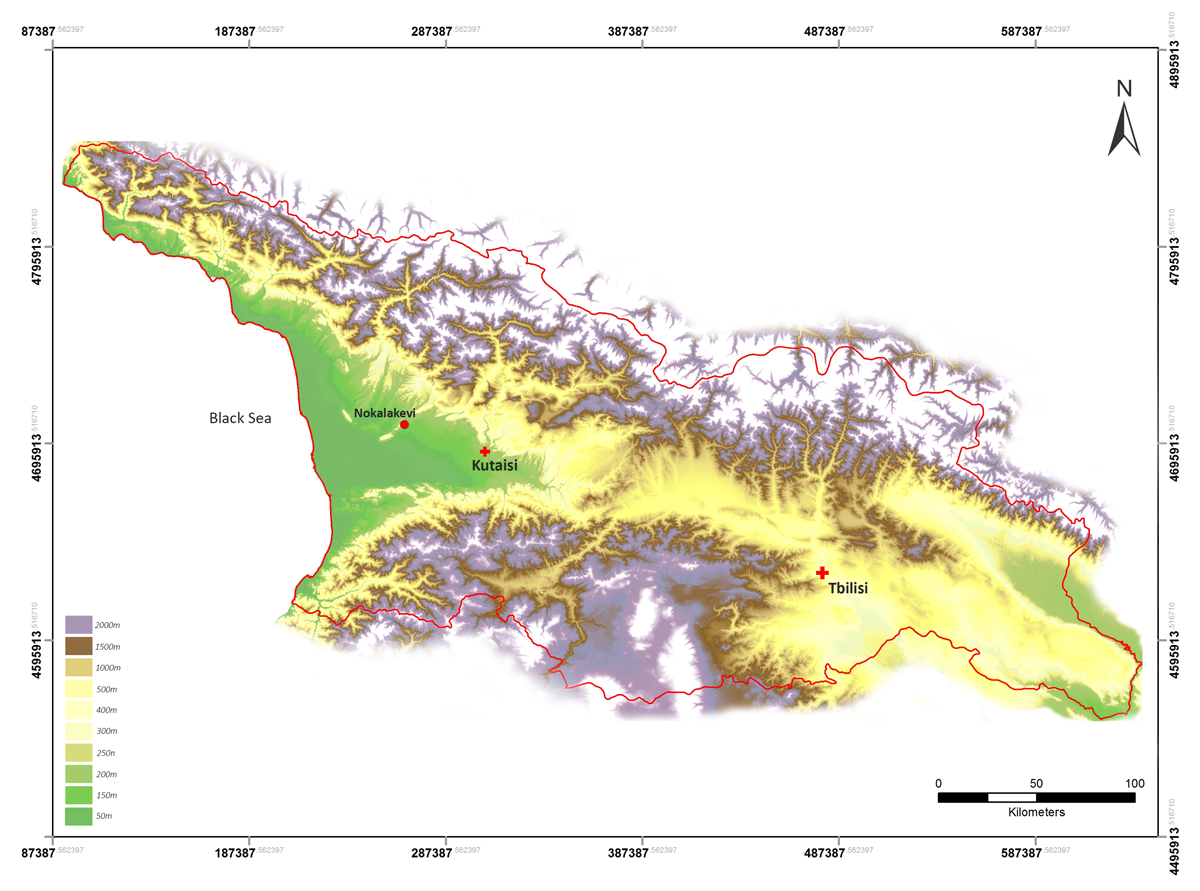
Figure 1
Topographic map of Georgia, generated from the ASTER GDEM produced by NASA and METI, showing the location of Nokalakevi. Coordinates in WGS84 UTM 38N.
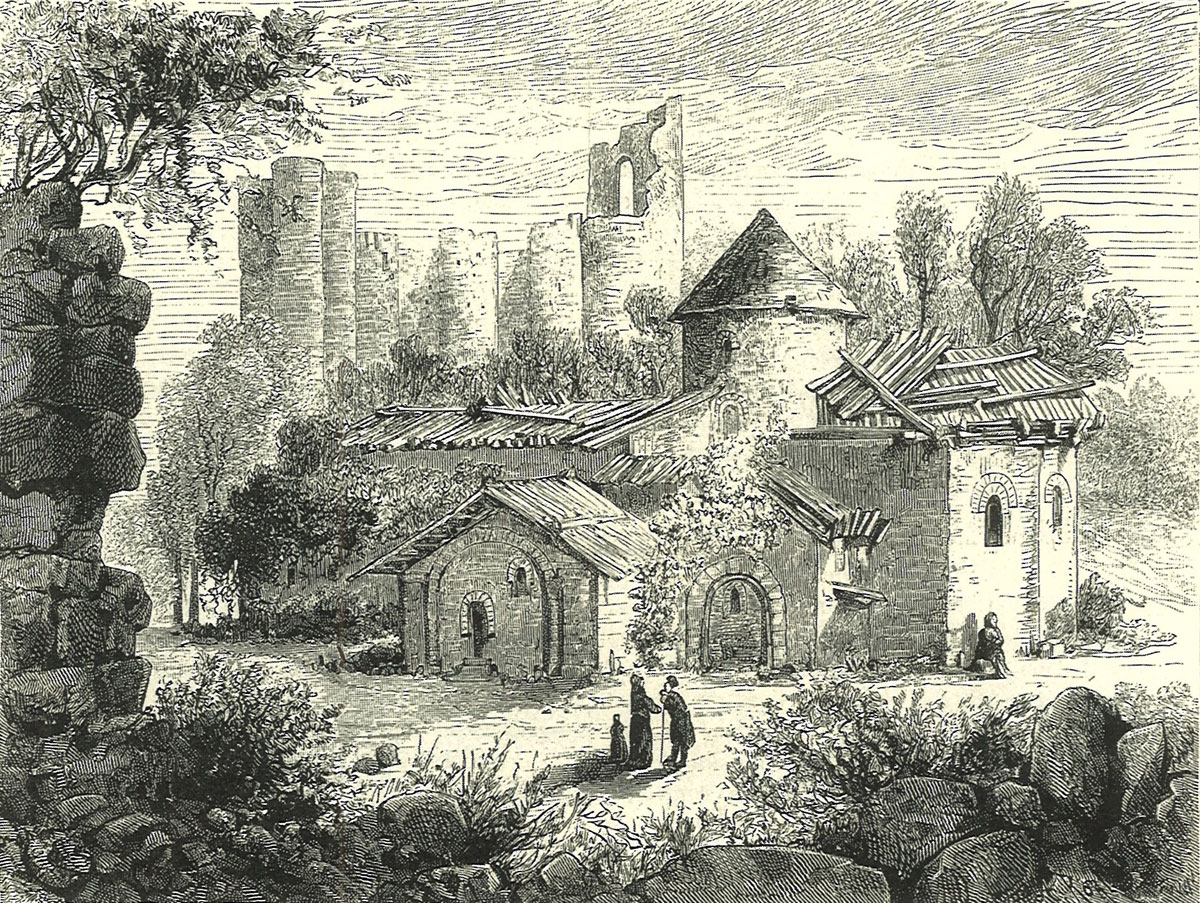
Figure 2
The Forty Martyrs’ Church among the ruins at Nokalakevi, as seen in the 1830s (Dubois de Montpéreux 1839).
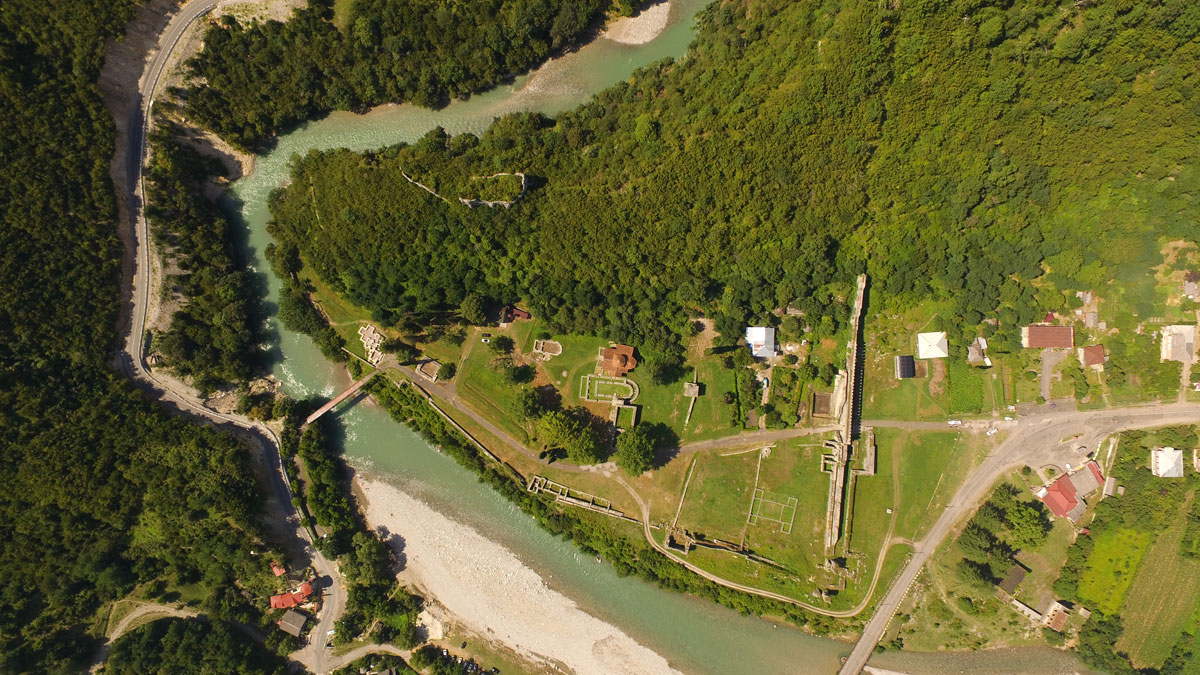
Figure 3
Vertical drone photo of the ‘lower town’ of Nokalakevi, enclosed within a loop of the River Tekhuri (© National Agency for Cultural Heritage Preservation of Georgia 2016).
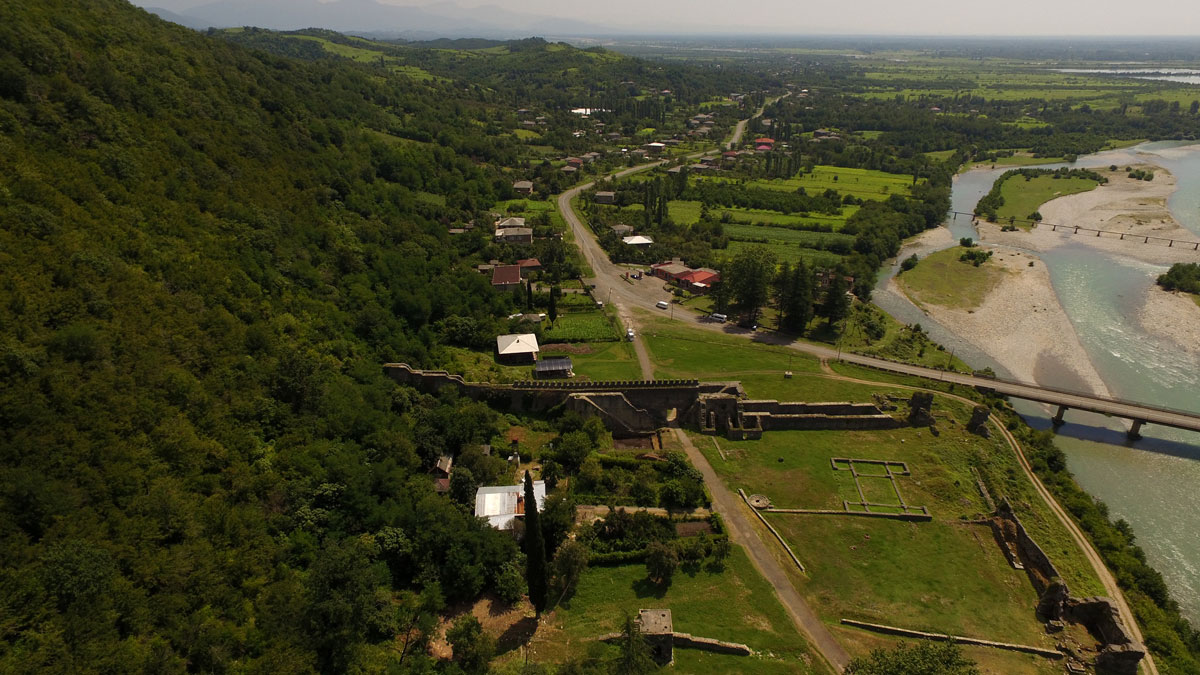
Figure 4
Oblique drone photo, looking east, showing the location of Nokalakevi at the junction of the foothills to the north (left) and the Colchian Plain to the south (© National Agency for Cultural Heritage Preservation of Georgia 2016).
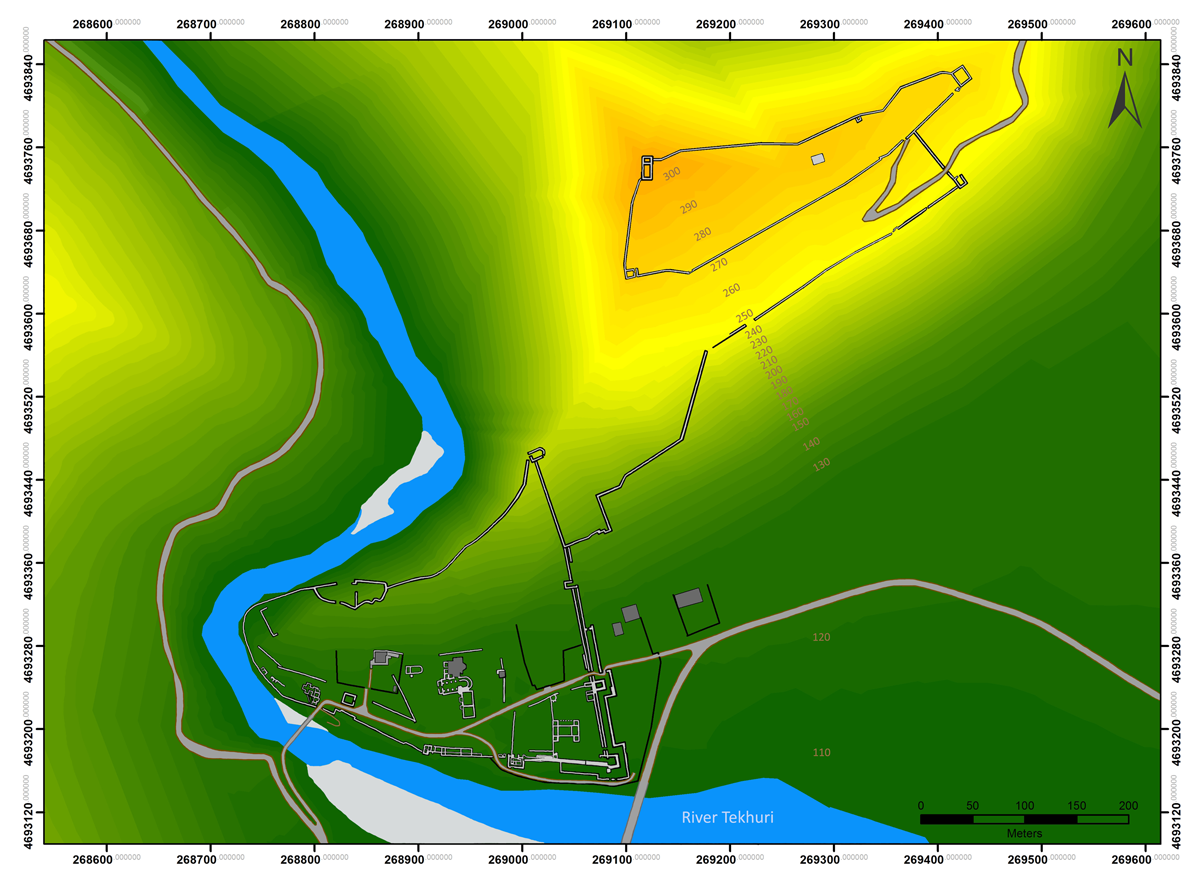
Figure 5
GPS survey of extant structures at Nokalakevi, 2009, showing modern infrastructure and surviving fortifications, the extent of the walls, and the relationship between the ‘upper’ and ‘lower’ town. Coordinates in WGS84 UTM 38N.
The picturesque ruins have long attracted interest from travellers,4 and were identified as a potential target for investigation soon after the first archaeological excavations in Georgia, in the mid-19th century.5 However, large-scale excavation at Nokalakevi did not begin until 1973,6 with the establishment of a well-funded expedition from the S. Janashia Museum in Tbilisi, and continues today through the Anglo-Georgian Expedition to Nokalakevi which was formed in 2001.7 The first formal archaeological work was a test excavation undertaken in the winter of 1930–31, when Dr Alfons Maria Schneider of the Deutsches Archäologisches Institut led an international collaboration funded by the Notgemeinschaft der Deutschen Wissenschaft in the Georgian Soviet Socialist Republic. Professor Giorgi Chubinashvili, of Tbilisi State University, offered guidance during visits to the site, but Schneider was directly assisted by Levan Muskhelishvili and Giorgi Gozalishvili in the excavations between 24 November 1930 and 27 January 1931.8 Little was published as a result of this work, with Schneider himself only producing a few hundred words for the German journal Forschungen und Fortschritte9 (later published in Georgian by S. Qaukhchishvili10), and both Gozalishvili11 and Muskhelishvili12 publishing short descriptions of the work many years later. As a result, not a great deal was known about the management or results of the project – beyond the brief interpretation offered by Schneider and the discovery of a hoard of 23 Byzantine solidi in one of the towers along the fortifications, still referred to colloquially as ‘Schneider’s Tower’.13
An opportunity to reassess this work was presented by the discovery of notebooks and correspondence in two German archives: Deutsches Archäologisches Institut, Istanbul (DAI-IST), and Das Bundesarchiv (BArch).14 Funding from the University of Winchester supported the translation of the source material by 7reasons Medien GmbH. Identification, translation and analysis of these remarkable archive collections has illuminated this pioneering study of Nokalakevi, and enabled reinterpretation of Schneider’s conclusions, but has also provided wonderful insight into the background to the collaboration, the project initiation and delivery, and some of the personal relationships.
Soviet-German collaboration
The extraordinary collaborative expeditions of the Soviet People’s Commissariat for Education (Narkompros) and the Emergency Association of German Science (Notgemeinschaft der Deutschen Wissenschaft) covered a wide variety of research areas from 1925, all of which took place within the Soviet Union. These expeditions gave German scientists access to new territories after the loss of the country’s colonies, but also provided fruitful collaborative opportunities for both German and Soviet scientists at a time when both had been marginalised by the international scientific community. Research projects in the first few years included ‘an expedition to study camel disease in the Urals (1926–27), a tuberculosis expedition to Kirghizia (1927), an expedition to study the problem of goiter (1927) […] a geological/ geographic expedition to the Pamir (1928)’,15 and the syphilis expedition to Buriat Mongolia in 1928, described in detail by Solomon.16
Such collaboration was, perhaps, only possible because of the personal qualities of the heads of both Narkompros and the Notgemeinschaft, and their commitment to science and education. Anatoly Lunacharsky (1875–1933) had been declared the first People’s Commissar for Education on 26 October 1917, when the Bolshevik Central Committee announced the members of the new government at the Second Congress of Soviets in Petrograd. Despite being considered a ‘political lightweight’ within Bolshevik circles, Lunacharsky was well-liked by Lenin and others and was driven by a passion for education, culture and the arts – particularly their power to deliver enlightenment.17 Indeed, the Russian name of the Commissariat, Narodnyi komissariat prosveshcheniia (often abbreviated as Narkompros), can literally be translated either as the People’s Commissariat of Education, or of Enlightenment. Following the creation of the Soviet Union in 1922, Lunacharsky was People’s Commissar solely for the Russian Federation, with Education/ Enlightenment devolved to the individual Soviet Socialist Republics. However, a meeting between Lunacharsky and Friedrich Schmidt-Ott of the Notgemeinschaft der Deutschen Wissenschaft in September 1925 seems to have paved the way for, among other things, the German-Georgian excavation at Nokalakevi.18
Friedrich Schmidt-Ott (1860–1956) was rather different to his Soviet counterpart, both in terms of background and his route to a position of influence. He first worked for the Prussian Ministry of Culture in 1888, and in 1907 was appointed Privy Councillor of the higher civil service (Wirklicher Geheimer Oberregierungsrat), which entitled him to be addressed as Exzellenz, as can be seen in some of the letters transcribed below. He then served as Prussian Minister of Culture between August 1917 and the end of the First World War in November 1918.19 The political upheaval in Germany at that point was perhaps not as holistic as in Bolshevik Russia, but the impact on education and culture was no less keenly felt. In April 1919, Schmidt-Ott published an essay arguing that the provincial governments could no longer support, as they had done, research and scholarship, and that the central government should take a lead role.20 The concept of the Notgemeinschaft der Deutschen Wissenschaft (NG) as a ‘nonpartisan, autonomous, national organization’ was further detailed by Schmidt-Ott and Fritz Haber in early 1920.21 In the following months the two set about winning support for it across academia, from industry, the banks and politicians, and the NG was founded in October of the same year with Schmidt-Ott the first president of the association.
In September 1925, Schmidt-Ott travelled to St Petersburg to participate in events marking the 200th anniversary of the foundation of the Russian Academy of Sciences, including a key meeting with senior political and academic representatives, including Mikhail Kalinin (Chair of the Central Executive Committee of the Congress of Soviets), Nikolai Gorbunov (Secretary of the Council of People’s Commissars of the Soviet Union), Olga Kameneva (Chair of the All-Union Society for Cultural Relations with Foreign Countries (VOKS)), Sergei Oldenburg (academician, and permanent secretary of the Academy of Sciences), and Anatoly Lunacharsky.
At this meeting Lunacharskii [sic] had apparently recognized in principle the possibility of joint expeditions. In what was clearly a followup, on 1 October 1925 Gorbunov and Schmidt-Ott had met in Berlin to discuss general issues of cross-national scientific cooperation. Notes of the meeting reveal that Gorbunov signaled his government’s interest in German science and asked Schmidt-Ott to submit specific proposals for cooperative undertakings.22
Proposals for work in Nokalakevi
By 1925 the function of the Commissariat of Education had been devolved to individual Soviet Socialist Republics. The Georgian SSR had been founded in 1921 following the invasion by the Red Army and removal of the moderate, Menshevik, Georgian Democratic Republic – which itself had been founded as an independent state in the months following the collapse of the Russian Empire. In 1922 the Georgian SSR was, along with every other, formally incorporated into the Union of Soviet Socialist Republics at its foundation. Widespread anti-Bolshevik feeling continued in Georgia, however, and led to the August Uprising of 1924, which was violently suppressed and punished by the Red Army and Cheka.
In 1922, Davit Kandelaki (1895–1938) was appointed as the first People’s Commissar for Education in Georgia, at a time when Narkompros across the USSR was being restructured to refocus funding away from the arts and to educational, political and propaganda functions. Indeed, the ‘new priorities of Narkompros were reflected in the selection of Davit Kandelaki […] An economist and specialist in education, Kandelaki appears to have had little if any involvement in the arts’.23 He was, however, committed to promoting skills-based education in Georgia, and was one of the founders of the Georgian Polytechnic Institute (now the Georgian Technical University) in 1928, and was elected its first rector. A west Georgian, born in Kutaisi in 1895 and educated in Germany, Kandelaki was 18 years younger than Stalin and a similar age to Beria, another of Stalin’s trusted Georgian inner circle. Kandelaki’s political career was to end in purge and execution in 1938, following a role as Soviet trade envoy to Nazi Germany from 1934–37. However, beyond his public role, Kandelaki worked directly for Stalin, and had been entrusted with a personal objective to rebuild good relations with Germany after the Nazis came to power.24 There is clearly a possibility that Kandelaki – like Beria – was entrusted with a confidential role by Stalin because private discussions could be held in Georgian.
Judging from the available sources, Kandelaki can perhaps be credited with the first proposals for a collaborative project at Nokalakevi. In a letter of 4th June 1929 (Figure 6), to Schmidt-Ott of the Notgemeinschaft, he wrote:
Excellency!
On the occasion of the negotiations concerning archaeological excavations in Georgia, the People’s Commissariat for Education of the S.S.R. Georgia sends a memorandum in German on the site of Nokalakewi and on the scientific prospects of the excavations by the Professors Dr Iwane Dschawachischwili [Ivane Javakhishvili] and Dr Georg Tschubinaschwili [Giorgi Chubinashvili], together with an excerpt of the map of the site and the road connections, as well as an extract of the essay on the Nokalakewi question (in Russian) by Prof Dr Tschubinaschwili [Chubinashvili].25
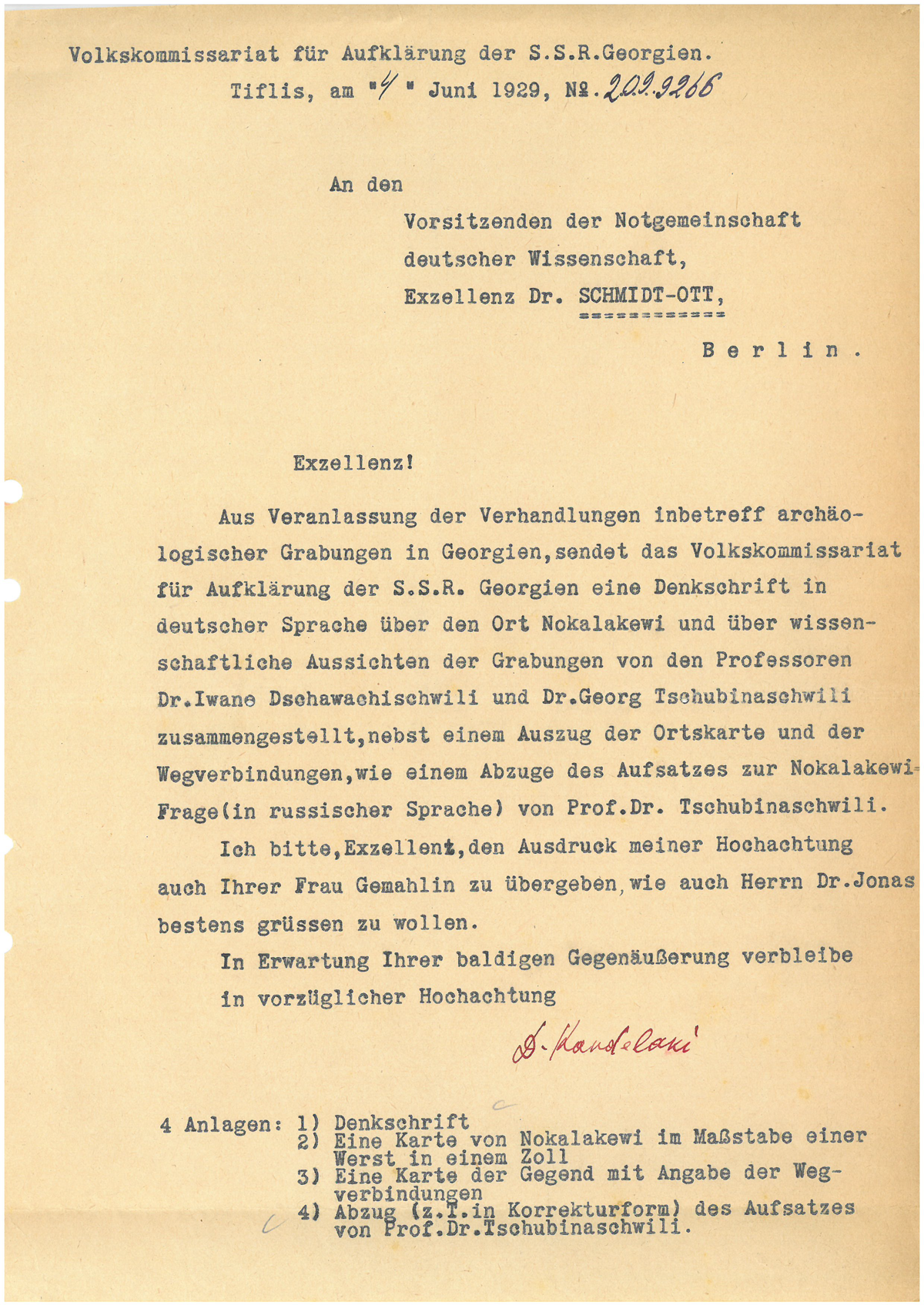
Figure 6
The start of the collaboration at Nokalakevi: The letter from Kandelaki to Schmidt-Ott, June 1929, held in the Bundesarchiv (BArch, R 73/11589a).
This letter was accompanied by four enclosures, of which the memorandum by Javakhishvili and Chubinashvili, and the essay by Chubinashvili on the potential of archaeological work at Nokalakewi – translated from Russian – survive in the archives. Both are worth presenting in some detail, as they seem to represent the first discussion of Nokalakevi presented by leading Georgian scholars to their western peers. Javakhishvili and Chubinashvili described the site itself to their German colleagues as follows:
Nokalakewi in the province of Mingrelia occupies an important place among all the ancient urban centres in Georgia that are now abandoned or in ruins, such as Bolnissi, Samshvilde, Dmanissi, Urbnissi, Vani, Gremi, Uplis-ziche and others. Nokalakewi was already identified as the Archaeopolis of the Byzantine writers and further still as the mythical Aea, about 100 years ago by the Swiss archaeologist Dubois de Montpereux.
One cannot but consider the name Archaeopolis of the Byzantine writers Procopius and Agathias to be a translation of some local city name (analogous to those of Rhodopolis or Hippos). The closest to this seems to be the name Nokalakewi, as Dubois and Brosset have already said. Although it is not a literal translation, it is a translation according to meaning: Nokalakewi – would mean “the place of a former town”. Various general statements about the land where Archaeopolis may have been located, the knowledge about the area in detail and then the comparison with the statements of Procopius led to the compelling conclusion for Dubois: the present-day Nokalakewi in the province of Mingrelia was identical with Archaeopolis.26
They go on to describe the relationship between Procopius’ descriptions and the topography and layout of the fortifications, which clearly establish the association of Nokalakevi with Archaeopolis, before returning to wider discussion and interpretation.
Insofar as isolated, accidental finds of objects during fieldwork and other earthworks may be taken into account here, it does indeed seem likely that there was a flourishing settlement here for several centuries before Christ. Therefore, it may not seem unfounded when, among others, Dubois reasons that Archaeopolis must be the residence of the Colchian kings Aea mentioned in the Odyssey and in Argonaut myths. If and when another city was chosen as the residence of the royal power cannot necessarily be stated at first, but the fact that during Justinian’s wars against the Persians Archaeopolis served primarily as a fortress is clear from the account in Procopius and Agathias.
Nokalakewi is a fairly extensive area, with only a small village on the riverbank to the side. The old city is surrounded on three sides by the Techúri River; it is situated on a rocky promontory and the adjoining flat parts of the riverbank. Significant parts of the old city walls, some of which ran in three belts, are still standing. The outermost lower course of walls surrounded the flat parts of the city and then moved uphill until it met the middle belt, which was situated at mid-mountain height. At the western end, the middle section of the wall has a fortress which at the same time forms a link to the lower belt of walls, and at the eastern end it must apparently also connect with the lower belt, in any case from here it connects with the upper castle which crowns the summit. The state of preservation of these walls seems to have suffered somewhat over the last 100 years, as can be seen from the descriptions.
[…]
In addition to the above-mentioned buildings, according to older and more recent descriptions, there is a special hidden passageway in the ground that leads from the lower town to the river water.27
After noting that the slopes of the hill were covered with dense undergrowth, meaning that the precise route of the walls ‘cannot be traced with certainty’, they go on to describe the buildings of the ‘upper castle’ before presenting an overview of the later written sources. Of particular interest in this summarising section of the essay that follows is another reference to accidental finds spots – this time elaborated upon – and the mention that Nokalakevi had been identified by the Georgian government as a site requiring excavation for over a decade.
Apart from these city remains which can be found directly on the surface and help to formulate the questions, in the walled part, but also outside it on both banks of the river, finds were constantly being made, some of which point to centuries before the birth of Christ. Such accidental finds, but also intentional excavations by inhabitants, have been known for a century and still occur from time to time. Since the extent of the sites could not be even summarily determined on the basis of oral information from the inhabitants, but the town is perhaps three kilometres in area, to which the adjacent parts on both banks of the river must be added, the prospect of rich prehistoric finds can initially only be assumed as possible in general terms. It must be remembered that Dubois already said the following about this 100 years ago: “la tradition donne à cette ancienne ville plus de dix mille feux, et chacun parle des immenses trésors qui sont enfouis dans les bois et sous les ruines: on supposait que je venais les lever.”
It is therefore quite understandable that more than a decade ago the question of scientific excavations at Nokalakewi was decided and certain preliminary orders were made by the government.28
The clear potential for archaeological work at Nokalakevi was specifically detailed in the essay by Chubinashvili, an excerpt of which, in Russian, was enclosed within this first communication to the Notgemeinschaft on the subject. The archive holds a typed document entitled ‘Ueber die Ausgrabungen in Nakalakevi’ (On the excavations in Nakalakevi), and while no author is named on this document a contemporary typed note in German on the top left marks it as having been translated.29 This, the subject, and the fact that it was clearly written by a Georgian specialist, identify this document as the essay by Chubinashvili. Having opened with a general topographic description the author then outlined the archaeological potential of the site and its environs, noting that, according
to the local population, remains (from burials) are found both on the subsequently lower eastern hills and on the other bank of the river Techur, where the present settlement is located, and on the higher hills. Thus, in December 1926, Karnev, an employee of the Academy of Sciences, acquired a large iron spear and blue beads that had just been found in this part.30
Chubinashvili went on to discuss the challenges of an excavation at Nokalakevi, which he described as ‘a great, extremely tempting and valuable, but also difficult and responsible task.’ Despite the daily discovery of objects, he is clear that ‘excavations will only yield rigorous scientific results if they are carried out systematically, energetically and without interruptions, even in the case of few or even completely unfavourable years.’ In Chubinashvili’s opinion, excavation work would have to be alongside protection of the area, construction of a base for the workers and a museum to hold the materials. In addition, money would be required to pay the workers, and to support periodical publication after each campaign of excavation.31
Commission for Excavations in Nokalakevi
Following the letter from Kandelaki, and the specialist reports from Javakhishvili and Chubinashvili, the Notgemeinschaft then sent their own specialists to assess the proposal in terms of collaborative work. Earlier studies imply that Professor Joseph Sauer conceived the plan for the trial excavation, however, his role in reality seems to have centred around a preliminary German visit to Nokalakevi in September 1929, after which he submitted a report to the Notgemeinschaft.32 On 20 January 1930 a committee met to discuss participation of the Notgemeinschaft in excavations on Soviet territory, including sites in Georgia, Ukraine and Russia, at which Schmidt-Ott noted ‘that the Georgian government was particularly interested in the cooperation of the Germans in Nokalakevi’.33 Among the conclusions of the committee was that ‘for the excavations in Nokalakevi, the Byzantinist Dr Schneider – currently in Jerusalem – should be chosen if possible.’34 On 29 January 1930 Schmidt-Ott replied to Kandelaki, enclosing Sauer’s report and formally proposing a collaborative excavation at Nokalakevi:
I was pleased to see from [Sauer’s report] the rich possibilities for joint work in the region of the Transcaucasian Soviet republics at the excavation sites mentioned by you in our negotiations. I have meanwhile negotiated with the expert committees of the Notgemeinschaft on the question of how far we can cooperate in excavations in Nokalakewi and Mzchet and would now like to make the following proposal to you, which I would also like to submit to the main committee of the Notgemeinschaft:
The Notgemeinschaft would, at a time convenient to you, send a Byzantinist to Nokalakewi this year and provide a small amount of money for a trial excavation in the ruins there […] I am still in contact with one of our Byzantinists, who is currently in Palestine, about the execution of such a plan.35
The Byzantinist in question was of course Dr Alfons Maria Schneider, a former student of Sauer, who had been identified by the committee previously as their preferred candidate for the project.36 Sauer’s report itself – held in a separate archive from the letter which references it – offers a summary of the context of the site in similar terms to that which had been provided by the Georgian experts, Professors Javakhishvili and Chubinashvili. The key passage in Sauer’s report, however, is clearly his recommendation that archaeological work at Nokalakevi held enormous potential, and his text concerning proposed targets for investigation at Nokalakevi was replicated almost verbatim in Schmidt-Ott’s response to Kandelaki. Sauer had written:
In Georgia, Nokalakewi should be considered under all circumstances. According to my observations above, we are dealing with a very early and historically highly significant cultural site, the development of which goes far beyond local interest and must affect the entire field of classical studies. Here, too, one should commit oneself for the time being ONLY to a trial investigation, for which the Great Tower at the eastern end of the plateau, the chapel and its surroundings, but above all the great castle at the western end and the subterranean passage leading into the depths could be considered. In my opinion, one would get clarity about the character and at most also about the time of the buildings preceding the ones already visible.37
By the summer of 1930, plans had clearly progressed significantly. The minutes of a meeting on July 1 that year are also preserved in the archives.38 While it is unclear whether it was held in Germany or Georgia, it was attended by People’s Commissioner Kandelaki, Professor Nutsubidze, Professor Chubinashvili, Privy Councillor Ed. Meyer, Privy Councillor Wiegand, Dir. Dr Unverzagt, Jonas, Minister of State Dr Schmidt-Ott, and Dr Griewank. The discussion of joint work at Mtskheta was put on hold until the following Spring, while the main focus remained on Nokalakevi:
The proposal of the Notgemeinschaft to send Dr Schneider first to Nokalakewi and to give him Rm. 5000 for excavations apart from the costs of travel and living expenses was repeated. Mr. Kandelaki welcomed the proposal; he had thought of drawing up a larger plan for the excavations from the outset but did not oppose starting a trial excavation on a smaller scale. Regarding the finds, the position should remain that the unique finds should remain in Georgia, while the other finds should go to the Germans and the Georgians in equal shares. Mr. Kandelaki expressed concerns about the funding amount. The Georgian government would send a professor and assistants to the excavation, it would take care of the accommodation, pay the compensation for the purchase or lease of the site, and provide tools. However, an increase of the excavation funds seems necessary to him. After being informed that the average daily wage of a worker in Georgia amounts to 3 rubles, Excellency Schmidt-Ott declared that the increase of the amount for excavation to Rm.10000 seems to be unobjectionable, Rm. 5000 of that amount would be given first. The Notgemeinschaft would not abandon the project, as long as it promised further success. It was also mentioned that substantial funds will most likely still be necessary for the excavation in 1931. To facilitate the clarification of the question of funding, it was decided that this, like other practical questions, would be discussed in a small commission consisting of Professor Nuzubidse [Nutsubidze], Professor Tschubinaschwili [Chubinashvili], Privy Councillor Ed. Meyer, Privy Councillor Wiegand, Dr Unverzagt, Jonas and Professor Sauer.39
The ‘Commission for Excavations in Nokalakevi’, thus established, met on Saturday 5 July 1930 and was joined by Dr Griewank and, later in the meeting, by Minister of State Dr Schmidt-Ott. Minutes of the meeting report that:
It was envisaged that Dr Schneider would come to Berlin in the autumn and would go to Georgia in November together with Prof Nuzubidse [Nutsubidze] and Prof Tschubinaschwili [Chubinashvili]. The weather in the winter months was considered suitable for the excavations. Professor Tschubinaschwili [Chubinashvili] informed the meeting that a geodetic survey and other scientific and technical tools will be provided by the Narkompros. From the Georgian side there is a commission for the excavation. A German-speaking assistant would be available for the execution.40
Importantly, in terms of identifying the methodology used, the minutes of the Commission also note that:
It was agreed that the work plan would have to be agreed upon on the spot by Dr Schneider and the aforementioned assistant or Professor Tschubinaschwili [Chubinashvili] if he himself can be present at the excavation.41
Schneider in Georgia
Alfons Maria Schneider (1896–1952; Figure 7) was born in St. Blasien, in the Black Forest, and appears to have suffered from one or more health conditions which led to him being discharged from the German army in 1917 – within a year of being drafted.42 He studied Catholic theology and Near Eastern languages at the University of Freiburg between 1918 and 1921, and then completed a doctorate in theology in 1926, studying under Joseph Sauer, Professor of Christian Archaeology at the University of Freiburg.43 Schneider was awarded a scholarship by the German Archaeological Institute, and took part in his first international archaeological expeditions in Southern France, Italy, Malta and Tripolitania (northwest Libya). During German excavations on the Greek islands of Aegina and Samos and at the Israelite city of Shechem,
he acquired such an unerring view of the terrain, such confidence in handling the spade and in dealing with local helpers that he was soon called upon to do his own excavations, which he did on Mount Gerizim, in Georgia (to Nokalakewi) and finally to Tabgha in Palestine.44
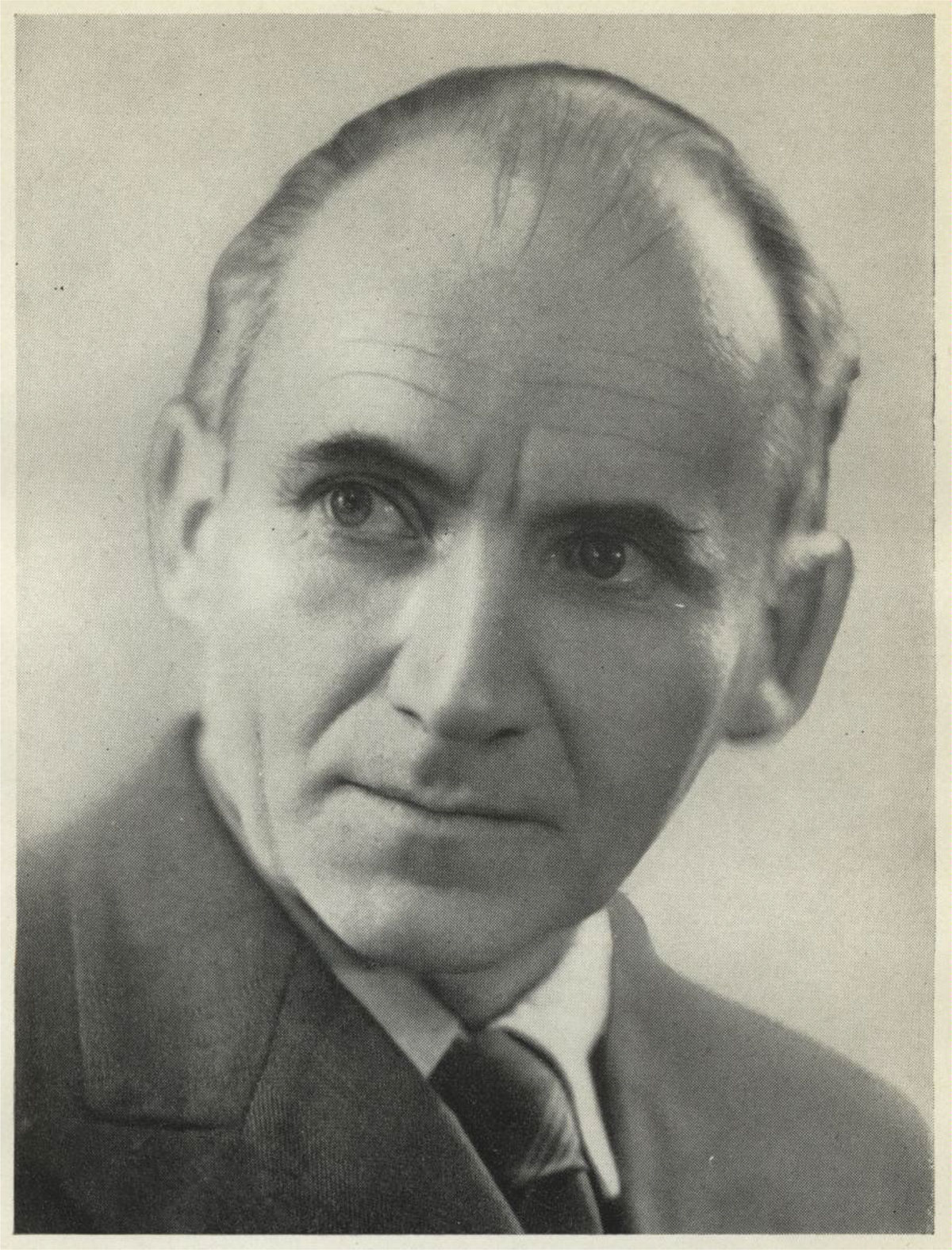
Figure 7
Dr Alfons Maria Schneider (Babinger 1953).
One of the Georgians assigned to work with Schneider, Giorgi Gozalishvili, noted that Giorgi Chubinashvili and Shalva Nutsubidze had presented an exhibition in Germany at the beginning of November 1930, and accompanied Schneider to Georgia on their return, as had been proposed by the ‘Commission for Excavations in Nokalakevi’ in July.45 Writing to Schmidt-Ott from Tbilisi on the 17 November, Schneider reported that:
After several conferences with the Ministry of Education, everything is now ready for the start of the excavation. The government sent a man to Nokalakewi at the beginning of last week to settle the questions of accommodation, food and workers on the spot. Yesterday he returned, everything is settled except for the wages. I will leave today. I have been assigned two young men from the local university, a historian and a Byzantine scholar, as assistants, and a representative of the government and of the party will also be with me. Unfortunately, I was not able to make full use of the time in Tbilisi, as I got a carbuncle on my left foot during the trip, which had to be cut open here and prevented me from walking for the first few days.46
He also noted, with some concern, that the funds for the excavation had not yet arrived, but that he would soon travel to Nokalakevi to begin work with the surveyor, and on clearing the terrain. Schneider and Gozalishvili arrived in Senaki on 24 November, where they met local authorities before moving on to Nokalakevi.47 Schneider had hoped that the first instalment of funds would arrive by Friday 21st November. However, although it did not come through until over a week later, it seems that they were able to start work on arrival in Nokalakevi on the 24th.48 Schneider wrote to Schmidt-Ott from Nokalakevi on 9 December at which point, while the money had arrived, they were still undertaking preparatory work.
Enclosed I am sending the first report on my topographical studies at the site. Apart from clearing work – the chapel at the top has already been uncovered – I have not yet begun with the excavation, as the commission at Tbilisi, which wanted to come for the opening, has not yet arrived. But I expect them in the next few days.
I have already received the first instalment of 2,000 Roubles on 29 November; please send me the rest as soon as possible.
I pay 3 roubles per day and head as wages. So, I hope to be able to achieve something with the means at my disposal. However, we can hardly expect to make any significant finds. The excavations on the Acropolis have so far yielded only a few slingshot and catapult balls, apart from shards from the 5th and 6th centuries. More will not be found up there. On the other hand, I hope to find something in the lower city.49
By coincidence on the same day, Boris Vinogradov, an official at the Embassy of the Soviet Union in Berlin, wrote to Dr H. Jonas, Secretary of the German Society for the Study of Eastern Europe, requesting that the ‘10,000 Rm for the archaeological work in the Caucasus [be] transferred to the Embassy here. The equivalent amount in Russian currency will then be made available immediately to the archaeologist Dr Schneider in Tbilisi’.50 On 23 December the Notgemeinschaft replied to Vinogradov to confirm that 6,000 Rm had been transferred to the account of the Russian Embassy, adding that
[t]his sum represents the remainder of the amount made available for the excavations in Nokalakewi, the first instalment of which has already been transferred to Dr Schneider. As Dr Schneider will need new funds in the near future, the Emergency Committee asks that Mr Eliawa be informed of the transfer as soon as possible, so that he can take all measures necessary for the successful continuation of the excavations in Nolalakewi.51
Mr Eliawa, referred to in this communication from the Notgemeinschaft, was in fact Shalva Eliava, Chairman of the Council of People’s Commissars of the Transcaucasian Socialist Federative Soviet Republic. Eliava, born near Kutaisi in west Georgia, was clearly taking a keen interest in the work at Nokalakevi because a second letter from the Notgemeinschaft, also sent on 23 December but directly to Schneider, informed him of the transfer of the 6,000 Rm, and that the
Russian Embassy has promised that the equivalent amount in Russian currency will be made available to you immediately and that Mr Eliawa has also promised help by the Georgian government to make the continuation of the excavations possible.52
Following Schneider’s receipt of the first instalment on 29 November (which appears from the correspondence to have been 4,000 Reichsmarks/ 2,000 Roubles), work was clearly well underway by the time he submitted a first report to the Notgemeinschaft on the 6 December. At this stage the topographic study appears to have been completed, and areas where he intended to excavate had been cleared of vegetation – by cutting it back ‘since burning of the bush did not prove successful’.53 Photographs taken by Gozalishvili (Figures 8,9, 10, 11) at the time demonstrate the relative sparsity of undergrowth, which may itself have been a reason for digging in winter. Schneider’s interpretation was that the city of Nokalakevi-Archaeopolis was divided into two parts, with the lower city (what he termed the polis) distinct from the military function of the acropolis, about which he writes:
In my opinion the Phylakterion mentioned by Prokop was located here, in which 3000 men were accommodated (de belle. Goth IV 13,8.). The actual Polis lay below in the plain surrounded by the Techuriknie, as well as at the slopes rising to the north of it.54
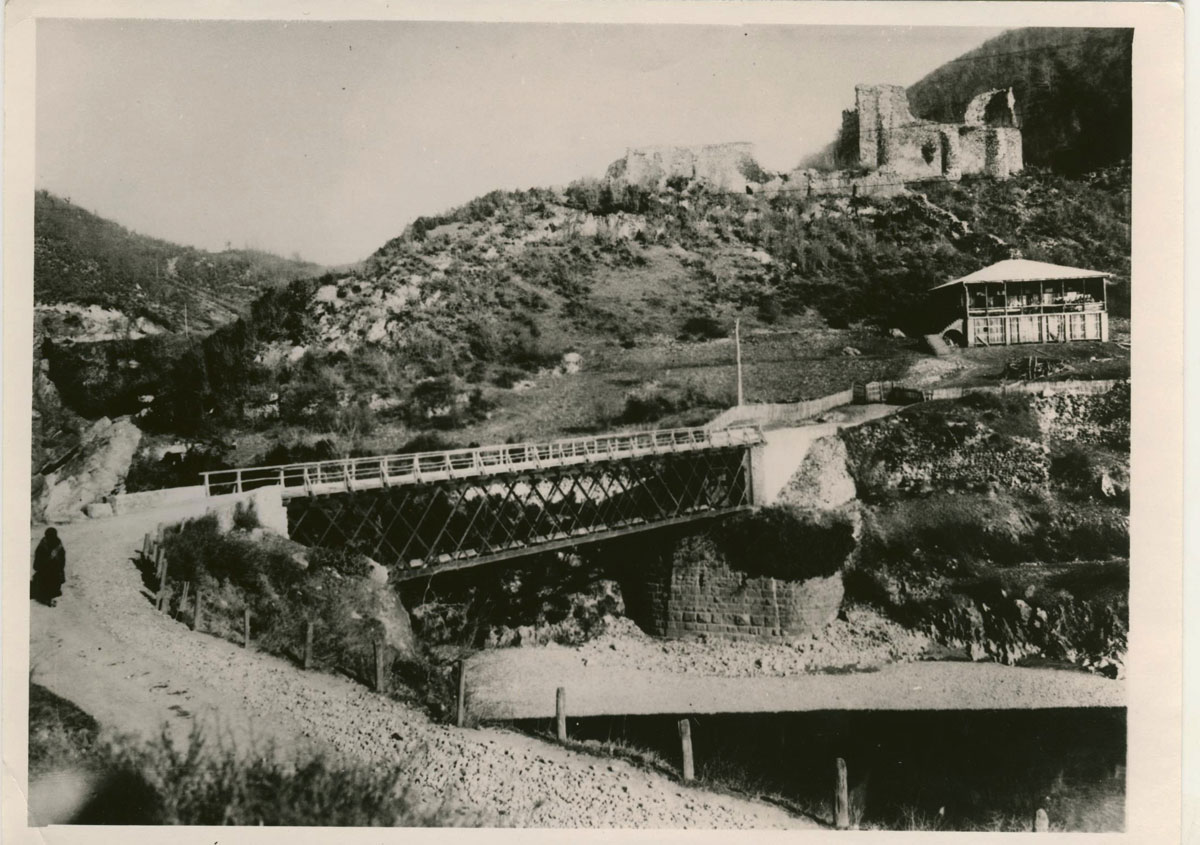
Figure 8
Looking north across the Tekhuri at the western end of the lower town, Nokalakevi, showing the road bridge, village hospital, and ruins, 1930/31. Professor Giorgi Gozalishvili Archive, S. Janashia Museum of Georgia Medieval Archaeology Collection (West Georgian Collection). © Georgian National Museum, Tbilisi.
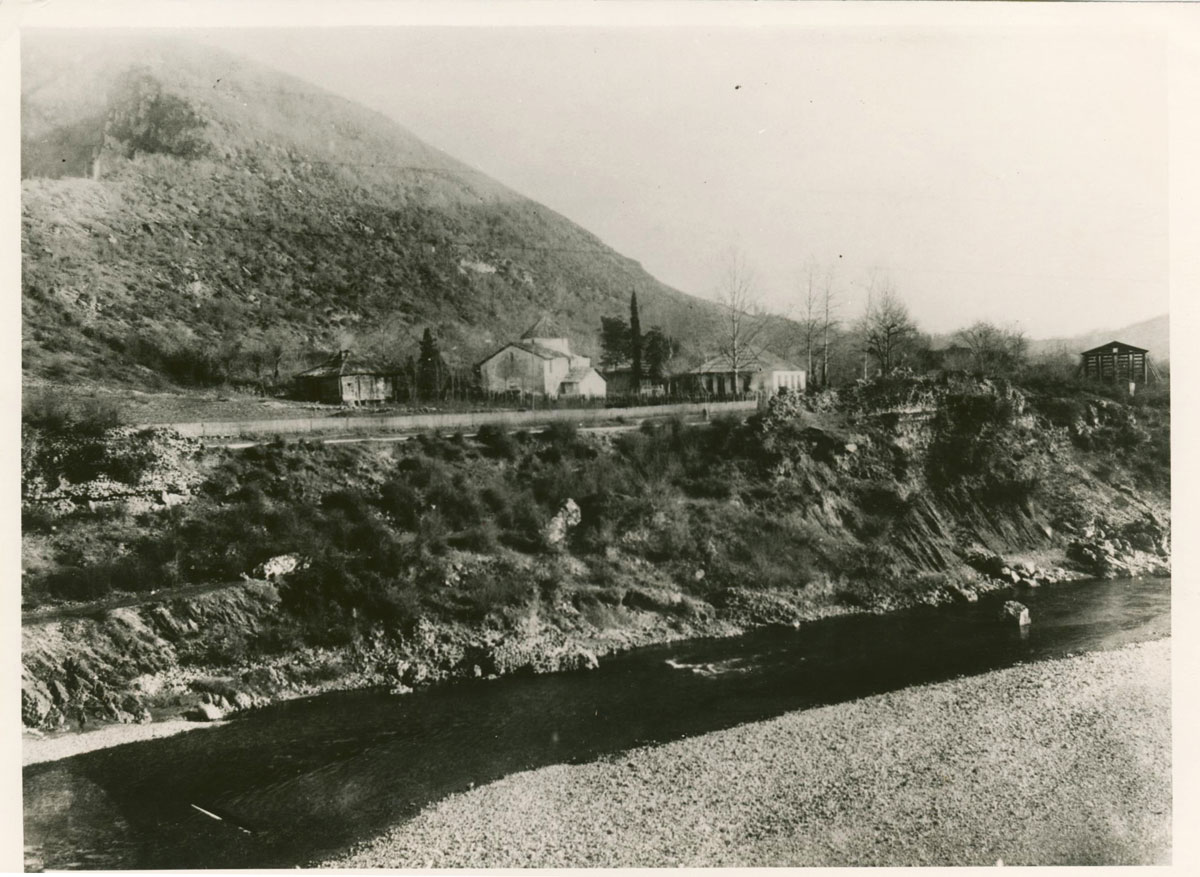
Figure 9
Looking northeast across the Tekhuri at the eastern end of the lower town, Nokalakevi, showing the Forty Martyrs’ Church and village houses 1930/31. Professor Giorgi Gozalishvili Archive, S. Janashia Museum of Georgia Medieval Archaeology Collection (West Georgian Collection). © Georgian National Museum, Tbilisi.
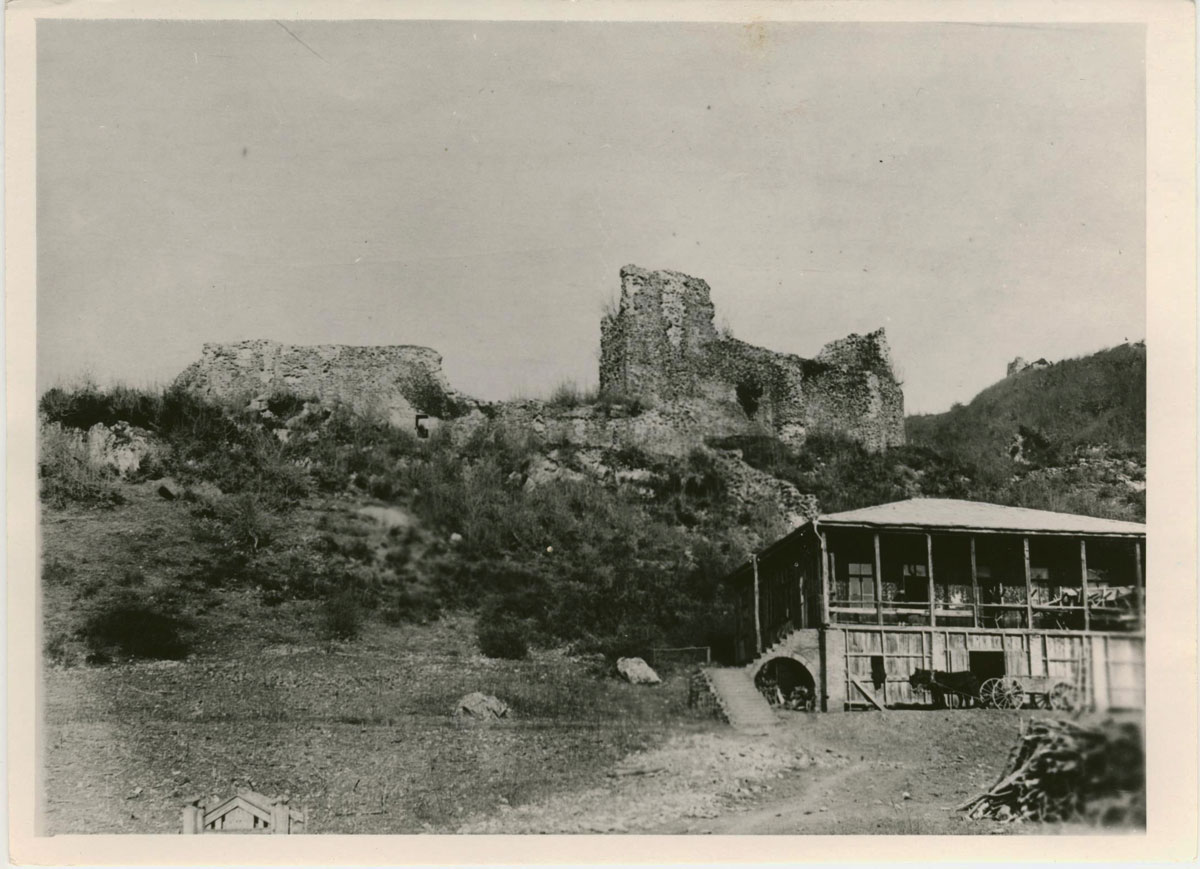
Figure 10
The village hospital – later repurposed as the first archaeological dig house in the 1970s – with standing remains behind, 1930/31. Professor Giorgi Gozalishvili Archive, S. Janashia Museum of Georgia Medieval Archaeology Collection (West Georgian Collection). © Georgian National Museum, Tbilisi.
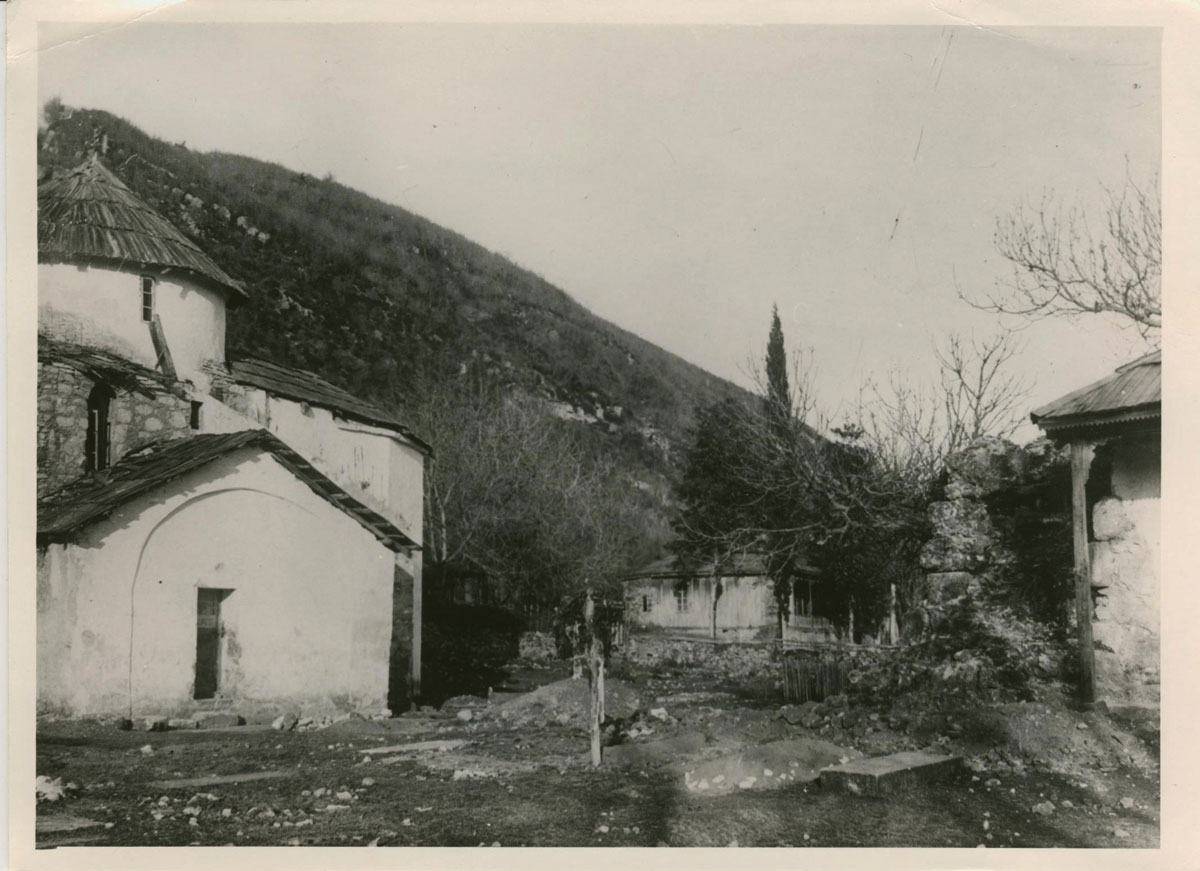
Figure 11
Looking northeast at the ridge on which the citadel is located. In the foreground the Forty Martyrs’ Church and village houses can be seen among the ruins, 1930/31. Professor Giorgi Gozalishvili Archive, S. Janashia Museum of Georgia Medieval Archaeology Collection (West Georgian Collection). © Georgian National Museum, Tbilisi.
He is also able to observe that soil and sediment deposits over the geology ‘amounts to approx. 3 m in the lower city’, which is a reasonable estimate given that the Anglo-Georgian Expedition encountered 3.5 m of archaeological deposits, but also suggests that some rudimentary investigation had already taken place.55 In terms of the walls of Nokalakevi, he identifies two phases
Wall A: this is 2.5 m thick and consists of a shell of large orthostat plates, which are filled with cast iron work.
Wall B: a hastily built work of stone blocks taken from the bed of the Techuri. It is 1,5 m thick. This wall is much narrower, the city and the acropolis are no longer a unified whole. The course of the wall shows the border of the actually inhabited city.56
Interestingly, it seems from these descriptions that Schneider had already decided, even prior to formal excavation, that Wall A – faced in large blocks – was the earlier fortification, and that on its partial destruction Wall B had been built to replace it, but without including the entire complex of ‘city and acropolis’ in this reconstruction. Subsequent investigation since 1931 has made it clear that, in actual fact, Wall B was earlier, and that Wall A represented a modification in the Justinianic period (6th century AD), and that it provided both a significantly enhanced defensive work around the more vulnerable eastern and south-eastern sections of wall, and a unification of the ‘acropolis’ and the ‘city’.57 Schneider’s commitment to this erroneous interpretation of the sequence of the fortifications was further compounded by his assertion that ‘the gate tower of the agora as well as the palace are built in the same technique as wall A’.58 While not incorrect per se, his interpretation of Wall A as the earliest work therefore also impacted on his relative dating of other structures which utilised the large limestone blocks (such as the gate tower of the so-called agora), and he does not seem to have reassessed this interpretation at any point. However, at the conclusion of his first report of the 6 December, Schneider outlined his plans for excavation which did include investigation of the walls:
I now intend to dig in the following places:
on the acropolis:
At the castle-like building on the south side, which encloses 4 large arches built of mortarless ashlar. This part is stuck in a mound of rubble about 2.5 m deep.
Uncovering the garrison chapel and its surroundings (1m of rubble).
Investigation trenches at wall A and B
in the polis
Clarification of the agora and palace boundaries
Excavation next to the early Georgian church, which may have been built in place of a temple
A larger deep excavation at suitable sites to provide information about earlier periods.59
Two and a half weeks later Schneider was again in Tbilisi, having spent Christmas Eve with a Mr Konsah. On Christmas Day he wrote to Schmidt-Ott with a further update, intending to return to Nokalakevi in the evening with seven members of the Commission for Excavations in Nokalakevi.60 Despite the ambitious targets, particularly in mid-winter, work was clearly progressing well, and the planned investigation of the acropolis area was almost complete. Schneider also reported that he had found a topographer and an architect, and was managing comfortably with the funds – having spent 1200 roubles thus far.61 A little under a month later, on 21 January 1931, Schneider wrote again – his last letter from Nokalakevi (Figure 12) – with news that the work in the polis was also completed and that ‘the Archaeopolis object is completely exhausted’.62 This letter also contains the first reference to ‘numerous search holes driven into the ground’,63 by which one can assume that he means the test pits or small exploratory trenches that are recorded in very rough sketches in his notebook (Figure 13).64 Schneider states that they had not found anything from the pre-Roman period and that remains of the 3rd century BC were ‘the earliest that could be found’.65 He also reports the discovery, in ‘Tower 6’, of 23 gold coins dating to the late 6th century rule of the Emperor Maurice Tiberius (Figure 14). Interestingly, he also observed that ‘otherwise, our excavation has been met with lively interest by the general population and many visitors, to whom I give explanations through my assistants’.66
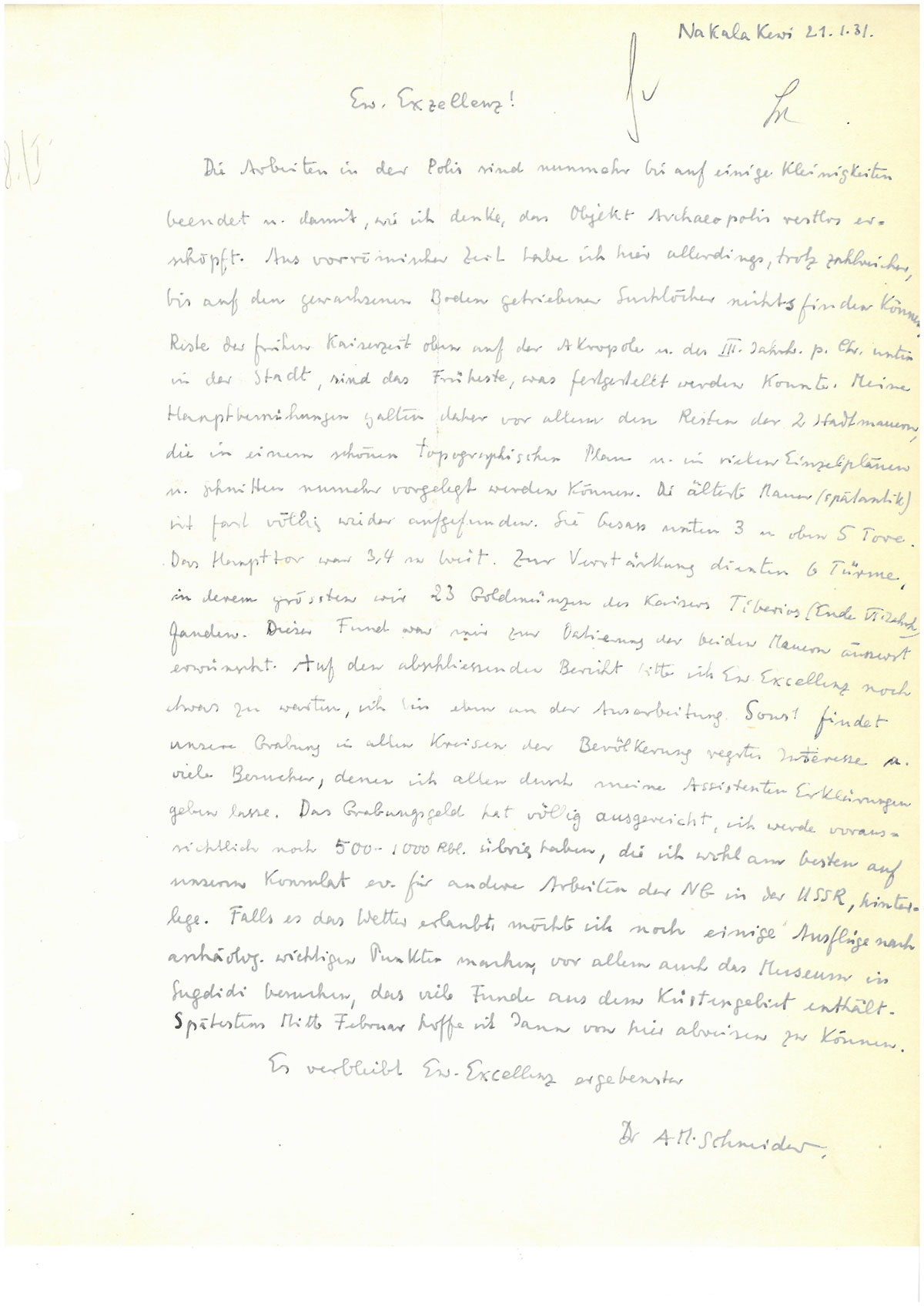
Figure 12
The final days of the collaboration: The last letter from Schneider to Schmidt-Ott, sent from Nokalakevi, January 1931, held in the Bundesarchiv (BArch, R 73/11589a).
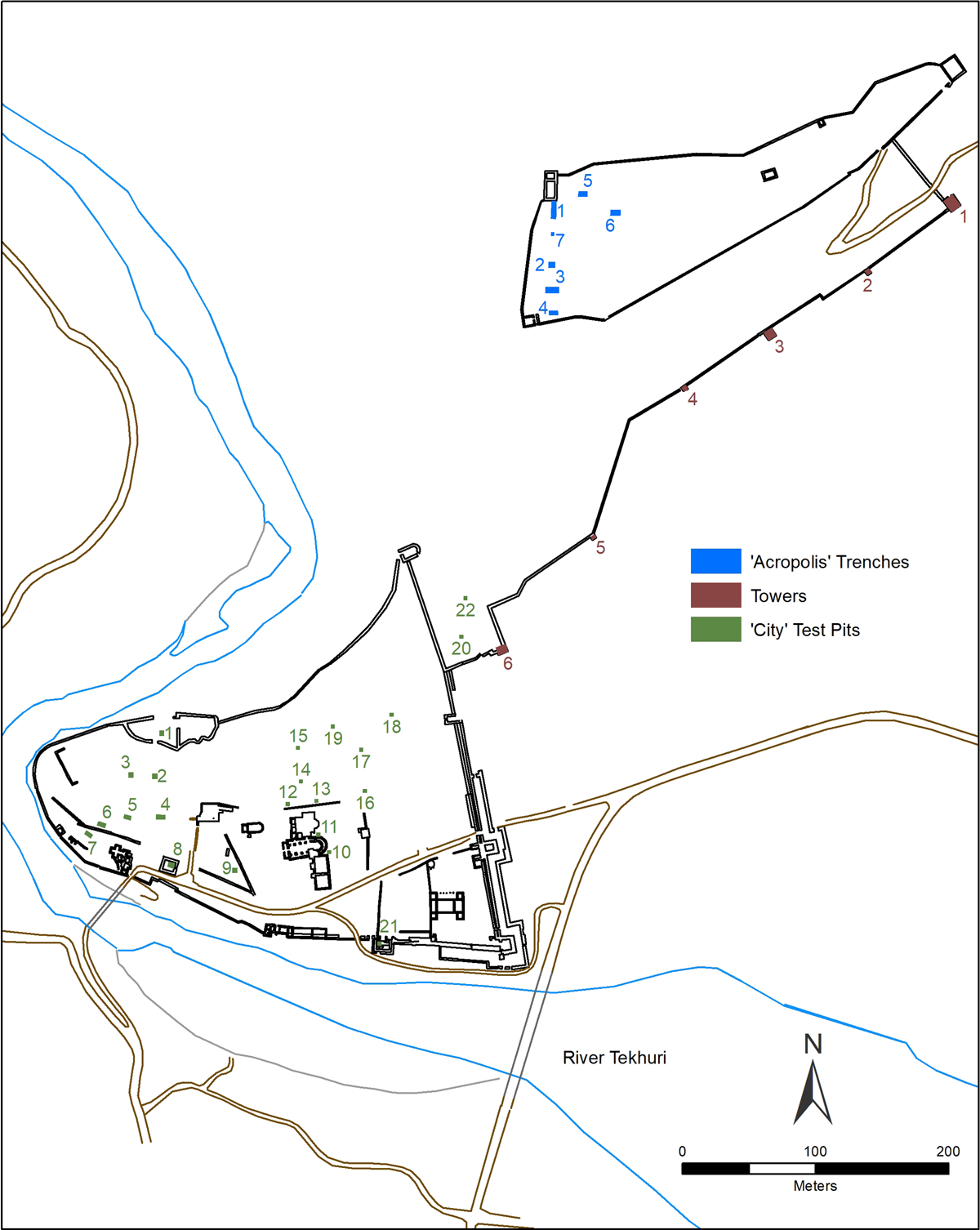
Figure 13
The approximate location of Schneider’s test pits and trenches based on the crude sketches in his notebook (DAI-IST Nachlass Alfons Maria Schneider Box IV Notizbuch Nokalakevi), and the numbering of the towers. Of the latter 1, 3, and 6 were excavated, and 2 and 4 were interpreted as contreforts (BArch, R 73/11589a).
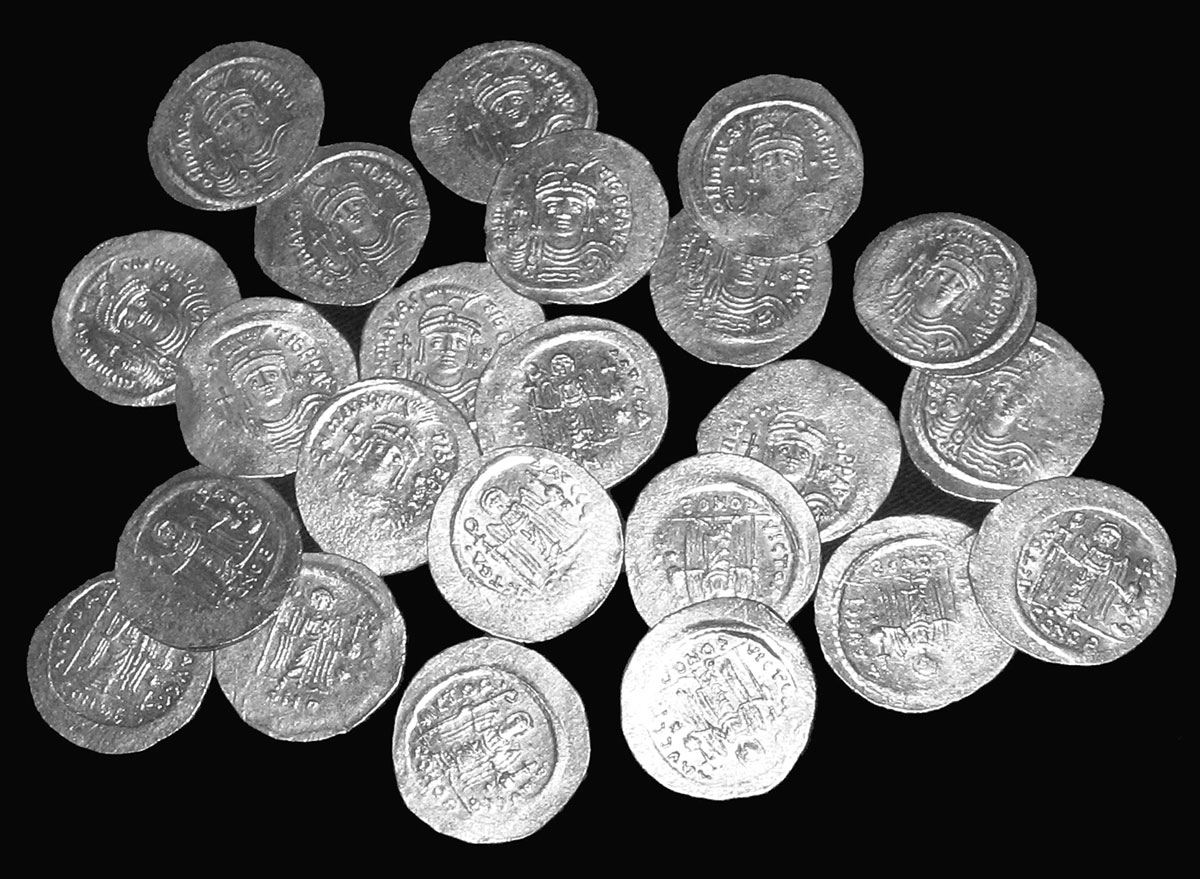
Figure 14
The 23 solidi, minted during the reign of the Emperor Maurice (582–602 AD), discovered during excavation of Tower 6, “Schneider’s Tower”, in January 1931.
Post-excavation reports
Muskhelishvili recalled that the work at Nokalakevi was concluded by 27 January 1931, following six weeks of excavation excluding days lost to winter weather, when they gave a presentation to local authorities in Senaki before leaving for Zugdidi.67 Gozalishvili also recalled, 50 years after the event, that the public lecture had been attended by about 600 to 700 people, who listened attentively.68 He describes the presentation, and the seventy questions that followed, lasting three hours. Furthermore, it is interesting to note that the questions had to be submitted in writing, though it is unclear whether this was to allow official approval of the questions, or simply to manage the huge numbers. Schneider’s final letter to Schmidt-Ott, sent from Tbilisi on the 30 January, offers some interesting personal observations of his last few days in Samegrelo:
Tbilisi, 30.1.31.
Your Excellency!
I ended my stay in Kolchis yesterday with a visit to the much-praised Sugdidi Museum. Unfortunately, the collection was packed in boxes due to renovation work and I could only get an overview by asking the director. The main part is a large collection of antique, oriental and modern coins, the rest is boring stuff, which seems to be the “decoration” of every local museum. Of the Greek-Roman antiquities which I hoped to find there, nothing could be found. Apart from that, I made excursions in the surroundings of Nokalakewi, where, according to the inhabitants, old things could still be found. In Bethlehem, 3–4 km north-east of the ruins, I found a 7th century church, as well as the remains of a late antique bath, which is still in use today. Further east, I was shown a coin of Sept. Severus, remains of a bronze brooch and a spearhead that came from a burial rock. In Dosakhe, 25 km to the north, there was supposed to be a Roman vault, which turned out to be a dripstone cave, inside of which, however, there were prehistoric shards, charcoal and bone remains. The topographical plan of Archaeopolis is ready, but several photographs by the architect are missing, which, contrary to all promises and despite repeated reminders, were sent to me only shortly before the onset of the winter rain. So, I will probably leave another 100–150 roubles so that the work can be finished in the spring. My presence is unnecessary, as the architect is well instructed, and my Georgian assistant is also well informed. The rest of the money – I can’t say how much yet, as the photographer hasn’t been paid yet, but it will be around 1000 roubles – will be deposited at the consulate at the disposal of the NG. I would like to go to Etschmiadzin for a day, and I hope to be in Berlin by the middle of February. I will probably manage with the money I have been given personally.
The day before yesterday, following an invitation from the Party Committee in Senaki (official town of Nokalakewi), I had my assistant give a lecture which was attended by about 700 workers, civil servants and schoolchildren and, as the numerous questions at the end proved, it aroused great understanding and interest. May Your Excellency forgive my poor writing, the room is badly heated, and I am a little cold.
Yours sincerely
Dr A.M Schneider69
The ‘Final Report’ that followed this, sent by Schneider from Tbilisi on the same day, actually contains less detail than his letter to Schmidt-Ott of the 21 January. One learns that there were ‘some 20 search trenches’,70 and that the gold coins had been found at a depth of 4 m, ‘under the rubble of tower 6’,71 but the rest of the report is largely confined to etymological discussion of the names Nokalakevi, Archaeopolis, and Tsikhegoji. Judging from a letter from Schneider to the Notgemeinschaft, sent on 4 Feb 1931 from Yerevan and describing his travels around Armenia, he remained in the South Caucasus before attending the final meeting of the Commission for Archaeological Excavations in Nokalakevi.72 The meeting took place on 8 February 1931, chaired by Gaioz Devdariani, who had replaced Kandelaki as People’s Commissioner for Education in the Georgian SSR. The value placed by the Georgian side on this collaboration is more than evident in the political representation on the Commission, which also included two of Devdariani’s deputies at Narkompros, the Head of the Narkompros Sector of Sciences, Professor Scharia, and the Secretary of the Georgian Section of VOKS (All-Union Society for Cultural Relations with Foreign Countries), Professor Nutsubidze. Those present in an academic capacity, in addition to Schneider, were Professors Tsereteli, Chubinashvili and Qaukhchishvili, the Director of the Museum of Georgia (Professor Kakabadze) the Deputy Director of the Caucasus Historical-Archaeological Institute (Ter-Avetisyan) and Schneider’s Assistants (Muskhelishvili and Gozalishvili).
With regard to the first item, ‘The report of the head of archaeological works Dr. SCHNEIDER about the result of trial excavations in Nokalakewi’, the Commission resolved that Schneider’s report was to be approved and that the Museum of Georgia had been been commissioned to publish a preliminary report on the excavations in the form of Special Notices.73 Regarding the second item, ‘The question of further excavations in Nokalakewi’,74 it also resolved that, since the result of the trial excavation was positive, further excavations were necessary, and that the Notgemeinschaft should answer the question of their start when they had considered Schneider’s report.
For some reason, in late March 1931 and writing from Mörsch, Baden, Schneider felt the need to provide a follow up to his final report, bringing some additional points to the attention of the Notgemeinschaft. From the perspective of the work he undertook, he claims that there were ‘more than 25 search trenches in the city area and about 15 on the acropolis’ but much of the letter has a rather negative tone.75 Schneider describes the ‘disappointment of the Georgians about the meagre finds made during the excavation’ and that this was because ‘the legendary treasures assumed here are not to be found’.76 He also claims that ‘it is not worth the cost to investigate the walls of the late period’ before commenting, sightly mysteriously, that ‘on the urgent advice of some gentlemen, I declared at the meeting of the committee on 8.II.31: the excavation is in principle finished, therefore none of the results can be changed’.77 Interestingly, Schneider also mentions that Chubinashvili had raised the possibility of a research trip to Georgian ruins on Turkish soil at the same meeting. In the second part of his letter, however, Schneider presents the Georgian contribution to the Nokalakevi project in rather unflattering terms:
II) Services of the Georgians:
Provision of about 25 shovels and picks.
Providing a young archivist as interpreter (Nov. 23–Dec. 22 and Dec. 28–Jan. 29). From Dec. 28: Providing another assistant.
The architect was present from Dec. 17–21 and Jan. 17–25, but he could not do anything for 5 of those days because of rainy weather.
The topographer was present from Dec. 27th–Jan. 9th (on leave from the Georgian Department of the University).
The photographer worked from 13–16 January, but of his 41 photographs only about 10 are usable.
These services, of course, correspond only to a small fraction of those of the N.G.78
However, Schneider seems to have been unaware that the agreement in July 1930, prior to his involvement, was that the Notgemeinschaft would provide the bulk of the financial support, while the ‘Georgian government would send a professor and assistants to the excavation, it would take care of the accommodation, pay the compensation for the purchase or lease of the site, and provide tools’.79 Schneider seems to be making a point about the balance of support, and one might suspect that much of this and the other seemingly negative observations were driven by his reluctance to undertake further work at Nokalakevi – a project which he had declared finished.
Schneider provided a review of the results of the excavation in his article in Forschungen und Fortschritte later in 1931, including the results of the topographic survey (Figure 15), though much of his short text was introducing the site to scholars unfamiliar with it. He stated that there was ‘no evidence available at all that the place was already inhabited in pre-Roman times’.80 Access to his notebooks and field sketches now allow this statement to be revisited, with clear indication from illustrations that material culture now associated with the pre-Roman, 4th to 1st centuries BC, was in fact retrieved, but was misinterpreted.81 Modern methods and techniques have gone even further, of course, and Optically Stimulated Luminescence dating of ceramic has, in recent years, provided absolute dates for Iron Age zoomorphic figurines (8th/7th centuries BC), and even fragmentary evidence of activity in the Early Bronze Age.82
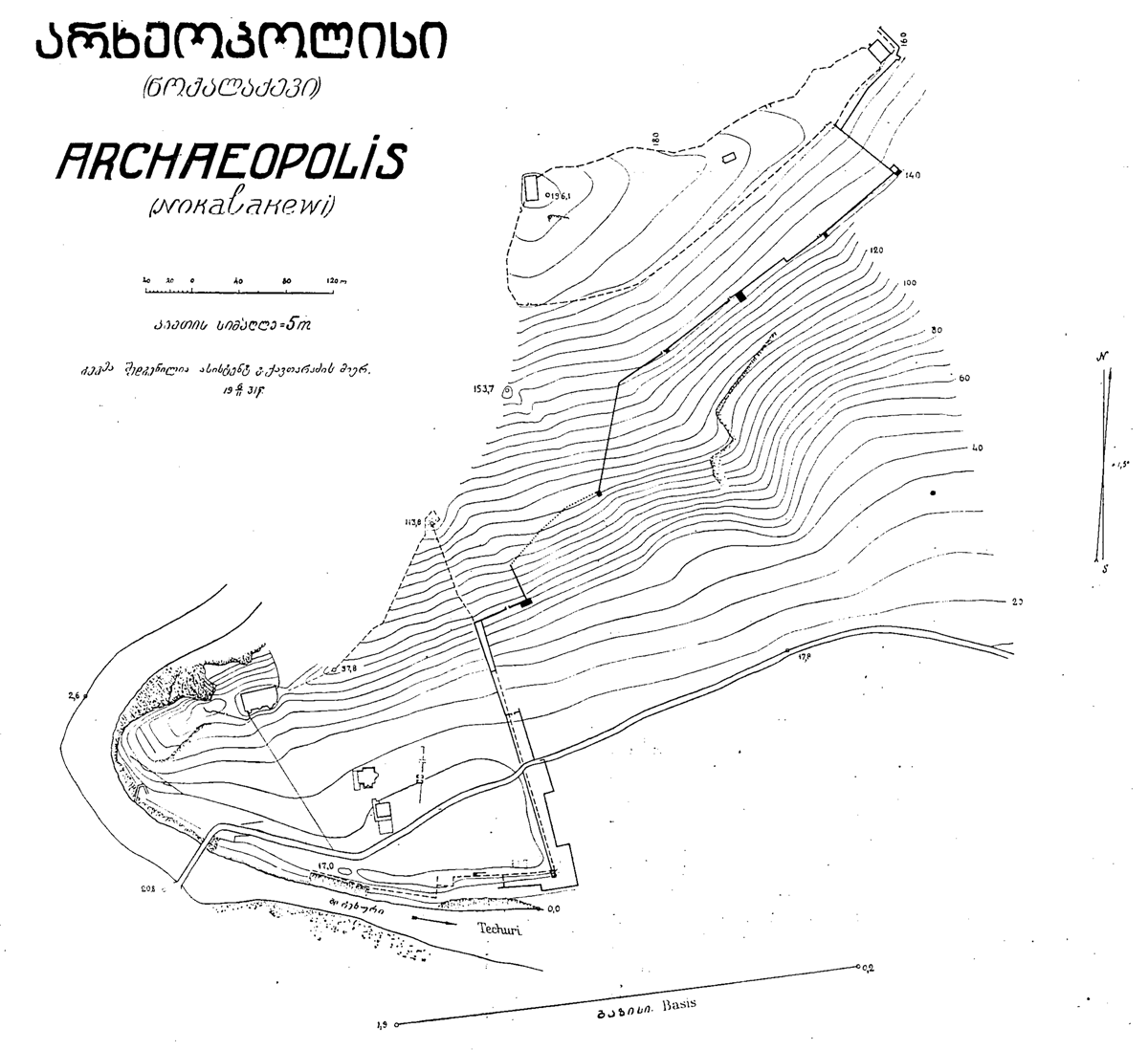
Figure 15
The first published survey of Nokalakevi (Schneider 1931), produced by the Georgian topographer working with Schneider.
Schneider’s other significant conclusion was, as has already been discussed, regarding the sequence of fortifications. He regarded the first wall – Wall A in his notebooks – to be the wider and more sophisticated defensive work, which
survived until the end of the 6th or beginning of the 7th century; then it was for the most part destroyed, apparently by an earthquake. Soon after, the enclosing wall was reconstructed to a limited extent, with the result that the city and the acropolis were thereafter separated from one another and were fortified fully independently by their own walls’.83
In actual fact the sequence is now better understood, after many years’ study, as the reverse – with the separate and less sophisticated fortifications (‘Wall B’) of the 4th and 5th centuries being unified and significantly improved by the technically superior ‘Wall A’ in the mid-6th century.84
Conclusion
It is not the intention of this paper to criticise the individuals involved, or the quality of work undertaken, in this pioneering excavation at Nokalakevi nearly 100 years ago. As archaeologists we are aware that theoretical and methodological frameworks are constantly evolving, alongside significant technological advances, and that which once seemed pioneering will very quickly become outdated. If criticisms can be made, they are probably more fairly aimed at the project design and the failure to follow up. The total fortified area at Nokalakevi, approximately 18–19ha, is still producing new insights and surprises even after 50 years of large-scale excavation that began with the well-resourced S. Janashia Museum expedition in 1973. To expect a two-month investigation to answer all of Nokalakevi’s questions would be naïve, and there are clear indications throughout the correspondence that this was only ever considered by all sides to be a trial excavation. However, the Georgian expectation, frequently expressed, seems to have been that this was simply the start of an ongoing project, while the Notgemeinschaft offered no firm commitment beyond the trial investigation. Schneider’s insistence that he had finished the excavation and arrived at conclusions that did not warrant any further investigation seems strange indeed after only about 30 test pits and survey. Indeed, his decision to send a further update to the Notgemeinschaft in March 1931 – and the critical tone of it – seems designed to discourage the funding of further collaborative work at Nokalakevi. One can only speculate at the reasons behind this, particularly as much of his correspondence during the work at Nokalakevi had been fairly positive. It is possible that he simply wanted to return to his work in Palestine, and by the following year Schneider was indeed working with Dr Mader at the basilica of Et-Tabgha, the traditional site of the miracle of the loaves and fishes.85 Though it was perhaps a brief diversion in Schneider’s career, his contribution to our understanding of Nokalakevi will always be that of a pioneer.
Notes
[1] Frédéric Dubois de Montpéreux, Voyage autour du Caucase, chez les Tcherkesses et les Abkhases, en Colchide, en Géorgie, en Arménie et en Crimée. Volume III (Paris: Librairie de Gide, 1839).
[2] Justinian, Novel 28, Praef.; Procopius, Wars II.29.18, VIII.13, VIII.14, VIII.17.17; Agathias, Histories, II, 19; II, 22, 3; III, 5, 9; III, 6, 12, III, 7, 11; III, 17, 5; III, 18, 10; IV, 9, 6; Theophanes, Chronographia, am 6209 [AD 716/17]. David Miller and Peter Sarris (trans.). The novels of Justinian: a complete annotated English translation (2 vol). (Cambridge: Cambridge University Press, 2018).
[3] Juansheri, “tskhovreba vakhtang gorgaslisa,” kartlis tskhovreba I, redaktori simon qaukhchishvili. 139–244. Tbilisi: metsniereba, 1955 (Juansher. “Life of Vakhtang Gorgasali,” in Life of Kartli (Kartlis cxovreba) I, ed. Simon Qaukhchishvili (Tbilisi: Metsniereba, 1955), 235.
[4] Paul Everill,.“Travellers’ Tales of Mingrelia and the Ancient Fortress of Nokalakevi,” Ancient West and East 18 (2019).
[5] Paul Everill, Nikoloz Antidze, Davit Lomitashvili and Nikoloz Murgulia, “Bringing Methodology to the Fore: The Anglo-Georgian Expedition to Nokalakevi,” Ancient West and East 17 (2018).
[6] Davit Lomitashvili, Besik Lortkpanidze, Tamila Kapanadze and Meri Zamtaradze, “Previous Archaeological Work at Nokalakevi, 1973–1998,” In Nokalakevi Tsikhegoji Archaeopolis: Archaeological Excavations 2001–10. BAR International Series 2612, ed. Paul Everill (Oxford: Archaeopress, 2014).
[7] Paul Everill ed., Nokalakevi Tsikhegoji Archaeopolis: Archaeological Excavations 2001–10. BAR International Series 2612 (Oxford: Archaeopress, 2014).
[9] Alfons Maria Schneider, “Archaeopolis (Nokalakewi),” Forschungen und Fortschritte 27 (1931).
[10] Simon Qaukhchishvili, lektsiebi bizantiis istoriidan. ts’igni 2. Metsniereba, 1948. (Simon Qaukhchishvili, Lessons from the History of Byzantium. Volume 2. (Tbilisi: Metsniereba, 1948).
[11] Giorgi Gozalishvili, “ramdenime sitqva nokalakevshi arkeologiuri gatkhrebis dats’qebaze,” nokalakevi-arkeopolisi I. arkeologiuri gatkhrebi 1973–1977, red. parmen zakaraia, 243–248. Tbilisi: metsniereba, 1981 (Giorgi Gozalishvili, “Several Words about the Beginning of Archaeological Excavation in Nokalakev,.” In Nokalakevi-Archaeopolis I. Archaeological excavations 1973–1977, ed. Parman Zakaraia (Tbilisi: Metsniereba, 1981).
[12] Levan Muskhelishvili, “nokalakevis dghiuri 1930. XII. 28–1931. I. 28,” nokalakevi-arkeopolisi II. arkeologiuri gatkhrebi 1978–1982, red. parmen zakaraia, 289–305. Tbilisi: metsniereba, 1987 (Levan Muskhelishvili, “The Journal and Results of the Excavations 1930–1931,” In Nokalakevi-Archaeopolis II. Archaeological excavations 1978–1982, ed. Parman Zakaraia (Tbilisi: Metsniereba, 1987).
[14] A third collection, at Scheyern Abbey, Oberbayern, appears to duplicate material held elsewhere.
[15] Susan Solomon. “The Soviet-German Syphilis Expedition to Buryat Mongolia, 1928: Scientific Research on National Minorities,” Slavic Review 52, no. 2 (1993): 207.
[17] Sheila Fitzpatrick, The Commissariat of Enlightenment: Soviet Organization of Education and the Arts under Luncharsky, October 1917–1921 (Cambridge: Cambridge University Press, 2002).
[19] Deutsche Forschungsgemeinschaft. 2020. “Friedrich Schmidt-Ott: President of the Notgemeinschaft der Deutschen Wissenschaft from 1920 to 1934”. Accessed October 2022. https://www.dfg.de/en/dfg_profile/history/presidents/friedrich_schmidt_ott/index.html.
[20] Suzanne Marchand, Down from Olympus: Archaeology and Philhellenism in Germany, 1750–1970 (Princeton: Princeton University Press, 2020).
[23] Jennifer Brewin, “Navigating ‘National Form’ and ‘Socialist Content’ in the Great Leader’s Homeland: Georgian Painting and National Politics under Stalin, 1921–39” (PhD diss., University of Cambridge, 2018): 68–69.
[24] Geoffrey Roberts, “A Soviet Bid for Co-Existence with Nazi Germany 1935–1937: The Kandelaki Affair,” The International History Review 16, no. 3 (1994).
[32] Claus Arnold, “Christian Antiquity and Roman Catholic German Science. The Freiburg Church Historian and Archaeologist Joseph Sauer (1872–1949)”. Paper presented at the Thirteenth International Conference on Patristic Studies, Oxford, August 16–21 1999.
[36] Semavi Eyice, “Prof. Dr. Alfons Maria Schneider (1896–1952),” Belleten 16, no. 64 (1952).
[42] Franz Babinger, “Alfons Maria Schneider (1896–1952),” Zeitschrift der Deutschen Morgenländischen Gesellschaft 103, no. 1 (1953).
[57] Parmen Zakaraia, “nokalakevis gamagrebis Sistema.” nokalakevi-arkeopolisi II. arkeologiuri gatkhrebi 1978–1982, red. parmen zakaraia, 136–189. Tbilisi: metsniereba, 1987 (Parmen Zakaraia, “The Fortification System of Nokalakevi,”. In Nokalakevi-Archaeopolis II. Archaeological excavations 1978–1982, ed. Parman Zakaraia (Tbilisi: Metsniereba, 1987).
[65] BArch, R 73/11589a. In the Southern Caucasus the 3rd century BC actually predates the arrival of the Romans by at least 140 years, so one might assume that Schneider was applying the term in its broadest sense.
[82] Paul Everill, Nikoloz Murgulia, Davit Lomitashvili, Ian Colvin, Besik Lortkipanidze, Jean-Luc Schwenninger and Gordon Cook, “The Recent Contribution of Scientific Techniques to the Study of Nokalakevi in Samegrelo, Georgia,” Anatolian Studies 71 (2021).
[85] Mader, Andreas Evaristus, and Schneider, Alfons Maria. “‘Ein Ha-Shiv’ah: Et-Tabgha: The Miracle of the Multiplication of Loaves and Fishes (in: Excavations in Palestine in 1931–32: 184–194).” Quarterly of the Department of Antiquities in Palestine 2 (1933).
Acknowledgements
The authors wish to gratefully acknowledge the invaluable assistance provided by numerous colleagues at both the Deutsches Archäologisches Institut, Istanbul, and Das Bundesarchiv, during Sean Doherty’s archival research. The authors are also grateful to the University of Winchester for providing the financial support which enabled translation of the German archive material.
Funding Information
Funding was internal from the University of WInchester, so not a grant in the normal sense.
Competing Interests
The authors have no competing interests to declare.