
Introduction
‘The work required here is such that it can be done by a lady.’
Letter from Emil Krüger, Director of the Rheinisches Landesmuseum Trier to the Governor of the Rhine Province dated June 21 1906 concerning the employment of archaeology graduate Elvira Fölzer at the museum.1
While German archaeology is often associated with field archaeology, shovelling and certain male excavators, the comprehensive process of archaeological knowledge production is actually based on shared labour, with many people contributing in different ways. It is this process and the mix of tasks and tools of archaeological labour that this paper is concerned with. Practices and tools are diverse, and so are the places and circumstances where these are put into practice. They are structured according to gender, class, race and ancestry, to name some of the relevant categories. Men, in general, are much more present in the public perception of archaeology than women, though many men have been left out of the historiographies of archaeology depending on their origins, or professional and social status.2
Our argument is simple and it falls both in the inclusive scientific tradition of Herstory in science3 and in ongoing female empowerment initiatives.4 Based on our analysis of original sources and research literature we argue that while women were always present in modern German archaeology, they tended to do the less visible work. This is, we think, why many women were not accounted for in traditional histories of archaeology. There were, however, exceptions. Some women held prominent positions as lead excavators and museum directors or professors early on. These women’s memoria was more likely to be cared for by their students, employees and colleagues than the memory of women in auxiliary or less visible positions. This is reflected in the fact that some of these pioneering women have already been included in the academic and popular literature.5
With the intention of overriding the Matilda Effect in science,6 we aim to bring to light many forgotten women who contributed to the formation of the discipline in Germany. We bring out the collectors, communicators and amateur archaeologists, curators and librarians, administrative or technical staff who contributed greatly to the generation of knowledge but are hardly considered in the historiography. Many of the so-called little tools of knowledge7 such as catalogues, forms, reports and the like regularly were in or went through the hands of women. Since the traditional historiography of archaeology was interested in researching discoveries, these seemingly mundane tools were not given much thought. These practices, tasks and tools were not valued as vital parts of knowledge production. At least in part, this explains why the men and women involved were largely overlooked. We aim to point out how certain tasks and practices were allotted according to the category of gender, and add, when we can, an intersectional perspective on other structuring categories.
It wasn’t just gender that affected whether someone received historiographic recognition. Rather than investigating the relevance of gender per se, which would have to include the analysis of gender relations in archaeology, we concentrate on making women visible in and through their work. A further limitation is that the historical-biographical empirical evidence does not yet allow us to make generalizing statements about the lives and careers of German female archaeologists. On the contrary, we present a collection of highly individual cases, some of which share common traits. The few women working in German archaeology up to the 1970s differ greatly in terms of their origins, education, jobs and careers. It is too early to attempt to write their collective biography.
Methods
This paper is based on a cross-disciplinary research project in the gendered history of archaeology in Germany.8 The funding body, the Federal Ministry of Science and Education, wishes to make women and their achievements in the fields of science and economy more visible. We thus apply the methods of historiography to provide biographies of women from the late eighteenth to the twentieth centuries and to offer insights into the processes of archaeological knowledge production.9 The attempt to make women visible is traditional, yet it is legitimate since women and their achievements are still underrepresented in the historiography of science.10 Internationally, there are several projects that apply a similar approach11 and feminist archaeology and gender studies have produced various publications on women’s biographies in the last decade.12 There is not much research yet on archaeologists in Germany, and it is usually not available in English.13 We aim to make our findings accessible for an English-speaking audience14 while we assemble a larger number of biographies to prepare a collective biography of women in German archaeology. To achieve this, we studied printed material and photos as well as documents from archives and private collections, including duty diaries and correspondence, drawings, personnel data files, catalogues, and many more.
It is challenging to trace the actual practices of gendered work since detailed accounts and first-person documents such as personal duty journals are rare. Photos are of limited informative value in this context. Cameras were increasingly taken on German excavations and excursions from the 1920s onwards, however the other steps of archaeological work in the laboratory, in the workshop or at the desk, on the other hand, were rarely recorded photographically. Photographs therefore give the false impression that archaeological work was primarily about excavations. In turn, women were long underrepresented in archaeology, which is why hardly any women appear in the majority of older photo collections.
This scarcity also means that encountering women in photographs entails a risk of overgeneralizing. For example, the Institut für Ur- und Frühgeschichte at the University of Jena houses a collection of photos from the 1930s and early 1940s featuring several women in action (Figure 1). They seem to give authentic evidence of excavation techniques, shared work and seemingly relaxed gender relations. But ultimately, these snapshots don’t tell us very much about the actual conditions and power relations on the dig and at the institute. Their informative value is limited. Such photo collections raise a fiction of authenticity that is sometimes difficult to penetrate. What is to be seen and how it is to be seen always depends on the photographer’s intentions.
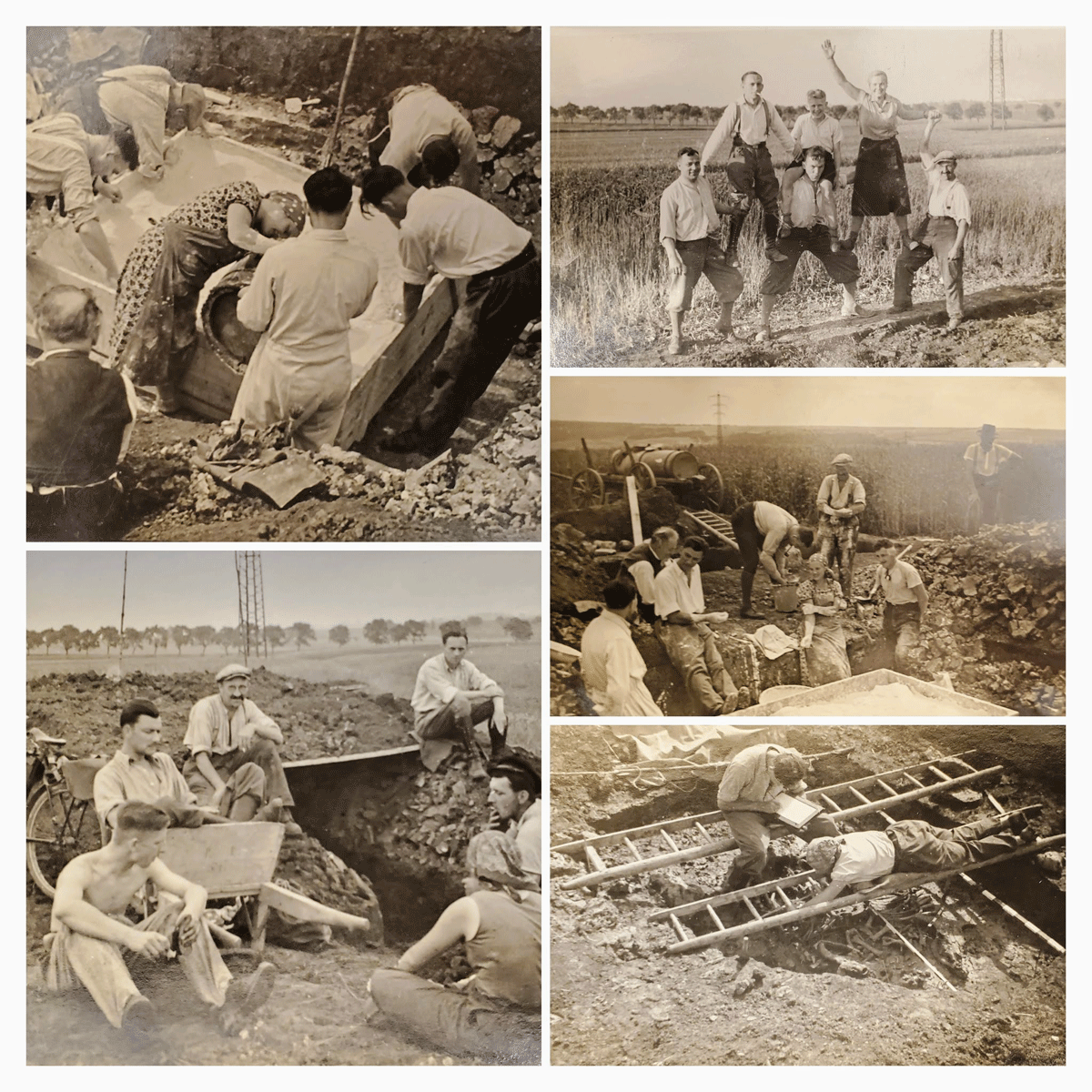
Figure 1
Excavation pictures from the University of Jena 1930s to 1940.
Reproduced with permission of Universität Jena, Institut für Ur- und Frühgeschichte Sammlung, Sammlungsschriftgut Grabungsfotos P-S, Stobra, Lkr. Weimar, auf dem Hügel. 1935/36; photos: unknown.
In the following, we will take a look at the nineteenth century and show how the shift from amateur Altertumsforschung (antiquity research) to professional academic archaeology resulted in the exclusion of women. We then move on to the turn of the twentieth century and see the first few women seize the new opportunities of studying for an academic degree, and take up careers in research and teaching. As we pursue a broad concept of archaeological work, we then turn to women working in administration, documentation and collection services or libraries and point to their specific contributions to the formation of the discipline. With regard to academic publishing, we also look specifically at subordinate activities and support services such as proofreading, typing and image editing. All too often, historical studies on female archaeologists only mention the very few who achieved major academic careers, leadership positions or professorships. This narrowness repeats a stereotypical, exclusionary and masculinist concept of what is a relevant contribution to the discipline, and what is not. We therefore take a broader view when we look at museum work and science communication in the next section. The paper closes with women’s appearances in field-work and a conclusion.
Unearthing the Past Together: Tasks, Tools, and Talents in Collaborative Archaeological Endeavours
The Price of Professionalization: Women’s Exclusion in the Shift from Amateur to Academic Archaeology and their Return
Early to mid-nineteenth century German prehistoric archaeology was shaped by citizen science. Germany saw the rise of prehistoric archaeology as a new field of interest and research. Local finds and sites were explored, and private collections and clubs were founded. Political nationalism fuelled this interest in regional and national prehistory.15 Over time, however, professionalization meant marginalization. This affected both men and women. The emerging non-academic jobs in archaeological research and outreach were at first open only to men. New job hierarchies and a lower-level employment sector emerged in the discipline and sometimes this opened up opportunities for women.
One of the first tasks that women had taken on in the emerging discipline was to give it a platform. For instance, we would like to highlight Sybille Mertens-Schaaffhausen (1797–1857), an expert on ancient gems, as an organizer of enlightenment scholarship. In her intellectual salon she gathered eminent professors, independent scholars and artists from all over Europe for the combined purpose of entertainment and scholarly conversation, creating networks in antiquity scholarship.16
The emerging antiquities societies and clubs held various options for women to participate and leave their mark. In these associations, women were no longer hostesses, but members under male leadership. Some funded these clubs with personal assets or donated items to build collections and libraries. Amateurs, both male and female, drove the expansion of prehistoric archaeology by organizing the process of knowledge production in their scientific societies. Most of them were engaged in several related fields: archaeology, anthropology and ethnology, and even linguistics.
These amateur enthusiasts of both genders facilitated the growth of prehistoric archaeology through structured knowledge production in scientific societies. The effort was mainly grounded in the educated middle class and its Protestant traditions. In Berlin, for example, the Berliner Gesellschaft für Anthropologie, Ethnologie und Urgeschichte (BGAEU),17 founded by Rudolf Virchow (1821–1902) turned into the vocational home of a number of female private scholars such as Elisabeth Lemke (1849–1925), who lectured and published broadly in ethnology and archaeology, and for Julie Schlemm (1850–1944). The latter was a self-taught expert on typology and benefactor and sat on several advisory boards and commissions.18
Meanwhile, a process of specialization and professionalization was underway. Archaeology was turned into an academic discipline with boundaries and separated branches.19 The field was professionalized with chairs and university institutes, and for many men archaeology became a profession. Access to the emerging academic job market in archaeology was largely limited to men with university degrees. As a side note, there is some evidence of wealthy women financing the studies and research of men.20
In the late nineteenth century, private grammar schools had emerged to facilitate women’s preparation for the Abitur examination as external candidates, marking a stride in female emancipation. While this qualified women to attend university lectures as guests, graduation was prohibited. Women were excluded from regular university enrolment until between 1900 and 1909.21 Elvira Fölzer (1868–1937) made history as the first woman to earn a doctorate in archaeology at Bonn in 1906. Coming from a prosperous merchant family, she invested her wealth in education and later secured a position as a temporary research assistant at the Provinzialmuseum in Trier, specializing in Roman ceramics, notably terra sigillata.22
Post-WWI, although they were now formally permitted to pursue their degree, women were anything but equal. They depended on the goodwill of male professors many of whom discriminated openly against women. Female students who had no financial support from their families also faced massive economic insecurities when studying, particularly since they also had to question whether they would ever find employment. Consequently, few chose archaeology as a major. Since teaching at schools was considered a socially acceptable career for (unmarried) women, some obtained teaching qualifications instead. Some women only discovered archaeology during their studies. In Berlin, a teacher training seminar by Albert Kiekebusch introduced many female teachers to prehistoric archaeology, offering semi-academic training and practical experience, including excavation and science communication.23 Several women from this seminar engaged in voluntary conservation work, with a few, like Gertrud Dorka (1893–1976), eventually making a career in archaeology.24 After numerous twists of fate Dorka became the director of the Museum für Vor- und Frühgeschichte in Berlin in 1947.
Forging the Paths for Others: Research and Teaching at Universities
Professionalization trends hindered women’s involvement in university-based archaeology, with the degree of participation influenced by shifts in national politics. In the 1920s, few women pursued university careers, and opportunities for female research assistants were scarce. Until 1920, women were prohibited from Habilitation, Germany’s prerequisite for teaching and securing a professorship, typically involving advanced research and a public lecture critically evaluated by a research committee.25
Margarete Bieber (1879–1978), a pioneering classical archaeologist, was the first woman to advance to professorship. In 1923, she became the director of the Gießen University Institute of Classical Studies. Her career faced an abrupt halt under Nazi rule due to her Jewish heritage and perceived political unreliability, leading to a ban on teaching. Bieber emigrated to London in 1934 and later to New York, where she remarkably resumed her career and supported other emigrant female archaeologists.26
Meanwhile, in Germany, women specialising in prehistoric archaeology found better opportunities to study and find jobs. This may sound contradictory considering the National-Socialist anti-feminist and pronatalist policies, which were mostly conservative bourgeois ideologies embellished with racist ideology. However, German prehistoric archaeology, historically inclined toward nationalism, saw heightened support from the National Socialist movement. After 1933, increased funding and professorships were allocated, creating roles in heritage management and education to promote public interest in prehistory for propagandistic purposes, preparing the justification for warfare.27 This period witnessed a dual dynamic: the exclusion of women from universities and the workforce, while some academically ambitious women received recognition in ‘Germanic prehistory.’ Many aligned their research agendas with Nazi ideology for employment opportunities.28 During WWII, women with academic degrees assumed significant roles in universities and conservation, some pursuing Habilitation. However, post-war, they were often replaced or relegated to lower positions, as male colleagues returned from military service.
In the Federal Republic of Germany (FRG), it took over two decades for the first women to be appointed to department chairship. Gisela Freund (1920–2023), who completed her Habilitation in prehistorical archaeology in 1949, became a full professor at Erlangen in 1969.29 Erika Simon (1927–2019), a classical archaeologist, achieved the same in 1963.30 In the German Democratic Republic (GDR), Edith Hoffmann (*1929) received a chair in Ur- und Frühgeschichte at Leipzig in 1979. Her career was exceptional because despite the socialist constitution’s commitment to gender equality and the expectation for women to work, career patterns in the GDR remained gender-specific.31 Gendered inequality in education began with university admission, featuring numerous access restrictions influenced by central planning, such as admission criteria which included parents’ social status and the political commitment of the applicant.32
Men enhanced their prospects of studying through extended military service, resulting in only a quarter of archaeology graduates being female, despite women comprised 50% to 80% of applicants to these programmes.33 Despite centralized job allocation, female graduates faced challenges in securing suitable positions or opportunities for doctoral studies. Many struggled to balance caregiving responsibilities and jobs in spite of reasonable childcare facilities. Consequently, few women attained leadership roles in the GDR. Although there were political pledges in the GDR for women’s professionalization, career limitations persisted. In the FRG the professional activity of women was generally discouraged in many ways until the 1970s.
Behind the Scenes: How Administration, Documentation, Collections, and Libraries Shaped a Scientific Discipline
From the beginning of the twentieth century onwards, women slowly entered the realm of administration, collection management, and research organization, employing various documentation techniques such as labels, catalogues, reports, and files. Documentation is pivotal in both knowledge management and scientific organization, influencing authority and objectivity claims. Documentation regimes structure how people work, speak and think about things. So, those involved in working with such materials significantly contribute to science institutionally and in knowledge production.
Early traces of women in documentation and administration are evident, particularly in collections and museums. The Westpreußisches Provinzial-Museum in Danzig, for instance, employed male and female volunteers before the 1890s, and in 1898, the first two women were hired for cataloguing and labelling.34 Employing women to label, inventory, and prepare objects for storage under male supervision was normalized shortly thereafter. As office occupations expanded, women were increasingly hired as technical assistants, clerks, and typists. Certain roles became coded as women’s jobs, rarely held by men thereafter.35
Dorothea Keiling (1884–1959), daughter of the in-house restorer at the Museum für Vorgeschichte in Halle, began as an auxiliary in 1914, later becoming a collections keeper.36 In the 1930s and early 1940s, some women with university degrees found initial employment in administration, collection management, and documentation, too. Classical archaeologist Hermine Speier (1898–1989) established the first photographic archive for the German Archaeological Institute in Rome in 1928. Dismissed in 1934 for anti-Semitic reasons, she became the first woman in a qualified position at the Vatican Museums.37 In Germany, graduates Beatrice Vermehren-Goering (1901–1977), Dorothea Haupt (1914–2000) and Gerda Bruns (1905–1970) took short-term roles in administration and collection management.38 Charlotte Busch-Geertsema (1897–?), a secretary for the German Archaeological Institute in 1940, listed her activities as follows: ‘Taking care of the administrative registry and duty diary. Dictations and fair copies, also in French, partly independently after consultation.’ After WWII she reconstructed the registry and assisted in accounting.39
A parallel transformation occurred in roles related to visualizing archaeological finds and findings (Funde und Befunde). Drawing served as the central authentication technique in archaeology, functioning both as an instrument and a means of understanding, especially in the context of excavation’s destructive nature. Drawing involves transferring an object or situation to a representational medium, encompassing structuring and interpretation.40 Over time, drawing methods in archaeology became standardized. Since drawing was regarded as an activity suitable to women from the upper and middle classes, many received training. Traces of women borrowing artifacts for drawing classes in Danzig date back to the 1880s.41 Their proficiency in drawing granted some women early access to actively participate in excavations.42
Visualization, including drawings, photographs, and maps, plays a vital role in knowledge transmission, making archaeological finds and interpretations mobile. Women often took on tasks such as copying, transferring, organizing, and dispatching images. Elisabeth Bellot (1881–1956), a teacher, artist, and self-taught archaeologist, contributed drawings to her voluntary excavation and conservation work in the 1910s and 1920s.43 In the subsequent decades, various women began receiving compensation or secured permanent employment by drawing purposes for excavations, publications, and museum displays.44 Hertha Möckel (1914–2013) drew for the Landesmuseum für Vorgeschichte in Dresden for over 50 years.45 Similarly, in the realm of photography, Charlotte Schütz (1895–1965) stands out as the earliest salaried female photographer during her employment at the Landesmuseum für Vorgeschichte in Halle from 1919 to the 1950s.46
Preserving the Past: Women’s Contributions Related to Text Production
As women’s participation in visual documentation grew, this leads us to the diverse tasks associated with text production. Numerous women engaged in translating the works of others, contributing to cognitive networks within the discipline. In the late nineteenth century, Johanna Mestorf (1828–1909) translated works by prominent Scandinavians such as Sophus Müller (1846–1934), Oscar Montelius (1843–1921), and Bernhard Salin (1861–1931), making their innovative literature accessible to German-speaking scholars.47 A similar pattern was observed with amateur scholar Margarete Lehmann-Filhès (1852–1911), who translated from Icelandic around the same period.48
From the 1920s onward, women were increasingly commissioned for typing, proofreading, and copyediting and compiling registers, as well as managing related correspondence and organizing the printing of publications.49 For some, these tasks served as a stepping stone to more permanent and responsible positions. In the 1930s and 1940s, classical archaeologist Gerda Bruns took on editing roles at museums and German Archaeological Institutes in Istanbul and Berlin.50 Prehistorian Waldtraut Schrickel (1920–2009), after leaving the GDR illegally in 1958, did freelance editing work in the FRG to re-establish a professional foothold.51 Other female graduates pursued careers as librarians and copy editors. For instance, at the East-Berlin Academy of Sciences, classical archaeologist Hiltrud H. compiled the National Bibliography of Prehistory and Early History for over three decades and served as the scientific editor for the Praehistorische Zeitschrift and Ausgrabungen und Funde, crucial prehistory journals in the GDR.52
Women were notably underrepresented as authors, a situation that shifted somewhat after the 1930s when more women completed doctorates, because publication was a degree requirement. Some published a paper in a research journal on the same topic. The replacement of the doctorate by the diploma as the primary academic degree after the 1950s in the GDR coincided with a surge in the number of female graduates in the 1960s. A similar trend was noticeable in the FRG. However, female authorship did not increase proportionally, as several women exited the field with a degree but without publishing. Then again, early instances of female authorship emerged with figures like Johanna Mestorf, Elisabeth Lemke, and others publishing articles before and around 1900.53 In 1908, amateur archaeologist Julie Schlemm notably authored the first German dictionary of prehistoric archaeology, titled Wörterbuch zur Vorgeschichte, and received commendable reviews.54 Schlemm’s work addressed both amateurs and professional archaeologists during a period of substantial knowledge growth in the discipline, necessitated by the abundance of new finds that required sorting, cataloguing, labelling, and study, all of which emphasized the need for reference materials.
Addressing the Public: Women in Museums and Science Communication
In the realm of science communication, women played pivotal roles from the early stages of the discipline’s history, particularly within archaeological museums. Notably, a discernible trend evolved over time, transitioning from voluntary and unpaid contributions to salaried positions. Some women achieved noteworthy advancements, ascending to leadership positions in this domain.
Johanna Mestorf, the prominent self-taught museum curator, warrants acknowledgment in this context. Prior to her appointment as custodian with a salary at the newly-established Museum für Vaterländische Altertümer at the University of Kiel in 1873,55 Mestorf underwent tutelage by Amalie Buchheim (1819–1902). Buchheim, having assumed curatorial responsibilities in the antiquities collection of the Grand Duke of Mecklenburg-Schwerin, learned the craft from her father who was the Duke’s sexton.56 By 1840, her employment in this capacity became formalized, representing a rare instance of a woman deriving a livelihood from curatorial work during the mid-nineteenth century. In 1891, Johanna Mestorf was offered the director’s position at the Kiel Museum, albeit with a salary lower than that of her male predecessor. Renowned for transforming the museum into a focal point for prehistoric archaeology in Europe, Mestorf attained the distinction of becoming the first female honorary professor in Prussia in 1899, albeit without teaching authorization.
In the 1920s and 1930s, a few women assumed positions in museums, albeit not always salaried ones.57 A 1941 handbook of prehistoric collections in southern and central Germany documented 124 male and 5 female directors.58 Emma Pressmar (1909–2000), for example, organized and supervised the prehistory department at the local history museum in Neu-Ulm, comprising a one-room ensemble, which was half of the museum’s space. Pressmar oversaw four exhibit cupboards, 15 table display cases, additional storage, and managed a library and archive. She maintained an entry catalogue, a collection of drawings and photos, and operated her own photography lab and finds preservation.59 During the WWII, numerous women took charge of evacuating and safeguarding museum collections and libraries.60 Post-WWII, some actively participated in the reconstruction efforts (Figures 2 and 3).
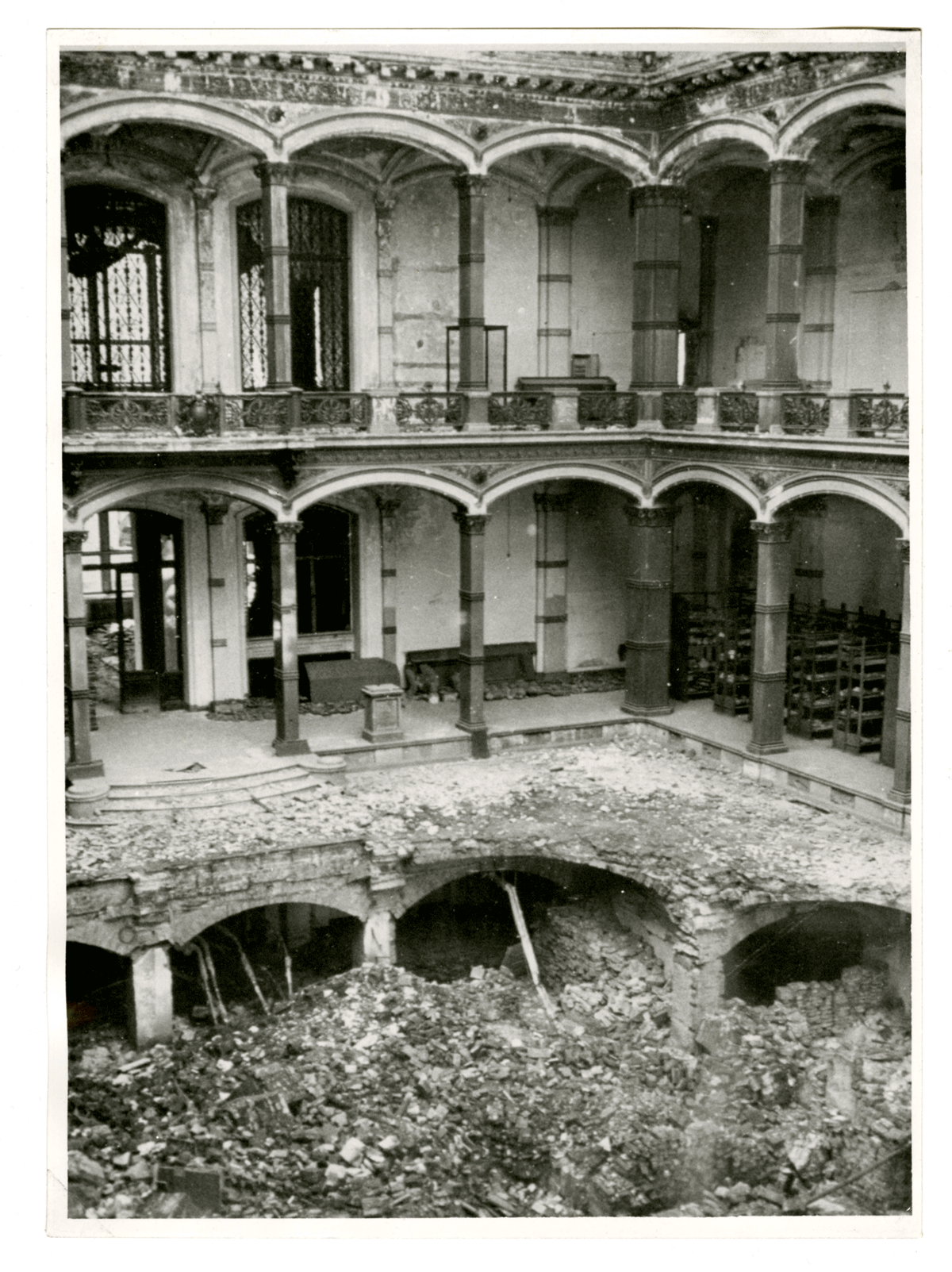
Figure 2
What was left of the Museum für Vor- und Frühgeschichte after evacuation was mostly destroyed in February 1945. About 3,000 artifact boxes stored for safekeeping in the Museum’s basement were obliterated. After the war, objects salvaged from the rubble were stored haphazardly on the ground floor. Gertrud Dorka, a politically untainted prehistoric archaeologist and former teacher, defied gender norms when she was appointed as the first post-war director of the Berlin Museum für Vor- und Frühgeschichte in 1947. She literally dug the museum out of its ruins.61
Reproduced with permission of Museum für Vor- und Frühgeschichte Berlin, Dorka Album F-5003, photo: unknown
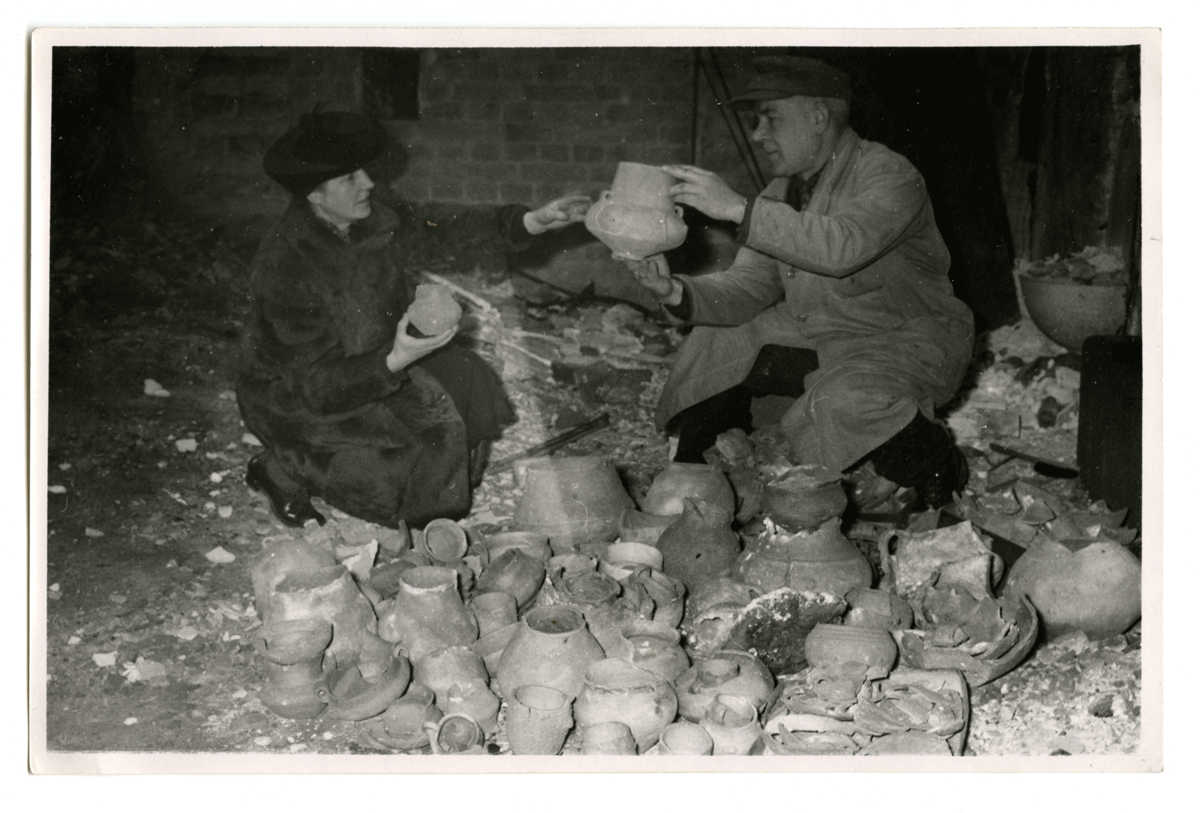
Figure 3
In January 1949, Gertrud Dorka, accompanied by her assistant restorer, retrieved artefacts while clad in a warm coat and hat. Reproduced with permission of Museum für Vor- und Frühgeschichte Berlin, Dorka-Album F-5012, photo: unknown.
However, our argument contends that science communication faced a heightened susceptibility to politicization during the twentieth century‘s totalitarian regimes. The purposeful convergence of science communication and political ideologies is notably evident in roles involving popular book and article composition, as well as giving lectures and guided tours. Prehistorian Gerda Merschberger (1909–?) exemplifies this tendency, actively delivering political lectures in the 1940s for organizations such as the Nazi Nurses‘ Association. Her topics encompassed race and women in prehistory, vehemently supporting a distorted model of Germanic prehistory diverging from the three-period-model and fantasising about ‘Urgermanen’ and ‘Großgermanen’ (i.e. the unsubstantiated concept of Proto-Germans and Great-Germans).62 Another archaeologist, Liebetraut Rothert (1909–2005), curated the propaganda exhibition ‘Lebendige Vorzeit’ (‘Prehistory Alive’) and contributed to popular National Socialist archaeology periodicals. She capitalized on new career opportunities in science propaganda within Amt Rosenberg, the official body for cultural policy in the NSDAP, the National Socialist Party.63 Conversely, later in the GDR, archaeologists were obligated to engage with the public frequently, presenting their research through the lens of the Marxist view of history.64 This duty was seen both as part of their professional responsibilities and as an obligation of their status, as educationally privileged citizens in the GDR.
Unsung Heroines: Women in Field Work
Our concluding focus pertains to fieldwork, a realm historically perceived as one of the last to admit women. Some scholarship suggests that women were not allowed to dig at all before the mid-twentieth century.65 However, our investigation reveals a different narrative, showcasing instances of women actively participating in excavations from the mid-nineteenth century onwards.66 Many accounts of female volunteers in fieldwork date back well into the 1910s and 1920s. Their tasks included pre-excavation organizing, packing and post-excavation labelling of finds, in addition to taking care of visitors and acting as witnesses to surveys.67
Evidence spanning the 1910s to the 1950s underscores the involvement of women in various salaried excavation activities, including heavy earthwork, though few held leadership roles. In 1932/33, classical archaeologist Gerda Bruns directed the German campaign at Pergamon, overseeing 20 male workers.68 The outbreak of WWII ushered women into leading positions, exemplified by Gudrun Loewe (1914–1994), who assumed the role of acting state commissioner for prehistoric antiquities of Thuringia in 1941 (Figure 4). This position involved overseeing all salvage excavations. Loewe enlisted other women, including students and office clerks, for her digs.69 Cläre F., one of the participants, recounted her experiences, expressing her enjoyment of practical fieldwork. She also commented on changing gender dynamics, noting that the initially curious locals gradually became accustomed to the women in trousers, ceasing to marvel at their presence.70
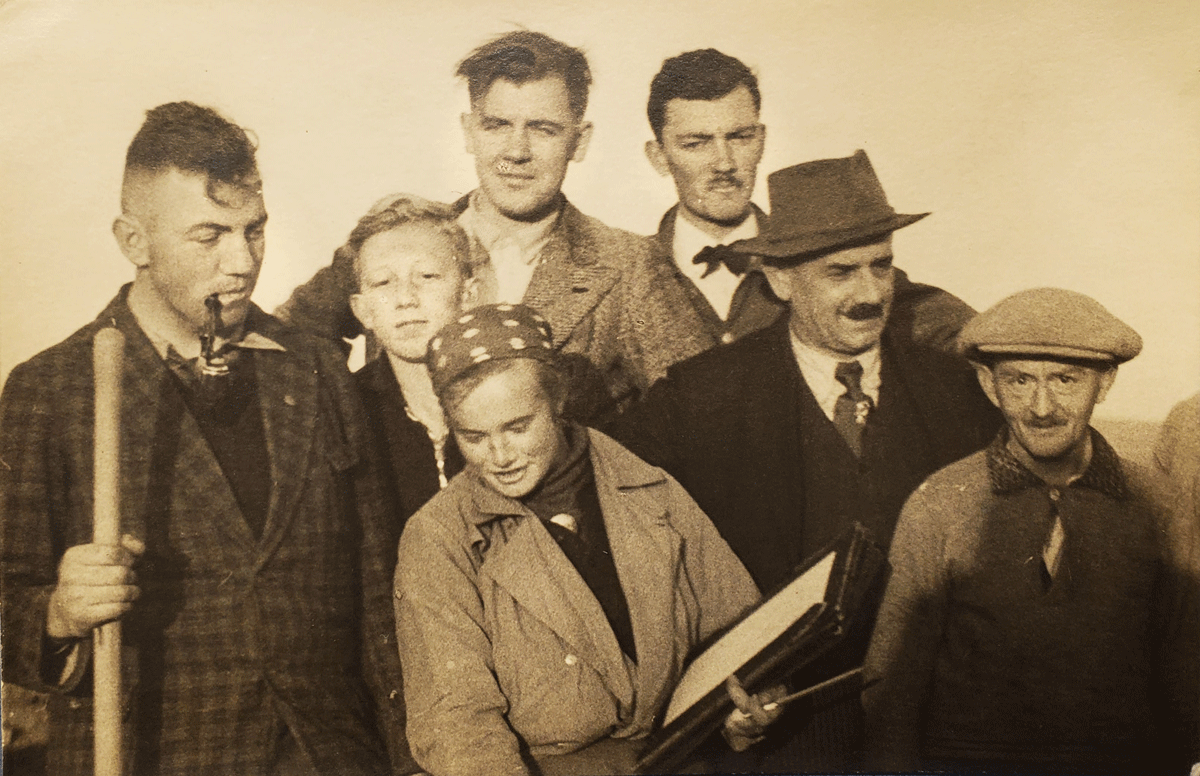
Figure 4
The photo was titled ‘Company of Shovellers.’ We identified research assistant Gudrun Loewe, technician Rudolf Keil and Professor Gotthard Neumann. Reproduced with permission of Universität Jena, Institut für Ur- und Frühgeschichte Sammlung, Sammlungsschriftgut Grabungsfotos D-E Schipperkompanie; photo: unknown.
Amidst the complexities of Nazi Germany, an examination of excavations provides a lens through which we can explore the intricate intersections of gender, race, and political persecution. The wartime conditions, coupled with ongoing crimes against humanity, disrupted traditional gendered power dynamics in archaeology, at times even reversing them. In the Emsland region, for instance, sisters Elisabeth (1914–1989), a graduate archaeologist, and Marie-Luise Schlicht (1908–1980), a private scholar, secured funding from the SS-Ahnenerbe for salvage excavations of burial mounds in 1941.71 The SS-Ahnenerbe, a well-endowed scientific think tank of the SS, engaged in archaeological research to promote Nazi ideology and prepare for conquest.72 To complete the earthworks, the sisters enlisted prisoners from Lager (camps) with regular convicts, imprisoned Wehrmacht soldiers and foreign prisoners of war. Requesting prisoners for heavy excavation work was a common practice in Nazi archaeology made possible by the erosion of individual rights in Nazi Germany.73 Elisabeth Schlicht did not critically reflect on the political circumstances that placed her in this position of power, which ran contrary to the gender norms of the period.74
Under the conditions of socialist ideology in the GDR, attempts were made to influence views of gendered divisions of labor by placing women in previously male-oriented occupations, so hiring women for excavation was widespread. An illustrative instance is the extensive excavation in Wahlitz (Saxony-Anhalt) during the 1950s. Here, men held managerial positions, with male and female students, children, volunteers, and local female farm workers actively participating in the excavation. The sustained engagement of regular female farm workers over consecutive years attested to their swift adaptation and remarkable effectiveness, fostering a strong sense of attachment to the excavation and the collaborative team.75 In the GDR, excavation also constituted a routine responsibility for female volunteer conservationists (Fundpflegerinnen) associated with the Kulturbund, the centralized organization focused on cultural, historical, and educational volunteer work. Trained and supervised by the GDR’s six national museums for prehistory and early history, these volunteers, aside from salvage excavations, documented finds and tended to monuments.76 Upon the passing of Erika M., a dedicated volunteer conservationist in Brandenburg, in 1991, her obituary paid tribute to the tangible aspects of her tasks:
As long as her health permitted, she toured the county in all weathers, inspecting the many protected ground monuments, visiting known sites, discovering new ones and, above all, talking to community leaders and residents to engage them in the concerns of ground monument preservation.77
Weather conditions emerge as a recurrent theme within the limited sources documenting women’s (and men’s) experiences in the field. In 1976, Emma Pressmar, the aforementioned director of the prehistoric collection at Neu-Ulm, shared her experiences:
Unterelchigen is growing into a cauchemar; everything was offered to me: from ice, snow, sandstorm, unbearable heat to a sudden thunderstorm, which soaked me to the skin on Monday.78
Unfortunately, sparse sources exist regarding the experiences and sentiments of women in the context of fieldwork.
Conclusion
Archaeology has consistently operated as a collaborative endeavour. The predominant focus on the contributions of (mostly male) directors in excavations, museums, heritage organizations, or university departments tends to overshadow the integral work and efforts of various individuals in the field, including other men and women. As we have described in the preceding pages, since the discipline’s inception, women have played diverse roles in archaeology, ranging from antiquarians, collectors, and excavators to museum staff. Their involvement spans tasks such as sorting, labelling, organizing, cleaning, reassembling, and restoring finds, as well as drawing, painting, and preparing publications, including illustrations and maps (Figure 5). Women were also actively engaged in excavations, undertaking earthwork and other forms of manual labour. Despite their significant contributions to research, knowledge transfer, and communication, many aspects of women’s involvement in archaeology remain underexplored in historical research. Due to the limited presence of women in esteemed positions until the late twentieth century, the majority of female archaeologists have been overlooked by historians of archaeology. We shed light on some of these less visible tasks, offering a closer examination of archaeological research practices.
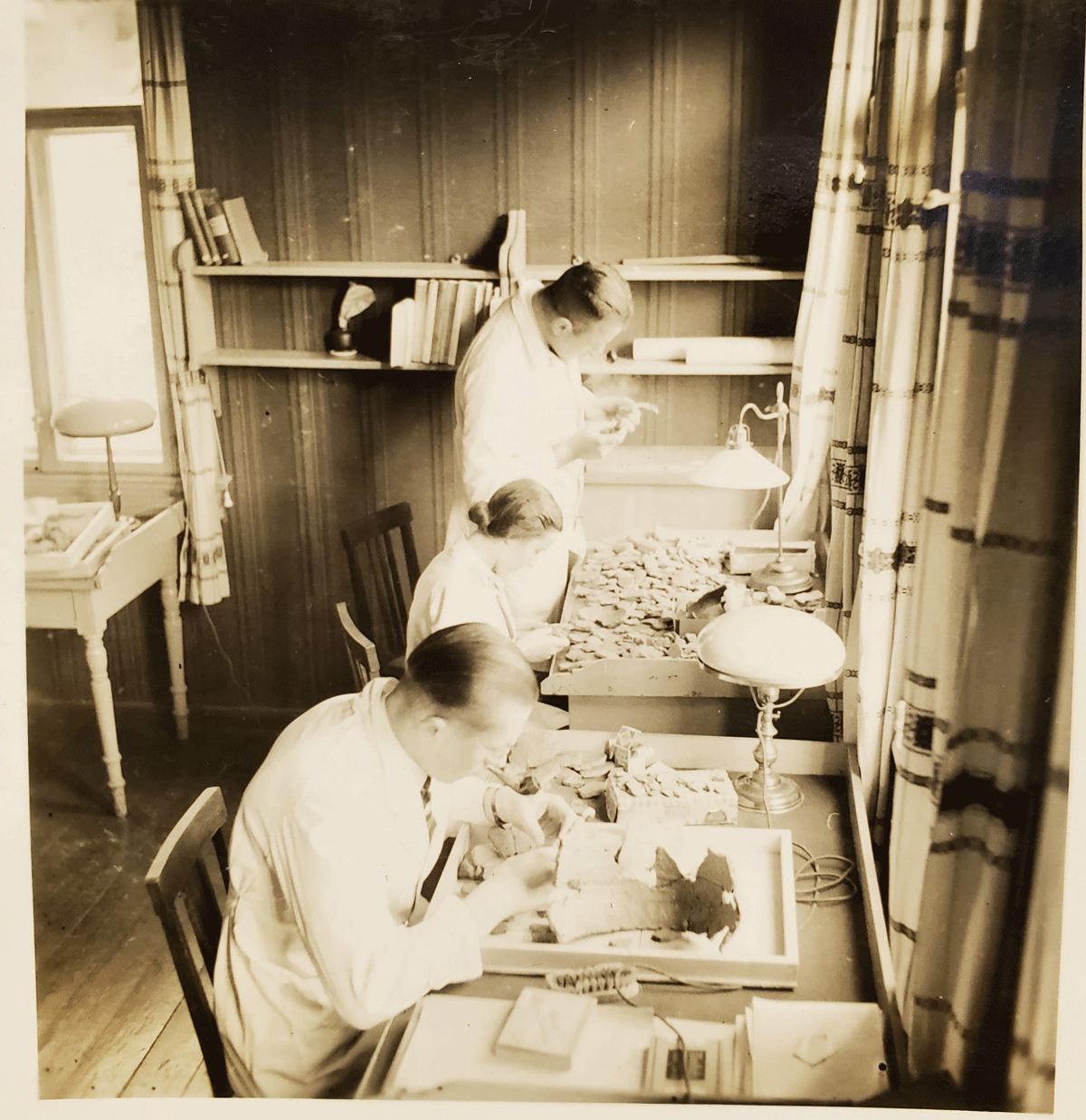
Figure 5
The photograph depicts two male university students from Jena and a female office employee engaged in the sorting and adhesive reconstruction of sherds from excavations conducted at the medieval castle complex on the Kyffhäuser between 1934 and 1938, pointing to women’s encounters with post-excavation responsibilities, such as transporting, cleaning, assembling finds, and preserving artefacts. Reproduced with permission of Universität Jena, Institut für Ur- und Frühgeschichte Sammlung, Sammlungsschriftgut, Ordner: Museum, photo: Rudolf Keil.
Notes
[1] References to archival material are not abbreviated in the notes.
[2] Jürgen Merten, “Elvira Fölzer (*1868). Zum sozialen und beruflichen Umfeld einer frühen Trierer Archäologin,” in Ausgräberinnen, Forscherinnen, Pionierinnen. Frühe Archäologinnen im Kontext ihrer Zeit, edited by Jana Esther Fries and Doris Gutsmiedl-Schümann (Münster: Waxmann, 2013), 125.
[3] Joan M. Gero, “Gender Bias in Archaeology: A Cross-Cultural Perspective,” in The Socio-Politics of Archaeology, edited by Joan M. Gero, David M. Lacy, and Michael L. Blakey (Amherst: University of Massachusetts Department of Anthropology, 1983), 51–57; Stephanie Moser, “On Disciplinary Culture: Archaeology as Fieldwork and Its Gendered Associations,” Journal of Archaeological Method and Theory 14, no. 3 (2007): 235–63.
[4] Londa Schiebinger, “The History and Philosophy of Women in Science: A Review Essay,” Signs 12, no. 2 (1987): 305–32, https://doi.org/10.1086/494323; Karin Hausen, “Einleitung,” in Frauen suchen ihre Geschichte. Historische Studien zum 19. und 20. Jahrhundert, edited by Karin Hausen (München: C.H.Beck, 1983),.
[5] See https://www.empowerwomen.org/en; https://herstorypod.de/podcast/; https://www.lostwomenofscience.org/.
[6] Julia K. Koch and Eva-Maria Mertens, Eine Dame zwischen 500 Herren. Johanna Mestorf, Werk und Wirkung, Internationales Symposium der CAU Kiel vom 15.-17.4.1999 in Bad Bramstedt (Münster: Waxmann, 2002); Jana E. Fries and Doris Gutsmiedl-Schümann, eds., Ausgräberinnen, Forscherinnen, Pionierinnen: Ausgewählte Porträts früher Archäologinnen im Kontext ihrer Zeit (Münster: Waxmann, 2013); Gudrun Sailer, Monsignorina. Die deutsche Jüdin Hermine Speier im Vatikan (Münster: Aschendorff-Verlag, 2014).
[7] Margaret W. Rossiter, “The Matthew Matilda Effect in Science,” Social Studies of Science 23, no. 2 (1993): 325–34. https://doi.org/10.1177/030631293023002004.
[8] Peter Becker and William Clark, “Introduction,” in Little Tools of Knowledge: Historical Essays on Academic and Bureaucratic Practices, edited by Peter Becker and William Clark (Ann Arbor: Univ. of Michigan Press, 2001), 1–34.
[10] Thomas Söderqvist, “What Is the Use of Writing Lives of Recent Scientists?,” in The Historiography of Contemporary Science, Technology, and Medicine: Writing Recent Science, edited by Ronald E. Doel and Thomas Söderqvist (London: Routledge, 2006), 99–101, 115, 125.
[11] Elisabeth Arwill-Nordblad, “Twelve Timely Tales: On Biographies of Pioneering Women Archaeologists,” Reviews in Anthropology 37 (2008): 139–140, https://doi.org/10.1080/00938150802038984; Margaret Conkey and Joan Gero, “Programme to Practice: Gender and Feminism in Archaeology,” Annual Review of Anthropology 26 (1997): 411–37. https://doi.org/10.1146/annurev.anthro.26.1.411.
[12] Visit https://beyondnotability.org/ and https://trowelblazers.com/.
[13] For an example see Margarita Díaz-Andreu and Marie Louise Stig Sørensen, eds., Excavating Women: A History of Women in European Archaeology (London: Routledge, 1998); for an overview, see Arwill-Nordblad, “Twelve Timely Tales,” 136–68.
[14] Jana E. Fries, “Vom Anfangen und Ankommen. Frauen in der deutschsprachigen Archäologie, von den Anfängen bis zu #MeToo,” in Grenzen überwinden. Archäologie zwischen Disziplin und Disziplinen. Festschrift für Uta Halle zum 65. Geburtstag, edited by Simone Kahlow, Judith Schachtmann, and Cathrin Hähn (Rahden/Westf: Leidorf, 2021), 49–58; Andrea Bräuning, “Wider das Vergessen. Professorinnen in der Archäologie (Vor- und Frühgeschichte),” in Alpen, Kult und Eisenzeit. Festschrift für Amei Lang zum 65. Geburtstag, edited by Jennifer M. Bagley, Daniel Neumann, and M. Schefzik (Rahden/Westf: Leidorf, 2009), 11–12.
[15] Doris Gutsmiedl-Schümann, Julia Katharina Koch, and Elsbeth Bösl, “Women’s Contributions to Archaeology in Germany Since the Nineteenth Century,” in Women in Archaeology. Intersectionalities in Practice Worldwide, edited by Sandra L. López Varela (New York: Springer, 2023), 282–307.
[16] Ingo Wiwjorra, “Die politischen und geistesgeschichtlichen Voraussetzungen der ur- und frühgeschichtlichen Archäologie im 19. und 20. Jahrhundert. Bemerkungen zu Forschungsstand und Forschungsperspektiven,” in Miscellanea Archaeologica III. Berlin und Brandenburg. Geschichte der archäologischen Forschung, edited by Wilfried Menghin and Jörg Haspel (Petersberg: Landesdenkmalamt Berlin, 2006), 11–12, 16.
[17] “Obituary for Sibylla Mertens-Schaffhausen.,” Allgemeine Zeitung, February 14, 1858, Addendum; Ernst Aus’m Weerth, “Die Antiquitätensammlungen der Frau Sibylla Mertens-Schaafhausen,” in Jahrbücher des Vereins von Alterthumsfreunden im Rheinlande, vol. 27, 1857; Doris Mauer, “Der Salon der Sibylla Mertens-Schaaffhausen,” in Die Töchter der Loreley: Romantik, Revolution und Feynsinn: Frauen am Rhein, edited by Anne Jüssen (Königstein/Taunus: Helmer, 2004), 113–32; Irma Wehgartner, “Zwischen Anspruch und Wirklichkeit: ‚Gelehrte Frauen’ in der Klassischen Archäologie Deutschlands,” in Göttinnen, Gräberinnen und gelehrte Frauen, edited by Sylvie Bergmann, Sibylle Kästner, and Eva-Maria Mertens (Münster: Waxmann, 2004), 159–69.
[18] Sabine Imeri, Wissenschaft in Netzwerken. Volkskundliche Arbeit in Berlin um 1900 (Berlin: Panamaverlag, 2019), 162–73.
[19] Elsbeth Bösl, “Elisabeth Lemke (1849–1925),” AktArcha – Akteurinnen archäologischer Forschung und ihre Geschichte(n) (blog), 2023, https://aktarcha.hypotheses.org/1241.
[20] Alexander Gramsch, “Eine kurze Geschichte des Archäologischen Denkens in Deutschland,” in Leipziger online-Beiträge zur Ur- und Frühgeschichtlichen Archäologie, edited by Sabine Rieckhoff and Wolf-Rüdiger Teegen, vol. 19, 2006, https://nbn-resolving.org/urn:nbn:de:bsz:15-qucosa2–339955; Herbert Kühn, Geschichte der Vorgeschichtsforschung (Berlin: De Gruyter, 1976).
[21] “Kleine Meldungen,” Mainzer Zeitschrift. Zeitschrift des Römisch-Germanischen Central-Museums und des Vereins zur Erforschung der Rheinischen Geschichte und Altertümer 4 (October 1909): 78.
[22] Kirsten Heinsohn, “Der lange Weg zum Abitur,” in Geschichte der Frauen- und Mädchenbildung, 2: Vom Vormärz bis zur Gegenwart, edited by Elke Kleinau and Claudia Opitz (Frankfurt a.M: Campus, 1996), 152–53; Patricia Mazón, Gender and the Modern Research University: The Admission of Women to German Higher Education, 1865–1914 (Stanford: Stanford University Press, 2003).
[23] Merten, “Elvira Fölzer (*1868),” 119–39.
[24] Gertrud Dorka, “40 Jahre siedlungsarchäologische Übungen und Studien in Berlin. Aus der Geschichte des ‚Seminars’, begründet von Albert Kiekebusch im Jahre 1915,” Berliner Blätter für Vor- und Frühgeschichte 5, no. 3/4 (1955): 74–79.
[25] For others see Humboldt Universität zu Berlin, Archiv, Phil.Fak.1. Prom. no. 749 Waldtraut Bohm, Lebenslauf 1930; Landesarchiv Berlin, A Rep. 001–06, no. 7353 Elisabeth Bellot Personalakte, Lebenslauf.
[26] Therese Wobbe, “Aufbrüche, Umbrüche, Einschnitte. Die Hürde der Habilitation und die Hochschullehrerinnenlaufbahn,” in Geschichte der Frauen- und Mädchenbildung, 2: Vom Vormärz bis zur Gegenwart, edited by Elke Kleinau and Claudia Opitz (Frankfurt a.M: Campus, 1996), 346.
[28] Wiwjorra, “Die politischen und geistesgeschichtlichen Voraussetzungen der ur- und frühgeschichtlichen Archäologie im 19. und 20. Jahrhundert,” 16–17; Henning Haßmann, “Archaeology in the ‘Third Reich,’” in Archaeology, Ideology and Society. The German Experience, edited by Heinrich Härke (Frankfurt a.M: Peter Lang, 2000), 65–139; Wolfgang Pape, “Zur Entwicklung des Faches Ur- und Frühgeschichte in Deutschland bis 1945,” in Prähistorie und Nationalsozialismus. Die mittel- und osteuropäische Ur- und Frühgeschichtsforschung in den Jahren 1933–1945, edited by Achim Leube (Heidelberg: Synchron, 2002), 166–68, 170, 172–73.
[29] Uta Halle, “Frauen in der Ur- und Frühgeschichte zwischen 1933 und 1945 – zwei Karrieren,” in Ausgräberinnen, Forscherinnen, Pionierinnen: Ausgewählte Porträts früher Archäologinnen im Kontext ihrer Zeit, edited by Jana E. Fries and Doris Gutsmiedl-Schümann (Münster: Waxmann, 2013), 169–216; Achim Leube, Prähistorie zwischen Kaiserreich und wiedervereinigtem Deutschland. 100 Jahre Ur- und Frühgeschichte an der Berliner Universität Unter den Linden (Bonn: Habelt, 2010), 106–7, 116–17.
[32] Anke Burkhardt and Ruth Heidi Stein, “Frauen an ostdeutschen Hochschulen vor und nach der Wende,” in Geschichte der Frauen- und Mädchenbildung, 2: Vom Vormärz bis zur Gegenwart, edited by Elke Kleinau and Claudia Opitz (Frankfurt a. M: Campus, 1996), 489–99; Gunilla Friederike Budde, Frauen der Intelligenz. Akademikerinnen in der DDR 1945 bis 1975 (Göttingen: Vandenhoeck & Ruprecht, 2003), 164–76.
[33] Ruth Struwe, “‘Karrierefrauen’ im Fach Ur- und Frühgeschichte in der DDR,” in Grenzen überwinden. Archäologie zwischen Disziplin und Disziplinen. Festschrift für Uta Halle zum 65. Geburtstag, edited by Simone Kahlow, Judith Schachtmann, and Cathrin Hähn (Rahden/Westf.: Leidorf, 2021), 66–68; Budde, Frauen der Intelligenz, 197.
[35] E.g. Bericht über die Verwaltung der naturhistorischen archäologischen und ethnologischen Sammlungen des Westpreußischen Provinzial-Museums für das Jahr 1898 (Danzig: Selbstverlag, 1890), 13.
[36] E.g. Museum für Vor- und Frühgeschichte Berlin, Archiv, Personalakte Käte R. 1928; Günther Behm-Blancke: “Mitarbeiterverzeichnis Museum UFG Thüringen.” in Jahresschrift des Museums für Ur- und Frühgeschichte Thüringens, vol. 1 (Band: Selbstverlag, 1953), 9; Gotthard Neumann, “Hundert Jahre Vorgeschichtliches Museum der Friedrich-Schiller-Universität Jena, Institut für Prähistorische Archäologie,” Ausgrabungen und Funde 8, no. 5 (1963): 223–31; Sieglind Kramer, “Tätigkeitsbericht des Museums für Ur- und Frühgeschichte Potsdam für die Zeit vom 1.7.1952 bis 30.9.1955,” Ausgrabungen und Funde 1, no. 1 (1956): 13–15.
[37] Archiv des Landesamts für Denkmalpflege und Archäologie Sachsen-Anhalt, 537 e Belegschaftsliste 1957–1963; “Kleine Mitteilungen,” Ausgrabungen und Funde 5, no. 1 (1960): 55.
[39] Museum für Vor- und Frühgeschichte Berlin, Archiv, Personalakte Beatrice Vermehren-Goering, Werkvertrag vom 1.10.1936; Museum für Vor- und Frühgeschichte Berlin, Archiv, Personalakte Dorothea Haupt, Werkvertrag zwischen dem Generaldirektor der Staatlichen Museen und Dorothea Waetzold vom 1.4.1939; Landesarchiv Berlin, Rep. A001–06 no. 3539, Lebenslauf Gerda Bruns, 11.6.1946.
[40] Landesarchiv Berlin, Personalakte Rep A 001–06 no. 7358, Charlotte Busch-Geertsema, Lebenslauf und Personalbogen, 9.3.1946.
[41] Bruno Latour, “Drawing Things Together,” in Representation in Scientific Practice, edited by Michael E. Lynch and Steve Woolgar (Cambridge, Massachusetts: The MIT Press, 1990), 19–68.
[42] E.g. Bericht über die Verwaltung der naturhistorischen archäologischen und ethnologischen Sammlungen des Westpreußischen Provinzial-Museums für das Jahr 1888 (Danzig: Selbstverlag, 1889).
[43] Albert Kiekebusch, “Die altgermanische Siedlung von Lagardesmühlen bei Küstrin. Zugleich ein Beitrag zur Geschichte des germanischen Backofens, Ausgrabungen des Märkischen Museums 1913/1914,” Prähistorische Zeitschrift 6, no. 3/4 (1914), 303–30; Archäologisches Museum Hamburg Archiv, VK 712 B1 08, Ordner Freiwillige Mitarbeiter.
[44] Maria Keil, “‘Stirb und werde’ – Biografische Notizen zu Elisabeth Bellot (1881–1956),” AktArcha – Akteurinnen archäologischer Forschung und ihre Geschichte(n) (blog), 2022, https://aktarcha.hypotheses.org/912.
[45] Ingo Bubert, “Dr. Johanna Brandt,” in Dr. Johanna Brandt. 1922–1996, edited by Johanna-Brandt-Gesellschaft Preetz (Schellhorn: Sventana-Gesellschaft, 2002), 7–31; Archiv des Landesamts für Denkmalpflege und Archäologie Sachsen-Anhalt, 535i II Personalakten Anneliese L., Landesmuseum, Zeugnis, 23.11.1949; Archiv des Landesamts für Denkmalpflege und Archäologie Sachsen-Anhalt, 535i I, Agnes K., Personalbogen, 9.5.1945.
[46] “Jubiläen,” Ausgrabungen und Funde 14 (1969): 221; H.J. Vogt, “Hertha Möckel zum fünfzigsten Dienstjubiläum,” Arbeits- und Forschungsberichte zur sächsischen Bodendenkmalpflege 32 (1988): 7–8.
[47] “Dienstjubiläum,” Ausgrabungen und Funde 9, no. 4 (1964): 227; Archiv des Landesamts für Denkmalpflege und Archäologie Sachsen-Anhalt, 537 e, Belegschaftsliste 1957–1963.
[48] For example, Bernhard Salin, Die altgermanische Thierornamentik. Typologische Studie über germanische Metallgegenstände aus dem IV. bis IX. Jahrhundert, nebst einer Studie über irische Ornamentik, trans. Johanna Mestorf (Stockholm: Wahlström & Widstrand, 1935).
[49] Elsbeth Bösl, “Margarete Lehmann-Filhés,” AktArcha – Akteurinnen archäologischer Forschung und ihre Geschichte(n) (blog), 2023, https://aktarcha.hypotheses.org/1279.
[50] Landesarchiv Berlin, Rep. 01–06 no. 34088, Personalakte Charlotte Ziegler, Personalfragebogen, 6.7.1945; Landesarchiv Berlin, Rep. 01–06 no. 15714, Lebenslauf, Olga Lange, 17.12.1945; Archiv der Römisch-germanischen Kommission (RGK), 148 Werkverträge, Werkvertrag, 2.6.1938, zwischen RGK und Renate Feubel, Frankfurt a.M. für 1.4.1938–30.6.1938: Anlage des Gesamtindexes für die Zeitschrift Germania Bd. 1–20.
[51] Landesarchiv Berlin, Rep. A001–06 no. 3539, Lebenslauf Gerda Bruns, 11.6.1946; Irma Wehgartner, “Gerda Bruns (1905–1970),” in Lebensbilder. Klassische Archäologen und der Nationalsozialismus, edited by Gunnar Brands and Martin Maischberger (Rahden/Westf.: VML, 2016), 391–404.
[52] Archiv der Römisch-germanischen Kommission (RGK) 2008, Waldtraut Schrickel an Wilhelm Schleiermacher, Bonn, 28.9.1958.
[53] “Mitteilungen,” Ausgrabungen und Funde 39, no. 5 (1994): 276.
[54] E.g. Johanna Mestorf, “Aus dem Steinalter. Gräber aus dem Steinalter ohne Steinkammer unter Bodenniveau,” Mittheilungen des Anthropologischen Vereins Schleswig-Holstein 5 (1892), 9–24.
[55] Julie Schlemm, Wörterbuch zur Vorgeschichte. Ein Hilfsmittel beim Studium vorgeschichtlicher Altertümer von der paläolithischen Zeit bis zum Anfange der provinzial-römischen Kultur (Berlin: Reimer, 1908); e.g. Hubert Schmidt, “Rezension zu: Wörterbuch zur Vorgeschichte. Ein Hilfsmittel beim Studium vorgeschichtlicher Altertümer von der paläolithischen Zeit bis zum Anfange der provinzial-römischen Kultur,” Zeitschrift für Ethnologie 40, no. 3 (1908), 471–73.
[56] Dagmar Unverhau, Ein anderes Frauenleben. Johanna Mestorf (1828–1909) und “ihr” Museum für vaterländische Altertümer bei der Universität Kiel (Hamburg: Wachholtz, 2015).
[57] Jette Anders, “Die vergessene Custodin. Amalie Buchheim – ein Leben im Dienste der Schweriner Altertümersammlungen,” Mecklenburgische Jahrbücher 126 (2011), 269–83.
[58] Elsbeth Bösl and Doris Gutsmiedl-Schümann, “Mithelfende Familienangehörige in der Archäologie,” AktArcha – Akteurinnen archäologischer Forschung und ihre Geschichte(n) (blog), 2022, https://aktarcha.hypotheses.org/472.
[59] Gerda Merschberger and Hans Reinerth, eds., Handbuch der vorgeschichtlichen Sammlungen Deutschlands. Süd- und Mitteldeutschland einschließlich des Protektorats Böhmen und Mähren (Leipzig: Johann Ambrosius Barth-Verlag, 1941).
[61] Archiv der Friedrich-Schiller-Universität Jena Bestand V Abt. LXXII Feldpostbriefe: Gudrun Loewe an Gotthard Neumann. 29.2.1944; Archiv der Friedrich-Schiller-Universität Jena Bestand V Abt. LXXII Feldpostbriefe, no. 916: Liste mit Akten des germanischen Museums in der Luftschutzsicherung, Gudrun Loewe: 13. Bericht, 7.11.1943–8.6.1944.
[62] Museum für Vor- und Frühgeschichte Berlin, Archiv, IXf4 b-14/3, Band 3 18.10.1950–14.7.1951; Karl Hohmann, “Gertrud Dorka zum 70. Geburtstag,” Berliner Blätter für Vor- und Frühgeschichte 10, no. 1 (1963), 1–4.
[63] E.g. “Vorgeschichts-Schulung der Schwesternschaft,” Germanen-Erbe 5, no. 3/4 (1940), 63.; “Schulungsarbeit des Reichsamt für Vorgeschichte der NSDAP,” Germanen-Erbe 5, no. 9/10 (1940), 158; Leube, Prähistorie zwischen Kaiserreich und wiedervereinigtem Deutschland. 100 Jahre Ur- und Frühgeschichte an der Berliner Universität Unter den Linden, 101–2.
[64] Henny Piezonka, “Liebetraut Rothert und die brandenburgische Bodendenkmalpflege 1938–1945,” Ethnographisch-Archäologische Zeitschrift 47, no. 1 (2006), 117–26.
[65] Eike Gringmuth-Dallmer, “Between Science and Ideology: Aspects of Archaeological Research in the Former GDR Between the End of World War II and the Reunification,” in Archaeology of the Communist Era. A Political History of Archaeology of the 20th Century, edited by Ludomir R. Lozny (New York: Springer, 2017), 260–62; Archiv der Universität Leipzig Phil. Fak. B 01/14:55: Bd. 2 Institut für Vor- und Frühgeschichte Film F 1210, Plakate: Karl-Marx-Universität Leipzig, Institut für Ur- und Frühgeschichte, öffentliche Vorträge.
[66] Cheryl Claassen, “Introduction,” in Women in Archaeology, edited by Cheryl Claassen (Philadelphia: Univ. of Pennsylvania Press, 1994), 5; Marina Picazo, “Fieldwork Is Not the Proper Preserve of a Lady: The First Women Archaeologists in Crete,” in Excavating Women: A History of Women in European Archaeology, edited by Margarita Díaz-Andreu and Marie Louise Stig Sørensen (London: Routledge, 1998), 202.
[67] Elsbeth Bösl, …“…beim Urnenbuddeln…,” AktArcha – Akteurinnen archäologischer Forschung und ihre Geschichte(n) (blog), March 26, 2023, https://aktarcha.hypotheses.org/300.
[70] Archiv der Friedrich-Schiller-Universität Jena Bestand V Abt. LXXII Feldpostbriefe, 191: Gudrun Loewe, 7. Bericht, 29.5.-18.8.1941.
[71] Archiv der Friedrich-Schiller-Universität Jena Bestand V Abt. LXXII Feldpostbriefe 222 Kläre F. an Gotthard Neumann, 13.9.1941. Translated from German.
[72] Archiv der Römisch-germanischen Kommission 1139, Elisabeth Schlicht an Ernst Sprockhoff, 15.5.1942.
[73] Frederick Jagust, “Follow the Money. Bemerkungen zum Verhältnis von Geld, Prähistorie und Nationalsozialismus,” in Politik und Wissenschaft in der prähistorischen Archäologie. Perspektiven aus Sachsen, Böhmen und Schlesien, edited by Judith Schachtmann, Michael Strobel, and Thomas Widera (Göttingen: V&R, 2009), 285–99; Dirk Mahsarski, “‘Wir werden uns dieser Aufgabe mit derselben Zähigkeit widmen, mit der sich die Schutzstaffel allen anderen Aufgaben bisher gewidmet hat.’ Die Förderung der Prähistorischen Archäologie durch die SS von 1933–1945,” in Die Spur des Geldes in der Prähistorischen Archäologie. Mäzene – Förderer – Förderstrukturen, edited by Susanne Grunwald et al. (Bielefeld: transcript, 2016), 87–119.
[74] Judith Schachtmann and Thomas Widera, “Zwangsarbeit in der Prähistorischen Archäologie zwischen 1933 und 1945. Überlegungen,” in Die Spur des Geldes in der Prähistorischen Archäologie. Mäzene – Förderer – Förderstrukturen, edited by Susanne Grunwald et al. (Bielefeld: transcript, 2016), 297–98.
[75] Archiv der Römisch-germanischen Kommission 1139, Elisabeth Schlicht an Ernst Sprockhoff, 7.12.1942; Archiv der Römisch-germanischen Kommission, Elisabeth Schlicht an Ernst Sprockhoff, Sögel, 31.3.1943.
[76] Archiv der Universität Halle-Wittenberg Rep. 21 no. 3502, Friedrich Schlette an VE Kreisbauhof Burg/Sachsen-Anhalt, 18.3.1952; Archiv der Universität Halle-Wittenberg Rep 21. no. 3493, Friedrich Schlette: Abschlussbericht über den Forschungsauftrag 2555 312 h6-01: Erforschung der frühgeschichtlichen Landwirtschaft durch Grabungen in Wahlitz o.D.; Archiv der Universität Halle-Wittenberg Rep. 21 no. 3500, Gedicht von Melitta M.
[77] Dietmar-Wilfried R. Buck, “Zur Tätigkeit der Fachausschüsse und Fachgruppen U- und Frühgeschichte des Kulturbundes,” in Miscellanea Archaeologica III. Berlin und Brandenburg. Geschichte der archäologischen Forschung, edited by Jörg Haspel and Wilfried Menghin (Petersberg: Landesdenkmalamt Berlin, 2006), 242–46.
[78] “Todesfälle,” Ausgrabungen und Funde 38, no. 6 (1993), 326. Translated from German.
Acknowledgements
The authors express their gratitude to the anonymous reviewers for their valuable recommendations, and, above all, extend their sincere appreciation to the editors for their energetic support and understanding.
Funding Information
This research project is funded by the Bundesministerium für Bildung und Forschung 2021–2024. Grant number: 01FP21056.
Competing interests
The authors have no competing interests to declare.
Author contributions
Both authors have made equally substantial contributions to the design of the paper. They have equal share in heuristics, research into source material and the evaluation of the acquired material. Both approve of the version to be published and agree to be accountable for all aspects of the work, ensuring questions related to the accuracy or integrity of any part of the work are appropriately investigated and resolved.