
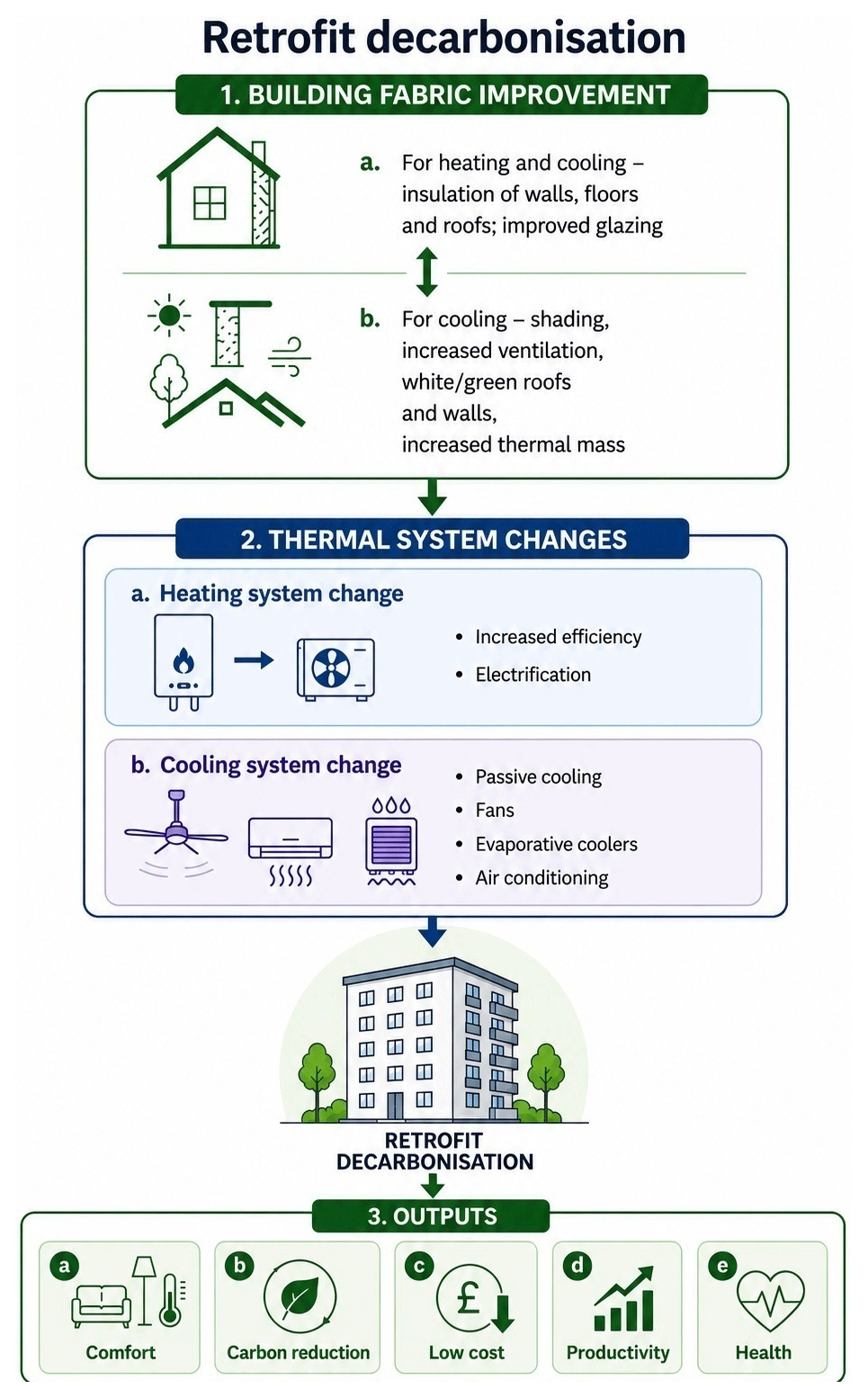
Figure 1
Overview of the building retrofit system and its goals.
Table 1
Policies to support heating and cooling decarbonisation.
| DELIVERY BARRIER | POLICIES |
|---|---|
| International | |
| Lack of clarity in the United Nations Framework Convention on Climate Change (UNFCCC) | Adopt fossil fuel phaseout as a goal |
| Lack of delivery mechanisms for the UAE Consensus on energy efficiency and the Global Cooling Pledge | Build on a coalition of the willing for fossil fuel phaseout, with specific commitments for buildings; inclusion in reporting frameworks |
| Slow phaseout of high global warming potential refrigerants | Strengthen provisions of the Kigali Amendment |
| Limited climate finance availability | Donor countries to increase climate finance for electricity access and clean heating and cooling |
| National | |
| Investor and industry confidence | Mandates; minimum energy performance standards (regularly updated); early mover and low-income household subsidies |
| Consumer knowledge and confidence | Information and advice programmes; installer accreditation |
| Weak incentives in rented buildings; weak regulation of buildings | Building standards at the point of sale or rent; strengthened regulations for retrofit technologies and practices |
| Shortage of trained workforce | Skills development; public investment programmes |
| Poor-quality housing | Housing improvement programmes |
| ‘Spark gap’ (electricity/fuel price ratio) | Higher carbon prices; switch of policy costs away from electricity |
| Lack of support for passive cooling | Programmes to support the use of shading and ventilation |
| Low rate of sectoral innovation | Support for technology and business model innovation |
| Lack of local policy and evaluation expertise | Capacity development |